It tries to killyour strategy.Most die.
Run it out-of-sample once, score it with real costs —and get an honest verdict in about a minute.
Launch price · full 7-day refund, before you download
v1.1.0 · actively maintained · free updates for life
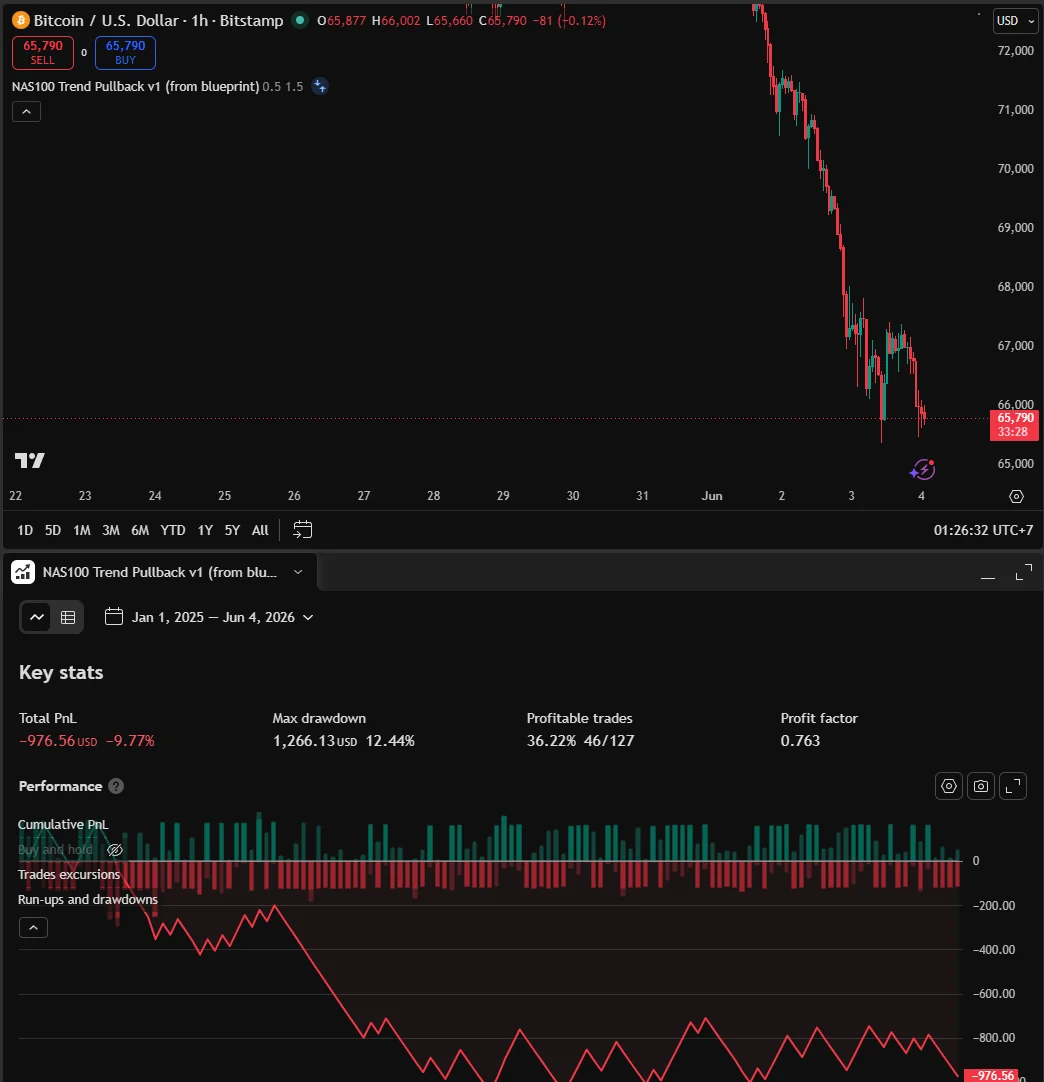
Pine Quant Studio · the AI quant that won't let you fool yourself
Most strategies that “work” are curve-fit. This proves it — before you risk a cent.
Quant Studio is the discipline a real quant uses, run by your AI: it takes a finished strategy and tries to break it — out-of-sample, Monte-Carlo, significance, decay — then hands you an honest verdict in minutes. It can't promise a winner; nothing can. What it can do is stop you trading a fake.
See it judge
You give it a finished strategy. It runs the out-of-sample stress test a quant does by hand over days — automated, in about a minute — and tells you the truth.
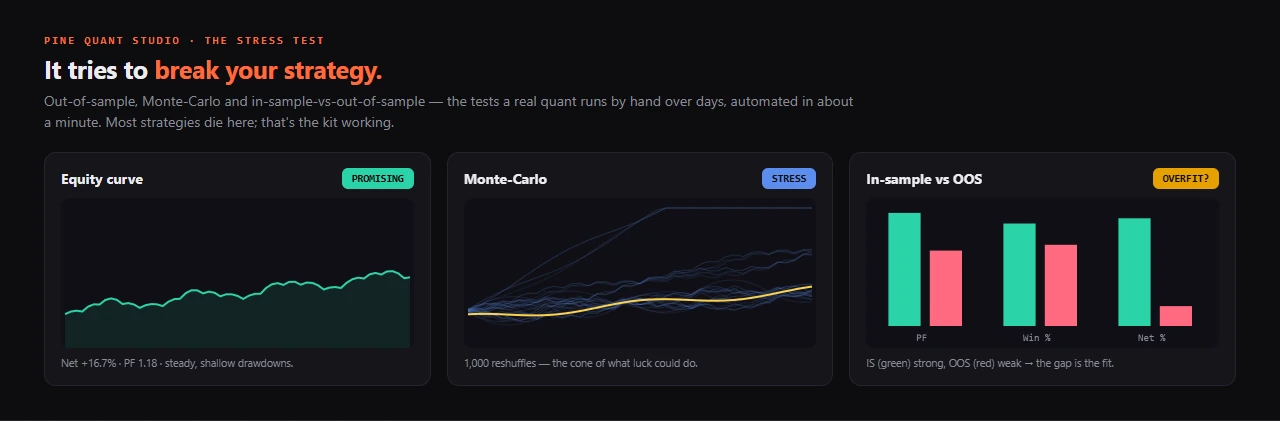
What it produces: an honest verdict report
A frozen strategy run across in-sample / out-of-sample / rolling-year windows on real TradingView data — no re-optimizing — boiled down to one verdict. Read the Trades column first: under ~20 trades is just noise.
| Window | Trades | Win % | Net % | Profit factor | Max DD % |
|---|---|---|---|---|---|
| Full history | 307 | 41% | 16.7% | 1.18 | 7.6% |
| In-sample 2016–2021 | 47 | 53% | 6.5% | 1.56 | 2.6% |
| Out-of-sample 2022–now | 22 | 50% | 3.5% | 1.76 | 1.3% |
| Year 2023 | 9 | 44% | 0.7% | 1.37 | 1.1% |
| Year 2024 | 8 | 50% | 1.3% | 1.73 | 1.3% |
The report that says NO — the trust shot
A 69%-win-rate strategy the kit refuses to rubber-stamp. Most “algo” products would sell this as a winner:
| Window | Trades | Win % | Net % | PF | Max DD % |
|---|---|---|---|---|---|
| Full history | 332 | 69% | 12.7% | 1.35 | 4.1% |
| In-sample 2016–2021 | 47 | 64% | 0.8% | 1.15 | 1.5% |
| Out-of-sample 2022–now | 2 | 100% | 0.5% | — | 0.3% |
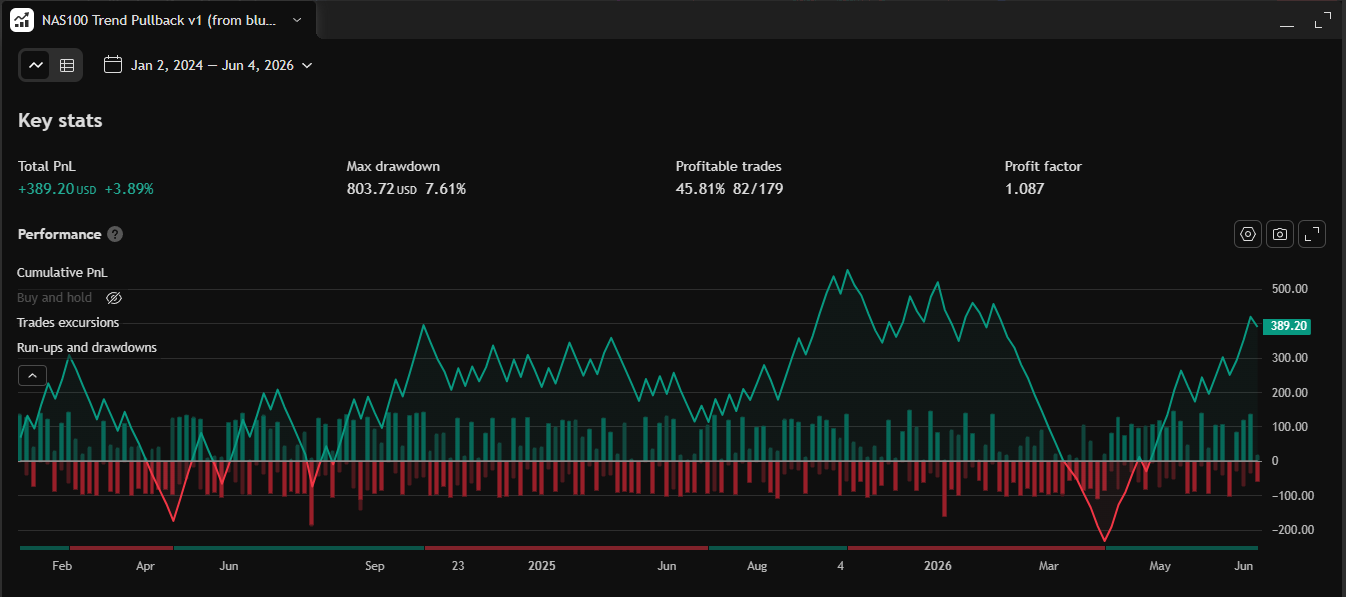
It catches curve-fitting
A backtest can look gorgeous and still be a memorised fluke. Here is the kit killing a beautiful fake — and passing a plain, honest one. That symmetry is the whole point.
The Overfit Autopsy — we took a winner and proved it fake ☠️
A gorgeous backtest — Sharpe 1.9, 71% win, +118%, a smooth 7% drawdown — dissected by four independent gates:
| Gate | What it found | What it means |
|---|---|---|
| In-sample (the bait) | Sharpe 1.9 · win 71% · +118% | gorgeous — most sellers ship this and call it an edge |
| 1 · Deflated Sharpe | 0.38 (best of 240 tries) | within the range of pure luck — no real edge |
| 2 · Out-of-sample | Sharpe −0.3 · −9% · PF 0.95 | the edge did not fade, it inverted — the fingerprint of memorised noise |
| 3 · Monte-Carlo | real drawdown 19% · risk-of-ruin 38% | the calm 7% was lucky ordering; a live account faces ~19% and worse-than-1-in-3 ruin |
| 4 · Parameter nudge | Sharpe 1.9 → 0.7 → 0.2 | lives on one lucky setting; change a knob and it is gone |
…and it passes a plain, honest one ✅
The same four gates that killed the pretty one pass a duller Donchian trend-follower — with only five pre-registered tries, not 240. The difference between a pass and a kill is not the curve; it is the honesty of the trial count:
| Gate | What it found | What it means |
|---|---|---|
| In-sample | Sharpe 1.15 · win 43% · PF 1.55 | deliberately modest — the right shape for a trend system |
| 1 · Deflated Sharpe | 97.8% at 5 honest tries | stays significant — the same numbers at 240 tries would read LIKELY OVERFIT |
| 2 · Out-of-sample | Sharpe 0.85 · PF 1.45 · 38 trades | the edge held and decayed gracefully — it did not invert |
| 3 · Monte-Carlo | real drawdown 18% · risk-of-ruin 4% | bigger than the backtest, but survivable (vs the fake's 38%) |
| 4 · Rolling years | 4 of 5 positive | no single year carries it — an edge, not one lucky trade |
What a pretty backtest hides — and what Quant makes loud
The three silent killers are invisible in a nice equity curve. Making each one loud is the whole reason the kit exists:
| The silent killer | Invisible in a backtest | Quant makes it loud |
|---|---|---|
| Lookahead / repaint | the curve looks clean and tradable | flagged before you trust a single signal |
| Ignored costs | fantasy fills, prettier numbers | commission and slippage wired in from line one |
| Over-optimization | the best of hundreds of tries looks like skill | the deflated Sharpe penalises every try you made |
Built like an institution
Past a single strategy: combine several honest edges into one book, with the toolkit a real desk uses to size risk.
Three edges, one honest book
Combine three separately-validated sleeves — trend, mean-reversion, breakout — and ask the only question that decides real risk: do they truly diversify, or are you just levering one bet three ways?
Do they actually diversify? (monthly P&L correlation)
| Trend | Mean-Rev | Breakout | |
|---|---|---|---|
| Trend | 1.00 | 0.10 | 0.30 |
| Mean-Rev | 0.10 | 1.00 | −0.15 |
| Breakout | 0.30 | −0.15 | 1.00 |
The blended book beats the best single sleeve
| Book | Sharpe | Max drawdown | vs best single sleeve |
|---|---|---|---|
| Best single sleeve (Trend) | 1.15 | 11.0% | — |
| Equal-weight blend | 1.42 | 8.5% | +0.27 Sharpe, lower drawdown |
| Risk-parity blend | 1.53 | 7.5% | +0.38 Sharpe, lower drawdown |
The gates that catch what a backtest hides
Not a vibe — a real quant toolkit your AI runs for you:
- Significance + deflated SharpePenalises how many variants you tried, so a “great” result is judged as real edge, not the luckiest of many tries.
- Monte-Carlo + risk-of-ruinShuffles the trades to reveal the drawdown you will really face — so you size for the 95th-percentile day, not one lucky run.
- PortfolioCombines strategies and markets to check they truly diversify, instead of levering one bet three ways.
- Decay-watchCompares live results to the backtest and turns a dying edge off on a rule, not a feeling.
- Auto-validateDrives live TradingView across in-sample / out-of-sample / rolling windows and writes the verdict report, hands-free.
Use it & own it forever
Five stages, each with a gate that tries to kill the idea — one file to run the whole thing in your AI, and the whole kit to keep.
Five stages — each with a kill-gate. Most ideas die here.
The discipline front-loads the one question every loser skips: “how would I know this is fake?”
- 1 · HypothesisState the edge in one sentence — and why it exists (a real inefficiency, not “the lines crossed”).
- 2 · ImplementA strategy with commission, slippage and sizing wired in from line one — no peeking at the future, no repaint.
- 3 · Backtest honestlyReal costs, in-sample data — and enough trades that the result is not noise.
- 4 · Stress itOut-of-sample, walk-forward, parameter-sensitivity. This is where most ideas die.
- 5 · Size & ship — or killPosition sizing, risk limits, an honest verdict — would you put your own money on it?
How you run it — copy, paste, done.
# Open Claude / ChatGPT / Cursor / Gemini, then:
⤵  drop in:  START_HERE_AI.md   ( + your strategy )

"Read START_HERE_AI.md and pine-quant-studio/SKILL.md, then run the
 full validation workflow on demo/demo_strategy.pine — backtest it
 in-sample and out-of-sample, run Monte Carlo and a significance test,
 and give me an honest verdict with the weakest point."

→  it runs every gate and writes the verdict — it tries to break your
   idea, never to flatter it.
What you can ask it to do
- “Validate this strategy honestly”It runs the full five-stage workflow and writes a verdict — KILL, weak/overfit, promising or inconclusive — with the weakest point named.
- “Do an overfit autopsy”When a strategy fails, it tells you exactly why it died and the honest path forward.
- “Run Monte-Carlo / significance / portfolio”Point it at an exported trade list and it runs the institutional gates above.
- “Validate my Foundation blueprint”It reads a Pine Strategy Foundation build directly and takes it through the gates.
What's in the box
- START_HERE_AI.mdThe one file you drop into your AI. It teaches the AI the whole kit — what to read, the rules it can't break, a ready first prompt.
- The skill + the methodThe five-stage workflow, the auto-validate loop, the validation checklist and the overfitting guide your AI follows.
- The real gatesSignificance, Monte-Carlo, Portfolio, Decay-watch and Auto-validate — the actual tools, yours to run.
- Worked case studies + a demo strategyThe Autopsy, the Workup and the Portfolio in full — plus a demo strategy to run the gates on first.
The moment you pay
- Instant accessPay by card, Google Pay or PromptPay and the kit is yours right away — one ZIP, link emailed too.
- Yours forever + free updatesNot a rental. No expiry, no seat check; every future version is free — email support@pulltrade.app.
- 7-day refund — before you downloadChanged your mind and haven't downloaded? Full refund within 7 days, no questions. Once you download, the window closes — files can't be returned.
Honest FAQ
The things you'd actually want to ask — answered without spin.
It makes no claim about returns. A green verdict across many windows is still a backtest — one symbol, one path, with costs that are assumptions and an out-of-sample that still isn't the future. The auto-validate is period-consistency on a frozen strategy, not a re-optimizing walk-forward.
Own every line — and extend it forever.
The full source, the AI-agent kit and free updates for life — yours the moment you pay.
Launch price · full refund within 7 days · own the source forever
Eleven tools.
One honest line.
The entire ProEA Lab Pine line in one pack — five indicators and six skills & kits, every Pine v6 source and every AI-extend kit. Build a system, validate it, render it, risk-gate it, then audit it — honestly, end to end.
Pine Quant Studio is a validation methodology and tooling — educational software and a process, not a signal service, not a strategy, and not a promise of profit. It makes no win-rate or return claim of any kind; its purpose is to help you falsify your own ideas cheaply before risking capital. Most strategies you test with it should and will be rejected — that is the kit working correctly. A backtest is a hypothesis about the past, not a prediction; surviving out-of-sample validation is not a guarantee of future results. Trading involves substantial risk of loss; forward-test on a demo, size small, and manage your own risk. © 2026 ProEA Lab.