Your AI reads chartsconfidently. And wrongly.
In a published 100-chart test, ChatGPT quoted usable levels ~23% of the time.This skill replaces chart-cosplay with a calibrated protocol.
v1.0.0 · actively maintained · free updates for life
★ proof, not promises · a real chart and the actual read it produced
Confidence is cheap. Calibration isn't.
In chartsnipe.com's published 100-chart test (2026), ChatGPT "quoted usable support and resistance only around 23% of the time." Below: a demo chart from the box + the read the skill produced on it.
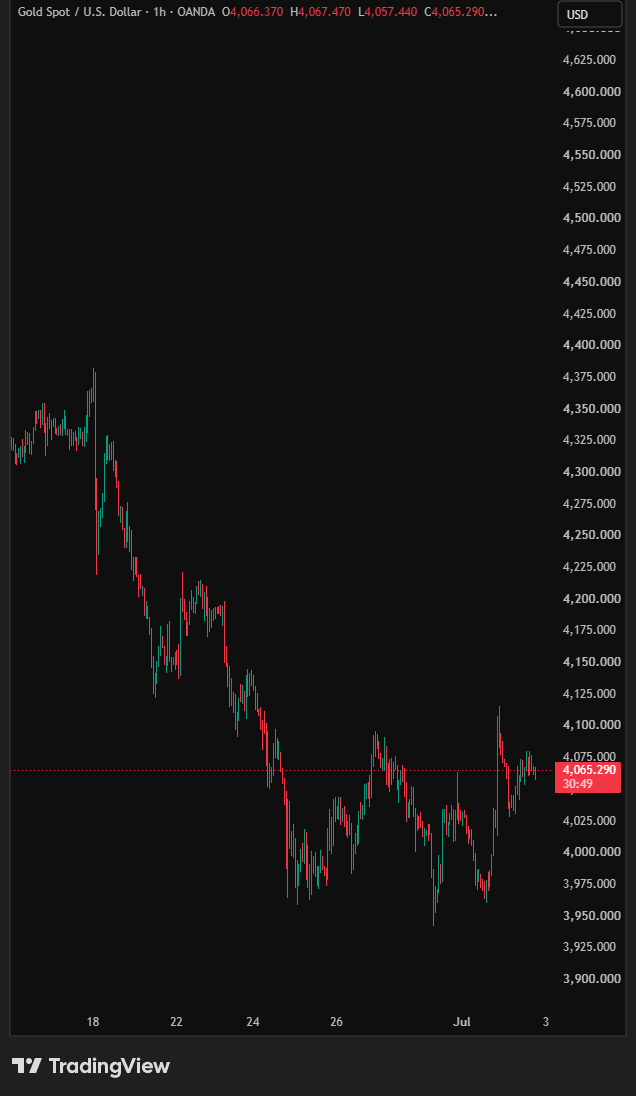
The read it actually produced (excerpts from demo/read-01.md)
1 · Frame — Gold Spot / U.S. Dollar (OANDA) · 1h · candlesticks · CALIBRATED —
the right axis is labeled every 25.000 points; I can honestly place levels to
about a quarter step, so all levels are quoted as ranges of roughly ±6–8 points.

4 · Zones (ranked)
- Zone 1 · support ≈ 3,945–3,975 — the range's two major lows + round 3,950 +
  impulsive departures from both (4 factors). Defended.
- Zone 2 · resistance ≈ 4,090–4,125 — the range's swing high + the fresh
  rejection wick + round 4,100 (3 factors). Defended (one fresh rejection).

6 · Context gaps
- The future: the image ends mid-range after a rejected poke — resolution
  direction is not knowable from pixels.
- Volume: no volume pane on screen — conviction was read from candle bodies alone.
[…]

"This read is context from one image at one moment: structure and zones you can
verify by looking — not a forecast, and not a trade plan."
What's inside the zip
- SKILL.mdThe READ loop — CALIBRATE → STRUCTURE → LEVELS → ZONES → CONTEXT GAPS → REPORT, six binding Read Gates.
- references/Axis-anchoring calibration (log scale, Heikin Ashi, cropped axes) · pointable structure language · zones with confluence ranking · the what-you-cannot-see section · an 18-check quality gate.
- templates/chart-read-report.mdThe fixed 6-section output, with a filled example.
- demo/2 real screenshots + their reference reads — validate YOUR AI against them in 2 minutes.
Test-drive your own AI in 2 minutes
Folder in, `chart-01.png` attached, say "read this chart" — then check the five tells: calibrated first? levels as evidenced ranges? pointed at the image? Context Gaps with the future named first? zero predictions or buy/sell?
Own Chart Reader — $12.99 · reads you can auditA chart read is context, not a trade. Precision is bounded by the image — if the axis is unreadable it delivers a structure-only read instead of inventing numbers. Pixels are not a data feed; for live computed structure you want a data-driven indicator instead.
Which AI works?
Any vision-capable one — Claude, ChatGPT, Gemini. Attach the folder (or paste SKILL.md), attach your screenshot, say "read this chart."
Will it tell me to buy or sell?
No — by design. It reads structure, ranks zones with evidence, and names what the screenshot cannot tell you. Predictions, targets and trade commands are banned by its Read Gates.
License & refund?
Personal, non-exclusive license; every read it produces is yours. 7-day refund before download; broken files fixed or refunded anytime.
Own every line — and extend it forever.
The full source, the AI-agent kit and free updates for life — yours the moment you pay.
One price · full refund within 7 days · own the source forever
The AI Trader
Starter Stack
Chart Reader is not part of the Stack — it's a separate $12.99 vision pack. The Stack is the write-and-repair side of the workflow: Prompt Vault to ask right, Builder Lite to write right, Pine Fixer to repair right — three full products, not a sampler.
Educational AI skill packs — not financial advice, not a signal service, and not code that trades. They teach the AI you already use to write, repair, prompt for, or read charts around TradingView Pine Script; scripts your AI produces with them are testable drafts — no win-rate, profit, or accuracy is claimed or implied, and correct code is not a profitable idea. TradingView and Pine Script are trademarks of TradingView, Inc.; these are independent educational products, not affiliated with TradingView. Trading involves risk; forward-test on a demo and manage your own risk. © 2026 ProEA Lab.