A major brokerage — Robinhood, in 2026 — made the dream official: let an AI agent trade for you.
Not write code, not explain a chart — trade.
Monitor the market, place the orders, rebalance, manage positions, all while you're doing something else entirely.
The same week, the feed did what the feed does.
A bot that reportedly placed thousands of trades and cleared serious money.
An agent reportedly posting a triple-digit return on a single position.
Screenshots everywhere.
"Made money while I slept," on repeat.
The oldest dream in trading, finally repackaged as a feature with a toggle: money without the screen, profit without the pain, execution without emotion.
And that is exactly why this will hurt people — because the dangerous version of a real thing always wears the face of the legitimate one. The brokerage is real. The agents are real. Some of the winners are real. The risk is real too.
To be fair to the legitimate version, it ships with guardrails: a dedicated trading account rather than your whole portfolio, controls to pause the agent, limits you set yourself — and fine print that says, in plain language, you are still responsible for what the agent does — and regulators underline it: the CFTC's advisory says outright that AI won't turn trading bots into money machines. Those guardrails are real, and they matter. But a guardrail is not an edge. A gate you can set is only as good as the system behind it — and the agent still can't supply that part.
Here's what the screenshot doesn't show you. The first time an autonomous agent does the wrong thing at the wrong speed, you may not be at the screen. That's the selling point. It's also the problem. An AI agent doesn't hand you an edge; it hands you leverage on whatever edge you already had. If the strategy is positive after costs, autonomy can compound it. If the strategy is zero or negative after costs, autonomy turns it into a disciplined machine for losing money — faster, cleaner, with fewer human interruptions.
If you trade MT5, you've already seen this movie. It was called set-and-forget: an EA on a VPS, trading while you slept, for years before anyone called it "agentic." The dream is the same. So is the graveyard. The label got smarter; the problem did not.
Before we go further, two requests:
- Save this before you connect any agent to a live account — yours, or one you're about to pay for.
- Send it to the person reposting the "money while I slept" screenshot. They're looking at the survivor and calling it the method.
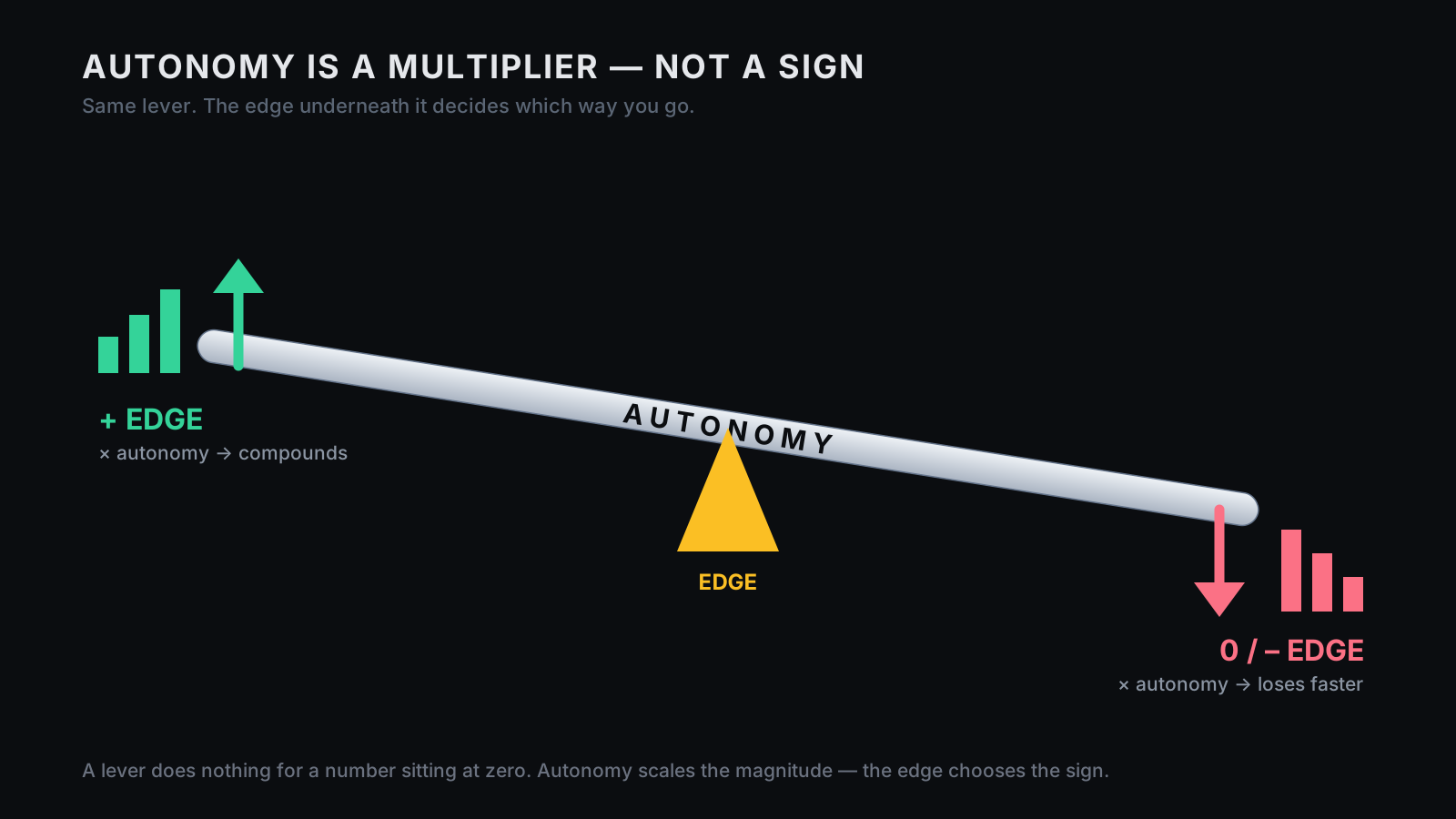
Skip this if you already know autonomy multiplies edge, not creates it
An AI trading agent is an execution layer, not an edge. It can monitor, act, rebalance, and place orders, and it can follow rules without boredom, fear, revenge, hesitation, or fatigue — which is genuinely powerful. But it executes the strategy you gave it. If that strategy has a real positive edge after costs, autonomy can help harvest it. If that strategy has no edge, autonomy only makes the losing process more disciplined.
| What the feed sells | What's actually true |
|---|---|
| "The AI made money while I slept." | The agent executed; the edge — or the variance — made the money. |
| "It's fully autonomous." | It's autonomous of your judgment too. |
| "Look at the huge return." | You're usually looking at the survivor. |
| "No human intervention needed." | No human intervention may also mean no human brake. |
| "A major broker supports agents." | Legitimacy of the feature is not validity of your strategy. |
| "The agent has an edge." | A widely shared agent can quickly become a crowded trade. |
Same agent, two outcomes. The autonomy is identical. The difference is the edge, the costs, the risk limits, and the gate — none of which the autonomy supplies.
I — The third wave: AI that builds vs AI that trades
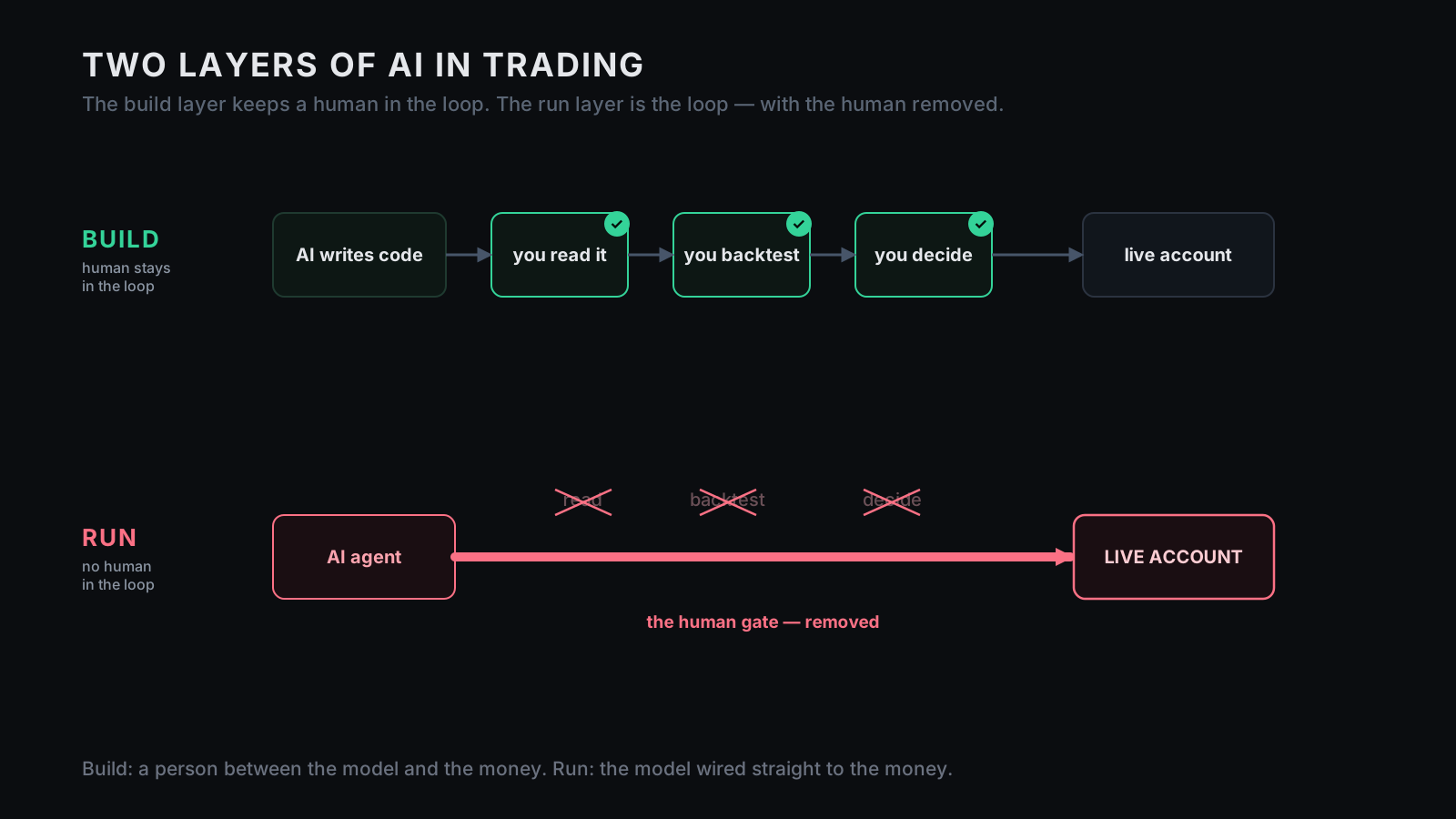
There have been three waves of "AI will fix your trading," and they are not the same risk, even though the feed mashes them together. The first wave was AI that answers — ask a model what it thinks of gold, get a confident paragraph. The second was AI that builds — ask for an EA and thirty seconds later you have clean code, inputs, comments, risk settings, maybe even a backtest; we wrote a whole piece on why that code was never the part that loses money. The third wave, the one cresting right now, is AI that trades: an agent wired to a live account, reading data, making decisions, sending orders, managing positions — closing the loop from signal to balance with no human in the middle.
This is a different risk class. When AI only builds, the human is still between the model and the money: you read the code, run the test, change the size, refuse to go live, stop before the first trade. Every one of those is a place a person can catch a problem. When AI trades, those checkpoints don't slow down — they disappear. The agent is faster than you, never tired, never afraid, never bored, never in doubt. That sounds like a list of advantages until you remember that fear and doubt are sometimes correct. An autonomous agent doesn't hesitate before the trade that ruins you — hesitation was a human feature, and you automated it away.
II — Autonomy is leverage, not edge
This is the whole thesis, so let's be precise. Autonomy changes the speed and consistency of execution; it does not change the sign of expectancy. Think of it as a multiplier: a positive edge multiplied by automation can compound, a zero edge multiplied by automation stays near zero minus costs, and a negative edge multiplied by automation simply loses faster. The agent doesn't care which one it's running. It follows the process.
That's why "fully autonomous" is never enough on its own. The operator asks the only question that matters — autonomous execution of what, exactly? A validated system? A cost-aware signal? A crowded setup? A coin flip with commission? A backtest curve that never met real slippage? A martingale with a nicer dashboard? The agent will execute every one of them just as faithfully, and that faithfulness is the danger. Humans leak good systems through fear and inconsistency, and automation fixes that — but humans also sometimes interrupt bad systems before they do more damage, and automation removes that too. The agent gives you perfect discipline; the question is whether the thing being disciplined deserves it. Autonomy doesn't decide whether you make money. It decides how fast the answer arrives.
III — The leaderboard is a survivorship machine
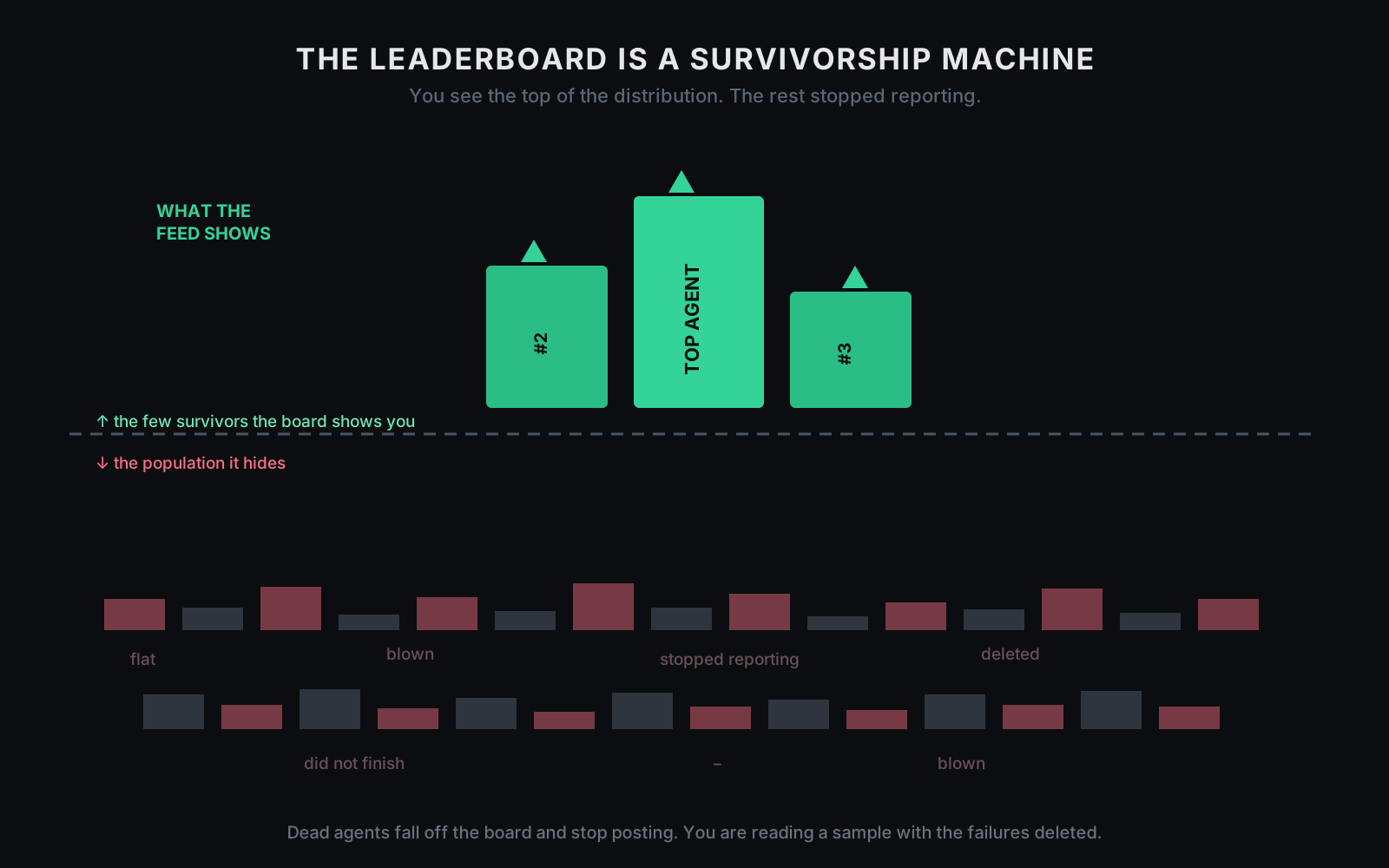
The most deceptive object in the entire agent economy is the leaderboard. A public board ranks agents by return, the top one is up some absurd number, the screenshot spreads, and a hundred thousand people conclude "the agent works." But a leaderboard is not a research report. It's a sorting machine: it takes a large population of agents, strategies, risk levels, and random outcomes, and shows you the top of the distribution — the ones that got lucky, the ones that took the most risk at the right time, the ones that survived the current window. The agents that didn't survive are quieter. They don't get shared. They fall off the board, they stop reporting, they become the part of the experiment nobody screenshots.
This is survivorship bias with a refresh button. If ten thousand agents take concentrated bets, a few will post triple-digit returns by chance alone — the same way that, in any large enough crowd flipping coins, someone gets ten heads in a row and looks like a prophet. The feed amplifies those few, the crowd calls it evidence, and the most-shared return is also the least informative number you could look at, because the mechanism showing it to you selected it for extremity. On these venues, only about 7–13% of human traders finish positive — the leaderboard is just the thin, lucky top slice of that. A leaderboard doesn't measure edge — it measures who survived variance most recently, then hides the population that didn't.
IV — You gave away the gate
In a disciplined AI workflow, four keys stay in the human's hand: the edge claim, the cost assumptions, the validation verdict, and the go-live decision — size, stop, kill-switch, whether real money is exposed at all. A fully autonomous trading agent puts pressure on all four, and hands over the last one entirely. "No human intervention" reads like a feature on the box. Read it again as a risk disclosure and it says: no human intervention possible, in time, when the one trade that matters arrives.
Most trades are ordinary, and the agent handles ordinary fine — the problem was never the 950 boring trades. The problem is the abnormal moment: the gap, the broker issue, the news candle, the volatility spike, the data-feed glitch, the regime the backtest never contained, the position that looks normal right up until it doesn't. That's where a human gate earns its keep — not because humans are smarter than the rule that worked yesterday, but because some moments need a decision from outside that rule: flatten, pause, cut size, stop for the day. An autonomous agent often can't tell the difference between "the signal fired" and "the environment has changed," and in that moment its great virtue — it never hesitates, never overrides, never flinches — becomes its fatal flaw. You didn't just remove human error from the loop — you removed the human from the one moment where caution might have been the correct trade. The right design isn't "agent or no agent." It's automation for the boring 95%, with a human still holding the kill-switch and the size dial over the 5% that decides the month.
V — The crowded robot
Now suppose the agent really does find a small, genuine edge. Good. The next question is the one the feed never asks: who else is running it? An edge is relative — it exists only because enough participants are not doing the same thing at the same time. Package the same agent for thousands of accounts, on the same venue, off the same model, reacting to the same signals, and the edge quietly turns into its opposite: crowding. This isn't hypothetical — on one major prediction venue, a reported 30%+ of wallets are already AI agents (per LayerHub data). Thousands of accounts, same trigger, same market, same exit, same urgency, different names — that isn't diversification, it's correlation wearing a dashboard.
When the signal flips, those agents don't exit slowly like humans with different beliefs and different nerve. They can exit together, at machine speed, into each other — same side, same doorway — turning an orderly move into a stampede and an assumed fill into a terrible one. Crowding that used to take months to build as a strategy "got popular" can now happen in a software update. An edge a hundred thousand agents can run isn't automatically an edge — it may be a synchronized trade with no one left to take the other side. The more universal the agent, the shorter the half-life of whatever it found, and the more violently it unwinds.
VI — The agent still trades through your broker
For all the talk of autonomy, the agent never escaped the most stubborn fact in trading: it transacts through your broker, at your spread, with your slippage, commission, swap, margin rules, execution delays, and symbol quirks — on every single order. "Autonomous" describes who clicks the button, not what the button costs. And this is where the headline stat flips from impressive to alarming: a bot that reportedly places thousands of trades is also paying the execution tax thousands of times. Each toll looks small; at machine frequency, small becomes structural.
If the edge per trade is tiny, friction can erase it. If the backtest used clean mid-prices, friction can flip it. And because an agent tends to trade most aggressively exactly when volatility is high and spreads are widest, it pays the steepest tolls precisely when risk is already elevated. We've written before that the spread is a tax you can't see; an autonomous agent is a machine for paying that tax faster than any human could. A strategy can be conceptually correct and still negative after execution cost — autonomy doesn't fix that, it accelerates your contact with it. The agent inherited your broker, your costs, and your worst fills — it just meets them at a speed where you can't intervene.
VII — Real vs fake: who lets you read the agent
Everything is "agentic" now — AI-powered, autonomous, self-learning, hands-free, twenty-four-seven. The words have stopped proving anything, because the real and the fake both say them, loudly. So you stop sorting by the label and start sorting by one thing: who lets you read what the agent is about to do, before it does it. A real automated system can show you the logic, the risk layer, the cost assumptions, the kill-switch, the max loss, a verifiable sample, and the failure periods — and it lets you hold the controls. A fake shows you a leaderboard rank, a testimonial, one huge trade, and a story, and asks you to wire your account to a process you're structurally forbidden to inspect.
That second thing usually isn't an edge you can't see. It's far more often nothing you can see — a prompt, a curve, and a confident sentence, dressed in the most autonomous-sounding language the marketing team could find. The question was never whether a robot is trading; it's whether you're allowed to read what the robot is about to risk, and who gets to say stop. If the seller won't show the logic, you're not buying autonomy — you're renting trust. If they won't let you set the risk, you're not using a tool — you're handing a stranger a dial. If they won't show the failures, you're not seeing evidence — you're watching a highlight reel. Autonomy you can read, size, and stop is a tool; autonomy you can't inspect is a stranger trading your money.
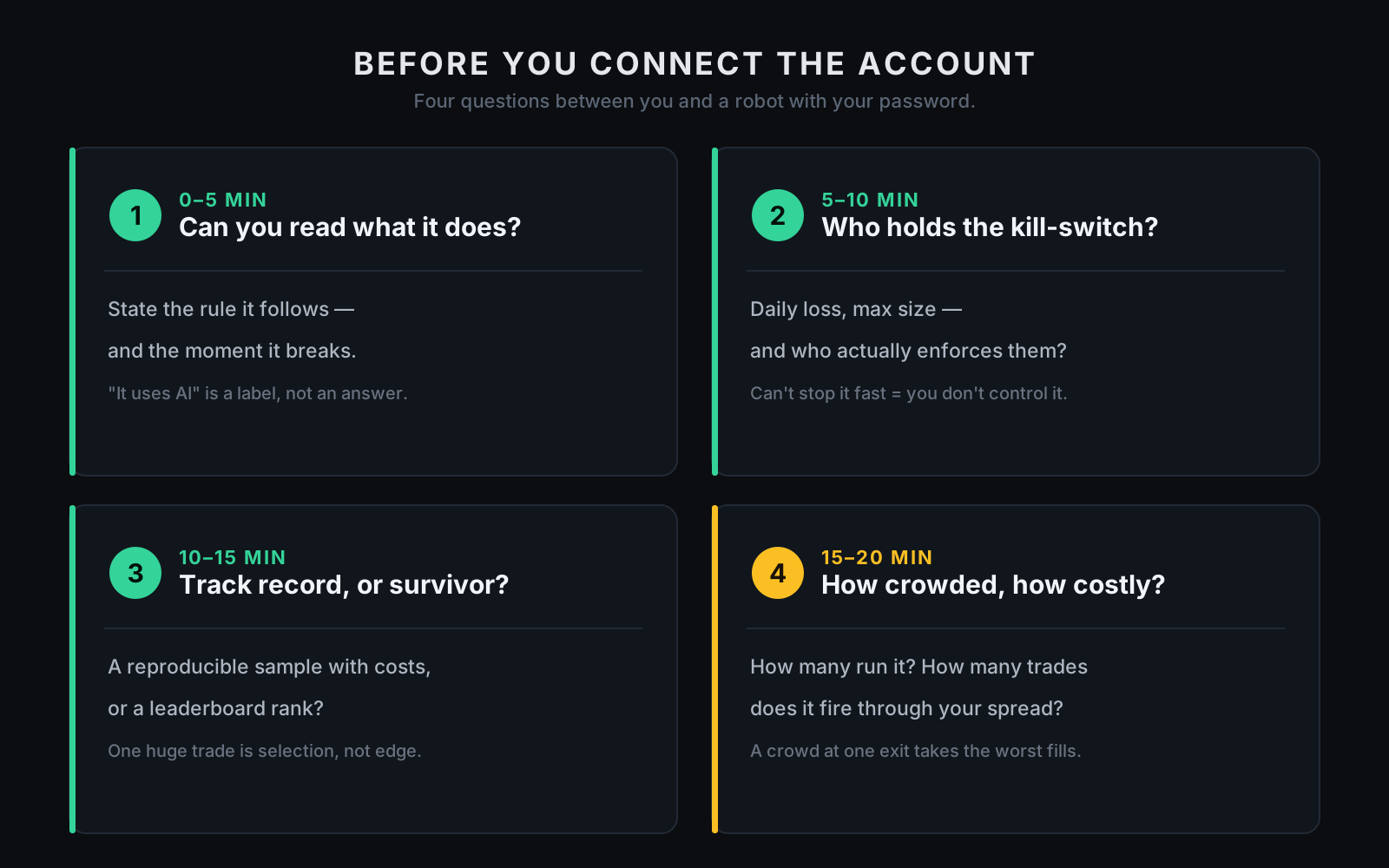
VIII — The 20-minute "what am I handing over?" audit
Run this before connecting any agent to an account — yours, a paid product, a platform feature, the one your friend found, and especially the one with the green leaderboard.
Minutes 0–5 · Can you read what it does? Open the actual logic and try to state the rule in one sentence. What triggers a trade, what cancels one, what changes size, what exits, what invalidates, what happens during bad data? If the answer is "it uses AI," that's not an answer — that's the label, and you're about to wire your account to a stranger's black box.
Minutes 5–10 · Who holds the kill-switch and the max loss? Find the hard limits: daily loss, per-trade loss, max position, max exposure, max number of trades, a circuit breaker, a pause control. Then ask who enforces them — you, the platform, the agent, or nobody. If you can't stop it fast, you don't control it; you're hoping it controls itself.
Minutes 10–15 · Track record, or leaderboard survivor? Ask where the performance comes from. A reproducible out-of-sample test with costs, across regimes, is evidence. A single huge return, a leaderboard rank, or a screenshot is selection. Demand the failures — worst day, worst drawdown, how many agents died or flatlined. Survivorship matters more than the winner.
Minutes 15–20 · The crowding-and-cost check. How many accounts run this same agent, on the same market, off the same trigger? How many trades does it place, and what's the average cost per trade? What happens when the spread widens, or when everyone exits at once? If you can't get an honest answer to crowding and cost, assume both are worse than advertised — the people selling autonomy aren't incentivized to make the toll booth visible.
Where this meets ProEA
Now the honest part. MTR is not an AI agent — it's a full-source MT5 EA. But operationally, an EA is an autonomous execution system: it can run on a VPS, trade while you sleep, and place orders without asking you every time. So we're not here to tell you autonomy is bad. We ship it. We're here to tell you what separates autonomy you can stand behind from autonomy you should run from — and then show the work.
The difference is everything the black box withholds. MTR ships as full MT5 source — 21 files, 16,923 lines — so you can read exactly what the system is about to do before it does it, including the risk layer where the account lives or dies. You can inspect the sizing, the stops, and the logic; you set the risk; you run it on your broker; and you can stop it. There's a published 28-month backtest you can recompute, not a leaderboard rank you have to trust — a sample, a method, and a source tree, instead of a sealed box asking for your account.
And the caveat, stated plainly because honesty is the brand: none of this is a promise of profit. Being readable doesn't make the edge eternal; you setting the risk doesn't mean the risk is small; a 28-month sample doesn't bind the future; and the system can lose money like any other — ours included — because the edge can decay, your broker can differ from our test, and an autonomous EA can have a bad month while you sleep. Inspectability and a human gate are proof of method, not proof of profit. But in a feed selling robots you're forbidden to inspect, a system you can read and can stop is the first thing worth trusting with the keys.
Disclosure: the one question for any AI-agent seller
We sell source and evidence you can inspect, and a system you control — not outcomes, not a hands-off money machine, not an "AI edge," not a guarantee. No agent, model, EA, or backtest can promise future results; autonomous or manual, trading carries real risk of loss, and past performance is not future performance.
So the next time something is sold to you as an autonomous "AI agent," ignore the leaderboard for a moment and ask the only question that separates a tool from a trap: "Can I read what it does, set my own risk, and stop it myself — or am I wiring my account to a box I'm not allowed to open?" If you can't open the box, the autonomy is the marketing. If you can, the agent was just a tool doing what you told it — the way it's supposed to be.
Your first 20 minutes
Don't take our word for it. Do the opposite of connecting your account to a stranger.
Minutes 0–5 · Read the risk module first. Open the source and go straight to where size and stops are decided — how it sets exposure, how it stops, what the worst-case behavior is, where the kill-switch lives. This is the layer an agent seller never shows you. Read ours before anything goes live.
Minutes 5–10 · Set your limits, not the defaults. Decide the per-trade size, the daily loss, the max exposure, and the conditions under which you stop the system — and set them. The dial is yours; that's the entire point.
Minutes 10–15 · Recompute, don't trust. Take the published 28-month sample and check it against your own broker's costs — spread, slippage, commission, swap. Evidence you can reproduce beats a leaderboard rank you have to believe.
Minutes 15–20 · Keep the gate. Run it small, on your terms, with a kill-switch you control, and decide — as the human in the loop — when it's allowed to risk money. Not because a leaderboard was green, but because you read it, sized it, tested it, and can stop it.
One last thing
The dream the feed is selling is trade without trading. The bill it doesn't show you is lose without knowing why — at machine speed, while you sleep, on a system you were never allowed to read.
Anyone can hand a robot the keys. Almost no one can read what the robot is about to do — and in the agent era, that gap is the whole difference between a tool you own and a stranger you funded.