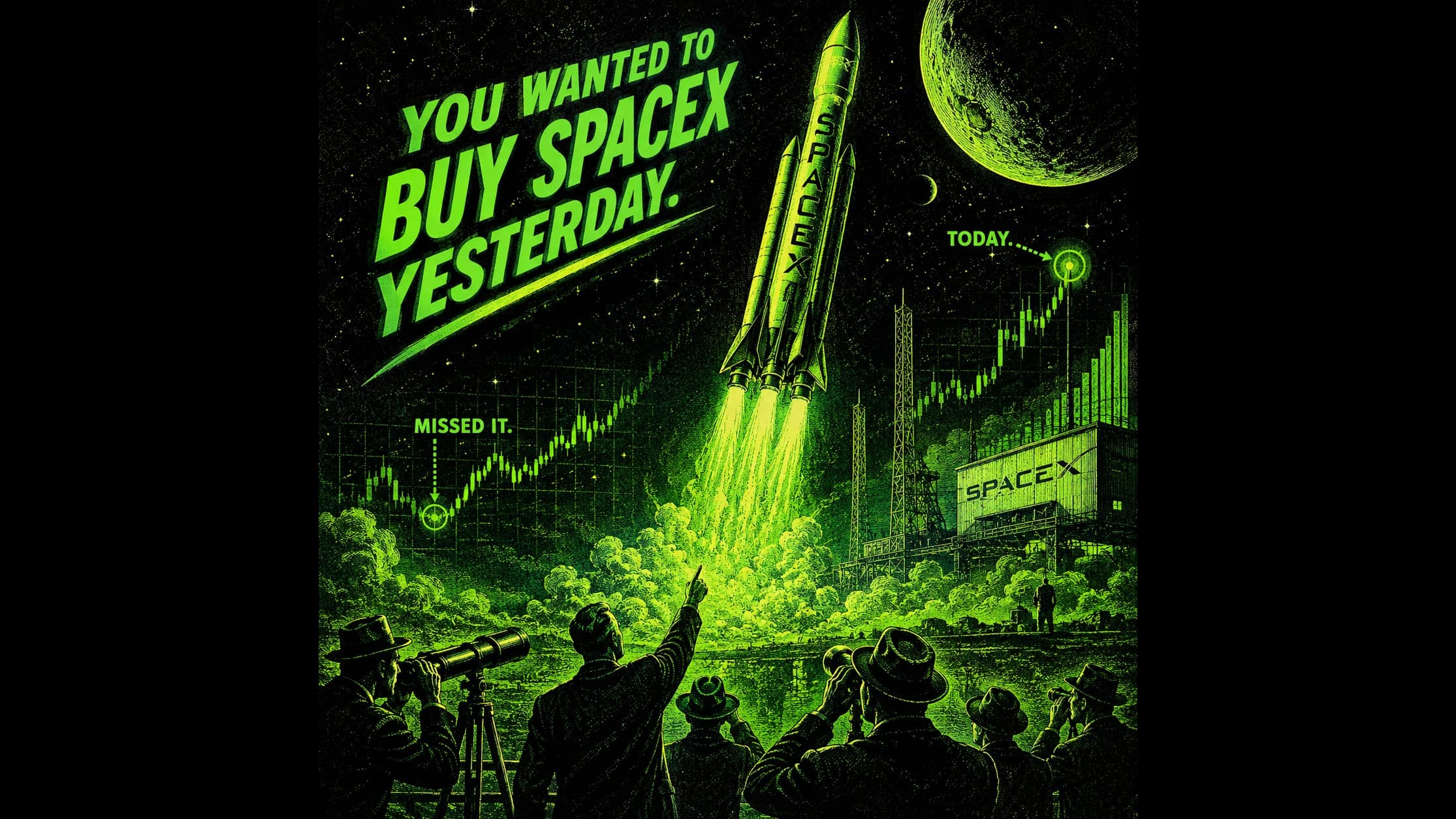
A few minutes after 9:30 a.m. New York time, the most-watched chart in the world printed its first candle.
You watched it happen.
Maybe with money. Maybe with your thumb on the buy button. Maybe just with that pull in your hands you didn't say out loud.
Everything below was written on June 11 — before the open. Not to predict the stock; we couldn't, and said so in writing. To predict you.
You wanted to buy. This was the anatomy of the wanting — written in advance.Read it now, after. Count the lines that came true. Then send it to the friend who is still refreshing the chart — the next "biggest ever" is already on someone's calendar.
— The pre-mortem follows exactly as written before the bell. Tenses untouched. —
Tonight, while you sleep, a number gets locked.
$135.
Tomorrow, a few minutes after 9:30 a.m. New York time, SpaceX starts trading under the ticker SPCX.
You already know this.
Everyone already knows this.
Your broker knows it too. The push notification is probably already written — sitting on a server, waiting for the open, addressed to you.
And somewhere around 9:31 tomorrow, you are going to feel something with physical weight.
A pull. Not in your head. In your hands.
You will want to buy.This is not a prediction about SpaceX.
This is a pre-mortem of the wanting — written before it happens, so you can read yourself in real time.
Read it tonight. Send it to the friend who already moved SPCX to the top of their watchlist.
T-minus one night — the number gets locked
Here is what is happening tonight, stripped of the rocket footage.
A group of banks closes a book. SpaceX sells hundreds of millions of shares at one fixed price. The raise is enormous. The valuation is enormous. The interest is enormous. (The specifics, as Reuters reports them: $135 a share, a record-setting raise around $75 billion, a valuation near $1.75 trillion — all of it subject to tonight's final print.)
The number is fixed before the public market gets to argue with it.
Two details in that paragraph matter to you personally.
First: the offer price is fixed. There is no live auction tonight where the whole world discovers fair value in front of you. A fixed price on a deal this size is unusual — and it means the argument moves to tomorrow. At the open. In public. Against everyone.
Second: the reported retail allocation is unusually large — up to around 30% of the deal, several times the typical slice. For decades, the retail complaint about IPOs was simple:
we never get in
This time, they made room for retail.
That can be exciting. You are allowed to enjoy it. You are also allowed to ask the quant's question:
The most oversubscribed deal in the world kept a huge slice for the people with the least information. Why?
Maybe brand. Maybe distribution. Maybe Musk. Maybe a genuine belief in public ownership. Maybe because a fixed-price deal with a giant retail book moves the emotional argument about value to one place: tomorrow's open.
Where you will be.
T-minus one hour — the feeling arrives on schedule
Tomorrow morning your phone will do this:
🚀 SPCX starts trading today.
Add SpaceX to your watchlist.
Be ready at the open.
The group chat will do this:
bro. SPCX. today.
my uncle got allocation at 135.
this is the new apple.
screenshot this.
Then the voice in your head will begin. It will not sound like greed. It will sound reasonable.
I'm not going to ape in. Just a starter position. Small size. I'll add on the dip. I can't be the only person on earth who sits out the biggest IPO ever.
Notice what happened.
You have not seen one candle. Not one bid, not one spread, not one real trade. And the position is already half-built — in language. "Starter position." "Add on the dip." "Just a little." The vocabulary of a plan, with no data inside it.
FOMO does not feel like greed from the inside. It feels like being reasonable.That is why it works.
9:30:00 — zero candles
Here is the only fully honest statement anyone can make about SPCX tomorrow morning:
Nothing is known.
Not little. Nothing.
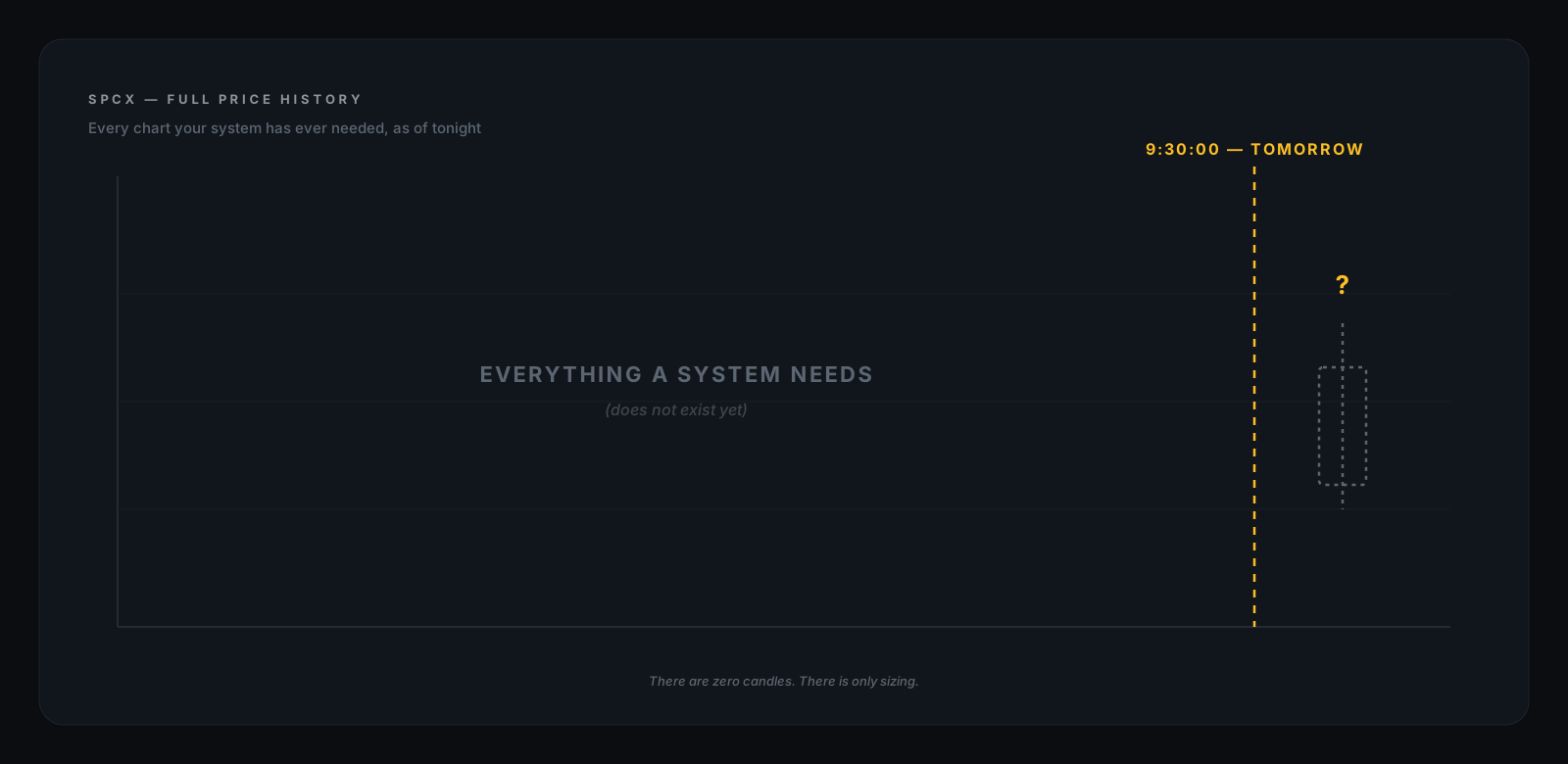
A trading system is a claim about the future earned from the past. Even a simple system needs history: candles, closes, ranges, volume, spread behavior, regimes, false breaks, trend days, gap days, drawdowns, bad fills. A system needs yesterday.
At 9:30 tomorrow, SPCX has no yesterday.
Zero candles. Zero closes. Zero support. Zero resistance. Zero average true range. Zero post-news behavior. Zero drawdown history. Zero "this setup worked before."
Whatever you do at 9:31 belongs to one category:
a feeling with a ticket attached
That does not make it wrong. It makes it honest. You can buy a feeling — people do it every day. Just do not call it a system.
There are zero candles. There is only sizing.The pop belongs to the offer
The group chat will say: IPOs pop. SpaceX is not a normal IPO. If this opens strong, it will never come back.
Maybe. IPOs often do pop. Historically, the average US IPO's first-day return is about 19% — and that number is measured from the offer price to the first-day close. It is the allocation holder's statistic. As the Wall Street Journal put it: for a select few, IPOs are winners — good luck to everyone else.
If you got stock at the fixed offer price, the famous pop is about you.
If you buy at the open, you are on the other side of that statistic. You are not collecting the pop. You may be paying it — to someone who got the offer.
That is the entire psychological trap. The chart will show a first public price, and your body will treat it like the beginning. But the trade began the night before. Some people entered at the offer. Some people enter at the open. Those are not the same trade. They just happen to share a ticker.
The pop belongs to the offer. The urge belongs to you.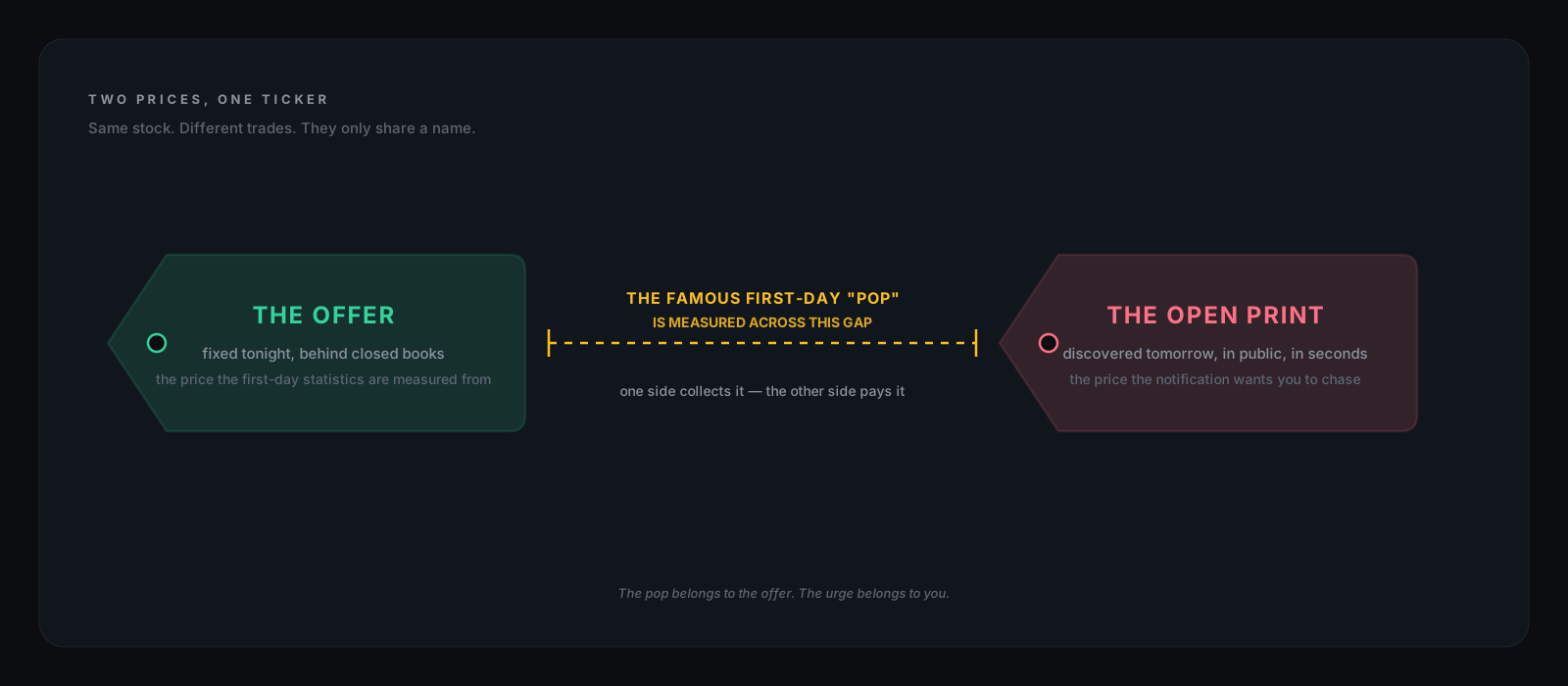
9:31 — what the open print is made of
The first public price tomorrow is not a valuation. It is an imbalance. A temperature reading. A pressure release. A crowd made visible as a number.
You may be buying from:
allocation holders taking profit
funds trimming excess demand
fast money flipping the first print
retail chasing the first candle
market makers widening spreads
people who only wanted the event, not the business
None of them are necessarily smarter than you. They simply stand in a different place in the line. At the open of day one, the product being sold is not just stock — it is excitement. And someone has to be the buyer of it.
That may still work. It may rip. It may bleed. It may open, spike, halt, fade, recover, and make every confident person look stupid twice before lunch. Nobody knows. That is the point.
From your entry, the honest evidence is not bullish or bearish. It is empty. No edge either way — just a decision under uncertainty, made in a room full of people whose phones are all vibrating at the same time.
The most expensive sentence tomorrow
The most expensive sentence tomorrow will be:
Just a starter.
Because "starter position" is often not a size. It is a permission slip. It means: I want exposure, but I do not want to admit I am making a decision.
A real starter has a number, a maximum loss, a date, a reason to exit. A mood starter has vibes. And vibes are how one share becomes three, three becomes ten, and ten becomes "I'll average down." Then suddenly you are not participating. You are managing.
That is the danger of day-one trading. Not that the stock must go down — it does not have to. Not that buying IPOs is always dumb — it is not. The danger is that the event manufactures urgency before the market manufactures information, and that urgency then borrows the language of a plan.
A position you cannot pre-commit three lines to is not a position. It is a mood.T-minus ten minutes — the Pre-Open Card
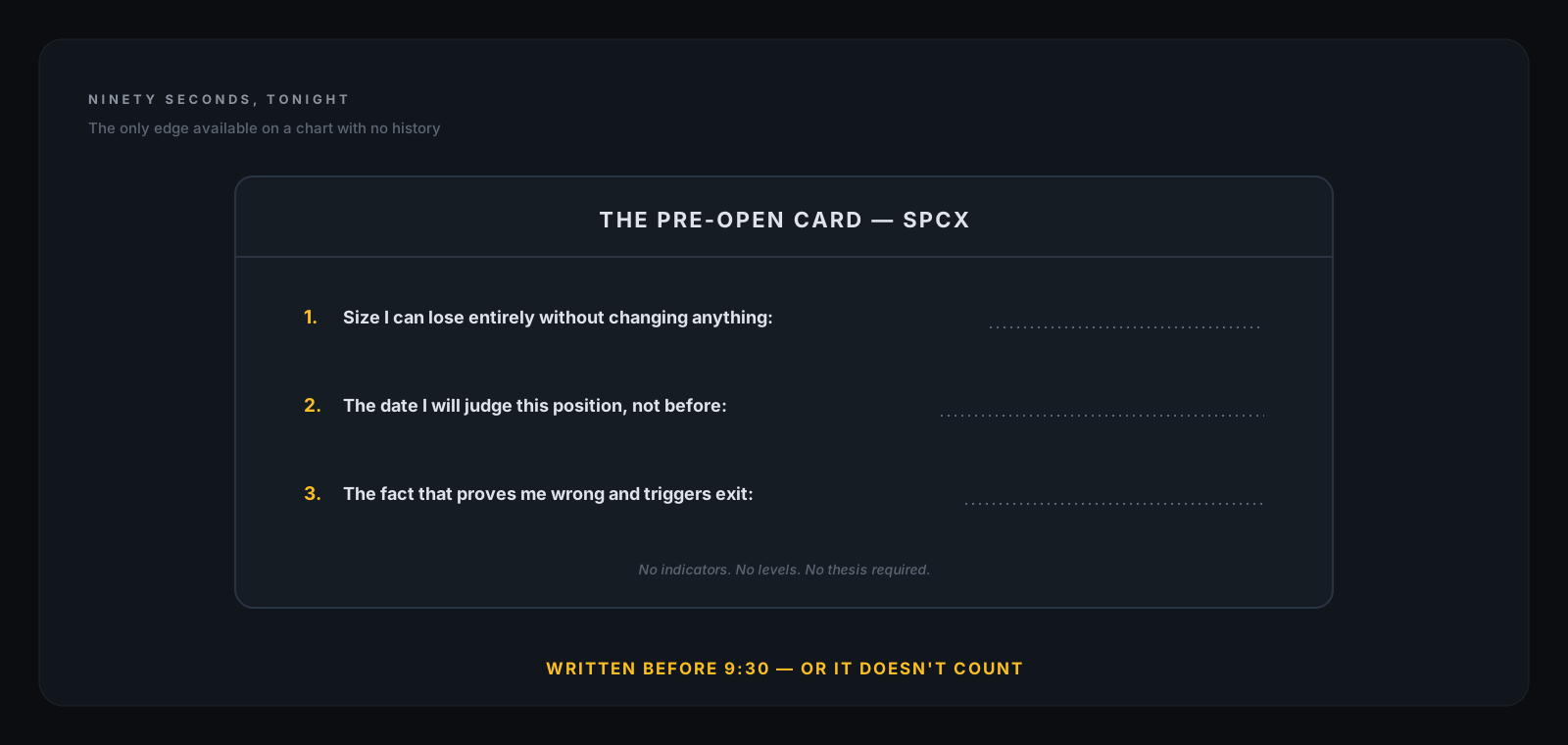
If you are going to touch SPCX tomorrow, earn the right with three written lines. Finished before 9:30. Not after the first candle. Not after the halt. Not after the group chat gets loud. Before.
THE PRE-OPEN CARD — SPCX

1. Size I can lose entirely without changing anything: ______

2. The date I will judge this position, not before: ______

3. The fact that proves me wrong and triggers exit: ______

Written before 9:30, or it does not count.
That is it. No indicators. No levels. No thesis required.
The card does not make the trade smart — nothing can, with zero candles. What it does is convert a feeling into a bounded feeling. Line 1 caps the damage. Line 2 blocks the 9:47 a.m. panic-add and the 2:15 p.m. revenge-sell. Line 3 forces a real exit, written before your nervous system starts negotiating.
Professionals do not survive because they never feel the urge. They survive because the urge arrives inside a box.
The Pre-Open Card is the box.
What this has to do with a gold robot
We sell a trading system. So let's point this at ourselves before someone else does.
The only reason a system can exist is yesterday. MTR has a 28-month evidence window with stated assumptions, source code you can read, and a public changelog — and we still tell you to be suspicious of it, because evidence is not prophecy. A backtest is not destiny. MTR can lose. Any system can lose.
That is the standard for something with thousands of candles behind it.
Tomorrow's chart has none. Not for us. Not for the banks. Not for the person with the allocation. Not for whoever is building a "SPCX day-one system" to sell you by Friday. They may have a thesis, an order, a story. They do not have a system. Nobody has a system for the first candle.
This is not a prediction that SpaceX dumps. It is not a prediction that it rips. It is the one boring sentence that survives both outcomes:
when there is no history,
there is no edge —
there is only sizing
That sentence is less exciting than a rocket. It is also the only thing you control.
Disclosure
Nothing here is advice or a forecast about SPCX, in either direction. Deal terms — price, share counts, ticker, allocations, dates — are as publicly reported before final pricing and can change at the final print. IPO statistics describe historical samples, not this specific stock: first-day pops and first-day collapses both happen, and the long-run evidence is mixed by issuer size, methodology, and entry point. We sell MT5 software whose logic and evidence you can inspect; we publish what a process does, never what you will make. And no — we do not have a SpaceX system. Tomorrow, nobody does.
The close
Tomorrow at 9:30, the most-watched chart in the world will print its first candle.
Millions of people will look at that candle and see a signal.
You will know better.
There is no signal yet. There is a fixed price from last night. An opening auction made of expectations. A group chat full of certainty. A broker app full of buttons.
And a card you either wrote before the open — or did not.
The rocket is real. The company is real. The urge is real too.
Only one of them is yours to control.
— End of the capsule. —
The morning after
We are not going to tell you what the candle did. You watched it — and whatever it did changes nothing above, which is the entire point. A pop would not have made chasing it a system. A bleed would not have made the card unnecessary. The mechanics were knowable before the open. The outcome never was.
(For the record: the deal terms above were as publicly reported before the final print. We have deliberately not updated them — this page is a receipt, not a news article.)
What's left is the only question that was ever yours:
Did you write the card —
or did the notification trade you?
Keep the card. The next "biggest IPO in history" is already in someone's pitch deck. The urge will be on time. The question is whether you will be.