2 a.m.
Another tab.
Another gold EA with five stars.
Another screenshot the color of money.
A 90% win rate. A curve that only knows one direction. Four hundred reviews.
A vendor saying "fully automated." A forum saying "avoid robots." A YouTube comment saying "changed my life."
And one question, typed into a search bar, that brought you here:
do forex EAs actually work?
You deserve a straight answer.
Here it is — from a team that builds and sells one.
The short answer
Mostly, no. Most forex EAs do not work for most retail traders, because they automate weak logic, overfit backtests, ignore real trading costs, break when regimes change, or hide dangerous sizing behind a smooth win rate. Regulators and academic studies show the retail trading base rate is brutally negative.
But "mostly no" is not "never." A small minority of automated systems can be genuinely useful — when the logic is real, the costs are modeled honestly, the risk is sized to survive, and the person running it can inspect what it actually does.
An EA does not add edge. It automates whatever truth — or fiction — you hand it.A robot is an amplifier.
Hand it an edge, it compounds the edge.
Hand it a story, it compounds the story.
That is the whole page. The rest is how to tell which one you are holding.
What do the numbers actually say?
Nobody selling you a robot wants to start here. So we will.
The base rate for retail trading is ugly — different regulators, different countries, different instruments, same shape:
| Who measured it | Population | Result |
|---|---|---|
| ESMA — EU regulators' analyses | Retail CFD accounts across EU national regulators | 74–89% of retail CFD accounts lose money |
| SEBI — official study, Sep 2024 | 10M+ individual equity F&O traders, FY22–FY24 | 93% lost money; aggregate losses over ₹1.8 lakh crore |
| Chague, De-Losso & Giovannetti — peer-reviewed | Brazilian futures day traders persisting 300+ days | 97% lost money; 1.1% beat minimum wage; 0.5% beat a bank teller's starting salary |
| CFTC — US retail forex diligence | Registered OTC forex dealers | Dealers must disclose profitable vs non-profitable account percentages — ask for them before depositing |
Read that table slowly.
An EA does not magically opt out of those base rates. A robot trading retail instruments, through retail brokers, at retail spreads, with retail leverage, swims in the same pool. Automation can remove some human mistakes. It can also automate the losing math faster.
So the honest question is not:
Do EAs work?
It is sharper:
Does this EA move me out of the losing base rate,
or does it lock me into it with more speed and less control?
That answer depends entirely on what got automated. Which brings us to the autopsy.
Why do most forex EAs fail?
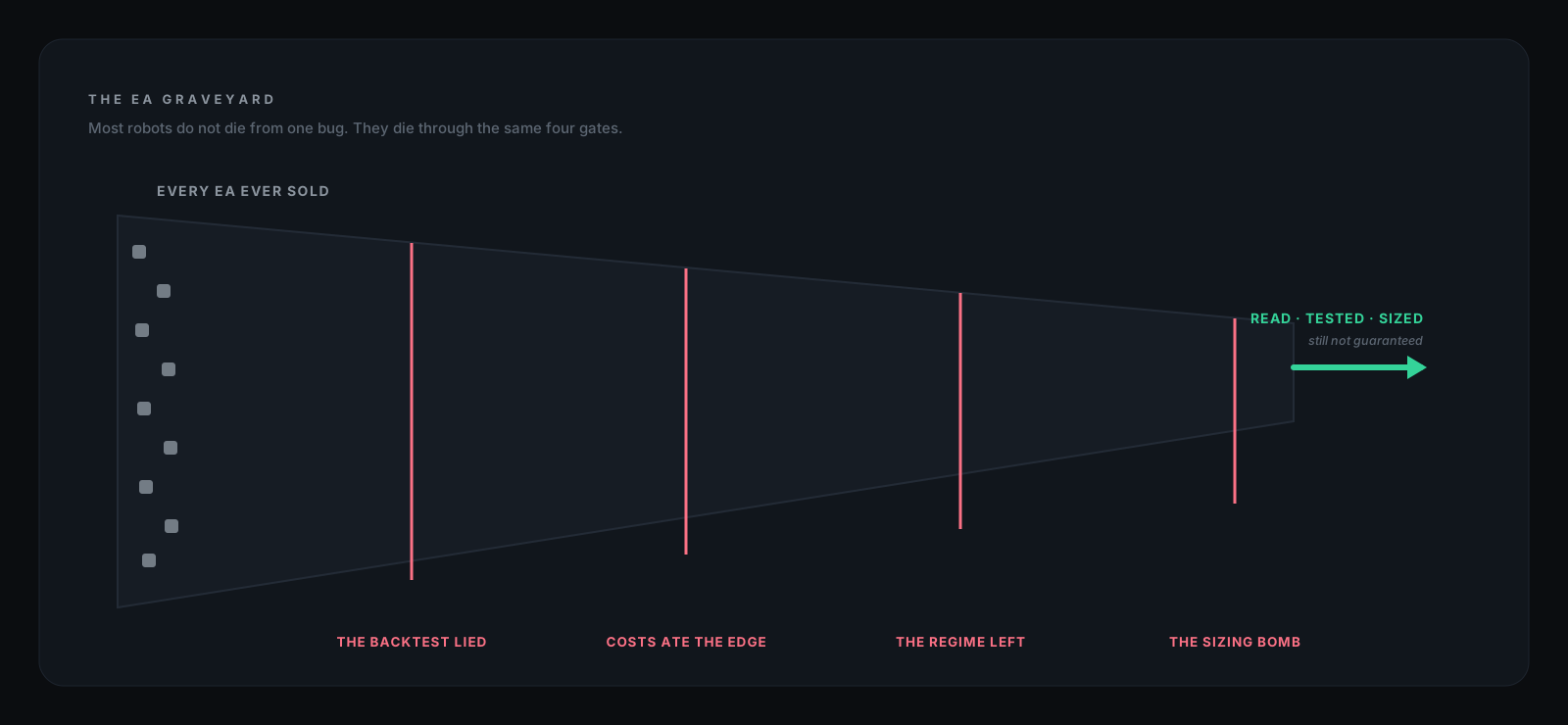
Across dead robots, broken backtests, marketplace blowups, and our own early failures, the cause of death usually falls into four buckets — plus a fifth nobody likes to name.
1. The backtest was fiction
The curve that sold the EA may be the prettiest survivor of a search. Try enough settings — RSI periods, stops, grids, sessions, symbols, filters — and something will always look incredible. The winning version gets published. The graveyard disappears.
That is why a beautiful backtest is not proof. It may be one lucky ordering of trades. It may be overfit. It may be quietly reading data it would not have live. If the seller cannot tell you how many versions failed, the winner means less than it looks.
A perfect curve is not evidence of an edge. It is evidence a search happened.
2. Costs ate the edge
Most retail EAs trade often and win small — the shape most sensitive to costs. Spread, commission, slippage, swap, execution delay, weekend gaps. And costs are not fixed: they widen exactly when the system most wants to act. A backtest priced at calm spread becomes a live system trading ugly spread; the tiny edge disappears; the robot keeps trading because the backtest told it to.
An edge smaller than real friction is not an edge. It is a donation schedule with settings.
3. The regime left
Every EA is built for a market condition — trend, range, volatility, session behavior. The strategy may not say it out loud, but the code knows. Then the regime changes: gold stops trending, volatility doubles, a range becomes a trend, a one-way market ends.
The EA did not change. The world did. This is the failure most owners misread — they think the robot "stopped working," when the market simply stopped being the one the robot was built to trade.
4. The sizing was a time bomb
The most dangerous EAs are often the prettiest. Grid, martingale, recovery, averaging — a staircase of small wins built over a cliff. They turn many small losses into one delayed large loss, which produces a beautiful win rate right up until the trend that does not stop.
High win rate plus rare account damage is not safety. It is one bad day wearing a strategy's clothes.
5. The owner overrode the system
Stops widened in a drawdown. Risk doubled after a loss. A system paused after a bad week, restarted at the worst possible moment. A profitable rule edited because the last three trades hurt.
Sometimes the robot was fine. The hand on the switch was not. Automation removes some emotion. It does not remove the owner.
Can an EA actually be profitable?
Yes. But the conditions are boring.
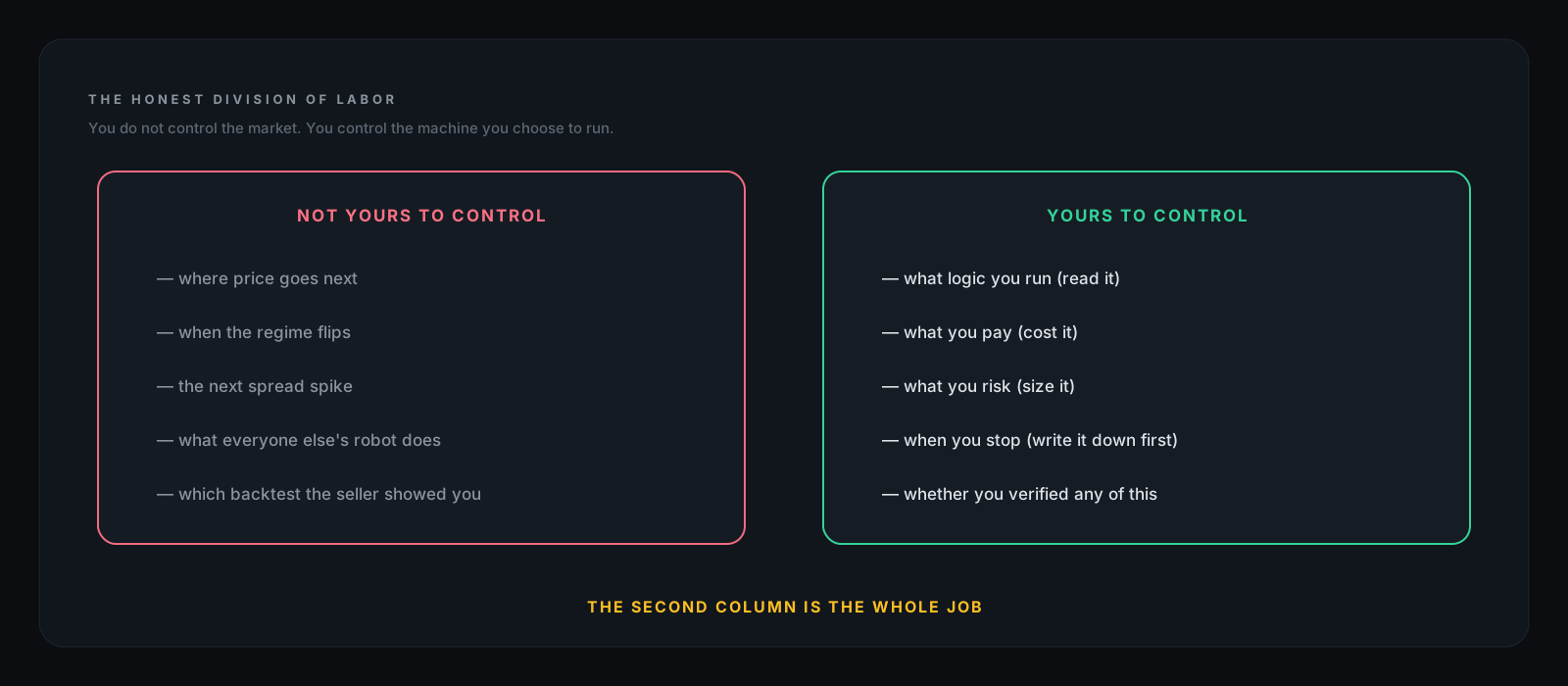
A profitable EA is not profitable because it is a robot. It is profitable because it encodes a real edge and executes it consistently. A serious EA needs all of this:
a clear reason the edge should exist
a backtest that did not just fit noise
out-of-sample survival
realistic costs
drawdown behavior written before the drawdown
position sizing that survives bad sequences
logic that can pause or stand aside when the regime changes
source or rules the operator can inspect
Notice what is not on the list:
secret indicator
AI brain
99% win rate
vendor screenshot
telegram proof
10% per month
That last one deserves its own paragraph. A common internet claim is that a forex robot can make 10–15% per month. Run the arithmetic once: 10% per month compounds to roughly 214% a year; 15% per month to more than 430% a year. The most famous track records in the history of investing do not live in that neighborhood. If a small downloadable robot could reliably produce that at survivable risk, it would not be sold for a few hundred dollars — it would be quietly attached to every dollar its creator could borrow.
If a $500 robot truly made 10% per month reliably, it would not be for sale.The honest version of a working EA is much less exciting: small edge, real costs, ugly periods, strict sizing, long tests, limited claims, constant monitoring. Boring is not a flaw. Boring is what survival looks like.
Are marketplace EAs and ratings trustworthy?
Marketplace ratings measure something real. It just may not be expectancy.
A five-star rating often measures:
how good the EA felt in its first weeks
how friendly the current regime was
how quickly buyers reviewed it
how well the seller supported installation
how recently the strategy avoided its cliff
That is not the same as positive expectancy after costs, across regimes.
The timing problem is huge: buyers review early, inside the honeymoon, before the system meets the condition that kills it. A grid EA in a friendly market can produce months of small wins and five-star reviews before the first real trend collects everything.
Survivorship does the rest. Dead systems get delisted, track records get restarted and relaunched as "v2" — the community has documented the pattern — and the marketplace you browse today is, by construction, the list of robots that have not died publicly enough yet. The modern layer on top: AI can now fabricate the face, the testimonials, and the track record. The one thing it cannot fake is letting you read the logic before you pay.
None of this means every marketplace EA is bad. It means the rating is not evidence. A rating says people liked it. It does not say the math survives.
How do you test an EA before risking real money?
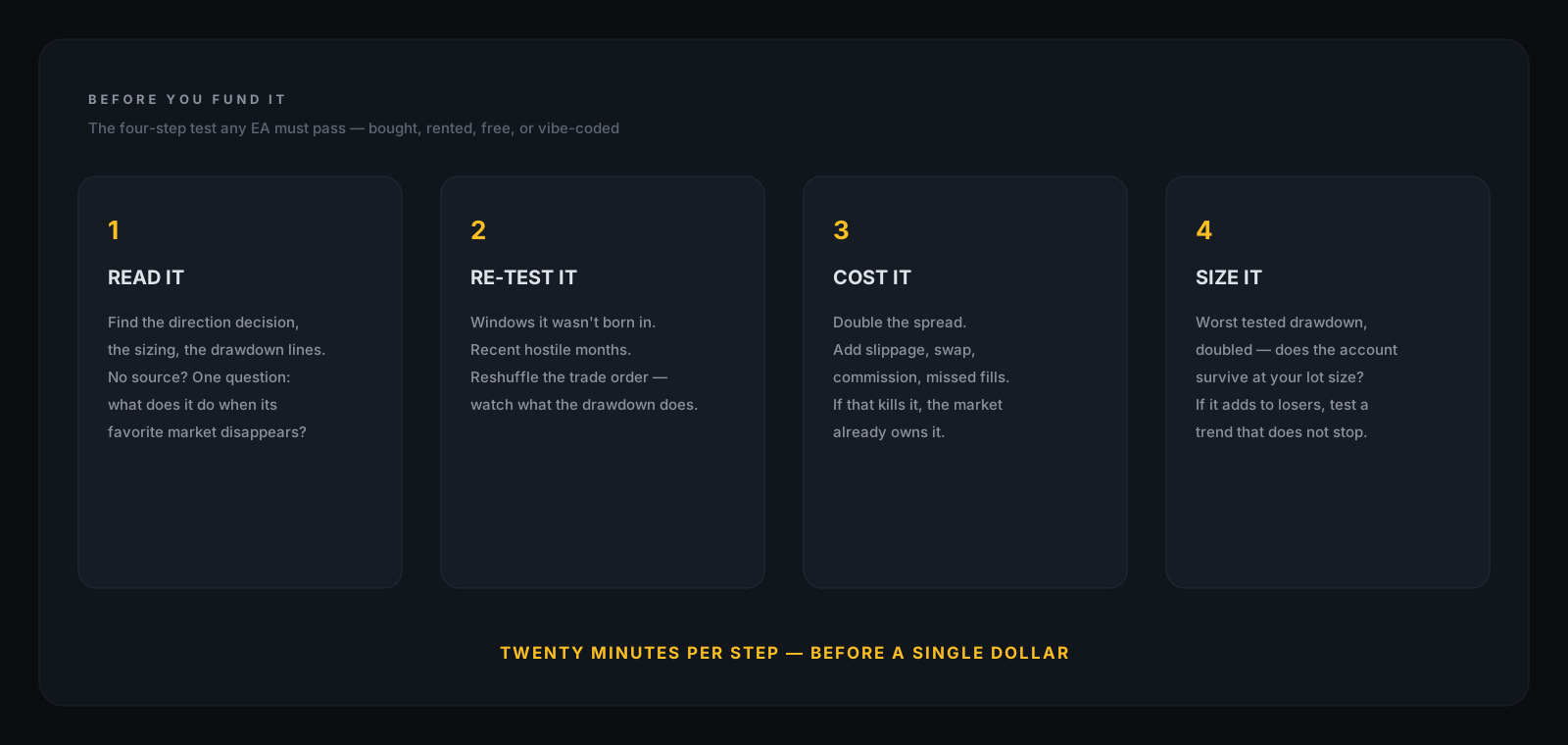
Use the four-step test. No live money. No excitement. No "just small size." Twenty minutes per step.
Step 1 — Read it, or demand the answer
If you have source, find the lines that matter:
direction decision
position sizing
order send
stop placement
drawdown rule
kill switch
If you do not have source, ask the seller one question: what does it do when its favorite market disappears? For a gold EA in 2026, ask the dated version:
Show me what it did after the January high.
A seller whose evidence stops before the hard window has answered.
Step 2 — Re-test it where it was not born
Do not run only the seller's window. Run different years, different regimes, the recent hostile months, the high-spread periods. Then reshuffle the trade sequence: same trades, different order. If the drawdown doubles when the order changes, your sizing is too fragile. A real edge does not need the one perfect timeline to survive.
Step 3 — Cost it like the worst day
Re-run with ugly assumptions: spread doubled, slippage on every entry, commission, swap, missed fills. If doubling the spread kills it, the market already owns it. Many small-edge robots look profitable only because the tester charged them a fantasy bill. The broker will not be that polite.
Step 4 — Size it for the sequence you have not seen
Take the worst drawdown in testing. Double it. At your intended lot size, does the account survive? If no, the EA is not "risky" — it is too large for the account. And if the system adds to losers, repeat the test with a trend that does not stop. That is the staircase-over-a-cliff exam.
An EA that passes all four steps is not guaranteed to make money — nothing is. It has only earned the right to a small, pre-sized forward test. That is the most any honest person can promise you.
Should you buy an EA, rent a signal, or build your own?
There are four versions of the same decision.
Renting signals
The weakest position. You own nothing and you learn nothing; you cannot inspect the logic, and when the market changes, your subscription becomes a liability you cannot repair. You can only cancel.
Buying closed EAs
Automation without inspectability. You may receive a working system; you may receive a screenshot with code attached. You cannot know which until the market tests it. A closed EA asks for belief. Belief is not a risk control.
Building with AI
Now genuinely possible — AI can write a trading bot in an afternoon. That is amazing, and dangerous, because the code was never the hard part; the edge is. Done with a quant's process, AI is a serious accelerator. Done on vibes, it is the fastest overfitting machine ever shipped.
Buying source
The only version of "buy" where the full four-step test becomes possible. You can read the logic, re-test the window, cost it, size it, even hand the code to an AI and tell it to find the flaws. That does not guarantee profit. It gives you the right to verify — and in this category, that right matters more than any screenshot.
Frequently asked questions
Are free forex EAs worth trying?
As education, sometimes. As money-makers, usually not — a free EA is often a marketing funnel, an abandoned experiment, or a risky recovery system with the fuse already lit. Run the same four-step test; free does not exempt it from spread, slippage, regime change, or bad sizing. The expensive part of an EA was never the price tag. It is the account it runs on.
Can an EA really make 10% a month?
A system can make 10% in a month by taking enough risk. Sustained 10% monthly compounds to roughly 214% a year, far beyond the most famous track records in investing history. Treat steady 10–15% monthly claims as a red flag unless the seller shows full risk, drawdown, and failure history — and notice that they almost never do.
Do prop firms allow EAs?
Some do, some restrict them, and some specifically ban grid, martingale, latency arbitrage, or copy trading. A prop challenge is a rulebook with barriers — an EA tuned for open brokerage trading can violate daily-loss or consistency rules even while "profitable." Read the rules math before paying the fee, and remember what "funded" actually means.
How much money do you need to run an EA?
Enough that the worst tested drawdown, doubled, does not force you to stop at the bottom — at the smallest lot size your broker allows. For many real systems that is more capital than the marketing implies. If surviving the math requires money you cannot afford to lose, the problem is not the EA's price. It is account size.
Why did my EA work for months and then suddenly stop?
Usually because the market left the regime the EA was built for. A trend EA dies in chop; a range EA dies in trend; a grid dies when the rescue stops coming. Before deleting it or doubling down, run the post-flip exam: how did it behave in the hostile window — did it pause, reduce risk, or keep doing the same thing?
Is a verified Myfxbook or a backtest screenshot proof?
It is evidence of a period, not proof of an edge. A backtest shows one simulated past; a live record shows one selected live window, chosen by the person showing it to you. The stronger evidence is logic you can read, assumptions you can inspect, and tests you run yourself. Screenshots can start curiosity. They should not end diligence.
Where MTR fits — and the standard it has to meet
We sell exactly one EA. It trades gold. So this page is, openly, the standard our own product has to survive.
MTR's public file inventory describes the modules and their roles. The source download is part of the purchase; it lets you inspect the implementation, sizing and basket behavior. The backtest section states its conditions and limitations. The changelog is public.
Run the four-step test on it. Read it. Re-test it. Cost it. Size it. Ask it the January question. We built it to be interrogated because, after everything above, interrogation is the only honest basis for buying any EA — including ours.
MTR can lose. Any system can lose. The difference we sell is not certainty. It is inspectability.
Disclosure
Every statistic on this page describes a measured population in a cited source — none of it predicts your result, in either direction. Nothing here is investment advice, and nothing here promises returns: not for EAs in general, and not for ours. We publish what systems do, never what you will make. If this page talks you out of buying something tonight — including from us — it did its job.
The close
"Do forex EAs actually work?" was always two questions wearing one sentence.
Do robots print money for people who buy them off a screenshot? The regulators already answered: overwhelmingly, no.
Can an automated system with a real, costed, survivable, readable edge work? Yes. Boringly. Conditionally. Only for an operator who verifies it.
Which means the real question was never about the robot. It was about whether you can verify the one in front of you.
That skill — not the software — is the edge. Everything on this blog exists to hand it to you.
So — are forex EAs worth it?
Mostly, no — not the way most buyers meet them: off a screenshot, a suspiciously smooth win rate, four hundred reviews collected inside the honeymoon, no source to read, no four-step test run before the money went in. The regulator base rates, the overfit backtests, the cost math, the regime changes, and the sizing time bombs above are not exceptions. They are the default.
Worth it, conditionally, for the minority willing to treat an EA as a machine to inspect rather than a story to trust — real logic, costed honestly, sized to survive, read before it's funded. That EA can be worth it. The one you haven't verified yet is not — it's a bet wearing a robot's clothes.