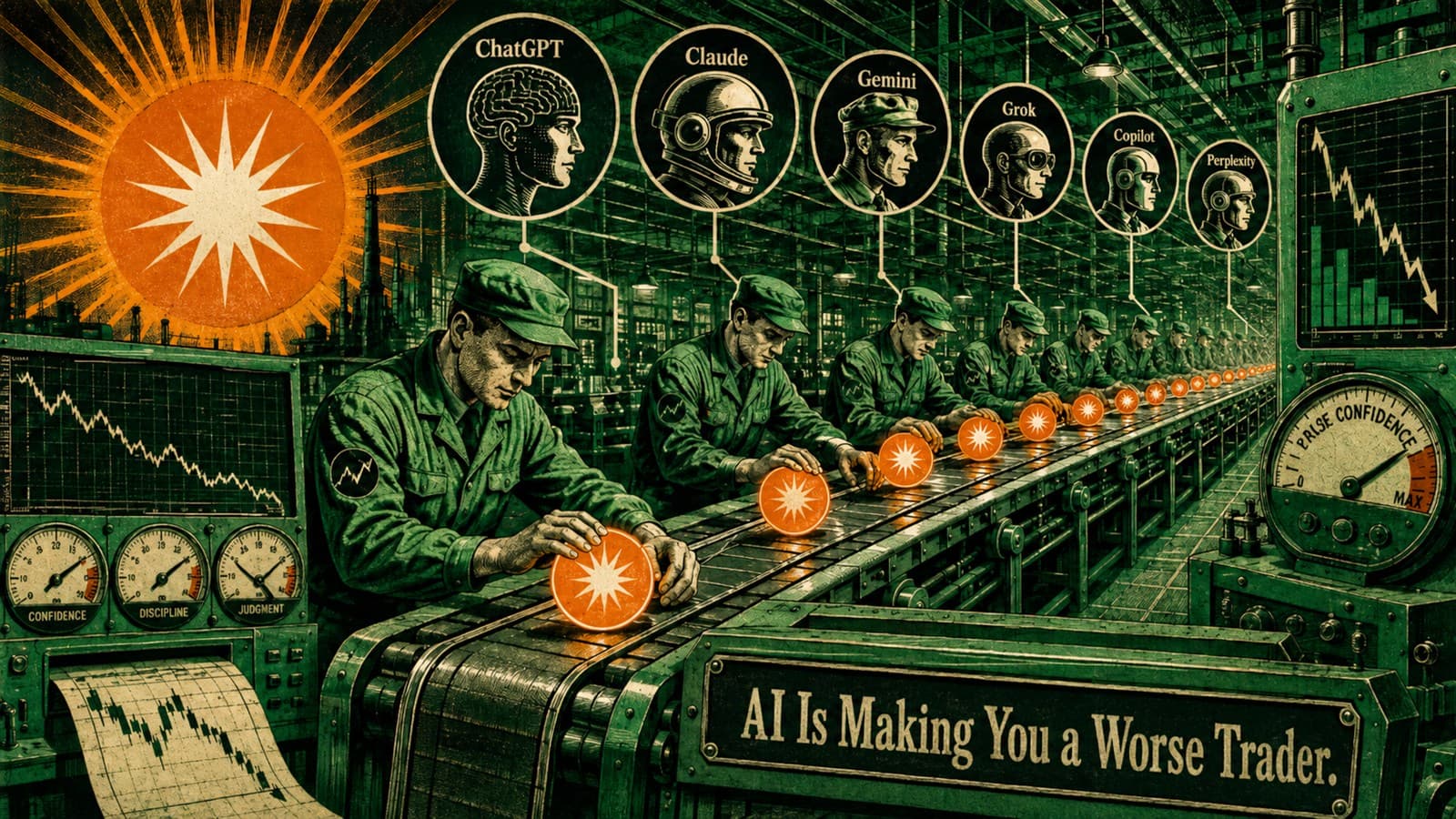
You opened ChatGPT, or Claude, or DeepSeek, and you typed something like: "Write me a profitable MT5 Expert Advisor that scalps gold." Thirty seconds later you had two hundred lines of clean MQL5.
It had inputs.
It had comments.
It had risk settings.
It compiled on the first try.
It even backtested green.
For one evening, it felt like you had finally cracked trading.
Then you ran it somewhere closer to reality — a different year, a different broker, a demo account, a prop challenge, a small live account — and the bot died. Fast, slow, quietly, violently; the speed doesn't matter. It died.
Here is the part nobody selling "AI trading bot mastery" wants to say out loud: the AI didn't fail you. It did exactly what you asked — it turned an idea with no proven edge into clean code with no proven edge, faster than you could. The machine was never the weak link. The idea was. And the most dangerous thing AI ever did for retail traders wasn't lowering the barrier to building a system. It lowered the barrier to confidently losing with one.
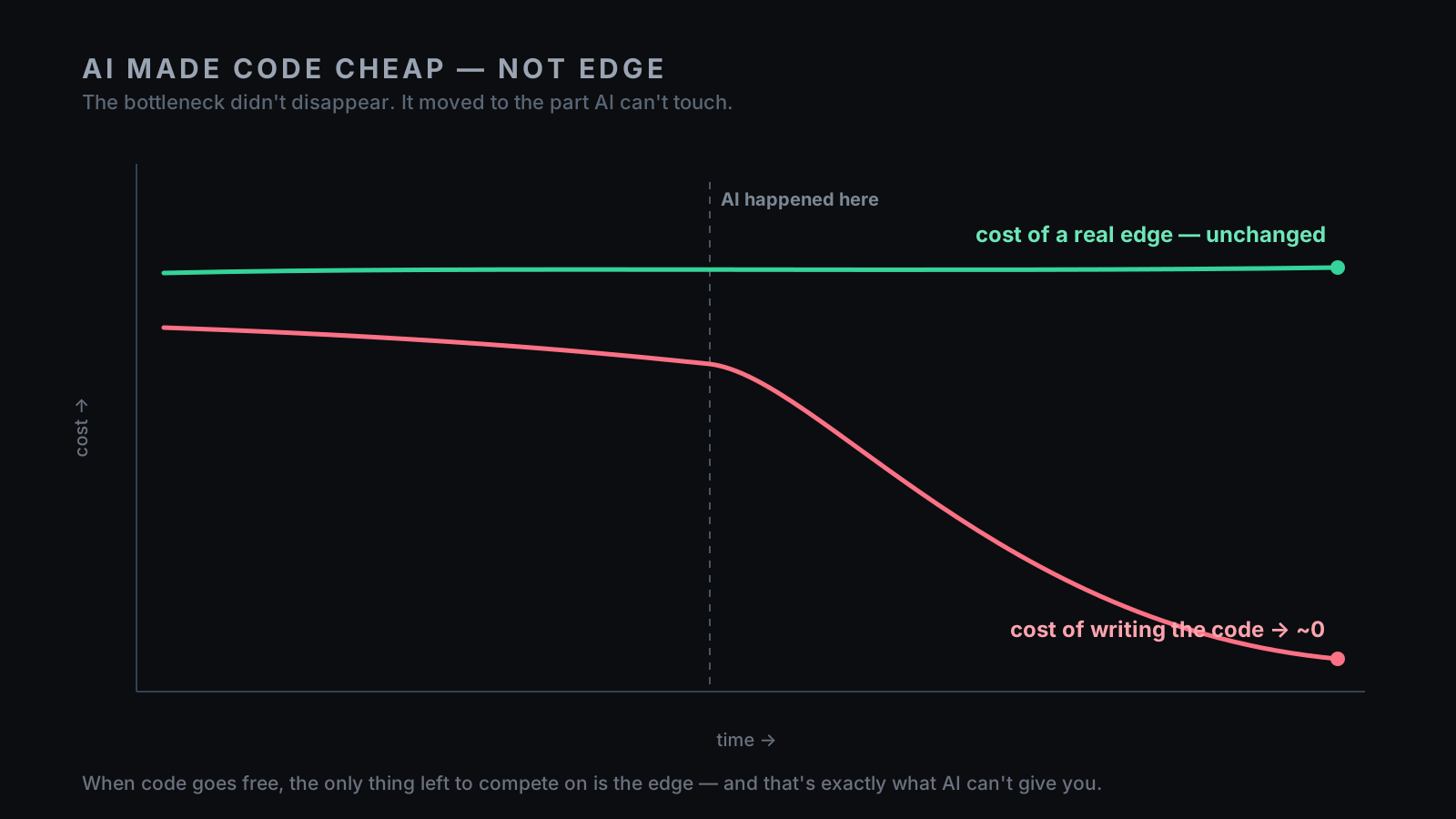
This is not an anti-AI piece. We use these tools every day — to scaffold code, explain modules, write tests, document systems, port logic, and speed up research — and used correctly they are ridiculous leverage. We'll be specific about exactly where, because a brutal piece that only attacks is just a different flavour of dishonest. But first someone has to say the thing the hype skips. AI made code cheap. It did not make edge cheap. The prompt is not the strategy; the backtest is not the proof; the compiled EA is not the system.
Before we start, two requests:
- Save this before your next "build me a profitable bot" prompt.
- Send it to the friend who says they're building an AI trading empire this weekend.
Not because AI is useless for trading. Because it is weak at the one thing people think it solves — and powerful at five things most people ignore.
Skip this if you already know AI writes code, not edges
An LLM converts your idea into working code. It does not convert your idea into a profitable one. If the idea has no edge, AI gives you a fast, clean, confident expression of no edge — and a backtest that flatters it. That is the danger in one sentence.
| What AI gives you in 30 seconds | What actually decides if you make money |
|---|---|
| Clean MQL5 / Pine / Python | Positive expectancy after costs |
| A bot that compiles | A system that survives unseen data |
| A backtest curve that goes up | Proof the curve isn't curve-fit |
| Sensible-looking parameters | Robustness across neighbouring settings |
| More filters when you ask | A reason the edge should exist at all |
| Confident explanations | Execution, risk, and broker reality |
| The feeling of progress | Evidence you can reproduce |
AI didn't remove the hard part of trading. It removed the easy part — and left you alone with the hard part, holding code you may not be able to read.
This isn't only our opinion. The CFTC's customer advisory is titled, almost word for word, that AI won't turn trading bots into money machines — and the base rates it's warning about were never a code problem:
Clean code didn't move one of those numbers — because none of them were ever a code problem.
I — The bot compiled. That's the trap.
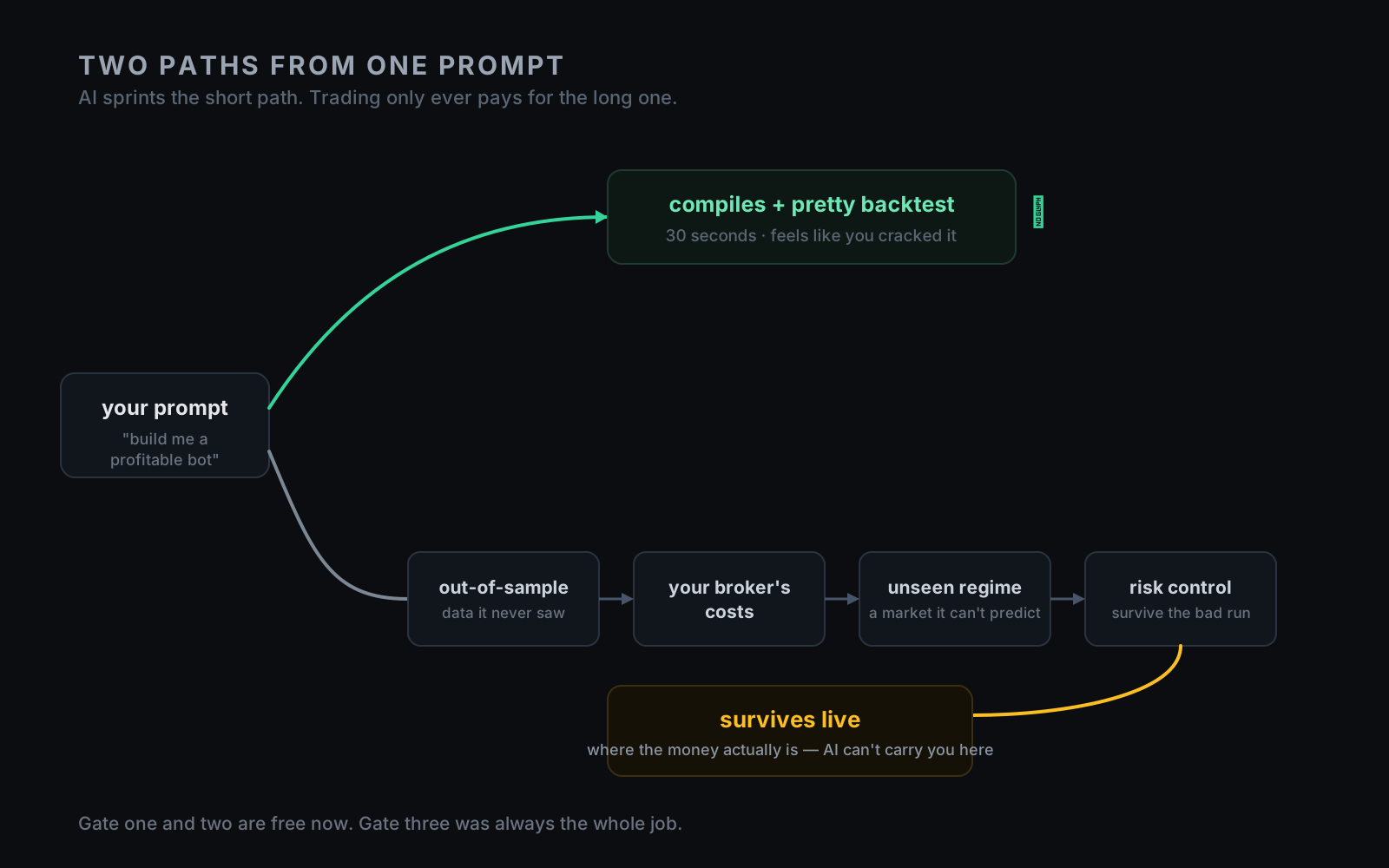
The most dangerous moment in AI trading isn't the error. It's the success. The code compiles, the EA loads, the tester runs, the equity curve goes up — and that feels like validation. It isn't.
A trading system passes through three gates. Gate one: it runs — no syntax errors, orders can be sent, the platform accepts the EA. Gate two: it backtests well — the historical curve looks good on a chosen sample. Gate three: it survives reality — it holds up out-of-sample, on your broker, after explicit costs, through a regime it never saw during construction. AI gets you to gate one essentially for free, and it can make gate two very easy to produce. Gates one and two are where the dopamine is.
Gate three is where the money is — and gate three cannot be skipped by code generation. It needs validation: broker cost, execution behaviour, out-of-sample testing, risk controls, position sizing, drawdown survival, regime awareness, and a reason the edge should exist. The AI made the first part instant, which makes the whole job feel smaller. It isn't smaller. It's the same canyon it always was — you just arrived at the edge faster, and with more confidence than the situation has earned.
II — An LLM is a plausibility engine, not a profit engine
To see why AI-built bots fail in such a specific way, you have to understand what the model is doing. A large language model is trained to produce the most plausible-looking answer — text and code that look like what a competent answer should look like. That is genuinely useful, and it is also exactly the trap. When you ask for "a profitable scalping EA," it gives you the most convincing-looking scalping EA it can: clean structure, sensible indicators, inputs, risk settings, maybe even logging. It looks like the thing. It's also why so much of what gets sold as "AI-powered" turns out, on inspection, to be marketing wrapped around simple rules rather than real machine learning — looking like the thing is the entire product.
But trading isn't paid by looking like the thing; it's paid by edge after cost. The model wasn't trained on your broker's fill quality. It doesn't know your spread at rollover, or whether your signal has any economic reason to exist, or whether your backtest is simply the prettiest version of noise. It will not refuse because the idea has no edge — it usually just gives you what you asked for. And "looks profitable" is not a harmless illusion; it is the precise failure mode that empties accounts.
To be fair to the tool: an LLM can help you discover a hypothesis, express it, test it, document it, and understand it. Those are real. What it cannot do is certify that an edge exists simply because the code compiled and the curve went up. An LLM can express an edge and help you test one. It cannot author or certify one — and the authoring is the whole job.
III — The five things AI leaves out by default
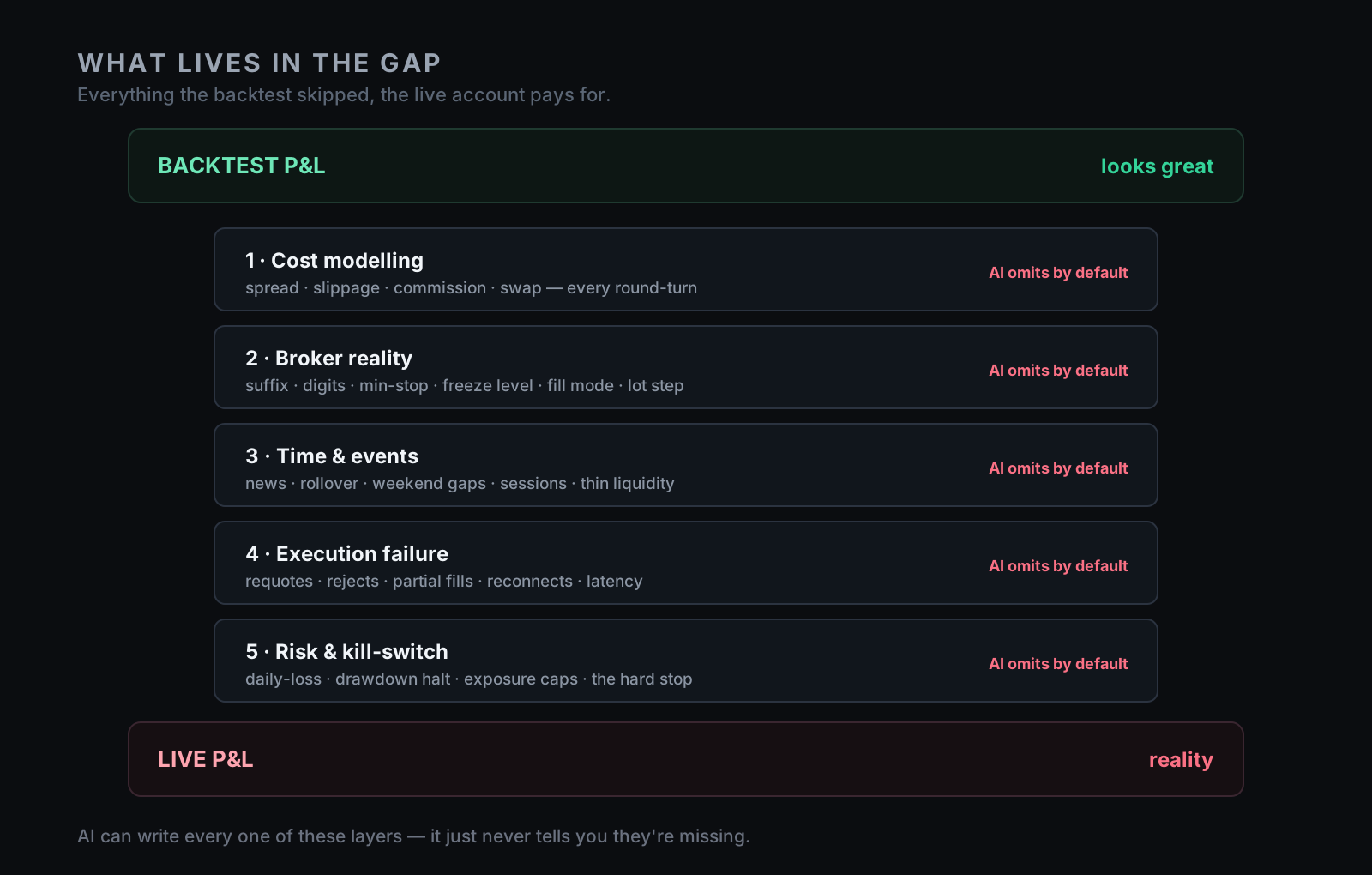
A live account and a backtest are separated by a stack of unglamorous engineering details. AI omits almost all of them by default — not because it can't write them, but because the default prompt doesn't contain the knowledge required to demand them. Each omission is invisible in the tester and brutal in live trading.
1 · Cost modelling. Spread, slippage, commission, swap, round-turn cost. A default AI bot behaves as if the market were frictionless. That market does not exist. (The whole Spread Is a Tax You Can't See problem, multiplied by every trade.)
2 · Broker reality. Symbol suffixes (XAUUSD.m vs XAUUSD), digits and point values, minimum stop distances, freeze levels, fill modes, lot step, order-rejection behaviour. Code that "works" in the tester can mis-order on the broker you actually use.
3 · Time and event handling. News, rollover, weekend gaps, session opens, thin liquidity, high-spread windows. A scalper that ignores the clock isn't a scalper — it's a slot machine with indicators.
4 · Execution failure. Requotes, rejected orders, partial fills, reconnects, latency, "trade context busy," server errors. The tester assumes the order happens; live trading asks whether the order actually happened.
5 · Risk and kill-switches. Max daily loss, max drawdown halt, exposure caps, position-count caps, spread halt, news halt — a hard stop that turns the system off before it turns the account off.
Here's the cruel recursion: you have to already understand all five to know you need to ask for them — and if you understood all five, you wouldn't have asked AI to "build me a profitable bot" in the first place. The traders most reliant on AI to fill the gap are exactly the ones who don't know what the gap contains. The AI can write every one of these layers beautifully. It simply doesn't know they're missing unless the operator does.
IV — You can now overfit at the speed of conversation
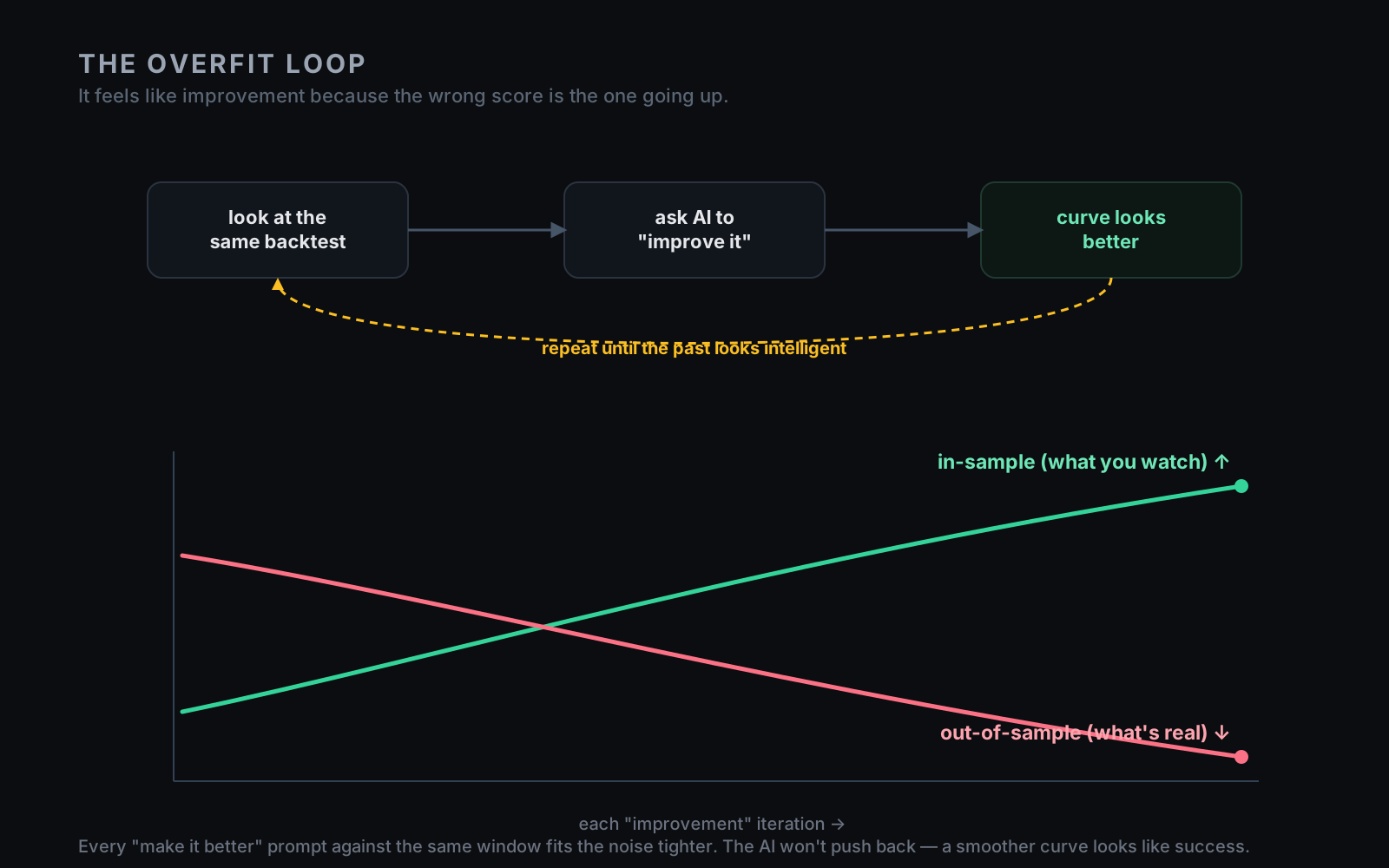
Overfitting — tuning a system until it fits the noise of your sample instead of any real signal — has always been the number-one killer of backtested strategies. AI didn't fix it. AI industrialised it. Reviews of AI-built strategies keep landing on the same finding: curve-fitting is the single most common way they die.
It used to take effort to overfit: add a parameter, run the test, wait, tweak, run again. That friction wasn't good research, but it was a speed limit. The speed limit is gone. "Add a trend filter." "Optimise the RSI period." "Make the 2023 drawdown smaller." "Add a confirmation." "Smooth the equity curve." Each prompt feels like progress — and if every "improvement" is guided by the same backtest window, you're not building robustness, you're teaching the bot to memorise the past. Every "make it better" prompt that points at the same backtest is an instruction to overfit: the curve gets prettier as the system gets weaker.
The AI will never push back, because a smoother historical curve looks like success, and looking like success is what it was trained to deliver. So you discipline the loop yourself, or it doesn't get disciplined: idea generation is one step, out-of-sample testing is another, walk-forward is another, cost stress is another, forward testing is another. AI can help with every one of them. It cannot supply the discipline between them — and that discipline is the only thing standing between "the curve looks intelligent" and "the intelligence was in the sample, not the strategy."
V — The competence illusion
There's a subtler damage AI does, and it's the most expensive of all. When you read clean, well-commented code you didn't write, you feel like you understand it — the structure is organised, the comments are friendly, the flow makes sense. That feeling is not understanding. Reading fluent code you didn't write feels like competence. It is the most expensive illusion in retail trading.
Understanding a system means you can answer what happens when the comments stop. What happens during a gap? If the order is rejected? If spread widens after the signal but before entry? If a stop is invalid because the broker's minimum distance changed? If the system opens a hedge and one leg fails? At rollover? If the terminal reconnects with stale state? If the first loss cluster arrives before the first profit cushion? A non-coder holding AI-generated code they can't truly audit isn't automatically safer than one with no code — often they're worse off, because now they have false confidence and a funded account. The black-box problem from Why We Sell Source, Not Signals doesn't disappear when you prompted the box into existence. Ownership of the prompt is not comprehension of the system, and the market charges full price for the difference.
VI — What AI is genuinely great at
Now the honest other side, because we mean it. AI is not useless for trading systems — it's powerful, just not as the captain. AI is a magnificent co-pilot and a dangerous autopilot. Point it at the work around the edge and it's pure leverage:
- Scaffolding — order-send wrappers, logging, input declarations, dashboard layout, the EA skeleton. Hours to minutes, on the part where mistakes are cheap.
- Refactoring — splitting modules, renaming, removing duplication, making logic easier to inspect. Less engineering drag.
- Porting — MQL5 → Pine, Pine → Python, analysis → dashboard logic, when the underlying idea is already known and tested.
- Explaining code — "what does this module do, what does it assume, what can break it?" accelerates your understanding instead of replacing it.
- Test tooling — out-of-sample splitters, Monte Carlo wrappers, cost-sensitivity sweeps, parameter-neighbourhood tests, report generators. One of the best uses of AI: not to skip validation, but to make it cheaper.
- Documentation — dev logs, parameter notes, change logs, research summaries. AI is excellent at making the work inspectable.
Notice the pattern. Every job on that list assumes the edge already exists and the human already understands it. Used that way, AI is one of the best things to happen to a systematic trader in a decade. Used to originate an edge from a prompt, it's an account-shredder with great manners. AI is a force-multiplier on a foundation — not a substitute for one.
VII — The only thing that closes the gap
So if AI can't author an edge but is brilliant at extending one, the move is the opposite of what the hype tells you: stop asking AI to invent a strategy, and start pointing it at a foundation that already has logic you can read.
That single change rewrites the job. The AI stops pretending to be the trader and becomes what it's actually good at — an analyst, assistant, tester, documenter, and refactorer working around a system that already exists. Now the prompts are useful: explain this risk module; find where spread is checked; summarise the exit logic; generate a cost-stress report; write a Pine dashboard for this rule; build a checklist for out-of-sample validation; compare this parameter family without touching the core thesis. The edge comes from the foundation, the speed comes from the AI, and the judgement stays with the human who can read the thing. Readable source first, AI extension second — never the other way around. That's not a compromise between "AI does everything" and "do it all by hand." It's the only configuration where AI helps you make money instead of helping you lose it faster.
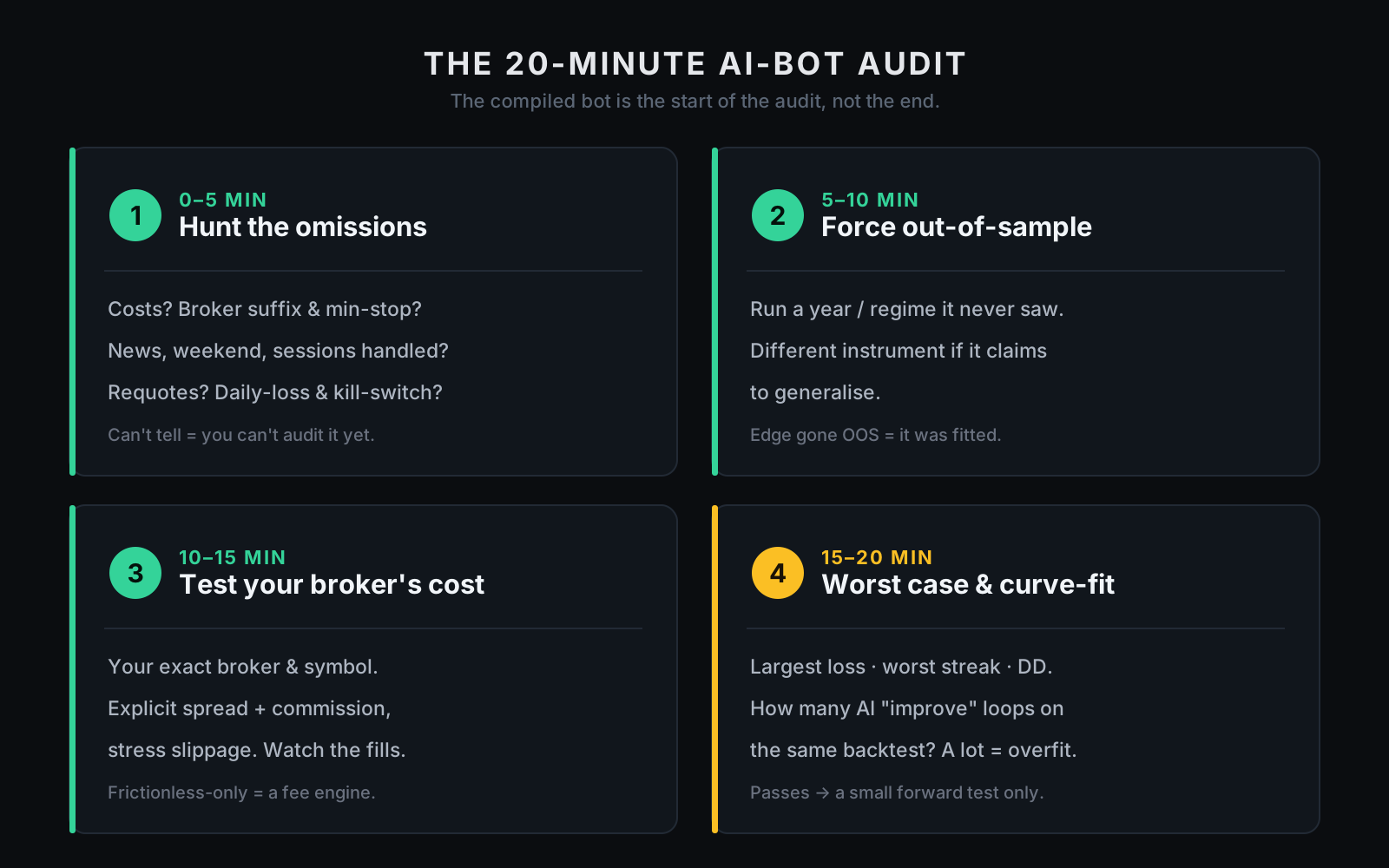
VIII — The 20-minute AI-bot audit
Before any AI-built EA — yours or one you bought — touches a funded or live account, run this. Twenty minutes, and it stops most disasters cold.
Minutes 0–5 · Hunt the omissions. Open the code and search for the five layers from Section III: does it model spread, slippage, and commission? Handle the broker suffix, digits, minimum stops, and lot step? Avoid news, rollover, weekend gaps, bad sessions? Handle rejected orders, requotes, reconnects, partial fills? Have daily-loss, drawdown, exposure, and spread halts? Every "no" is a live-trading landmine the backtest hid. If you can't tell whether a layer exists, that is the answer: you can't audit this bot yet.
Minutes 5–10 · Force out-of-sample. Run the strategy on data it never saw — a different year, a different regime, a different instrument if the logic claims to generalise. If the edge evaporates, it was never an edge; it was your prompt history, fossilised into parameters.
Minutes 10–15 · Test your broker's cost. Run the bot on the exact broker and symbol you'd actually trade, with explicit spread and commission assumptions and some stress slippage. Watch the fills, not just the P&L. A strategy that only works in the frictionless tester is a fee engine — usually not for you.
Minutes 15–20 · Find the worst case and the curve-fit. Sort the trades: largest loss, worst losing streak, deepest drawdown, worst day, worst session. Then ask the honest question — how many times did I ask AI to improve this against the same backtest? If the answer is "a lot," assume the curve is overfit until proven otherwise. A bot that passes this audit hasn't earned your trust — it's earned a small forward test. A bot that can't even be read hasn't earned your money — it's earned your suspicion.
Where we actually use AI
Now the ProEA ledger, plainly. AI didn't kill the edge business — it killed the code business, and that's a distinction we built around rather than against. Here's exactly where the line sits for us:
Good — point AI here; it's pure leverage. Scaffolding, refactoring, porting, documentation, and test tooling. Explaining modules. Generating the harness that tries to break a system we already trust. Exploring variations of logic whose edge is already established. This is where AI compounds the work.
Dangerous — useful only with discipline. Generating strategy hypotheses (fine as ideas to test, deadly as conclusions to trust), and any "improve the bot" loop run against a single backtest. These help a disciplined operator and quietly destroy an undisciplined one. The tool is the same; the out-of-sample discipline is what changes the outcome.
Never — we don't let AI do this. Originate or certify the edge from a prompt. Replace validation. Wave away broker costs. Ignore drawdown. Call a compiled bot a finished system, or a green backtest a proof.
MTR exists because of that line. It ships as full MT5 source you can read, a published 28-month backtest grid you can recompute, and testing with explicit cost assumptions. You can point your own AI at our source — ask it to explain a module, find the spread logic, summarise the risk layer, propose a test, help you break the system before the market does. That isn't a threat to us; it's the entire idea. We don't sell you a prompt that prints money. We sell you a foundation you can read — with or without AI. And it's why our Pine line is built deliberately for AI: the logic lives in readable source, so a model can extend it without having to hallucinate an edge from a one-line prompt. AI writes excellent code on top of a real foundation. It can't hand you the foundation. That part is still the work.
Disclosure: we sell capability, not a prompt that prints money
We sell source, evidence, and tools you can inspect — not outcomes, and certainly not a magic prompt. No AI, EA, or backtest can promise future results. Past performance is not future performance; every backtest is broker-specific and sample-specific; every live account pays real costs and carries real operational risk. AI-built or human-built, the same audit applies — including to ours, which is why we hand you the source to run it.
If someone is selling you "AI that builds profitable trading bots," ask the question the demo never answers — not "can it write the code?" (it can), but "where does the edge come from, and can I read it?" If the answer is the prompt, the answer is no.
Your first 20 minutes
Don't take our word for any of this. Take the source.
Minutes 0–5 · Read what AI usually omits. Open MTR's source and go straight to the unglamorous parts — the cost handling, the broker and symbol logic, the news and session filters, the risk and kill-switch layer, the places the system refuses to trade. Notice how much of a real system is the boring part. That's the part the account cares about.
Minutes 5–10 · Point your AI at it. Paste a module into your favourite model and ask it to explain the logic, list the assumptions, and find what can break. You'll learn the system faster — and feel the difference between code you can interrogate and code you merely hope works.
Minutes 10–15 · Recompute, don't believe. Take the published backtest grid and check it against your own broker's costs. Re-run a window out-of-sample if you like. Stress one assumption. Evidence you reproduce beats evidence you're shown.
Minutes 15–20 · Decide on what you measured. A readable foundation, costs that survive your broker, a drawdown you could actually sit through, logic you can inspect → then a small forward test. Not because an AI sounded confident. Because you read the thing and it held.
One last thing
If this stopped you from funding one more bot that "compiled and backtested great," it did its job. Send it to the person about to type "build me a profitable EA" into a chat box this weekend.
AI gave every trader a brilliant engineer who will build almost anything you ask, instantly, without ever asking whether it should exist. The engineer was never the missing piece. The edge was — and that part the machine still can't hand you.