Two traders, same week, same AI model.
The first opened a chat and typed "build me a profitable EA that scalps gold." Thirty seconds later: clean code, inputs, comments, a green backtest, a funded account — and, a week on, a blown one.
The second used the same model differently: not to find the edge, not to certify it, not to decide whether real money should be exposed, but to scaffold code, build test harnesses, refactor modules, document assumptions, stress costs, and speed up every boring part of making a system real.
In a few days they shipped a research pipeline that would have taken a month by hand.
One of them thinks AI is a scam now.
The other thinks it's the best thing to happen to a serious builder in a decade.
Same tool. Opposite outcomes. The difference wasn't the model — it was the job they gave it. The gambler asked AI to be the quant: find the edge, judge the edge, write the bot, bet the account. The operator used AI as a tireless junior engineer — build the plumbing, build the validator, explain the module, write the report — and kept the only job that still matters: deciding what's actually true.
This is the constructive half of AI Won't Give You an Edge. That piece was the warning — what AI can't do. This is the method — what it can do, and how to point it there without fooling yourself. Not "AI is useless," not "AI will trade for you," but something more useful: AI is a force-multiplier on disciplined work, and an equally powerful force-multiplier on self-deception. The line between those two outcomes is workflow, and almost nobody draws it on purpose.
Before we start, two requests:
- Save this before your next "I'll just have AI build it" session.
- Send it to the builder who thinks AI replaced the work — and to the trader who swore off AI after one bad bot. They're both half right.
Not because AI is magic, and not because it's useless — but because AI didn't remove the hard part. It made the labor cheap and the judgment expensive.
Skip this if you already make AI do the labor and keep the judgment
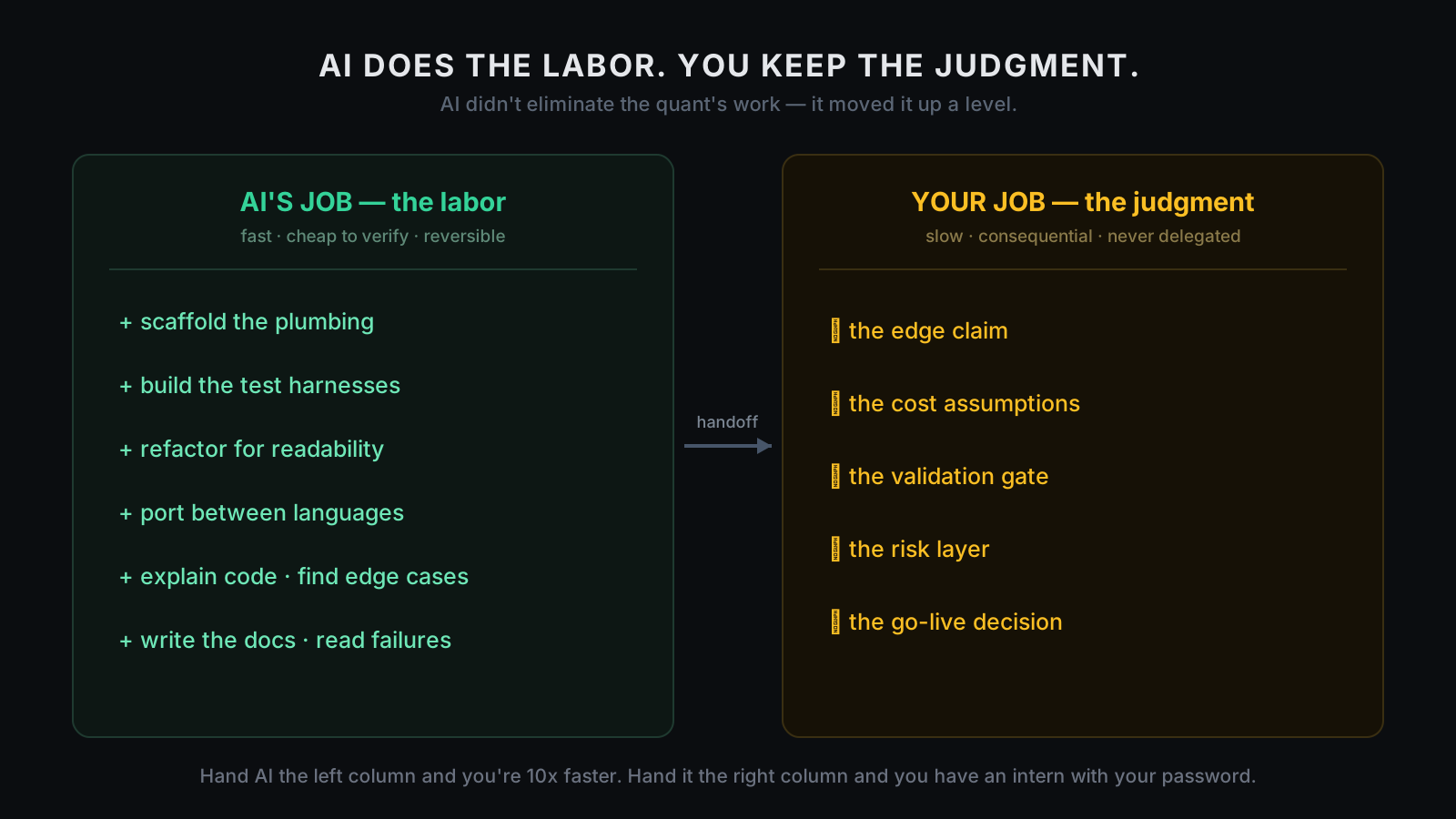
AI is extraordinary at the parts of system-building that aren't the edge — plumbing, scaffolding, refactoring, porting, documentation, explaining code, building validators, stress-testing assumptions — and dangerous the instant you let it own the parts that decide whether money should be at risk: the edge claim, the cost assumptions, the validation verdict, the go-live call. Used as a junior engineer who never sleeps, it's a multiplier. Used as the quant who decides what's true, it's an overconfident optimizer with a beautiful writing style.
| Prompt-and-pray (the gambler) | Operator-assisted (the quant) |
|---|---|
| "AI, build me a profitable strategy." | "AI, build the harness that tries to kill my idea." |
| "The AI found an edge." | "I formed a hypothesis; the data judged it." |
| "AI tested it — looks great." | "AI never touched my out-of-sample verdict." |
| "AI wrote it, so it's fine." | "I read every line AI wrote." |
| "I have an AI bot." | "I have a validated system AI helped me build." |
| "It's AI-powered." | "Here's the logic, the risk layer, and the sample." |
Same model, both columns. The tool is identical. The discipline is the entire difference.
I — AI changed the job, not the work
The fear was that AI would replace the quant. What actually happened is more useful: it promoted them. The work that makes a trading system real — finding a plausible hypothesis, turning it into rules, testing it out-of-sample, modelling cost, controlling risk, reading failures, deciding to go live — didn't vanish. It moved up a level, from doing every mechanical task by hand to supervising a machine that can do the mechanical tasks faster. The quant who used to spend three weeks hand-coding a backtest engine now spends three hours directing an AI to build it, and the rest of the week on the only thing that was ever scarce: judgment.
AI didn't kill the quant. It promoted them from typist to supervisor — and the supervisor's job is exactly the part AI can't do. But a promotion only helps if you actually do the supervisor's job. Hand AI the whole process and you didn't become 10x — you left the loop where the value lived and called it automation. Stay in the loop, point AI at the labor, and you get the leverage without surrendering the thing that made you useful. That's the split: the operator stays in the loop; the gambler leaves it and calls it a robot.
II — Where AI is a genuine 10x
Let's be concrete about the speed, because it's the part every serious builder actually feels. AI is a real multiplier when the task is cheap to verify, easy to inspect, downstream of a human hypothesis, and not responsible for the final verdict — which covers most of the work:
- Plumbing — data loaders, indicator functions, the EA skeleton, order-send wrappers, logging, dashboards. Hours to minutes, on code where a bug is obvious and reversible.
- Refactoring — splitting a 2,000-line monolith into readable modules, extracting the risk layer, removing duplication. Readable code is auditable code.
- Porting — translating a tested idea between MQL5, Pine, and Python to validate it in a second environment.
- Comprehension — "explain this module, list its assumptions, tell me what breaks it." Accelerating your understanding, not replacing it.
- Test tooling — out-of-sample splitters, walk-forward harnesses, Monte Carlo wrappers, cost-sensitivity sweeps, regime-split tests. Possibly the highest-value use of AI in trading — not to skip validation, but to make it cheap.
- Documentation — dev logs, parameter guides, changelogs, failure summaries that make the work inspectable for the next person (often future-you).
Notice the pattern: every item is labor in service of an edge that already exists or a hypothesis you're about to test. AI is a 10x force-multiplier on everything around the edge — which is most of the work, and none of the authority. A month of plumbing becomes a week; a week becomes an afternoon. That speed is real and large, and it's exactly why operators who use AI well are pulling away both from the ones who refuse to touch it and from the ones who hand it the wheel.
III — Point AI at building your executioner
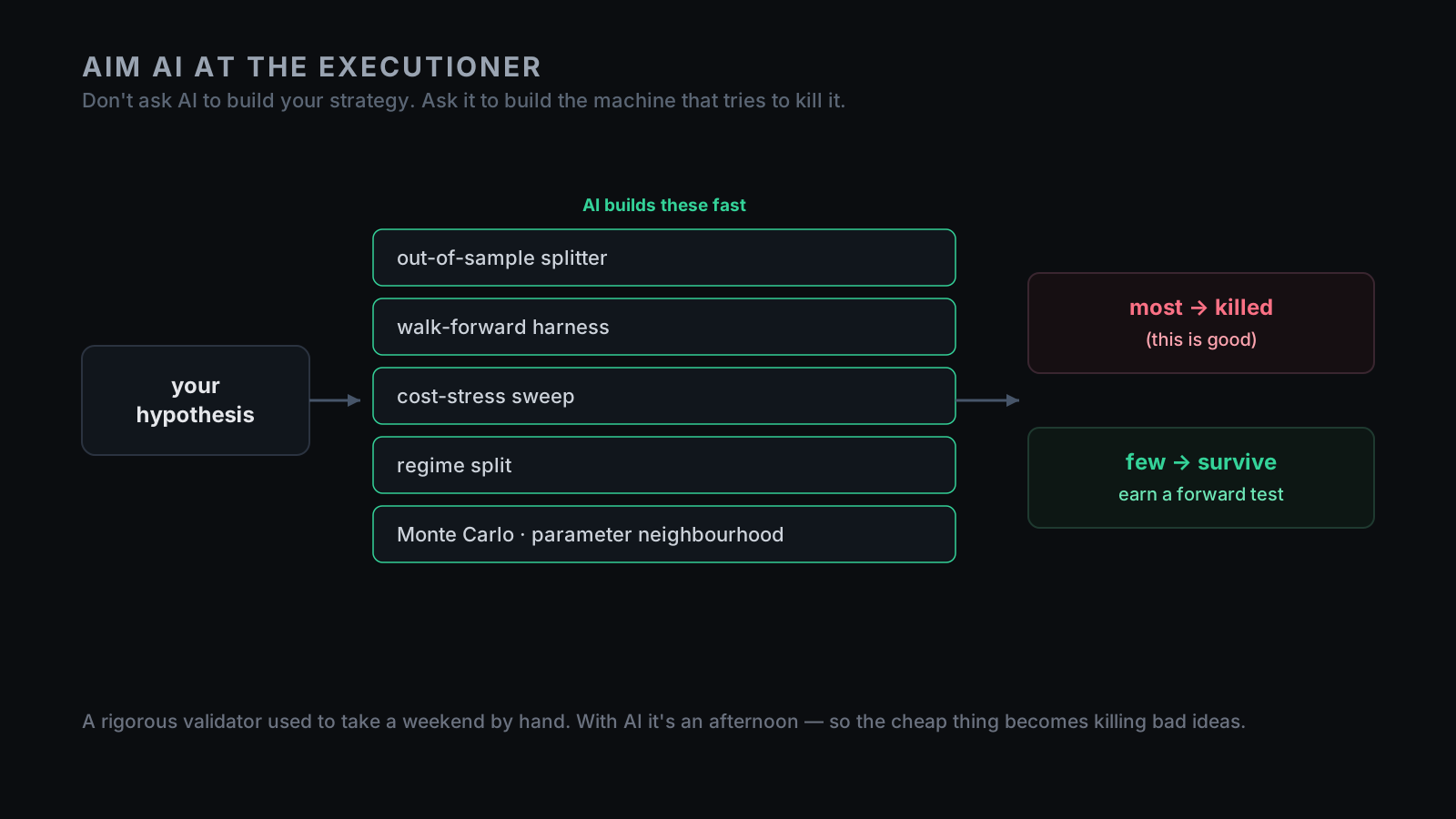
Here's the single best workflow change, and almost nobody makes it: don't point AI first at building your strategy — point it at building the thing that tries to kill your strategy. The validator. The out-of-sample splitter, the walk-forward harness, the cost-stress report, the regime split, the Monte Carlo wrapper, the parameter-neighbourhood test, the failure dashboard that lays the corpse on the table. Aim AI at building your executioner, not your fantasy — the apparatus that tries to falsify the edge, not the edge itself.
This inverts the gambler's instinct in the most productive way. The gambler asks AI to generate something that looks profitable; the operator asks AI to build the machine that destroys things that aren't. And it's a perfect job for AI, because a rigorous walk-forward-plus-cost-stress harness is tedious and finicky to hand-code — which is exactly why most retail traders skip it and just eyeball one backtest. AI removes the excuse: a validator that used to be a weekend of fiddly work becomes a one-afternoon prompt. The cheaper it is to try to falsify an idea, the more ideas you can put through the grinder, and the more seriously you can treat the few that survive. AI doesn't find your edge. It can build the machine that proves whether you have one.
IV — AI overfits at conversation speed
Now the danger, stated precisely, because it's the trap the whole AI feed is walking into. A large language model is overconfident, it overfits to recent and local patterns, and — the subtle one — it amplifies your own bias, because it's trained to give you a satisfying answer. Point that at "improve my backtest" and you've built an optimizer made of conversation: every "add a filter," "tune the period," "smooth the 2024 drawdown" tightens the system to the exact past you can see, and the model cheerfully helps, because a smoother curve looks like the improvement your prompt asked for. "AI, make the backtest better" is curve-fitting with a co-pilot who rarely says no. Reviews of AI-built strategies keep finding it's the single most common way they die.
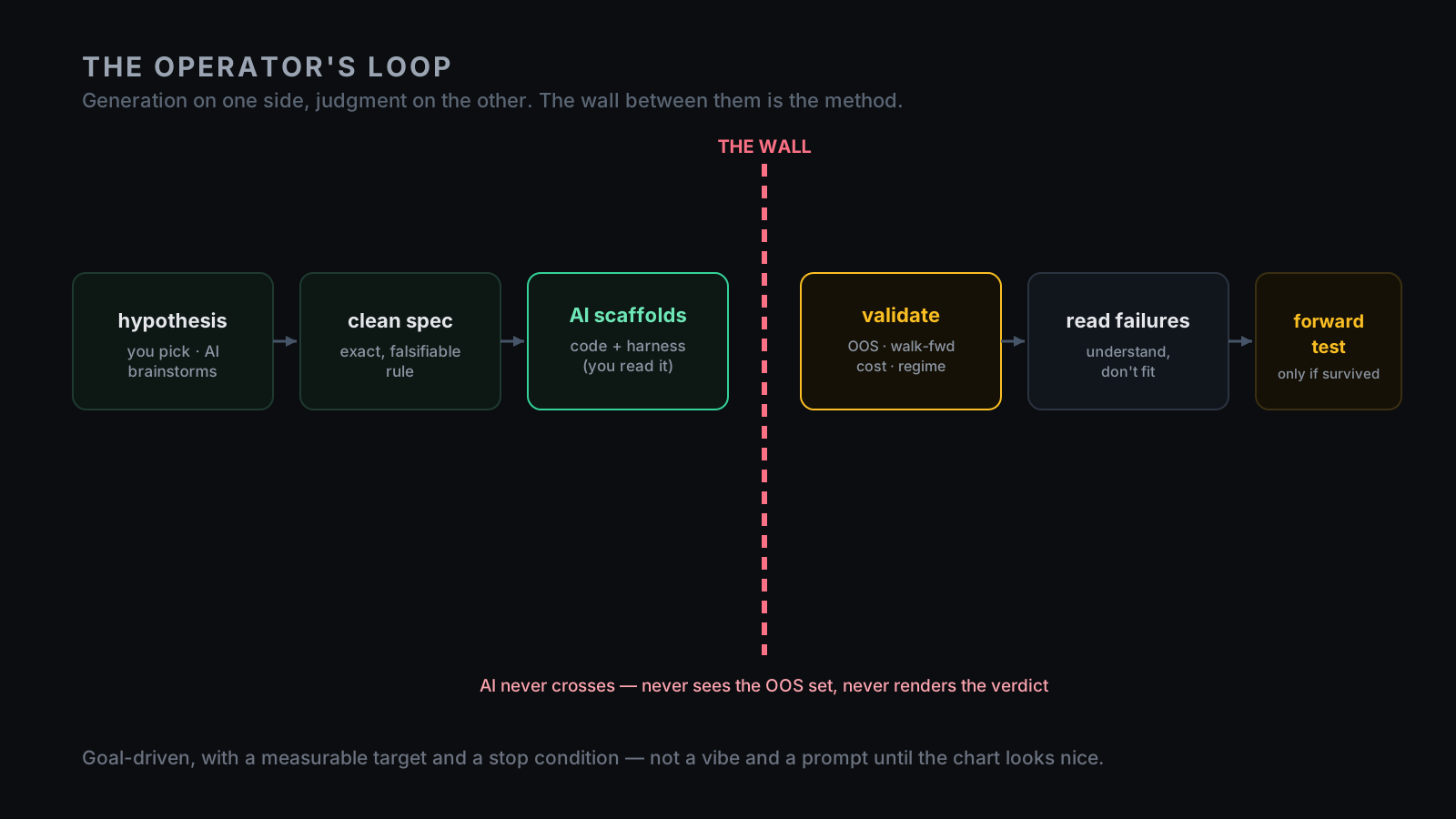
And it compounds the oldest sin in quant. Test enough random signals and one looks brilliant by pure luck — and AI lets you test enough at the speed of typing. Generate a hundred AI signals, keep the gorgeous curve, refine until the ugly months vanish, and you haven't found an edge; you've found the luckiest coin flip in a hundred, dressed in clean code and a confident explanation. There's exactly one rule that keeps this from eating you alive: AI may generate hypotheses, write the code, build the harness, and help read failures — but the model that generated or tuned the strategy must not see the out-of-sample data used for the verdict, and it must never render that verdict. Generation and validation are separated by a wall; the AI lives on the generation side. The moment it grades its own homework on data it helped fit, your evidence is fiction.
V — The four things AI must never own
Supervising AI means knowing which decisions you never delegate. Four keys stay in your hand:
- The edge claim. AI can suggest a hypothesis, implement a rule, and explain why it sounds plausible — but the claim "this has edge" is a conclusion you draw from validation, not a sentence the model gets to assert. When a model says "this is profitable," it's predicting plausible text, not certifying expectancy.
- The cost assumptions. Spread, slippage, commission, swap, execution delay, broker quirks — AI omits or simplifies these by default, because frictionless markets are easier to write. You set the cost model, preferably pessimistically, before you believe a number (the whole Spread Is a Tax You Can't See problem).
- The validation gate. Out-of-sample, walk-forward, regime splits, cost stress — AI can build the gate; it must not own the verdict, because the thing being judged can't also be the thing that judged it on data it saw.
- The go-live decision and the risk layer. Whether real money is exposed, at what size, with what hard stop and kill-switch — operator decisions with consequences the model doesn't bear. A careful assistant even helps here, tending to leave risk parameters as explicit TODOs rather than guessing defaults that could blow up an account.
VI — The operator's loop
Put it together and the workflow is simple, repeatable, and the opposite of "prompt and pray." It runs in one direction, with the wall from Section IV in the middle. Hypothesis: you choose a specific, falsifiable idea with an economic reason to exist; AI can brainstorm a firehose of candidates, but you pick and state it precisely enough to be wrong. Clean spec: you (with AI's help) turn it into an exact rule — entry, exit, stop, sizing, regime filter, instrument, cost model, invalidation, review point — precise enough that a stranger could implement it identically. AI scaffolds: AI builds the implementation and the harness from the spec, fast; you read what it wrote. Validate behind the wall: you run it on data the AI never used to tune it — out-of-sample, walk-forward, cost-stress, regime splits — and the data renders the verdict; most ideas die here, which is the process working. Read the failures: AI is excellent at the post-mortem ("where did this lose, what regime hurt it, what assumption broke"), which you use to understand and write a better hypothesis — not to "fix" the curve until it passes. Forward test: only if it survived — small, on your broker, at a size you can survive, with abort rules written before the test begins.
Generation on one side, judgment on the other — the wall between them is the whole method. Goal-driven, with a measurable target and a stop condition; not a vibe and a prompt until the chart looks nice.
VII — Real vs fake: who can show their work
Now the part that matters most in 2026, because the feed has made it urgent. Everything is "AI-powered" now — every indicator, bot, signal group, and course has bolted the letters onto the label, and a huge share of it is rule-based marketing in a machine-learning costume (the forums are full of traders discovering their "AI" indicator is an if-statement in a trench coat). So "we use AI" has stopped meaning anything, because everyone says it, including the things that don't. "AI-powered" is a sticker — it tells you nothing, because real and fake both wear it. Regulators say as much: the CFTC had to warn the public that AI won't turn trading bots into money machines.
So you stop sorting by who uses AI (that test is dead) and start sorting by who can show their work. A real system can show its logic, its risk controls, its cost assumptions, a verifiable sample, and its failure periods; where a genuine edge exists, it arrives with evidence you can reproduce. A fake can't show those things — not always because the seller is hiding a secret, but often because there's nothing under the label except a prompt, a curve, and a story. Real isn't "we use AI." Everyone uses AI. Real is "here's the logic, the risk layer, and the sample" — and fake hides behind the word because there's nothing underneath it. The question was never whether a tool has AI in it. It's whether the person selling it can open the box. The ones who can, do. The ones who can't, say "AI" louder.
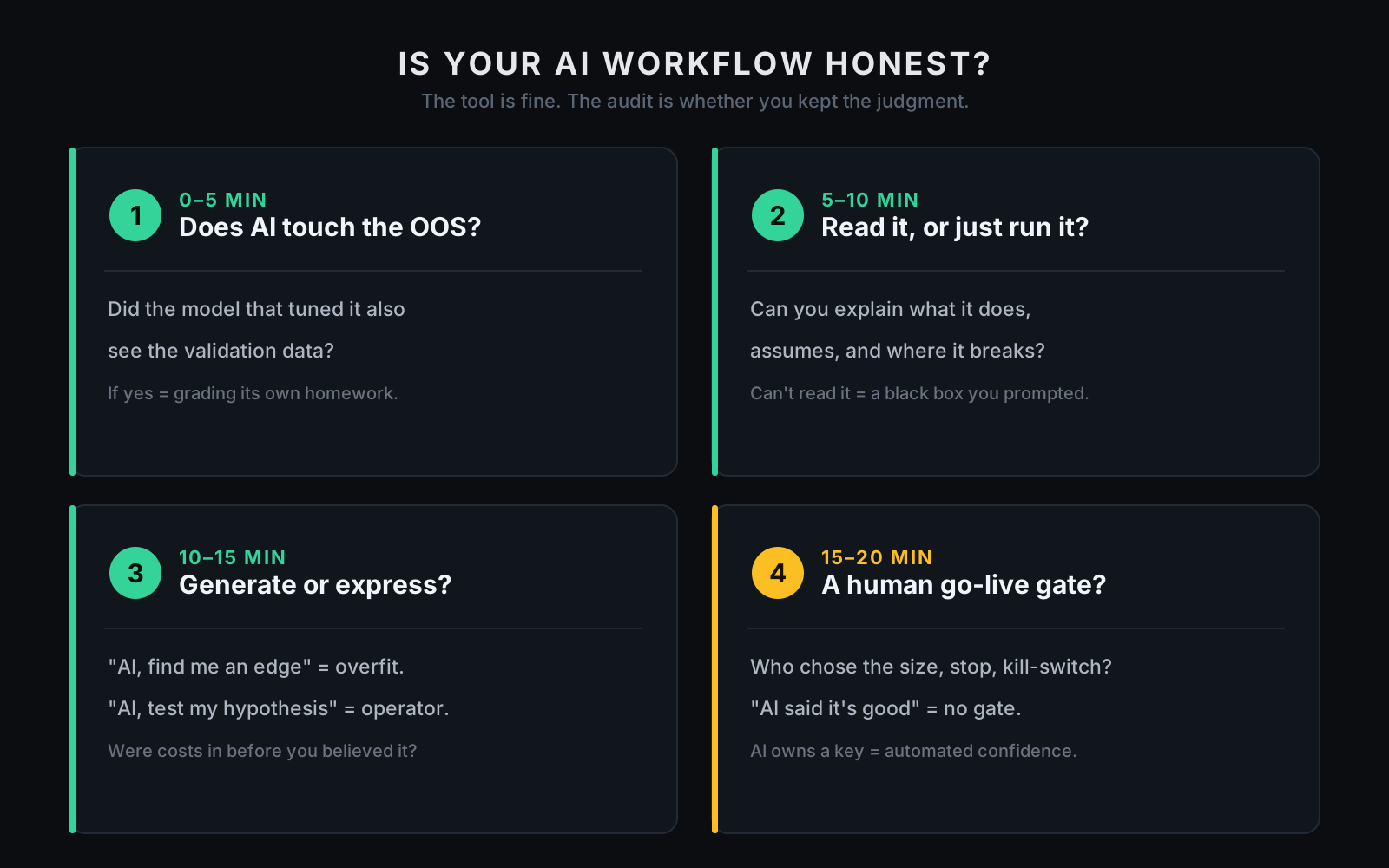
VIII — The 20-minute AI-workflow audit
Run this on your own process — or on any "AI" system before you trust a dollar to it.
Minutes 0–5 · Does AI touch the out-of-sample verdict? Trace your workflow. If the model that generated or tuned the strategy also saw the data you "validated" on, you have no validation — you have AI grading its own homework. The wall must be real.
Minutes 5–10 · Do you read the code, or just run it? Open the last thing AI built. Can you explain what it does, what it assumes, what breaks it, where the risk is, where costs are handled? Running code you can't read isn't a system — it's a black box you prompted into existence (the AI Won't Give You an Edge trap).
Minutes 10–15 · Did AI generate the edge, or express your hypothesis? Be honest about where the idea came from. "I asked AI for a profitable strategy" is generation-as-edge — assume it's overfit. "I had a hypothesis and AI helped me implement and test it" is the operator loop. And were costs in before you believed the backtest, or did the frictionless number fool you first?
Minutes 15–20 · Is there a human gate before live? Who decided to risk real money, at what size, with what hard stop and kill-switch? If the answer is "AI said it was good," there is no gate. If AI owns any of the four keys — the edge, the costs, the validation, the go-live — your "AI system" is automated confidence, not a system.
Where this meets ProEA
Now the honest part — and it's the whole reason to publish a method instead of a slogan. You can't prove you're "the real thing, not a sticker" by saying it; the fakes say it louder. You prove it by showing the work. So here's how we actually use AI, on purpose, in the open: heavily, and exactly where this article says to. It scaffolds our plumbing, builds the test harnesses that try to break our own ideas, refactors for inspectability, writes the dev logs, and explores variations of logic we already trust. What it does not do is invent the edge from a one-line prompt, certify it, wave away broker costs, or turn a pretty curve into a go-live decision — the edge came from research and brutal, AI-blind validation a human supervised, and it ships as full MT5 source plus a published 28-month sample you can recompute.
You don't have to take our word that we're rigorous — the method is published and the source is inspectable, and a fake can't hand you the logic, the risk layer, and the sample. That's the whole difference between AI as a tool and "AI" as a sticker. And the caveat, stated plainly because honesty is the brand: AI-assisted is not a promise. Building faster doesn't make an edge real, a published sample doesn't guarantee the future, and our system can lose money like any other — the edge can decay, your broker can differ from our test. Inspectability is proof of method, not proof of profit. But in a feed full of stickers, proof of method is the first thing worth trusting.
Disclosure: the one question for any "AI" seller
We sell source and evidence you can inspect — not outcomes, not an "AI edge," not a guarantee. No model, system, or backtest can promise future results; AI-built or hand-built, trading carries real risk of loss, and past performance is not future performance.
So the next time something is sold to you as "AI-powered," ignore the label entirely and ask the only question that separates real from fake: "Can you show me the logic, the costs, the risk layer, and a sample I can verify — or is 'AI' the whole answer?" If "AI" is the answer, AI is the marketing. If they can open the box, the AI was just a tool — the way it's supposed to be.
Your first 20 minutes
Don't take our word for it. Run the operator loop on our system, with your own AI, and feel the difference.
Minutes 0–5 · Point your AI at the source — to explain, not to judge. Paste a module from MTR's source into your model and ask it to explain the logic, list the assumptions, and tell you what breaks it. This is AI as a comprehension accelerator — the good use — on a real, readable system.
Minutes 5–10 · Have AI build a validator against our grid. Ask it to scaffold a cost-stress or regime-split check against the published 28-month evidence — not to declare victory, but to help you test. This is Section III firsthand: AI building the executioner, fast.
Minutes 10–15 · Keep the wall. Run that validator yourself, on your broker's costs, with the AI nowhere near the verdict. The data decides. Notice how different that feels from "AI said it's good."
Minutes 15–20 · Decide like an operator. A readable system, costs that survive your broker, a risk layer you can see, a sample you reproduced → a small forward test. Not because an AI sounded confident. Because you supervised the machine instead of obeying it.
One last thing
If this turned your AI from a slot machine into a power tool, it did its job. Send it to the trader about to let a chatbot pick their risk size this weekend.
AI didn't make trading easy. It made the labor cheap and the judgment priceless — and quietly sorted everyone into two camps. Anyone can prompt a bot now. Almost no one can show you the method behind it — and that gap is the whole difference between real and fake.