A signal is the easiest thing in trading to buy.
Which is exactly why it's so tempting: a green arrow, a Telegram ping, a number to copy — a trade idea with the hard part removed.
Except the hard part was the part that mattered. What you bought isn't an edge — it's access to someone else's decision: one you can't fully inspect, can't reproduce, can't adapt, and can't keep once the service stops. That can be fine for some traders; there's nothing automatically wrong with signals or managed tools. The problem is quieter — most people don't realise what they're giving up. They think they bought a system. Often they bought dependency.
We sell the opposite: full source code — the actual logic, yours to read, test, change, break, repair, and keep. It's harder to sell and harder to buy, because ownership asks more of you. You can't just wait for a ping; you have to open the machine. That's the point.
And it's the idea this whole blog has been building toward. A backtest can't be trusted unless you can inspect its assumptions. Costs can't be measured unless you can see how the system trades. A prop rulebook can't be fitted unless you can change the sizing and risk. Every serious audit starts at the same place: you have to be able to open the box.
Before we start, two requests:
- Save this before your next signal subscription or black-box EA.
- Send it to the trader who keeps switching signal groups and never gets closer to understanding the machine.
Not because every signal seller is a crook — most aren't. Because renting an edge and owning one are different decisions, and almost nobody makes that choice on purpose. (We've since written that choice out for two specific cases: trading journals, and a rented toolkit we compete with directly.)
Skip this if you already buy source over signals
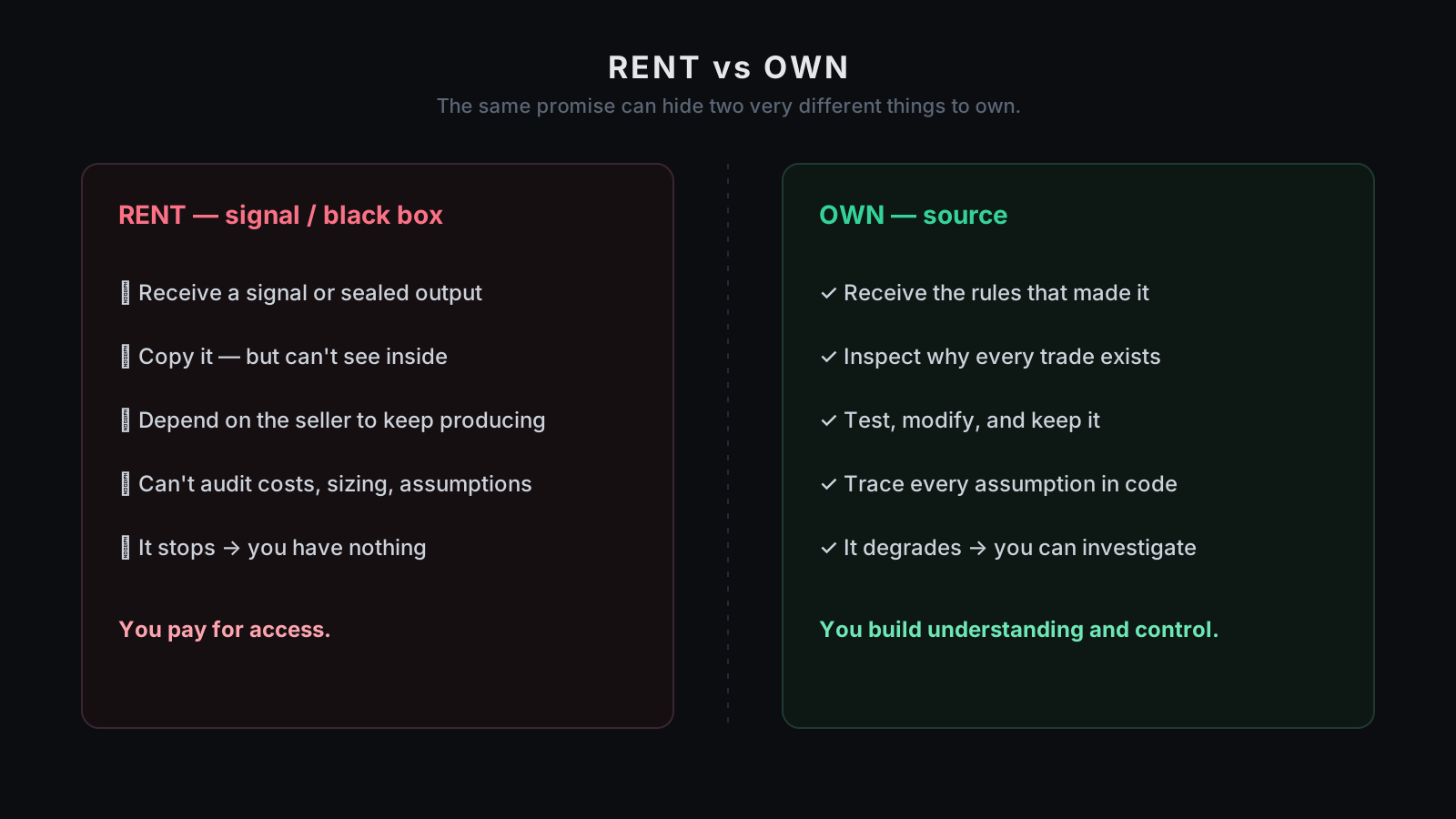
There are two ways to acquire a trading edge. They can look identical on a sales page and behave like opposites after you pay.
| Renting a decision | Owning the logic |
|---|---|
| You receive a signal, arrow, or black-box output | You receive the rules that created it |
| You can copy the trade | You can inspect why the trade exists |
| You depend on the seller to keep producing | You can test, modify, and keep the system |
| You can't fully audit costs, sizing, assumptions | You can trace every assumption in the code |
| If it stops working, you may not know why | If it degrades, you can investigate |
| You pay for access | You build understanding and control |
Neither is automatically wrong. Convenience is a real reason to choose signals; control is a real reason to choose source. The mistake isn't picking one — it's buying convenience while believing you bought control. That's where most disappointment begins.
I — Rent or own
Every trading product sits somewhere on a single axis: how much of the system do you actually own?
At one end is the pure signal — a call to copy. Buy here, sell there, stop here. You receive the output, never the process. A step closer is the black-box EA: a file that runs, but with its logic encrypted or obfuscated, so you can execute it and never read it. At the far end is source — the real rules: the risk logic, the sizing, the entry conditions, the exit behaviour, the spread handling, and the places the system says no.
Marketing calls all three "systems." But ownership decides what happens after the sale: can you verify it, adapt it, keep it, fix it when the market changes, and learn from it even when the edge decays? With rented decisions the answer is usually no; with source it can be yes. So the real question was never only "is this a good edge?" It's "whose edge is it after I pay?"
II — A signal is a decision without the reason
A signal is a conclusion with the reasoning removed. That feels efficient — why learn the engine if someone hands you the answer? — until the answer stops, because markets change.
When it works, you feel sharp. When it breaks, you have almost nothing to examine. Was the edge ever real? Did the regime shift? Did spread quietly kill it? Did the seller change the logic? Was it even profitable after costs, on your broker (see Spread is a tax you can't see)? You may never know, because the trade arrived and the explanation didn't — and without the explanation, you can't tell a normal losing streak from a broken system. You copied a decision; you never acquired the reason. That's why signal dependency gets expensive even when the monthly fee looks small: the real cost isn't the subscription, it's the understanding you never built.
III — You can't audit a black box
This is the thread that ties the whole series together. Backtest Isn't Reality asked you to interrogate the curve. Spread Is a Tax asked you to measure execution cost. Prop-Firm Rules, Decoded asked you to fit the system to the rulebook. All three require the same thing: access.
You can't run a backtest autopsy on assumptions you can't read. You can't audit costs you can't trace to the code that pays them. You can't fit a strategy to a prop challenge if you can't change its sizing and risk. A signal feed lets you do almost none of it; a locked EA, only part. Source isn't a luxury feature — it's the foundation that makes every other kind of due diligence possible.
But be precise about what that means. Source doesn't create edge. It creates inspectability. Bad code can be open; fragile logic can be readable; a weak strategy can ship with beautiful comments. Readable does not mean profitable. What ownership buys you isn't alpha — it's the ability to check, and you cannot distrust productively what you cannot inspect. That sentence is the entire philosophy.
IV — Incentives matter
Follow the incentives; they outlast intentions and they shape the product more than any sales page.
A recurring signal service earns when the customer keeps paying. That doesn't make the seller dishonest — education and research can be genuinely valuable — but it does shape the business toward one goal: retention. Keep the customer interested, hopeful, subscribed. And if the reasoning stays hidden, the customer stays dependent. The buyer should simply understand that structure before they accept it.
A source sale works differently. We don't earn a recurring fee from your dependency. Once you have the files, you have the files — you can inspect them, run them, modify them, keep them, and decide never to buy from us again. That's worse for recurring revenue and better for alignment: the only durable thing left is reputation, and if the product doesn't survive inspection, the next buyer hears about it. A subscription can be paid to preserve hope; an inspectable product has to survive doubt. We'd rather build for doubt.
V — The dependency trap
Renting decisions carries a cost that never appears on the invoice: it keeps you a customer instead of making you an operator.
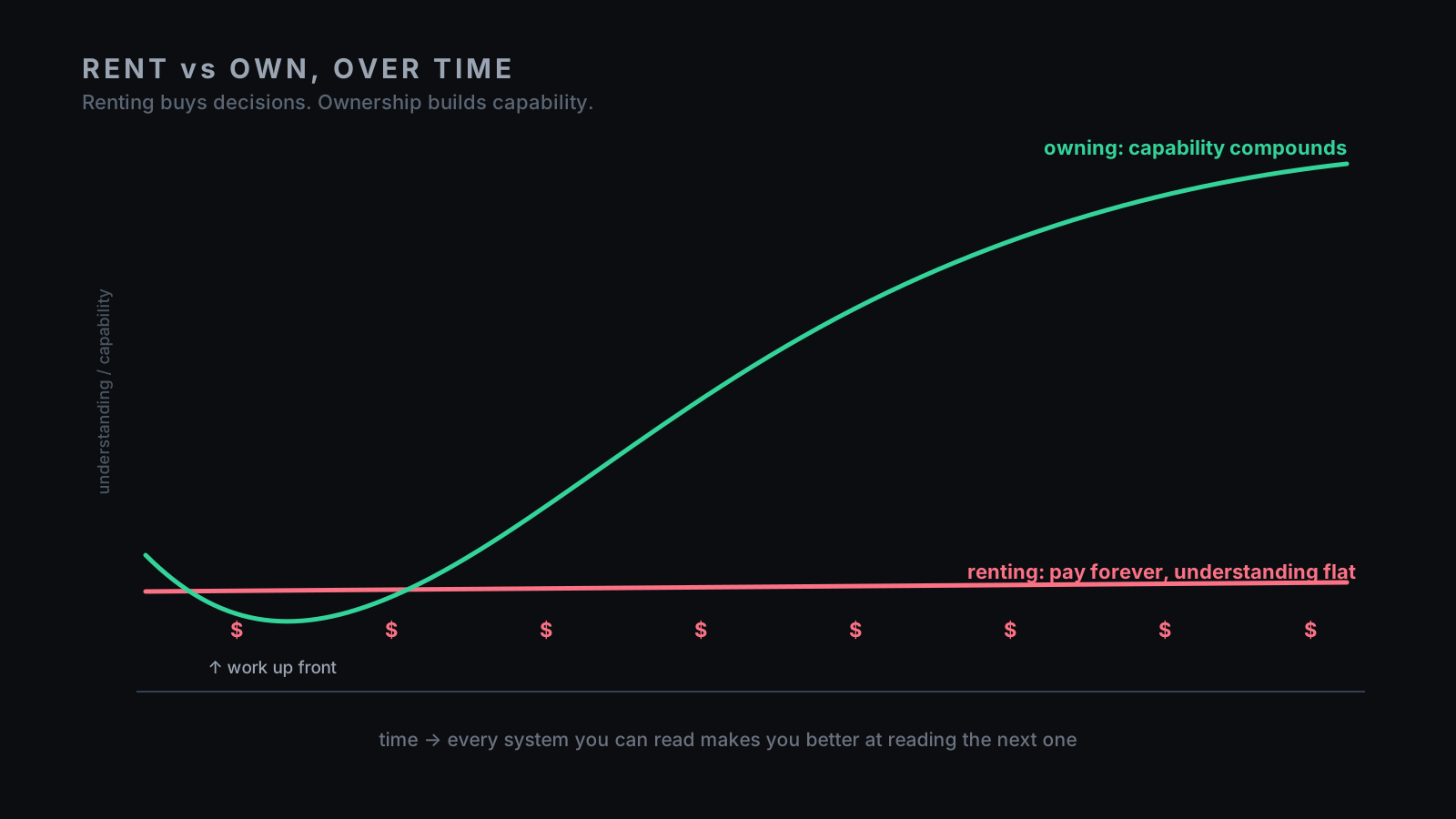
Every month you pay, you copy, you wait. Maybe it works, maybe it doesn't — but if the service disappears, changes, or decays, what's left? Usually nothing: no logic, no process, no transferable method, no machine to study, no system to adapt. You're back to shopping. The subscription may be cheap; the dependency isn't.
Ownership compounds the other way. The first source system you read closely is slow going — structure, risk logic, order handling, cost assumptions, sizing, exits. The second is faster, because the patterns rhyme. You start spotting bad assumptions sooner, you stop being impressed by screenshots, you learn what real risk controls look like — you become harder to fool. Owning a system isn't only about this system; it's about becoming the kind of trader who can inspect the next one. Renting keeps the meter running. Owning builds the operator.
VI — Source is control
Owning the code isn't philosophy for its own sake; it's a set of concrete powers a renter never has.
You can test it on your broker — your symbol, your spread, your commission, your swap, your execution — not a generic one. You can change the risk: smaller size, different caps, session rules, spread thresholds, behaviour around news and rollover. You can fit it to a prop-firm rulebook: the daily-loss and drawdown buffers, the trailing floor, position limits (Prop-Firm Rules, Decoded). And you can hand the source to your own AI — Claude, ChatGPT, Gemini — to explain a module, find the risk logic, list the assumptions, or propose a change, even if you're not a coder.
You still need judgment; AI doesn't make weak trading logic strong. But it has something real to work on. A black box can't be extended and a subscription can't be forked — source you own can be studied, adapted, and improved. That doesn't guarantee profit. It gives you control — and without control, you're mostly hoping the person behind the curtain keeps doing the right thing.
VII — The honest cost of owning
Source is not the easy path, and we should say so plainly. There's no green arrow to copy, no promise you'll never have to think, no one-click replacement for judgment.
Owning a system means doing the work: read it, run it, reproduce the baseline, test it on your broker, change one assumption at a time, forward-test small, keep records, know when to stop. A signal lets you skip most of that — that's its appeal — but skipping the work also skips the learning. If what you want is pure convenience, source will frustrate you — and it's better to say that before you buy. We're not trying to sell source to people who want magic; we're trying to sell it to people who want ownership. A trader who wants to be told what to click shouldn't buy ours. A trader who wants to understand the machine might. That boundary matters more than a conversion.
VIII — The five-question ownership test
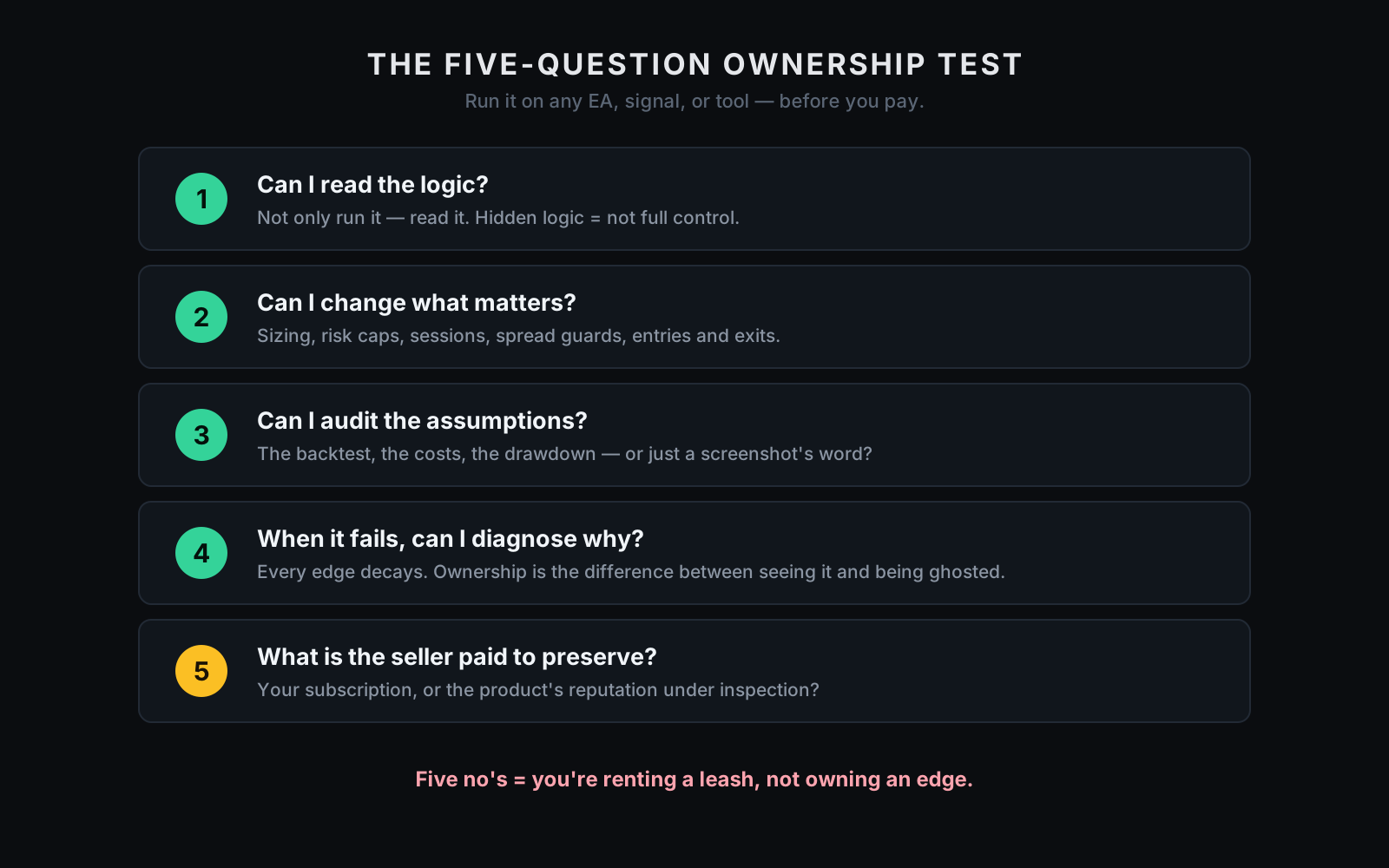
Before buying any EA, signal, or trading tool, ask five questions. They cut through most sales pages in about a minute.
- Can I read the logic? Not just run it — read it. If it's encrypted, obfuscated, or "proprietary," you're not buying full control.
- Can I change what matters? Sizing, risk caps, session filters, spread guards, entries and exits — the things that decide whether it survives your broker and your firm.
- Can I audit the assumptions? The backtest, the costs, the drawdown behaviour — or are you taking a screenshot's word for it?
- When it fails, can I diagnose why? It will go through hostile stretches; the question isn't whether performance gets uncomfortable, it's whether you can investigate the discomfort.
- What is the seller paid to preserve? Your dependency, or the product's reputation under inspection? It isn't an accusation — it's understanding the incentive.
No, no, no, no, and "your subscription" means you're not buying ownership — you're renting access. That may be your choice. Just make it consciously.
Why we chose source
Now MTR, plainly — not as a miracle, as a machine you can open.
Selling source is not the easiest business model. A subscription would monetise better; a signal group would keep people returning; a locked EA would protect the logic. We chose source because it matches the product's whole argument: if the thesis is "don't trust screenshots," then hiding our own logic would be hypocrisy. So the product has to be inspectable.
What you actually get. Full MT5 source — 16,923 lines across 21 files: strategy logic, risk logic, execution behaviour, assumptions you can inspect instead of accept. A published 28-month backtest and KPI grid — not because a backtest proves the future (it doesn't), but because it gives you a baseline to reproduce, stress, and challenge. A Rust tick simulator with explicit cost assumptions — not because any simulator perfectly models your broker (it can't), but because cost assumptions should be visible and testable, not hidden in a screenshot. One time, $49, yours to keep, with a 7-day pre-download refund. You get the files. Not a ping, not a promise, not a black box.
What it is not. It is not a signal, not a guarantee, not a push-button retirement machine, and not immune to spread, slippage, regime change, broker differences, or bad operation. Owning the source doesn't make trading easy — it makes the system inspectable. That's the honest claim. If you want effortless copying, this is the wrong product. If you want source you can read, test, stress, modify, and keep, that's exactly why it exists.
Disclosure: nobody pays us a recurring fee for your dependency
We don't run a signal group, sell a monthly subscription to keep the logic alive, or need you waiting for the next ping — on purpose. We sell capability, not guaranteed outcomes: owning the source means you control and inspect the system, never that any system guarantees profit. Past performance is not future results; every backtest is broker-specific; every live account carries costs, slippage, latency, psychology, and operational risk.
If a seller's whole model needs you to keep paying while preventing you from inspecting what you pay for, understand that structure before you accept it. It may still be useful to you — but it isn't ownership. We'd rather sell you something you can keep than rent you something you can only follow.
Your first 20 minutes with the source
This is what owning it looks like — the opposite of waiting for a ping.
Minutes 0–5 · Open the files. Read the structure: the risk engine, the entry and exit rules, the spread and cost handling, the position sizing, the places the system refuses to trade. Don't optimise yet — meet the machine first.
Minutes 5–10 · Reproduce the baseline. Run the published setup before you change anything — same symbol if you can, same timeframe, same modelling mode. If you can't reproduce it, you've learned something important for $49 instead of on a live account. Don't skip that lesson.
Minutes 10–15 · Change one thing. One parameter — a risk cap, a session rule, a spread assumption — then re-run and watch what moves. That feedback loop, the one a signal never gives you, is the entire point of ownership.
Minutes 15–20 · Make it yours. Drop in your broker's real cost (Spread), fit the guards to your prop firm if you trade one (Prop-Firm Rules), set it to your risk, and decide — on evidence you generated yourself — whether it earns a small, forward-tested place in your process. Not because we said so. Because you checked.
One last thing
If this saved you one more month of renting decisions you could never inspect, it did its job. Send it to the trader about to join another signal group without asking what they actually own.
Rent a decision and you may get convenience. Own the logic and you get responsibility — heavier, yes, and also the only path that turns a customer into an operator. We sell source because we'd rather you stopped needing us. A leash was never a relationship.