You passed.
You paid the evaluation fee, hit the profit target without breaching the daily-loss rule, and the dashboard flipped to "Funded." You screenshotted the certificate, posted it, and for a moment it felt like you'd crossed the line between people who talk about trading and people who do it.
You were, finally, a funded trader.
Then the part nobody screenshots happened. Maybe a consistency rule flagged your best week. Maybe a clause invalidated the trade that hit the target, or a minimum hold-time rule appeared where your strategy used to live. Maybe the firm changed terms on existing accounts. Maybe you requested a payout and the process turned slower, stranger, and more conditional than the marketing made it sound — or the firm announced a restructure, a pause, a wind-down. And the capital you thought you were trading started to look less like capital and more like permission.
Here's the upgrade to the story, and I'll be careful with it: you were not funded in the way most traders imagine. You bought access to an evaluation game. In many retail-funded models that means a controlled account — often simulated, governed by a rulebook the firm owns, with payouts treated as an expense of the business. That is not automatically fraud: some firms are transparent, some traders genuinely get paid, and some accounts really are live-funded or graduate to real capital under clear rules. But the dominant retail-funded model is not the clean story of "a desk hands you capital because you're good." It's closer to a fee business that sells the feeling of capital, filters a crowd through rules, and pays only the small subset that survives both the market and the contract. This piece is about telling those two apart before you wire the fee.
Before we start, two requests:
- Save this before you pay for your next challenge.
- Send it to the friend posting a "FUNDED ✅" certificate this week.
Not because getting funded is shameful, and not because every firm is a scam — but because most traders are buying something very different from what the word "funded" makes them feel, and the difference is the whole game.
Skip this if you already know the fee is the product
A prop challenge charges you a fee to prove you can hit a profit target without breaching loss rules. Pass, and you may receive a "funded" account — and in many retail-funded models that account is not the same as being handed unrestricted live capital. It may be simulated, it may be internally risk-managed, it may be paid from firm operating revenue, and it is governed by a rulebook the firm controls. None of that is automatically dishonest. It does make the model conditional — and most traders never price the conditions before they pay.
| What the word suggests | What the model often is |
|---|---|
| Real capital backing | Access to a controlled account |
| "I am funded" | "I passed one gate and remain under rules" |
| A firm that wants me to win | A firm whose reliable revenue is fees |
| Rules are fixed | Rules may contain change clauses |
| Payout proof = everyone gets paid | Survivorship marketing can hide denials |
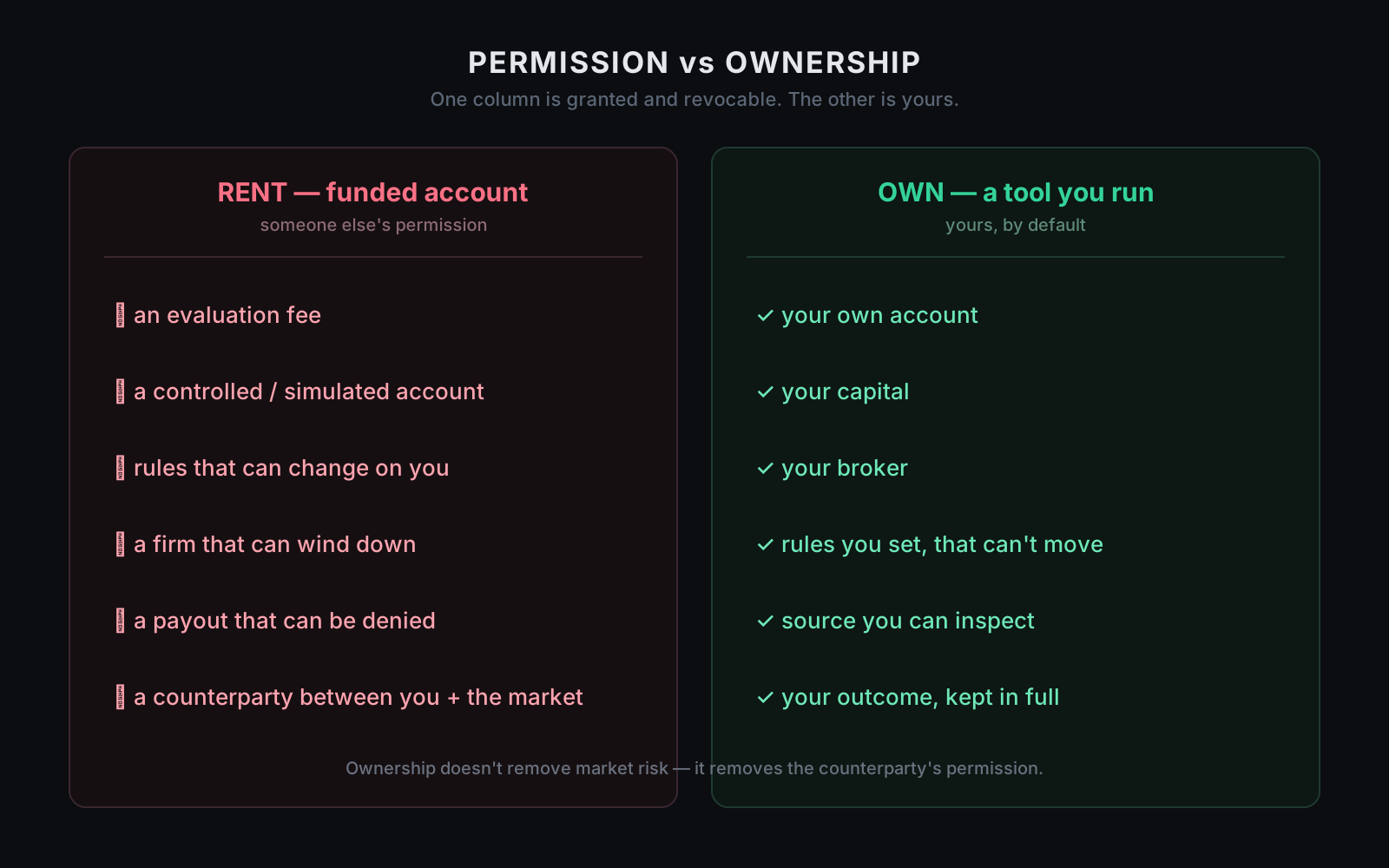
| I own the opportunity | I rent permission from a counterparty |
The product was never the dashboard balance. The product is the paid attempt — and the dream that makes traders buy another one.
I — What you actually bought
Walk the transaction forward honestly. You pay an evaluation fee, then trade to a profit target inside a box of rules — daily loss, max drawdown, minimum days, consistency rules, news rules, minimum hold times, copy-trading clauses, payout conditions. Clear one phase, maybe a second, and the dashboard says funded. But look at what you actually received: not capital the way a professional desk allocates it, not ownership of an account, not unconditional access to trading profits. You bought the right to attempt a payout under terms the firm writes and controls.
That can still be useful — for a disciplined trader, a good firm with stable rules is a way to access opportunity without risking large personal capital. But it isn't the same as owning the account: the funded balance isn't your money, the rulebook isn't yours, and the word "funded" guarantees none of the payout. So the adult question was never "how big is the account?" It's "what exactly did I buy, who controls the rules, and what has to stay true for me to get paid?" If you can't answer that before paying, you're not buying funding — you're buying excitement with terms attached.
II — The math of the funnel
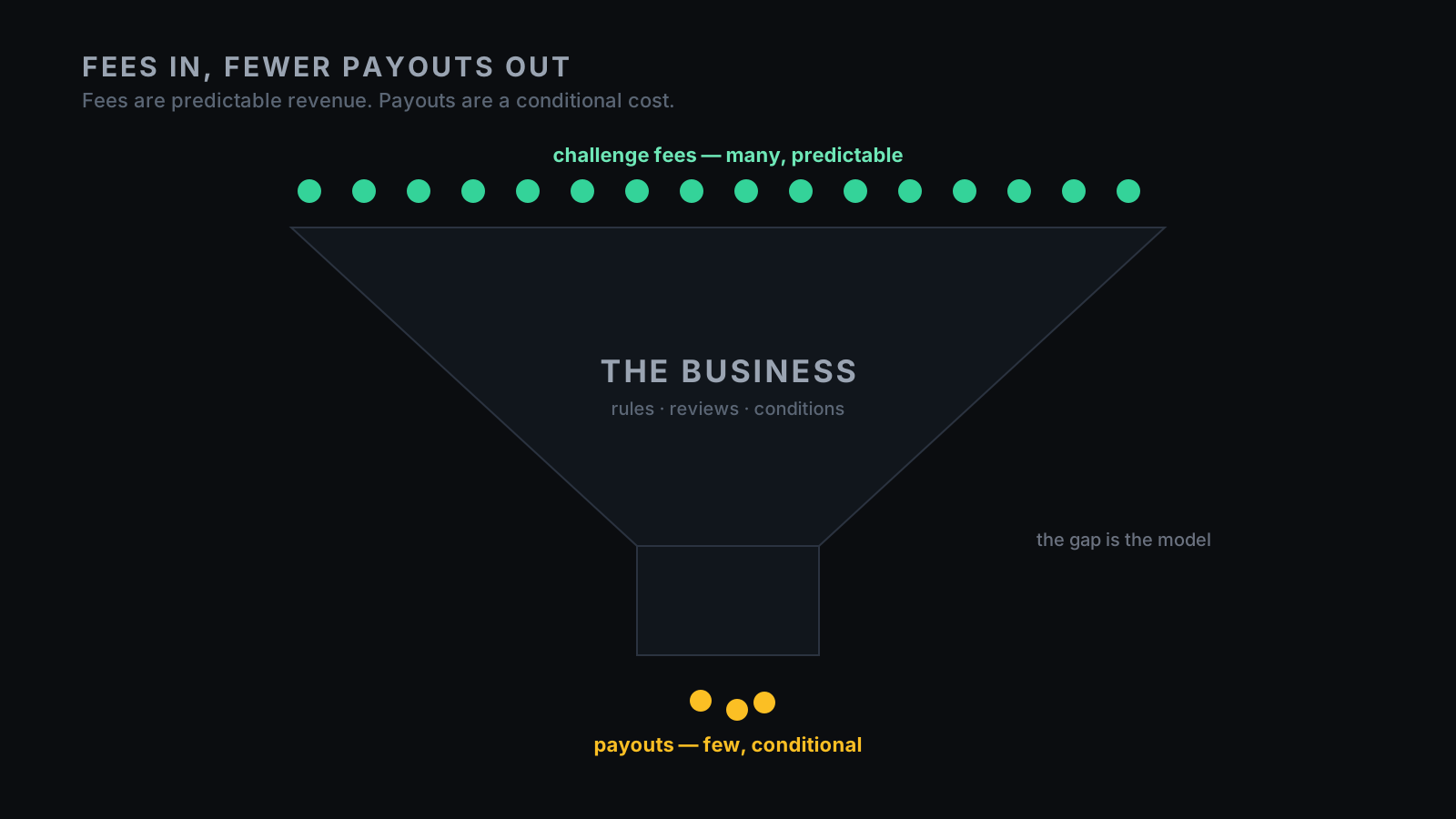
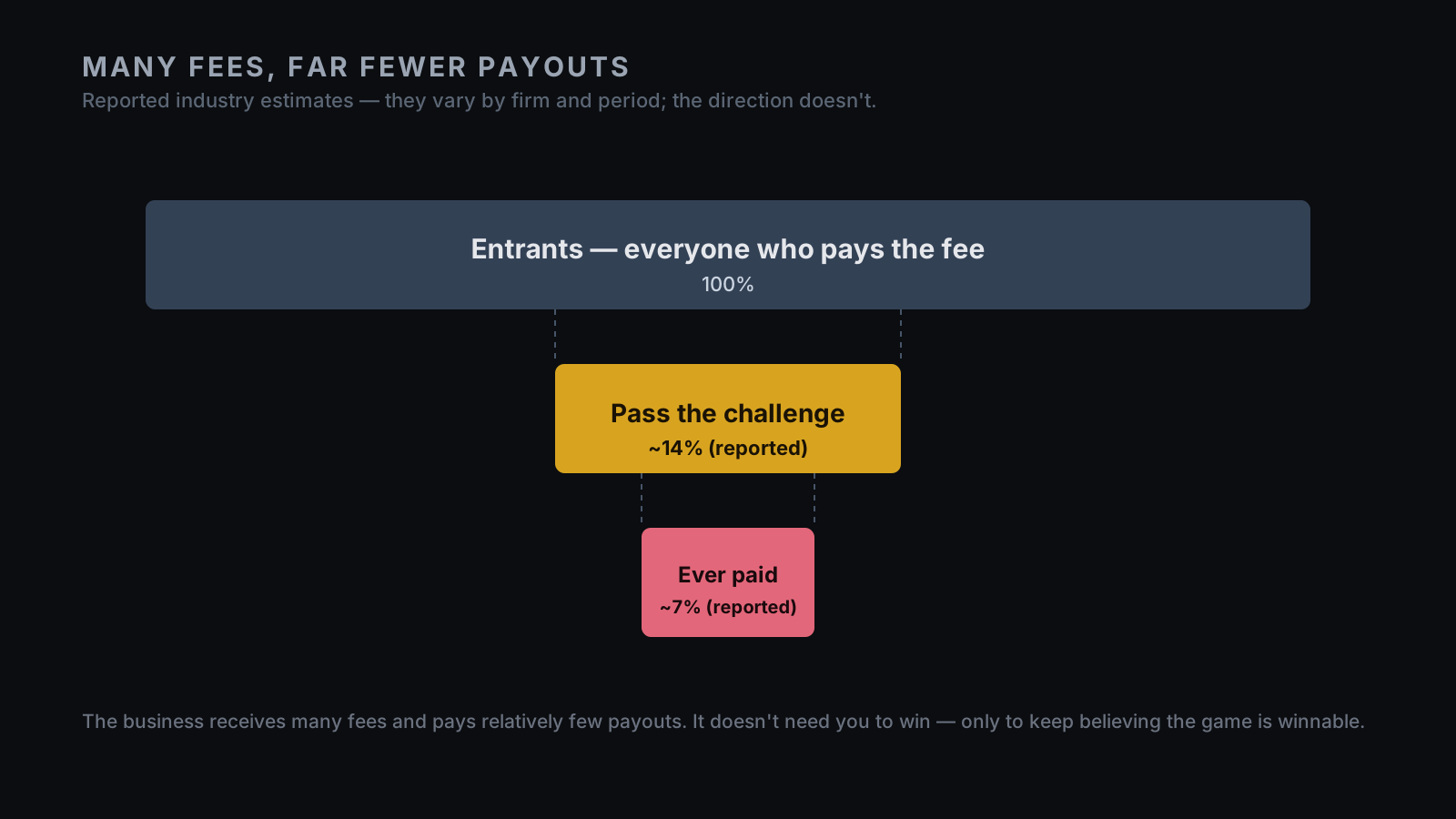
Follow the money and the model stops being mysterious. Reported industry estimates for 2026 suggest only a minority of challenge buyers pass, and a smaller minority still ever reach a payout — one commonly cited summary lands near 14 of every 100 entrants passing and about 7 ever getting paid, with average payouts a small fraction of the funded size. Treat those as directional estimates, not universal law: they vary by firm, product, instrument, and period. The direction is the point. The business doesn't need you to win. It needs enough traders to keep believing the game is winnable — and enough payouts to keep that belief credible.
For the trader, that's a negative-skew payoff — many small fees out, a rare payout in — the same shape we took apart in Win Rate Is a Vanity Metric, except here you're the one selling the cheap option. For the firm, the other side can be attractive: predictable fee revenue, conditional payout expense. None of that requires a villain; it's a business model, and models matter because they predict behaviour under stress. If payouts are the cost of goods, the firm has an incentive to manage that cost — through rules, reviews, consistency clauses, delays, and risk-model adjustments. Some firms handle that transparently; some don't. Your job is to know which kind you're paying before the fee leaves your account.
III — The funding is often a simulation
Here's the part that reframes the word funded, and it's increasingly stated openly. At many firms, a trader who passes does not immediately receive live capital. They may trade a demo or simulated account; the firm may pay approved profits from its operating revenue (funded, in large part, by challenge fees); it may copy only selected traders to live capital later, judged by an internal risk model that decides who's worth backing, copying, delaying, or terminating. Say it plainly and fairly: a simulated evaluation is not automatically a scam — it can be a legitimate, cheap way to filter for skill and cap the firm's risk. But it changes what you're buying.
You may not be trading the market with the firm's capital. You may be trading a score — evaluated by a counterparty whose rules and incentives you don't control. That's why the language matters. A funded dashboard can feel like capital. Mechanically, it may be permission — and permission can be reviewed, paused, denied, or revoked. Capital in your own brokerage account is still risky; you can lose it. But it's yours. A funded dashboard is a claim on a process someone else runs. Treat those as the same thing and you've mispriced the most important risk in the transaction.
IV — The rules are the product
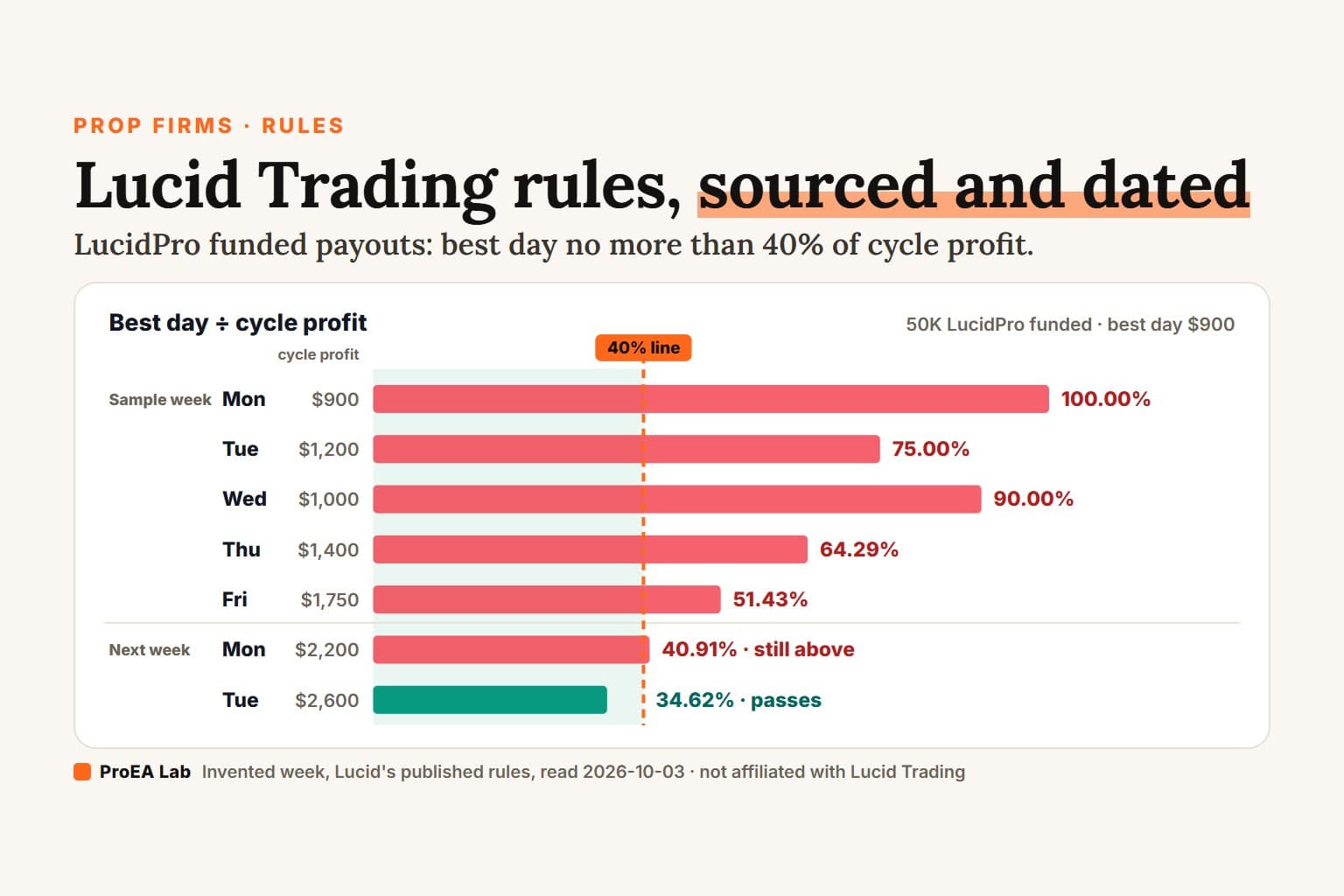
Every funded model ships with rules. The obvious ones get the attention — daily loss, max drawdown, profit target, minimum days. The soft ones are often more dangerous: consistency rules that flag your best day as too good, minimum hold times that void scalps, news and weekend restrictions, copy-trading and "abusive trading" clauses, discretionary payout reviews, and language dense enough that almost any account can be found in breach if someone wants it to be. These aren't decoration. They are the product — they define what counts as valid performance, which is why a trader can make money and still fail the process.
The worst version is retroactive movement: terms that change on accounts that already exist. When a firm can raise the target, shorten the allowed hold, cut the split, or add a consistency requirement after you've traded, the rulebook stops being a contract and becomes a dial. A rulebook that can move after you've performed isn't just risk — it's counterparty power, and you're on the wrong end of it. That doesn't mean every firm will abuse it; it means you should know whether it can happen before you pay. Read the terms like a contract, because that's exactly what they are — the account size is the headline, and the small print is the business.
V — The shakeout
Even if the rules are fair and the account pays today, one risk remains that has nothing to do with your trading: the firm itself. The prop space has been through a serious shakeout — many firms launched in the boom, and a large share didn't survive the operational, platform, compliance, trust, and payout pressures that followed. Some closures were platform-driven, some business-model-driven, some trust-driven after rule changes detonated a firm's reputation. For you, the cause matters less than the result: if the firm pauses payouts, rewrites terms, or winds down, your funded dashboard is not the same as money in your own account — it's a counterparty claim.
Passing the challenge proves you can pass the challenge. It does not prove the firm will be there on payout day. Your equity in a funded account isn't yours the way money in your own brokerage is yours; it's a claim on an entity that can rewrite your terms, freeze your account, or simply cease to exist — leaving you an unsecured creditor with a screenshot. That's not a market risk you can hedge with a stop. It's counterparty risk, and most traders accept it without noticing, because "funded" makes the risk feel like it disappeared. It didn't. It just moved off the chart.
VI — The transparent firms are different
Now the honest counterweight, because a piece that only burns is just marketing with a different bias. A genuine, transparent minority exists, and if you're going to trade prop it's the only tier worth your fee. It tends to look like this: a clearly named broker or execution partner; live funding, or simulation terms explained plainly; stable rules with no retroactive changes; recent, third-party-verifiable payout evidence and a readable denial policy; realistic risk limits; and marketing without bait-and-switch. Some disciplined traders use these firms and get paid. That's real.
So the point of this article is not every prop firm is a scam. It's that the burden of proof is on the firm, and "funded" is a marketing word until a named broker, a stable rulebook, and a real payout history make it a fact. A good firm should make the mechanics obvious on request: demo or live? who's the broker? where do payouts come from? can the terms change? what voids a payout? how many traders actually get paid, and how are disputes handled? If a firm can't answer those plainly, the problem isn't your skepticism — it's a model asking you to trust what it won't show. Verification isn't negativity. It's due diligence, and it's cheaper than a denied payout.
VII — The one thing no firm can revoke
Step back and look at what you actually control in the funded model. The account size? No. The rules? No. The payout review? No. The platform? No. The firm's solvency? No. The word "funded" gives the feeling of ownership, but almost the entire stack is permission — granted by a counterparty, reviewed by a counterparty, revocable by a counterparty.
There is exactly one thing in this game that no firm can retroactively change, wind down, or deny: a tool you own outright, running on your own account, your own capital, your own broker. Owning a strategy you can read and run is the opposite of renting permission to attempt a payout — no evaluation-fee treadmill, no profit split, no consistency clause, no simulated dashboard, no payout review, no "we've updated our terms" email after the trade. That does not make your own account safer in the market: it can lose money. What it removes is a whole category of risk — the counterparty's permission. The real question was never "how do I get a bigger dashboard balance?" It's "what do I still own if the counterparty changes its mind?" — and for serious traders, cleaner usually beats bigger.
VIII — The 20-minute funded-account audit
Before you pay another challenge fee — for any firm, no exceptions — run this. It's the difference between buying access and buying a subscription to hope.
Minutes 0–5 · Demo or live? Find the named brokerage partner and whether funded accounts are live, demo, or simulated, and under what conditions trades are ever copied to real capital. No named broker, or funded accounts that stay simulated, isn't automatically disqualifying — but it means you're buying evaluation access, not direct capital, and the risk you're taking is different.
Minutes 5–10 · Read the whole rulebook — especially the soft rules. Not the marketing page, the rulebook. Daily loss and drawdown are the obvious ones; hunt the quiet ones — consistency rules, minimum hold times, news/weekend restrictions, copy-trading and "abusive trading" clauses, discretionary review, and any language allowing changes to existing accounts. The quiet rules are where accounts die.
Minutes 10–15 · Verify payouts, not screenshots. Look for recent, third-party-confirmable payout evidence, the denial policy, average timing, and public dispute history — not a wall of cropped withdrawal images. Survivorship marketing shows you the few who got paid and never the queue behind them.
Minutes 15–20 · Do the funnel math, then ask the ownership question. Multiply the fee by the retries you'll realistically need against the reported pass rate, weigh it against a realistic payout and the counterparty risk, and see whether the expected value was ever in your favour. Then ask the one that matters most: when this firm changes its rules, delays a payout, or disappears, what do I still own? If the answer is nothing, you weren't building an asset — you were renting permission. That may still be a trade you choose. Just choose it with open eyes.
Where this meets ProEA
Now the honest part. We don't run a prop firm, we don't sell challenges, and we're not here to tell you no disciplined trader should ever use a funded route — some do, some get paid, some treat the rules professionally and make the transparent tier work. But ProEA is built on the opposite philosophy: own the tool, run it on your own terms, inspect the logic, control the risk, keep the outcome. We're not selling a guaranteed payout. We're selling the opposite of rented permission.
That's why MTR is sold as full MT5 source: no evaluation fee, no profit split, no consistency clause, no demo server someone else controls, and no payout review standing between you and your own broker. You own the strategy, you run it on your capital, and you keep the outcome — good or bad — in full. And the caveat matters, because honesty is the whole brand: ownership removes the counterparty and rulebook risk of the funded model; it does not remove market risk. Your own account can lose money, ours included, and source code is control and inspectability, not a promise of profit. What it is not is a subscription to someone else's permission. That distinction is the entire article.
Disclosure: the one question that ends the pitch
We sell source and evidence you can inspect — not outcomes, not funded accounts, not payouts. No tool or strategy can promise future results; trading any account, prop or your own, carries real risk of loss. Past performance is not future performance, and owning a tool does not make you profitable — it makes you the owner.
So before you pay for "funding," ask the firm the one question the pitch avoids: "Is this real capital with a named broker — and can the rules change after I've already traded?" If the funding is simulated and the rules can move, you're not being funded in the way the word makes you feel. You're being evaluated — possibly fairly, possibly not, but definitely under someone else's permission. Know that before you pay.
Your first 20 minutes
Don't take our word for it. Take the source — and compare what you'd own with what you'd rent.
Minutes 0–5 · Read what you'd own. Open MTR's source and notice what isn't in it: no evaluation-fee logic, no profit-split clause, no remote rulebook, no payout reviewer. It's a strategy that runs on your account — a tool, not a permission slip.
Minutes 5–10 · Run it on your own broker's demo. Not a prop firm's demo — your broker's, your symbol, your spread, your costs. You're testing a tool you'd own, on the account environment you'd actually control.
Minutes 10–15 · Read how it loses. Find the risk layer, the stop, the exposure cap (the Staircase Over a Cliff checklist applies here too) and decide whether you can sit through its drawdowns — on your own terms, with no rule that can change them and none that can disqualify you either. It's your risk.
Minutes 15–20 · Decide on ownership, not permission. A tool you can inspect, a broker you choose, capital you control, risk you understand, outcomes you keep → a small forward test. Not because a dashboard said "funded." Because you own the thing and answer to no rulebook but your own.
One last thing
If this stopped you from paying for one more challenge before you read the rulebook, it did its job. Send it to the friend about to buy a "funded" account because the certificate looks good on the timeline.
A funded account is permission, and permission can be revoked. A tool you own isn't safer by magic — but it's yours, and in a market full of rented dashboards, that difference is the whole point.