An AI-optimized backtest that looks perfect is the most common way overfitting reaches retail traders now. Here's how to audit one — the specific checks that separate a curve-fit artifact from an edge — before any money touches it. (The Monte Carlo resample of our own EA shows what those checks exist to catch.)
You typed your idea into the AI.
Build me a mean-reversion strategy on gold.
Optimize it. Make it robust.
Ninety seconds later it handed you a staircase to heaven. Smooth climb, tiny drawdown, inputs neatly named, backtest report attached. A line so clean it looked like it had a private tutor.
You felt it in your chest. This is the one. Finally — the edge, the system, the thing you'd been chasing for months.
Here's what should cool that feeling down fast.
You didn't find an edge. You ran a search.
And a search, run long enough, always returns a winner — even when there's no edge anywhere in the room.
That gorgeous backtest isn't necessarily the best strategy. It may simply be the luckiest survivor of everything the AI quietly tried.
Different RSI period. Different stop. Different target. Different filter. Different session. Different timeframe.
Most failed. One looked perfect.
Guess which one the tool showed you.
The survivor. Never the graveyard.
That's the whole disease. AI didn't make overfitting new — it made overfitting instant. The old way, a quant could fool themselves by testing too much. The new way, anyone can do it in ninety seconds, with a prompt and a progress bar, and never feel the search happen.
Save this before you fund the next perfect AI backtest.
And send it to the friend who just messaged you a 90-degree equity curve captioned "AI is insane." It might be — but the curve probably isn't.
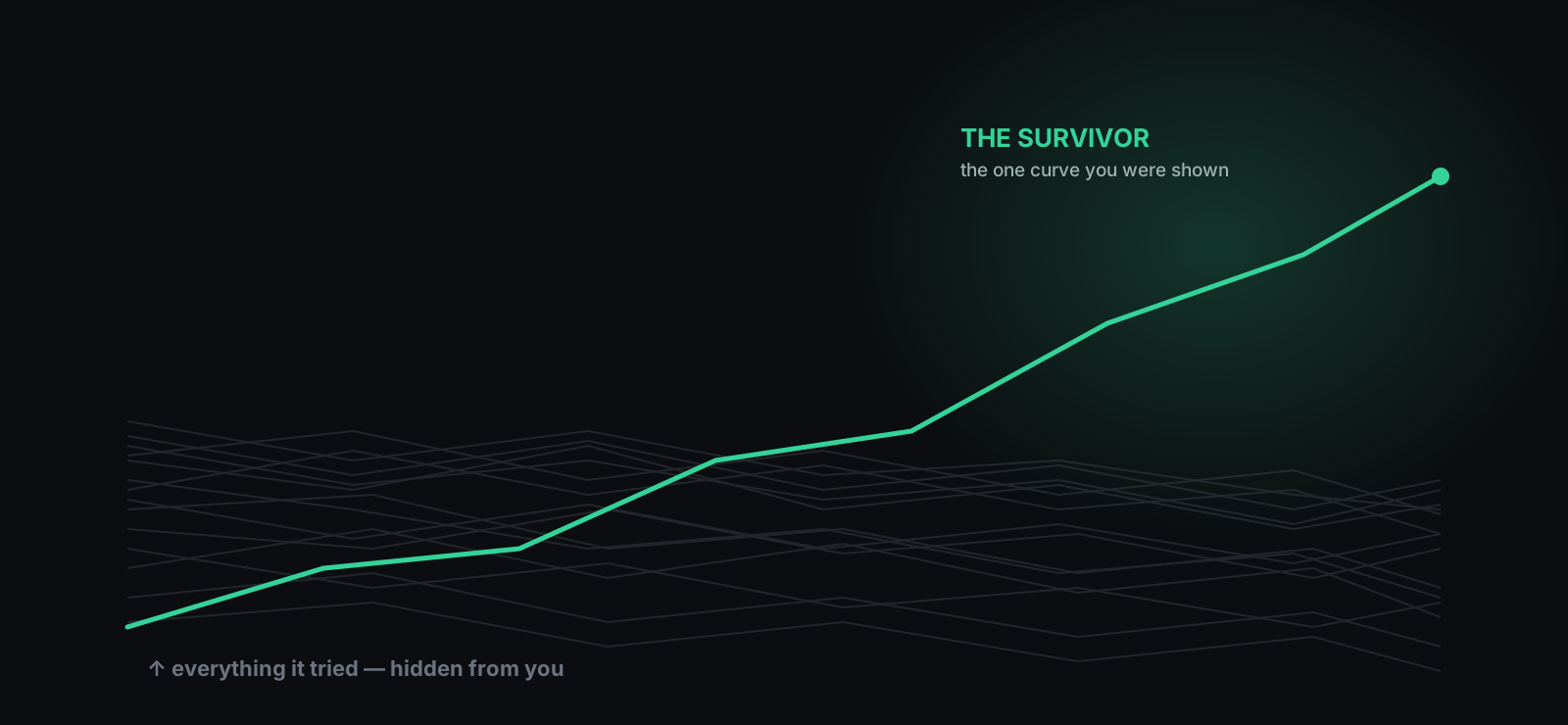
The hidden denominator. The more strategy variations you tried, the less impressive the best one is — and AI hides this number by default.
Multiple-testing / selection biasThe Deflated Sharpe Ratio discounts a headline Sharpe for the number of trials, selection bias, and non-normal returns.
Bailey & López de Prado, 2014 ↗The kind of number an honest builder shows: the failed strategies, not just the one survivor.
MTR research log ↗The 60-second version
AI strategy generators let you try thousands of variations in minutes. That's powerful — and it's exactly how you fool yourself.
Try enough combinations and one will look incredible by chance. That doesn't mean it found market structure; it means the search had enough attempts for randomness to dress up as skill.
So the raw backtest is never enough. The questions that actually decide whether it's real: how many variations were tried, did the survivor work out-of-sample, does the edge have a reason to exist, did it survive realistic costs, and — the tell — will the builder show you the losers.
A single perfect curve is not evidence. It's a survivor. The survivor is not the edge — the graveyard is the denominator.
| What the perfect backtest feels like | What it actually might be |
|---|---|
| "AI found a hidden edge." | AI found the luckiest curve in a search you didn't count. |
| "Look how smooth the equity curve is." | Smooth in-sample is often what overfitting looks like. |
| "It's optimized." | "Optimized" can mean curve-fit to noise. |
| "The backtest proves it works." | One selected backtest proves almost nothing without the trial count. |
| "More tweaks improved it." | More tweaks also raise the chance of a false discovery. |
| "The tool gave me the best one." | Yes. That is exactly the statistical problem. |
I. The new easy button
For years, "AI for trading" meant chat — explain an indicator, write some Pine Script, suggest a strategy. Now it builds.
Describe a rule in plain English and AI writes the code. Ask for optimization and it sweeps the parameters. Point an EA generator at MT5 and it grinds through thousands of entry/exit/filter combinations and hands you the best performers. Tell it "improve the drawdown, raise the win rate, smooth the curve, try filters" — and it does. Again, and again, and again.
The friction is gone. What used to take a quant a careful week now happens faster than your coffee cools.
That feels like progress, and sometimes it is. But friction had one accidental benefit: it reminded you that you were searching. Every failed attempt cost you effort, so you felt the size of the search in your bones.
AI removes that reminder. You no longer feel the weight of the fifty thousand attempts — you only see the final curve. The easy button didn't lower the skill to find an edge. It lowered the skill to manufacture the appearance of one.
II. You didn't find an edge — you ran a search
Here's the central idea the whole piece rests on.
When you try many strategy variations and keep the best result, the "best" is biased upward — even if every variation has zero real edge. Statisticians call it multiple testing, data mining, p-hacking, optimization bias. Same mechanism under every name: flip enough coins and one lands heads ten times in a row. That coin isn't special. It's just the one you stopped on.
A trading strategy is a coin you can flip in a thousand shapes — indicator, period, threshold, stop, filter, session, symbol, timeframe. Search across all of them and the laptop will surface a combination with a stunning backtest. Not because it found a market truth, but because you gave randomness ten thousand chances to look like genius.
The market didn't reveal an edge to you. Your search revealed the best-dressed accident.
And here's the part that feels backwards: the harder you "work" — the more variations you try, the more you tune — the worse the overfitting gets. Effort feels like rigor. Uncounted effort is just selection bias wearing a lab coat. (It's the same family of self-deception as an AI-coded backtest that secretly peeks at the future — different bug, identical outcome: gorgeous in-sample, broken live.)
III. The math: a winner is expected
This isn't a vibe. It's a theorem.
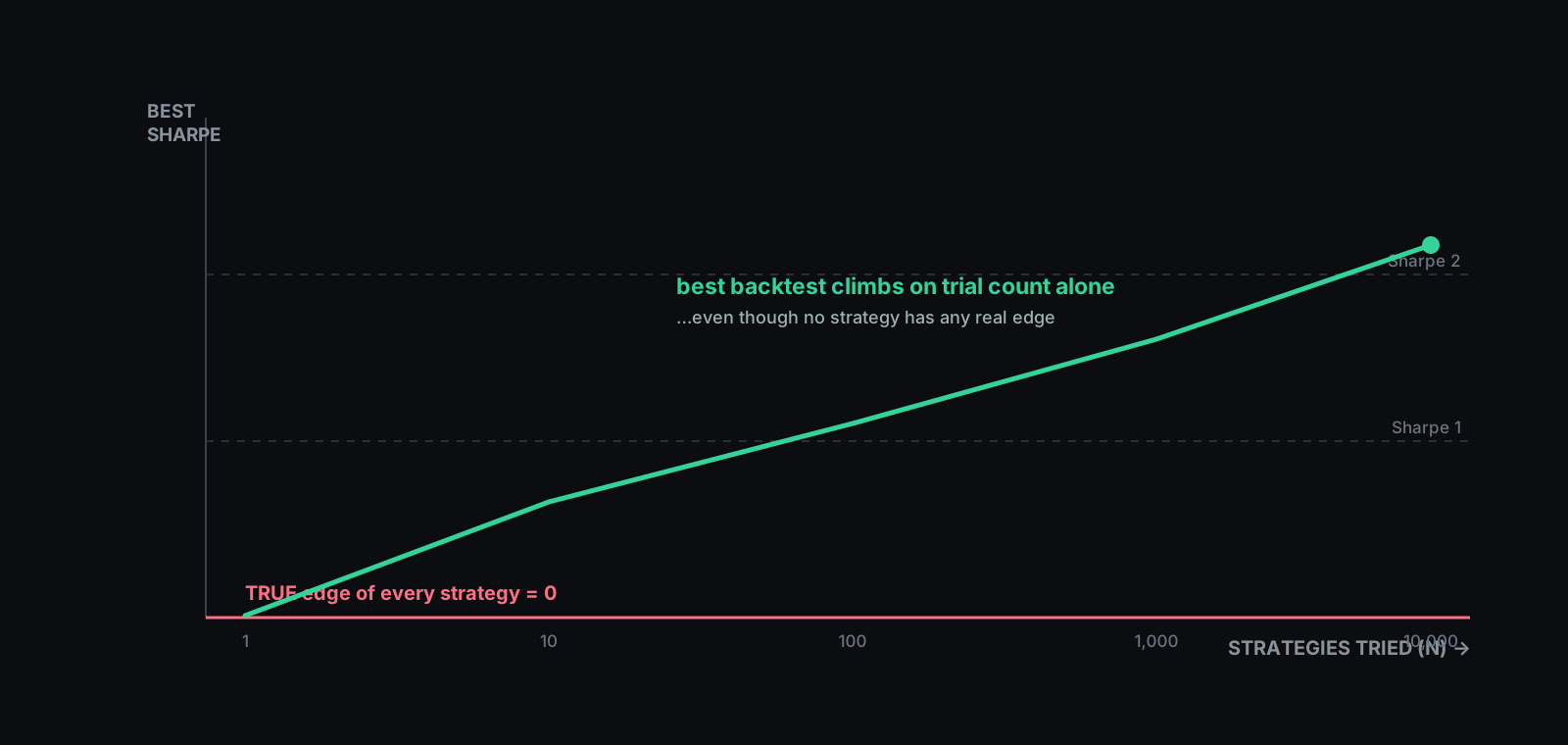
López de Prado and Bailey formalized it as the False Strategy Theorem: the expected maximum Sharpe ratio across N trials rises as N rises — even when the true Sharpe of every strategy is exactly zero. Try more things, and the best-looking thing looks better, mechanically, from luck alone. Their blunt conclusion: with enough trials, there is no Sharpe ratio large enough to reject the hypothesis that a strategy is false.
So a Sharpe of 2 from five honest attempts is interesting. A Sharpe of 2 from ten thousand attempts is a much weaker claim. Same number — different denominator. The denominator is the search.
That's why they built the Deflated Sharpe Ratio. A normal Sharpe asks "how good did this return stream look?" A deflated Sharpe asks "how good does it still look after counting how many things you tried?" The second question is the grown-up one.
A raw Sharpe with no trial count is a trophy with the tournament bracket missing. You can't tell if it beat one opponent or ten thousand ghosts.
IV. AI made the search invisible
Data-mining bias is older than computers. What changed in 2026 is the scale and the invisibility of the search.
A human optimizing by hand might try twenty versions and start to feel guilty. Fifty, and they know they're torturing the data. A hundred, and even the spreadsheet looks embarrassed. AI feels none of that. It tries fifty thousand before your coffee cools, and it never flinches.
Worse: you don't see the fifty thousand. You see the one it presents. So the single most important number for judging a backtest — how many things did it try? — is exactly the number AI deletes from view. You're handed the winner with the search history wiped.
The AI isn't lying. It's doing precisely what you asked: find the best-looking curve. The lie sneaks in when you treat "best-looking" and "real" as the same word.
An AI strategy generator isn't automatically an alpha machine. It's often a data-mining-bias machine with a friendly face — friendly face, sharp teeth.
V. A perfect curve is a smell, not proof
Flip your instinct. A flawless, smooth, steep equity curve from a first AI search should lower your confidence, not raise it.
Real edges are ugly. They have flat months, gut-churning drawdowns, regime failures, stretches where the rules still work long-term but feel broken in the moment. That ugliness isn't a flaw — it's often the sign the curve isn't simply memorizing one slice of history. Markets are not polite enough to produce a perfect line. (This is the same wall every backtest hits between simulation and live; we wrote the general version in "Your Backtest Isn't Reality.")
So when something looks too good, the prettier the curve, the ruder your questions should get: A perfect curve is not proof of skill. It's proof a search happened.
Ask how many trials, what out-of-sample, what costs, what walk-forward, what reason, what failed. If the answer is silence, the curve isn't evidence. It's a sales page with a chart on it.
VI. Optimization is not validation
This is where many traders confuse two opposite jobs.
Optimization asks: which settings looked best on this data? Validation asks: does this idea still work when it no longer gets to choose the data? Those are not the same job, and one cannot do the other's work.
Optimization is allowed — it's useful research. It finds parameter zones, exposes weak assumptions, helps you understand a system. But it never validates itself: the optimized result is the suspect, not the verdict. Validation has to happen somewhere the optimization never touched.
And here's the trap that quietly grows your denominator: the moment you look at the out-of-sample result, tweak a rule, and run again, that data is no longer out-of-sample. It has joined the search. That's not evil — but you have to count it.
Every peek counts. Every "just one filter" counts. Every time you ask AI to improve the curve after seeing the result, the denominator grows. Research is allowed to search. Validation must remember the search.
VII. What actually survives a search
This isn't a "never use AI to build strategies" piece — that would be lazy and wrong. Used with discipline, AI is a phenomenal research accelerator. The catch is that its output (a winning backtest) is the start of the work, not the end. A finding earns attention only if it clears four gates:
- Out-of-sample survival. Build and tune on one slice; test, untouched, on a slice the search never saw. If it dies, it dies — don't resuscitate the holdout with a new filter and pretend the patient was healthy. Then walk it forward: re-fit periodically and confirm it keeps working on each next unseen window.
- A reason it should exist. Can you name why the edge is there — a behavioral bias, a liquidity effect, a structural cost, a regime quirk? "The optimizer liked it" is not a reason. An edge with no economic story is almost always an artifact.
- A deflated number. Discount the headline Sharpe / profit factor / expectancy for the trials you ran. No trial count, no confidence.
- Survival after costs. Spread, slippage, commission, funding, execution delay. A strategy that only works before costs doesn't work — it rents fantasy space in your tester.
Clear all four and you still don't have a guarantee. You have a candidate that has earned further testing — not trust. That cautious, unexcited state is the correct one.
VIII. The kill log is the honesty signal
Here's the reframe that changes what you ask of any strategy, any seller, any tool.
The honest artifact in strategy research is not the winning equity curve. It's the graveyard — the list of everything that was tried and failed. The strategies that looked great in-sample and died out-of-sample. The filters that did nothing. The recovery logic that made drawdown worse. The clever ideas that got punched by costs.
Why does the graveyard matter? Because it reveals the denominator. It tells you how large the search was — and without the denominator, the survivor means very little.
A seller showing one gorgeous backtest is showing you the coin that landed heads ten times. A builder showing the failed attempts is showing you the whole tournament. That's the difference between a magician and an engineer: the magician shows you the trick; the engineer shows you the failed prototypes.
The survivor is not the edge. The graveyard is the denominator. No graveyard, no evidence.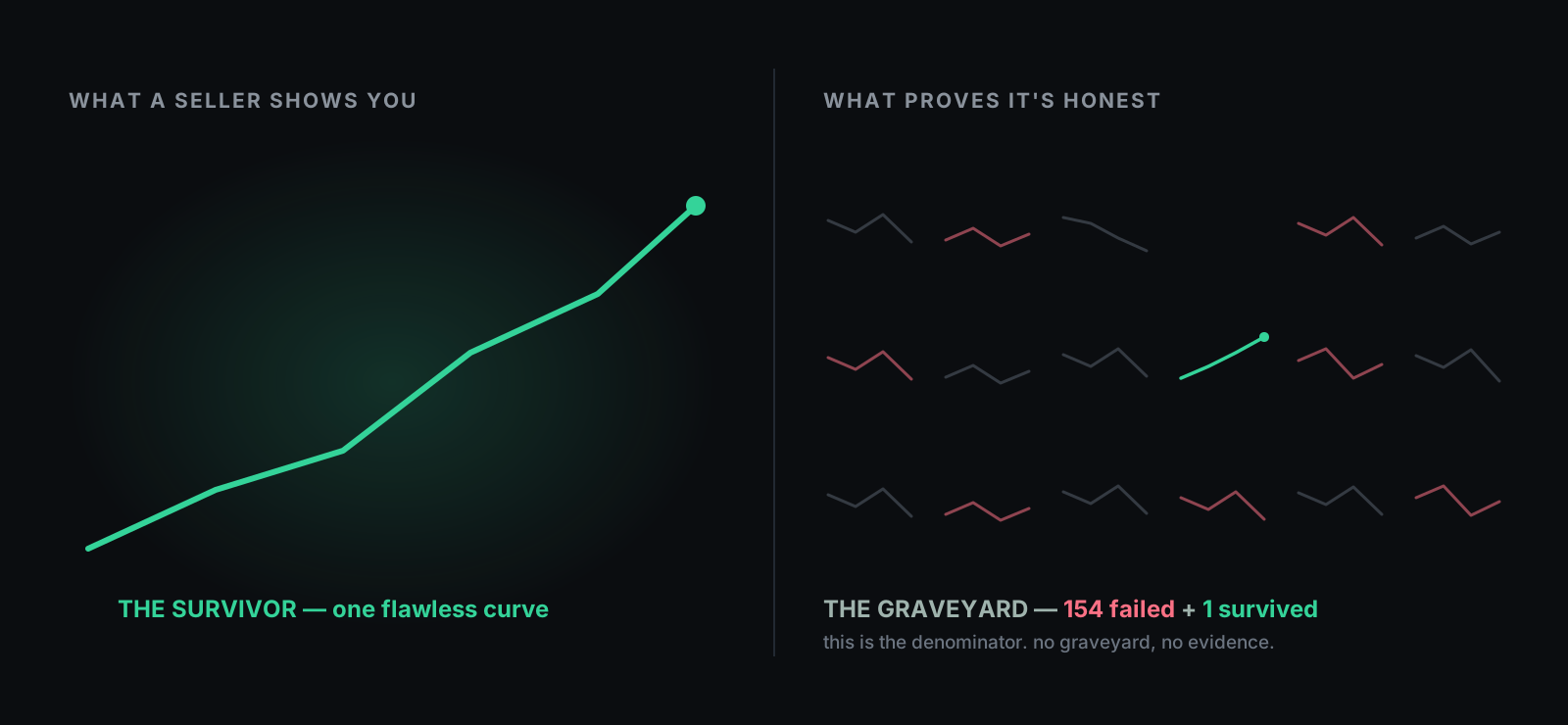
The anti-perfect-backtest prompt
Whenever AI hands you a beautiful backtest, make it audit its own search first. Paste this, fill in what you have, and read the verdict honestly.
You are auditing an AI-generated or optimized trading strategy.
Do not praise the equity curve. Do not assume the best backtest is real.
Treat the result as the SURVIVOR of a search until proven otherwise.

I will provide: strategy rules, backtest report, optimization settings,
number of trials (if known), parameter ranges, costs included,
in-sample period, out-of-sample period, trade list (if available).

Audit, in order:

1. TRIAL COUNT — estimate how many variations were tried (parameter combos,
   filters, timeframes, symbols, repeated prompts, manual tweaks).
   If unknown, state: TRIAL COUNT UNKNOWN = LOW EVIDENCE VALUE.

2. SEARCH MAP — list every dimension searched (entries, exits, stops, targets,
   filters, sessions, indicators, symbols, timeframes).

3. OUT-OF-SAMPLE — was there a TRUE untouched test period? Compare in-sample vs
   out-of-sample. If none, mark NOT VALIDATED.

4. COSTS — does the backtest include spread, commission, slippage, funding,
   execution delay? If missing, mark PRE-COST ONLY.

5. ECONOMIC REASON — why should this edge exist? Reject "the optimizer found it"
   or "the curve is smooth." Require a structural / behavioral / liquidity /
   regime reason.

6. ROBUSTNESS — parameter stability, neighboring settings, walk-forward,
   regime split, outlier dependence, Monte-Carlo path reshuffle.

7. DEFLATED VERDICT — choose one: LIKELY SEARCH ARTIFACT / INCONCLUSIVE /
   PROMISING BUT NOT VALIDATED / READY FOR A SMALL FORWARD TEST / REJECT.

8. NEXT ACTION — the single test that would most quickly FALSIFY this strategy.

Be skeptical. Be specific. Do NOT optimize it further.
That last line matters. When the problem is over-search, more search isn't first aid — it's the knife going deeper.
The 20-minute "is this real or just lucky?" audit
Run this before a cent of real money touches any AI-generated strategy.
Minutes 0–5 — Count the trials. Write down, honestly, how many variations were tried to get here — every parameter sweep, every AI retry, every "just one filter," every timeframe and symbol tested. If you used a generator, find its trial count (it ran thousands). "Trial count unknown" is not neutral — it's high risk. You can't deflate a Sharpe you refuse to count.
Minutes 5–10 — Split the history. Take the final strategy as-is and run it, with zero tuning, on data the optimization never touched. No new filter, no quick fix. If the smooth curve turns flat or negative, stop — it didn't survive the first adult conversation. This one step kills most "perfect" strategies.
Minutes 10–15 — Demand a reason, then charge costs. Fill the blank in one sentence: "This edge should exist because ______." Can't? Drop your confidence hard. Then add realistic spread, slippage, commission, and funding and re-run. Watch how much magic survives the invoice.
Minutes 15–20 — Walk it forward, then size like you're wrong. Re-fit only on past data, test on the next unseen slice, repeat. If it survives, start tiny — size as if the real edge is half what the report claims (after deflation, it usually is). The market is very good at invoicing optimism.
Where this meets what we build
This is exactly why MTR ships the way it does.
The easiest way to sell a trading system is to show one stunning backtest and let the curve do the talking. The honest way is harder: show the search. Show what failed, the filters that did nothing, the configs that died out-of-sample, the clever ideas that got punched by costs.
MTR comes with a 155-strategy research log for that reason. The failures aren't an embarrassment to hide — they're the denominator that makes the survivor mean something. Paired with a backtest whose assumptions are stated out loud and source you can read line by line, the kill log changes the claim from "trust this perfect curve" to "here's the survivor, here's the graveyard, here are the assumptions, here's the source — try to break it."
That doesn't make MTR safe, and it doesn't guarantee a cent. As we say on every page: it's a process, not a prophecy. MTR can lose — any real edge has ugly stretches; that's how you know it's real and not memorized. But a system whose failures you can inspect beats a flawless backtest whose search you can't count — every time the market stops cooperating with the curve.
AI is a great way to search. The honesty is in showing you what the search threw away. (It's the same division of labor we landed on when an agent gets the keys to a live account: the machine does the work; the human keeps the receipts.)
Disclosure
We sell source and a research record you can inspect — not outcomes, not certainty, not a guaranteed edge. AI strategy and EA/indicator generators are genuinely useful research tools, but their default output can be a backtest selected from a hidden search, which systematically overstates confidence. Out-of-sample testing, walk-forward, realistic costs, trial-count disclosure, the Deflated Sharpe, and kill logs reduce that risk — they never remove it. MTR can lose. Any strategy can lose. Backtests are simulations of the past, not promises about the future. The point isn't to claim certainty; it's to stop mistaking the luckiest survivor of a search for proof of skill.
One question before you trust any "AI-built" strategy
Don't ask how good the backtest looks. Ask:
How many strategies did you try before this one — and will you show me the ones that failed?
If the answer is a number and a graveyard, you're looking at research. If it's one perfect curve and a shrug, you're looking at the most expensive kind of luck — the kind you mistake for skill, and fund.
AI will always find you a winner. Whether it's real is the one thing it can't tell you, and the one thing you have to check yourself.