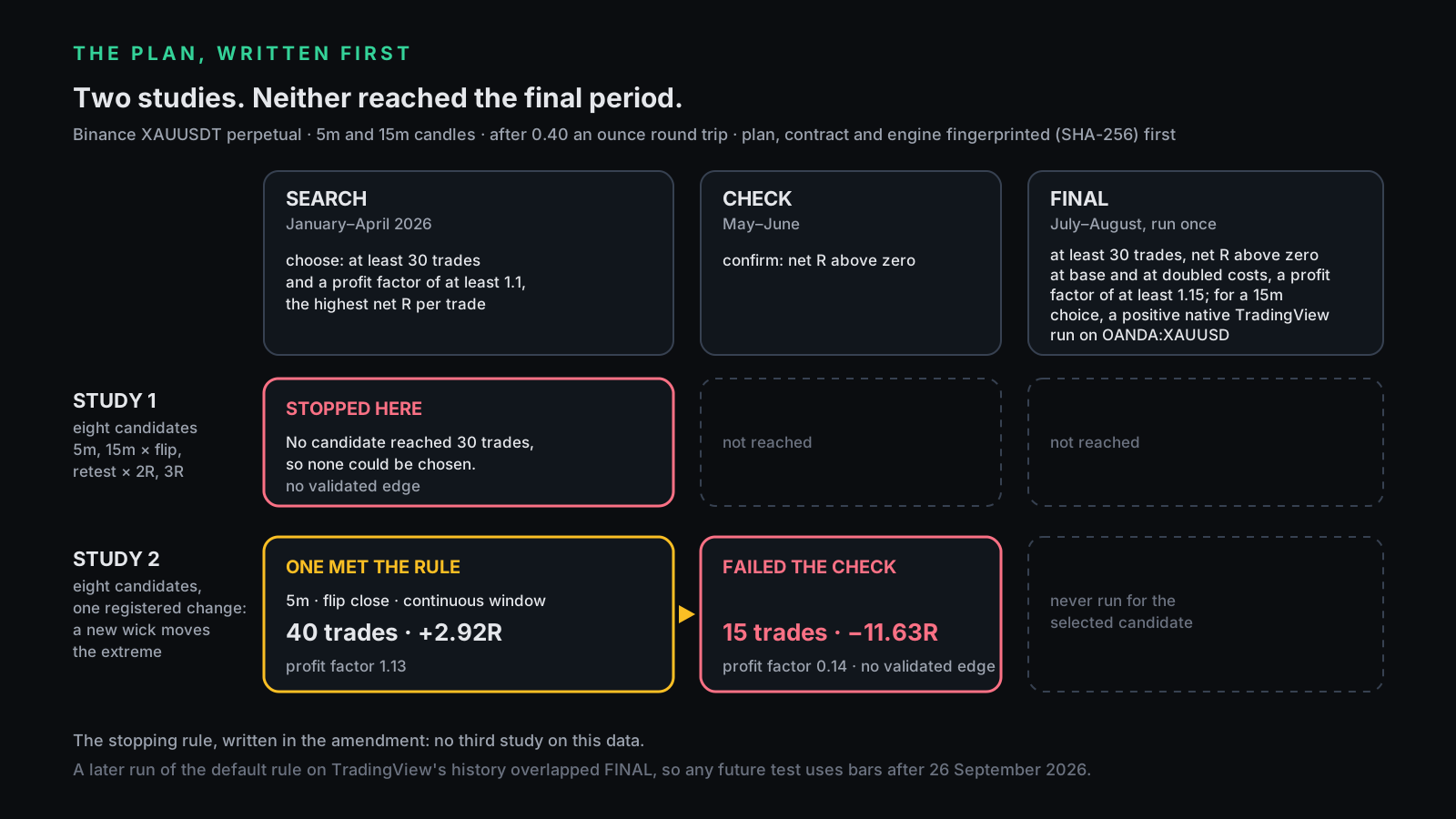
We tested the rule the written-first way, twice, on 2026 gold data.
Neither study produced a setting we could call tested.The first found too few trades to choose from.
The second chose one, and it failed its check period.
So Gold Sweep Desk ships with design-choice defaults and says so.
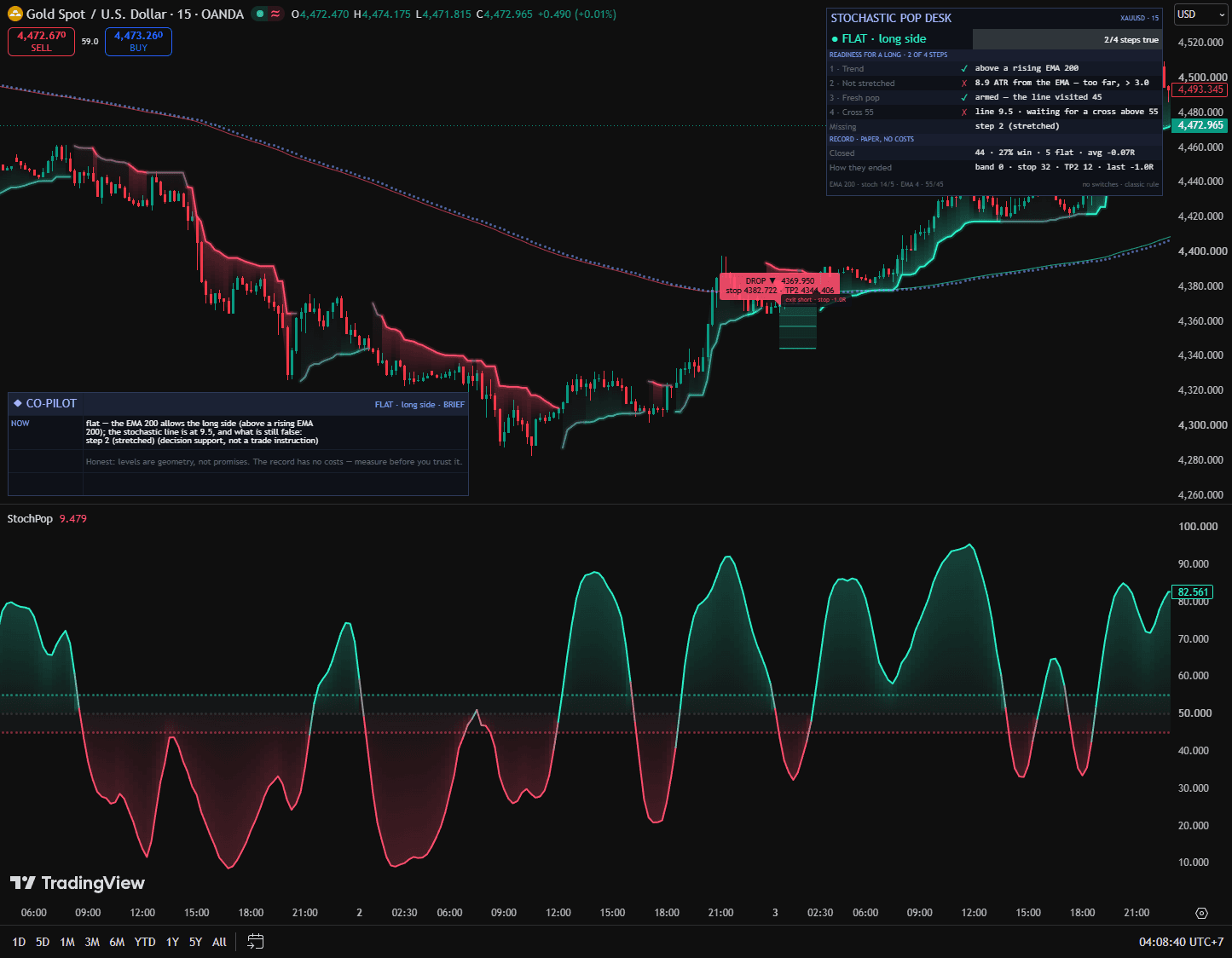
The default rule's small recent record on TradingView is below too, with why it proves nothing.
This article is where the numbers live. The free page carries none of them, and the Pro page makes no performance claim.
The rule
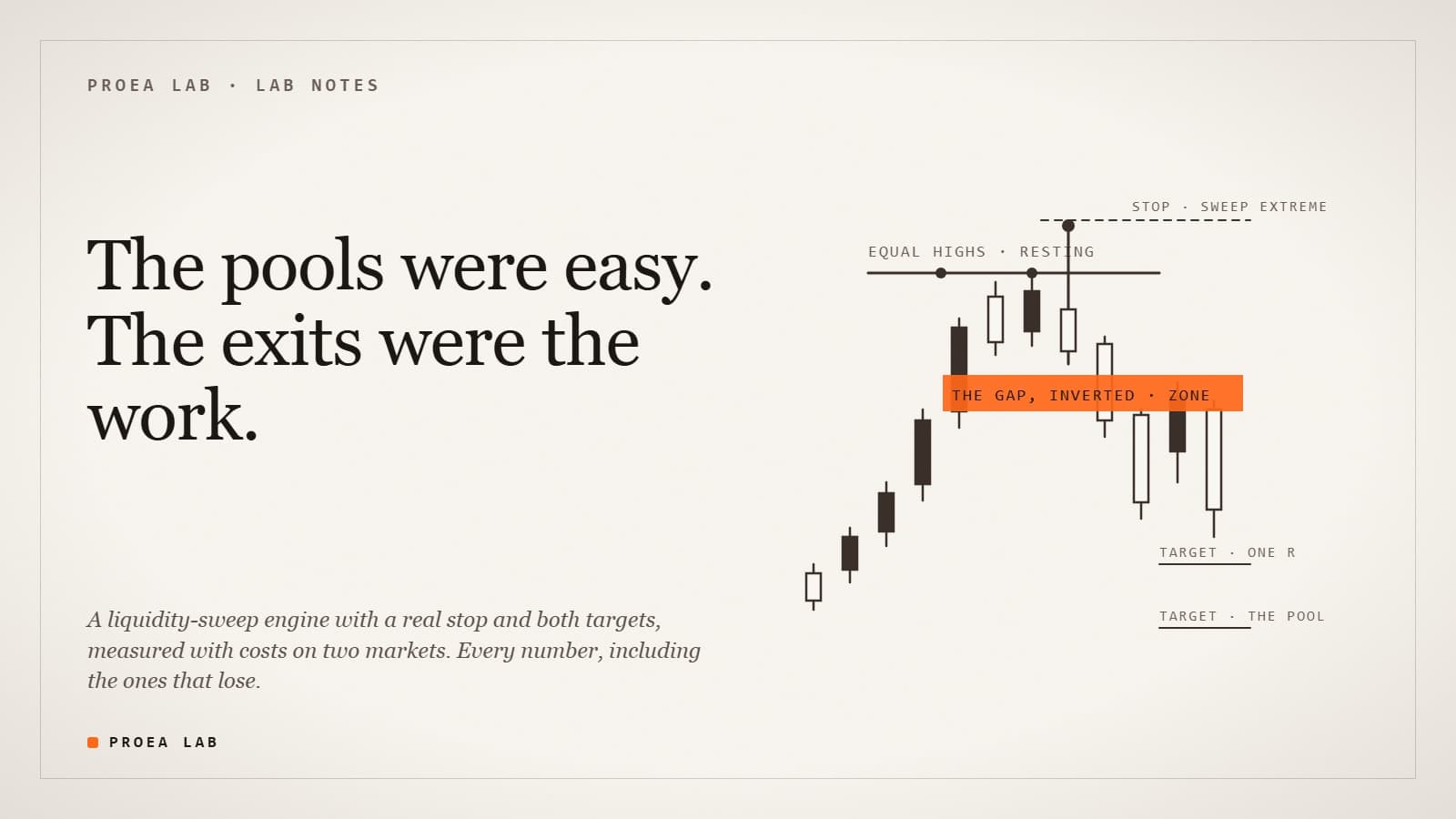
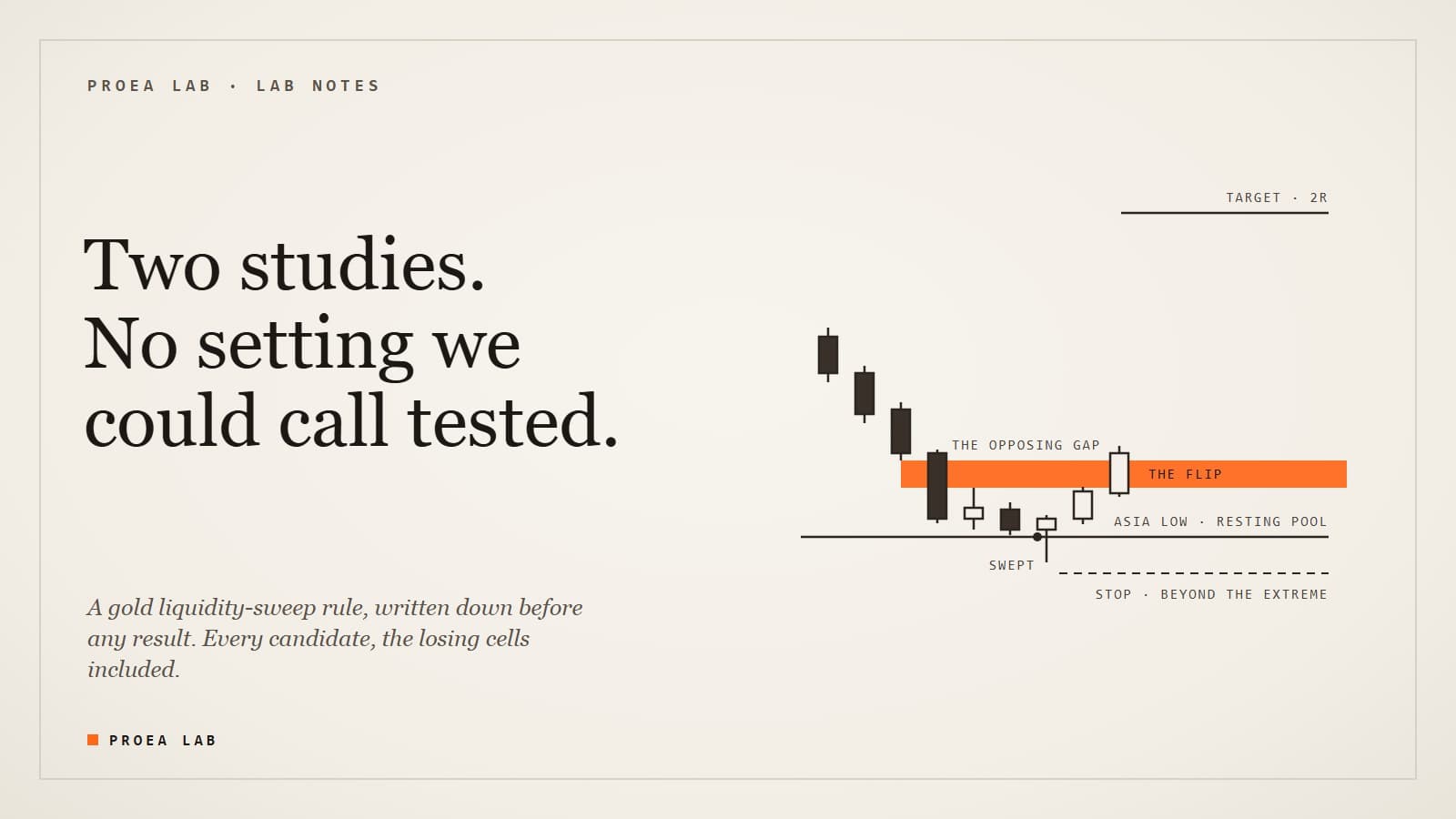
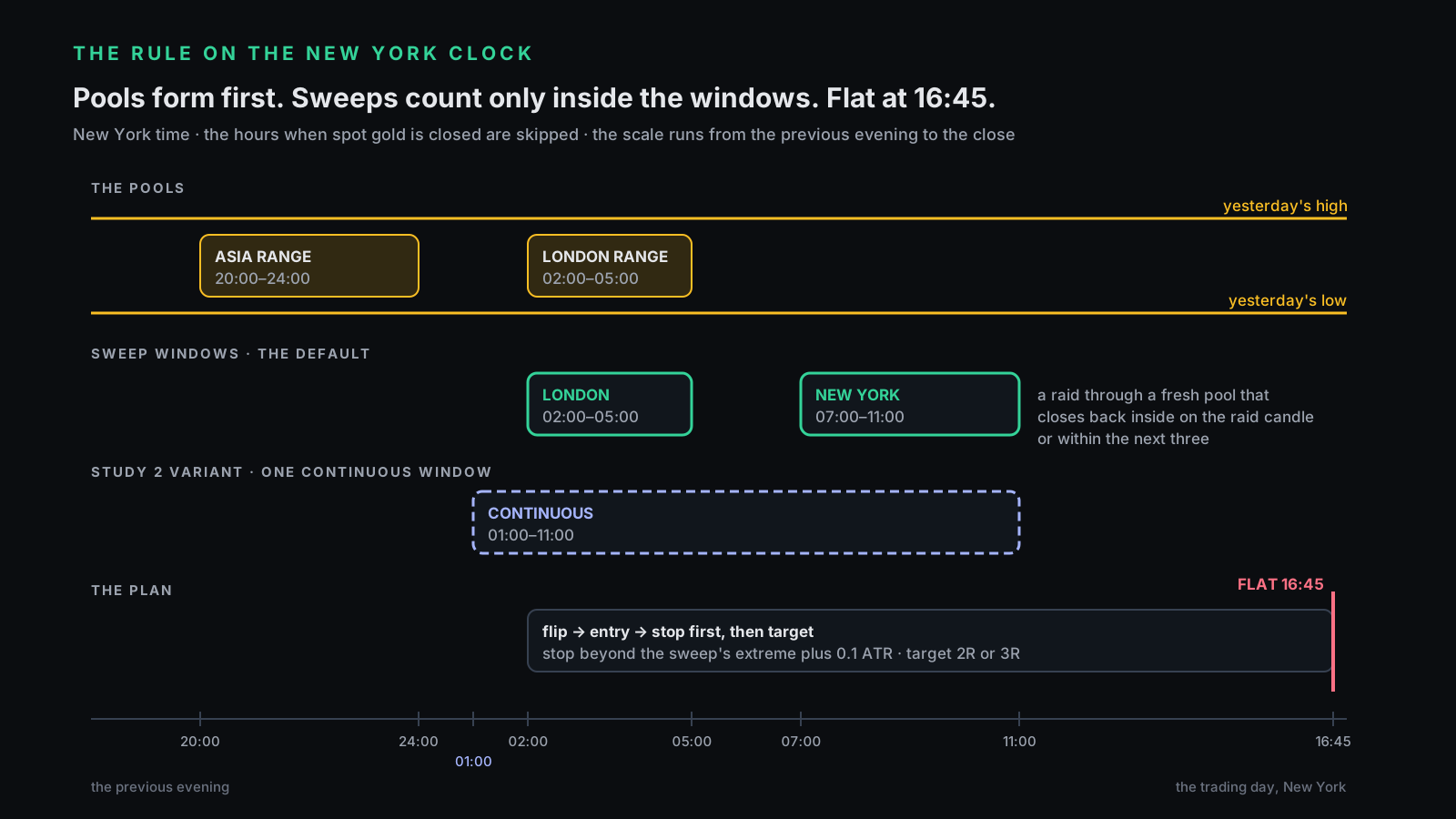
Gold's session liquidity: yesterday's high and low, the Asia range (20:00–24:00 New York) and the London range (02:00–05:00) are the pools. In the London (02:00–05:00) or New York (07:00–11:00) window, a raid through a fresh pool that closes back inside, on the raid candle or within the next three, is a sweep. A close through the nearest opposing fair value gap, at least 1 ATR from the sweep's extreme, is the flip. The entry is that close (or, as a variant, a later close back inside the gap); the stop sits beyond the sweep's extreme plus 0.1 ATR; the target is 2R or 3R; stop first, then target, flat at 16:45 New York. The written contract is in the release (docs/engine-contract.md), with the plan and its dated amendments beside it (docs/measurement-plan.md).
Run it yourself. Gold Sweep Desk is free and open-source (MIT), no signup, and its Strategy Lab is the second file in the same download. Get it on the free page →
How we measured
- The question: does the rule make R after realistic spot-gold costs on 5- and 15-minute candles, in a final period it was never tuned on?
- Data: Binance's XAUUSDT perpetual (public, checksummed archives), December 2025 to August 2026. The rule skips the hours when spot gold is closed. Over July and August, its 15-minute returns had a 0.997 correlation with OANDA:XAUUSD on TradingView.
- Costs: 0.40 an ounce for the round trip (spread and slippage for a spot or CFD gold trader), not Binance's fees.
- Periods: SEARCH January–April 2026, CHECK May–June, FINAL July–August, the final to be run once.
- Written first: the plan, the rule's contract and the engine were fingerprinted (SHA-256) before any result, and the amended plan, the engine and the study script again before Study 2's first result. Changes after that are dated amendments.
- Pass rule: choose on SEARCH (among candidates with at least 30 trades and a profit factor of at least 1.1, the highest net R per trade), confirm on CHECK (net R above zero), then FINAL once: at least 30 trades, net R above zero at base and at doubled costs, a profit factor of at least 1.15, and, for a 15-minute choice, a positive native TradingView run on OANDA:XAUUSD.
Study 1: eight candidates, too few trades
Timeframe (5m, 15m) × entry (flip close, retest close) × target (2R, 3R); a sweep failed on any new extreme before the flip. SEARCH, January–April 2026, after costs:
| Candidate | Trades | Net R | R per trade | Profit factor | Deepest fall | Longest losing run |
|---|---|---|---|---|---|---|
| 5m · flip close · 2R | 18 | +4.85 | +0.27 | 1.59 | 3.52R | 2 |
| 5m · flip close · 3R | 18 | +2.99 | +0.17 | 1.33 | 5.17R | 2 |
| 5m · retest close · 2R | 9 | +7.32 | +0.81 | 4.56 | 1.24R | 1 |
| 5m · retest close · 3R | 9 | +5.67 | +0.63 | 3.76 | 1.24R | 1 |
| 15m · flip close · 2R | 21 | −7.85 | −0.37 | 0.30 | 10.16R | 5 |
| 15m · flip close · 3R | 21 | −7.75 | −0.37 | 0.31 | 10.16R | 5 |
| 15m · retest close · 2R | 14 | +4.58 | +0.33 | 2.00 | 1.78R | 3 |
| 15m · retest close · 3R | 14 | −1.16 | −0.08 | 0.79 | 4.59R | 3 |
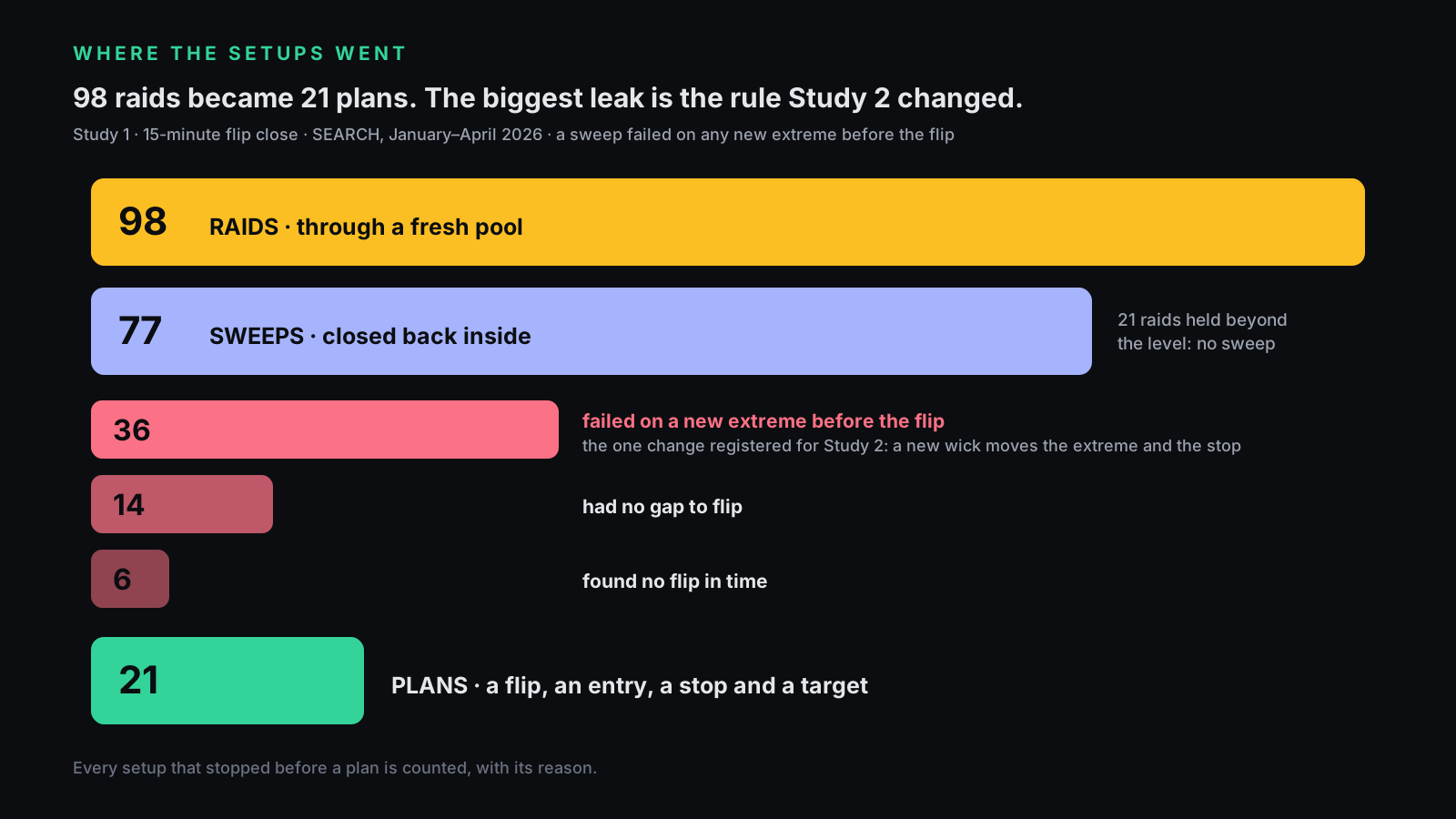
No candidate reached 30 trades, so none could be chosen: no validated edge. The 5-minute retest rows look good on nine trades; nine trades say very little. Where the setups went (15-minute flip close): 98 raids, 77 sweeps, 36 sweeps failed on a new extreme before the flip, 21 raids held beyond the level, 14 sweeps had no gap to flip, 6 found no flip in time, 21 plans.
Study 2: one change, registered before its first result
The most setups were lost to "a new extreme before the flip". A sweep often keeps wicking for a while (36 of the 77 sweeps above did), so we registered one change for every candidate: a new wick moves the extreme (and the stop) and only a close back beyond the swept level ends the setup. We also tried one continuous 01:00–11:00 window beside the two windows, and kept the 2R target for all. SEARCH, January–April 2026, after costs:
| Candidate | Trades | Net R | R per trade | Profit factor | Deepest fall | Longest losing run |
|---|---|---|---|---|---|---|
| 5m · flip · two windows | 20 | +2.52 | +0.13 | 1.27 | 5.57R | 4 |
| 5m · flip · continuous | 40 | +2.92 | +0.07 | 1.13 | 5.32R | 4 |
| 5m · retest · two windows | 9 | +7.22 | +0.80 | 4.51 | 1.24R | 1 |
| 5m · retest · continuous | 19 | +11.89 | +0.63 | 2.65 | 3.63R | 2 |
| 15m · flip · two windows | 21 | −7.85 | −0.37 | 0.30 | 10.16R | 5 |
| 15m · flip · continuous | 34 | −5.26 | −0.15 | 0.71 | 7.56R | 5 |
| 15m · retest · two windows | 14 | +4.59 | +0.33 | 2.01 | 1.78R | 3 |
| 15m · retest · continuous | 16 | +4.18 | +0.26 | 1.75 | 2.36R | 4 |
Only one candidate met the selection rule: 5-minute, flip close, continuous window (40 trades, profit factor 1.13). On CHECK, May–June 2026:
| Candidate | Trades | Net R | R per trade | Profit factor | Deepest fall | Longest losing run |
|---|---|---|---|---|---|---|
| 5m · flip · continuous | 15 | −11.63 | −0.78 | 0.14 | 11.63R | 9 |
It failed the check: no validated edge. Our stopping rule, written in the amendment, says there is no third study on this data. The FINAL period (July–August 2026) was never run for the selected candidate.
The default rule on TradingView's recent history
After both studies, while auditing the product, we ran the default rule (15-minute, flip close, the two windows, 2R) on the recent history TradingView loaded on our charts (on OANDA:XAUUSD 15m, from 30 June 2026). That history overlaps the FINAL period, so we say so here and in a dated amendment to the plan: FINAL is no longer untouched for the default rule, and any future test uses bars after 26 September 2026.
| Chart | Trading days | Plans | Net R after costs |
|---|---|---|---|
| OANDA:XAUUSD 15m | 63 | 12 | +1.9 |
| OANDA:XAUUSD 5m | 20 | 7 | +5.8 |
| BINANCE:XAUUSDT.P 15m | 40 | 11 | +2.5 |
These are twelve, seven and eleven plans. The same 15-minute rule lost 7.85R over 21 trades from January to April. Small samples of one rule can change sign from one period to the next; these rows support no conclusion either way, and they are why the desk shows its own chart's record rather than a claim.
Sixteen candidates were tried in all. A search that looks at sixteen candidates can find good-looking rows by chance alone; that is why the choice has to survive a check period, and here it did not.
What we disclose about ourselves
An earlier build of a related tool (Sweep Desk 1.1) had reported good in-sample gold numbers over a window that overlaps this study's FINAL period. That is why we looked at the sweep-and-inversion family at all. None of this rule's settings were fitted on that window.
What this means for the tool
- The defaults (flip close, the two windows, Study 2's close-back fail rule, 2R, flat at 16:45) are design choices. The tool marks the day's liquidity, the sweep and the flip, and draws a plan you can judge; it does not tell you the plan will work.
- The on-chart record is that chart's own history, counts first.
- Gold Sweep Desk Pro is a set of tools (the game plan before each window, context checks and your own gates, half off at 1R, a multi-market Radar, alerts, a Research Lab) and makes no performance claim.
Check it yourself
The engine is the release's tests/reference/engine.mjs. The pre-registration hashes: plan 6db5cace… (study 1) and 4332aedd… (study 2 amendment), engine 3a764de7… and 2376306d…. The 1.1.0 release ships a later revision of the engine (02c14246…), the one that matched the Pine engine plan for plan on TradingView; re-run on the same archive on 1 October 2026, it reproduces every row of the three study tables above. The data is Binance's public XAUUSDT archive from data.binance.vision.
Hypothetical backtests after the stated costs, not a forecast and not a live record. Not financial advice.