Count your trading subscriptions.
The journal. The charts. The data feed. The screener. The news squawk you muted in March but still pay for.
Somewhere between the third and fourth renewal email, you did the math.
You're paying rent on your own trading history.
Your trade history is yours. The question is whether the tool that reads it is.This piece is the decision, written down honestly: when a subscription journal genuinely earns its monthly fee, when a one-time purchase is the adult choice, what "one-time" must include before it deserves your money — and the three tests that sort real ownership from a subscription wearing a costume. We sell both models, which is exactly why we can afford to tell you the truth about each.
Two requests before we start:
- Save this for the next renewal email that makes you wince.
- Send it to one trader who just discovered their canceled journal took four years of trade history with it.
Skip this if you're already sure
Sixty-second version — the trading journal one-time-purchase decision, compressed: subscriptions and one-time purchases fail in opposite directions. The subscription's failure mode is the lockout — stop paying and you lose access not just to features but often to your own accumulated history, which makes the fee less like rent and more like ransom the longer you stay. The one-time purchase's failure mode is abandonware — you paid once, the developer moved on, and now you own a snapshot that slowly stops working. The fix is the same in both directions: before paying, test what happens on the worst day. For a subscription: what exactly do I lose the day I cancel? For a one-time tool: what proves this still gets maintained, and does it run without the vendor existing? A journal passes when your data exports freely, the tool runs on your machine, and the update history is public and dated. Everything else is pricing theater.
| What traders think | What's actually true |
|---|---|
| "Subscriptions are a scam" | Subscriptions fail one way (lockout); one-time fails the other (abandonware) |
| "One-time = I own it" | A one-time price on a cloud-locked tool is a subscription with extra steps |
| "I'll export my data before canceling" | Export is a feature vendors control; test it before you need it |
| "Lifetime deal = lifetime" | It means the product's lifetime, not yours |
| "The monthly fee is small" | The fee isn't the cost; the hostage dynamics are |
What do trading journals cost? (checked 3 October 2026)
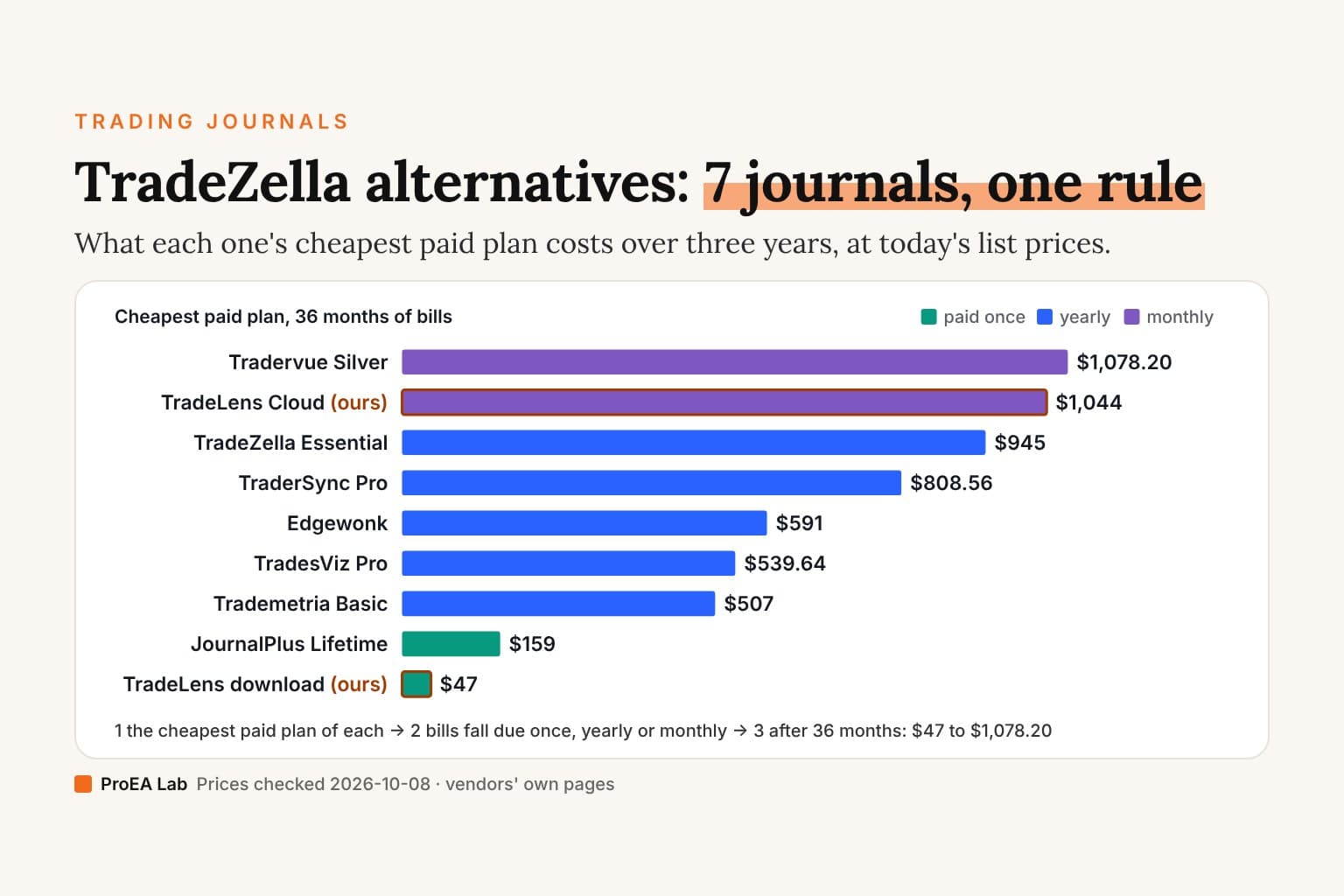
Two journals on this list sell once; the rest rent. These are the prices on each vendor's own pricing page on 3 October 2026, before tax. The 3-year column is our arithmetic on those prices.
| Journal | How you pay | Posted price | 3 years |
|---|---|---|---|
| TradeLens download (ours) | Once | $47 | $47 |
| JournalPlus Lifetime | Once | $159 | $159 |
| Edgewonk | Yearly | $197/yr | $591 |
| TradeZella Essential | Monthly or yearly | $35/mo or $315/yr | $1,260 or $945 |
| TraderSync Pro | Monthly | $29.95/mo | $1,078.20 |
| TradeLens Cloud (ours) | Monthly | $19 the first month, then $29/mo | $1,034 |
Some first years cost less: TraderSync showed up to 25% off a yearly plan on 8 October ($269.52 for Pro, down from up to 60% off a first year on 3 October), and JournalPlus also sells a $99 yearly plan. Higher plans cost more everywhere. The 3-year rent bill for a full trading stack adds an indicator plan.
The price is the boring half of the decision, though. A one-time row only wins if the tool passes the tests below, ours included.
I — The rent trap
The subscription model's quiet genius is that it doesn't have to be good forever — it only has to be slightly too annoying to leave this month. And a journal is the stickiest SaaS there is, because the thing that accumulates isn't configuration. It's your trading life. Four years of trades, notes, screenshots, lessons.
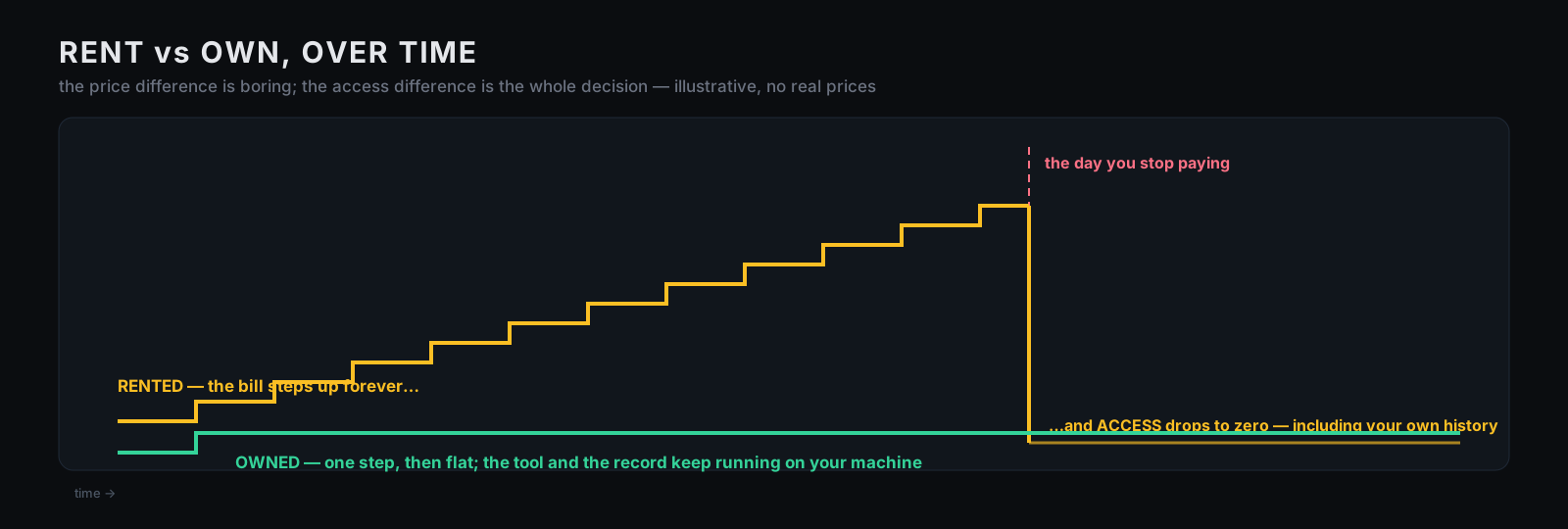
Now read the cancellation page. Most subscription journals downgrade you to read-only at best; some archive your account entirely after a grace window. The features were rented — fine, that's the deal. But the history was yours before the tool ever saw it, and getting it back out is suddenly gated behind an export button the vendor owns, in a format the vendor chose.
Past a certain point you're not paying for the journal. You're paying so your own history doesn't go dark.That's the lockout test, and it's the first question to settle before the price ever matters: what exactly stops working — and what disappears — the day you stop paying? Ask it while you're calm, because you'll otherwise learn the answer while you're not.
II — The abandonware test: what "one-time" must include
One-time purchases have their own graveyard, and pretending otherwise would be marketing. You've seen it: the lifetime-deal tool whose last update predates two MetaTrader builds, the forum thread where the developer's account went quiet in 2024. Buying once is only ownership if what you bought survives the vendor losing interest.
So hold every "one-time purchase" journal against four requirements:
It runs on your machine. Local execution, files you can see. A one-time price on a cloud-locked tool is a subscription with extra steps — the server bill doesn't care what you paid once, and when the vendor stops paying it, your "lifetime" ends.
Your data exports today. Inspect which fields leave the product, in what format, and whether another empty workspace can restore them. Trade CSV, journal notes and attachments may need separate exports. Local storage alone does not establish portability.
The update history is public and dated. A changelog with dates is the closest thing software has to a heartbeat monitor. No public receipts of movement = assume abandonware and price it accordingly.
Best case: the source ships. Then even true abandonment isn't death — the tool is yours to run, fix, and extend for as long as you care. That's the full version of the argument we made in Source, Not Signals, and it's the strongest form of "one-time" that exists.
A one-time price is a claim about the future. Source code, local execution, and a dated changelog are the only collateral a vendor can post.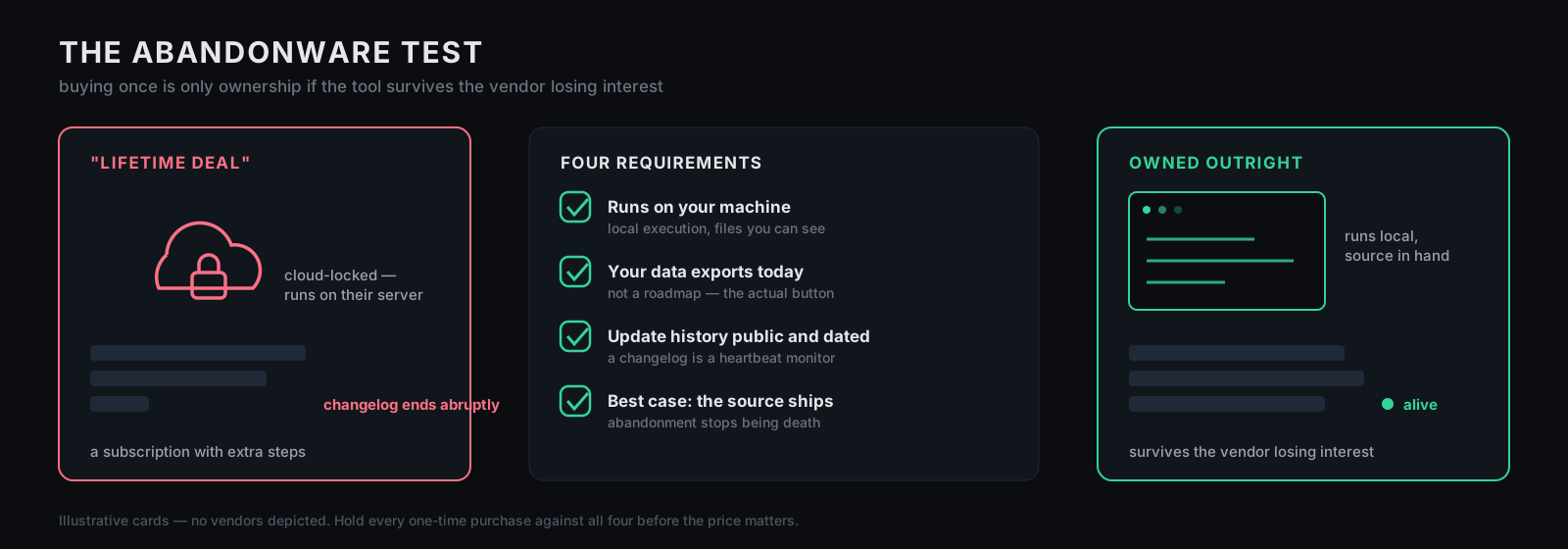
III — The spreadsheet tier, honestly
The cheapest real one-time, no-subscription journal is a template — a Google Sheets or Excel build you buy once for the price of lunch. Fair is fair: for a manual logger with modest volume, a good template is genuinely enough. It's local-ish, it exports by definition, it can't lock you out, and it will never bill you again.
Where the tier caps out is structural, not cosmetic. A sheet can't import your platform history, so every row is typed by hand — and a hand-typed journal inherits the omission lie: the editor is the person with the strongest incentive to skip the ugly rows. A sheet also stores; it doesn't conclude. Your leak sits in the rows, unformed, waiting for an analysis pass that Sunday-you keeps rescheduling. Templates are honest about their price and dishonest about their labor — you're the import engine and the analyst, forever.
IV — When renting wins
Now the fair case for the other side, because the subscription earns its fee in specific, real situations. Sync is genuinely hard — if you trade from a desk, a laptop, and a phone, a hosted journal keeps one truth across all three with zero export/import ritual. Managed AI is genuinely convenient — analysis features that run server-side spare you API keys, model updates, and setup. Delivery needs a server — the always-on layer that pushes a daily digest into your Telegram (we wrote a whole piece on why delivery decides journal survival) has to live somewhere, and "somewhere" costs monthly money whoever runs it. Zero maintenance is a feature — some traders correctly refuse to run software.
If several of those describe you, rent — knowingly, with the lockout question answered in writing. The dishonest move isn't subscribing; it's subscribing by default because the pricing page made monthly feel small.
Rent buys convenience. Owning buys survival. The mistake is not knowing which one you're paying for.V — The 20-minute ownership audit
Minutes 0–5 — The export test. Before paying anyone: find the export. Not the marketing claim — the actual button. Full history, open format, today. If you can't find it in five minutes on the trial, that's the answer.
Minutes 5–10 — The lockout test. Read the cancellation/downgrade policy and write one sentence: "The day I stop paying, I lose ___." If the blank includes access to my own history, price the subscription as history-ransom, not tool-rent.
Minutes 10–15 — The receipts test. Find the changelog. Public? Dated? Moving this quarter? For one-time tools this is the abandonware heartbeat; for subscriptions it's proof the fee funds development, not just servers.
Minutes 15–20 — The arithmetic. Take the one-time price and divide by the subscription's monthly fee — that's the breakeven in months. Now be honest about how many months you'll actually keep journaling (your last three attempts are the data). Sub-year breakevens argue for owning; multi-year with heavy sync needs argue for renting.
Does your journal export preserve the record?
Test a small fictional record before moving real history. A trade CSV can preserve P/L while losing the notes, planned risk or screenshots that made it a journal. On 8 September 2026 we built this reusable acceptance kit and tested ProEA's own source functions first. It is a format/accounting check, not a verified trading account or an independent product review.
Download the complete acceptance kit (ZIP), or inspect its instructions, original timestamped trades, UTC-normalized trade CSV, separate cash ledger, notes/tags/grouping manifest, synthetic text attachment, expected figures and blank acceptance worksheet. Use a disposable workspace and retain the original files.
The fixture has three trade rows, including two exits belonging to one declared position. Gross P/L is USD 0; commission, swap and fees total USD 2, leaving USD −2 net trading P/L. Separate deposits/withdrawals net USD 75: an opening USD 1,000 becomes USD 1,073. The first exit crosses midnight in a fixed +02:00 source clock but remains on the prior UTC date. The sidecar carries planned risk, a Unicode note, tags, position grouping and an attachment reference; it is not an import schema supported by the free MT5 analyzer or a promise that a journal accepts those fields.
| Field or operation | ProEA source-function result, 8 September 2026 |
|---|---|
| Website TradeLens export → generic CSV import | Financial fields, IDs, timestamp instants, SL/TP, volumes and the fixture's simple trade tags preserved after the timestamp correction included in this update |
| Timestamp correction | The original website importer rejected its export's zoned ISO times. The revised importer accepts explicit offsets and up to millisecond precision; legacy naive inputs remain UTC. Invalid dates/offsets are rejected. |
| Locally available download source, version file 1.0.0 | Tested separately; its importer still requires explicit conversion to supported UTC text before restoring the exported times. This website update does not modify the desktop package. |
| Trade comment and magic number | Imported from the fixture, but absent from the tested CSV exporter; they do not survive this export path |
| Planned risk, position grouping, journal notes and attachment references | Not carried by this trade CSV. Keep the sidecar/files separately; restoring them through the product is untested here. |
| Account identity and full workspace restore | Import uses the selected destination account. No live account restore, database duplicate-import check, attachment upload or full-workspace backup was tested. |
The automated website check executes the actual exporter with synthetic rows and feeds its CSV to the actual importer; browser download/network seams are replaced. It tests functions, not a live account or the operating system's file-save behavior. The dated verification record identifies the tested source and limits. A matching row count is only one check. Use the worksheet statuses preserved, transformed, separate export, unavailable or untested and inspect the restored fields. See the import guide's repeatable steps.
Other vendors should be judged by the same test. TradeZella documents trade CSV exports and separate PDF/Lexical note exports. Those are vendor-documented features, not round trips we performed. Ask whether attachments, grouping and your chosen fields restore; do not assume either complete loss or complete preservation from a pricing model.
Where TradeLens sits
The honest ledger, caveats first. TradeLens is our trade journal, and the download edition — launch-priced at $47, one-time — deliberately does not include the rented conveniences: no managed sync, no managed AI, no Telegram delivery. Those are Cloud features, because they need a server, and the download edition's whole point is that there isn't one. If §IV described you, the $47 edition is the wrong buy — read the Cloud paragraph instead.
The download edition provides Python/FastAPI and web source, platform importers and launchers. It runs locally; using an external AI provider with your own key has separate data-flow and provider considerations. Source access and the dated TradeLens changelog are inspectable, but local possession is not an export pass. Our acceptance test above records the specific fields that survive, the desktop timestamp transformation, omitted fields and untested restoration steps. Keep backups of both the original database and any exported files according to the edition's instructions; a trade CSV is not a complete workspace backup.
TradeLens Cloud is the rent option — $29/mo ($19 your first month), cancel anytime — and it exists for exactly the §IV reasons: sync across devices, a managed AI Coach with no API key to bring, and the always-on delivery layer (daily digest, trade autopsies, Telegram DMs). Same journaling core either way — Cloud adds managed sync, AI, and delivery on top. The honest map: own the desk if you run one machine and want your history lockout-proof forever; rent it if multi-device sync and managed delivery are worth a monthly fee to you. Evidence, not prophecy: neither edition claims to make you profitable — the claim is that your history stays yours and gets read.
Disclosure
This is education about pricing models, not a promise about outcomes. Every vendor claim above is checkable on the linked pages, and the one question worth asking any journal vendor — including us — is the lockout question: "What exactly do I lose the day I stop paying?" A vendor who answers in one plain sentence respects you. A vendor who answers with a pricing-page link already told you.
Your first 20 minutes
Run the audit on the journal you use right now — the export test first. If the export works, save one full backup today and calendar it monthly; ownership starts with possession. If it doesn't work, you've learned the most expensive fact on this page while it's still cheap. Then run the same four tests on whatever you're considering next — ours included; the pages are linked above and the tests take twenty minutes.
The fee was never the point.
The history is the point.
Rent the conveniences if they earn it.
But own the record. It's the only asset in your trading that only compounds.