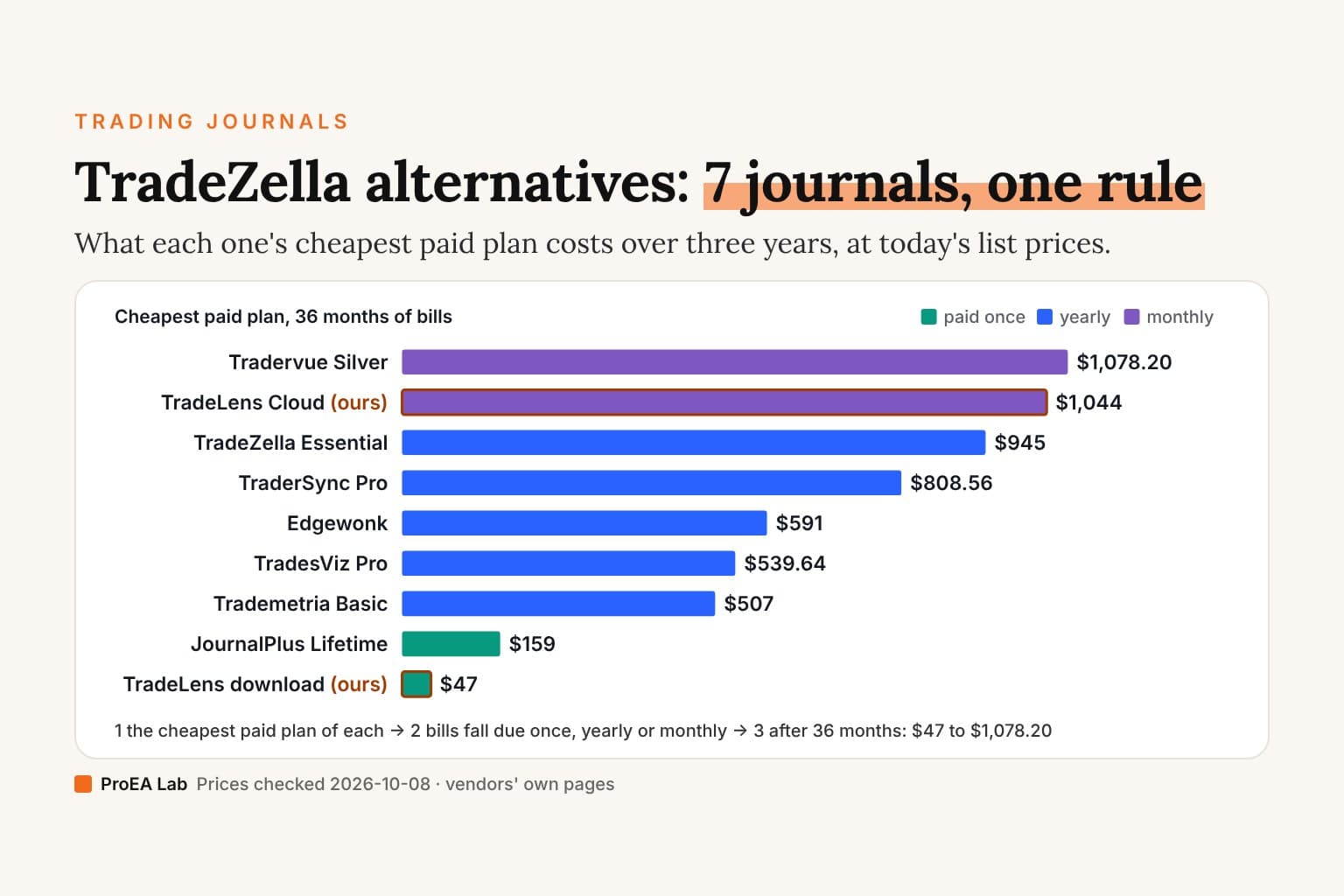
What can you still buy once? Fewer trading tools than you'd think, and the rent adds up. At list prices on 3 October 2026, LuxAlgo's cheapest paid plan costs $899.64 over three years. The cheapest journal plans cost $591 (Edgewonk) to $1,260 (TradeZella, month to month). One of each comes to $1,490.64 or more. Our Complete Suite is $97, paid once: 15 products, including our Pine v6 tools and the TradeLens journal, with full source. TradeLens alone is $47.
Search "trading tools one-time purchase" and the results pile up: broker ads and free-calculator roundups. Subscription reviews follow. Almost nobody answers the actual question.
There's a reason. The answer barely exists.
Edgewonk is the cleanest example. Traders once cited it as the one-time-license holdout. Its own pricing page today pairs "Edgewonk comes with an annual subscription" with "$197 billed every 12 months."
The last famous one-time tool went recurring.
ProEA's position belongs up front. We sell the other kind: an EA, indicators and a journal, each sold once with full source. We also sell a monthly membership, so we're not purists, but every product can be bought outright.
This article argues toward our business model. Every competitor number below comes from the vendor's own page, checked on 3 October 2026. You can check the receipts and weigh the argument yourself.
The question this page answers: what does a trading stack cost over three years if you rent it, what does the fine print say in the vendors' own words, and what can you actually still buy once?Why is almost every trading tool a subscription?
Recurring revenue is worth more than one-time revenue to the vendor. A subscriber pays every month until they act to stop; a buyer pays once and must be won again. Investors price software companies on that difference.
No conspiracy is required. Just watch who benefits. Predictable revenue is the vendor's feature, not yours.
Your feature should be the roadmap a subscription funds. Sometimes, it truly is.
Those cases come at the end. A fair argument has to leave room for them.
What does renting a trading stack cost over 3 years?
The bill is blunt. Below is each vendor's cheapest paid plan, at the price on its own pricing page on 3 October 2026, before tax. The 3-year columns are our arithmetic on those prices, nothing more.
| Tool and plan | Their posted price | 3 years, month to month | 3 years, annual billing |
|---|---|---|---|
| LuxAlgo Essential — indicators, charting | $24.99/mo, or $224.91 the first year, then $299.88/yr | $899.64 | $824.67 |
| TradeZella Essential — journal | $35/mo or $315/yr | $1,260 | $945 |
| TraderSync Pro — journal | $29.95/mo | $1,078.20 | Not totaled (renewal price not stated) |
| Edgewonk — journal, one plan | "$197 billed every 12 months" | No monthly plan | $591 |
Three caveats. LuxAlgo's lower first year was a promotion its page said would end within days; renewals bill at the standard rate. TraderSync's annual offer changed within a week: up to 60% off the first annual plan on 3 October, up to 25% off ($269.52 a year for Pro) on 8 October, so we don't total it. Edgewonk's $197 is the price outside the EU and UK, where VAT is added.
Higher plans cost more. LuxAlgo Premium is $39.99 a month: $1,439.64 over three years. TradeZella Pro, its cheapest plan with unlimited Trade Replay, is $59 a month or $531 a year: $2,124 or $1,593. TraderSync Premium is $49.95 a month: $1,798.20.
Replay correction, 5 October 2026: TradeZella's official pages disagree about limited replay on Essential. Our review documents both sources; the unlimited-replay comparison above is consistent with both.
Put one indicator plan beside one journal. On the cheapest paid plans at list price, three years cost $1,490.64 (LuxAlgo Essential with Edgewonk) to $2,159.64 (LuxAlgo Essential with TradeZella Essential, month to month). That's not an attack line.
Just sticker-price multiplication.
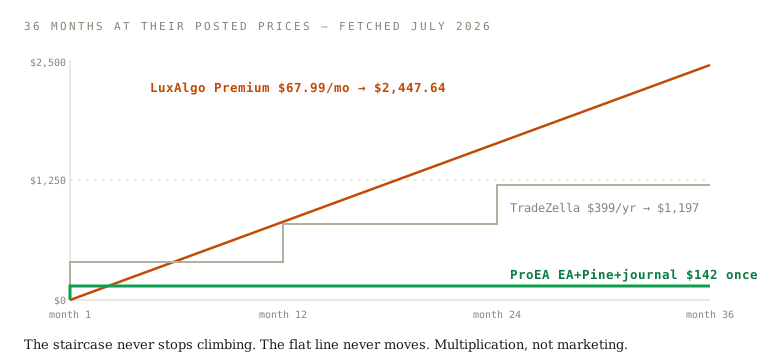
For scale: our Complete Suite is $97, once. It holds 15 products: the MT5 EA with full source, the 11-tool Pine v6 stack and the TradeLens journal, plus our strategy lab, paid desks, Pine Pro Library and AI starter packs. Year two costs nothing.
It is not the same purchase. A LuxAlgo plan pays for a hosted charting platform, market data and AI credits, with new features as they ship. Our $97 buys files you keep, with nothing hosted. Want our journal hosted? That's rent too: TradeLens Cloud is $29 a month after a $19 first month.
The trade-offs are real. We get to them later.
The fine print that compounds
Sticker prices get the attention. These clauses do the compounding, quoted from the vendors' own pages on 3 October 2026.
LuxAlgo's Terms of Service (§6): promotional pricing "applies only to the initial payment and is non-recurring; renewals, including annual auto-renewals, are billed at the then-current standard rate for your plan." The 30-day money-back guarantee "covers only the first subscription payment made on your account," and "Charges for renewal periods are not eligible for refunds, pro-rated credits, or retroactive application of promotional pricing."
TraderSync's policy page: "All payments made are non-refundable and we do not offer pro-rated refunds." It adds: "TraderSync is not responsible for continued subscriptions should a client forget to cancel their account. It is the customer's responsibility to confirm the cancellation."
Its pages also state a real 7-day free trial. Annual pricing showed "Save up to 25% when paying for a year" on 8 October; on 3 October it was "Up to 60% off" the first annual plan.
TradeZella's Terms of Service (§22): "TradeZella has a no refund policy after sign-up. All payments made are final and non-refundable." Canceling stops the next renewal; the paid period runs out. An earlier version of this page said we found no published refund policy. We had missed the Terms page, which loads inside TradeZella's web app. Our review has the details.
Edgewonk, credit where due: a real "14-day, 100% money-back guarantee," printed on the pricing page, and a price it says you lock in for life. The clause that matters sits in its Help Center: after canceling, "you will lose access to all features. You will also lose access to all trade screenshots and all notes." The export won't carry them out either: "We don't export all data like screenshots, notes, etc." Reactivating the subscription later brings the journal back.
Read that one again. Years of your own trade notes and screenshots, locked inside a subscription and left out of the export. That's not a pricing problem. That's an ownership problem.
What still exists one-time in 2026?
The landscape still has options beyond our catalog.
Free tiers set the baseline. LuxAlgo's Free plan has no time limit and includes its free indicator Library. We said so in our review of them, and it remains true. Our own desks are not in this group: their Pine source now comes in Pine Pro Library, a one-time purchase that the Complete Suite includes.
TradingView's free plan charts most things a beginner needs. Broker platforms cost nothing. Before buying anything, anyone's anything, exhaust these.
Lifetime licenses survive at the edges. JournalPlus sells lifetime access to its journal for $159, or $99 a year, with a 7-day money-back guarantee, per its homepage on 3 October 2026. Before paying for any lifetime deal, ours included, run the ownership audit: where your data lives, whether it exports, and whether the changelog still moves.
Source code you own is another category. It's the one we sell in, and why the price can be one-time.
With MTR, you get the MT5 source itself; the Pine stack ships all 11 scripts readable. The TradeLens download keeps your journal in one local SQLite file on your machine.
Cancel nothing, because there's nothing to cancel. Nobody else holds the file, so your notes can't be taken back.
Each carries a 7-day refund window before download, in writing, on its page.
When is the subscription honestly the better buy?
Four cases hold up under the same standard we applied to LuxAlgo and TradeZella.
You want a roadmap. Subscriptions fund new features monthly; a one-time tool is what it is on the day you buy it. If you want a suite that keeps growing, rent it.
You want community and support scale. Big subscription vendors run big Discords and course libraries. They also hold live events.
A source file doesn't come with 20,000 neighbors.
You churn tools quarterly. If you realistically try and abandon systems fast, one cheap month beats one permanent purchase. Rent long enough to test, then cancel before the renewal, per the clauses above.
You'll never open the code. Owning source you'll never read means paying for verification you'll never do. That still has value: you could audit it or pay someone to. Be honest about whether you value it.

If none of those fit, the arithmetic in §2 is the whole argument. You trade MT4/MT5 and keep tools for years; your data and indicators should outlive any vendor's billing system.
Month 37
The whole argument fits in one multiplication: monthly price × 36. Put the number on paper. Then ask what you own at month 37.
An answer of "the newest version of a tool I love using" supports subscribing with a clear head. An answer of "nothing, and my notes are inside" points straight back to the Edgewonk clause. Price accordingly.
Every tool is cheap per month. Almost nothing is cheap times thirty-six.