For a USD account and a 100-ounce XAUUSD contract, lot size = risk budget in USD ÷ (entry-to-stop price distance in USD × 100), before costs. Round down to your broker's permitted volume step. If the result is below its minimum trade size, no permitted size fits that budget. Our XAUUSD lot size calculator starts with that example and has a broker-specification mode for different contract ounces, volume limits and entered costs.
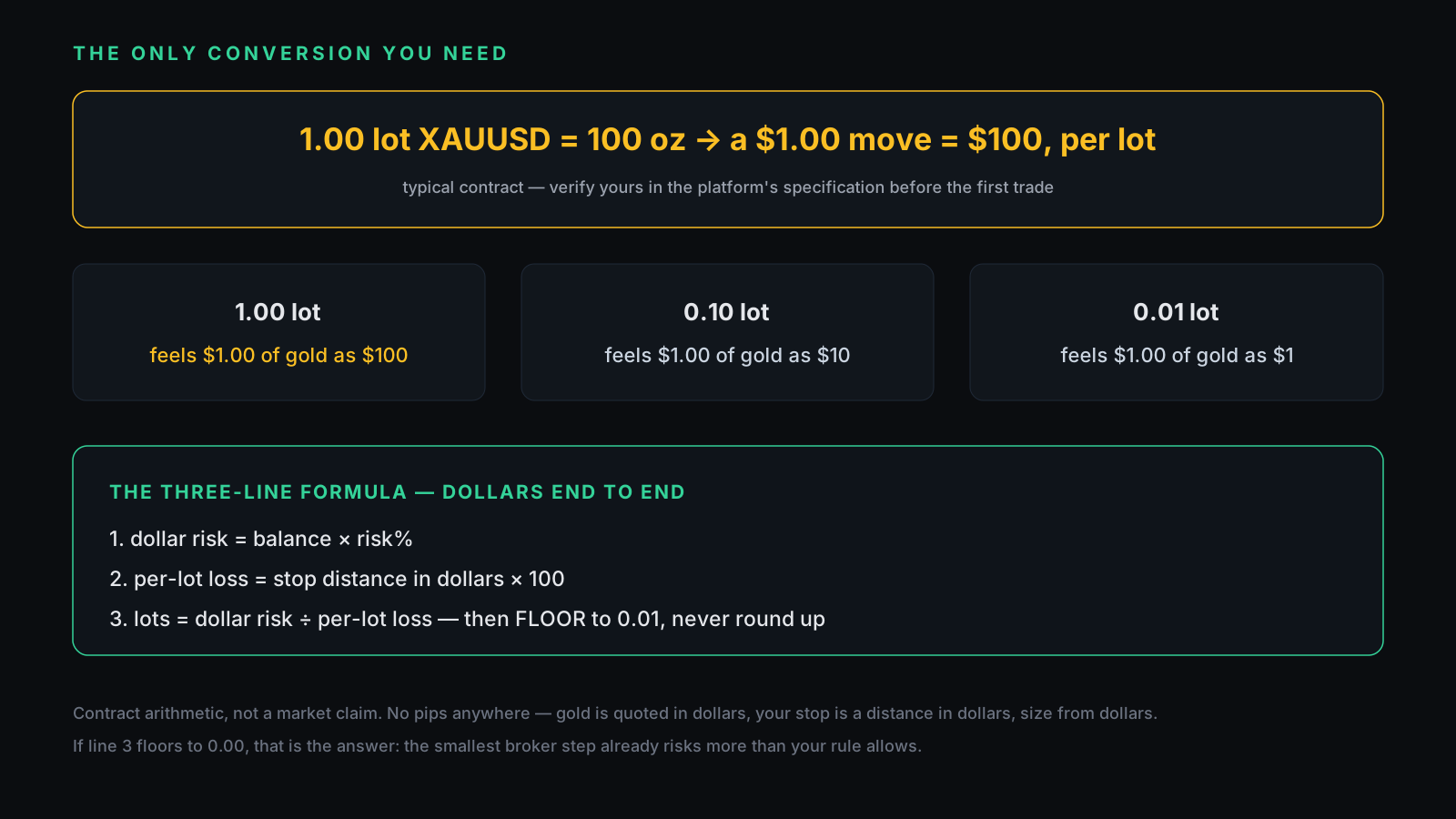
Under that contract assumption, 1.00 lot represents 100 ounces and 0.01 lot represents 1 ounce. A $1 price move changes their value by $100 and $1 respectively, before costs. Check your broker's contract size, minimum volume and volume step; these are instrument settings, not universal XAUUSD rules. MetaTrader 5: symbol specifications.
The formula estimates price-distance risk. Fees, spread not already included in your entry/stop prices, slippage and gaps can increase the actual loss. A non-USD account also needs currency conversion; flooring the lot size does not guarantee a maximum loss.
| Lots | Ounces (100-oz contract) | Per $1 move in gold |
|---|---|---|
| 1.00 | 100 oz | $100 |
| 0.10 | 10 oz | $10 |
| 0.01 | 1 oz | $1 |
Worked-example arithmetic, not market data or a broker profile. Check your broker's contract size, minimum volume and step.
Read as text
- Budget: 1% of $10,000 is $100. With a $8 stop, each 0.01 lot (1 ounce) risks $8, so 1.00 lot risks $800.
- 12 steps of 0.01 fit under the line: 0.12 lots, risking $96 before costs (raw 0.125 lots).
- Rounding up to 0.13 lots would risk $104, over the $100 line. Floor, never round.
How this window was chosen: The article's four worked examples: a USD account, 1% risk, a 100-ounce contract, 0.01-lot minimum and step, no spread, commission or slippage. Each number comes from the same function as the XAUUSD lot size calculator, which floors to the step and returns 0.00 when even the minimum exceeds the budget.
How do I calculate XAUUSD lot size?
Use USD of price distance, rather than an undefined number of gold "pips." For a USD account: risk budget = balance × risk percentage ÷ 100; per-lot price-distance loss = absolute difference between entry and stop × contract ounces; raw lots = budget ÷ per-lot loss. Choose the largest permitted broker volume at or below that result. With a 100-ounce contract and a 0.01-lot step, a $100 budget and an $8 stop give 0.125 raw lots, floored to 0.12 lots, or $96 before costs. In the free calculator, select Use my broker specifications and estimated costs when your contract, volume settings or cost assumptions differ.
| What the forex habit assumes | What XAUUSD actually is |
|---|---|
| "A pip is a pip everywhere" | An undefined gold "pip" can be confused with a tick, point, or another price increment |
| "1 lot ≈ $10 per pip" | On a 100-oz contract, 1.00 lot → $100 per $1.00 of price movement |
| "30-pip stop, like always" | Stops live in dollars of gold price — and gold covers dollars quickly |
| "Round 0.125 lots up to 0.13" | Round down to a permitted volume to stay within the calculated price-distance budget |
| "The calculator always gives a size" | Sometimes the honest size is 0.00 — don't take the trade |
I — Why gold sizing burns forex-natives
On EURUSD, the universe agreed decades ago: a pip is the fourth decimal, one pip on one standard lot is about ten dollars, and every position-size formula on the internet quietly assumes it.
Gold terminology needs an extra check. A price distance of $0.01, $0.10 and $1.00 describes three different moves; treating them as interchangeable "pips" creates a tenfold or hundredfold error. Your platform's tick size and point size have specific definitions. Read the symbol specification before translating either into a monetary value.
The fix is to stop translating. Gold is quoted in dollars; your stop is a distance in dollars; size from dollars directly. No intermediate unit, nothing to mis-define.
II — The one number: $100 per dollar, per lot
The examples use 100 ounces per 1.00 lot, a contract size documented in OANDA's gold specification example (XAUUSD: 100 oz per lot, 0.1 lot = 10 oz; checked 2026-10-09). That document also illustrates why minimum trade size must be checked separately. Your broker's symbol specification takes precedence. Under the 100-ounce assumption:
A $1.00 move in the gold price changes a 1.00-lot position by $100. A 0.10 lot feels it as $10. A 0.01 lot, where that volume is permitted, feels it as $1. These are USD price changes before costs and account-currency conversion.
On that contract, each lot changes by $100 for every dollar gold moves. A $12 stop distance on 1.00 lot is $1,200 of calculated price-distance risk. The same stop on 0.01 lots is $12. The contract is the lever; the lot size is where you grip it.
One honest caveat, stated the way our own calculator's source code states it: 100 oz is the typical contract, not a law of physics. Some brokers and account types differ. §"The 20-minute check" shows you where to verify yours — do it once, before the first trade, not during it.
How much is 1 lot of XAUUSD? (and the "pip value" trap)
With the 100-ounce contract assumed here, one lot's notional value is gold price × 100: at hypothetical prices of $2,000 and $3,000, that is $200,000 and $300,000 respectively. The margin your broker requires is a separate calculation; it does not change the contract exposure.
And the pip value everyone searches for? First define the price increment. Here are three possible increments run through the same 100-ounce arithmetic, before costs:
| If a "pip" means | Per pip, 1.00 lot | Per pip, 0.01 lot |
|---|---|---|
| $0.01 of price | $1 | $0.01 |
| $0.10 of price | $10 | $0.10 |
| $1.00 of price | $100 | $1 |
Three answers, one instrument. That table isn't for memorizing; it's the reason this article refuses the unit. Size in dollars and every row collapses back into the one number you already know: $100 per dollar of movement, per lot.
Which entry and stop prices should I enter?
Use the prices at which you plan to open and close the position, not two points on a chart without checking which quote it shows. MetaTrader describes buys at Ask and sells at Bid; a long position's stop-loss condition is checked against Bid, and a short position's against Ask. The trigger price is not a guaranteed fill. MetaQuotes: deals and stop-loss orders.
Here is a hypothetical long CFD calculation, not a current gold quote or trade recommendation. Keep the USD 10,000 balance, 1% budget, 100-ounce contract and 0.01-lot step. Suppose the quote is Bid 3,000.00 / Ask 3,000.30, and the planned entry is 3,000.30 with a planned stop exit at 2,995.00.
- Execution-price distance: 3,000.30 − 2,995.00 = $5.30 per ounce, not the $5.00 between the starting Bid and the stop.
- Loss per lot: 5.30 × 100 = $530, excluding commission, slippage and other unentered costs.
- Size: $100 ÷ $530 = 0.188679… lots; floor to 0.18 lots, or $95.40 of estimated loss under those assumptions.
In the calculator's price-input example, choose Entry and stop prices, then Buy, and enter 3000.30 and 2995.00. The $0.30 opening spread is already inside that $5.30 distance. Adding the same $0.30 as an extra allowance would count it twice. Any allowance for a worse fill or another cost absent from those prices is a separate assumption. Check your symbol's actual contract, permitted volume and order conditions before applying the arithmetic.
III — The formula, and four worked examples
Three lines for the worked examples below: USD account, 100 ounces per lot, minimum volume and volume step both 0.01 lot; costs excluded.
- Dollar risk budget = balance × risk percentage ÷ 100.
- Per-lot price-distance loss = absolute entry-to-stop distance in USD × 100.
- Lots = dollar risk budget ÷ per-lot loss — then floor to 0.01 for this example. For another broker, use its permitted volume step and minimum.
Four accounts, same 1% rule, real arithmetic (these are the exact outputs of the calculator — its math is a public, tested function):
| Balance | Risk (1%) | Stop | Per-lot loss | Raw ÷ | Size |
|---|---|---|---|---|---|
| $2,000 | $20 | $5.00 | $500 | 0.040 | 0.04 lots |
| $10,000 | $100 | $8.00 | $800 | 0.125 | 0.12 lots — not 0.13 (§IV) |
| $500 | $5 | $4.00 | $400 | 0.0125 | 0.01 lots (price-distance risk $4 = 0.8%) |
| $300 | $3 | $6.00 | $600 | 0.005 | 0.00 — no trade (§V) |
Notice what the table does at the edges. It never rounds 0.125 up to 0.13. It hands the $500 account less risk than allowed rather than more. And on the last row it refuses outright — which deserves its own section, because it's the answer most sizing content is unwilling to print.
IV — Floor, never round
Take the $10,000 row. The raw division says 0.125 lots. Ordinary rounding says 0.13 — it's closer, after all.
But walk the dollars: at 0.13 lots, an $8.00 stop represents 0.13 × 100 × 8 = $104 before costs. You budgeted 1% — $100. The rounded-up size exceeds that price-distance budget by 4%. Floored to 0.12, the same calculation gives $96. Execution costs and a fill beyond the stop can still push the actual loss above the budget.
That's why flooring isn't a style choice; it's the only direction that cannot lie to you. Rounding up means "risk a little more than I said" — and a sizing rule that drifts upward isn't a rule, it's a mood with a spreadsheet. (Our calculator's source floors with deliberate float-safety, for the same reason its comments explain: on certain ordinary inputs — a $2,900 account, 1%, a $1.00 stop — naive computer arithmetic lands one broker-step below the honest 0.29. The code corrects the computer's error without ever correcting yours upward. Pedantic? Yes. That's the point.)
Rounding up is a tiny lie told at position size — and position size is where tiny lies compound.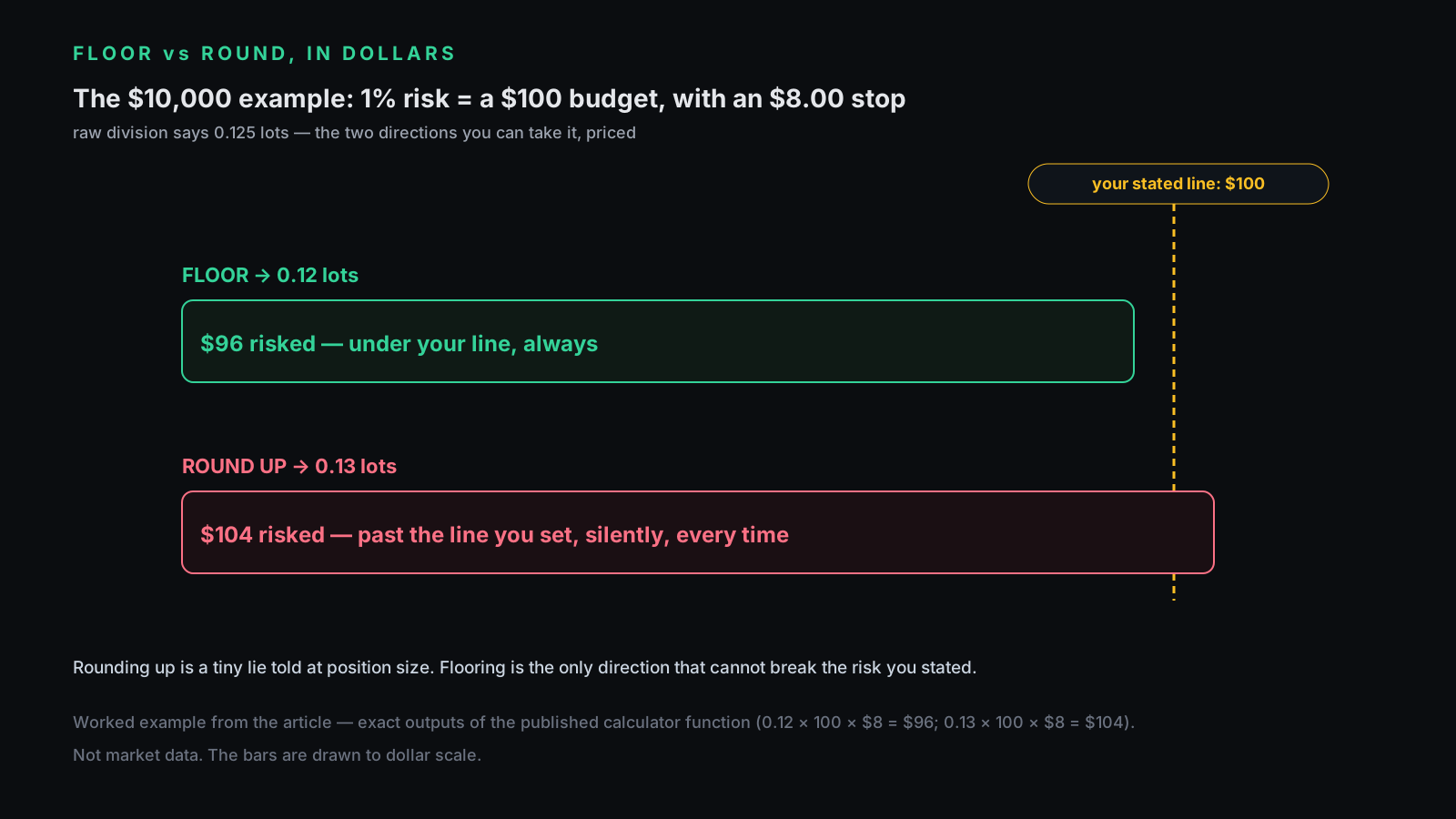
V — "Stop too wide" is an answer
The $300 row: a $6.00 stop represents $600 per lot, so a 1% budget ($3) buys 0.005 lots. With the example broker's 0.01 minimum, the smallest permitted size represents $6 before costs, twice the budget.
Every calculator faces this moment and most of them flinch: they print 0.01 anyway, because "0.00" feels broken. Ours prints the refusal in plain language — the smallest possible position already risks more than you allowed — because that sentence is the correct output. The account isn't too small to trade; it's too small to trade this stop on this instrument at this rule. The honest options are structural: a tighter stop that still respects the setup, a smaller risk instrument, or patience while the account grows. "Just take the 0.01" is the fourth option, and it's the one that turns 1% rules into 2% realities, one polite exception at a time.
Gold makes this collision common on small accounts, structurally: its price distances are large in dollars, and every dollar costs $100 a lot. That's not a reason to avoid gold. It's a reason to size it with a calculator that's allowed to say no.
VI — Choosing the risk percent
The formula sizes a trade; it doesn't pick the 1%. That number comes from a different question — how many consecutive losses can this account absorb while I keep executing? — and it's the question we simulated at scale: the difference between risking 1% and 5% per trade isn't linear, it's the difference between variance you survive and variance you don't. Short version for gold specifically: volatility tempts oversizing ("it moves so much, one good trade pays the week") and punishes it by the same mechanism. Pick the percent from your survival math, write it into your journal's rules so plan_followed can police it, and let the formula do the rest. The formula is the easy part. Keeping the percent honest is the trade.
The 20-minute check
Start with the blank specification card — printable HTML or CSV worksheet. Keep the completed copy locally; it contains no verified broker presets.
Minutes 0–5: open MT5 Market Watch → your exact symbol → Specification. Record the broker/account type, symbol suffix, checked date, contract units, tick size/value, volume minimum/maximum/step and account/profit currencies. Minutes 5–10: for a USD account and gold quoted in USD per ounce, enter the verified contract ounces and volume settings in the calculator's broker mode. If currencies or units differ, resolve them separately; this calculator does not convert currencies. Minutes 10–15: enter additional price allowance only for costs absent from the entry/stop prices, and opening-plus-closing commission per 1.00 lot. Compare the breakdown with your hand calculation. Minutes 15–20: check a below-minimum example, then examine the separate order and margin checks below. A demo calculation does not verify live fills.
A permitted size can still be a rejected order
Reproduce this hypothetical case in the existing calculator: USD 10,000 balance, 1% risk, USD 5-per-ounce stop, 100 ounces per lot, minimum/step 0.01 and maximum 100 lots. Before costs the estimate is 0.20 lots. Add USD 0.50-per-ounce allowance and USD 6 round-trip commission per lot: per-lot loss becomes (5 + 0.50) × 100 + 6 = USD 556. Flooring 100 ÷ 556 gives 0.17 lots, with estimated stop loss USD 94.52. Change only the minimum to 0.18: no permitted size fits. These are teaching inputs, not a broker profile.
That USD 94.52 is a planned loss under the inputs, not margin required to open the order. The browser does not check collateral. A separate terminal margin estimate can differ because the symbol's calculation mode, account settings and existing positions affect it. Do not substitute a risk budget for a margin check. MetaQuotes: margin calculation methods.
If the terminal rejects an order, read the actual error and separately check: volume (per-order min/max/step and total same-direction position/pending-order limit), price restrictions (stops level, valid price increments and any freeze restriction), availability (trade mode, order type and session), and margin (required versus free margin under current settings). The worksheet keeps these checks separate. A calculator result does not certify order acceptance. MetaQuotes: symbol specifications.
Where we sit
Bias, priced: the lot-size calculator is free, client-side, and this article is its documentation — the same three-line formula, the same floor, the same refusal sentence, all in a tested public function; the rest of the free tools run the same way, in your browser, nothing uploaded. And in the same lane, transparency-first: MTR, our gold EA, ships as full source — a different animal entirely, a hedge-grid engine rather than this article's fixed-fractional formula, which is exactly why it ships readable: you open the files and see how it sizes before you run it, instead of extending a promise. The formula in this article, though, belongs to nobody. It's free. It was always free.
Disclosure
The worked examples assume a USD account, a 100-ounce XAUUSD contract and a 0.01-lot minimum and step. They exclude fees, slippage and gaps, and are calculations rather than market observations. Verify your broker's specification and account-currency conversion before using them. A stop order and a floored size do not guarantee the loss will stay within the calculated amount. We sell tools in this lane (a free calculator, a source-available EA). If a worked example disagrees with the calculator under the same assumptions, email support@pulltrade.app.
Your first 20 minutes
Tonight: run the 20-minute check on your broker. Memorize the number. Write your risk percent where your journal can see it. Then, before the next gold trade, three lines of arithmetic or one calculator visit — and if the answer is 0.00, take the answer.
Gold doesn't punish small accounts. It punishes unconverted habits — at $100 per dollar, per lot.Use this animation on your site.
Frequently asked questions
How many ounces is 1 lot of XAUUSD?
100 troy ounces on a standard gold contract, so 0.10 lot is 10 ounces and 0.01 lot is 1 ounce. Some brokers and account types use a different contract size: check your symbol's Specification in MT5 before you size.
How much is 0.01 lot of gold worth per $1 move?
$1 on a 100-ounce contract: 0.01 lot is 1 ounce, so each $1 the gold price moves changes the position by $1 before costs. 1.00 lot moves $100 per $1.
How do I calculate lot size for XAUUSD?
Risk budget in USD ÷ (stop distance in USD × 100), then round down to your broker's 0.01 step. A $100 budget with an $8 stop gives 0.125, so 0.12 lots, which risks $96 before costs.
What lot size should I use for a $500 gold account?
At 1% risk ($5) and a $4 stop, 0.01 lot, which risks $4. With a $6 stop even 0.01 lot risks $6, more than the budget, so the honest answer is no trade at that stop.
Should I round lot size up or down?
Down. Rounding 0.125 up to 0.13 lots turns a $100 budget into $104 at the stop; flooring to 0.12 keeps it at $96.