You asked AI the wrong question.
Everyone does.
Where's gold going? Should I buy? Is this setup good?
The AI answered — confidently, beautifully, uselessly.
Because the market did what the market does, and ignored the paragraph.
We've spent a few articles on why that fails — most recently why an AI forecast can be right and still not pay.
All true. And it's quietly convinced a lot of traders that AI is useless for trading.
It isn't.
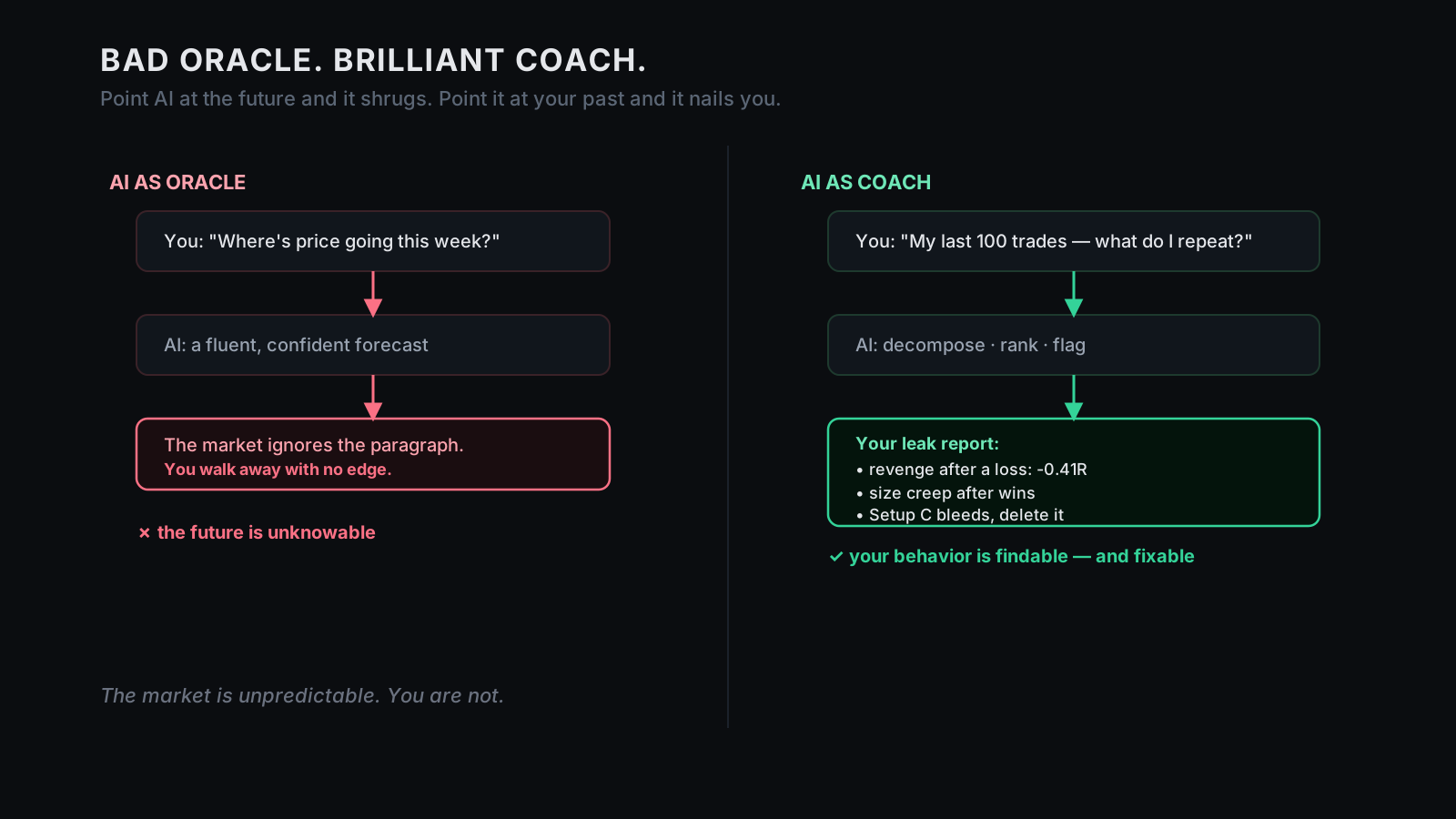
It's just been pointed the wrong way. Because buried in your platform — in your journal, in the trades you already took — there's a better question. Not what will the market do next? but what do I keep doing? That one AI can actually answer, not because it knows the future, but because your past is sitting right there in rows: entry, exit, size, stop, P&L, setup, time. The trades you took calm and the ones you took tilted. The setups that make money and the ones that only feel good. The hour of the day when you become a different species, and the Friday-after-a-red-day cluster where your discipline quietly leaves the building and takes the risk plan with it.
You think your losses are emotional. They are. But once they're logged, they become data — and data can be decomposed. That's the constructive AI use case most traders miss: AI is a terrible fortune-teller and a brilliant forensic coach. It can't tell you where price is going with any useful certainty, but it can tell you, very clearly, that after two losses you size up, reach for lower-quality setups, and turn an ordinary red day into a small documentary about poor supervision. That's not magic. That's your own history, finally refusing to be edited by memory.
The market is unpredictable. You are not.
Save this before your next "what should I trade?" prompt. Send it to the trader who's convinced they need a better prediction — when they may only need to find the leak.
Reported win-rate zone for revenge-tagged trades in journal analysis — versus roughly 50–60% on planned setups.
TradeZella ↗How much larger the average revenge-trade loss runs than a planned-trade loss — size climbs exactly as discipline drops.
TradeZella ↗Deterministic leak-detectors a modern AI journal coach runs across risk, behavior, timing, and edge to surface your highest-impact mistakes.
TradesViz AI Coach ↗The 60-second version
AI isn't useful because it can tell you what to trade next. It's useful because it can analyze what you already traded. Most traders never review properly — they remember the big win, explain away the ugly loss, forget the revenge trade, and call rule-breaking "context," oversizing "confidence," and a random entry "discretion." Then they wonder why the same month keeps repeating with different candles.
A trade journal turns that mess into rows, and AI turns the rows into a pattern. The goal is not to ask "why am I losing?" — that gets you a horoscope. The goal is to ask it to break your history into buckets, find which setups have positive expectancy, find which sequence causes leaks, find when your size creeps, and find where you stop following your own rules. That gets you evidence. The market is noisy; your behavior isn't — it repeats, and that's exactly why AI can find it.
| The wrong AI question | The better AI question |
|---|---|
| "Where will price go?" | "Where do my losses cluster?" |
| "What should I buy?" | "Which setup has positive expectancy?" |
| "Why did I lose?" | "Break my losses by setup, regime, time, and sequence." |
| "Am I a good trader?" | "Which rule violation costs me the most R?" |
| "Should I keep this strategy?" | "What's expectancy by setup and market condition?" |
| "Motivate me." | "Show me the leak I keep repeating." |
I — Losses aren't just feelings; they're a dataset
A bad trade feels personal, and that's the problem. You remember it as shame, frustration, anger, or "I knew better" — and none of those are useful units. A journal changes the unit. Instead of "I messed up again," you get a sentence like after a losing trade my next trade runs −0.31R, but when I wait one session it returns to +0.18R. Now the problem isn't your identity; it's sequence — and sequence is fixable. Instead of "I have discipline issues," you get trades outside my defined setup win 38% at −0.22R, while my defined setup runs +0.34R. Now it isn't discipline; it's filtering. Instead of "I always give back profits," you get after two winners my average size jumps 42% while expectancy turns negative. Now it isn't bad luck; it's size-creep after confidence.
That's why honest journaling works: it turns emotional fog into categories, and AI accelerates the sorting. A loss is a feeling you can argue with; a logged loss is evidence you can't. AI isn't reading your soul here — it's slicing rows faster than you can avoid them.
II — Leak #1: sequence risk
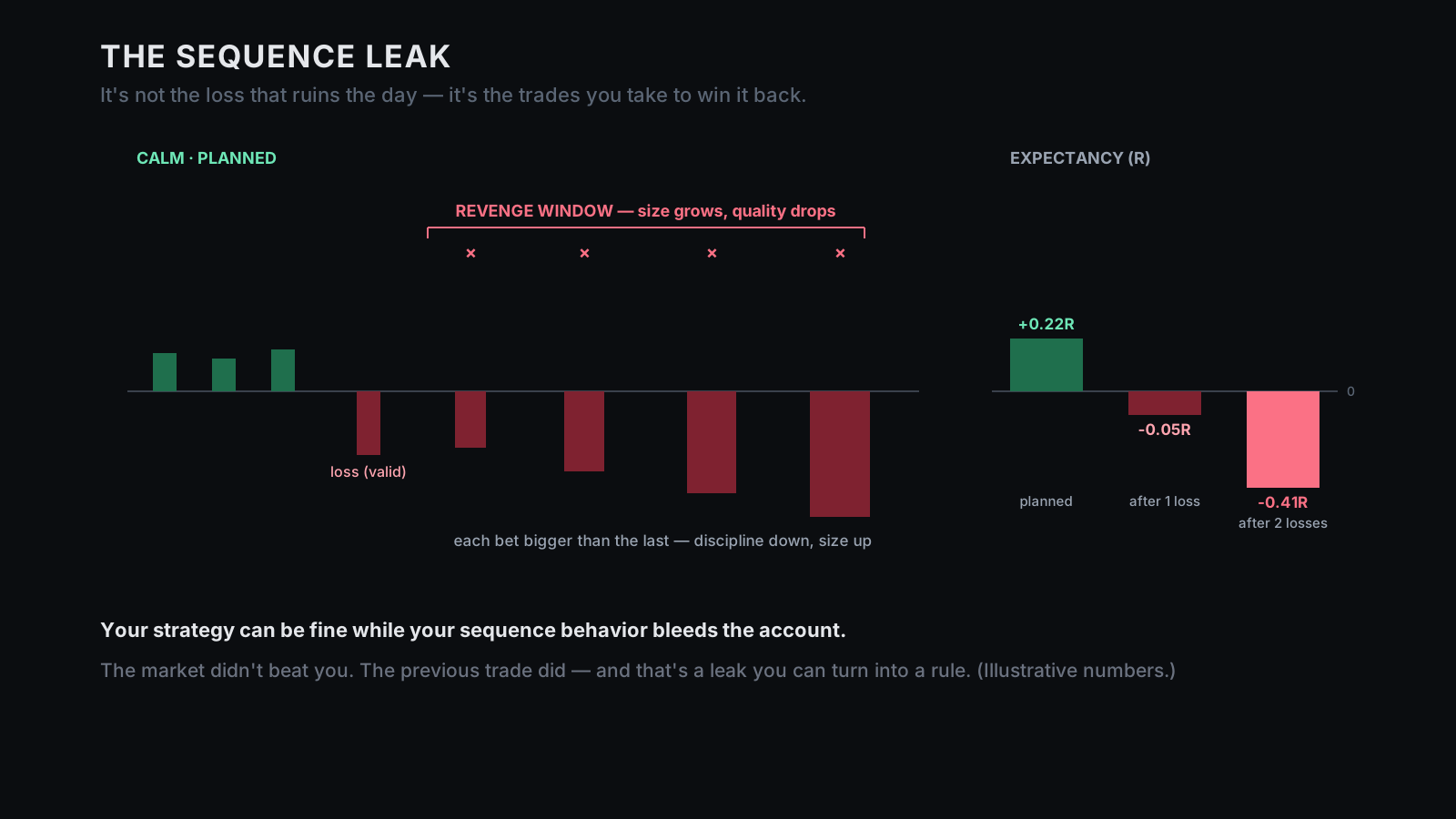
Most traders analyze trades one at a time, which misses the pattern entirely — because the dangerous trade usually isn't the losing trade, it's the trade after it. The first loss is often valid, normal, inside the plan. The second trade is where the account starts hearing dramatic music: you want it back, so you widen the criteria, enter earlier, size up a touch, stop waiting for confirmation, and tell yourself this setup is "basically the same." It isn't. It's revenge in a clean shirt.
AI catches this the instant you ask it to split your trades by what came before — for example:
- the first trade of the day
- the trade right after a win
- the trade right after a loss
- the trade after two losses in a row
- the trade after a large loss
- the trade after a missed move
- the trade after hitting your daily drawdown limit
Then compute expectancy in each bucket. The output is often ugly and useful — an illustrative shape:
Normal setup:               +0.22R
Trade after one loss:       -0.05R
Trade after two losses:     -0.41R
Trade after a missed move:  -0.36R
You may discover your strategy is fine and your sequence behavior is not. The market didn't beat you — the previous trade did. And that's a leak you can turn straight into a rule.
III — Leak #2: expectancy by bucket
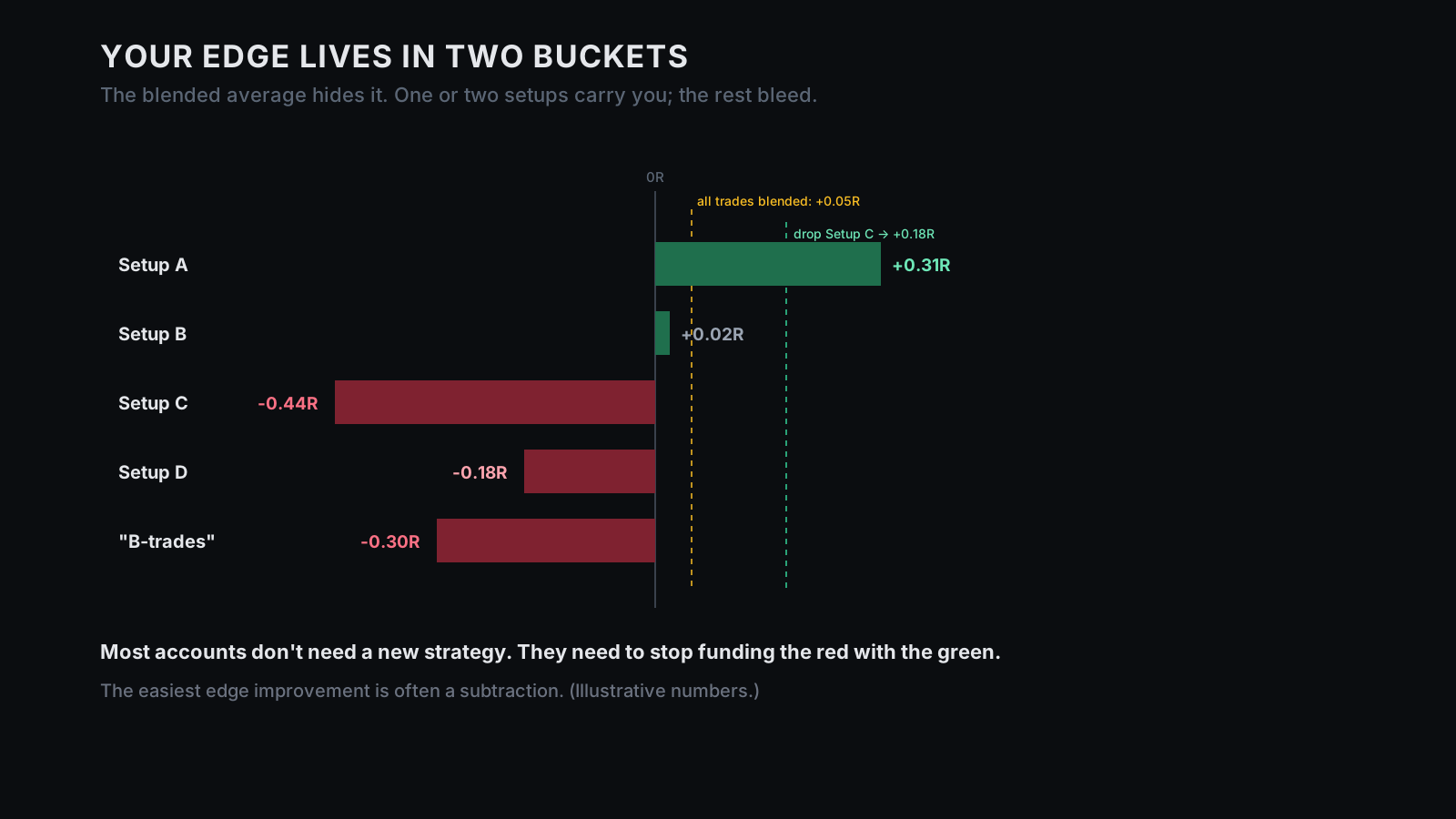
Your blended expectancy is a liar by omission. It tells you the average; it hides where the money actually came from. You think you have one strategy — your journal may reveal three living in the same account: a real edge, a breakeven filler, and an emotional bleed. Mixed together, the average becomes fog. AI separates the fog when you ask for expectancy broken out by setup, symbol, time of day, session, weekday, regime, direction, holding time, risk multiple, and entry type — then ask the brutal follow-up: what happens if I remove my worst bucket?
The answer is often absurd — an illustrative shape:
All trades:            +0.05R
Setup A only:          +0.31R
Setup B only:          +0.02R
Setup C only:          -0.44R
All trades minus C:    +0.18R
That's not a new strategy — it's a subtraction. The easiest edge improvement is often deleting the thing that never had an edge, which is the same lesson as Win Rate Is a Vanity Metric: the blended number hides the truth until you split it by where the money really comes from. Most traders don't need more trades — they need fewer lies in the sample.
IV — Leak #3: behavioral drift
Some leaks never show up in a setup label — they show up in behavior. You cut winners early and let losers run past the stop. You take partial profits too soon, then add to losers. You shrink size after a valid loss and balloon it after a lucky win. You skip the A-setup out of fear, then chase it late. You trade the one hour you swore you'd avoid. None of that is visible in a win/loss tally, but all of it is recoverable if your journal logs the plan next to the outcome: planned R vs actual R, planned stop vs actual exit, intended size vs taken size, was-this-in-my-plan.
Feed AI those columns and ask it to compare intention to execution. A trader insists "my entries are bad"; the journal answers entries are fine — you exit winners at +0.4R while your losers reach −1.2R. Different diagnosis, different fix. Another swears "I need better setups"; the journal answers your best setup works, but 43% of your trades are taken outside it. Again, different fix. Behavioral drift is where you quietly hand back the edge you actually had — and it's the layer AI surfaces that pure win-rate stats can't.
V — Ask for a decomposition, not a horoscope
Most people fail right here, so read it twice. The bad prompt is "why am I losing money?" — AI has nothing to work with, so it writes a polite cloud of generic advice (manage emotions, follow your plan, avoid overtrading, improve discipline): warm soup, zero protein. The better prompt hands it a job instead:
Break my last 100 trades into buckets by setup, regime, time of day,
and sequence after win/loss, plus position-size change. Compute
expectancy in R for each bucket, then rank the leaks by total R impact.
Now it's an analyst, not a therapist. Ask a vague question and you get a horoscope; ask for a decomposition and you get a diagnosis. You want where, when, which setup, after what sequence, at what size, with what expectancy — not a paragraph of encouragement. That's how AI becomes useful here: not by guessing the future, but by refusing to let your past stay blurry.
VI — Turn one finding into one rule
Finding a leak isn't the finish; it's the start. A finding that doesn't become a rule is just an interesting wound. Found that trades after two losses run −0.41R? The rule is no new trade until the next session after two losses. Found that Friday afternoons are negative expectancy? No new trades Friday after noon. Found that Setup C bleeds at −0.44R? Setup C is deleted until it shows 30 paper trades of positive expectancy. Found that size jumps after wins? Fixed size by the risk rule, all session, no post-win increase.
Don't try to fix five things. Fix the one leak with the biggest measured cost, write it so a tired version of you can still obey it, then re-run the same analysis in a month and confirm the number moved. Traders don't get better through revelation — they get better through leak removal. It's the exact loop a good AI copilot automates: find the leak in the data, write the rule, enforce the rule, measure again.
VII — Why this is the real AI trading killer app
AI prediction is exciting; AI journaling is merely useful — which is precisely why it's underrated. Nobody wants to hear "upload your CSV and analyze your mistakes." They want "tell me where gold goes next." But the second request is where AI is weakest, and the first is where it's quietly excellent — because the data already exists. No forecasting, no oracle act, just organize, slice, compare, rank, flag, and translate into rules, which is exactly what language models and analysis tools do well when properly constrained.
A trader with a small, real edge can still lose by leaking it through revenge trades, oversizing, wrong-regime entries, and sloppy exits — so plugging those leaks can be worth more than another signal ever was. AI can't hand you an edge — but it can stop you handing yours back. The market will stay unpredictable no matter how big the models get. You stay predictable. Point the brilliant coach at the predictable thing.
VIII — What AI can still get wrong
Don't worship the coach either. AI can misread your CSV, calculate wrong, confuse gross and net P&L, miss commissions, double-count partial closes, treat a deposit as trading profit, or hallucinate a pattern out of too small a sample. So the rules are non-negotiable: verify every calculation, check sample sizes, separate gross from net, include fees, tag setup and regime clearly, distrust any pattern from a tiny bucket, and never let it invent a missing field. When it announces "your Friday trades are terrible," make it show its work — how many Friday trades? what's the expectancy and total R? is one outlier driving it? what happens if I remove the worst trade? The coach has to show its work — the same standard you'd hold any other AI tool to. Useful, not magical.
The forensic prompt
Export your trades, then paste this with your table. It refuses the horoscope and forces the decompositions that matter.
You are my trading forensic coach. Do not forecast the market, do not
motivate me, do not give generic psychology advice, and do not flatter
me. Analyze ONLY the trade history I paste, and find measurable leaks.

My columns: trade_id, date_time, symbol, direction, setup, regime,
entry, stop, target, exit, result_R, pnl_net, fees, position_size,
planned_risk_R, actual_risk_R, MFE_R, MAE_R, rule_followed, notes.

1. DATA HYGIENE
   Check for missing columns; whether P&L is net of fees; whether
   result_R is consistent with entry/stop/exit; flag impossible values.

2. BASELINE
   Trades, total R, expectancy in R, win rate, avg win, avg loss,
   largest win/loss, profit factor.

3. EXPECTANCY DECOMPOSITION
   Break expectancy down by setup, regime, symbol, direction, time of
   day, weekday, session, sequence-after-win/loss, and size bucket.

4. BEHAVIORAL LEAKS
   Look for revenge after losses, size creep after wins, size up in
   drawdown, cutting winners early, holding losers too long, moving
   stops, trading outside regime, overtrading after a missed move.

5. IMPACT RANKING
   Rank the top 5 leaks by R impact. For each: affected trades, count,
   expectancy, total R, confidence given sample size, and whether one
   outlier drives it.

6. RULE CONVERSION
   For the biggest actionable leak, write ONE rule: WHEN [condition]
   THEN [action]. Simple enough to follow next session.

7. OUTPUT
   The biggest leak, the evidence, the one rule, and what to track over
   the next 20 trades.

Rules: don't invent missing data; if a sample is too small, say
INCONCLUSIVE; verify calculations step by step; be blunt; no motivation.
The CSV spec
You can start simple — even a messy table analyzed tonight beats a perfect one you never build.
# minimum useful columns
date_time, symbol, direction, setup, regime, entry, stop, exit,
result_R, net_pnl, fees, position_size, notes

# better — sharper forensics
trade_id, session, weekday, planned_risk_R, actual_risk_R, MFE_R, MAE_R,
rule_followed, mistake_tag, previous_trade_result, daily_pnl_before_trade,
current_drawdown
The richer the journal, the sharper the work — and the column you're missing is often the discipline you're missing.
The 20-minute audit
Run this today, with a spreadsheet and a chat window.
Minutes 0–5 — Export the journal
Pull your last 50–100 trades into a CSV. Fewer than 30? Still run it, but mark the findings as early evidence, not verdicts — don't pretend a small sample is final.
Minutes 5–10 — Clean the columns
Make sure each row has at least a setup, a result in R, the symbol, direction, date/time, size, and a note. If a column is missing, start logging it now.
Minutes 10–15 — Run the forensic prompt
Paste the table, ask for the decomposition (not motivation), and read the top leak. Then make it prove the finding: show me the rows that support this.
Minutes 15–20 — Write one rule
Take the biggest leak by R impact — not the most painful one — and turn it into a single mechanical rule (after two losses, stop until the next session; no trades outside Setup A and B; no size increase after a win). Track it for 20 trades, then audit again. That's the loop.
Where this meets ProEA
This method runs on one fuel: trade data that means something. And that's exactly where discretionary, vibe-based trading falls apart — when every trade is a one-off judgment call, the "setup" column is mush and the buckets decompose into nothing, so AI can only summarize the fog. You can only analyze trades you can read — and a process gives you a history that actually makes sense. Every MTR trade has a defined reason, belongs to a rule, and carries a logged context, so the forensic above has something real to chew on — and you can ask the questions a black box can't answer: was this trade inside the rule? the right regime? did costs behave as expected? did the failure come from the setup, the regime, the sizing, or the market?
That doesn't make MTR safe and it doesn't make it win — MTR can lose, like any system. But an inspectable system produces trades you can review against its own logic: a system you can read creates better data, better data creates a better review, and a better review finds the leak faster. Not magic — process. The point of this piece isn't to sell you a system; it's to get you to look at your own data honestly tonight. If you decide you'd rather analyze a system whose logic you can fully inspect, the source is right there to read first.
Disclosure
We sell source and evidence you can inspect — not outcomes, not guarantees, not a magic prompt. AI used as a coach on your own data is genuinely powerful; AI used as an oracle on the market is not. Trade-history analysis can surface real patterns, but it can also misread columns, calculate incorrectly, overstate a small sample, or find a pattern that doesn't persist — and a leak found in the past may not be the only cause of future losses. Closing a behavioral leak does not guarantee profit, and a system with positive historical expectancy can still lose. MTR can lose. Any system can lose. Trading is risky; leverage magnifies it; past performance is not future performance. Use AI as a forensic coach, not an oracle: verify the math, check the sample, turn findings into rules, then measure again.
Your first 20 minutes
Stop asking where the market is going. Export your last hundred trades, paste the CSV, and ask AI to decompose expectancy by setup, regime, time, sequence, and size — then ask for the single biggest leak by R impact, not the most dramatic one, and make it show the rows. Write one rule, track twenty trades, repeat. If you'd rather practice the lens on a clean dataset — one where every trade has a readable reason and the costs are stated — open MTR's source and backtest and analyze that. Verify us. Don't trust us. The answer has been behind you the whole time, in the trades you already took.
One last thing
You spent months asking a brilliant machine to guess the future and got nothing, because the future doesn't answer. The whole time, the answer you needed was behind you — in the trades you already made, waiting for someone patient enough to count them honestly. That's the job AI was born for.
AI can't tell you what the market will do. It can tell you exactly what you keep doing.
The market is unpredictable. You are not. Stop asking AI where the market is going, and start asking where you keep going wrong — then, for once, listen.