You asked the question everyone eventually asks — where is EURUSD going this week? Is gold about to break out? What should I buy? And the AI answered immediately.
No hesitation, no awkward silence, no "honestly, the next move is mostly noise." Just a clean paragraph: a direction, a reason, a target, a risk level, a little macro context, maybe even a probability.
It sounded like a fund manager.
It felt like you'd just been handed the thing the market is built to hide from you — a peek at tomorrow.
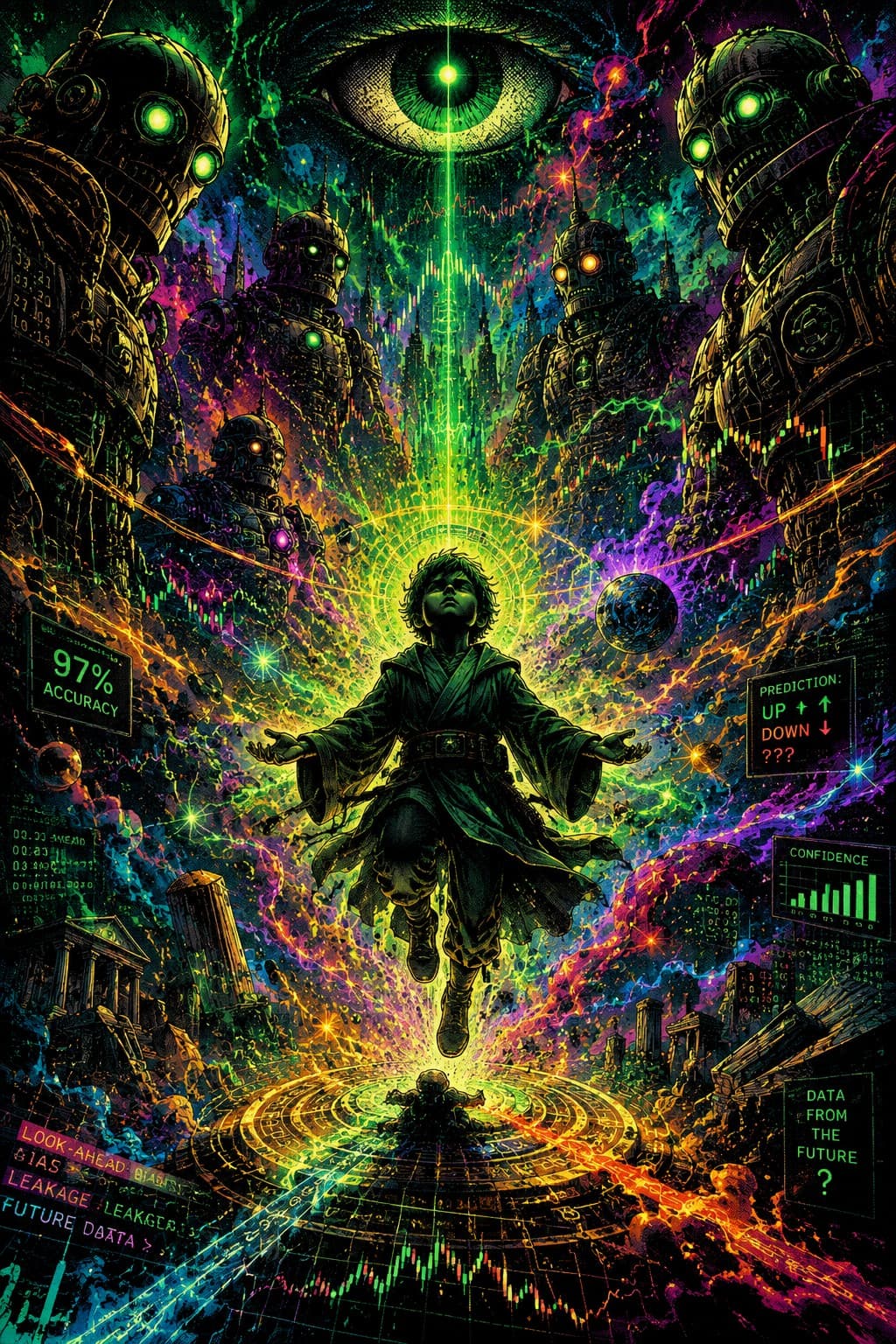
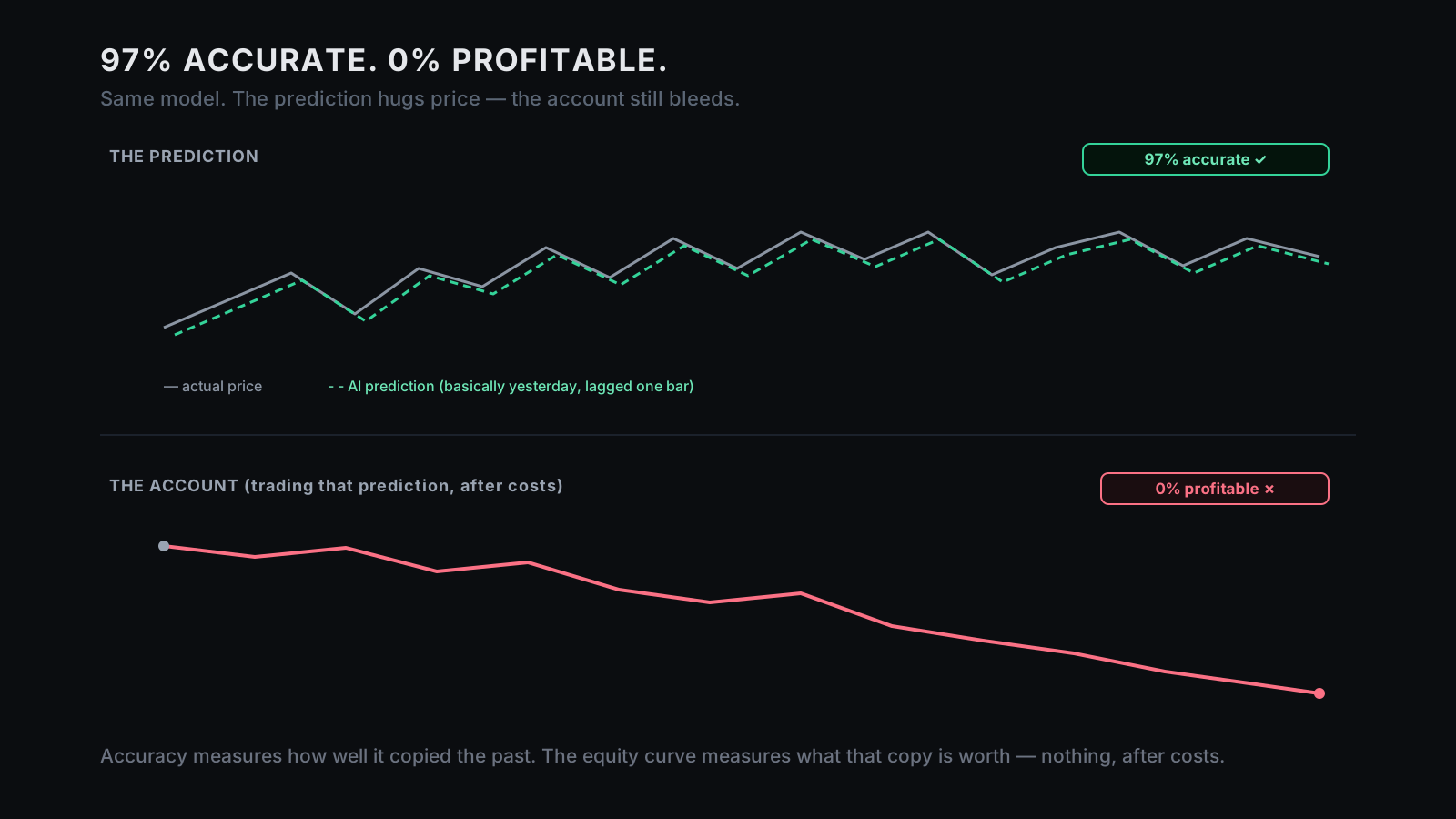
Or maybe you went deeper. You trained a model — an LSTM, a transformer, some notebook off GitHub with a chart that looked like science — to predict price. You plotted the prediction against what actually happened, and the two lines sat almost perfectly on top of each other. Accuracy: 95%. Maybe 97%. Your brain did the thing brains do around big numbers and money: I cracked it.
Then you traded it. And it lost.
Not because the prediction was obviously wrong — that would have been easier. It lost while looking right. It lost because it predicted price in a way that didn't pay after costs; because "price tomorrow will look a lot like price today" scores beautifully on accuracy and terribly as an edge; because being right about the market and making money in the market are two completely different games.
AI can be right about the price and still be wrong about your account.
Prediction is the most seductive thing you can ask AI to do. It's also, for most traders, the least profitable — not because AI is useless, but because "what will happen next?" is the wrong job. The better job sounds boring: help me build a process that survives costs, crowding, and live trading. One is an oracle request; the other is engineering. The first produces beautiful sentences. The second can produce a system.
Save this before the next confident AI price call talks you into a position. Send it to the friend who just texted you a screenshot of a model with "97% accuracy" and the words "this changes everything." It doesn't — but what you ask AI for next might.
Frontier models were given real-money accounts and traded autonomously; across the full live window, the cohort lost money.
Prediction Arena / Cybernews ↗A ChatGPT news-signal strategy's Sharpe fell sharply as the approach became known and crowded.
Lopez-Lira & Tang, arXiv ↗The baseline every prediction must beat: tomorrow looks like today. Barely beating the brick means no edge.
Prediction auditThe one-sentence version
A model can predict price with stunning accuracy and still lose money, because accuracy is not expectancy. A line that hugs price isn't automatically an edge — the easiest "prediction" in markets is just tomorrow will look a lot like today, and that baseline scores high while being nearly worthless to trade. Markets don't pay you for drawing a line close to price. They pay you for being right enough, by enough size, after spread, after commission, after slippage, before everyone crowds the same signal, with sizing that survives the misses. That's a very different job — so the real question isn't can AI predict the market? but can the prediction become a tradable process with positive expectancy after costs? Most can't. The fix isn't a better oracle; it's to stop asking AI for the future and start asking it to help you build a process you can test.
Skip the deep dive only if you can already answer this: is your AI's prediction measurably better than the dumbest baseline — "tomorrow equals today" — after costs? If you've never checked, you don't have a prediction. You have a mirror.
| What you believe | What's actually true |
|---|---|
| "95% accuracy means it works." | High price accuracy usually means the model is copying yesterday. |
| "It predicted the move." | Directional correctness isn't profit. Payoff size decides it. |
| "This is my edge." | If a public AI can find it, the crowd can find it too. |
| "The forecast backtest is great." | Forecast accuracy and P&L after costs are different numbers. |
| "AI sounds confident." | Confidence is style, not calibration. |
| "The smartest models should win live." | Live trading adds costs, sizing, liquidity, execution, and crowding. |
I — The tell: "97% accurate" is usually a mirror
Start with that beautiful chart — predicted price in one color, actual price in another, the two lines sitting right on top of each other. Before you celebrate, ask the boring question: what would the dumbest possible model have scored? The dumbest model says tomorrow's price = today's price. That's the brick. It doesn't know macro, doesn't read news, doesn't run a transformer, doesn't have a YouTube tutorial with dramatic music — and on most price series it's already hard to beat on raw accuracy, because price rarely teleports. Most days, tomorrow is near today.
So a model that predicts a number close to today looks extremely accurate while saying almost nothing tradable. That's the persistence trap. A line that sits on top of price isn't a forecast — it's a mirror with a one-bar delay. The part that's easy to predict is where price roughly is; the part that pays is the next move large enough to beat costs. Those are different targets, and most "97% accurate" models are only good at the first. Your account only cares about the second.
II — Accuracy is not profit
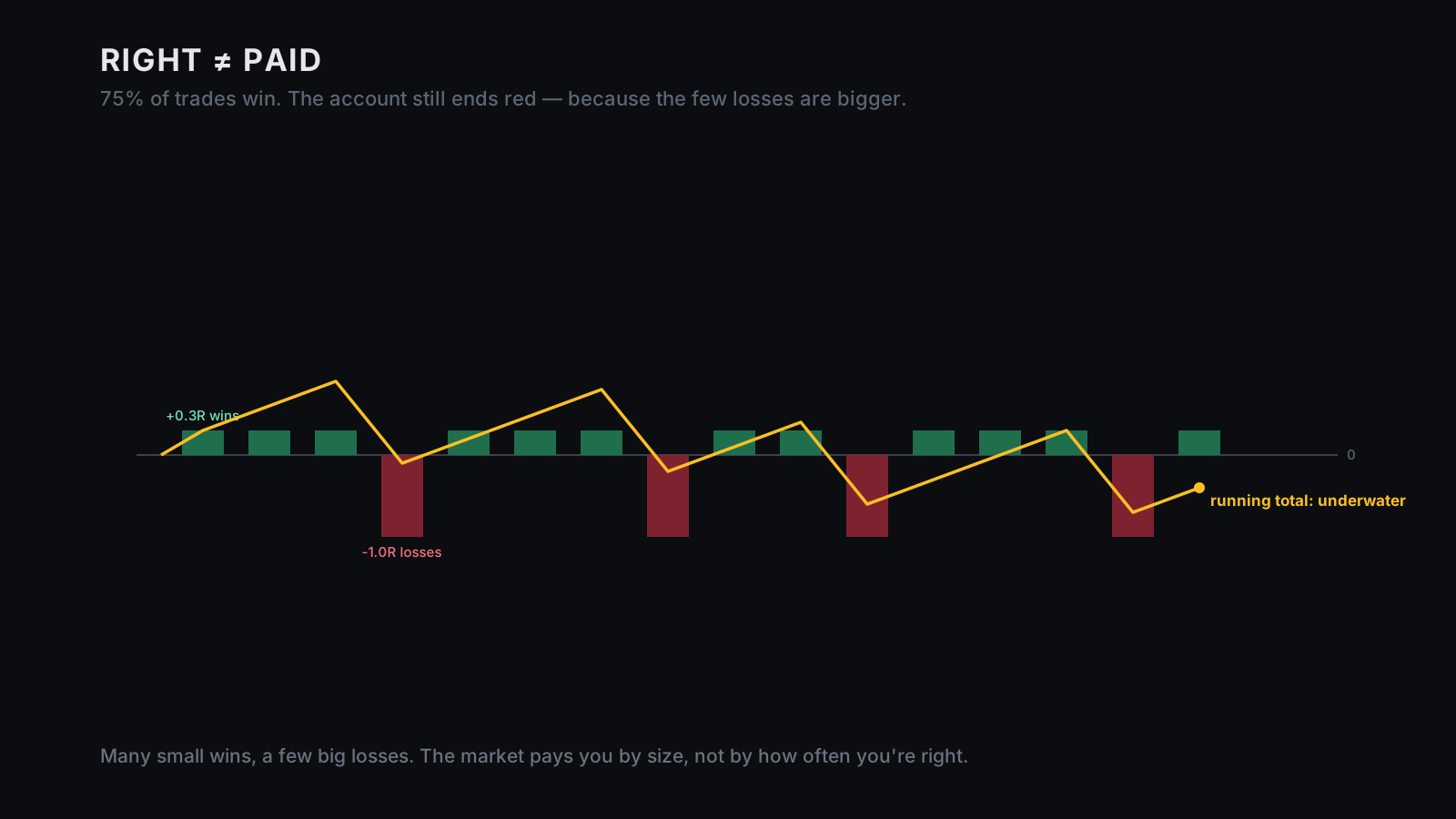
Even a model that calls direction better than a coin flip can lose, because markets pay by payoff, not by hit-rate. Picture a model that's right 70% of the time — it feels unstoppable, until you look at the sizes:
AI is right 70% of the time.
  avg winner:  +0.3R
  avg loser:   -1.0R

0.70 x (+0.3R) = +0.21R
0.30 x (-1.0R) = -0.30R
expectancy     = -0.09R per trade   -> right most of the time, still bleeding
Right most of the time. Losing money the whole time. Prediction screenshots are dangerous precisely because they show frequency and hide magnitude — the line, not the trade. A prediction isn't a strategy. A strategy needs an entry, an exit, a position size, a cost model, a slippage assumption, a risk cap, and a stop rule. Without those, "AI was right" means almost nothing. The market doesn't pay you for being right — it pays you for being right enough, by enough size, after costs, without getting destroyed when you're wrong. That's the same illusion we took apart in Win Rate Is a Vanity Metric, now wearing an AI badge.
III — The cost wall
Assume the model really finds something — a small edge, a mild drift, a little directional information. Good. Now the market sends the bill: the spread, the commission, slippage, latency, a gap, fill quality, market impact. That tiny predictive edge has to survive all of it, and most don't. This is why accuracy is such a poor scoreboard — it doesn't include the toll booth. A model can be slightly better than the brick and still be untradable because the edge is thinner than the friction, especially on short horizons where the predicted move is smaller than the spread.
A real market edge is a thin film; trading costs are the towel that wipes it off. We mapped that friction in detail in The Spread Is a Tax You Can't See. So the question to put to any AI forecast isn't how accurate is it — it's what's the expectancy after spread, commission, and slippage? If it only works in a frictionless world, it doesn't work; it works in a simulator with free rent.
IV — The crowding decay
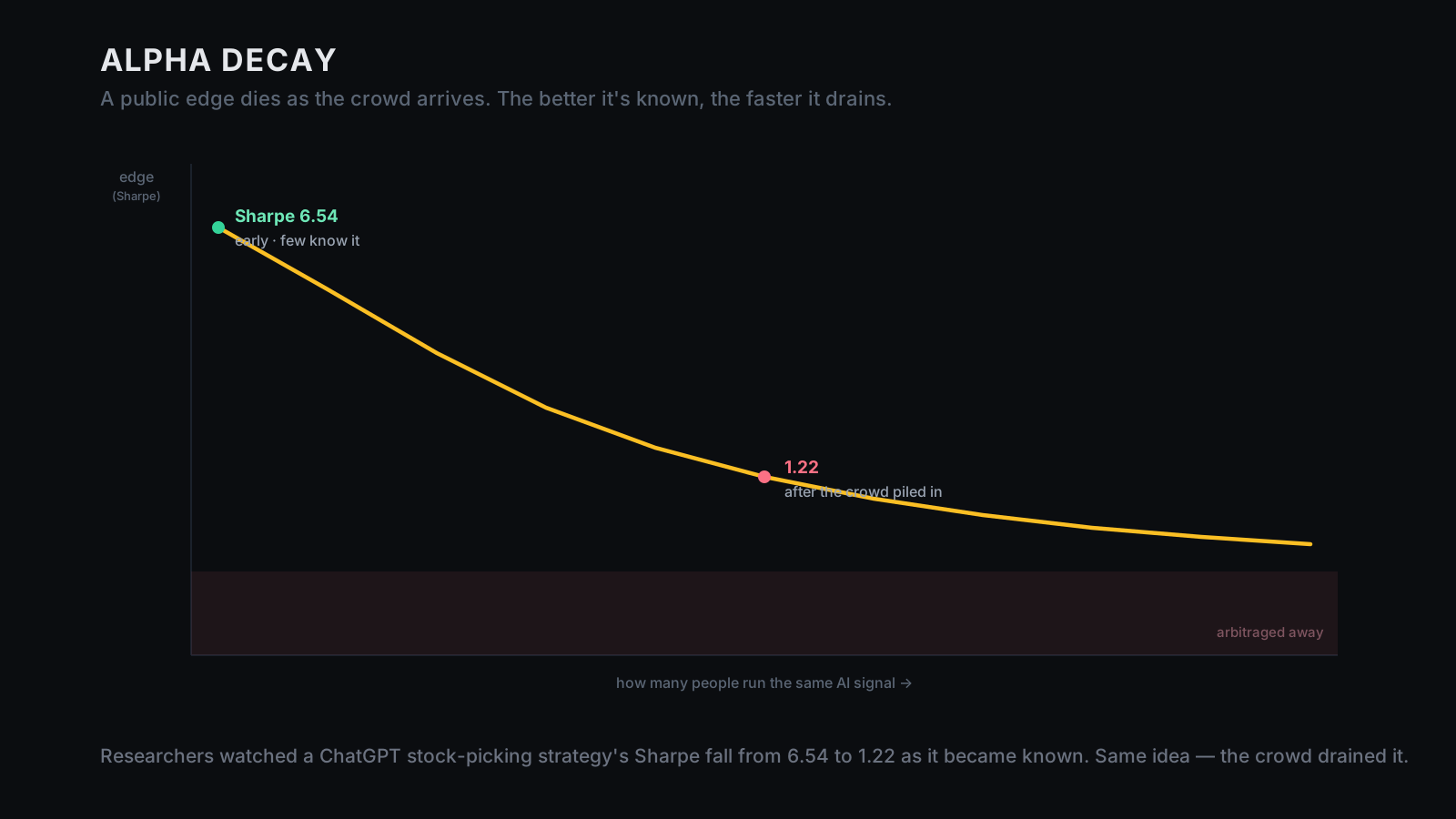
Now suppose the prediction is genuinely real: it beats the brick, it survives costs, it produces positive expectancy. Congratulations — and start the clock. If the edge comes from a public model and public data, it gets copied fast: the same prompts, the same headlines, the same charts, the same "undervalued" tickers. Signals many traders can generate for free become crowded, and crowded signals get arbitraged away. Researchers watched it happen in real time — a widely-cited ChatGPT stock-picking strategy saw its Sharpe ratio fall from 6.54 to 1.22 as the approach became known and used. Same model, same idea; the crowd arrived and the alpha drained out.
An edge everyone can ask the same chatbot for isn't an edge — it's a queue. This is the cruelest twist of AI prediction: the better and more popular the predictor, the faster it eats itself. The only edges that last are hard to copy, which is exactly what a one-prompt forecast is not. So the right question isn't did the AI find something? — it's what stops everyone else from finding and trading the same thing? If the answer is "nothing," treat the edge as temporary at best.
V — The live-fire test
Theory is useful; real money is ruder. In early 2026, researchers ran a live-fire test with frontier language models trading prediction markets on real-money accounts — exactly the arena AI should enjoy: lots of information, constant updates, clear probabilities, no fatigue, no emotion, fast reasoning. And yet, across the full evaluation window, the live-trading cohort lost money. That doesn't prove AI will never trade profitably. It proves something more useful:
Intelligence is not the same as a tradable edge.
A model can read, reason, research, summarize, and compare probabilities — and still fail once the game becomes price, execution, liquidity, cost, sizing, and timing. Even the regulator says it flatly: the CFTC warns that AI "cannot predict the future or sudden market changes." Trading isn't an IQ test; it's an adversarial, cost-adjusted execution game with a scoreboard that hates overconfidence. The frontier model can sound smarter than you, and the market can still take its money. That should humble everyone — us included.
VI — Why prediction is the most seductive ask
Prediction is tempting because it's the thing you most want. You don't want a process; you want an answer. You don't want to hear define your edge, test it out-of-sample, charge costs, check expectancy, size conservatively, avoid crowding. You want up or down? buy or sell? now or wait? AI is dangerous here because it will always answer — it doesn't naturally pause and say "this is mostly noise." It produces a plausible next sentence, dressed in macro reasoning, support-and-resistance, probabilities, and confident language, and that makes it feel like analysis.
But fluency isn't calibration. A fluent answer can still be wrong; a confident answer can still be untradable; a beautifully reasoned forecast can still fail after costs. AI confidence isn't evidence — it's the interface. And the interface is very, very good. That's the trap.
VII — What AI is genuinely great at here
So don't close the tab — change the job. AI isn't useless in trading; it's extraordinary the moment you stop hiring it as a fortune-teller. Point it at the work it's actually good at:
- turning a vague hunch into a precise, testable rule
- building the backtest harness — with spread, commission, and slippage
- analyzing your trade journal for patterns you won't admit
- red-teaming a trade you've already fallen in love with
- slicing performance by regime to find where an edge dies
- auditing costs and documenting the system
The shift is small to say and enormous in effect: from "what will the market do?" to "help me build, test, and stress a process with positive expectancy after costs — and tell me where it breaks." The first question has no honest answer; the second is exactly the patient, structured work AI accelerates. Stop hiring AI as a fortune-teller; hire it as an engineer. The fortune-teller hands you a sentence. The engineer builds the test. One feels better; the other survives longer.
VIII — The fix: trade a process, not a forecast
Replace every prediction with a process you can test. Before an AI forecast moves a single dollar, run it through three questions that kill almost every fake edge.
1. Is it better than a brick? Compare the model to the naive baseline next value = last value, on data it has never seen — not the training period, not the notebook demo, not the chart you already stared at. If it doesn't clearly beat the brick, stop. You have a mirror, not a predictor.
2. Does it pay after costs? Turn the prediction into trades, charge spread, commission, and slippage, and measure expectancy, drawdown, and the out-of-sample equity curve — not accuracy. If it only wins before costs, it loses.
3. Why isn't it already crowded? Finish the sentence: "this edge survives because ______." If the honest answer is "because the AI told me," you're done — that's not an edge, it's consensus with a user interface.
Don't ask what the market will do; ask whether your rule still makes money after costs — and whether it would survive everyone knowing it. A forecast is a guess in a suit. A process is something you can measure, repeat, and defend.
The AI-prediction audit prompt
Here's the action artifact — paste it into any AI before you trust a forecast, a signal, or a model. It does the one thing the demo never does: it judges the prediction as a tradable process instead of grading it on accuracy.
I have an AI market prediction or model. Do not evaluate it by accuracy
alone. Audit it as a TRADABLE PROCESS.

Inputs I'll give you:
- predicted values or signals, actual prices, timestamps
- instrument, timeframe
- spread, commission, slippage assumption
- entry/exit rules, position-sizing rule

Run this audit:

1. BRICK TEST
   Compare the model to the naive baseline (next value = last value).
   Show whether it beats the brick on UNSEEN data.

2. DIRECTION TEST
   If it predicts direction, compute directional accuracy, then the
   average win, average loss, and expectancy in R.

3. COST TEST
   Convert predictions into trades. Charge spread, commission, and
   slippage. Report expectancy AFTER costs.

4. ROBUSTNESS
   Split train / validation / out-of-sample. Show whether performance
   survives outside the fitting period.

5. CROWDING
   State whether the signal is private and hard to copy, or public and
   likely crowded.

6. VERDICT (pick one)
   - MIRROR: accurate but doesn't beat the naive baseline
   - UNPAID EDGE: beats baseline but dies after costs
   - CROWDED EDGE: works but likely decays if widely used
   - PROMISING PROCESS: survives baseline, costs, and out-of-sample
   - INCONCLUSIVE: not enough data

Rules:
- Do NOT give me a market forecast.
- Do NOT optimize the model to look better.
- Do NOT flatter the result.
- Judge ONLY whether the prediction can become a tradable process.
The line that does all the work is the first one: do not evaluate it by accuracy alone. That single instruction is both the disease and the cure.
The 20-minute audit
You don't need to be a quant — you need twenty minutes and the willingness to be disappointed early instead of expensively.
Minutes 0–5 — The brick test
Put the model's accuracy next to the naive baseline next value = last value. If it isn't clearly, repeatably ahead of the brick on unseen data, the accuracy is an illusion. Stop here.
Minutes 5–10 — Accuracy to money
Turn the predictions into trades:
if predicted_return >  threshold:  go long
if predicted_return < -threshold:  go short
else:                              stay flat
Then charge spread, commission, and slippage and measure expectancy and the equity curve — not hit-rate. If it only wins before costs, it loses.
Minutes 10–15 — The crowding question
Write one sentence: "this edge isn't already gone because ______." A credible answer names something real — private data, an execution advantage, a hard-to-copy process, a regime-specific filter. A bad answer is "because the AI is smart." That's a bumper sticker, not an edge.
Minutes 15–20 — The oracle audit
Scroll back through your last ten AI trading chats and count how many were where's price going / what should I buy versus help me test this rule / compare to the baseline / charge costs. The first number is your exposure to the trap. You want far more of the second.
Where this meets ProEA
Here's our stake, said straight. MTR does not predict the market. It doesn't claim to know where price is going, and we'll never put a forecast in your inbox. It's a rule-based system with an intended positive expectancy, tested over 28 months under stated assumptions, with source you can inspect. A predictor sells you certainty; a system gives you a process. A prediction says "price will go here." A system says "if these conditions occur, this is the rule, this is the risk, this is the exit, this is the cost assumption, and this is where it fails."
You can't audit a forecast until after the trade is over — but you can audit a process before it touches a dollar. A process you can inspect beats a prediction you have to believe. That doesn't make MTR safe and it doesn't guarantee profit. MTR can lose. Any system can lose. We're not selling tomorrow's price; we're selling a thing you're allowed to take apart.
Disclosure
We sell software and evidence you can inspect — not forecasts, not outcomes, not certainty. No AI, ours or anyone else's, can reliably predict market prices or sudden market changes; high reported accuracy routinely fails to survive costs, crowding, and live execution. A confident prediction is not a verified edge, and a system with positive historical expectancy can still lose. Trading is risky; leverage magnifies the risk; past performance is not future performance. MTR can lose. Any system can lose. The point isn't to claim we see the future — it's that a process you can audit beats a prediction you have to trust.
Before you pay for any "AI predicts the market" product, ask one thing:
Show me the strategy's profit after costs versus the naive baseline, out of sample — not the accuracy, not the prediction chart, not the prompt.
An honest builder can show you that. A fortune-teller will change the subject.
Your first 20 minutes
Don't take our word for any of it. Take the last AI price call that excited you and run the brick test — was it actually better than "tomorrow equals today"? Then convert it to trades and charge real costs. Then write the one sentence explaining why the edge isn't already crowded away. Then open MTR's source and read what actually triggers a trade: no forecast, no magic, just a rule you can inspect. Verify us. Don't trust us. The goal isn't a better crystal ball — it's a process that survives contact with costs, crowds, and live markets.
One last thing
AI can predict the market. It can draw a line that hugs price, hand you a target, and say it with total confidence — it can make the future feel promptable. It just can't make that line pay: not after costs, not after the crowd, not after live execution, not after a single sizing mistake. The future isn't a text box. But a process you can measure, repeat, and defend? That you can build today — and the same AI that can't tell you where price is going is genuinely brilliant at helping you build it. Ask for that instead.