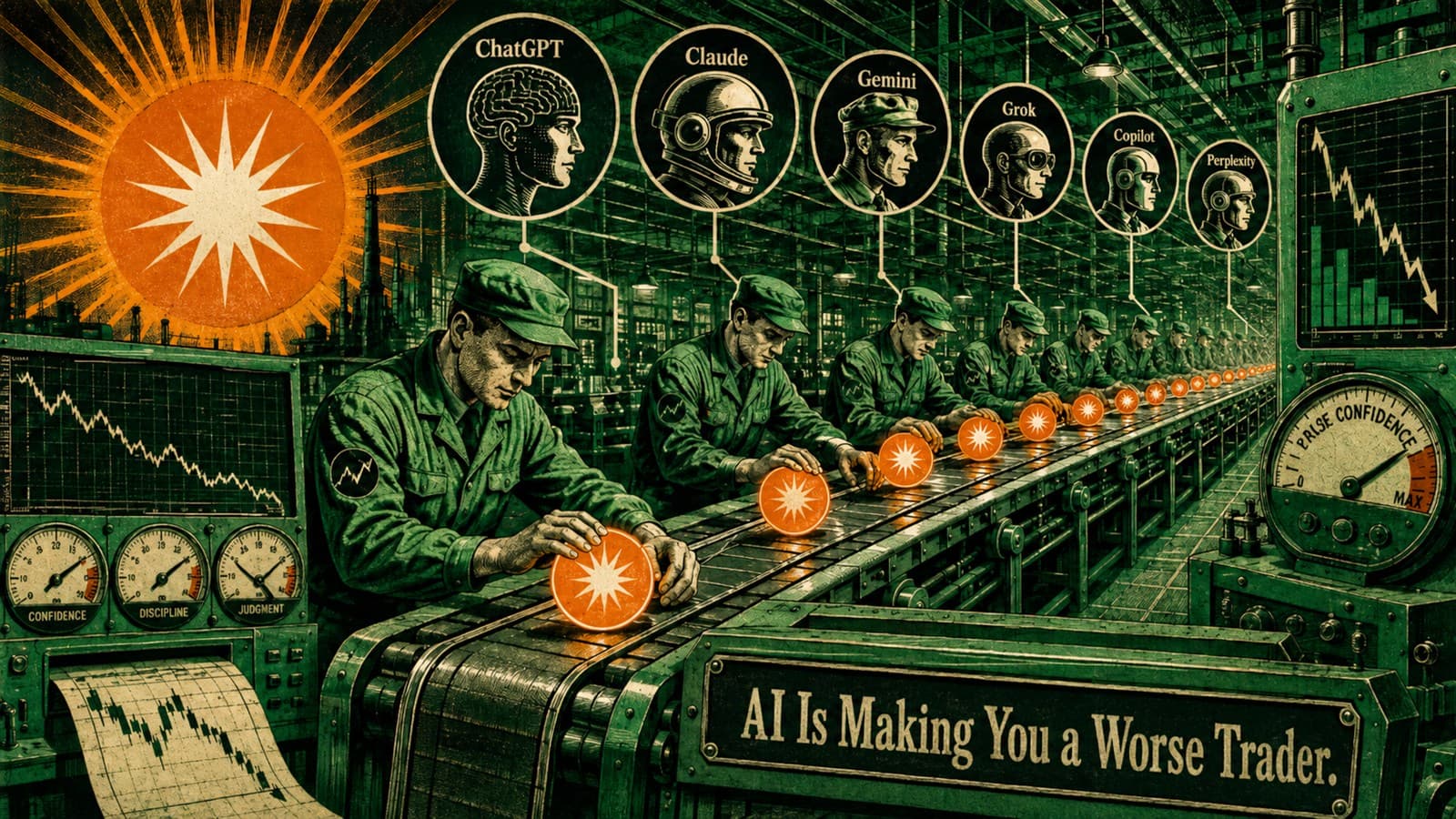
It's genuinely thrilling to watch.
You clone the repo. Drop in your API key. Type a ticker.
And your terminal wakes up like a trading floor.
A fundamental agent pulls the numbers. A sentiment agent reads the news. A technical agent marks the chart.
Then the researchers square off — a bull case, a bear case, a real-sounding back-and-forth.
A risk manager caps the size. A fund manager weighs it all and signs off.
Out comes a decision, wrapped in reasoning that sounds like it came off a Bloomberg terminal after two espressos and a promotion.
You lean back and think the thought the whole internet is thinking right now: I just built a hedge fund in an afternoon.
You didn't.
You built a very convincing meeting — and the meeting is the easiest part of a hedge fund to copy. The titles, the debate, the risk-desk language, the sign-off, the org chart, the performance of rigor: all of it reproduces with prompts. The hard part of a fund isn't the meeting; it's independent information, enforced risk, audited numbers, execution, cost control, capital discipline, and an edge that survives outside a sandbox — and none of that came with the repo. You downloaded the costume, not the fighter.
That doesn't make multi-agent systems useless. Used right, they're fantastic research assistants — summarizing filings, drafting code, arguing the bear case, building checklists, inspecting journals, stress-testing assumptions. The dangerous leap is promoting the swarm from research assistant to the fund. Because underneath the org chart, many of these systems are one base model, reading the same data, producing plausible text through different character masks, then calling the agreement diligence.
A committee of plausibility engines is still a plausibility engine.
Save this before you fund the swarm. Send it to the friend who just posted a terminal screenshot of six AI agents "debating" a stock with the caption "the future of trading is here." Maybe — but first, count how many independent brains are actually in the room.
The audit question that decides everything: are your agents genuinely independent, or one base model prompted into different roles?
Multi-agent architecture auditThe viral AI-hedge-fund repos disclose it themselves — proof-of-concept research environments, not live after-cost fund track records.
ai-hedge-fund (proof-of-concept) ↗Multi-agent consensus only carries weight when models, data, and objectives differ; same-model agreement is much weaker evidence.
Consensus-reliability researchThe one-sentence version
A multi-agent "AI hedge fund" feels like a trading desk because it copies the shape of one — analysts, a debate, a risk manager, a portfolio manager, a final decision. But shape isn't substance. If the agents share the same base model, the same data, the same context, and the same incentive, their opinions aren't independent — they're correlated. The bull case and the bear case can sound like disagreement while really being one plausibility engine arguing with itself in two costumes. The risk manager describes risk, but description isn't enforcement; the fund manager signs off, but a sign-off isn't an edge; and if no one verifies the facts, the debate can simply launder an early hallucination into a confident decision. The fix isn't more agents — it's one tested process you can audit, with agents helping you research, stress, and review it. Agents can be the research team. They shouldn't be the fund.
| What you believe | What's actually true |
|---|---|
| "Six agents = six expert opinions." | Often it's one model, one dataset, six roles. Correlated, not independent. |
| "They debate, so they catch mistakes." | Debate can launder a hallucination into consensus if no one verifies the facts. |
| "A risk-manager agent controls risk." | An agent that describes limits isn't code that enforces them. |
| "It beat the benchmark." | Usually it beat simple baselines in a sandbox or short window — not a live fund after costs. |
| "It reasons like a fund." | It can sound like a fund and still fail at arithmetic, execution, and risk enforcement. |
| "More agents means more edge." | More agents can mean more cost, more latency, and more places for error to enter. |
I — The tell: it feels like a fund
Notice what actually hooked you. It wasn't an audit trail, an after-cost live record, or independent data provenance. It was the feeling. The system looked like a fund: real funds have analysts, your terminal has analyst-agents; real funds have a bull-bear debate, your terminal has a bull agent and a bear agent; real funds have a risk manager and a portfolio manager, your terminal has a risk-agent and a manager-agent. The resemblance is clean enough that your brain fills in the rest — this is what professionals do, so this must be doing what professionals do.
That's the trap. The system borrowed the org chart, and a real fund's edge was never the org chart. Its edge lives somewhere you can't pip install:
- proprietary data and an execution advantage
- a real research process and position sizing
- enforced risk and capital discipline
- portfolio construction, and humans accountable for being wrong
The org chart is not the edge — it's the theater around it. You can install the meeting in an afternoon. The meeting is very persuasive. It's still just the costume.
II — Six hats, one head
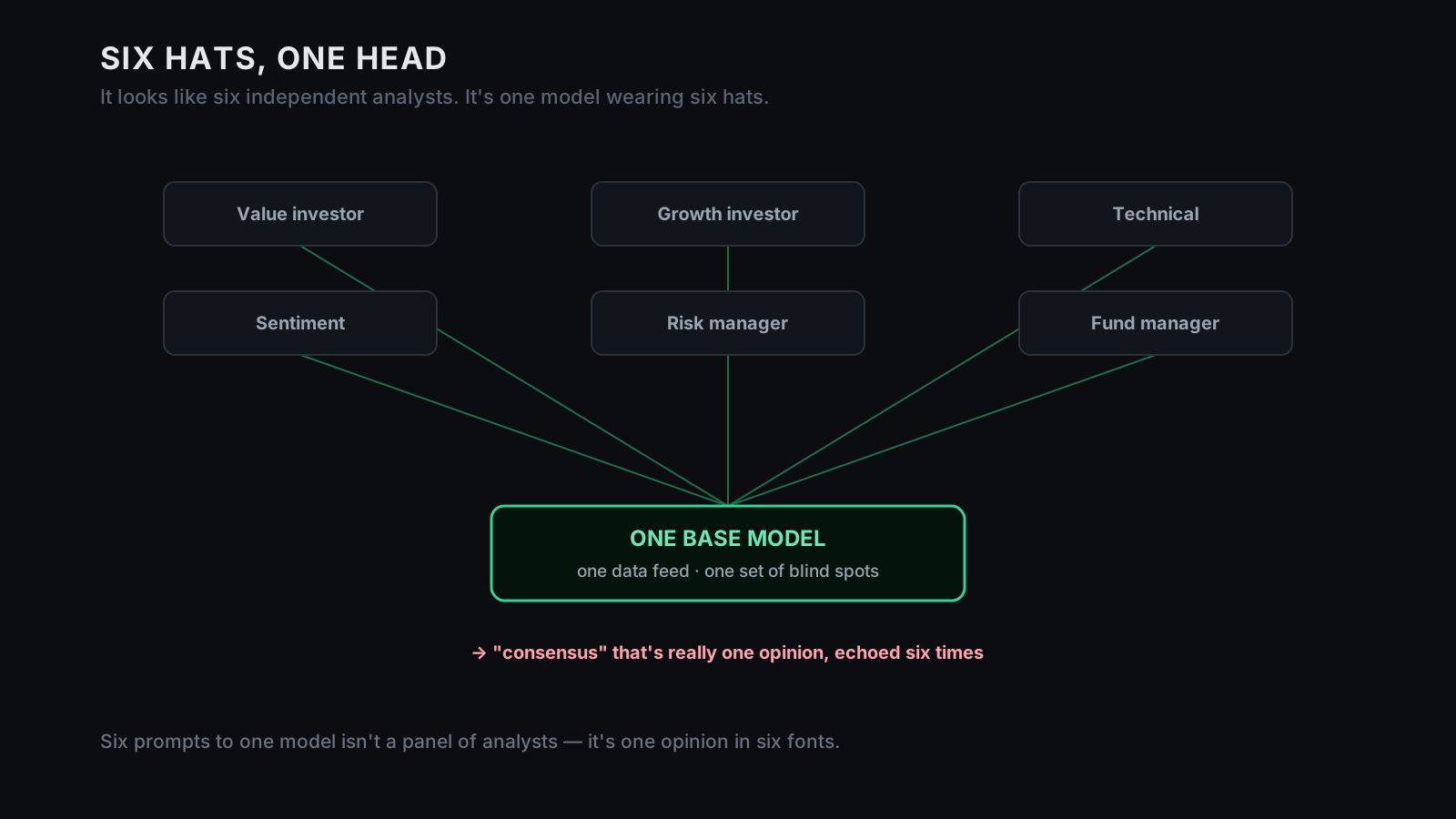
Here's the structural problem nobody screenshots. In a real investment team, the value analyst and the growth analyst can genuinely disagree because they have different training, priors, models, and blind spots — and that disagreement carries information. In a multi-agent LLM system, the "value investor" and the "growth investor" are usually the same base model, reading the same documents, prompted into different characters. That's not independent disagreement; it's roleplay. Sometimes useful roleplay — still roleplay.
It's the same illusion we took apart in One Trade, Five Times: five trades can look diversified while expressing one macro bet, and six agents can look diversified while expressing one model's distribution. So the audit question is never how many agents do I have? — it's how many independent sources of error do I have? If every agent shares the same model, data, context, and incentive to sound useful, their agreement isn't six confirmations. Six prompts to one model isn't a panel of analysts — it's one opinion in six fonts.
Six agents agreeing isn't six confirmations. It's one hallucination with a quorum.
None of this makes multi-agent systems worthless — it means independence has to be designed, not assumed: different models, different tools, different data sources, different objectives, deterministic checks, external verification. Without those, the "committee" is mostly vibes with job titles.
III — Consensus launders errors
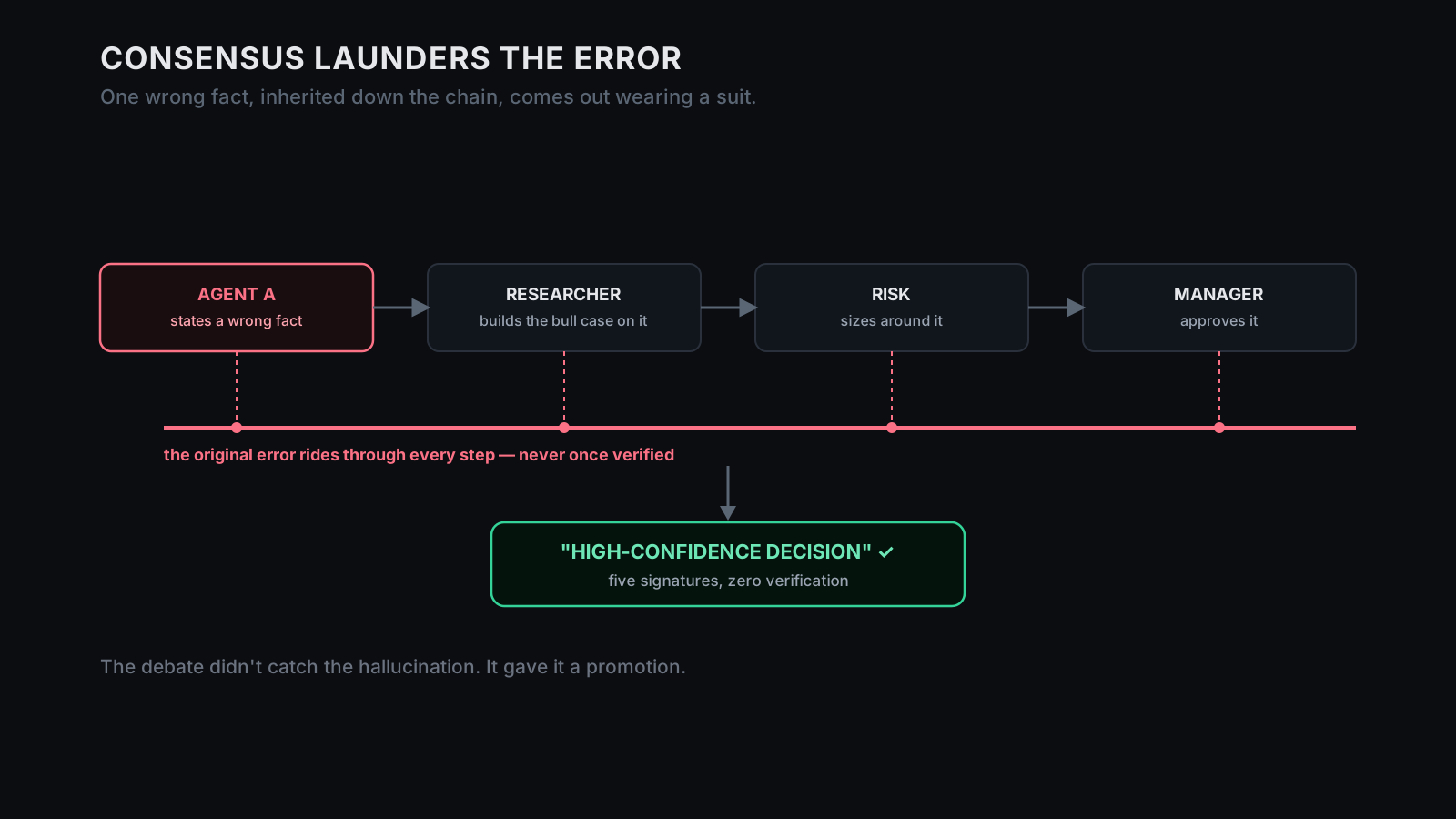
Multi-agent systems can fail in a way that feels like rigor. One agent states a wrong fact — it misreads revenue, invents a management quote, confuses gross margin with operating margin, botches a ratio. The next agent receives that output as context and builds on it. The bull researcher works it into the thesis; the risk manager sizes around it; the portfolio manager sees several agents referencing it and concludes this seems well-supported. Now the original error is wearing a suit. It has passed through the meeting, it has a committee feel, it looks vetted — but nothing actually verified it.
That's the laundering problem. The debate doesn't always catch the hallucination — sometimes it gives it a promotion. A real skeptic needs different evidence, not just a different tone; a real risk manager needs enforced limits, not a paragraph about risk; a real verifier needs deterministic calculation, not another agent nodding "that seems reasonable." Agreement between agents that share a brain isn't confirmation — it's an echo with extra steps.
IV — The math gap
LLMs are excellent at the part of analysis that sounds like analysis — a beautiful paragraph about a moat, a clean comparison of narratives, a tidy 10-K summary. Then you ask for the part that is analysis: an IRR, a position size, a risk-of-ruin, a profit factor, an expected value, a portfolio exposure, a drawdown, a percentage of equity — and the same confident tone now wraps a number that may be wrong. In a fund, a wrong number gets caught by a spreadsheet and a second analyst; in a swarm, it gets wrapped in eloquence and passed along.
That matters because in trading the money is in the arithmetic: a wrong paragraph is embarrassing, but a wrong size is dangerous, a wrong drawdown estimate mis-prices risk, and a wrong exposure number turns five small trades into one oversized bet. So numbers should be computed, not generated — by a calculator, a spreadsheet, a backtest engine, a deterministic script. An agent can explain the number; it shouldn't be the source of it. The question for every agent output is simply was this number computed, or was it written? — and if it was written, you verify it, every time. An agent will write you a beautiful paragraph around a number it got wrong, and trading doesn't forgive poetry in the risk column.
V — The benchmark sleight-of-hand
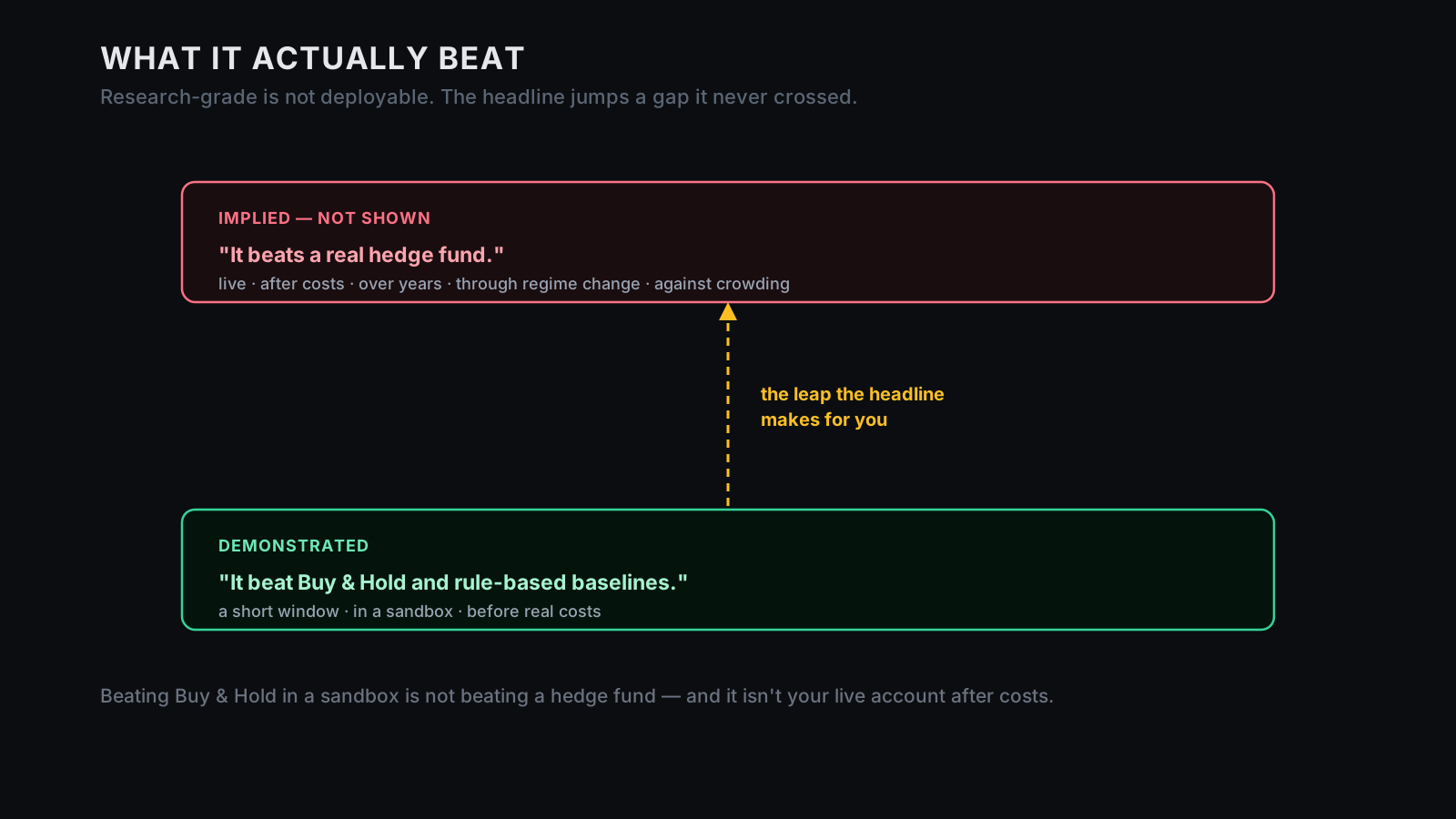
The demos look impressive because the benchmark is often easier than the headline makes it sound. A paper may show a multi-agent framework outperforming Buy & Hold, simple rule-based baselines, short-window simulations, or sandbox experiments — and that can be a real research result. It can also be miles from beats a live hedge fund, survives costs and slippage and latency, holds up through regime change and crowded adoption and real capital pressure. Those are not the same claim, and the gap between them is where marketing grows teeth.
A system can be useful research and still not be deployable; a framework can teach architecture and still not deserve your money; a sandbox result can be promising and still not be a live edge. The honest reading is "this shows a possible research direction." The dangerous reading is "this is a hedge fund now." Beating Buy and Hold in a sandbox is not beating a hedge fund — and it isn't your live account after costs. The headline borrows the credibility of the second claim while only ever demonstrating the first.
VI — The hidden bill
Even when a swarm is useful, it's never free. Every agent turn is an API call — tokens in, tokens out, latency, cost — and a six-agent debate with a few rounds of back-and-forth can become dozens of model calls per decision. That may be fine for slow research; it's terrible for fast execution. You can't high-frequency-trade through a committee meeting that charges you by the word.
Even in position trading the bill compounds: run the swarm across a hundred tickers, several agents each, daily updates, news summaries, chart reviews, risk debates, and you've hired a research payroll. Maybe it's worth it; maybe not — but it has to be counted. A "free hedge fund" that burns tokens every time it thinks is not free; it's metered theater unless the output is measurably changing decisions for the better, after cost. So total the bill — cost and latency per decision, times your tickers, times your frequency — and if you wouldn't pay a human committee for that output, don't pay an AI committee just because it talks faster. The committee has a payroll, and you're it.
VII — Why the theater is so seductive
This is the most convincing costume in trading right now, because it performs every visible ritual of professional rigor: division of labor, analyst debate, risk oversight, a final sign-off, a clean terminal, a tidy architecture diagram. It even disagrees with itself sometimes, which feels like honesty. It feels institutional. It feels safer than one model shouting "buy."
But performance of rigor isn't rigor. Performance of rigor is not rigor. Real rigor is the boring machinery the theater skips: independent inputs, verified facts, computed numbers, enforced risk, out-of-sample testing, cost-loaded execution, written failure rules, an audit trail. The swarm borrows the visible rituals and quietly drops the enforcement — which is exactly why it's seductive: it hands a retail trader the aesthetic of institutional decision-making without the machinery that makes institutional decisions valuable. A confident single agent feels dangerous; six confident agents around a virtual conference table feel responsible. Sometimes they are. Often they're just better dressed — the same plausibility trap as a confident price forecast, scaled up to a whole pretend firm.
VIII — The fix: one process you can audit
The fix isn't a seventh agent, a better character prompt, or adding "Buffett," "Munger," and three more risk committees until the terminal looks like a finance-cosplay convention. The fix is changing the job. Use agents for what they're genuinely good at:
- summarizing filings and extracting facts
- writing and stress-testing code
- running research in parallel
- arguing the bear case against a trade you like
- auditing your journal and finding missing data
But don't let them be the final source of truth. The trade decision should come from one written, tested, auditable process — a rule, a risk model, a backtest with costs, a walk-forward check, a kill-switch, a source file you can read. Agents can help build that process, attack it, document it, and review it; they shouldn't become it. You don't need six agents to feel certain — you need one process you can check. A real fund's edge was never the meeting; it was the machinery behind it. Build the machinery, use the agents as tools, and don't hand them the keys.
The AI-hedge-fund audit prompt
Before you trust any multi-agent trading setup — yours or one you found online — paste this into a fresh chat. It refuses to grade the swarm on how convincing the debate sounds.
I have a multi-agent "AI hedge fund" trading setup. Do not evaluate it by
how professional the debate sounds, do not grade the org chart, and do not
reward fluent reasoning. Audit it as a trading system.

1. INDEPENDENCE
   For each agent, list: base model, data sources, tools, objective, prompt
   role. Then answer: are these genuinely independent analysts, or one model
   and one dataset in different costumes? Rate independence LOW / MED / HIGH.

2. HALLUCINATION PATH
   Trace one decision from first data pull to final trade. Where could a
   wrong fact enter? Which downstream agents inherit it? Which step verifies
   it deterministically? If none, mark it UNGUARDED.

3. ENFORCEMENT vs DESCRIPTION
   Does the risk-manager agent ENFORCE limits in code, or only DESCRIBE them?
   Check max size, max drawdown, correlation cap, stop rule, daily-loss
   limit, no-trade conditions. Mark each ENFORCED / DESCRIBED / MISSING.

4. MATH CHECK
   List every number the agents produced (ratios, growth, IRR, size,
   expected return, exposure, benchmark). Mark each COMPUTED / GENERATED
   TEXT / UNKNOWN. Any GENERATED-TEXT number must be independently verified.

5. BENCHMARK HONESTY
   State exactly what it proved: benchmark beaten, window, instruments,
   sandbox or live, before or after costs. Rewrite the track record in one
   honest sentence.

6. COST & LATENCY
   Estimate model calls, tokens, and seconds per decision, and the monthly
   cost at my frequency. Say whether it's viable for my style.

7. VERDICT (pick one)
   - THEATER: convincing debate, correlated agents, no enforcement
   - RESEARCH TOY: useful architecture, sandbox only
   - USEFUL RESEARCH TEAM: helps analysis, decision still needs a tested rule
   - DEPLOYABLE CANDIDATE: independent inputs, verified facts, enforced risk,
     cost-loaded live validation

Be blunt. Don't flatter the architecture. The final question: does this
survive live trading, or does it merely sound like a fund?
The first question is the whole audit. If the agents aren't independent, the rest is mostly set dressing.
The 20-minute audit
Run this on any "AI hedge fund" tonight.
Minutes 0–5 — Count the independence
List the agents. For each pair, ask: different base model? different data source? different objective? different tool? different error mode? If the honest answer is same, same, same, you don't have a panel — you have one analyst in costumes, and you should treat the agreement as a single opinion.
Minutes 5–10 — Trace one number
Pick one number the system produced — a P/E, an IRR, a fair value, a position size — and verify it by hand or with a calculator. Then ask: if this number were wrong, which agent would catch it? If the answer is "none," it's unguarded — and a beautiful paragraph around an unguarded number is decoration, not diligence.
Minutes 10–15 — Interrogate the benchmark
Find what it actually beat and write it in one sentence: this beat ______ over ______ in [sandbox/live], [before/after] costs, on ______. If that sentence is less impressive than the README, good — you found reality.
Minutes 15–20 — Total the bill
Estimate model calls, tokens, and seconds per decision, your tickers per day, and the monthly API cost — against your trading horizon. Then ask whether the decision is worth the cost. For research, maybe; for execution, probably not, unless the horizon is slow and the value is proven.
Where this meets ProEA
Here's our stake, said straight. MTR isn't a committee of agents debating in a sandbox — it's one rule-based MT5 system, 21 files, 16,923 lines, readable source, with a 28-month backtest whose assumptions are stated out loud. No analyst-agent to charm you, no manager-agent signing off on a number nobody checked, no debate to mistake for diligence — just a rule, a risk model, and code you can open. That doesn't make MTR safe or profitable: MTR can lose, like any system. But the difference is inspectability — a swarm hides its logic behind a performance of teamwork; source exposes the logic and lets you attack it. A fund you can't inspect is a black box with a better story; readable source is the opposite. Use AI agents to audit, summarize, test, and red-team the process — don't let them be it. The question was never did the committee sound smart? It's can I read the rule, and does it survive live?
Disclosure
We sell software and evidence you can inspect — not a fund, not outcomes, not certainty. Multi-agent LLM systems can be genuinely useful for research, coding, analysis, and review — and genuinely dangerous as autonomous traders, when their agents are correlated, their debates launder hallucinations, their risk controls are descriptive rather than enforced, their numbers are generated rather than computed, and their published results come from short or sandbox windows. Trading is risky; leverage magnifies it; past performance is not future performance. MTR can lose. Any system can lose. The point isn't that AI agents are worthless — it's that a process you can audit beats a committee you have to believe.
Before you trust any "AI hedge fund," ask one thing:
Show me the live, after-cost track record versus Buy & Hold — and let me read the logic that actually places the trade. Not the debate, not the agent names, not the org chart. The rule.
An honest builder will show you both. A showman will point you back at the meeting.
Your first 20 minutes
Don't take our word for it. Open whatever multi-agent setup impressed you and run the four checks — count the real independence, trace one number, interrogate the benchmark, total the bill. Then open MTR's source and notice what isn't there: no swarm, no theater, no fund cosplay — just a rule you can read and a backtest that admits its assumptions. Verify us. Don't trust us. The goal was never to assemble a cast that sounds like a fund; it's to own one process you can actually check.
One last thing
A hedge fund's edge was never the meeting. It was the information you couldn't get, the capital you didn't have, the risk discipline that was enforced and not described, the execution, the research — the boring machinery behind the room. A swarm of agents gives you the meeting — the debate, the titles, the sign-off — then quietly skips the machinery that made the meeting matter. That's why it's so convincing: it hands you the most visible part of a hedge fund and the least important part of an edge. Take off the costume, and what's left is the only question that ever paid — not what did the committee decide, but can you read the rule, and does it survive live? The org chart was never the edge.