There's a new dream going around in 2026.
Point an AI at the news.
Let it read the Fed statement, scan the jobs number, watch the Reddit threads, and drink from the X firehose like a caffeinated raccoon with a Bloomberg terminal. Then let it score the sentiment and fire the trade before everyone else.
It feels like the ultimate edge — a tireless digital intern with no sleep schedule and, apparently, no fear of CPI.
Here's the brutal part.
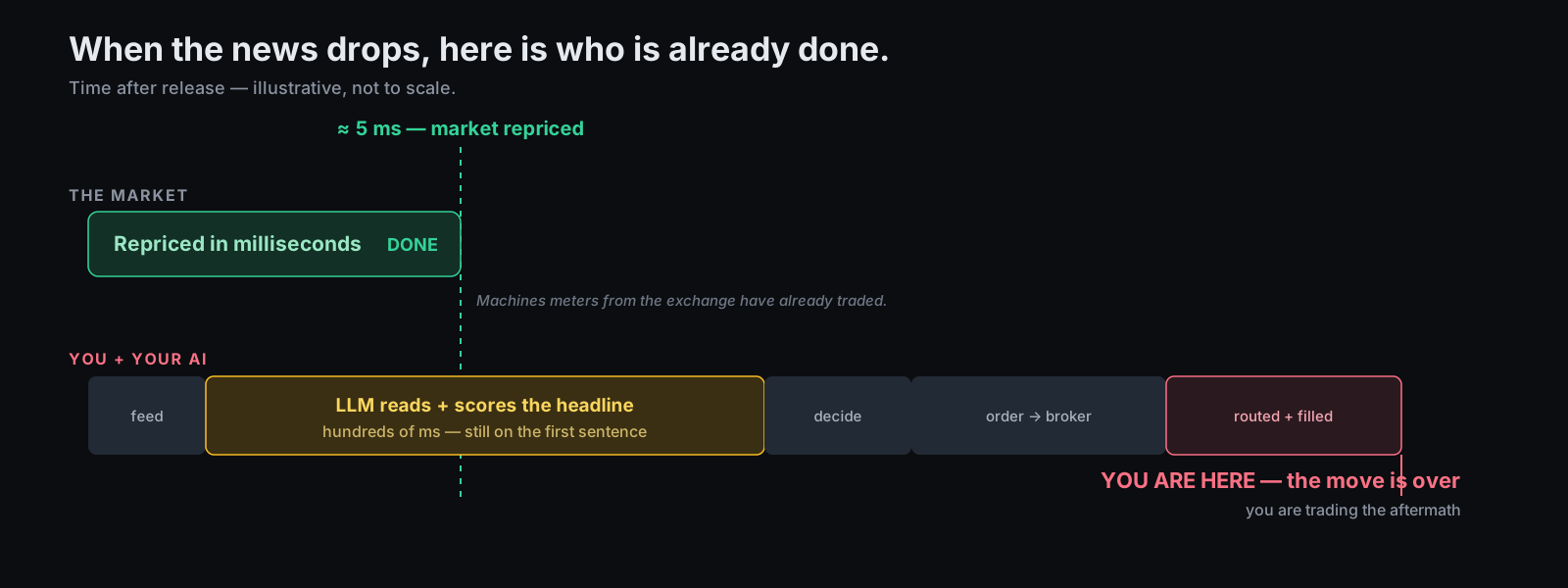
By the time your AI has read the first word of the headline, the price has already moved.
Not "will move." Not "about to." Moved. Done. Over.
Scheduled macro news can be priced into liquid markets within the first few milliseconds of release — by machines sitting meters from the exchange. The market moved before your model finished reading.
You are not trading the news. You are trading its echo.
And the echo is where the fast money sells to everyone who just figured out what happened. So you're not early. You're not even on time. In the news race, you're not the fast money — you're the liquidity the fast money feeds on.
That's the whole problem. AI didn't make you early. It made you confidently late.
Save this before you wire an LLM to a news feed and a buy button. And send it to the friend who keeps messaging you:
I'm building a bot that trades headlines with AI.
That friend isn't building a news trader. They may be building a liquidity donation machine with a very thoughtful paragraph generator attached.
Highly liquid instruments can reprice within the first few milliseconds of a scheduled macro surprise — before any human or model reacts.
Chordia, Green & Kottimukkalur, 2017 ↗Trading intensity can jump more than a hundred-fold in the instant after a macro release — the machines, not you.
Low-latency trading evidence ↗When everyone sees the same public signal, the fastest trader still captures the rent. Public information doesn't help you. The speed does — and it isn't yours.
Budish, Cramton & Shim, QJE 2015 ↗The 60-second version
The AI-news pitch sounds airtight: markets move on information, AI reads information fast, therefore AI can trade news fast. The first two are true. The conclusion is where the account gets slapped.
Scheduled macro news is processed by co-located machines in milliseconds. Your LLM isn't in that race — it's too slow, and so is your broker route, your internet path, and your model's reasoning step. Even when the AI reads the headline correctly, the market has often repriced before your order exists.
So the real question was never "did my AI understand the news?" It's "did the move still exist by the time my order arrived?" For scheduled macro news, the honest answer is usually no. That doesn't make AI useless — it means you hired it for the wrong job. Use it to research, test, and review. Don't hire it as a sprinter in a race that ended five milliseconds after the gun.
| What the AI-news dream feels like | What's actually happening |
|---|---|
| "My AI reacts instantly." | "Instantly" for an LLM is slow in a millisecond market. |
| "I'm trading the news." | You're trading the aftermath of the news. |
| "AI gives me a speed edge." | Speed is the one edge retail structurally can't have. |
| "It read the sentiment correctly." | Everyone's model read the same headline — and the price already moved. |
| "I got in fast." | The machines got in first. Your order may be their exit. |
| "The model is smart." | Intelligence isn't the bottleneck. Latency is. |
I — The dream: AI trades the headline for me
You can see why it's seductive. News moves markets; AI reads faster than any human; so wire the two together and let a model watch the central-bank feed, the macro wire, the earnings line, Reddit, and X — then ask it is this bullish or bearish, what changed, what do I trade? It sounds modern. It sounds inevitable. It sounds like the kind of thing that should work because the sentence is so clean.
But trading is where clean sentences go to get punished by plumbing.
The dream assumes the bottleneck is interpretation. It isn't. For scheduled macro news the bottleneck is time. The information goes public, machines parse it instantly, orders hit the book, price moves — and only then does your LLM begin doing the thing you thought made it powerful: reading.
In most AI workflows, thinking is the advantage. In a latency race, thinking is the delay. That's the uncomfortable inversion: you added intelligence to go faster, but for this one job, intelligence is the slow part.
II — The race is over in milliseconds
Here's the fact that ends the fantasy. When scheduled macro news hits — an inflation print, a jobs number, a rate decision — the first reaction in liquid markets is measured in milliseconds. Not minutes. Not seconds. Milliseconds.
A blink takes roughly 100 to 150 milliseconds. The first price reaction can be over before your eyelid finishes a single lap — many times over. And it isn't a human contest, or even an LLM contest. It's a hardware, location, feed, parser, and routing contest.
The fastest players don't ask a general-purpose model "what do you think about this headline?" They run one tight loop: parse the number, compare it to the expectation, fire — no prose, no reasoning, no friendly explanation. Your AI-news bot runs eight steps instead: receive the headline, read it, infer meaning, score sentiment, decide, format an order, send it to the broker, and wait for the route. Every one of those steps costs time the fast players don't spend. The headline can be right, the interpretation can be right, and the trade can still be late. And late isn't a small detail. Late is the trade.
III — The speed ladder — where you actually stand
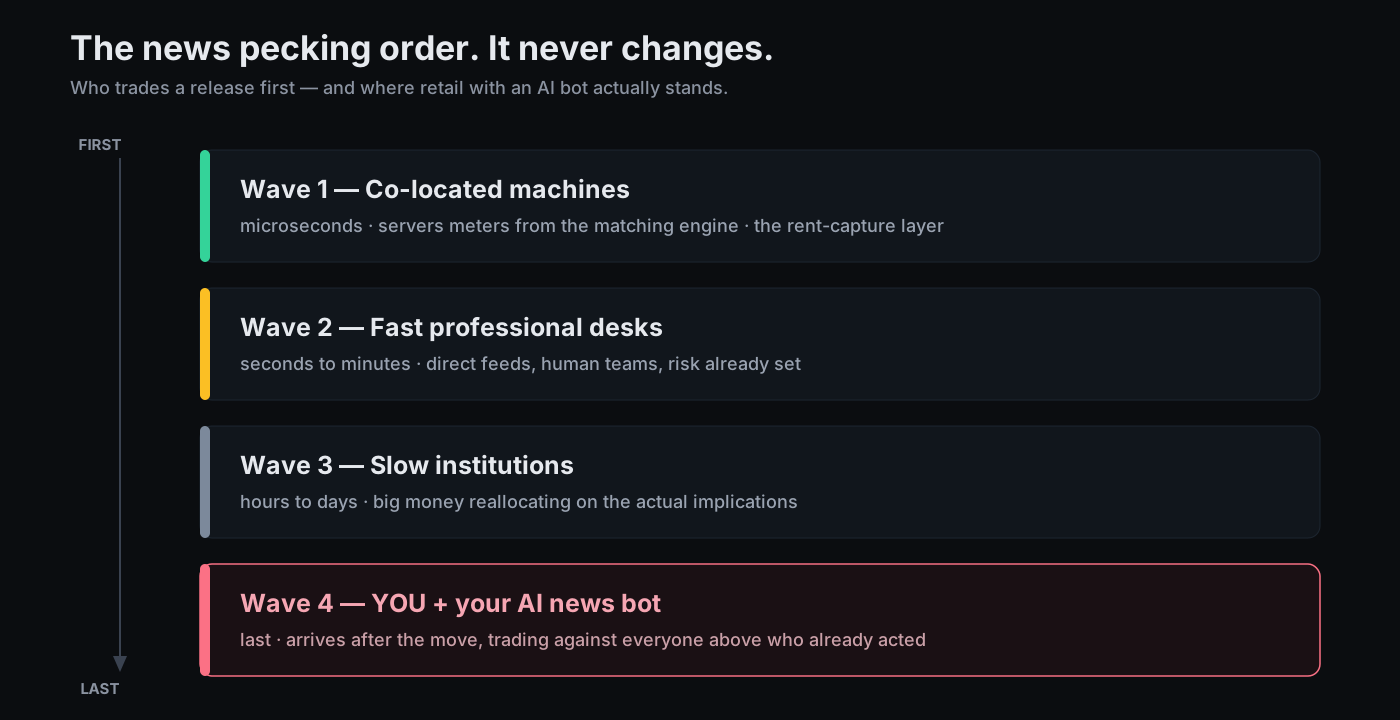
News doesn't get traded once. It gets traded in waves, in a strict order that never changes.
- Wave 1 — the machines (microseconds). Co-located systems near the exchange's matching engine, specialized feeds, hard-coded parsers. They trade the release before a human or a model can process the first sentence. This is the rent-capture layer.
- Wave 2 — fast professional desks (seconds to minutes). Direct feeds, human teams, risk already set. Not first, but still not you.
- Wave 3 — slow institutions (hours to days). Large money reallocating on the actual implications, not the first tick.
- Wave 4 — you. Retail, your broker, your API, your LLM, your news feed, your order route, and your hope that "fast enough" means something.
An AI news bot doesn't move you to Wave 1. At best it makes you a faster Wave 4 — still last, still arriving after the move, still trading against everyone above you who already acted. A faster horse is still a horse in a race the cars already finished. You don't win it by becoming a more eloquent latecomer.
IV — Seeing the news isn't the edge. Being first is.
This is the part even smart people get wrong, and there's rigorous theory behind it.
Economists Budish, Cramton, and Shim studied the high-frequency "arms race" and named the prize: latency arbitrage — profit captured from information that is symmetrically observable. In plain English: even when everyone can see the exact same public signal — the same headline, the same number — whoever acts on it first takes the rent. The information being public doesn't help you. The speed does. And the speed isn't yours.
That demolishes the premise. The pitch is "my AI can read the news." But reading was never the bottleneck — the headline is public the instant it drops, and a million eyes and machines see it at once. The only thing that pays is being first to act, and you are structurally, permanently, not first.
Knowing what the news says is worth nothing if a thousand machines knew it five milliseconds before you and have already traded it.
The researchers' own conclusion is the tell: this is a "socially wasteful arms race" baked into the market's design — the people studying it call the speed race itself the problem. If the academics say the only winner is whoever spent the most on speed, that's not a game you out-clever with a sharper prompt. (It's the same trap as betting on a model that forecasts the move: even a correct call arrives too late to trade — the version we wrote in "AI Predicts the Market.")
V — Your LLM is the slowest thing in the stack
Here's the irony that should sting. You added AI to go faster — but in a microsecond race, the language model is the slowest component you could possibly insert.
A modern LLM is brilliant and, by HFT standards, glacial. It reads, reasons, generates, explains — wonderful for research, fatal for a race. Reading and scoring a headline takes it hundreds of milliseconds, sometimes seconds for a careful model. That alone is tens of thousands of times slower than the machines that already traded. Then you still have to send the order.
The firms that actually trade news don't want a paragraph. They want a machine that does almost nothing: parse a structured number, compare, fire. They optimized away everything that thinks. You're optimizing toward a thing that thinks. For trading the news, intelligence is not the bottleneck — distance to the matching engine is, and you measure yours in thousands of kilometers.
Don't ask a poet to win a drag race. Especially not while charging the poet by the token.
VI — The late order is the product
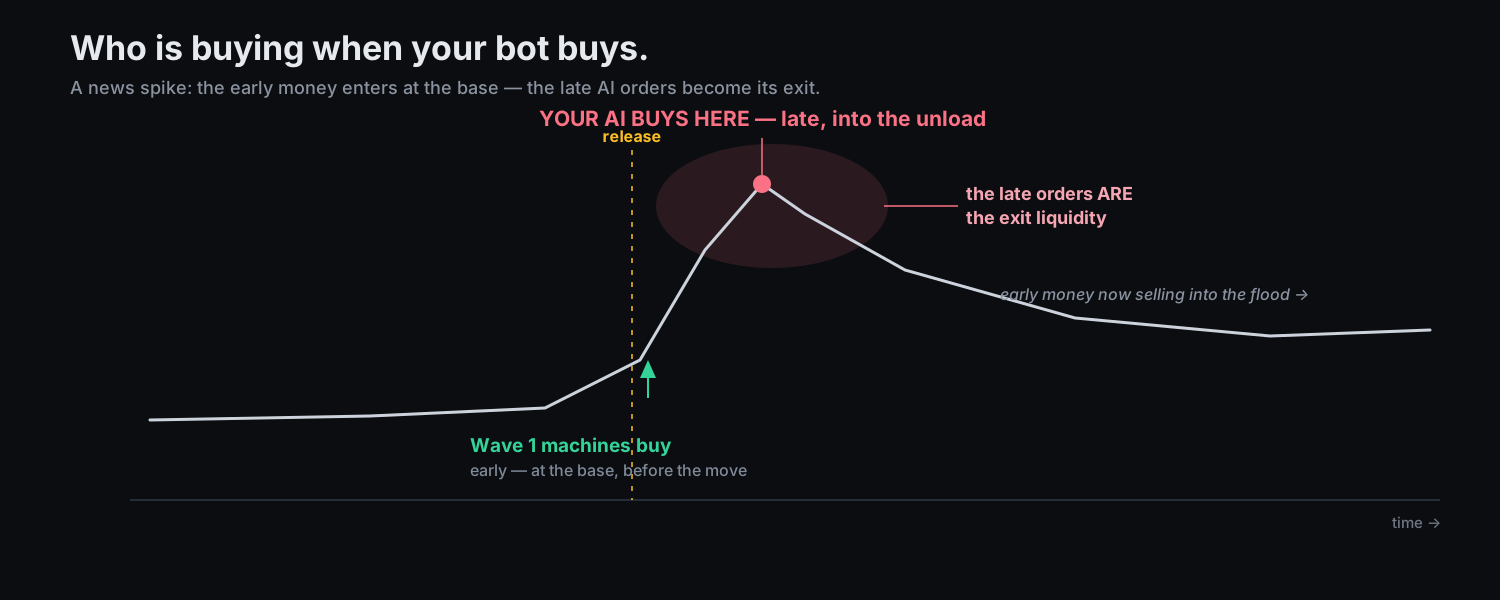
So what happens to your late order? It doesn't vanish. It becomes someone else's liquidity.
When a number drops, the machines move price first. Then a flood of late reactions pours in — retail and slow bots all reading the same headline, all hitting buy on the "obvious" direction. The fast players are now on the other side, happily selling into that flood. Markets do "liquidity hunts" around announcements: a sharp spike that triggers the obvious entries and stops, then a reversal that traps everyone who chased.
Your AI, trained to map "strong number → buy," walks straight into it. It sees a positive surprise, scores it bullish, and fires — into the exact moment the early money is unloading. You feel like you're trading the news. You're providing the exit liquidity for the people who actually traded it. The late money in a news move isn't always the participant. Sometimes it's the product.
That's what makes AI-news trading dangerous for retail. It doesn't just arrive late. It arrives late with confidence.
VII — Everyone's AI reads the same headline
Even ignore speed for a second. There's a second killer: crowding.
A trading edge has to be yours. The moment a signal is obvious and public, it stops paying — everyone trades it and the price already reflects it. AI sentiment on public news is the most crowded signal imaginable: the headline is identical for everyone, and the models reading it are largely the same handful of LLMs reaching largely the same bullish/bearish verdict.
So even if you were somehow fast, you'd be doing the same thing as ten thousand other AI-news bots, at the same instant, on the same words. That's not an edge. That's a queue — and queues are bad places to look for alpha. The more popular "AI news trading" gets, the less any of it works.
And then there's the model itself: an LLM will confidently assign a sentiment that's wrong, or miss that the number was already expected and priced in weeks ago. Reacting fast to a misread just loses money faster.
VIII — The game you can actually win
This isn't an "AI is useless" article — that would be lazy and wrong. AI is excellent for trading the moment you stop asking it to be first.
Point it at the slow, valuable work where thinking is the advantage: researching strategy ideas, turning rules into testable code, auditing a backtest for leakage, finding the behavioral leaks in your journal, summarizing the macro context after the first reaction, building checklists, red-teaming a trade. Those jobs reward intelligence. News scalping rewards latency. Different games, different tools.
The edge available to retail is rarely speed. It's process — a defined, mechanical setup with a tested, positive expectancy after costs, executed the same way every time, on a timeframe where milliseconds don't decide the outcome. An edge that doesn't care whether you read the news first, because it isn't betting on reaction time. (That's the same division of labor we landed on when an agent gets the keys to a live account: the machine does the work, the human keeps the receipts — and you can use AI like a quant, not a gambler.)
Let AI think. Don't ask it to be fast — it can't be, and the race where fast wins was never open to you.The AI-news audit prompt
Whenever you're tempted to build or buy an AI-news strategy, make it audit its own latency first. Paste this, fill in what you have, and read the verdict honestly.
You are auditing my AI-news trading strategy.
Do not evaluate whether the AI understands the news.
Evaluate whether the strategy can act BEFORE the edge is gone.
Treat it as TOO LATE until proven otherwise.

I will provide: news source, release type, instrument, broker,
execution route, model used, model latency, feed delay,
order-routing delay, entry rule, exit rule, costs, test results.

Audit, in order:

1. LATENCY STACK — estimate end-to-end time, in milliseconds:
   news release -> feed arrival -> model read+score -> decision
   -> broker/API routing -> fill. Give a total.

2. MOVE WINDOW — for this event type, does the main move happen
   within milliseconds, the first second, minutes, or hours?
   If it's over before my order arrives, mark TOO LATE FOR NEWS SCALPING.

3. PUBLIC SIGNAL — is the signal public and obvious? Would many other
   models read it the same way at the same time? If yes, mark CROWDED.

4. COST TEST — positive expectancy after spread, commission, slippage,
   post-news spread widening, and execution delay? If not, mark NEGATIVE.

5. ROLE — classify the strategy:
   NEWS SCALPING (must be first; retail likely cannot win)
   AFTERMATH (trades post-news structure; must be tested separately)
   MACRO CONTEXT (uses news as slow context, not an instant trigger)
   INVALID (no tradable process after costs)

6. VERDICT — one of: DO NOT TRADE / RESEARCH ONLY /
   USE AS CONTEXT, NOT TRIGGER / TEST AS POST-NEWS STRUCTURE /
   VALIDATED PROCESS CANDIDATE.

Be conservative. Do not optimize the strategy.
Judge only whether this is a speed race I can actually win.
For most retail AI-news workflows, the honest verdict is the fifth line of step 6: use as context, not trigger.
The 20-minute "am I racing machines?" audit
Run this on any AI-news idea before it touches money.
Minutes 0–5 — Time your real latency. Measure the whole path, not just the model: release time, feed arrival, model read+score, decision, order submission, broker acknowledgment, fill. Add it up honestly. If it's more than a few milliseconds — and it is; it's hundreds, minimum — you're not trading the news. You're trading its echo. That can still be tradeable, but it's a different strategy. Name it honestly.
Minutes 5–10 — Check whether the move was already gone. Pull up the last several scheduled releases of the same type — CPI, NFP, FOMC. Find where the bulk of the move actually happened. If most of it was over before your stack could react, you don't have an entry. You have a chase.
Minutes 10–15 — Run the crowding test. Ask whether ten thousand other AI bots would read this same headline the same way. If yes, the signal isn't private — so why would you get paid for it? If the answer is "because AI is smart," stop. That's not an edge. That's a bumper sticker.
Minutes 15–20 — Rewrite the edge. Finish one sentence: "My edge here is not speed. My edge is ______." Good answers describe a tested setup, a post-news structure that triggers after the spread normalizes, a mechanical rule with positive expectancy. Bad answers are "AI reads the news first," "AI reacts instantly," "faster than humans." If your edge depends on being first, you're done — because you aren't first.
Where this meets what we build
This is the whole reason MTR is built the way it is.
MTR isn't a news-reaction bot trying to out-sprint co-located machines to a headline — that's a ticket to a race we'd be selling you to lose. It's a mechanical system on a defined setup, with a tested expectancy after costs, that executes the same logic every time on a timeframe where being a microsecond late doesn't decide the trade. The edge, such as it is, comes from a repeatable statistical process you can read and verify — not from a reaction time you physically cannot have at a retail desk.
And the honest part, the way we are on every page: it's a process, not a prophecy. MTR can lose — a real edge has losing stretches; what it doesn't have is a dependence on beating HFT to a number. You can read the source, see the 155-strategy research log, and check the disclosed backtest's stated assumptions. None of that requires you to win a speed race, because the whole design sidesteps the one game retail always loses.
Use AI as the analyst it's great at being. Just stop hiring it as a sprinter in a race that ended before it finished reading the first word.
Disclosure
We sell source and evidence you can inspect — not outcomes, not certainty, not a speed edge. Trading scheduled news as a retail participant means competing against co-located, low-latency systems built for public-information races; AI does not close that gap and often widens it by adding processing time. "Sentiment-AI" win-rate claims you see advertised are typically unsourced marketing. MTR can lose. Any strategy can lose. Backtests are simulations of the past, not promises about the future. The point isn't that AI is useless — it's that speed is the one edge retail can't prompt into existence, so build one you can.
One question before you trade a single headline with AI
Don't ask whether your AI read the news correctly. Ask:
By the time my order reaches the market, is the move already over?
If the honest answer is yes — and for scheduled news, it is — then you're not trading the news. You're the late order the fast money was waiting for.
Let AI read the world for you. Just never bet that it can read it first.