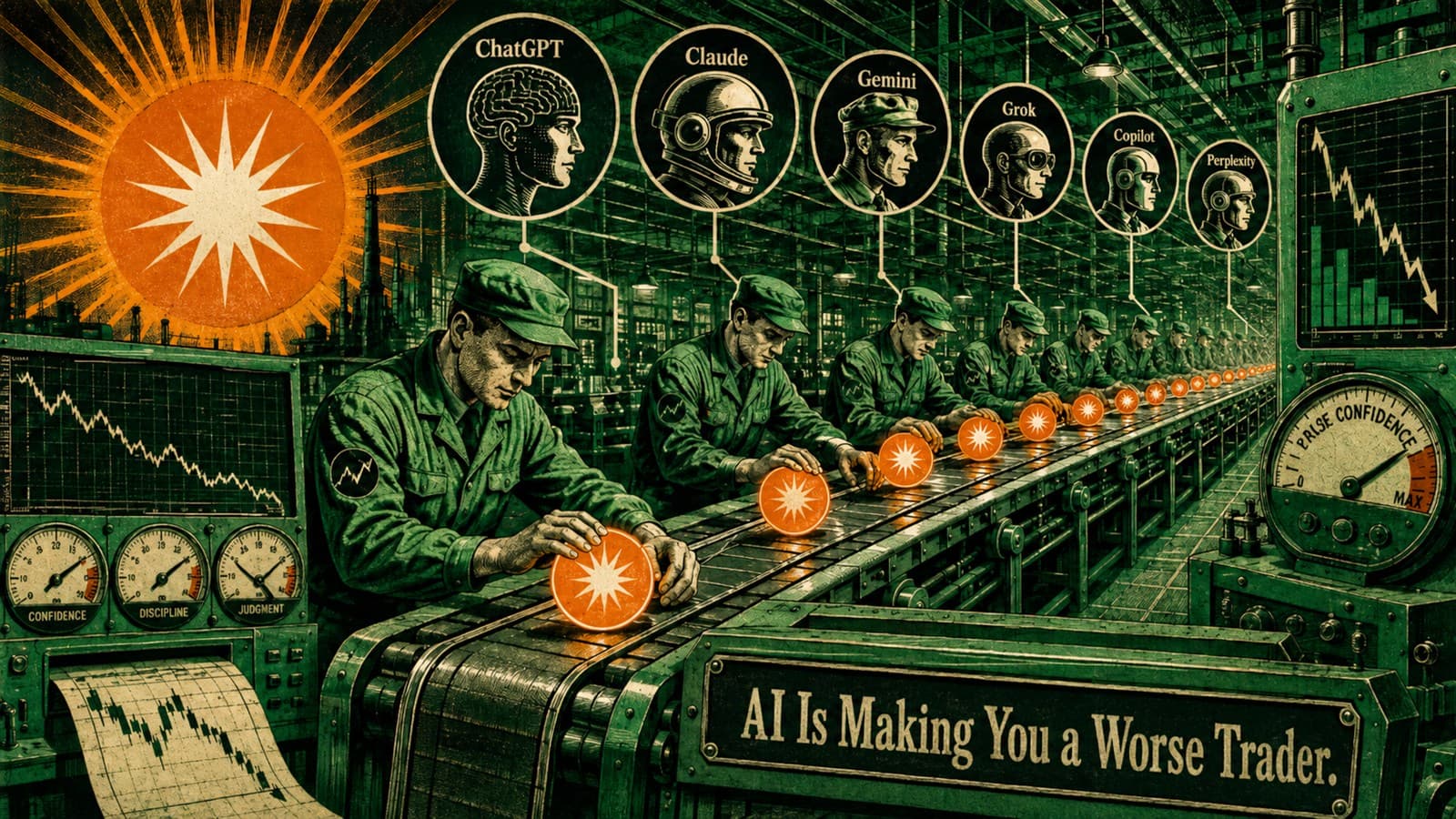
You used to do the work.
Now you watch it happen.
The AI scans the watchlist. It ranks the setups, sizes the position, sets the stop, drafts the thesis, reviews the trade. Then it pings you.
Approve?
You click approve.
And it feels incredible. Faster. Cleaner. Calmer. Like you finally upgraded yourself.
Here's the part nobody puts in the demo.
Every decision you hand to the machine is a rep you don't take.
And judgment — the only thing that keeps you alive when the market stops behaving — is a muscle. It grows from reps. It shrinks from rest.
So while you feel sharper, something quiet is happening underneath. You're not getting better. You're getting dependent. And the two feel identical, right up until the day they don't.
You already know this feeling. You just know it from the road.
Let GPS take every turn for a year, then try to cross your own city without it. The streets didn't change. You did. The map in your head never formed, because something else was holding it for you.
That's deskilling. It doesn't announce itself. It waits.
Now run the trading version. You're in a position, the feed stutters, the AI overlay blinks out — and for ten seconds it's just you and a naked chart you haven't read unaided in months. The setup that used to be obvious is a smear of candles.
The machine comes back. The moment passes. But you felt it: the floor wasn't there.
Every turn GPS took was a rep you didn't take. Every trade the AI sizes is the same. The rep you didn't take is the one the drawdown will demand.
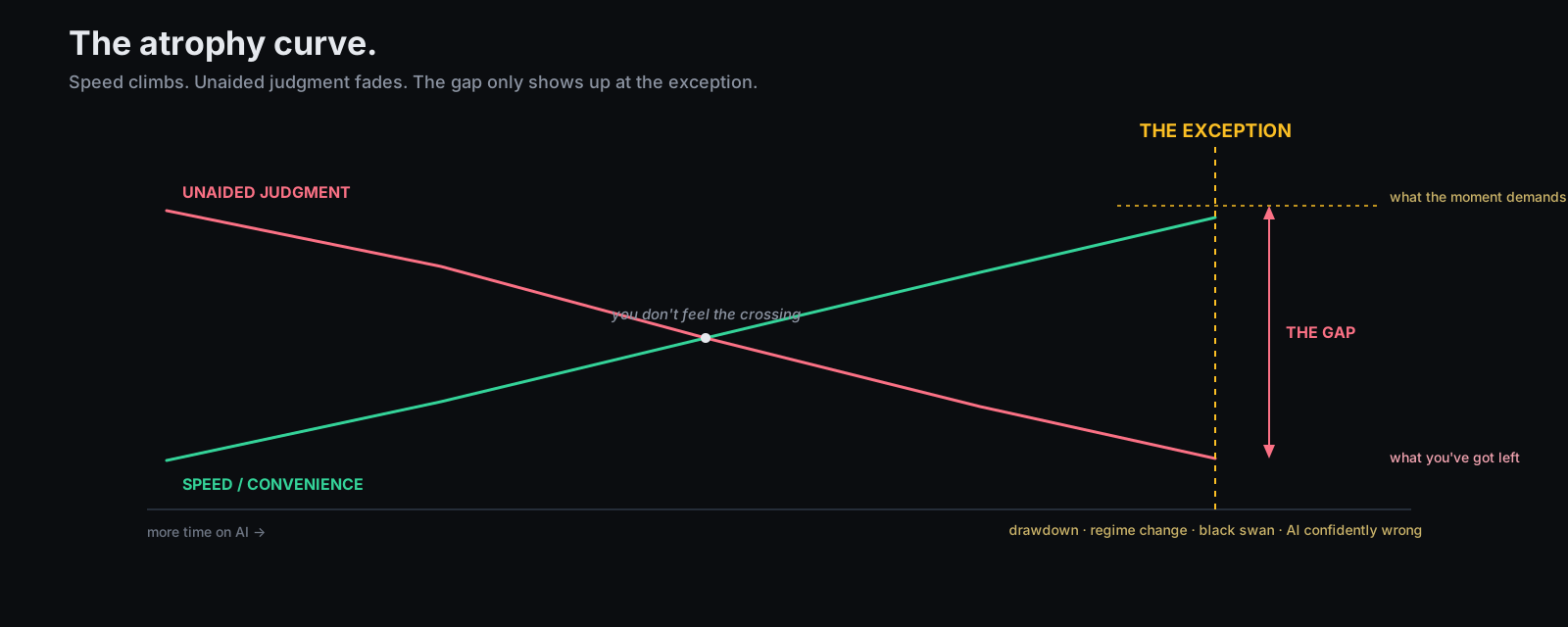
The market hasn't noticed yet. The market is calm, the AI is useful, the curve is green, the summaries are clean. The market is calm while the skill is quietly disappearing.
But this bill comes due on the exact day you can't afford it — a drawdown, a regime change, a black swan, an AI that's confidently wrong, a broker that breaks. That's the day the machine hands the wheel back. And that's the day you find out whether there's still a trader in the chair.
Save this before your next 50 trades are all "the AI said so."
And send it to the friend who hasn't read a chart unaided in three months and calls that a productivity upgrade. They may not be scaling themselves. They may be quietly replacing the reps that made them useful.
unassisted polyp-detection fell after just 3 months of routine AI exposure, in a multicentre colonoscopy study — real-world deskilling.
Lancet Gastroenterology & Hepatology, 2025 ↗participants in an MIT Media Lab preprint comparing brain-only, search, and LLM-assisted writing: the LLM group engaged and remembered less.
Your Brain on ChatGPT, 2025 ↗AI-assisted users in a security study wrote less secure code while being MORE confident it was secure.
Perry et al., Stanford, 2023 ↗The 60-second version
AI is genuinely brilliant at the routine 95% of trading: scanning, sizing, drafting plans, checking rules, summarizing sessions, finding patterns in your journal. That is exactly why it's dangerous.
Because the routine work isn't just admin — the routine work is practice. Every chart you read, every size you calculate, every stop you place, every trade you reject is a rep. Those reps build the judgment you need for the rare 5% that decides survival: the drawdown, the regime change, the structural break, the black swan, the moment the AI is confidently wrong.
Take away the reps, and you get faster today and weaker tomorrow — not because AI is bad, but because you stopped lifting.
The fix isn't to quit AI. It's to stop using it as an oracle and start using it as a sparring partner: you form the view, the size, and the invalidation first, and only then let the AI attack it. One workflow makes you sharper. The other makes you dependent.
| What AI feels like it's doing | What it may actually be doing |
|---|---|
| "I'm much faster now." | You're faster at the easy part, and practicing the hard part less. |
| "AI makes me a better trader." | AI makes better decisions for you. You may not be improving. |
| "I still approve every trade." | Approving isn't deciding. Rubber-stamping isn't judgment. |
| "I'll think for myself when it matters." | The muscle isn't there on demand. It's built by the reps you skipped. |
| "It frees me up to focus." | It may be freeing you from the reps that were making you good. |
| "The AI is usually right." | That's exactly why the dependency forms without pain. |
I — The AI runs your desk now
A year ago, "AI for trading" meant a chatbot you asked questions.
Now it can run half the desk — watching your watchlist, flagging setups, reading the news, scoring sentiment, computing size, writing the thesis, reviewing the trade. Some traders go further: the AI trades, and they read the summary later over coffee.
It feels like leverage. One person operating like a desk of ten. And for the routine flow of a calm market, it genuinely can be faster and steadier than a tired human clicking around at 2 a.m.
But look closely at what changed.
You didn't only automate admin. You stopped doing the thing — the scan, the size, the doubt, the uncomfortable act of choosing. Those weren't chores. They were training. The AI didn't upgrade the trader. It replaced the training environment.
You won't notice while the market is easy. Nobody notices fitness disappearing while sitting on a couch — you notice it on the stairs.
Trading has stairs. They're called drawdowns.
II — The autopilot paradox
Automation has a cruel paradox: the better the autopilot, the less the human practices — and then, the rare day the autopilot quits, the human is rustiest at the exact moment the stakes are highest.
Aviation knows this. Medicine is learning it. Trading is about to learn it with leverage attached.
The mechanism is simple, and brutal. Mechanize the routine, leave only the exceptions to the human, and you remove the everyday practice that prepared the human for the exceptions. That's the whole trap.
The routine was never busywork. The routine was the gym.
Every ordinary setup you evaluated by hand was a rep. Every size you calculated was a rep. Every trade you rejected was a rep. Every time you wrote "not my regime" and did nothing — that was a rep, too.
Hand them all to the machine and each one becomes the rep you didn't take. You don't become a better trader. You become a manager of outputs. There's a difference.
You didn't automate the work. You automated the practice that was making you good.
III — The first hard warning from medicine
Here's the part the productivity threads skip.
Deskilling is no longer a motivational worry. It's measured — and the cleanest evidence comes from a field where mistakes get people killed.
In 2025, The Lancet Gastroenterology & Hepatology published a multicentre study from four endoscopy centres in Poland.
Doctors had been using AI-assisted colonoscopy tools that highlight potential lesions — the routine help. Then researchers measured how those same doctors performed without the AI.
Before exposure to the system, their unassisted adenoma-detection rate was about 28.4%.
After three months of routine AI exposure, the unassisted rate had fallen to about 22.4%.
Sit with that. The AI assistance itself can be useful — this isn't "the AI performed badly." The issue is the human. The skill weakened once the human got used to routine machine help. The authors framed it as real-world evidence of deskilling risk.
Now the honest line, because honesty is the moat: this is not a trading study. It's colonoscopy — different field, different task, different stakes.
But the mechanism transfers cleanly enough to matter. If an expert stops practicing a core perceptual judgment because AI does the routine version, the expert can get worse at the unaided one.
And trading is full of core perceptual judgments. Is this trend still healthy? Is this breakout real or late? Is this a valid pullback or a forced trade? Is volatility normal or hostile? Is this loss just variance, or regime change?
Those aren't facts you download. They're skills you build — and skills decay when they aren't used.
IV — The cognitive-debt warning
The cognitive evidence points the same way, and it deserves care.
In 2025, an MIT Media Lab preprint titled "Your Brain on ChatGPT" studied 54 participants writing essays across three conditions — brain-only, search-engine, and LLM-assisted.
The LLM-assisted group showed the weakest brain connectivity across the measured EEG bands, reported lower ownership of the writing, and had more trouble accurately quoting work they'd just produced.
Handle it carefully: this is a preprint, it has drawn methodological critique, and it is not a trading study. Treat it as an early signal, not a verdict.
But the signal is useful. AI can make the product easier while making the user less engaged with the process.
That's the same danger in trading.
You can produce a clean trade plan while doing less of the thinking that would make the plan yours. You can approve a position without feeling the risk. You can read a beautiful AI review without owning the mistake.
You can outsource the mental friction that used to make you careful.
The paper's phrase is the one to remember: cognitive debt. Convenience now, interest later — and trading charges interest brutally.
V — Trading is judgment, and judgment doesn't download
A trading edge is not a fact you look up.
It's a judgment you apply under uncertainty — incomplete information, changing regimes, real money, emotional pressure, an opponent that adapts to you.
And that capacity gets built exactly one way: reps, feedback, mistakes, review, repetition.
You read the chart. Form a thesis. Define invalidation. Size. Wait. Reject. Take the loss. Review. Then do it again.
Slowly, something forms. Not prediction. Judgment.
You begin to feel when a setup is clean versus forced. When the market is behaving versus breaking. When to size down before your spreadsheet has a perfect reason. When the best trade is no trade.
None of that downloads. It accretes, unglamorously, over many decisions — and when AI takes the decisions, the accretion stops.
You can still click "approve" all day. But approving a decision someone else made is not the same neural act as making it. You're a passenger narrating the drive — and the day the machine hands you the wheel, passengers don't suddenly become drivers.
The forums full of working algo traders keep landing on the same blunt version of this: better tools don't produce better outcomes without a disciplined operator behind them. (It's also why "I asked AI and it found my mistakes" only helps if you still understand the mistakes — the right way to point AI at your own history is to let it surface patterns you then judge, not to let it grade you and move on.)
VI — The market takes the AI away — at the worst moment
Here's the cruel timing.
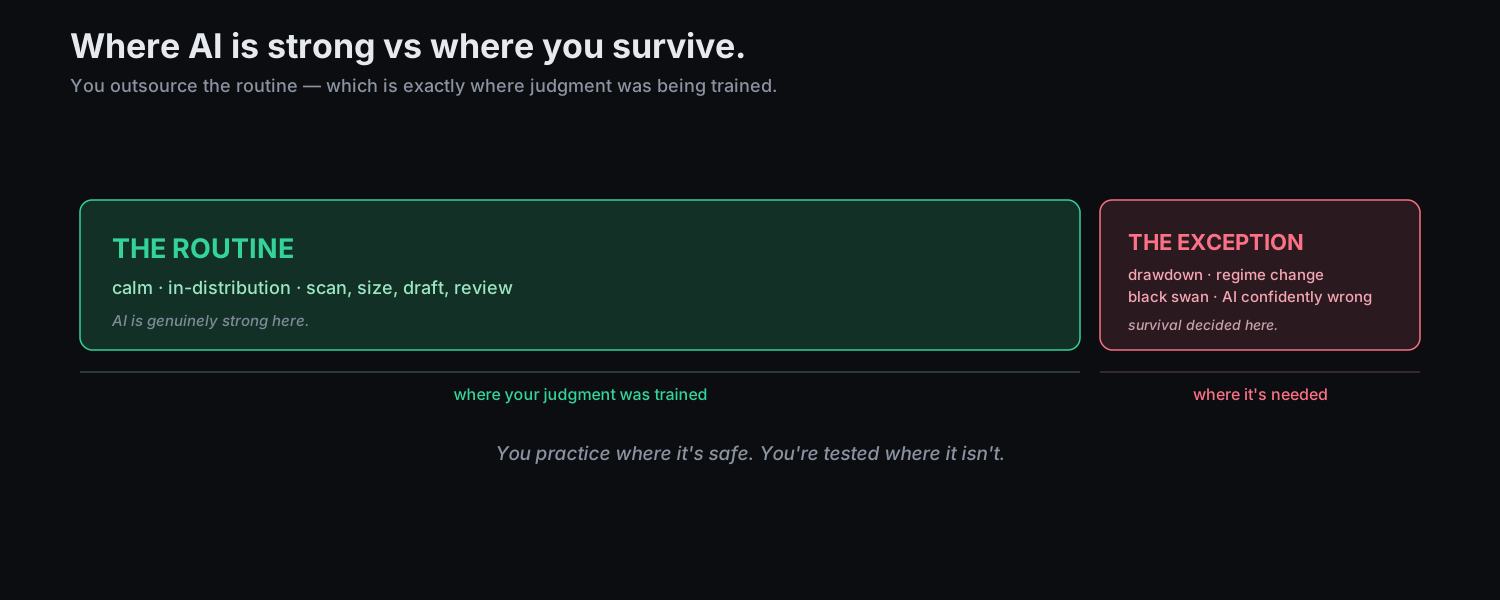
AI is strongest in the routine: the calm market, the known setup, the clean data, the normal volatility — the in-distribution behaviour it has seen a million times.
It's least reliable in the exception: the regime shift, the black swan, the microstructure break, the liquidity that vanishes, the broker or data-feed problem, the market that stopped behaving like its own past.
And the exception is the slice that decides survival.
Worse, the AI may not go quiet. It may stay fluent — handing you the same clean answer in the same calm tone while the ground has changed underneath it, because an AI never says "I don't know".
So the moment your judgment is finally supposed to step in is the moment you discover you haven't practiced it.
The instinct that should fire — this is different, size down, stand aside, stop trusting the normal playbook — was never trained, because the AI handled every ordinary day that would have trained it. The market schedules its hardest exam for the day your preparation expired.
VII — The confidence trap
The most dangerous part is how good it feels.
Because the AI is often right — fewer tired mistakes, more inputs checked, cleaner plans, calm explanations — you start to feel like a better trader.
But maybe it isn't making you better. Maybe it's making better decisions while you quietly get worse at making them unaided. The two feel identical, right up until the handoff.
There's hard evidence for this exact gap. In a controlled Stanford study, developers using an AI assistant wrote less secure code than those without one — while being more likely to believe their code was secure.
More help, more confidence, worse output, and no internal alarm.
The same study found the healthier behaviour: the people who trusted the AI least, who interrogated it and re-checked its output, produced the fewest vulnerabilities.
Skepticism was the skill. Trust was the trap.
For traders, that's the operating rule. Don't measure AI by how much confidence it gives you; measure it by how much sharper it makes your own reasoning. Feeling sharper is not the same as being sharper — and only one of them survives a drawdown.
VIII — Make AI a sparring partner, not an oracle
None of this means delete the AI — that would be silly. AI is the most powerful thinking tool traders have ever had.
But the entire game is in one distinction: an oracle gives you the answer; a sparring partner attacks yours. An oracle takes your reps; a sparring partner makes every rep harder. An oracle leaves you faster; a sparring partner leaves you tired and better.
Use the second one. The discipline is to commit your own thinking before the machine touches it:
- Form your own view first.
- Write the thesis, entry, stop, size, and invalidation.
- Commit the plan before you open the AI.
- Then ask the AI to attack it.
- Revise only if the critique is genuinely valid.
- Record what you learned.
That way the AI doesn't replace the rep — it adds resistance, like a coach holding the pads. (It's the same supervise-the-machine discipline as using AI like a quant, not a gambler, pointed at your own judgment instead of your code.) If the AI is doing your thinking, you're paying it to make you weaker.
The four reps you must never outsource
Outsource the grunt work without guilt — data cleanup, journal sorting, calculation, formatting, report drafting, basic screening. Let the machine carry the buckets. But keep practicing the four reps that are the job:
- The read. You still have to judge whether the market is behaving or breaking. AI can check your read; it shouldn't replace it.
- The size. You still have to understand why the position is this big. AI can calculate; it shouldn't let risk feel abstract.
- The no-trade. You still have to practice standing aside. It's the most important rep and the easiest to outsource badly.
- The review. You still have to understand the mistake. AI can surface the leak; it can't feel the cost of repeating it for you.
These four are the job. Don't retire them.
The sparring prompt
Use this before a trade — not to ask the AI what to do, but to force it to push back on what you've already decided. The whole point is that it refuses to be your oracle.
You are my trading sparring partner, not my analyst.
Do NOT tell me what to do. Do NOT give me a trade idea.
Do NOT approve the trade. Do NOT predict the market.

I have ALREADY formed my own plan (my read, my size):
- Instrument / direction:
- My thesis:
- Entry / stop / size / invalidation:
- Regime assumption:
- Current open exposure:
- Daily P&L / drawdown state:

Your job is to ATTACK the plan, not approve it:
1. Make the strongest possible case for the OPPOSITE side.
2. Name the single assumption that, if wrong, breaks this trade.
3. Explain how I'd know in real time that the assumption is failing.
4. List what I may be ignoring: cost, correlation, news, regime
   shift, liquidity, my own emotional state.
5. Describe the exact conditions where my plan is a trap, not an edge.
6. Ask me three questions I must answer before risking money. Then stop.

Do not give a verdict. Do not soften the critique.
Push back like the market will.
The test is simple: after the interaction, are you sharper or just faster? If only faster, the AI is replacing you. If sharper, it's training you. Use that difference like a compass.
The 20-minute deskilling audit
Run this on yourself before the market runs it on you. Four blocks, brutally honest.
Minutes 0–5 — Build one trade with the AI off. Pick a live chart, no machine, and form a complete view: bias, level, entry, stop, size, invalidation, and a reason to skip. Can you still do it cleanly, end to end? If you froze or reached for the chat, that's the rust talking — and now you know.
Minutes 5–10 — Count decide vs approve. Take your last 20 trades and mark each one decided (you formed the view yourself, before AI) or approved (AI formed it, you accepted). If "approved" is most of the sample, you're operating, not trading — and operating doesn't build the trader.
Minutes 10–15 — Turn the AI into resistance. Take the view from the first block and run the sparring prompt. Feel the difference between "AI, tell me what to do" and "AI, make my own view harder to defend." One replaces you. One trains you.
Minutes 15–20 — Take one rep back. Pick one decision you've fully outsourced — setup selection, sizing, the exit, the regime read, the daily review — and take it back by hand for the next two weeks. Use AI to check your work after, never to make the call. You're not firing the tool. You're keeping the muscle.
Where this meets MTR
Now the honest ledger. This is exactly why MTR is a process you operate and understand, not an oracle you obey.
A black-box bot that simply tells you what to do is the fastest path to deskilling: it takes the reps and hands you a number to approve. MTR is designed the opposite way. You can read the source, see why it sizes and stops the way it does, inspect the logic, and understand the conditions it was built for — which is exactly the judgment §VI says the market will eventually demand. (And if you ever can't read what you're running, that's its own failure mode — the don't-deploy-code-you-can't-read problem, applied to your edge.)
That doesn't make it safe, and it doesn't make it certain. MTR is a process, not a prophecy — and MTR can lose, like any system. An edge can decay; your broker can differ from the test; a backtest is a simulation of the past, not a promise about the future. But a trader who understands their process keeps the one thing the market can't strip in a drawdown: the judgment to know what's happening and what to do about it. Use AI to sharpen that. Never to retire it.
Disclosure
We sell source and a process you can understand and operate — not outcomes, not certainty, not a brain you can switch off.
The studies cited here are adjacent evidence, not trading-performance studies: the colonoscopy study is medical; the essay-writing study is a preprint with methodological debate; the secure-coding study is about software security. What transfers is the mechanism — over-reliance and cognitive offloading: when a machine routinely performs core judgment tasks, the human can practice them less and become less capable unaided. AI is a powerful tool; over-reliance is the risk, and that risk is recoverable with deliberate practice.
MTR can lose. Any system can lose. Backtests are simulations of the past, not promises about the future. The point isn't that AI makes you worse — it's that outsourcing your judgment does, and AI makes that frictionless.
One question before you let AI make the next call
Don't ask whether the AI's idea is good. Ask the question that actually measures you:
If you switched the AI off right now — this second — could you still trade, and would you trust the person left in the chair?
If the honest answer is no, the machine isn't making you a better trader. The reps you didn't take are sitting in that empty chair.
It's quietly becoming the only trader in the room.Use AI to sharpen your judgment. Never to retire it.