You ran the sweep overnight.
By morning, the AI had handed you the winner: a clean rising equity curve, Sharpe 2.4, a 78% win rate, drawdown that barely scratched.
The line went up so smoothly it looked like it had been raised by emotionally stable parents.
You feel it in your chest — this is the one. You finally cracked it.
No. You ran a lottery with ten thousand tickets and got excited about the one that hit.
That sentence hurts because it ruins the prettiest part of AI strategy research. AI can test more ideas than you ever could — that is genuinely useful, and it is also genuinely dangerous, because if you test enough strategies, one of them will look brilliant even when there is no edge at all. Not because it learned. Not because it found structure. Not because the market whispered a secret into your GPU. Because somebody always wins the coin-flip tournament.
Put a million monkeys at a million keyboards. Have each one flip coins and "trade" for a year. At the end, one monkey will have a beautiful track record — a smooth curve, a great Sharpe, a deeply confident facial expression. The monkey did not discover a strategy. It won the noise tournament. Now replace the monkeys with strategy configurations, the coin flips with backtests, and "random monkey" with "AI optimizer." Congratulations: you have just described how thousands of retail trading systems are born.
Quants have a blunt phrase for this.
Torture the data long enough and it confesses to anything.
AI did not create this problem. It removed the friction that used to slow it down. A human might test twenty ideas and get tired; AI can mutate, sweep, score, rerun, rank, filter, and decorate ten thousand strategies before lunch. That is not automatically progress. Sometimes it is just industrialized coincidence.
This is the post that keeps the machine honest — the gauntlet real funds run, written so you can run a version of it tonight. It also closes the edge-measurement arc this blog has been building:
- #17 — a backtest can be one lucky path out of thousands.
- #19 — dollars and win rate hide the edge until you count it in R.
- #20 — a single winner can hijack your expectancy.
- #21 — and one strategy from thousands can hijack your belief.
Two things before we start. Save this before your next AI sweep makes your heart race. And send it to the friend who just told you their AI "found something incredible." You might save them a funded account.
published return factors were examined in the multiple-testing debate; many claimed findings weaken once the search count is considered.
Harvey, Liu & Zhu (2016) ↗a much stricter significance hurdle suggested for new factors once prior testing is accounted for.
Multiple-testing adjustment ↗the Deflated Sharpe Ratio adjusts a headline Sharpe for selection bias, non-normal returns, and backtest overfitting.
Bailey & López de Prado ↗The 60-second version
A backtest result is a sample. The best result from many backtests is not a normal sample — it is selected, and that selection matters. If you test one strategy and it gets Sharpe 2.4, that might be impressive. If you test 8,000 strategies and keep the one with Sharpe 2.4, that might be ordinary. The strategy did not change. The meaning changed because the search changed. That is the entire trap.
AI makes it easy to draw thousands of strategy samples, then shows you the prettiest one. Unless you correct for how many tries it took, the headline number is inflated. The fix is not "never use AI." The fix is a sequence:
Count the trials.
Freeze the winner.
Test on data it never saw.
Deflate the score.
Check parameter stability.
Only then call it an edge.
A real edge survives being doubted. A coincidence only survives being admired.
I — The crime scene
One backtest of one strategy is an honest question: did this rule work on this history? The trouble starts when you ask the question many times and keep only the prettiest answer. One strategy tested once is research. Ten thousand strategies tested and sorted by Sharpe is a beauty contest for noise.
Selection inflates. Always. If 100 people each flip a coin 10 times, someone in the room will look gifted — they might get 9 heads, maybe 10 — and everyone else stares at them like they have a coin-flipping edge. They do not. They were selected after the contest. The same thing happens in strategy research. If you test enough parameter combinations, one will look great. If you test enough filters, one will line up perfectly. If you test enough timeframes, one will seem magical. If you let AI mutate the rules long enough, one backtest will start glowing like it knows something — but maybe it does not know anything. Maybe it is just the best coin flipper in the room.
That is the crime scene. You are not measuring one strategy anymore. You are measuring how hard you searched.
Finance has been burned by this before. So has medical science. Any field that tests thousands of ideas and publishes the winners eventually learns the same painful lesson: a lot of "discoveries" are just the survivors of many failed attempts nobody showed you. Trading is worse, because the survivor has a chart — and charts are persuasive little criminals.
II — Why AI makes it worse
AI did not invent data mining. Traders were overfitting long before chatbots learned to say "certainly." The old constraint was effort: you had to code the strategy, run the backtest, change parameters, run again, export, compare, and get bored. That boredom was not elegant, but it acted like a brake.
AI removed the brake. Now the workflow looks like this:
Generate idea.
Write code.
Run backtest.
Mutate parameters.
Add filter.
Remove filter.
Try new timeframe.
Try new symbol.
Sort by Sharpe.
Repeat overnight.
This is powerful. It is also how you manufacture false confidence at scale. The most important number in the whole process is usually hidden:
How many strategies were tried before this one was shown?
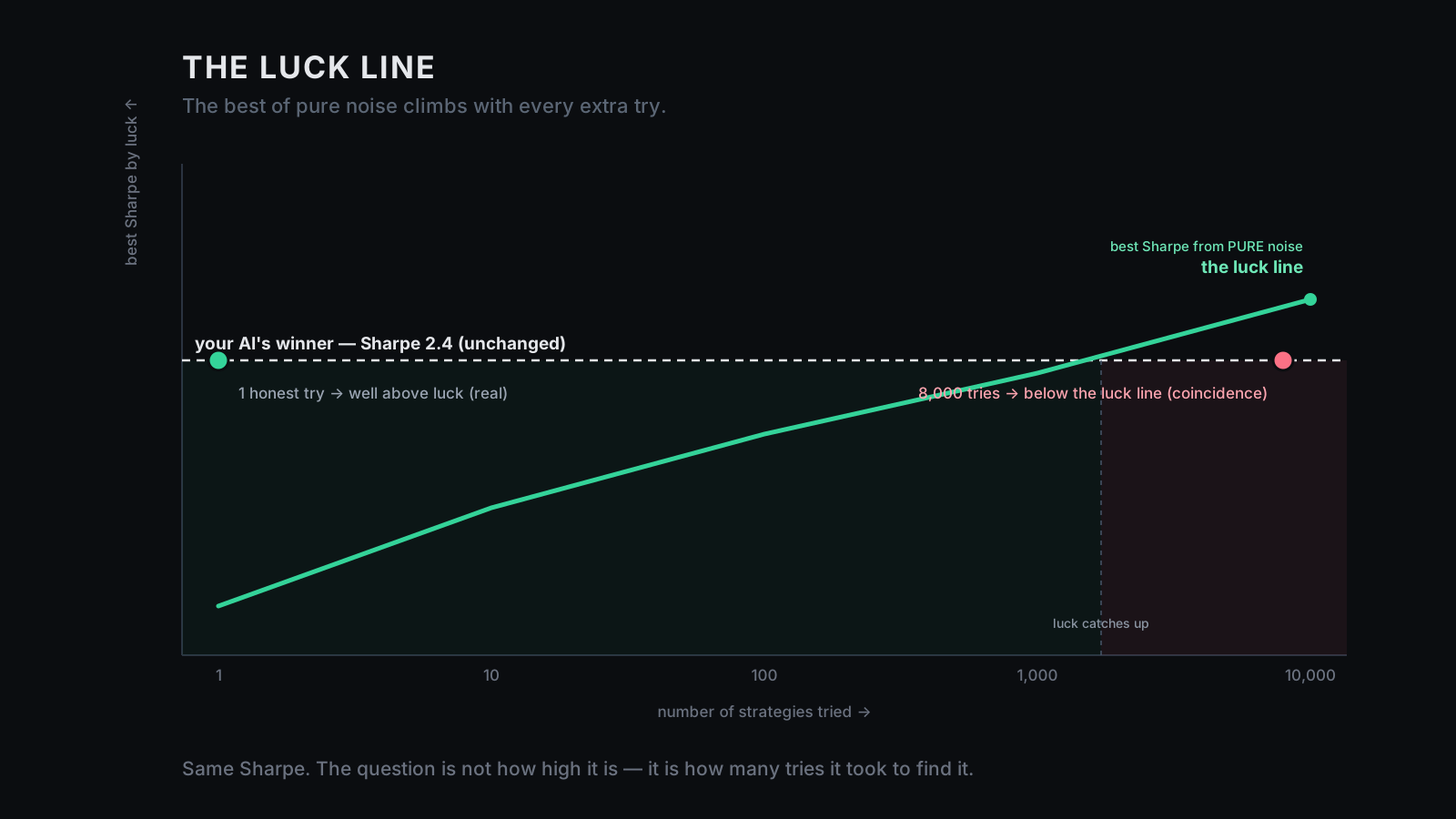
Not how good the winner looks. How many losers it beat. A Sharpe of 2.4 after one honest hypothesis is a different animal from a Sharpe of 2.4 after 8,000 attempts. A clean equity curve from a pre-registered rule is different from a clean equity curve that emerged after 300 filters were tried and 299 were quietly buried.
This is the vendor problem. It is the AI-agent problem. It is also the honest builder's problem — because you do not have to be dishonest to fool yourself. You just have to search widely and forget to count. That is why AI strategy research needs a trial ledger: every run counts, every sweep counts, every "small tweak" counts, and every time you look at the result and change the rule, that data just became part of the search. The search is not evil. Uncounted search is evil. Tiny distinction. Huge tuition bill.
III — The luck line
Here is the mental model that should sit above every optimizer. There is a line that rises as the number of attempts rises — call it the luck line — and it answers one question: how good should the best strategy look if all strategies were pure noise?
With one try, the best noise strategy probably looks unimpressive. With 10 tries, one looks better. With 100, the best one starts to look interesting. With 1,000, one can look shockingly good. With 10,000, the best-of-noise can look like a product page. The exact math is not the point. The point is simple: more attempts raise the bar.
So the right question is never "is Sharpe 2.4 good?" The right question is "is Sharpe 2.4 still good after I account for how many tries it took?" A result you did not search for is valuable; a result selected from a giant search must be discounted. Same number, different evidence. This is why "AI found a winner" is not enough — AI will always find a winner if you let it search long enough. The question is whether the winner sits above the luck line. Most retail traders never draw the line, so every pretty result feels like discovery. That is how the monkey gets funded.
IV — The Deflated Sharpe
This is where quants stop arguing with vibes. The Deflated Sharpe Ratio is a tool designed to answer a brutal question: after accounting for selection bias, non-normal returns, and the number of trials, is this Sharpe still meaningful? A normal Sharpe asks how good the return stream looked. A deflated Sharpe asks how good it still looks after I admit how it was found — and that second question is the one most retail backtests avoid like a phone call from the tax office.
The deflation comes from three broad haircuts:
1. Number of trials
2. Variation across trials
3. Return shape and sample length
Number of trials matters because picking the best from many attempts inflates the result. Variation matters because if the sweep produced wild outcomes, the top one is more likely to be an extreme draw. Return shape matters because trading returns are rarely normal — they can be skewed, fat-tailed, short, and weird. The practical lesson: do not quote a Sharpe without its search history. A raw Sharpe is a profile photo. A deflated Sharpe is the same person after you see the group chat. Less flattering, more useful.
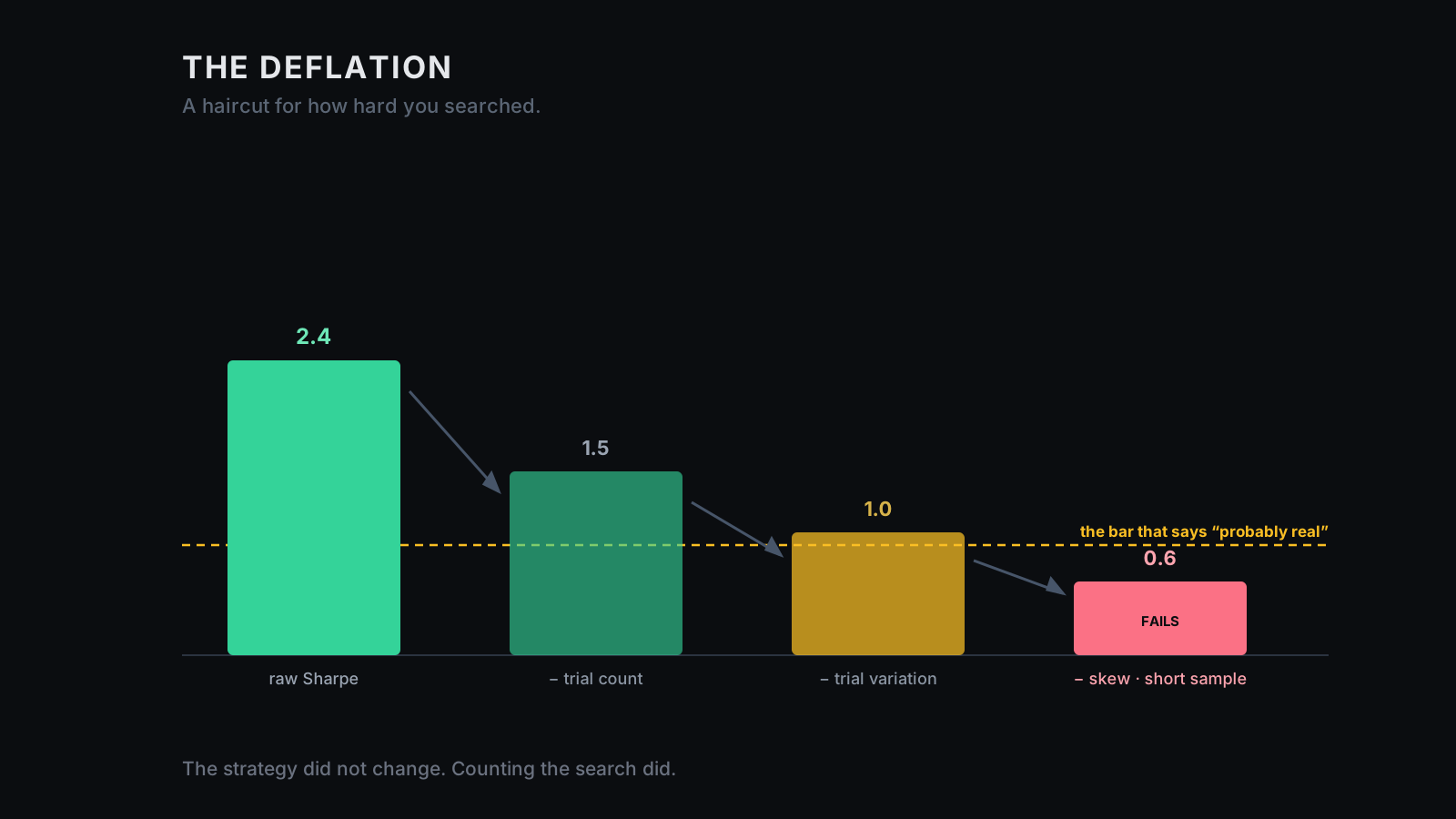
Practical version, not exact DSR:

Raw in-sample Sharpe:       2.4
Strategies tried:           ~8,000
Trial count disclosed:      yes
Frozen hold-out tested:     no
Parameter plateau:          unknown

Verdict: do not trust the raw Sharpe yet.
Next:    run frozen out-of-sample → compute Deflated Sharpe
         → check whether small parameter changes destroy it.
The exact version can be computed. But even before the math, the discipline changes the conversation. A trader asks how good is the backtest? A quant asks how much searching produced it? That is the upgrade.
V — Walk-forward
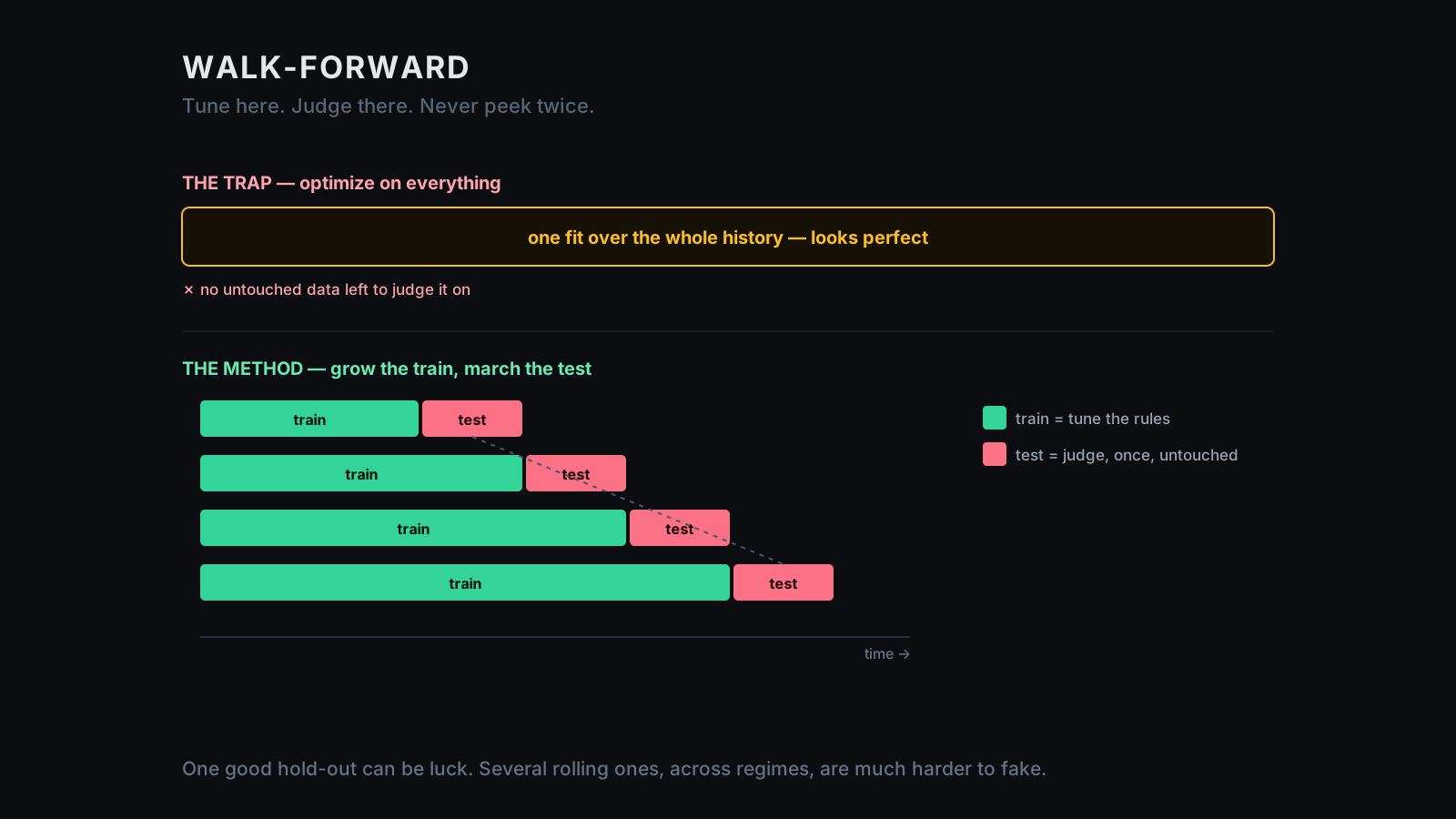
The cleanest defense against best-of-many is time the search never touched. Split the data: train on one section, test on a later section, and freeze the rules before the test. Do not adjust after seeing the answer. That last line is where most traders fail. They say "I did out-of-sample." Then you ask what happened when it failed, and they say "I adjusted the filter and ran it again." Congratulations — that was not out-of-sample anymore. That was in-sample with extra steps.
Hold-out data is single-use. The first time you use it to make a decision, it is spent. If the strategy fails on untouched data and you tweak the system based on that failure, the hold-out has entered the search, and the luck line rises again. This is why walk-forward is useful — not because it is magic, but because it forces repeated separation between fitting and judging:
Train: 2022            Test: 2023 Q1
Train: 2022–2023 Q1    Test: 2023 Q2
Train: 2022–2023 Q2    Test: 2023 Q3
Each step asks the same thing: can the rule survive a future slice it did not optimize on? One good hold-out can still be luck. Several rolling hold-outs across different regimes are much harder to fake. That is the point — not perfection, friction. A serious validation process should make it harder for luck to pass.
VI — PBO
PBO means Probability of Backtest Overfitting. The name sounds like something a hedge fund uses to frighten interns, but the idea is simple: if your strategy wins in-sample, does it still rank well out-of-sample? An overfit process tends to produce champions that look great on the slices they were selected from and weak on the slices they did not see. A real edge should not only win in the place you tuned it; it should remain respectable when the judging slice changes.
The formal version uses combinatorially symmetric cross-validation — very fancy, very useful — but you can steal the core idea without the full machinery:
Change the judging slice.
Freeze the rule.
Re-rank the result.
See if the champion stays a champion.
The questions that expose overfit are the ones you can ask this afternoon:
If tuned on 2024, does it work on 2025?
If tuned on gold, does it work on another liquid instrument?
If tuned on the Asia session, does it survive London?
If tuned on one volatility regime, does it survive another?
If top-ranked in-sample, is it still above median out-of-sample?
That last one is the PBO smell test: if your in-sample winner lands below the median out-of-sample, it was probably not a finder — it was a fluke selector. A real edge should travel. Maybe not perfectly, but enough. A coincidence is local. It works in the exact window it was born in and gets homesick everywhere else.
VII — Seven tells of an over-searched strategy
You can often smell selection bias before you compute anything. Not always, but often.
1. A knife-edge optimum. Move one parameter one notch and the system collapses. That is not a robust edge; that is a spike. Real edges tend to live on plateaus. Flukes live on needles. (Your grid-vs-cliff instinct applies here too.)
2. Too many conditions. Seven filters, five confirmations, three sessions, two volatility gates — one moon phase, probably. Every extra condition can be a genuine mechanism. It can also be another way to memorize the past. Complexity is not sophistication; sometimes it is just overfit with better posture.
3. Gorgeous in-sample, dead out-of-sample. The classic symptom. The system performs beautifully where it was optimized and loses its personality the moment it leaves home.
4. A Sharpe too clean for the sample. A short sample with a smooth curve and almost no drawdown should make you curious, not excited. Curiosity asks how many versions were tried. Excitement skips that question and wires money. Do not be excitement.
5. No trial count. A seller shows you the winner but will not tell you how many versions were tested. That is not a small missing detail — that is the denominator. A backtest without a trial count is a magic trick with the trapdoor hidden.
6. It works on one symbol, one timeframe, one window. Edges can be specialized, but if a strategy only works on one exact combination and dies everywhere nearby, treat it as fragile until proven otherwise.
7. It got prettier every time AI "tried harder." This one is new and important. If every additional AI search makes the in-sample backtest cleaner and smoother, do not automatically call that progress — that may be the optimizer learning the past better, not the market. A curve can become prettier while the strategy becomes less real. The prettiest overfit is still dead. It just dies in high resolution.
VIII — How to use AI without fooling yourself
None of this means stop using AI — that would be silly. AI is excellent at search. It can generate hypotheses, write code, build harnesses, run parameter sweeps, create validation reports, compute deflated metrics, and draw robustness charts. That is powerful. The mistake is letting the same machine that searched also declare victory. Use AI for labor, not for the verdict.
A safe AI research loop looks like this:
1. Pre-register the test.
2. Define the hold-out before the search.
3. Run the search.
4. Count every trial.
5. Freeze the winner.
6. Test once on untouched data.
7. Deflate the score.
8. Wiggle the parameters.
9. Promote only if it survives.
This is the difference between AI as colleague and AI as slot machine. Slot-machine AI says: "I searched thousands and found this beautiful winner." Colleague AI says something far less exciting and far more useful:
I searched thousands. This was the winner.
Here is the trial count.
Here is the deflated score.
Here is the untouched hold-out.
Here is where it failed.
Proceed carefully.
The goal is not to stop AI from searching. The goal is to stop yourself from worshipping the best survivor of the search.
The 20-minute coincidence test
Run this on a strategy you already want to believe. It bites.
Minutes 0–5 — Count the trials. Write down the number most people hide:
How many versions did I test?
How many parameter combinations?
How many filters?
How many re-runs?
How many times did I look at the result and tweak?
Be honest. If you do not know the number, write "trial count unknown = high risk." You cannot correct for a search you refuse to count.
Minutes 5–10 — Spend one hold-out. Choose a chunk of data the strategy never optimized on — a different year, a different quarter, a different symbol, a different regime. Run the frozen strategy once, with no tweaking afterward. If it fails, it fails. The hold-out is not a suggestion box; it is a judge.
Minutes 10–15 — Deflate. Ask AI to compute the score with the trial count included:
Compute a validation report for this strategy. Do not optimize anything;
only evaluate the frozen strategy.

Inputs: return series · raw Sharpe · number of strategy trials tested ·
number of observations · skewness · kurtosis · in-sample window ·
out-of-sample window.

Estimate:
1. Deflated Sharpe Ratio (or a practical approximation).
2. Probability the raw Sharpe is inflated by selection bias.
3. Out-of-sample Sharpe.
4. Whether it clears a realistic bar after multiple testing.
5. A plain-English verdict: likely coincidence / inconclusive /
   promising but needs validation / robust enough for a small forward test.
The key line is do not optimize anything — say it like you mean it, because the model will happily help you lie to yourself if you ask politely.
Minutes 15–20 — Wiggle the knobs. Move each important parameter slightly — not to find a better result, but to see whether the result survives:
EMA 50 → 45 / 55
ATR 14 → 12 / 16
Stop 1.5× ATR → 1.3× / 1.7×
Session filter → one hour earlier / later
Then ask: does performance degrade gradually, or fall off a cliff? Gradual degradation suggests a plateau. A cliff suggests a spike. Real edges prefer plateaus; overfit loves spikes.
Where this meets ProEA
This is one of the sharpest reasons we care about source. A track record can be the luckiest survivor of ten thousand sweeps. A beautiful equity curve can be the winner of a noise tournament. A vendor can show you the strategy that survived and never show you the graveyard. That is why the better question is not what is the backtest? but how was this backtest found? Was it one stated method, or the prettiest survivor of a hidden search? Were the rules defined before the result, or did they get more complicated every time the past resisted? Was the logic inspectable, or did the seller hand you a curve and ask you to clap?
MTR is built around source and evidence because inspectability changes the conversation. You can read the logic, inspect the assumptions, and ask whether the conditions look like a mechanism or a memory of the past — and you can run the very tests in this article against it. Our published backtest is one 28-month grid, shown in full, not the prettiest survivor of a hidden search; every line of the logic is readable. That does not guarantee profit — nothing does. Inspectability is proof of method, not proof of future outcome. MTR can lose; any system can lose. But a system whose method you can inspect is a different object from a screenshot you can only admire.
The same standard cuts both ways, as it should. Ask any seller — including us — "how many versions did you try before you showed me this one?" A serious builder should not be offended by that question; they should expect it. Because in the AI era, the trial count is part of the result. Not trivia — part of the result. (Counting R tells you the unit; the outlier test tells you if one trade carried it; the Monte Carlo tells you if one ordering carried it; this tells you if one search carried it.)
Disclosure
We sell source and evidence you can inspect — not outcomes, not guarantees. Backtests can be overfit. Walk-forward tests can still fail. The Deflated Sharpe and PBO are tools, not guarantees. A strategy that passes these tests can still lose money live; a strategy that fails them might still work in a future regime, but it has not earned trust yet. Trading is risky and leverage magnifies risk; past performance is not future performance. The point is not certainty. The point is to stop confusing the prettiest survivor of a search with a real edge.
The one line to take with you
The next time AI hands you a winner, do not ask how good it is first. Ask how many losers it beat to get there — then ask whether it still wins on data it never saw. A real edge survives being doubted. A coincidence only survives being admired.
Run the 20-minute test tonight. If it is real, you will trade it with a spine instead of a hope. If it is a coincidence, you just saved yourself the tuition.