FTMO sells two CFD evaluations. The 2-Step has a 10% profit target, then 5% in the Verification, a 5% Maximum Daily Loss, a static 10% Maximum Loss and at least 4 trading days per phase. The 1-Step has one 10% target, a 3% Maximum Daily Loss, a 10% Maximum Loss that trails the highest end-of-day balance, and a Best Day Rule: your best day can be no more than 50% of your profitable days' total. Both daily limits reset at 00:00 CE(S)T and count floating losses; neither challenge has a time limit. Rewards are 80% on the 2-Step (up to 90%) and 90% on the 1-Step.
The programs at a glance
| Program | Profit target | Max daily loss | Max loss | Minimum days | Best-day cap | Reward |
|---|---|---|---|---|---|---|
| FTMO Challenge: 2-Step (Standard or Swing) | 10%, then 5% | 5% of initial capital | 10%, static | 4 trading days per phase | None | 80%, up to 90% |
| FTMO Challenge: 1-Step (Standard only) | 10% | 3% of initial capital | 10%, end-of-day trailing | None listed | 50% of Positive Days' Profit | 90% |
| FTMO Futures (Growth or Pro) | $3,000 to $9,000 | Evaluation: Growth none, Pro $1,000 to $2,000 | $2,000 to $6,000, end-of-day trailing, then locks | None listed | Evaluation: 40% Growth, 50% Pro | 90/10 |
Sources: Trading Objectives, Comparison Table and Futures Trading Objectives & Rules, checked 2026-10-08. US visitors get ftmo.oanda.com, which we don't cover.
Where the floor sits: both loss floors on $100,000
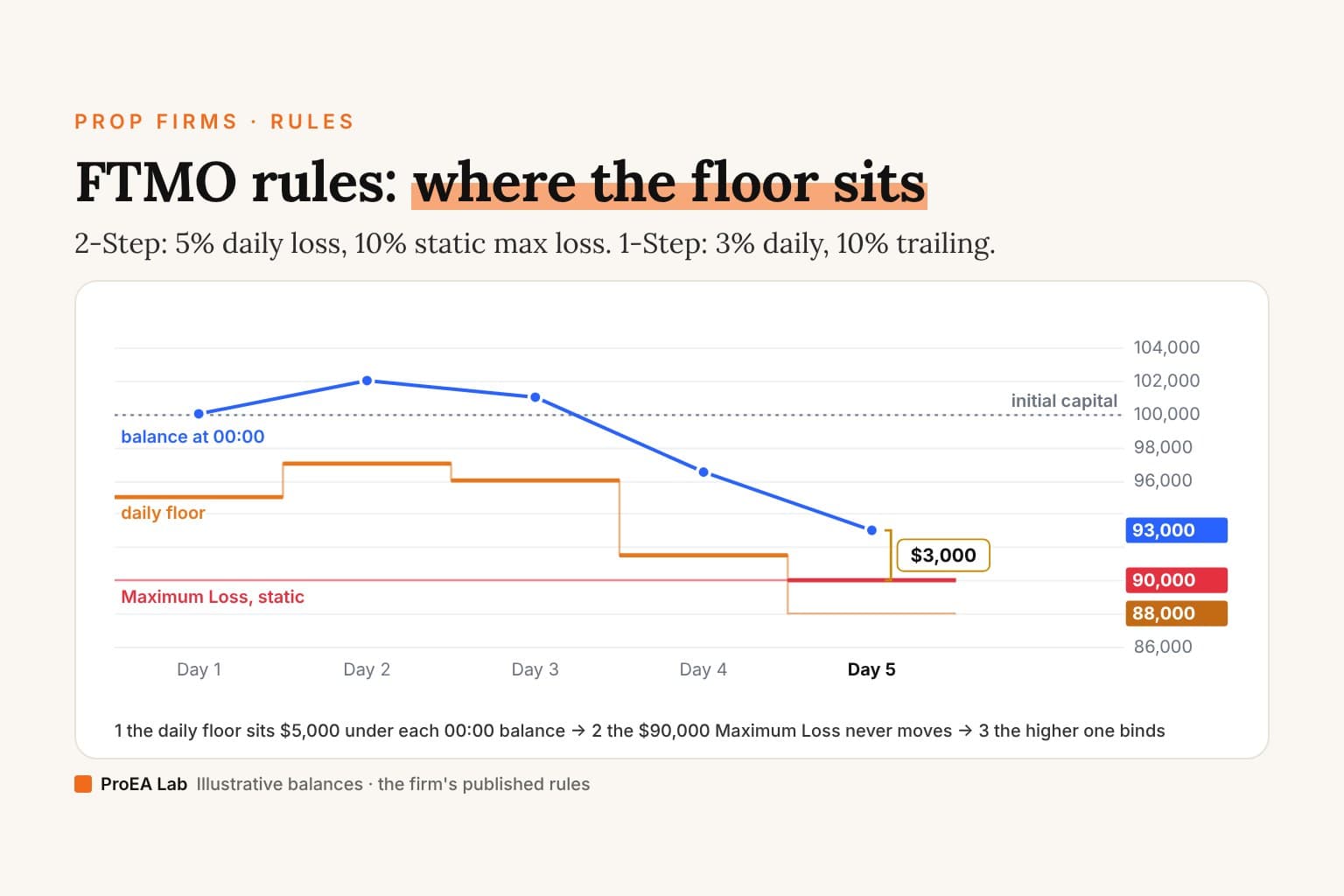
Today's floor on a $100,000 2-Step is the higher of two lines: your 00:00 CE(S)T balance minus $5,000, and the static $90,000 Maximum Loss. Your equity, open trades included, must stay above it all day. On the 1-Step the second line trails. The balances are FTMO's own examples; days 4 and 5 of the 2-Step are invented.
Day 5: the daily floor drops to $88,000, under the $90,000 Maximum Loss. The static floor binds: $3,000 of room.
Illustrative balances, not market data: days 1 to 3 are FTMO's own Maximum Daily Loss example, days 4 and 5 are invented. The rules are FTMO's, as quoted in the 2-Step section and read 2026-10-08.
Rule: daily floor = the balance at 00:00 CE(S)T − 5% of initial capital ($5,000); Maximum Loss = initial capital − 10% ($90,000), static. Equity under either is a breach, so the higher one binds.
Read as text
- Day 1 (FTMO's example): balance at 00:00 CE(S)T $100,000. Daily floor $95,000, Maximum Loss $90,000 (static). The tighter is the daily floor, $5,000 away.
- Day 2 (FTMO's example): balance at 00:00 CE(S)T $102,000. Daily floor $97,000, Maximum Loss $90,000 (static). The tighter is the daily floor, $5,000 away.
- Day 3 (FTMO's example): balance at 00:00 CE(S)T $101,000. Daily floor $96,000, Maximum Loss $90,000 (static). The tighter is the daily floor, $5,000 away.
- Day 4 (invented): balance at 00:00 CE(S)T $96,500. Daily floor $91,500, Maximum Loss $90,000 (static). The tighter is the daily floor, $5,000 away.
- Day 5 (invented): balance at 00:00 CE(S)T $93,000. Daily floor $88,000, Maximum Loss $90,000 (static). The tighter is the Maximum Loss, $3,000 away. Below a $95,000 midnight balance the static floor binds and the day's room shrinks under $5,000.
Survives: the worst moment leaves $90,500, $500 above the Maximum Loss ($90,000).
Balances from the film: FTMO's examples, plus two invented 2-Step days. Floors by FTMO's rules as quoted on this page, read 2026-10-08. The worst moment is equity against the 00:00 CE(S)T balance (closed and open P&L, swaps and commissions); touching a floor counts as a breach here.
| Day | Balance at 00:00 CE(S)T | Daily floor | Maximum Loss floor | Tighter floor | Room from that balance |
|---|---|---|---|---|---|
| 1 | $100,000 | $95,000 | $90,000 | $95,000 | $5,000 |
| 2 | $102,000 | $97,000 | $90,000 | $97,000 | $5,000 |
| 3 | $101,000 | $96,000 | $90,000 | $96,000 | $5,000 |
| 4 | $96,500 | $91,500 | $90,000 | $91,500 | $5,000 |
| 5 | $93,000 | $88,000 | $90,000 | $90,000 | $3,000 |
| Day | Balance at 00:00 CE(S)T | Daily floor (balance − $3,000) | Maximum Loss floor (highest midnight balance − $10,000) | Tighter floor |
|---|---|---|---|---|
| 1 | $100,000 | $97,000 | $90,000 | $97,000 |
| 2 | $104,000 | $101,000 | $94,000 | $101,000 |
| 3 | $103,000 | $100,000 | $94,000 | $100,000 |
On the 1-Step the $104,000 midnight balance lifts the Maximum Loss to $94,000, and the dip to $103,000 leaves it there.
FTMO Challenge: 2-Step
Two phases on the same account size, then the FTMO Account, where "continuous compliance with applicable Trading Objectives is required at all times."
| Rule | FTMO Challenge | Verification | FTMO Account |
|---|---|---|---|
| Profit Target | 10% | 5% | None |
| Maximum Daily Loss | 5% of initial capital | 5% | 5% |
| Maximum Loss | 10%, static | 10%, static | 10%, static |
| Minimum Trading Days | 4 | 4 | None |
| Trading Period | Unlimited | Unlimited | Not listed |
FTMO prints only the $100,000 example; the other rows apply its percentages.
| Account | Challenge target | Verification target | Daily loss amount | Maximum Loss Limit |
|---|---|---|---|---|
| $10,000 | $1,000 | $500 | $500 | $9,000 |
| $25,000 | $2,500 | $1,250 | $1,250 | $22,500 |
| $50,000 | $5,000 | $2,500 | $2,500 | $45,000 |
| $100,000 | $10,000 | $5,000 | $5,000 | $90,000 |
| $200,000 | $20,000 | $10,000 | $10,000 | $180,000 |
- Maximum Daily Loss: a floor for equity ("Balance + Open Positions P/L ± Swaps – Commissions"), "recalculated daily at 00:00 CE(S)T" as that balance minus 5% of initial capital. The amount is fixed; the floor moves with each midnight balance.
- Maximum Loss: "A static limit." It doesn't rise when you make money (static vs trailing).
- Minimum Trading Days: a day (CE(S)T) counts if you open at least one position; a trade held for days counts once. Both phases take "as few as 8 Trading Days."
- Rewards: 80%, "increases to 90% if Scaling Plan or Premium Programme conditions are met." The fee "may be refunded with the first Reward withdrawal."
FTMO Challenge: 1-Step
One phase, then the FTMO Account: tighter limits, a trailing Maximum Loss and a Best Day Rule instead of minimum days.
| Rule | FTMO Challenge | FTMO Account |
|---|---|---|
| Profit Target | 10% | None |
| Maximum Daily Loss | 3% of initial capital | 3% |
| Maximum Loss | 10%, end-of-day trailing | 10%, end-of-day trailing |
| Best Day Rule | 50% | 50%, for Reward eligibility |
| Minimum Trading Days | None listed | None listed |
| Trading Period | Unlimited | Not listed |
| Account | Profit target | Daily loss amount | Maximum Loss Amount | Day-1 Maximum Loss Limit |
|---|---|---|---|---|
| $10,000 | $1,000 | $300 | $1,000 | $9,000 |
| $25,000 | $2,500 | $750 | $2,500 | $22,500 |
| $50,000 | $5,000 | $1,500 | $5,000 | $45,000 |
| $100,000 | $10,000 | $3,000 | $10,000 | $90,000 |
| $200,000 | $20,000 | $6,000 | $20,000 | $180,000 |
- Maximum Loss: the highest 00:00 CE(S)T balance "of any preceding trading day or, if higher, the amount of Initial Simulated Capital," minus 10% of initial capital. "The limit can only increase, but never decrease." No lock; it resets only "when a Reward is withdrawn and a new FTMO Account is provided."
- Best Day Rule: your Best Day may not be "more than 50% of your Positive Days' Profit," the sum of your profitable days, so losing days stay out. "Exceeding the Best Day limit is not treated as a rule breach": you trade on until it's back under. The fastest finish is "as few as 2 trading days." See our consistency rule guide and firms without one.
- Rewards: 90%. "Rewards cannot be left on the account to grow the balance," and "The entry fee is not refunded."
Sources for both challenges, checked 2026-10-08: Trading Objectives, How long does it take to become an FTMO Trader?, How do I withdraw my reward?, Is the entry fee refunded?.
Standard vs Swing: news, overnight and weekends
Swing is "available exclusively within the FTMO Challenge: 2-Step" and changes only these conduct rules.
| Rule | Standard | Swing |
|---|---|---|
| News, Evaluation | Unrestricted, subject to Forbidden Trading Practices | Same |
| News, FTMO Account | No opening or closing on targeted instruments 2 minutes either side of restricted releases | No restriction |
| Overnight and weekend, Evaluation | Allowed | Allowed |
| Overnight and weekend, FTMO Account | Close before the weekend, or a market break over 2 hours | No restriction |
| Leverage | Up to 1:100 | Up to 1:30 |
| Switching | To Swing: not allowed | To Standard: after a Reward withdrawal |
A Stop Loss or Take Profit triggered inside the news window is a breach too. Only targeted instruments count: around NFP you may trade EURGBP, but not USDJPY or GBPUSD. Sources, checked 2026-10-08: Can I trade news?, overnight and weekend, the Swing account type, account specifications.
EAs, copy trading and forbidden practices
- EAs: allowed. A third-party EA sharing "exactly the same strategy" with other traders risks "being denied the FTMO Account" under the capital cap: "$400,000 per trader or strategy (prior to any scaling)." (strategies, accounts, checked 2026-10-08.)
- Copy trading: not addressed. No FTMO page we read mentions trade copiers; no third party may "perform simulated trades for you or in coordination with you." Ask FTMO first.
- Forbidden Trading Practices include exploiting price errors, opposite positions across accounts, "gap trading" (opening trades "two hours or less before a relevant financial market is closed for at least two hours"), EAs making "more than 2,000 server requests per day," and splitting a trade idea "to circumvent the Best Day Rule." (source, checked 2026-10-08.)
- Size and activation: no "substantially larger position sizes" than usual, at FTMO's discretion (clauses 7.3 and 7.5), and trade within 30 calendar days of receiving a phase (clause 5.8.4). (Terms and Conditions, checked 2026-10-08.)
Rewards, payout timing and the Scaling Plan
- When: "on the 14th or any following day after the first placed trade on the specific account," all positions closed. Review takes 1–2 business days; payment typically follows "within 1–2 business days after the invoice is approved."
- How: bank wire, Visa Direct / Mastercard Send (up to $20,000), Skrill (up to $3,000) or crypto; minimum $20 by wire, $50 in crypto. (source, checked 2026-10-08.)
- Scaling Plan: "25% every 4 months," up to "$2,000,000 (across all your FTMO Accounts)," after 4 months with "at least 10% net simulated profit," "at least 2 processed Rewards" and a positive balance. The 90% share is "(valid for 2-Step only)." (source, checked 2026-10-08.)
Account sizes and prices on 2026-10-08
One-time fees, in euros, from the pricing table on FTMO's home page:
| Account | 2-Step fee (refundable) | 1-Step fee (not refundable) |
|---|---|---|
| $10,000 | €89 | €79 |
| $25,000 | €250 | €199 |
| $50,000 | €345 | €319 |
| $100,000 | €540 | €499 |
| $200,000 | €1,080 | €999 |
That day both $100,000 accounts also showed special-deal prices (€439 and €399) for buyers without one active. Prices apply "to FTMO Standard accounts only," and "There are no recurring fees" (source).
FTMO Futures: a separate rulebook
Billed monthly; the trading day runs from 6:00 p.m. ET to 4:10 p.m. ET.
| Evaluation | Profit target | Max drawdown (end-of-day trailing) | Daily loss limit | Consistency | Monthly fee |
|---|---|---|---|---|---|
| Growth 50K | $3,000 | $2,000 | None | 40% | $119 |
| Growth 100K | $6,000 | $3,500 | None | 40% | $169 |
| Growth 150K | $9,000 | $5,000 | None | 40% | $229 |
| Pro 50K | $3,000 | $3,000 | $1,000, hard | 50% | $139 |
| Pro 100K | $6,000 | $4,500 | $1,500, hard | 50% | $199 |
| Pro 150K | $9,000 | $6,000 | $2,000, hard | 50% | $269 |
The drawdown trails the highest close, "locks permanently" at the initial capital, and equity "cannot hit" it. This consistency rule counts losing days, unlike the 1-Step's. The Sim-Funded Account drops the target and consistency rule; its daily loss limit is soft on Growth ($1,000 / $2,000 / $3,000) and hard on Pro. Payouts need 4 qualifying days (Growth) or 5 (Pro) and split 90/10. (source, checked 2026-10-08.)
FTMO's numbers in our calculators
- Daily loss: in the daily loss limit calculator, baseline $100,000, rule 5 (3 for the 1-Step). Day 2 with −$1,200 realized and −$300 floating reads $3,500, matching FTMO ($100,500 equity minus $97,000). It gives no credit for the day's gains, and it can't see the static floor: on Day 5 it reads $5,000.
- Drawdown: the trailing drawdown calculator gives the 2-Step's $90,000 exactly. For the 1-Step's Day 3 (start $100,000, high-water mark $104,000, 10%) it reads $93,600, $400 below FTMO's $94,000: it takes 10% of the peak, FTMO a fixed $10,000. Subtract by hand. More in prop-firm rules, decoded.
- Sizing: $100,000, 0.5% risk, a 25-pip stop and a $10 pip value give 2.00 lots in the forex position size calculator: ten such stops fill the 2-Step's daily amount, six the 1-Step's. The risk of ruin calculator models only a static floor, so it's optimistic for the 1-Step.
- Target and Best Day: the profit target calculator turns $10,000 at $500 risk, a 45% win rate and 2R into 58 trades (29 for the Verification), an estimate, not a forecast. FTMO's own Best Day example in the consistency calculator (best day $10,000, profitable days $16,000, threshold 50) reads 62.50% and $4,000 more, matching FTMO's "at least $20,000." The net $10,000, after three $2,000 losing days, is the right input only for FTMO Futures.
Where do FTMO's own pages disagree?
- Touching the 1-Step limit. Trading Objectives: violated "If the equity drops below this limit." The home page table: equity "cannot reach or fall beneath" it. Don't touch it.
- News in the Evaluation. The news FAQ says "You may trade freely"; the Forbidden Trading Practices count opening trades when major news is "scheduled" as gap trading. FTMO's discretion decides.
- EA limits. "2000 max positions per day" in the strategies FAQ; "more than 2,000 server requests per day" in the Forbidden Trading Practices. Requests run out first.
Not published
- Any rule on trade copiers, or prices for the Swing account type.
- Whether 1-Step accounts can scale, or a 1-Step minimum day count (the FAQ's two days follow from the Best Day Rule).
- How the CE(S)T clock maps onto MetaTrader server time, given as "GMT+2 +DST."
Where we sit
We're not affiliated with FTMO and earn nothing if you buy from it. We sell the Prop Firm Challenge Toolkit, a TradingView indicator that tracks daily-loss, drawdown and target buffers in dollars from the rule numbers you enter; FTMO's Account MetriX is the source of truth. More firms on the prop firms hub, including Lucid Trading.
Disclosure
Every rule is quoted or summarized from the linked FTMO page as read on 2026-10-08. The film and the tables use FTMO's examples plus two invented days: not a forecast, and no view on whether an account is worth buying. If a row no longer matches FTMO's pages, email support@pulltrade.app and we'll correct it in public.
Use this animation on your site.
Frequently asked questions
When does the FTMO daily loss limit reset?
At 00:00 CE(S)T. Both CFD challenges recalculate the Maximum Daily Loss floor from the balance recorded at midnight: 5% of initial capital below it on the 2-Step, 3% on the 1-Step. The limit counts floating losses, so a position held over midnight brings its whole floating loss into the new day.
Is FTMO's maximum loss static or trailing?
It depends on the challenge. On the 2-Step it's a static 10% of initial capital ($90,000 on a $100,000 account) that doesn't rise when you make money; on the 1-Step it trails, set at the highest balance recorded at 00:00 CE(S)T minus 10% of initial capital, and it can only increase. FTMO Futures uses an end-of-day trailing drawdown that locks permanently at the initial capital.
What is FTMO's Best Day Rule?
On the 1-Step, your best day can be no more than 50% of your Positive Days' Profit, the sum of your profitable days' results, so losing days stay out of the denominator. Exceeding it isn't a breach: you keep trading until it's back at 50% or less. The 2-Step has no best-day cap.
Can you trade news with FTMO?
During the Evaluation, yes, subject to the Forbidden Trading Practices, which count opening trades when major news is scheduled as gap trading, so FTMO's discretion decides. On a Standard FTMO Account you can't open or close trades on targeted instruments 2 minutes either side of restricted releases; the Swing account type has no news restriction.
Can you hold FTMO trades overnight or over the weekend?
In the Evaluation, yes, on both account types. On a Standard FTMO Account you must close before the weekend or a market break over 2 hours; the Swing account type, available only on the 2-Step, has no such restriction.
Does FTMO allow EAs and copy trading?
EAs are allowed, but a third-party EA running the same strategy for other traders risks being denied the FTMO Account under the $400,000 per-trader-or-strategy capital cap, and EAs making more than 2,000 server requests per day are a Forbidden Trading Practice. No FTMO page we read on 2026-10-08 mentions trade copiers, so ask FTMO before you connect one.
When does FTMO pay rewards, and what is the profit split?
You can request a Reward on the 14th or any later day after the first trade on the account, with all positions closed; review takes 1–2 business days and payment typically follows within 1–2 business days of invoice approval. The split is 80% on the 2-Step (90% if Scaling Plan or Premium Programme conditions are met) and 90% on the 1-Step; FTMO Futures splits 90/10.
How many minimum trading days does FTMO require?
On the 2-Step, at least 4 trading days per phase, so as few as 8 across both; a trade held for days counts once, on the day it opened. The 1-Step lists no minimum, but its Best Day Rule makes 2 trading days the fastest finish, per FTMO's FAQ.