Use ChatGPT or Claude as a reviewer, a rule-keeper and a research assistant, not as a forecaster. It can sort your journal into the buckets where you lose, check a planned trade against rules you wrote, argue against a chart read you give it, and write code you then test. It can't tell you where price goes next, can't be trusted to read exact prices off a screenshot, and can't trade a headline before the market has repriced it.
| The job | Use AI for it? | What to watch |
|---|---|---|
| Review your journal for leaks | Yes | Check its math and the trade count behind every finding |
| Enforce your own rules | Yes | It is only as good as the rules you write down |
| Chart analysis | For structure and objections | Never trade a price it read off pixels |
| Write and audit code | Yes, with tests | Code isn't an edge |
| Predict price | No | Accuracy isn't profit after costs |
| Trade the news | No | The first move is over in milliseconds |
Every section below uses the same split. You supply the facts and make the decision. The model sorts, reasons and objects.
Point AI at what you already did and what you plan to do, not at what the market will do next.How do you use AI to review your trading journal?
Export your trades, give the model a fixed list of columns, and ask it to break expectancy down by setup, by what happened on the trade before, and by position size. Then make it rank the leaks by R and turn the biggest one into one rule.
For most traders this is the most useful job, because the data already exists. Memory edits the record; a journal keeps the rows, and the model isn't predicting anything, only counting what you did. Ask for three decompositions:
- By setup. Expectancy in R for each setup tag, then: what happens to my total if I delete my worst setup? A blended average can hide one setup that carries the account and another that bleeds it.
- By sequence. The first trade of the day, the trade after a win, after a loss, after two losses in a row, after a missed move, after the daily loss limit. The trade to watch is the one after a valid loss.
- By size. Size against the plan, after wins and after losses. Size that creeps up to win a loss back shows here and nowhere else.
That is a decomposition, not a horoscope: "why am I losing money?" only gets generic advice about discipline. Export at least these columns (our guide to how to journal forex trades explains why R, a closed list of setup tags and a "plan followed" flag do most of the work):
date_time, symbol, direction, setup, entry, stop, exit, result_R,
net_pnl, fees, position_size, rule_followed, previous_trade_result
One finding becomes one rule. "Trades after two losses run negative" becomes after two losses, no new trade until the next session. Fix the leak with the largest cost in R, not the one that hurts most, then rerun the analysis on the next batch and see whether the number moved.
Make it show its work. A model can misread a column, mix gross and net P&L, count a partial close twice or find a "pattern" in six trades. Ask for the rows behind every finding, the count, and the result without the single best trade. Check its expectancy with the trading expectancy calculator, and read how many trades you need to test a strategy before you believe a small bucket.
Can AI enforce your trading rules?
Yes, if you write the rules down first. Put them in a Claude Project, a custom GPT or any AI workspace that keeps instructions loaded, then give it three jobs: argue against each trade before you enter, work out the allowed size from your rules, and review the session without flattery.
Many traders know their rules and break them anyway, alone at the screen. Checklists exist for people who know what to do and skip it under pressure. Non-trading evidence (medicine): after a 19-item surgical safety checklist was introduced at eight hospitals, inpatient complications fell from 11.0% to 7.0% and deaths from 1.5% to 0.8% (Haynes et al., NEJM 2009, abstract checked 2026-10-11). It is a before-and-after study in surgery, not a trading result.
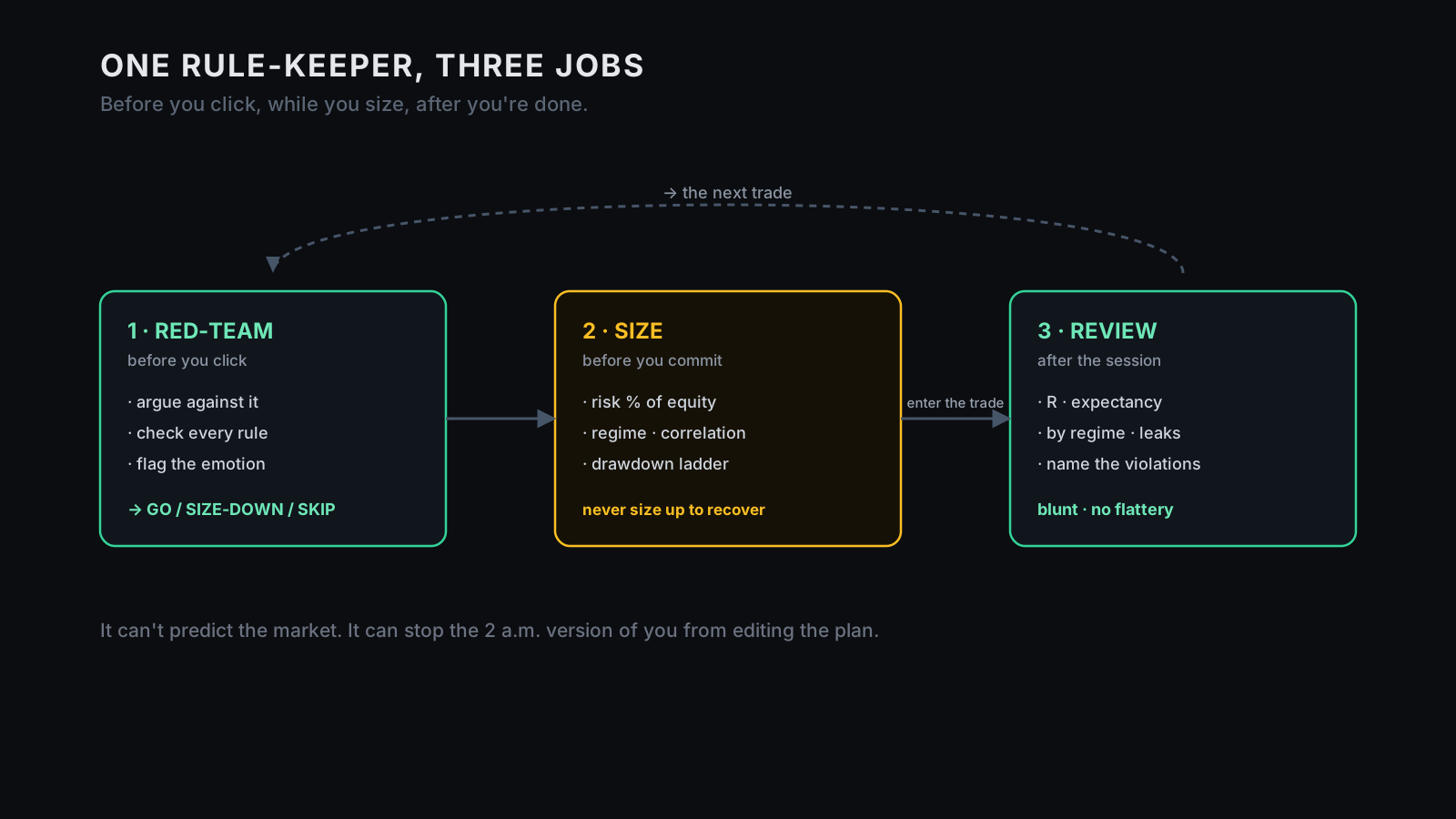
- Red-team the trade. It argues the case against (wrong regime? stop invalid? correlated positions open? down on the day?) and returns GO, SIZE-DOWN or SKIP with the rule behind it. Much of the value is having to explain the trade to something told not to agree with you.
- Enforce the size. From equity, stop distance, drawdown, open exposure and the daily loss state, it computes a size or says SKIP, and shows the math. Check it with the position size calculator and the open position risk calculator.
- Review the session. Total R, expectancy, every rule violation and one correction, instead of the story you'd tell yourself.
The instructions are your trading system, written down:
You are my trading copilot. You enforce my written rules, red-team my
trades, calculate allowed size and review my sessions.
You do not predict markets, generate signals or flatter me.
If information is missing, ask. If uncertain, choose the conservative action.

MY EDGE:          [one falsifiable sentence]
WORKS IN:         [regime, session, instrument]; skip everything else
RISK PER TRADE:   [% of current equity]
CORRELATION CAP:  [max total risk on one driver, e.g. USD]
DRAWDOWN RULES:   [when size shrinks, and when trading stops]
DAILY LOSS STOP:  [amount]
FORBIDDEN:        sizing up to recover, widening stops, no-stop trades

GUARDRAILS: never invent prices, statistics or signals; treat my numbers
as inputs to check, not facts; never place trades.
If you can't fill a bracket, that blank is a hole in your trading, not in the prompt.
Write the guardrails in: an NBER working paper found that "prompting LLMs to make rational decisions reduces biases" (Bini, Cong, Huang and Jin, NBER Working Paper 34745, January 2026, checked 2026-10-11). The limits stay. A copilot can't create an edge; on a losing process it only makes you lose more consistently. And it checks whatever you feed it, true or not.
Can ChatGPT or Claude analyze a trading chart?
They can describe structure and argue with your read. They can't be trusted to read exact prices off a screenshot. A vision model can name a support level where no candle traded, in the same confident tone as a real one. So the rule is: you read the chart, and the AI reasons about your read.
| Don't ask | Ask instead |
|---|---|
| "Where are support and resistance?" | "My levels are [list]. Does the structure respect them?" |
| "Is this a good trade?" | "Argue against this setup." |
| "Where will price go next?" | "Does this match my written setup?" |
| "Read the RSI value." | "RSI is [value]. Does it confirm or conflict with my read?" |
| "Should I enter?" | "What's the strongest reason to skip?" |
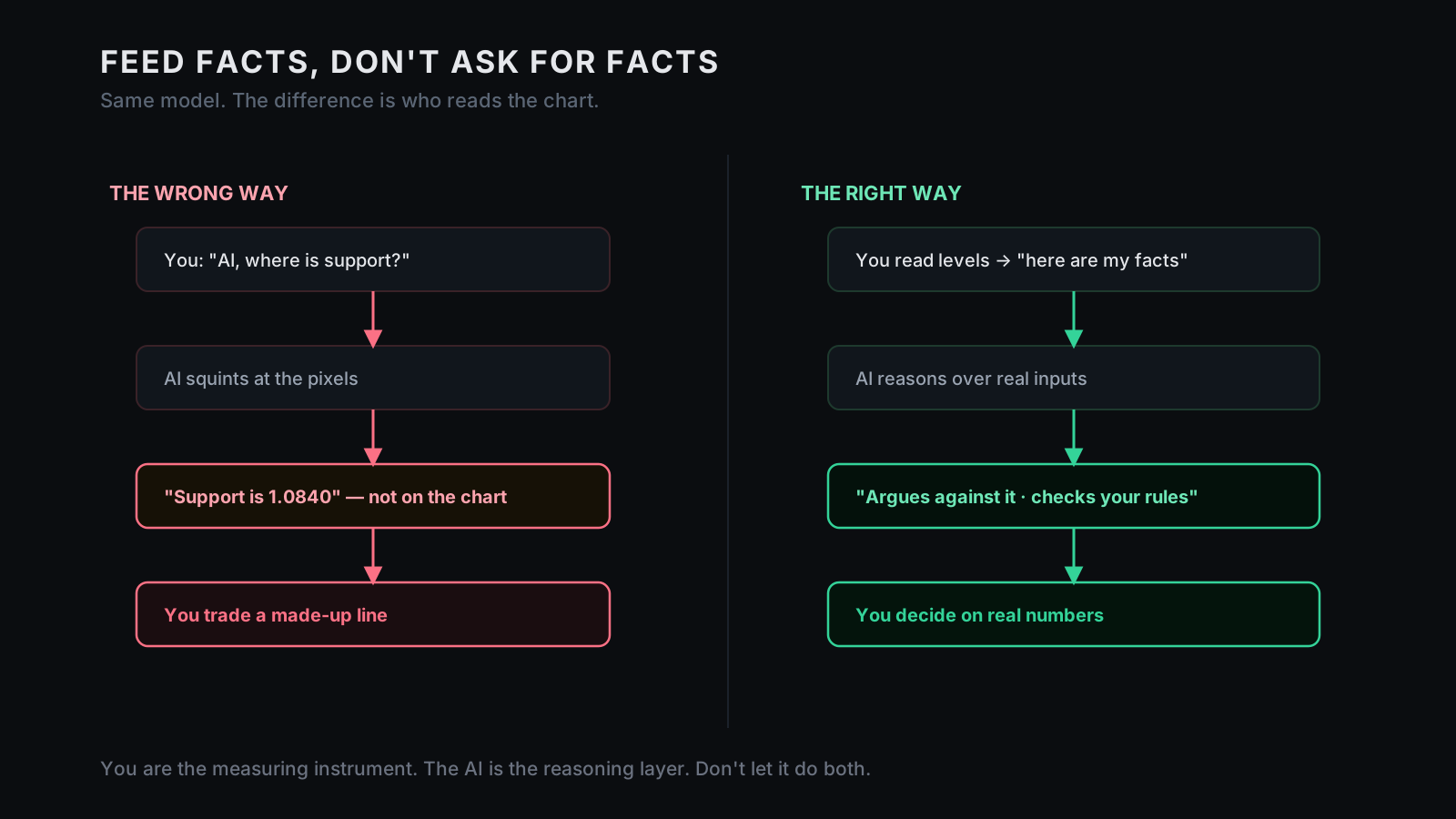
It is good at describing the shape (a range, compression, a failed breakout) and at catching contradictions, like a flat chart from someone whose rule says "trend only". It is bad at exact levels, axis scale, counting bars and small indicator panes, and a misread level becomes a misplaced stop.
Test the model you actually use. We haven't published a controlled, dated comparison of ChatGPT, Claude and Gemini on charts; versions, image resolution and settings change the result. So run your own:
- Save a few clean charts with the later candles hidden, plus an answer sheet of the visible prices.
- Ask "where are support and resistance?" and write down every level it names.
- Count invented levels, wrong values, forecasts you didn't ask for, and the times it correctly said it couldn't read something.
- Record the model, version, date and settings, and rerun after the next update.
Even a perfect read isn't an edge, since anyone can paste the same chart into the same model. Use it for discipline: am I forcing this?
Can AI predict the stock market?
Not in a way you can trade on its word. A forecast has to beat the dumbest baseline, survive costs, and survive everyone else asking the same model. The CFTC's customer advisory on AI trading bots puts it plainly: "AI technology can't predict the future or sudden market changes" (CFTC, checked 2026-10-11).
Test 1: does it beat the brick? The dumbest model says tomorrow's price equals today's, and it already scores well on accuracy because price rarely jumps far in a day. A prediction that hugs the price line may only be copying yesterday. Compare it with the brick on data it has never seen. For a language model, that means dates after its training data ends; otherwise it may simply remember the answer, a form of look-ahead bias.
Test 2: does accuracy turn into money after costs? Markets pay by the size of wins and losses, not by how often you're right. Illustrative arithmetic, not a measurement:
right 7 times in 10, average win +0.3R, average loss -1.0R
0.7 x 0.3 - 0.3 x 1.0 = -0.09R per trade, before costs
Right most of the time, and still losing. Then the spread, commission and slippage come off, and a thin forecasting edge on a short timeframe can be smaller than they are. Our guide to forex trading costs prices that friction per trade. And if a backtest of the forecast looks perfect, run the checks in how to audit an AI backtest first.
Test 3: why isn't it crowded? Lopez-Lira and Tang tested GPT-scored news headlines as a stock signal. In the current version of their paper, the strategy's annualized Sharpe ratio fell from 6.54 in 2021Q4 to 3.68 in 2022, 2.33 in 2023 and 1.22 over January–May 2024, as LLM use spread (arXiv 2304.07619 v6, checked 2026-10-11). The authors call this suggestive and say other factors could contribute. A 2026 preprint by Meng and Chen builds a theoretical model of the same mechanism, signals decaying faster as more traders run similar AI (arXiv 2605.23905, checked 2026-10-11); it is a model, not a market test.
What happened when models traded real money? In Prediction Arena, six frontier models each started with $10,000 and traded real-money prediction markets on their own for 57 days, 12 January to 9 March 2026. On Kalshi every one finished down, between 16.0% and 30.8%; on Polymarket the group averaged −1.1% (Zhang et al., arXiv 2604.07355, checked 2026-10-11). Prediction markets aren't forex, and one study doesn't prove AI can never trade profitably; it does show that reasoning well isn't the same as having a tradable edge. So change the request from "where is price going?" to "help me turn this idea into a rule, test it with costs on unseen data, and tell me where it breaks".
Can AI trade the news faster than the market?
No. Chordia, Green and Kottimukkalur found that the S&P 500 ETF (SPY) and the E-mini future respond to macro announcement surprises within five milliseconds, with trading intensity rising more than 100-fold after the release (Review of Financial Studies, 2018, checked 2026-10-11). A language model has to receive the headline, read it, score it and write an answer before your order even leaves for the broker.
News is traded in waves: co-located machines next to the exchange first, then fast professional desks, then institutions repositioning on what the news means, and last you, with a retail feed, a broker route and an AI news bot. The bot makes you, at best, a faster last wave, trading against everyone who already acted.
Seeing the news first isn't the prize; acting first is. Budish, Cramton and Shim showed that in a continuous market "even symmetrically observed public information creates arbitrage rents", which induce "a never-ending socially wasteful arms race for speed" (Quarterly Journal of Economics, 2015, checked 2026-10-11). A public headline that every model reads the same way is the most crowded signal there is.
The question for any AI news strategy is not "did my AI understand the headline?" It is: did the move still exist when my order arrived? For scheduled releases, assume not until your own records show otherwise.
What AI can do is summarise what changed against expectations once the first reaction is over, and help you test a post-release rule as its own strategy. Use news as context, not as a trigger.
Can AI write a trading bot for you?
It can write the code, and that's useful. But code isn't an edge, and a generated strategy has no reason to include costs, broker behaviour, news gaps or a kill switch unless you specify them. We cover the workflow (a written spec, the code, an independent validator and a hostile code audit) in how to build a trading bot with AI.
If the AI would hold your broker keys and place orders, read AI trading agents first; if you're buying a bot sold as AI, run the checks in do forex EAs actually work.
Does relying on AI make you a worse trader?
It can, if the AI does the reps that build your judgment. Hand them all over and you get faster on calm days and weaker on the day the AI is wrong. There is no trading study of this yet; the evidence is adjacent:
- Non-trading evidence (medicine). At four endoscopy centres in Poland, the adenoma detection rate in standard colonoscopies fell from 28.4% in the three months before AI detection tools were introduced to 22.4% in the three months after (Budzyń et al., Lancet Gastroenterology & Hepatology, 2025, abstract checked 2026-10-11). It is an observational study of doctors working without the AI.
- Non-trading evidence (essay writing). In an MIT Media Lab preprint with 54 participants, the group writing with an LLM showed the weakest brain connectivity, the lowest sense of ownership of their essays, and had trouble quoting what they had just written (Kosmyna et al., arXiv 2506.08872, checked 2026-10-11). It is a preprint.
- Non-trading evidence (software). In a user study, participants with an AI coding assistant wrote significantly less secure code and were more likely to believe it was secure; those who trusted it less wrote code with fewer vulnerabilities (Perry et al., CCS 2023, checked 2026-10-11).
The fix is the order of operations: use the AI as a sparring partner, not an oracle. Form your own view (bias, entry, stop, size, what would prove you wrong), write it down before you open the chat, then ask the AI to attack it, and change the plan only if the objection holds up.
Hand over the grunt work freely: cleaning data, sorting the journal, formatting a report. Keep the four reps that are the job: the read, the size, the no-trade and the review. A quick check: of your last 20 trades, how many did you decide, and how many did you only approve?
Which three prompts should you start with?
1. Journal forensics, after you export your trades:
You are my trading forensic coach. Analyze ONLY the trades I paste.
Do not forecast, motivate or flatter me. Do not invent missing data.
1. Check the data: missing columns, net vs gross P&L, result_R.
2. Baseline: trade count, total R, expectancy in R.
3. Expectancy by setup, by sequence (after a win, a loss, two losses)
   and by size bucket.
4. Rank the leaks by total R, with the trade count behind each and
   whether one outlier drives it. Mark small samples INCONCLUSIVE.
5. For the biggest leak, write ONE rule: WHEN [condition] THEN [action].
Show the rows behind every finding.
2. Pre-trade red team, after you've written your own plan:
I have already made my plan. Do not approve it, predict price or give me
a trade idea. Do not state any price, level or indicator value I did not
give you; if you need a number, ask.
Plan: instrument, direction, entry, stop, size, invalidation, setup,
regime, levels I read, open exposure, today's P&L.
1. Make the strongest case for the opposite side.
2. Name the one assumption that breaks this trade if it's wrong.
3. Check the plan against my written rules (pasted below).
4. List what I may be ignoring: costs, correlation, news, my state of mind.
5. Return GO / SIZE-DOWN / SKIP with the rule behind it.
3. Forecast audit, before you trust any AI prediction or model:
Audit this prediction as a tradable process, not by accuracy.
1. BRICK TEST: does it beat "next value = last value" on unseen data?
2. COST TEST: as trades, after spread, commission and slippage, what
   is the expectancy?
3. OUT OF SAMPLE: does it hold outside the fitting period?
4. CROWDING: is the signal private, or public and easy to copy?
5. VERDICT: MIRROR / UNPAID EDGE / CROWDED EDGE / PROMISING / INCONCLUSIVE.
Do not forecast the market. Do not tune the model to look better.
Disclosure
We sell trading software, including TradeLens, a trade journal whose AI coach computes only from the trades you import, so we have a stake in the journal-review use above. Nothing here is a forecast or a promise of results. AI models can be wrong while sounding certain, the medical, writing and software studies are labelled as non-trading evidence, and trading with leverage can lose more than you expect.
Frequently asked questions
Can you use ChatGPT for trading?
Yes, for review, rule-checking, research and code: sorting your journal by setup and sequence, checking a planned trade against rules you wrote, arguing against your chart read, and writing code you then test. Don't use it to forecast price or to read exact levels off a screenshot.
Can AI predict the stock market?
Not reliably enough to trade on its word. A forecast has to beat the tomorrow-equals-today baseline on data the model has never seen, stay positive after costs, and survive other traders using the same signal. The CFTC's customer advisory says AI technology can't predict the future or sudden market changes.
Is ChatGPT good at chart analysis?
It can describe structure and challenge your reasoning, but it can name price levels it can't actually read from the image, in the same confident tone as real ones. Give it the levels you read yourself, ask it to argue against the setup, and check every number it volunteers.
Can AI trade the news?
Not faster than the market. A study of the S&P 500 ETF and E-mini futures found prices responded to macro announcement surprises within five milliseconds. Use AI to summarise what changed after a release, not as the trigger for an entry.
How do I use AI to analyze my trading journal?
Export your trades with a result in R, a setup tag, the time and the size. Ask for expectancy broken down by setup, by what happened on the previous trade and by size, then rank the leaks by R, check the count behind each one, and turn the biggest into one written rule.
Which is better for trading, ChatGPT or Claude?
We haven't published a dated comparison, and model versions change. Run the same saved charts and journal through the versions you can use, with an answer sheet, count the invented values, and choose by the errors you recorded.
Will using AI make me a worse trader?
It can, if it does all the reading, sizing and reviewing for you. Studies in medicine and in essay writing found skills or engagement dropped with routine AI help; neither is a trading study. Form your own plan first, then ask the AI to attack it.
Can AI build a profitable trading bot?
It can write the code, but code is not an edge. Whether a strategy works depends on testing it with costs, out of sample and then live; AI can help build and audit that test, but it can't supply the edge.