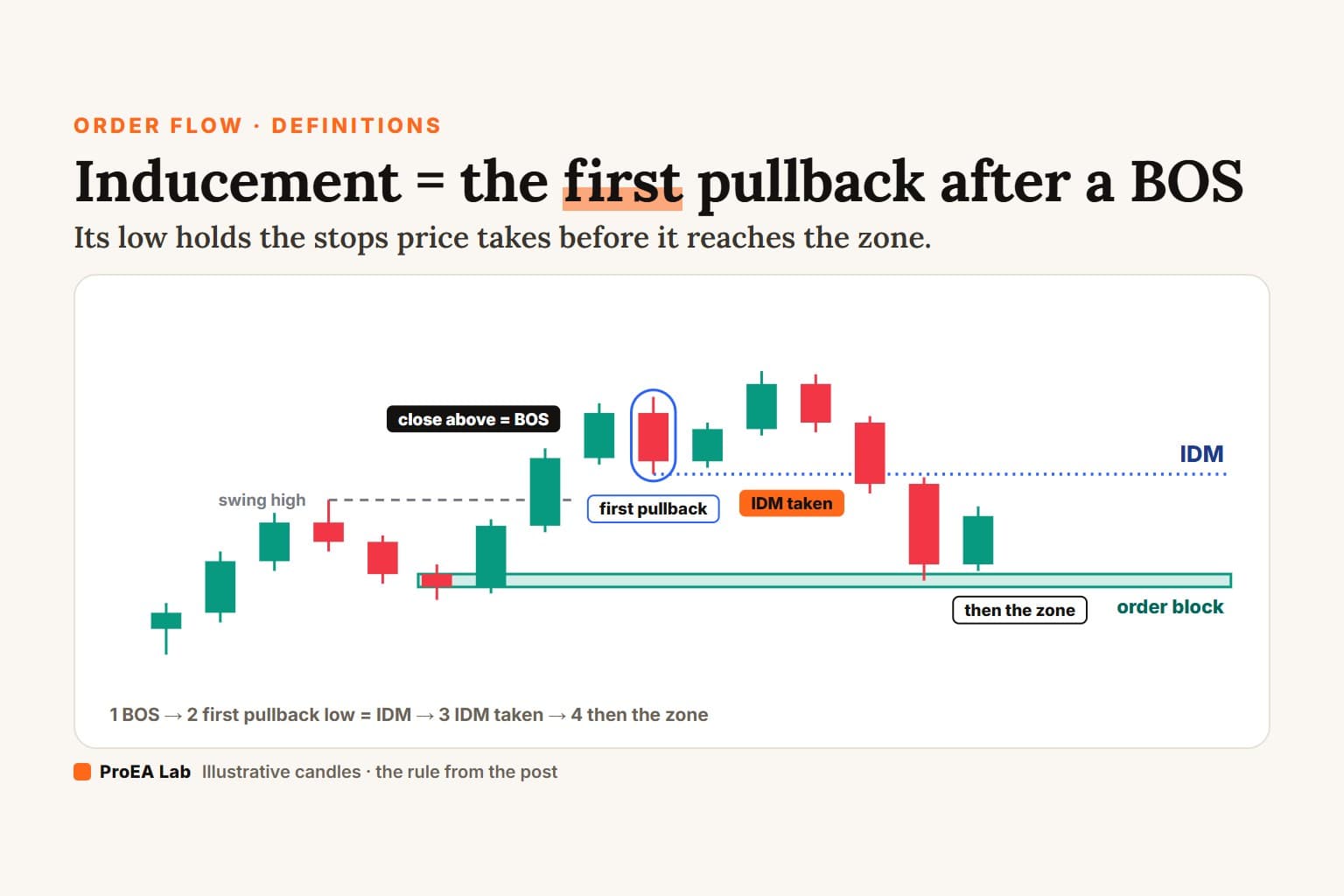
Inducement (IDM) is the low of the first pullback after a break of structure. After a candle closes above a swing high, the first candle whose low dips below the one before it starts a pullback; where the lower lows stop, that low is the IDM. The break's order block sits below it, so price has to trade through the IDM to get back to the zone. The stops under it are the first liquidity it takes. A bearish IDM mirrors it: the high of the first pullback after a close below a swing low.
Breaks are read by closes. An IDM is taken by any trade beyond it: a wick fills the stops under it as well as a close does.
Every chart below is a replay of simulated candles, read by one written rule. It builds on BOS vs CHoCH, the liquidity sweep and the order block, and it's part of our SMC & order flow definitions.
What is inducement (IDM) in trading?
The rule, for a bullish IDM:
- Break: a candle closes above a confirmed swing high (3 candles a side), with structure already up: a BOS.
- Zone: the break's order block, the last down candle before that close. Its body is the zone.
- IDM: the first pullback after the break. Take the first candle whose low is below the candle before it, and follow the lower lows until a candle makes none. That low is the IDM, fixed when that candle closes.
- In front: the IDM sits above the zone. If price trades into the zone before the IDM is known, the zone has no IDM.
- Taken: the first later candle that trades below the IDM. A wick counts.
- Valid: the zone counts only after its IDM is taken. If another BOS comes first, the new break gets a new IDM.
Simulated 15-minute candles, not market data. Swings are confirmed by 3 candles on each side; order blocks follow SMC Basics' rule. No ProEA indicator draws inducements; the IDM marks are this article's rule.
Read as text
- Structure is up. A candle closes above the swing high at 120.54: a BOS.
- The last down candle before that close, 120.41 to 120.53 (body), is the break's order block: the zone.
- 6 candles after the break, a candle makes a lower low than the one before it: the first pullback. It ends at 120.81, where the next candle makes no lower low.
- That low, 120.81, is the inducement (IDM). It sits between price and the zone, so stops resting below it are the first liquidity price meets on the way back.
How this window was chosen: The first 15-minute window of the simulated market in which a close above a confirmed swing high, itself a higher high, with structure already up (a BOS: the close beyond a swing before it was also up) creates an order block with a visible body; the first pullback after the break is at least one average candle deep (from the highest high since the break), ends at least one average candle above the zone and is internal (not also a 3-a-side swing low); and that low (the IDM) is known within 8 candles of the break, and price does not trade below the IDM for at least 4 candles after it is known. The film ends 3 candles after the IDM is known; what happens to it next is the next films' subject.
Use itMark the IDM as soon as the next candle makes no lower low. It doesn't move after that.
Watch outThe first pullback after a break is the one most traders buy. That's why its low holds stops.
Does a wick take the inducement, or a close?
A wick. Stops fill on a trade, not on a close. A close below the IDM takes it too. Then the zone behind it counts.
Simulated 15-minute candles, not market data. Swings are confirmed by 3 candles on each side; order blocks follow SMC Basics' rule. No ProEA indicator draws inducements; the IDM marks are this article's rule. Breaks of structure are read by closes; an IDM is taken by any trade beyond it.
Read as text
- A candle closes above the swing high at 107.06: a BOS. Its order block is 106.37 to 106.56 (body).
- The first pullback after the break ends at 107.09: the IDM, above the zone.
- 4 candles later a candle trades to 107.02, below the IDM, and closes back above it at 107.26. A wick is enough: the stops under the low fill on a trade. The IDM is taken, and from that candle the zone counts.
- Price doesn't reach the zone before the film ends, 8 candles after the take.
- The film shows whatever came next; it isn't a result.
How this window was chosen: The first window in which a close above a confirmed swing high, itself a higher high, with structure already up (a BOS: the close beyond a swing before it was also up) creates an order block with a visible body; the first pullback after the break is at least one average candle deep (from the highest high since the break), ends at least one average candle above the zone and is internal (not also a 3-a-side swing low); and that low (the IDM) is known within 8 candles of the break; no other close beyond a swing comes before price trades below the IDM, which happens within 16 candles of it being known, on a candle that trades at least a quarter of an average candle below it and closes back at or above it (a sweep). The film ends 8 candles after that candle, whatever happens. Windows are picked film by film, each the first that shares no candles with a window already picked, so no two films share candles.
Use itLog the take the moment price trades beyond the IDM, then look to the zone behind it.
Watch outThe take can print a swing low of its own (3 candles a side). A later close below it is a CHoCH on the same chart: the trend reading turns, even with the zone still ahead.
Does waiting for the IDM filter anything?
Less than it sounds. The zone sits behind the IDM, so price can't reach the zone without trading through the IDM first. Every touch of the zone comes after a take, sometimes on the same candle.
What the rule changes is the first pullback. You don't buy it, and you don't treat its low as support. The same goes for a fair value gap behind the IDM.
Simulated 15-minute candles, not market data. Swings are confirmed by 3 candles on each side; order blocks follow SMC Basics' rule. No ProEA indicator draws inducements; the IDM marks are this article's rule. Same candles in both tabs; neither plan is a result.
Read as text
- After a BOS above 139.92, the first pullback ends at 140.31: the IDM. The break's order block, 139.36 to 139.72, sits below it.
- Plan one buys that pullback when the next candle closes, at 140.48, with a stop a hair under its low, at 140.30.
- 4 candles later a candle trades to 140.03. The stop fills: stops under the first pullback are the liquidity this rule expects price to take.
- 9 candles after that, price trades into the zone. That candle also closes below the swing low at 140.03: a CHoCH.
- 3 candles later a candle closes below 139.36: the zone is gone as well. Waiting changed where the plan looked; it didn't make the zone hold.
How this window was chosen: The first window in which a close above a confirmed swing high, itself a higher high, with structure already up (a BOS: the close beyond a swing before it was also up) creates an order block with a visible body; the first pullback after the break is at least one average candle deep (from the highest high since the break), ends at least one average candle above the zone and is internal (not also a 3-a-side swing low); and that low (the IDM) is known within 8 candles of the break; no other close beyond a swing comes before price trades at least a tenth of an average candle below the IDM, within 16 candles of it being known; and price first trades into the zone 1 to 20 candles later, without closing below it on that candle. The film ends 6 candles after price reaches the zone, whatever happens. Windows are picked film by film, each the first that shares no candles with a window already picked, so no two films share candles.
Use itLet the first pullback go. Write down the zone behind it as the place you'll look, before the pullback starts.
Watch outWaiting changes where you look. It doesn't make the zone hold: in this replay the zone is closed through as well.
What if the inducement is never taken?
Then the zone never becomes valid under this rule, and there's no trade. Price breaks structure again, and the new break's first pullback is the new IDM.
Simulated 15-minute candles, not market data. Swings are confirmed by 3 candles on each side; order blocks follow SMC Basics' rule. No ProEA indicator draws inducements; the IDM marks are this article's rule. Waiting for the take has a cost: here, no trade.
Read as text
- A BOS above 106.20 leaves an order block at 105.77 to 105.90. The first pullback after it ends at 107.05: the IDM.
- Price never trades below 107.05. 14 candles after the IDM is known, a candle closes above the next swing high, 108.35: another BOS.
- Under this rule the old zone never became valid: its IDM was never taken, and price never came back to it. A plan that waited for the take had no trade here.
- The new break has its own first pullback, ending at 109.00: the new IDM, with the new break's order block behind it.
How this window was chosen: The first window in which a close above a confirmed swing high, itself a higher high, with structure already up (a BOS: the close beyond a swing before it was also up) creates an order block with a visible body; the first pullback after the break is at least one average candle deep (from the highest high since the break), ends at least one average candle above the zone and is internal (not also a 3-a-side swing low); and that low (the IDM) is known within 8 candles of the break; a later close above a swing high (another BOS) comes within 16 candles of the IDM being known, followed by that break's own first pullback, and price doesn't trade below the first IDM before the film ends, on the candle that makes the new IDM known. Windows are picked film by film, each the first that shares no candles with a window already picked, so no two films share candles.
Use itWhen a new BOS comes before the take, move the IDM to the new break's first pullback.
Watch outA zone whose IDM was never taken isn't fresh and valid. Under this rule it never counted.
Inducement vs liquidity sweep
| Inducement (IDM) | Liquidity sweep | |
|---|---|---|
| What it is | a level: the first pullback's low | an event: a wick through a level that closes back |
| Where | between price and the break's zone | any swing, equal lows, a session's high or low |
| What counts | any trade beyond it, wick or close | a wick beyond it, then a close back inside |
| What comes next, by the rule | the zone behind it counts | a turn needs a later close: a CHoCH or a gap closed through |
An IDM taken by a wick that closes back is also a sweep. One taken by a close isn't.
Where the definitions differ
"Inducement" means at least four different swings on the pages that rank for it (checked 4 Oct 2026):
- The first pullback after the BOS. This page's reading. WritoFinance: "This first retracement is very often the inducement zone — not the real entry opportunity." TradingFinder: "this first pullback is an inducement level in many situations."
- The first pullback before the break. innercircletrader.net: "Inducement in the case of BOS is the very first pullback before the market broke the structure."
- The most recent pullback before the high. LuxAlgo: "the most recent internal pullback before a swing extreme", with the zone behind it not "treated as valid until that pullback has been run."
- Any minor swing near a level. TradingEdges: "look for any minor swing points within 10-30 pips before it. Those minors are likely inducements."
They split on the take as well. ICT Killzone uses a body close: "wick extends beyond the level, body closes inside = inducement. Body closes outside = continuation." Here both are a take.
And on hindsight. howtotrade: "It is easiest to spot a valid inducement in retrospect." The rule here names the IDM when the candle after it closes, and never moves it.
Most pages explain inducement as manipulation by large players. howtotrade says it plainly: "There’s no real proof anywhere that confirms this." You don't need the story to use the level.
How to spot inducement, step by step
- Fix the timeframe and the swing length before you look.
- Wait for a break: a close beyond a swing, in the trend's direction.
- Mark the break's order block: the last opposite candle before that close.
- Mark the first pullback after the break and follow it until a candle makes no new extreme. That extreme is the IDM.
- Check that the IDM sits in front of the zone. If the pullback reached the zone, there's no IDM.
- Wait for a trade beyond the IDM. A wick is enough.
- Then watch the zone. A close beyond its far edge ends it.
Which timeframe works best?
We haven't compared timeframes, so we can't name a best one. The rule is the same on every chart. Pick the timeframe before you look, and read the break, the pullback and the zone on that timeframe's candles.
Common mistakes
- Buying the first pullback after a BOS. That pullback's low is the IDM.
- Calling every small low an inducement. One per break: the first pullback after it.
- Waiting for a close below the IDM. A wick takes it.
- Calling a close below a full swing low a take. That's a CHoCH.
- Moving the IDM after the fact. It's fixed when the next candle closes.
- Reading "IDM taken" as a buy signal. It's a condition. The zone can still fail.
Does inducement work?
Which tools draw inducement?
None of ours. We read the Pine source of Signal Desk, Sweep Desk, SMC Basics and the SMC AI-Scored Toolkit (v1.4.2), and every other free desk: none draws or labels an IDM. Fractal Model Desk's table notes an earlier sweep of a local swing as "possible inducement context, intent unknown" in a tooltip; it doesn't draw an IDM either.
The pieces, on your own chart, free. Signal Desk labels BOS and CHoCH on closed candles (View preset Pro). SMC Basics draws the break's order block with the rule these films use. The IDM between them you mark yourself: the first pullback's low after the break. Their default swing lengths are 5 and 10 candles a side; the films here use 3.
Sweep Desk marks confirmed swing lows and highs as resting liquidity and labels a wick through one that closes back inside ("SSL swept"). Its swings are 5 candles a side, so it sees bigger pullbacks than most first ones, and it counts a sweep only when the candle closes back. A close through takes an IDM too.
Disclosure
We build Signal Desk, Sweep Desk, SMC Basics and Fractal Model Desk and give them away; we sell other indicators, including the SMC AI-Scored Toolkit. We have no relationship with WritoFinance, TradingFinder, innercircletrader.net, LuxAlgo, TradingEdges, ICT Killzone or howtotrade. Nothing here is financial advice.
Use these animations on your site.