
You probably don't need a better strategy.
You probably need to stop betting too much on the one you already have.
He had a real strategy. Not a Discord signal, not a screenshot system, not a "bro, trust me" indicator with a green arrow and a gambling problem. A real one — two years of backtests, stable demo results, clear entries, clear exits, a setup he could explain without sounding like he was summoning a demon from TradingView.
Then he lost the account in one afternoon.
The strategy didn't fail. The size did. One trade felt obvious — the kind that makes your brain go quiet in the worst possible way — and he risked about 40% of the account, because "this one was different." It wasn't different. It was a normal losing trade wearing a very expensive costume.
The account dropped 40%, and here's the part most traders learn too late: a 40% loss doesn't need a 40% gain to recover. It needs 67%. That's not psychology — that's arithmetic, and arithmetic doesn't care how good your setup looked. He spent the next week trying to win it back: bigger trades, faster decisions, worse entries, the usual funeral playlist. By Friday the strategy was still fine. The account was dead. And he walked away thinking he was bad at trading.
He wasn't bad at trading. He was bad at sizing — and those are completely different problems. A bad strategy needs research. Bad sizing needs one formula. Position sizing is the rare trading problem that's deep enough to save an account but simple enough to fix before your next trade.
Two things before we start:
- Save this and run the 5-minute fix before your next trade.
- Send it to the friend who's "good at analysis" but somehow keeps blowing up. That friend isn't cursed. They're just too big.
the risk-per-trade zone that keeps a normal losing streak survivable.
The real account killer
Most traders think the market kills them because they were wrong. It doesn't. Being wrong is normal — every strategy is wrong, every edge has losing streaks, every profitable system has ugly weeks where it looks stupid, broken, and personally offensive.
The market doesn't take the account because you were wrong. It takes the account because you were wrong too big. That sentence is the whole article.
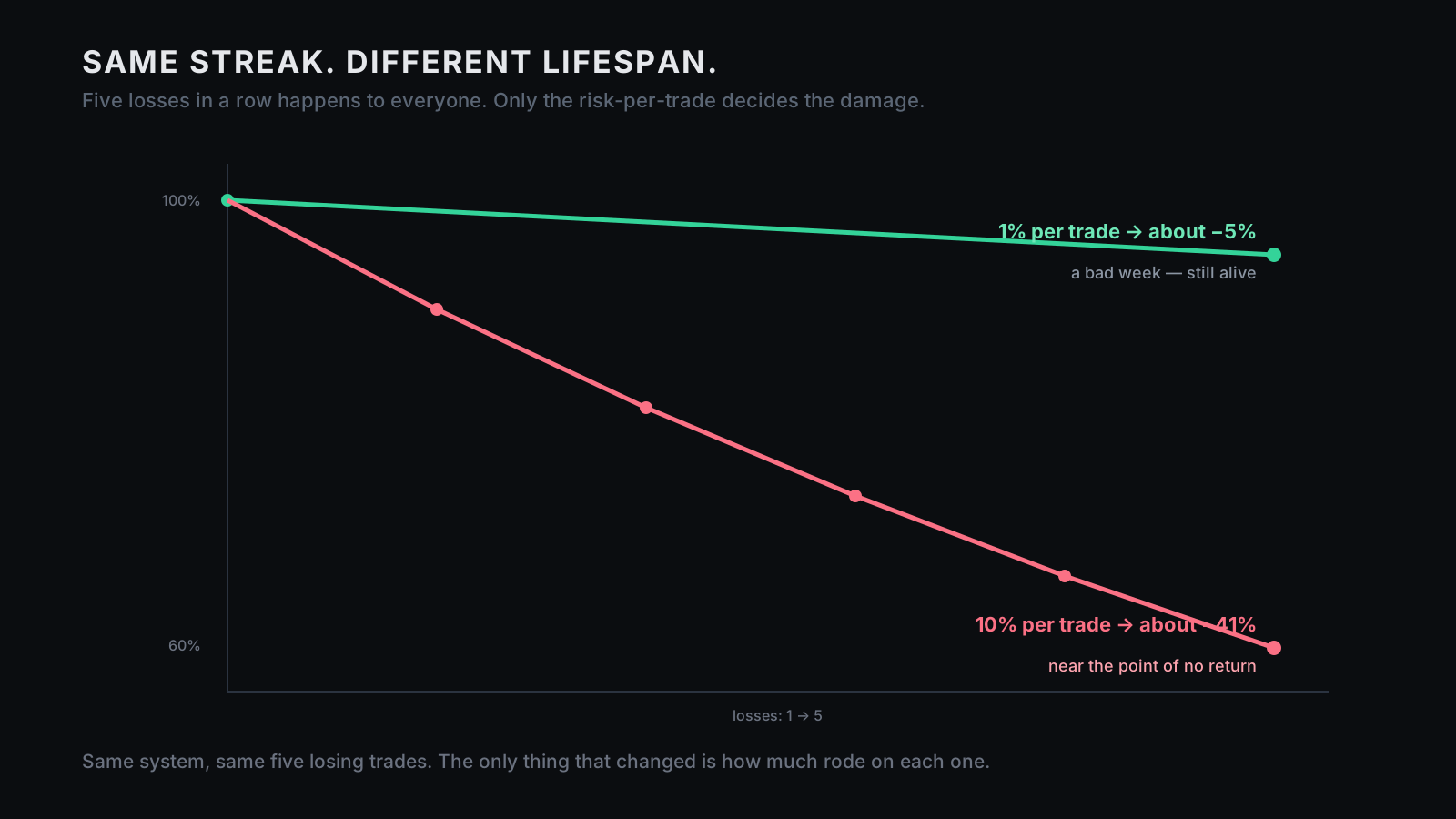
A trader risking 1% can be wrong five times and still just have a bad week. A trader risking 10% can be wrong five times and suddenly needs a motivational quote, a new deposit, and probably a long walk outside. Same strategy, same losing streak, completely different outcome.
That's why position sizing matters more than most traders want to admit. It isn't sexy. Nobody goes viral saying "I risked 0.7% today and followed my plan." But that boring number decides whether your edge gets enough time to prove itself. A good strategy with bad size is a time bomb; a mediocre strategy with disciplined size at least stays alive long enough to be measured. Survival isn't optional — it's the platform everything else stands on.
I — Strategy is not the account. Size is.
The retail statistics are brutal, but they're useful if you read them correctly. A huge share of retail traders lose money, regulators have warned about it for years, and the obvious conclusion is "trading is hard." True — but incomplete. The better conclusion: most traders aren't losing only because they can't predict the market. They're losing because they combine uncertain prediction with oversized exposure.
That's the account-killer cocktail. Bad prediction hurts; bad prediction plus big size ruins you.
This is the part traders resist, because blaming the strategy feels productive — if the strategy is the problem, you get to go hunting again. New indicator. New model. New AI agent. New holy grail with a cleaner landing page. (You don't need a better strategy; you need to survive long enough to run the one you have.)
Sizing gives you nowhere to hide. It says your entry can be good, your chart read can be good, your thesis can be reasonable — and you can still deserve the loss if the position was too large for the stop. That's not an insult. It's freedom. If your problem is edge, the fix is uncertain. If your problem is size, the fix is mechanical — and you can do it today.
II — The recovery curve nobody wants to look at
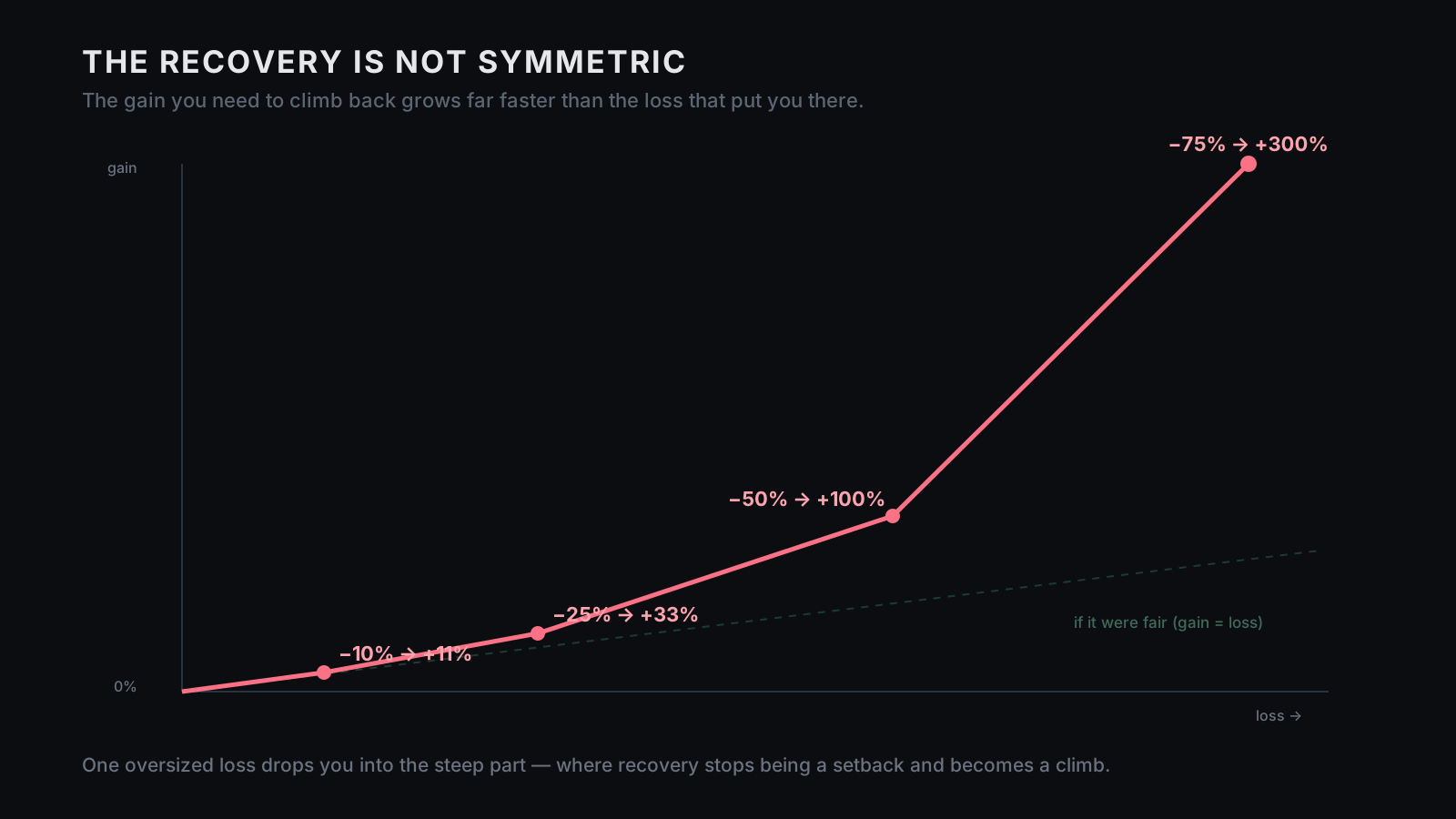
Losses aren't symmetrical. This is the math that should be printed above every trading desk.
Lose 10%, and you need about 11% to recover — annoying, but fine. Lose 25%, and you need 33% — now you're climbing. Lose 50%, and you need 100%: you have to double what remains just to get back to zero. Lose 75%, and you need 300% — that's no longer recovery, that's a fantasy arc.
This is why one oversized trade can do more damage than twenty small losses. Small losses keep you in the flat part of the curve; big losses throw you into the vertical part, where the account becomes mathematically heavy. Most traders think risk management is about avoiding losses. Wrong. Risk management is about controlling the size of losses so recovery stays realistic. You can't avoid being wrong. You can avoid making one wrong trade so large that the next correct trade no longer matters. That's the game — not prediction, recovery geometry.
III — The one formula that fixes the next trade
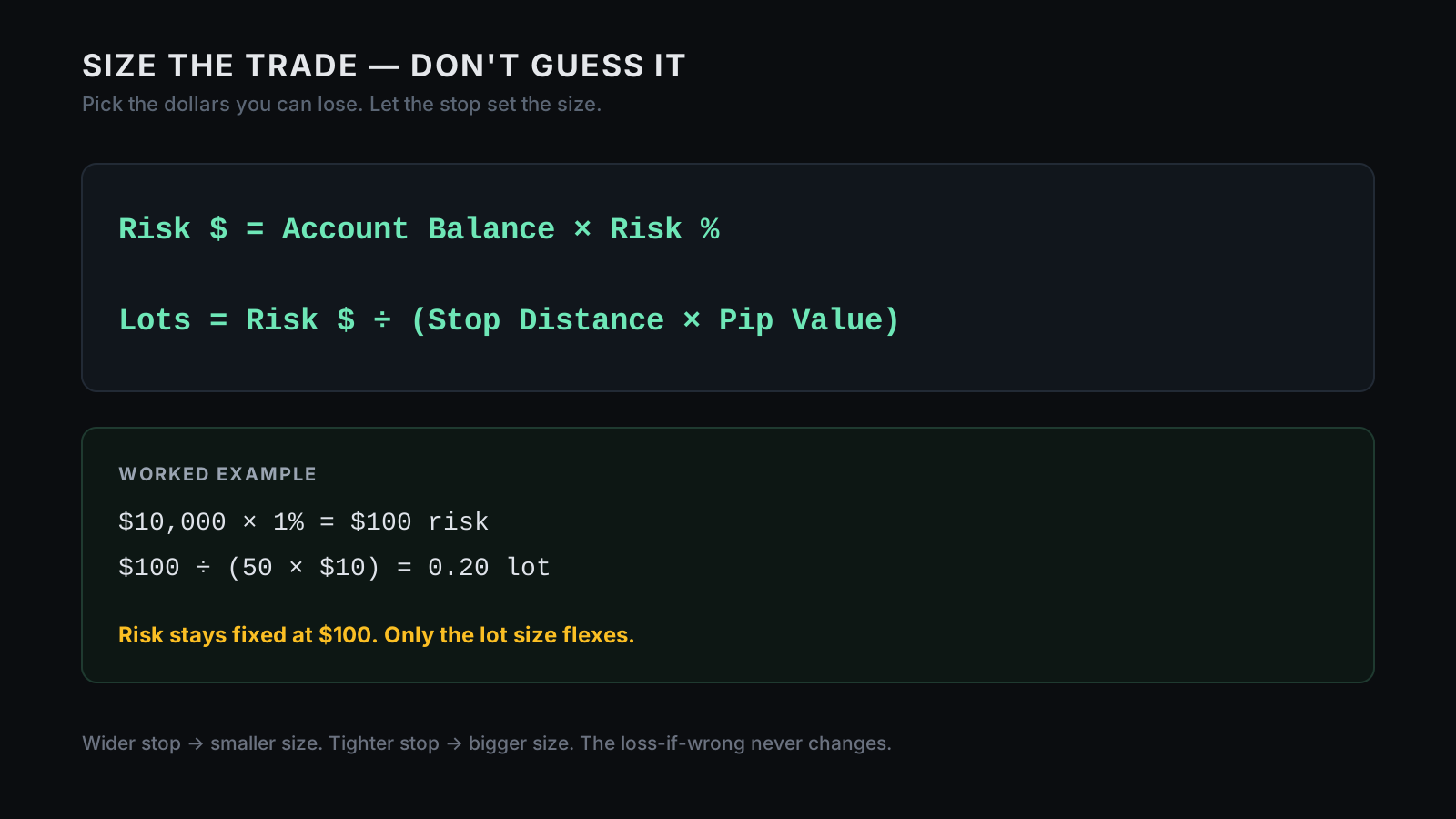
Here's the whole fix. First, choose how much of the account you're willing to lose if the trade is wrong. For most traders that's 0.5% to 1%; aggressive, maybe 2%. Above 2%, you'd better have a large sample and zero emotional attachment. Above 5%, you're not sizing a trade — you're starting a hostage negotiation with your account.
The formula is two lines:
Risk $  =  Account Balance  ×  Risk %

Lots    =  Risk $  ÷  (Stop Distance  ×  Pip Value)
A worked example, so it's concrete:
Account Balance = $10,000
Risk per trade  = 1%   →   Maximum loss = $100

Stop distance   = 50 pips
Pip value       = $10 per pip per standard lot

Lots = $100 ÷ (50 × $10)  =  0.20 lot
That's it. You trade 0.20 lot. If the stop hits, you lose about $100 — not $600 because the setup "looked clean," not half the account because you were "sure." The risk stays fixed; the lot size flexes. A wider stop means a smaller position, a tighter stop means a larger one, but the loss-if-wrong stays the same every time.
That's how professionals think. They don't ask "how many lots can I take?" They ask, "what size makes this idea cost exactly my planned risk if I'm wrong?" — and the formula answers it.
IV — Stop first. Size second. Never backwards.
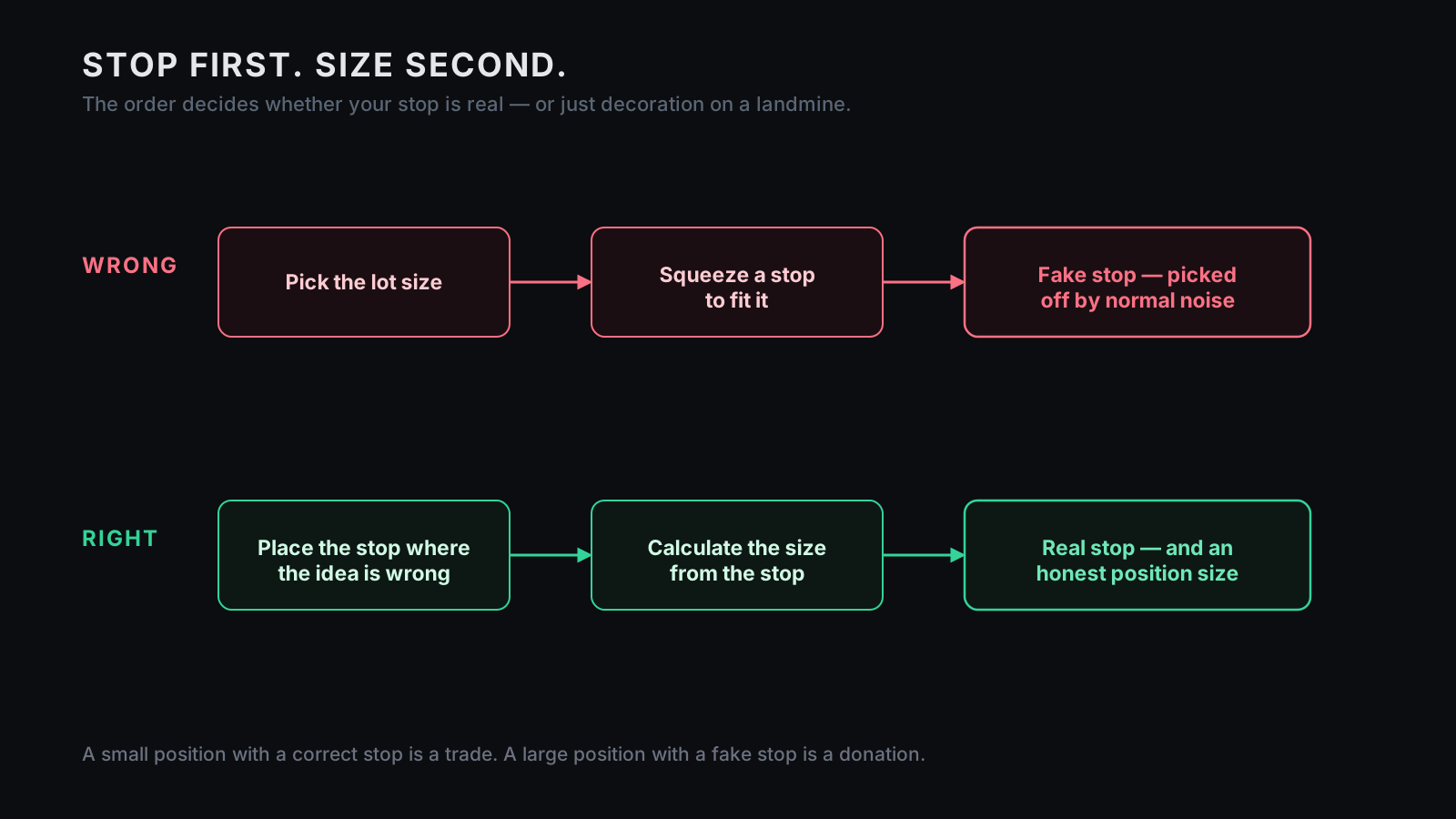
Most traders run this process backwards. They pick the lot size first, then look for a stop that makes that size feel acceptable. That's how the account starts lying to itself: "I want 1 lot" → but the real invalidation is 80 pips away → "that's too much risk" → so the stop shrinks to 20 pips. Not because the trade is wrong at 20 pips — because the trader wanted 1 lot.
That isn't risk management. It's decorating a landmine. The stop should go where the idea is wrong, not where your desired lot size becomes comfortable. If structure says the stop belongs 80 pips away, it belongs 80 pips away — then the formula tells you the size.
Sometimes the correct size will feel tiny. Good — that feeling is information. It means the trade needs more room than your ego wanted to pay for. A small position with a correct stop is a trade. A large position with a fake stop is a donation. The order is sacred:
1. Define the trade idea.
2. Place the stop where the idea is wrong.
3. Measure the distance.
4. Calculate the size.
5. Enter only if the size makes sense.
Never the other way around.
V — Correlation: the hidden multiplier
Now the trap that catches the "disciplined" trader. You risk 1.5% on EUR/USD, 1.5% on GBP/USD, 1.5% on AUD/USD. Each ticket says 1.5%. Beautiful. Professional. Clean. Except you're probably not holding three separate trades — you're holding one large anti-dollar bet wearing three costumes. If the dollar rips, all three hit their stops together, and your "1.5% risk" just became 4.5%, maybe more once spreads widen.
Correlation is how traders break their own rules while technically following them. The account doesn't care that the trades had different symbols; it cares that they shared the same driver — same currency, same macro event, same risk-on impulse, same crowded idea. If they move together, they lose together.
The fix is to size by theme, not just by ticket. Before you add a position, ask what you're really betting on, what else in the account is already betting the same thing, and what the total loss is if all of it goes at once. Three correlated 1% trades aren't three trades. They're one 3% trade with better branding — and the market settles them as one.
VI — Risk of ruin, without the math headache
"Risk of ruin" sounds like something a quant says right before everyone leaves the room, but the idea is simple: it's the chance that normal losses kill you before your edge has enough trades to work. Every strategy has losing streaks — even a good one, especially a real one. Win 55% of the time and you'll still see five losses in a row; not because the edge died, but because probability has hands.
At 1% risk per trade, five losses costs roughly 5% — a bad week, still alive. At 10% risk per trade, the same five losses costs roughly 41% — and now you're in the danger zone of the recovery curve. Same system, same streak, completely different lifespan.
That's the uncomfortable truth: a winning strategy can still go broke if the size is large enough. A positive expectancy doesn't save you from an ordinary losing streak when each loss is too big. (It's the same reason a win rate is a vanity metric — the headline number means nothing if the size lets a normal streak end you.) "I have an edge" isn't enough; the real question is whether the account can survive the ordinary pain required to realize it. If it can't, you don't have a trading system — you have a prediction engine strapped to a bomb.
VII — Let AI build the boring calculator
This is where AI is genuinely useful — not as a magic signal machine, not as the guy in the group chat who says "gold will pump" with terrifying confidence and no stop loss, but for the boring arithmetic you should never skip. Ask it to build you the tool:
Build me a position-size calculator.
Inputs: account balance, risk %, entry price, stop price,
        pip/point value, symbol.
Outputs: risk in $, stop distance, correct position size,
         a warning if risk > 2%, a warning if correlated
         exposure exceeds my limit.
Include examples for forex, gold, indices, and crypto.
Then ask for a second one:
Build me a losing-streak simulator.
Inputs: account balance, risk per trade, number of losses.
Output: balance after the streak, total drawdown,
        gain required to recover, and a warning level:
        normal / dangerous / account-threatening.
That's AI used correctly: not replacing judgment, just protecting it from laziness (it's the build-it-yourself workflow, aimed at the one tool that protects you most). Because most accounts don't blow up because the trader didn't know the formula. They blow up because the trader didn't run the formula when it mattered. Build the calculator, use it before every trade, and make guessing impossible.
The 5-minute fix
Do this before your next trade. Not next month, not when the new journal template is ready — before the next trade.
Minute 1 · Pick your number. Choose your fixed risk per trade: 1% as a default, 0.5% if you're rebuilding confidence, 2% only with discipline and data. It does not change because a setup "feels good" — feeling good is not a risk model.
Minute 2 · Place the stop where the idea is wrong. Find the price that actually invalidates the trade — from structure, not from the lot size you want — and measure the distance.
Minute 3 · Run the formula. Risk $ = Balance × Risk %, then Lots = Risk $ ÷ (Stop × Pip Value). Trade that size. If it feels too small, the trade is telling you the stop is wide or the setup is expensive. Listen.
Minute 4 · Check correlation. Ask what else in the account shares the same driver. If something does, count it as one bigger trade and cut size.
Minute 5 · Set the circuit breaker. Pick a daily and weekly loss limit — say −3% on the day, −6% on the week — and obey it. A bad day should stay a bad day, not become a blown account with a story attached.
Where this meets ProEA
This is why a real automated system needs a risk layer you can inspect — not a hidden lot multiplier, not a "smart recovery" module that quietly increases exposure until the account starts sweating (a staircase over a cliff), not a black box that says "AI-optimized risk" and hopes nobody asks where the size came from.
The risk layer is where the account lives. Entries get the attention; sizing decides survival. So in MTR, the first thing worth inspecting isn't the entry logic — it's the sizing and stop logic: how it decides risk, how it turns a stop distance into a position size, what happens after a losing streak, what happens when positions share a driver, and what the hard stop is on a bad day. You set the risk percentage, you set the limits, and you can read exactly how the account is protected when the market does something completely normal: hand you losses.
That's the honest version of risk management — not "you won't lose," but a loss sized like a business expense instead of a personal crisis. Correct sizing can't make a losing system win; it can only keep a winning one alive long enough to prove it. A readable risk layer is proof of method, not proof of profit — MTR can lose like anything else. It just can't blow you up in a way you couldn't see coming and size against.
Disclosure
We sell source and evidence you can inspect — not outcomes, not guarantees. Trading involves risk, leverage magnifies it, and past performance is not future performance. A sizing formula can reduce the chance of ruin for a positive-expectancy system; it cannot turn a negative one positive, and it cannot promise a profit. Position sizing isn't magic — it's the seatbelt. You can still crash. But without it, even a small crash can be fatal.
Your first 20 minutes
Don't take our word for it — go look at where the size is decided.
Minutes 0–5 · Find the risk layer. Open MTR's source and go straight to the sizing and stop logic — the part that decides how much the account can lose if the trade is wrong. That's the engine room.
Minutes 5–10 · Set your own number. Change the risk percentage to one you could survive a bad month on — the number that lets you sleep through a losing streak, not the one that makes a backtest look exciting. You hold that dial.
Minutes 10–15 · Stress a losing streak. Take the published 28-month sample and ask: what would five, then ten, losses in a row have cost at my size — and would I still follow the system after? If the answer is no, the size is too big.
Minutes 15–20 · Build your calculator. Have your AI turn the formula into a tool you'll use on every manual trade too. Five minutes, and guessing a lot size becomes as strange as trading without a stop.
One last thing
Everyone wants the trade that changes the account. Almost nobody wants the rule that protects the account long enough for that trade to matter — which is why most traders keep restarting: new strategy, new account, same size problem.
The market is hard enough when you're sized correctly. Don't make it impossible by being too big. You can keep searching for a better strategy, or you can fix the number that's actually killing the account — today, before the next trade. The market doesn't take your account because you were wrong. It takes it because you were wrong too big — so stop being too big, and most of the danger simply disappears.