You're down 18%.
You're staring at the account, and a voice that feels like pure common sense is talking: one good trade and you're back. Two, max. You know the system works — so put on size, catch the next move, erase the red, and never speak of this again. The voice is calm, logical, almost soothing.
It is also the exact sound an account makes right before it dies.
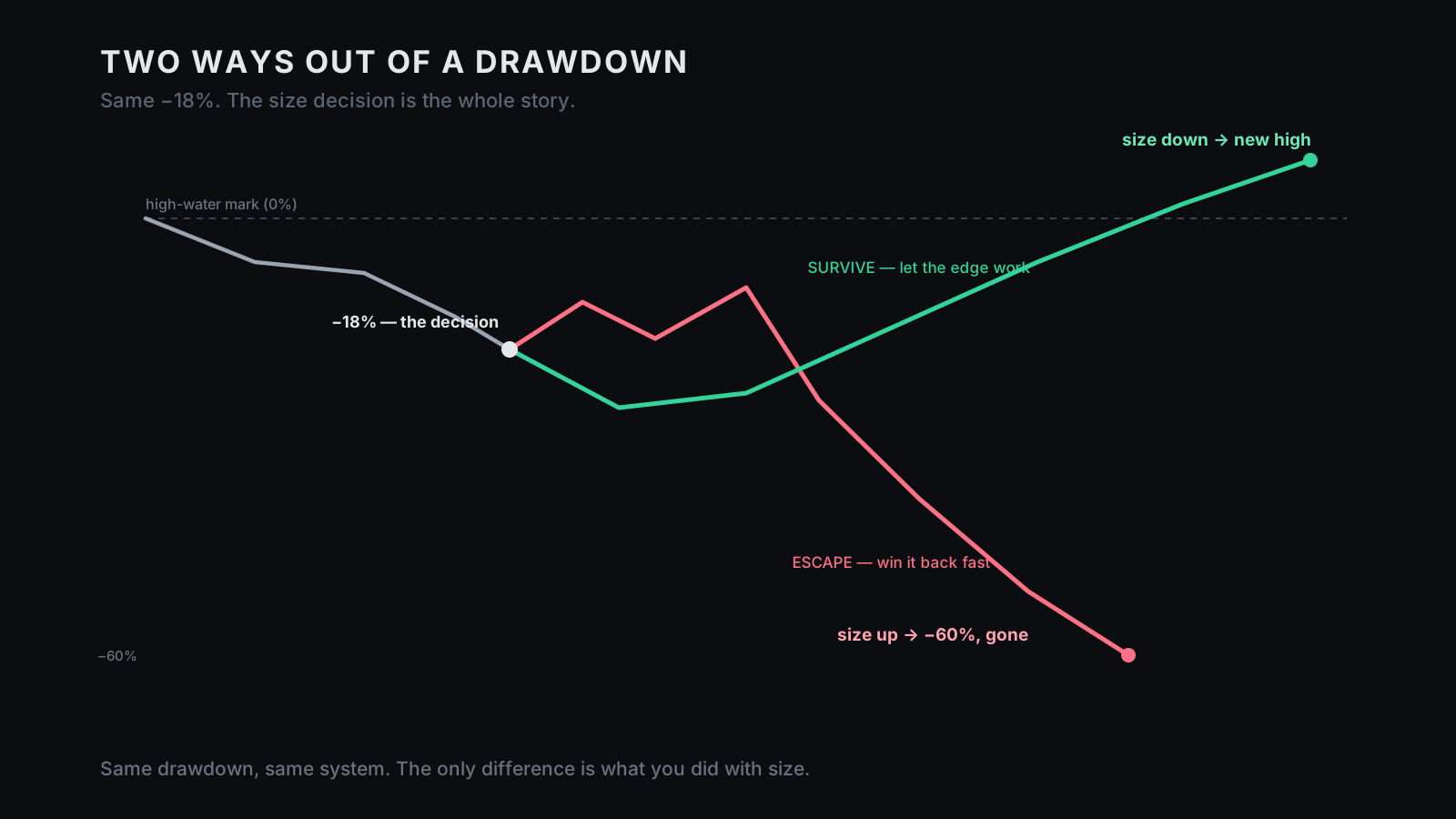
Here is the thing almost nobody tells you: the drawdown was never the danger. The escape attempt is. A −18% drawdown on a system with a real edge is a Tuesday — your Monte Carlo told you to expect worse. You can sit in it, keep sizing by your rule, and climb out. What you cannot survive is the decision to end it quickly by betting bigger, because that is the move that turns a routine −18% into a fatal −60%.
This post is about the single hardest act in trading: making your position smaller at the precise moment every instinct you have is screaming to make it bigger. It is hard because your brain is, briefly, working against you — and the fix is not willpower. The fix is a decision you make now, in the calm, that your panicking future self only has to obey.
A drawdown is survivable. The plan to end it quickly usually is not.
Save this for the next time you're underwater and the voice starts talking. And send it to the friend who "just needs one good trade to get back to even."
how much more intensely a loss registers than an equivalent gain — the pressure that makes a drawdown feel like an emergency.
Tversky & Kahneman (1992) ↗after a loss, people turn risk-seeking when a chance to get back to even appears — the exact instinct that sizes you up at the worst time.
Thaler & Johnson (1990) ↗the gain needed to recover a 50% drawdown — why protecting the capital base beats chasing a fast comeback.
drawdown recovery mathSkip the read? The 60-second version. A drawdown is expected; your system was always going to have them. The danger is behavioral: after losses, humans become risk-seeking when a chance to break even appears — the precise opposite of correct. That instinct is the martingale (bet more after losing), and it is the fastest account-killer in existence. The right move is the opposite — anti-martingale: bet less as you draw down, protecting the capital base so your edge has time to work. The reason this is so hard is that you have to do it while tilted, so you don't decide it then. You pre-write a sizing ladder in calm — "at this drawdown, I risk this much" — and in the storm you just follow it. Sizing by a percentage of current equity already does most of this automatically; the deadly mistake is overriding it to "get back faster."
| What your brain says in a drawdown | What the math says |
|---|---|
| "Size up — one good trade fixes this." | Size down — protect the base so you survive to recover. |
| "Getting back to even is the goal." | Surviving the next ten trades is the goal. |
| "The system stopped working." | A normal drawdown is the system working as expected. |
| "I need to do something." | You need to do less — smaller, slower, by the rule. |
| "Cut size and I'll never recover." | Cut size and you guarantee you're still here to recover. |
I — The drawdown is the weather, not the crash
A drawdown is a decline from your equity's high-water mark, and on any real system it is not a malfunction — it is a feature. Your edge plays out over hundreds of trades; in between, losing streaks cluster, variance bites, and the curve goes red. Your Monte Carlo showed you the 95th-percentile drawdown precisely so this moment wouldn't surprise you. A drawdown inside that envelope is weather: unpleasant, expected, survivable.
So the drawdown itself almost never blows up an account. Accounts don't die from the loss. They die from the reaction to the loss. The −18% is the weather. Flooring the accelerator on an icy road to "get home faster" is the crash. This entire article is about not crashing.
II — Why your brain screams "size up"
Your instinct to size up in a drawdown is not stupidity — it's biology, and it's measurable. Two findings from behavioral finance explain almost the whole trap. First, loss aversion: losses register roughly 2.25 times as intensely as equivalent gains (Tversky & Kahneman, 1992). A −18% drawdown doesn't feel like −18%; it feels like an emergency, and emergencies demand big action.
Second, and more dangerous, the break-even effect: when people are sitting on a loss and a chance to get back to even appears, they become risk-seeking — they take bigger gambles specifically to erase the red (Thaler & Johnson, 1990). It's the same wiring that keeps gamblers at the table after a bad night. Your rational mind thinks it's choosing to "press the edge." Your lizard brain is just desperate to make the pain stop. The urge to size up in a drawdown is not a trading signal. It's a pain reliever with a 100% account-failure rate.
What size lets you be wrong ten more times and still be in the game?
III — The martingale trap
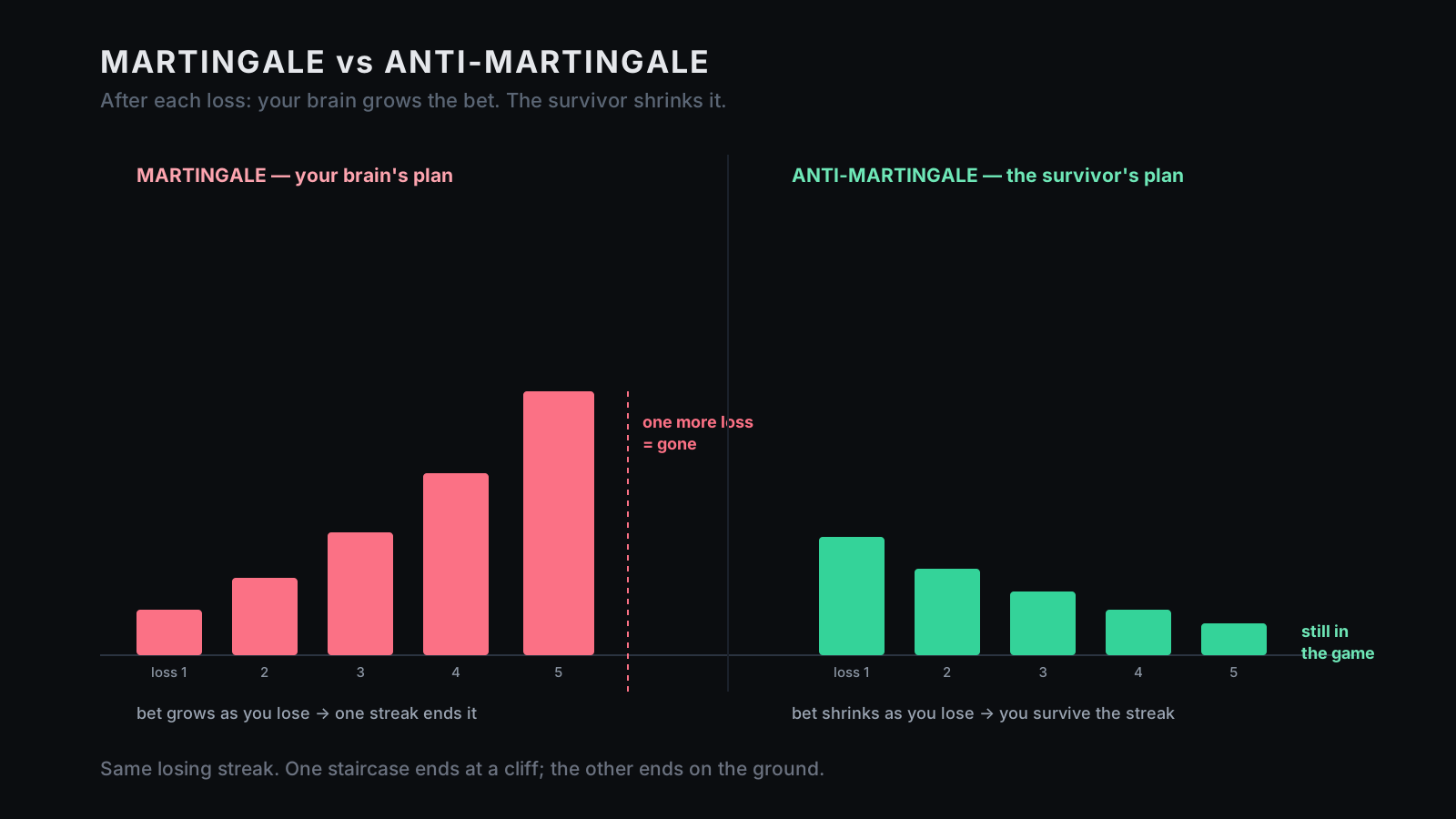
The instinct, followed to its conclusion, has a name: the martingale — increase your bet after a loss so the next win recovers everything. It feels mathematically clever ("I only need one winner!") and it is the single most reliable way to destroy a trading account, because the size grows fastest exactly as the losing streak deepens. A few bad trades in a row — well within normal — and the bet is so large that one more loss is terminal. You don't get the rescue winner; you get the gap that arrives while you're holding five times your normal size.
This is the same cliff the grid and martingale EAs walk off, and the same one Kelly warns about from the other side: betting bigger as your edge estimate is falling puts you out past the overbet point, where even a real edge goes to die. Martingale doesn't recover losses. It postpones them and adds interest.
IV — The correct move is anti-martingale
The professional discipline is the exact inversion: anti-martingale — size down as you lose, and only size back up as equity recovers. It feels awful, because it seems to admit defeat and lock in a slower recovery. But look at what it actually does: by shrinking the bet as the account falls, it flattens the downside, so a bad streak bleeds the account slowly instead of cratering it. You keep enough capital alive for your edge to reassert itself.
Yes, sizing down means a deeper-feeling climb back. That's the trade, and it's the right one: you give up the fantasy of a fast recovery in exchange for the fact of a recovery at all. A fast recovery you blow up chasing is worth nothing. A slow recovery you actually complete is worth everything. (Anti-martingale is also just fractional Kelly in motion — bet the edge you can trust, and trust it less when the results are questioning it.)
V — The quiet gift of %-of-equity sizing
Here's the relief: you may already own the de-risking machine and just keep switching it off. If you risk a fixed percentage of current equity per trade — not a fixed lot — your bet size shrinks automatically as you draw down. No bravery required, no decision in the moment:
Risk 1% of CURRENT equity, and the bet de-risks itself:

  $10,000 account → 1% = $100 risk per trade
  after a −20% drawdown:
  $8,000 account  → 1% = $80 risk per trade

  the bet fell 20% with zero emotional input
That is anti-martingale happening for free, every trade, while you do nothing. The deadly move is to override it — to switch to fixed lots, or bump the percentage, precisely when you're down, to "get back faster." The trader who blows up didn't lack a risk rule. They suspended it at the worst possible moment. Most of the work here is simply not turning the machine off.
VI — Decide in calm, execute in the storm
The reason "just be disciplined" fails is that the drawdown degrades the very judgment you'd need to be disciplined with. After losses you are tilted, tired, and loss-averse — the worst possible state in which to make a sizing decision. So don't make it then. Make it now.
Write a drawdown ladder: a pre-committed schedule that says, in advance, exactly how much you risk at each level of drawdown. When the account hits a level, you don't deliberate — you read the ladder and obey. The decision was made by your calm, rational self; your panicking self is demoted to a clerk who follows instructions. You cannot out-discipline a drawdown in the moment. You can only out-prepare it beforehand.
| Account drawdown | Risk per trade | What it means |
|---|---|---|
| 0 to −8% | full size (1×) | normal noise — trade your plan, change nothing |
| −8% to −15% | 0.66× | the system is being tested — start protecting the base |
| −15% to −22% | 0.5× | deep but within Monte-Carlo expectation — half speed |
| beyond −22% | 0.25× or halt | near the kill-switch — survival mode, then review |
(Numbers are illustrative — anchor the levels to your own Monte-Carlo drawdown distribution, not these defaults.)
VII — Recovery is survival × time, not one big trade
The break-even effect lies to you about how recovery actually happens. It frames recovery as an event — the one big trade that erases the red. Real recovery is a process: your edge, applied at a survivable size, compounding over many trades. The only way to lose access to that process is to run out of capital first, which is exactly what the "one big trade" plan risks.
And the arithmetic is unforgiving in a way that rewards caution: a −20% drawdown needs +25% to recover; −33% needs +50%; −50% needs a full +100%. Every percent you let the account fall deeper — by sizing up and losing — makes the required comeback steeper. Sizing down protects the base so the hole stays shallow enough to climb out of. Survival is the only thing that compounds. Everything else is a story you can only tell if you survived.
VIII — Normal vs broken
Sizing down is the middle gear between two other settings you already have. When a drawdown is normal — inside your Monte-Carlo envelope — you keep trading the rule, just smaller as the ladder dictates. When it crosses into broken — past the level where your edge should have reasserted — you stop, via your kill-switch, and review. The ladder lives between "keep going" and "full stop," and it's what keeps you from skipping straight from denial to panic. Knowing which regime you're in is the whole game: a normal drawdown sized down is patience; a broken system sized down is just dying slowly. The ladder buys you the time to tell them apart without blowing up while you decide.
The AI drawdown-ladder prompt
Let AI turn your own backtest into a personalized ladder — then follow it, especially the part that tells you to shrink.
Here are my system's trade results as R-multiples, plus my current
account equity and high-water mark.

Please:
1. Run a Monte Carlo (reshuffle the trades 5,000+ times) and report the
   median and 95th-percentile maximum drawdown.
2. Using those, propose a drawdown sizing ladder: at each drawdown band,
   a risk multiplier (1×, 0.66×, 0.5×, 0.25×, halt), anchored to my
   distribution — not generic numbers.
3. Mark the drawdown level where the loss exceeds normal Monte-Carlo
   expectation (the "consider it broken / kill-switch" line).
4. Show my CURRENT drawdown and which rung I'm on right now.
5. Remind me what risking a % of current equity does automatically.

Do not tell me to size up to recover. Do not add a martingale.
Only show me how to size down and survive.
The last two lines are the guardrail. You are not asking AI for a way out of the drawdown; you're asking it to help you stay in the game long enough to not need one.
The 20-minute drawdown audit
Minutes 0–5 — Find your current rung. Compute your drawdown from the high-water mark and your system's 95th-percentile Monte-Carlo drawdown. Where are you — weather, or near the edge?
Minutes 5–10 — Check the machine is on. Are you sizing by a percentage of current equity, or fixed lots? If fixed, you've disabled the free de-risker. Switch it on.
Minutes 10–15 — Write the ladder. Build your drawdown ladder now, in calm, anchored to your own numbers. Tape it where you'll see it when you're underwater. The point is that the hard decision is already made.
Minutes 15–20 — Name your get-even trigger. Write down the exact thought that will try to make you size up ("one good trade and I'm back"). Naming it in advance turns it from a command into a symptom — when you hear it, you'll know it's the break-even effect talking, not a signal.
Where this meets ProEA
The deadliest version of this problem is the one you can't see, because a machine is doing it for you. "Smart recovery," "drawdown protection," "adaptive lot" — these phrases can describe a sober anti-martingale that sizes down in a drawdown, or a hidden martingale that sizes up into losers until one streak ends the account. On an equity curve, the two look identical right up until one of them doesn't exist anymore. You cannot tell which one you bought from a screenshot.
This is why we sell MTR as source you can read: you can open the sizing logic and see, in plain code, whether it de-risks or doubles down — whether a drawdown makes the next bet smaller or larger. That doesn't make it safe; a real edge can still draw down past expectation, and MTR can lose. Inspectable sizing can't feel fear for you — but it does mean no hidden martingale is making your worst instinct automatic. The question to ask any system, ours included: when it's losing, does the next position get bigger or smaller? If the seller won't show you the code that answers that, the screenshot is hiding the only thing that matters.
Disclosure
We sell source and evidence you can inspect — not outcomes, not guarantees. Anti-martingale sizing and drawdown ladders reduce the risk of ruin; they do not remove it. A system can draw down beyond its backtest, an edge can decay, and sizing down can still end in a loss — it is meant to make that loss survivable, not impossible. Monte-Carlo envelopes are estimates from past trades and can be exceeded. Trading is risky, leverage magnifies risk, and past performance is not future performance. The goal is not to avoid drawdowns. It is to make sure the drawdown — not your reaction to it — is the worst thing that happens.
Your first 20 minutes
Open your account and find your high-water mark and your current drawdown. Confirm you're sizing by a percentage of current equity. Then, while you are calm, write the ladder: the risk multiplier you will use at each level of drawdown, anchored to your own Monte-Carlo numbers, ending in a halt near your kill-switch. Tape it somewhere visible. You have just made the hardest decision in trading in advance, when your judgment was clear — so that the next time the voice says one good trade and you're back, you already have a better answer written in your own calm handwriting.
The one line to take with you
The drawdown is not the emergency. The plan to escape it is. Size down, stay alive, and let the edge do the boring work of bringing you back — because the only traders who recover are the ones still holding cards when the deck turns.