How much should you risk per trade? The honest answer is a formula, not a feeling — and the difference between 1% and 5% per trade is usually the difference between compounding and blowing up. This is the position-sizing math, worked end to end — with the risk-of-ruin calculator to run your own numbers as you read.
You finally have a system you trust.
Not a screenshot, not a signal group, not a "bro this one prints" strategy that starts sweating the moment spread widens — a real system.
You measured it in R.
You removed the biggest winner and the edge survived.
You checked it was not just the prettiest survivor of a thousand AI sweeps.
You audited correlation and found the real exposure.
The system looks good — a 55% win rate, the average winner about 1.8 times the average loser.
Now there is only one question left, the question nobody answers honestly: how much do I bet?
You guess. Maybe 1%. Maybe 2%. Maybe 5% because the system is "proven" now. Maybe you size up after three green days, because the human brain is a very expensive machine designed to become stupid after a short winning streak. Here is what should bother you: there is an exact answer. A formula, around since 1956, that maximizes long-run capital growth — carried out of information theory into blackjack and then into markets. It is called the Kelly criterion, and when you plug in your numbers it may tell you to risk an amount that looks completely insane. Then, if you obey it at full strength, it may try to destroy you.
That is the paradox. The optimal bet and the survivable bet are not the same bet. Kelly gives you the mathematical ceiling; real traders live below it — because the ceiling assumes something dangerous: that you know your edge exactly. You do not. That is the whole article.
How much are you betting that your edge is exactly what you measured?
Save this before your next "the system is working, I'll just size up" moment. And send it to the friend who doubled lots after three green days — that friend is not confident, that friend is leaning over a cliff with a spreadsheet.
John Kelly formalized the log-growth bet-sizing rule that became the Kelly criterion.
Kelly, Bell System Technical Journal ↗around twice the Kelly fraction, long-run growth falls toward zero; beyond it, overbetting can destroy a real edge.
Kelly growth curve ↗a common professional compromise — most of the theoretical growth with far less path pain.
Fractional Kelly ↗The 60-second version
Kelly is a formula for the bet size that maximizes long-run geometric growth. It is real and it is powerful — and it is dangerous when used like a target. There are two traps. First, full Kelly can be brutally large: mathematically optimal over a long enough horizon, but with a path that includes drawdowns most humans cannot sit through. Second, Kelly assumes your edge inputs are true — your win rate, your average win and loss, your reward-to-risk. Those are not facts. They are estimates from a limited sample, and estimates can be inflated by one outlier, one lucky backtest path, one overfit AI sweep, or one calm regime that will not last.
So the professional lesson is not "use Kelly." It is: compute Kelly, treat it as a ceiling, bet a fraction of it, and then cut again for uncertainty, correlation, drawdown, and sanity. Kelly is not the number you live at — it is the number you back away from.
| What you think | What is true |
|---|---|
| "Risk 1%" is the answer | 1% is a simple rule, not an edge-adjusted answer |
| Bigger size on a proven system means faster growth | Past the optimal point, bigger size means slower growth and more ruin |
| The optimal bet is safe | Full Kelly can create drawdowns most people cannot survive emotionally |
| Kelly needs win rate and reward-to-risk | It needs the true values, and yours are estimates |
| Double the bet, double the growth | Around 2× Kelly, growth falls toward zero |
| Kelly gives me my target size | Kelly gives a ceiling; real size lives below it |
I — The question nobody answers
Most trading education talks about entry — where to buy, where to sell, where the candle closes, where the moving average crosses the other moving average and everyone pretends this is a personality. Almost nobody teaches the most important question: how much? How much of the account should this idea get — not "small lot because I'm nervous," not "bigger lot because this setup looks clean," but mathematically?
If one system has a tiny edge and another has a strong edge, should both risk the same 1%? Probably not. If one setup wins 40% of the time with 4R winners and another wins 80% with 0.4R winners, should both get the same capital? Probably not. A flat "risk 1%" rule is useful — it protects beginners from becoming a screenshot on someone else's risk-management post — but it ignores edge entirely. Kelly answers the deeper question: given this edge, what bet size maximizes long-run growth? That is a serious question, but the answer is not safe just because it is mathematical. Math is very good at being right in a world you cannot emotionally survive.
II — Meet Kelly
The practical trading version of Kelly is refreshingly simple:
Kelly fraction:   f* = W − (1 − W) / R

  W  = win rate
  R  = average win ÷ average loss
  f* = fraction of the account to risk

Example — a "good" system:
  W = 55%   R = 1.8
  f* = 0.55 − (0.45 / 1.8) = 0.55 − 0.25 = 0.30
  →  full Kelly = risk 30% of the account per trade
Read that last line again. Thirty percent. Not 1%, not 2% — thirty. The formula looks at a 55% win rate with 1.8-to-1 payoff and says: if these numbers are true, this is the growth-maximizing bet. And that conditional is where the trap lives — if these numbers are true. Kelly is not insane; Kelly is precise. The problem is that your inputs are not.
III — Why the optimal bet feels insane
Kelly maximizes long-run geometric growth, which is not the same as maximizing comfort. It does not care if the equity curve makes your nervous system file a complaint, if you are down 40% and suddenly rediscover religion, or if you abandon the system at the bottom. The math assumes you keep betting — again and again, with accurate edge estimates, across enough trials, without panicking, without cutting size at the wrong time, without doubling down like a raccoon with a brokerage account. Real humans do not behave like that.
Full Kelly can produce deep drawdowns as part of the ride — not a bug, part of the ride — and the formula can be right and still unusable for you, because a bet you cannot hold through its drawdown is not optimal in practice. It is theoretical growth you will abandon, and abandoned growth is not growth; it is a story you tell after you quit. The best mathematical bet is not automatically the best human bet.
IV — The overbet cliff
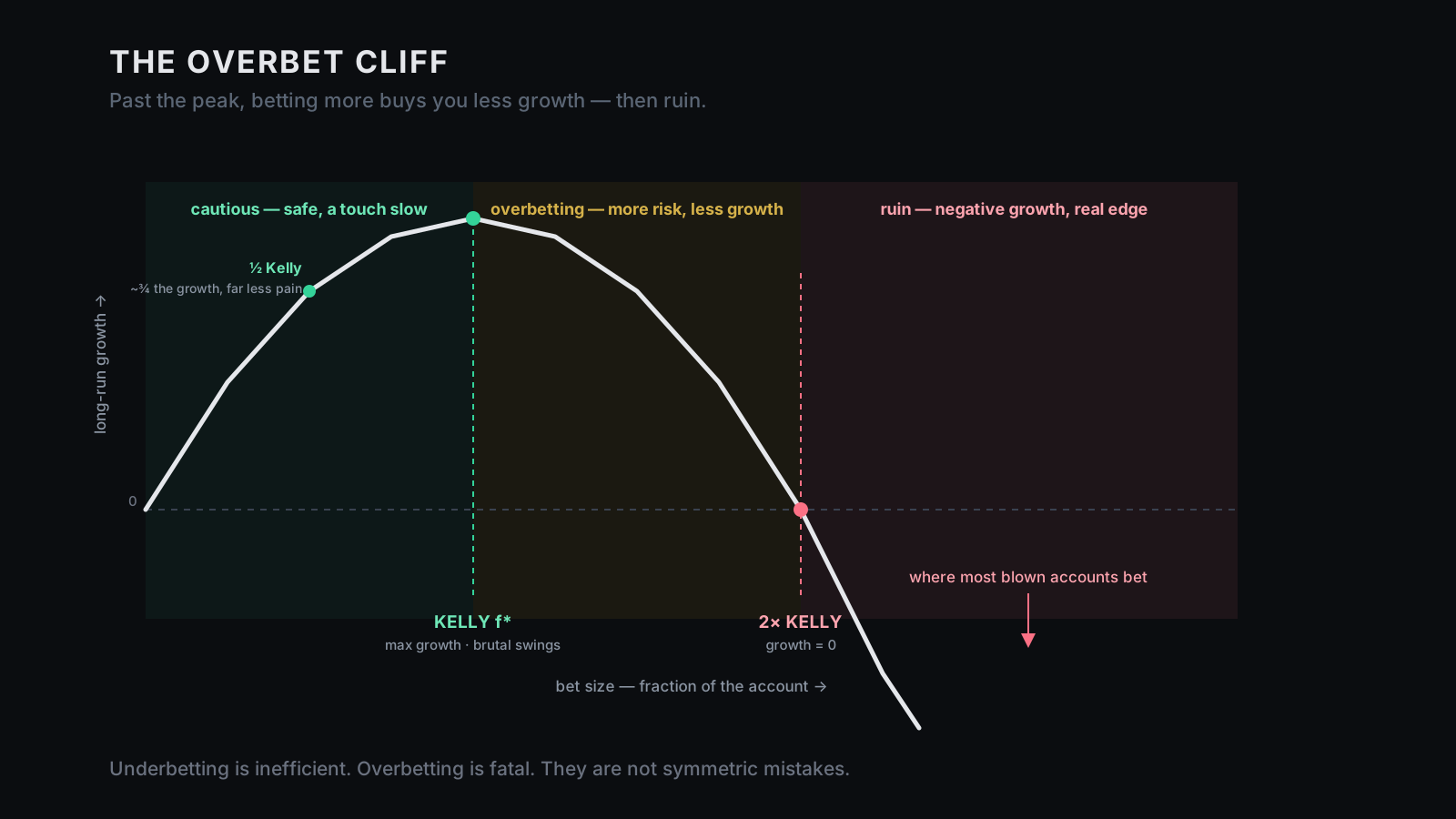
This is the most important picture in the article. As bet size increases, long-run growth rises — at first, bigger is better, because tiny bets underuse the edge. Then growth reaches a peak. That peak is the Kelly fraction. Past that point, something strange happens: you keep betting more, but growth starts falling — more risk, less growth, more stress, less reward. At around twice Kelly, long-run growth falls toward zero. Beyond that, it turns negative, which means you can have a real edge and still lose over time because you bet it too big.
This breaks people's intuition. They think if my system wins, bigger size means bigger results — but that's only true up to the peak. Past the peak, bigger size starts destroying the compounding engine. That is the overbet cliff. Underbetting is inefficient. Overbetting is fatal. They are not symmetric mistakes: bet too little and you grow slower; bet too much and you can kill a winning system. So when uncertain, the professional bias is not "size up." It is bet less — because being too small is annoying, and being too big is terminal. (It's the same lesson position sizing teaches one trade at a time, now applied to your whole staking plan.)
V — The fatal assumption
Kelly trusts your edge — that is the fatal assumption. It takes your W and R as true, but they are estimates, and this entire run has been about why those estimates flatter you. Your expectancy might be carried by one giant winner. Your backtest might be one lucky hand. Your AI might have selected the best of thousands of noise strategies. Your open book might be one correlated bet wearing five tickets. Your sample might be too small, your costs too low, your live execution worse, your regime about to change. Kelly knows none of that. It takes your inputs and multiplies them directly into bet size.
That is why it punishes overconfidence so hard. Suppose your measured edge says full Kelly is 30%, but your true edge is half as strong — now the true Kelly is closer to 15%, and betting the measured 30% puts you at roughly 2× true Kelly: the cliff. This is how traders use "math" to overbet — not because the formula is wrong, but because the confidence is wrong. The formula is honest. The inputs are salesmen. Your job is to discount them before they ever touch the account.
VI — Fractional Kelly
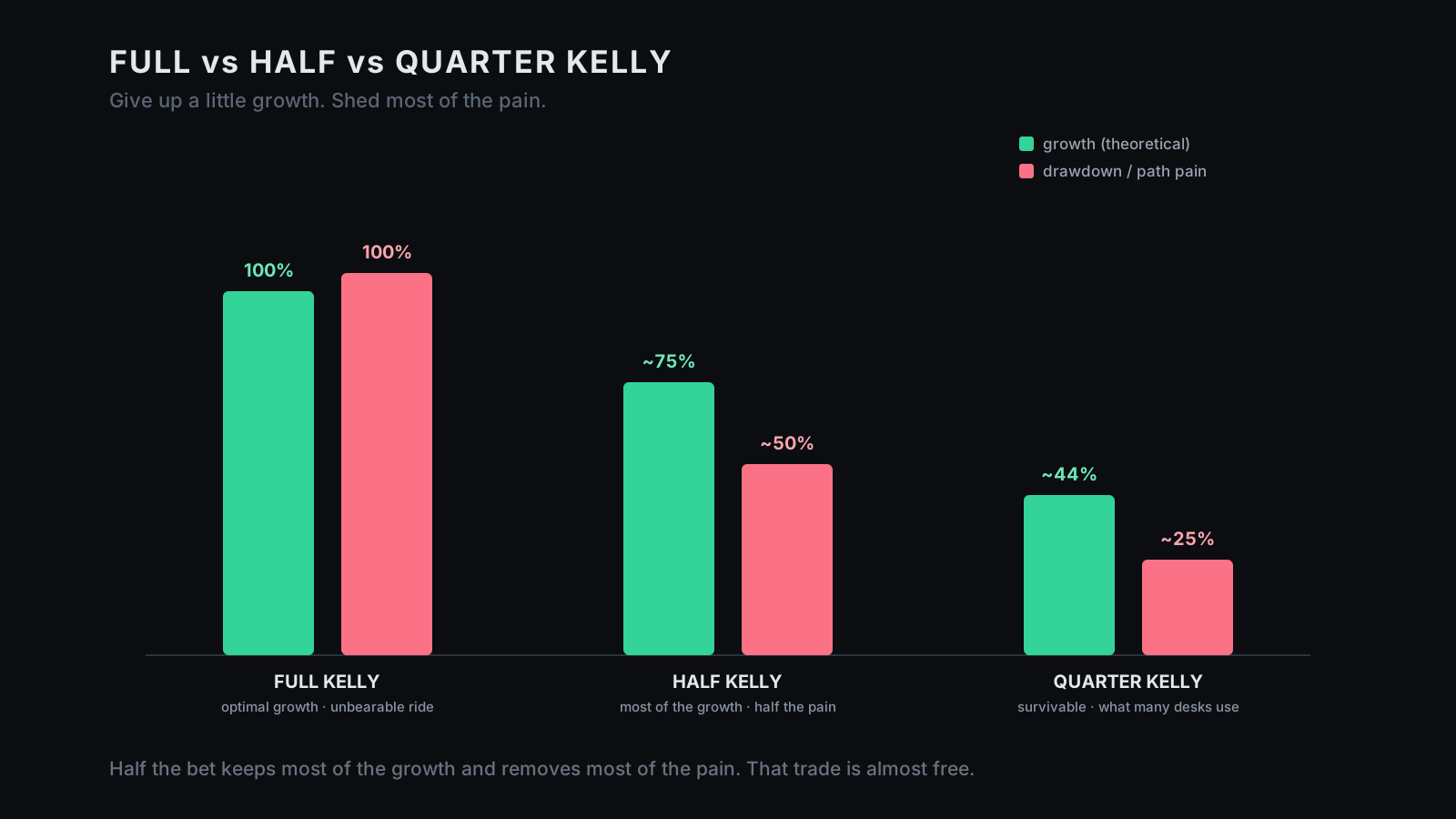
Fractional Kelly is the humility discount: instead of betting full Kelly, you bet a fraction of it. The tradeoff is generous — you give up a sliver of theoretical growth and buy back most of the path pain. Half-Kelly is famous because it keeps much of the growth while cutting a lot of the volatility and drawdown; quarter-Kelly is more conservative still. Many real money managers use fractions because they know the truth: the edge estimate is never as clean as the spreadsheet.
| Fraction | Risk if full Kelly = 30% | What the fraction says about your edge |
|---|---|---|
| Full Kelly | 30% | "I know my edge exactly." (almost nobody does) |
| Half Kelly | 15% | "I trust the edge, but not perfectly." |
| Quarter Kelly | 7.5% | "I respect how easily I could be wrong." |
| Eighth Kelly | 3.75% | "I want the system alive long enough to find out." |
Those numbers are still large for most traders — but now we are at least moving in the right direction, and the fraction is not fear; it is uncertainty priced into size. Given everything the run taught you about inflated edges, a quarter — or less — is not cowardice. It's arithmetic. The size of your Kelly fraction is the size of your honesty about your edge.
The fraction is not fear. It is uncertainty priced into size.
VII — When Kelly says zero
Kelly has one very useful feature: it can say no. Run a system with no real edge — a win rate and payoff that don't actually beat costs — and the fraction comes out zero or negative:
Win rate 45%   ·   average win 1R   ·   average loss 1R
  f* = 0.45 − (0.55 / 1) = −0.10
  →  the math's verdict: do not bet this system
A negative Kelly does not mean "use smaller lots," or "maybe risk 0.5%," or "turn on recovery mode and pray." It means no. If Kelly comes out at or below zero, the sizing problem was never the problem — the edge is the problem. That is why Kelly is not only a bet-sizing tool; it's an honesty test, one more mirror like the deflated Sharpe and the correlation audit before it.
Sometimes the best position size is zero.
This is deeply offensive to people who really wanted the system to work. Good — math should occasionally be rude.
VIII — The full sizing stack
Kelly does not replace the rest of your risk discipline; it sits inside it as a ceiling. The correct process is layered, and every adjustment after step 3 moves down:
- Measure the edge in R, from your real trade distribution — not dollars, not win rate, not vibes in a hoodie. (That's counting R.)
- Stress the edge before you size it. Did one trade carry it? Was it selected from thousands? Is the sample too small? Did it survive out-of-sample? A contaminated input makes a dangerous size.
- Compute full Kelly — the ceiling, not the target.
- Take a fraction — half, quarter, or less; the less certain you are, the smaller the fraction. Most retail traders should not be emotionally anywhere near full Kelly.
- Cap by correlation — if five trades share one driver, the cluster shares one bet, not five. (That's the exposure audit.)
- Cap by fixed risk — the simple per-trade limit you can sleep with still wins; the formula does not get to override your survival rule.
The final size is the smallest number the stack produces. Good sizing is not the formula's first answer — it is a series of reasons to bet less.
The AI Kelly prompt
Let AI do the arithmetic, not the decision — and read the verdict yourself, especially the part where it tells you to bet less.
Here is my trade history as a list of R-multiples. Please:

1. Estimate win rate (W), average win in R, average loss in R,
   reward-to-risk (R = avg win / avg loss), and expectancy in R.
2. Compute full Kelly: f* = W − (1 − W) / R, plus half, quarter, eighth.
3. Run uncertainty checks:
   - sample-size warning
   - Kelly if my true edge were 50% smaller
   - Kelly if average win is 20% lower, or win rate 5 points lower
   - whether one outlier is carrying the edge
4. Flag risks: full Kelly above 5%; half Kelly above my fixed cap;
   Kelly zero or negative; size above my correlated-exposure limit.
5. Recommend: full Kelly (ceiling), a conservative fraction, the final
   size after caps, and a plain-English explanation.

Do not assume the measured edge is exact — treat the inputs as optimistic.
Do not optimize the strategy. Only size the frozen edge.
The last lines are the whole game. You are not asking the model for permission to bet big; you're asking it to price in your own uncertainty.
The 20-minute bet-sizing audit
Minutes 0–5 — Get W and R. From your journal, in R-multiples, pull your win rate, average win, average loss, reward-to-risk, and sample size. If you do not have a clean journal, stop — that is the answer. You have been sizing blind.
Minutes 5–10 — Compute full Kelly. Plug into f* = W − (1 − W) / R and stare at the number. If it is big, do not get excited — recoil. That is the ceiling, not the target.
Minutes 10–15 — Choose your fraction. Pick half, quarter, or less, and write why — sample under 300 trades, edge maybe inflated by regime, live costs maybe worse, correlation can stack exposure, you want to survive estimation error. If you cannot explain the fraction, you have not chosen it; you have guessed.
Minutes 15–20 — Apply the caps. Compare your fractional-Kelly size to your fixed per-trade max, your correlation-cluster max, your drawdown tolerance, any prop-firm daily limit, and your plain sleep-at-night limit. Take the smallest. That is your bet — not because it is glamorous, but because it survives.
Where this meets ProEA
Bet sizing is logic, and logic is exactly what you cannot audit in a black box. A vendor can say "smart money management," and that phrase can mean two completely different things: a sober fractional-Kelly ceiling, or a hidden multiplier that sizes up into losers until the account finally meets the wrong streak. From an equity curve, the two can look similar — until they do not.
This is why we sell MTR as source you can read. With source, the sizing rule is yours to inspect: you can see whether the system sizes from a risk cap or from a recovery fantasy, whether its assumptions about edge are humble or hopeful, whether correlated positions share a cap, whether it respects the account or slowly negotiates with it. That does not make MTR safe — source does not guarantee profit, a visible formula does not mean the bet is always right, and MTR can lose. But inspectable sizing means nobody is secretly betting your account for you. If a system decides position size, you should be able to answer:
- What edge does this sizing logic assume?
- What happens if that edge is half as good?
- What cap stops it from betting too much?
- Does it ever size up to recover losses?
If those questions can't be answered, the system is asking for trust exactly where it should offer proof.
Disclosure
We sell source and evidence you can inspect — not outcomes, not guarantees. The Kelly criterion is a model: it assumes known edge, repeatable bets, and stable distributions that real markets often violate, and its outputs are highly sensitive to estimation error. Fractional Kelly reduces risk but does not remove it — a strategy sized with fractional Kelly can still lose, a positive historical expectancy can decay, correlation can stack exposure, and drawdowns can exceed simulation. Trading is risky, leverage magnifies risk, and past performance is not future performance. Kelly is not a magic number; it is a ceiling that reminds you how dangerous overconfidence becomes when translated into size.
Your first 20 minutes
Open your journal, compute your real W and R, and plug them into Kelly. Then cut the number — for sample uncertainty, for outliers, for AI overfit, for correlation, for drawdown — until the bet is one you could keep placing through a long, ugly losing streak without flinching, revenge-sizing, or turning the system off at the bottom. That smaller number is not weakness; it is the professional bet. The formula gave you the ceiling. You were never supposed to live there.
The one line to take with you
There is a perfect bet size for the edge you have. The whole skill is being honest about how small that edge might really be — and then betting even less. Amateurs ask how much they can bet. Professionals ask how much they can afford to be wrong about.