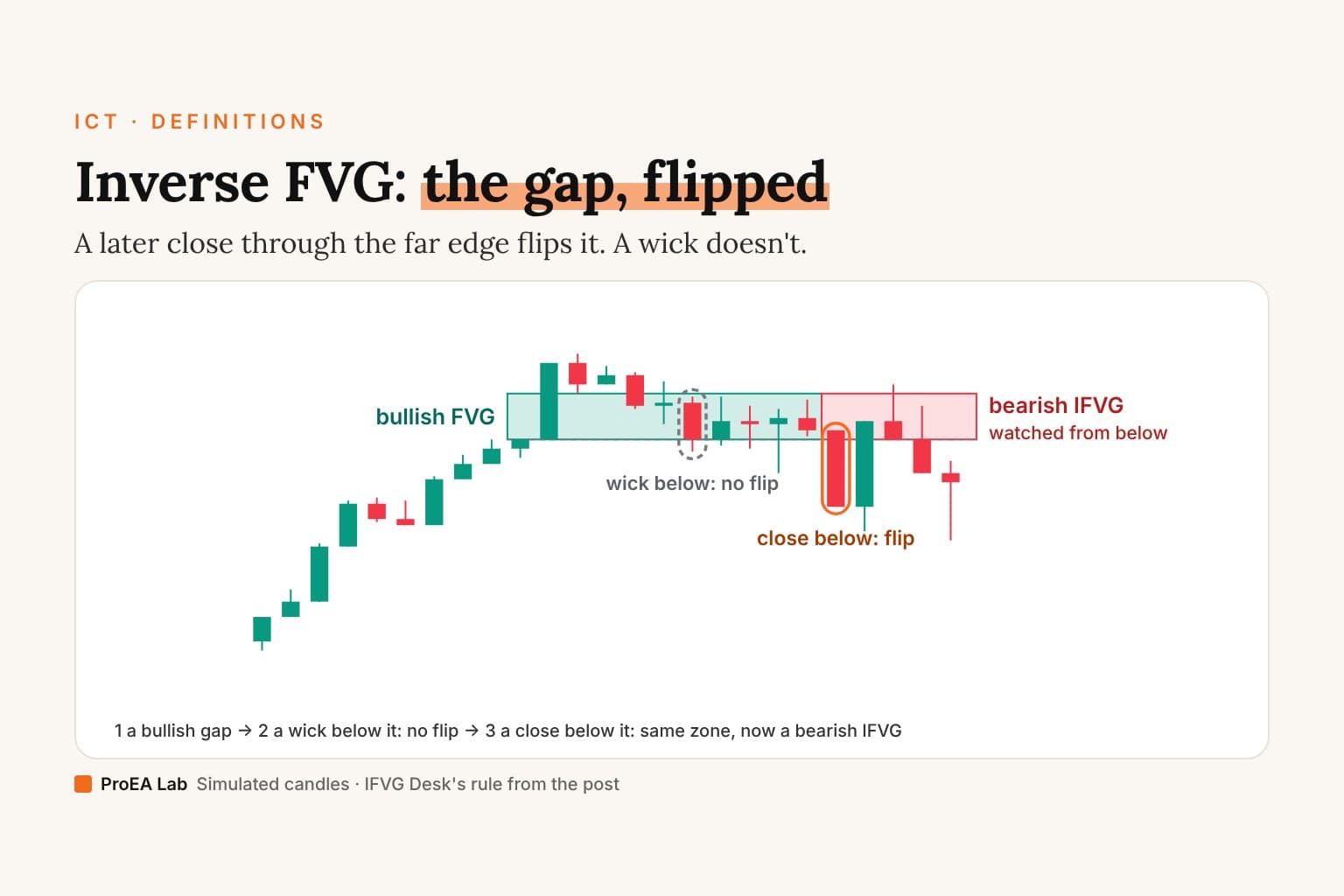
An inverse fair value gap (IFVG) is a fair value gap that a later candle closes through. A bullish gap that a candle closes below becomes a bearish IFVG, watched as resistance from below. A bearish gap that a candle closes above becomes a bullish IFVG, watched as support from above. Our IFVG Desk counts only a close strictly beyond the gap's far edge, on a later candle than the one that completed the gap.
A wick through the gap doesn't flip it. Neither does a close exactly on the edge. ICT, the Inner Circle Trader, calls it an inversion fair value gap; inverse FVG, iFVG and IFVG are the same thing.
Every rule here is IFVG Desk's (version 1.2.0 Pine source), so you can check it against code; the films replay a simulated market read by it. It builds on the fair value gap; the same flip on an order block makes a breaker block.
Same zone, other side, on a close.What is an inverse fair value gap?
A failed gap, kept on the chart with its direction reversed. Three checks, each on a closed candle:
- The gap. Bullish: candle 3's low strictly above candle 1's high. Bearish mirrors it. IFVG Desk keeps gaps of at least 0.05 × ATR(14), smaller than the 0.3 × ATR(14) SMC Basics uses, so it finds more of them.
- The flip. A later candle closes strictly beyond the far edge: below a bullish gap's bottom (candle 1's high), above a bearish gap's top (candle 1's low). The zone doesn't move. Only the side price is on changes.
- The end. After the flip, a close strictly beyond the other edge ends it. A gap still waiting more than 180 candles after it formed expires. Each gap flips once.
Simulated 15-minute candles, not market data. Gaps follow IFVG Desk's rule (at least 0.05 × ATR(14)); each film draws only the gap it follows. A flip needs a later close strictly beyond the far edge.
Read as text
- A bullish gap forms: candle 1's high 98.42, candle 3's low 98.57. It is 0.15 tall, 1.21 times ATR(14), above IFVG Desk's 0.05 minimum. Its far edge is its bottom, 98.42.
- 4 candles later a wick trades below 98.42 and the candle closes back inside. A wick is no flip: the gap is still bullish.
- 9 candles after the gap, a candle closes at 98.20, strictly below 98.42. By IFVG Desk's rule the gap is now a bearish IFVG: the same 98.42 to 98.57, with price below it, watched as resistance from below.
- 1 candle after the flip, price trades back into the zone from below without closing above its top. The IFVG is still alive; the film stops 4 candles after the flip.
How this window was chosen: The first 80-candle window of the simulated market in which a bullish gap at least half an average candle tall, and at least a tenth of the price range the film shows, forms at least 16 candles in and a later candle closes below its bottom 3 to 12 candles after it formed, with no close back above its top in the 4 candles after that. The film ends 4 candles after the flip.
Use itMark the far edge the moment candle 3 closes. The first later close strictly beyond it is the flip: note that candle.
Watch outAfter the flip, the other edge is the line that ends it. One close back through it and the IFVG is gone for good.
Does a wick through the gap make it an IFVG?
No. The close decides. This is the drawn example from IFVG Desk's own manual: candle 1's low is 106 and candle 3's high is 100, so a bearish gap runs from 100 to 106. Candle 4 wicks to 109 and closes at 104. Move candle 5's close and wick and read the verdict:
Flipped: a bullish IFVG, 100 to 106.
The close, 108.0, is strictly above 106, the far edge. Same zone, other side: price is above it now, and it is watched from above. In the desk's default mode this close is the entry, if the session check passes. A later close below 100 would end it.
Made-up round prices from IFVG Desk's manual. The verdict applies the desk's flip rule: a later close strictly beyond the far edge.
At the manual's 108, the gap becomes a bullish IFVG, still 100 to 106. From there a close below 100 ends it; a close at exactly 100 doesn't. The flip is recorded at the confirming close, never backdated: until candle 5 closes it can fall back inside, the trap that makes indicators repaint.
The same check on simulated candles, a wick past the far edge and a close back inside:
Simulated 15-minute candles, not market data. Gaps follow IFVG Desk's rule (at least 0.05 × ATR(14)); each film draws only the gap it follows. A wick past the far edge flips nothing; only a close strictly beyond it does.
Read as text
- A bullish gap forms: candle 1's high 97.26, candle 3's low 97.64. It is 0.38 tall, 1.34 times ATR(14), above IFVG Desk's 0.05 minimum. Its far edge is its bottom, 97.26.
- 5 candles later a candle's wick reaches 97.16, 0.10 below the far edge, and the candle closes at 97.49, back inside the edge.
- The close decides: no close strictly beyond the far edge, no flip. No candle closes beyond it in the next 6 either, so the gap is still fresh and still facing its original way.
How this window was chosen: The first window in which a bullish gap at least half an average candle tall and a tenth of the film's price range, at least 16 candles in, is first wicked below its bottom 3 to 12 candles after it formed, by at least a fifth of an average candle range, the candle closing back at or above the bottom, and no candle closes below the bottom in the next 6. The film ends 6 candles after the wick. Each film's window starts after the windows of the films above it, so no two films share candles.
Bullish vs bearish IFVG
The names trip people up: a bullish IFVG was a bearish gap a few candles ago.
| Bullish IFVG | Bearish IFVG | |
|---|---|---|
| Starts as | a bearish FVG: candle 3's high below candle 1's low | a bullish FVG: candle 3's low above candle 1's high |
| The flip | a later close strictly above the top | a later close strictly below the bottom |
| Then watched as | support, from above | resistance, from below |
| Trades | long | short |
| Ends on | a close strictly below the bottom | a close strictly above the top |
IFVG vs fair value gap vs breaker block
An IFVG is what a fair value gap becomes when it fails. A breaker block is what an order block becomes when it fails, and the breaker also needs a structure break the other way. IFVG Desk has no structure check. If you want one, write it down before you look, and expect fewer IFVGs.
The fair value gap page ends a gap on a close beyond its far edge. If you trade inversions, that same close starts the IFVG.
An IFVG can also confirm a liquidity sweep. Our Sweep Desk uses the inversion as its default confirmation: after a sweep, a candle closes through an opposing gap printed up to 40 candles before the sweep, and that inverted gap becomes the entry zone.
How do you trade an IFVG? Entry, stop and exit
There's no single IFVG strategy, only rules. IFVG Desk's, as rules rather than advice:
- Entry, default: the flip close. Enter at the close of the candle that flipped the gap, and only that candle. If a required check fails on it, the zone stays on the chart as ARMED, but this mode never enters it later.
- Entry, optional: the retest. A later candle trades back into the zone and closes beyond its trade-side edge and beyond its own open. A touch without that close is no entry and doesn't use the zone up.
- Checks. On by default: the candle opens from 09:30 to before 11:00 New York time. Off by default: a higher-timeframe gap, a recent sweep, an SMT divergence, the previous day's direction, an entry body of at least 0.5 × ATR.
- Stop. One tick beyond the 10 candles before the entry candle: below their lowest low for a long, above their highest high for a short.
- Target and size. 1R. Size is the planned cash risk (100 by default) divided by the stop distance, rounded down; zero means no plan.
- Exit. Levels fixed once entered. The plan ends at the target, the stop, the open of a candle that gaps past the stop (more than 1R lost), a candle touching both (counted as the stop), or after 120 candles. One resolved plan per New York day.
The retest and the plan, on simulated candles. The window was picked before its result was known, and both tabs happen to end at the stop:
Simulated 15-minute candles, not market data. Gaps follow IFVG Desk's rule (at least 0.05 × ATR(14)); each film draws only the gap it follows. The desk's 09:30–11:00 New York window and its one plan per day are left out: the simulated market has no sessions. A tick is 0.01 here; results are before costs.
Read as text
- A bullish gap forms: candle 1's high 93.04, candle 3's low 93.52. It is 0.48 tall, 1.88 times ATR(14), above IFVG Desk's 0.05 minimum. Its far edge is its bottom, 93.04.
- 5 candles later a candle closes below 93.04: a bearish IFVG, armed. In the retest mode, nothing is entered on the flip itself.
- 2 candles trade back into the zone without closing below it and below their own open: a touch is no entry.
- 3 candles after the flip, a candle trades into the zone and closes at 92.94, below 93.04 and below its own open: the retest entry, short at that close.
- The stop goes one tick beyond the highest high of the 10 candles before the entry: 93.73, 0.79 away. The target is 1R the other way: 92.15. Both are fixed from here.
- 5 candles later price trades to 93.73: the stop, −1R before costs. One plan, not a result.
How this window was chosen: The first window in which a bullish gap at least half an average candle tall and a tenth of the film's price range (plan levels included), at least 16 candles in, is closed through 3 to 12 candles after it formed, a candle 2 to 12 candles after the flip trades back into it and closes below its bottom and its own open (IFVG Desk's retest entry), and the plan ends within 30 candles of the entry, whichever way. The film ends 3 candles after the plan ends. Each film's window starts after the windows of the films above it, so no two films share candles.
Other public rules agree on the close and differ after it. LuxAlgo's open-source IFVG script (published 1 Feb 2024, checked 2026-10-07) inverts a gap when "the price closes above or below the FVG area in the opposite direction of its bias." Forexbee's iFVG guide (updated 22 Sep 2026, checked 2026-10-07) waits for the retest, "Do not open the trade instantly after the break because it will be an aggressive trade setup", and puts the stop elsewhere: "place your stop loss on the opposite side of the zone." Same pattern, two stops, two different trades. In our small test below, the retest version finished below the flip close on both charts.
Use itPick the entry mode before you open the chart: the flip close or a later retest. Write the stop and the close that cancels the idea next to it.
Watch outSwitching modes after you've seen what price did turns one rule into two, and lets hindsight pick the one that looks better.
Which timeframe is best for IFVGs?
We haven't compared timeframes, so we can't name a best one; the rule is the same on every chart. IFVG Desk is built for standard intraday candles and suggests 1- to 5-minute charts. Its optional higher-timeframe check reads gaps only once their own candles close, so they arrive late on purpose.
Does the IFVG work?
Failed gaps, the raw material, are common. In our zone-score study, of 1,693 zones that price came back to, 711 (42.0%) closed beyond their far edge before price moved 1 ATR in the zone's favour: fair value gaps and order blocks together, 50 sessions of gold futures on 5-minute candles (the study). What price did after those failures, we didn't measure.
An answer needs hundreds of trades on more than one market, a period the rule never saw (a walk-forward test), real costs, and something to beat: the same stop, target and session on entries that ignore gaps. Until then, an IFVG is a precise way to describe a failed gap, not a demonstrated edge.
The most common IFVG mistakes
- Calling a wick a flip. Only a close beyond the far edge counts, and IFVG Desk needs strictly beyond: a close on the edge is no flip.
- Flipping a gap on its own third candle. The flip needs a later candle.
- Treating ARMED as an entry. An inverted gap is a zone. The entry mode, the checks and the risk plan still decide.
- Reusing a dead IFVG. A close back beyond its other edge ends it for good, and so should an age limit.
- Judging it from screenshots. LuxAlgo's script page warns: "Backtesting historical signals is incorrect as it does not consider the mitigation of IFVGs." Count forward, on closed candles.
What's the exact IFVG rule?
IFVG rule (IFVG Desk 1.2.0 defaults)
Closed candles only. ATR = ATR(14).
1. The gap: candle 3's low strictly above candle 1's high
   (bullish), or candle 3's high strictly below candle 1's
   low (bearish), at least 0.05 ATR wide. The zone is the
   space between those two wicks.
2. The flip: a later candle, not candle 3, closes strictly
   beyond the far edge. Bullish gap closed below its bottom
   = bearish IFVG. Bearish gap closed above its top =
   bullish IFVG. A wick, or a close on the edge, is no flip.
3. The end: a close strictly beyond the IFVG's other edge
   invalidates it. More than 180 candles after the gap
   formed, it expires. Each gap flips once.
4. The entry: the flip candle's close, inside 09:30-11:00
   New York, if every required check passes. Not entered
   then = never entered from that flip. Optional mode: a
   later candle overlaps the zone and closes beyond its
   trade-side edge and its own open.
5. The plan: stop one tick beyond the prior 10 candles'
   low (long) or high (short), target 1R, levels fixed
   once entered, one resolved plan per New York day.
Steps 1 to 3 are the definition. Steps 4 and 5 are one way to trade it, IFVG Desk's, and the test above is all the evidence we have for them.
Which tools draw inverse fair value gaps?
The whole rule on your own chart. IFVG Desk draws each gap, flips it on a strict close and shows its state (WAIT, ARMED, PLAN ACTIVE or DAY DONE), with the reason when an armed IFVG wasn't entered. A strategy companion runs the same engine in the Strategy Tester. Pine v6, full source in Pine Pro Library. New to Pine? Here's how to add a script to TradingView.
SMC Basics, also in the library, draws the gaps an IFVG starts from and removes a gap on a close through its far edge; it doesn't flip them. LuxAlgo's script also flips on a close, then signals retests from wicks or closes, your choice. Same name, different rules after the flip: check which one a tool uses before you trust its boxes.
More concepts, one written rule each: smart money concepts. ICT's models in learning order, with what we measured: ICT concepts.
Disclosure
We build IFVG Desk, SMC Basics and Sweep Desk and sell them in Pine Pro Library, alongside our other indicators. We have no relationship with LuxAlgo, Forexbee or TradingView. Nothing here is financial advice, and no IFVG rule on this page, ours included, has a validated edge.
Use these animations on your site.
Frequently asked questions
What is an inverse fair value gap (IFVG)?
A fair value gap that a later candle closes through. A bullish gap that a candle closes below becomes a bearish IFVG, watched as resistance from below; a bearish gap that a candle closes above becomes a bullish IFVG, watched as support from above.
Does a wick through a fair value gap make it an IFVG?
No. Our IFVG Desk counts only a close strictly beyond the gap's far edge, on a later candle than the one that completed the gap. A wick through the gap doesn't flip it, and neither does a close exactly on the edge.
Is an inversion fair value gap the same as an inverse FVG?
Yes. ICT calls it an inversion fair value gap; inverse FVG, iFVG and IFVG are the same thing. The zone doesn't move when it flips: only the side price is on changes.
What is the difference between an IFVG and a breaker block?
An IFVG is what a fair value gap becomes when it fails; a breaker block is what an order block becomes when it fails. The breaker also needs a structure break the other way, while IFVG Desk's rule has no structure check.
Where does the stop go on an IFVG trade?
In IFVG Desk, one tick beyond the swing of the 10 candles before the entry candle: below their lowest low for a long, above their highest high for a short. Forexbee's guide places it on the opposite side of the zone instead, which makes it a different trade.
When is an IFVG invalidated?
Before an entry, a close strictly beyond the IFVG's other edge ends it. In IFVG Desk, a gap still waiting more than 180 candles after it formed expires too, and each gap flips only once.
Which timeframe is best for IFVGs?
We haven't compared timeframes, so we can't name a best one; the rule is the same on every chart. IFVG Desk is built for standard intraday candles and suggests 1- to 5-minute charts.
Does the IFVG work?
We haven't shown that it does, and our test is too small to say either way. On QQQ and SPY 1-minute candles from 17 Aug to 5 Sep 2026, IFVG Desk's default rule made 15 trades on each: −525.57 USD (profit factor 0.299) on QQQ and +210.81 USD (profit factor 1.571) on SPY.