

Complete Suite Everything on the list, one payment
$97, one payment.
Renews never / Full source / 7-day refund before download
The Suite adds no Range Verdict features; it includes Pine Pro Library, so this desk's code comes with it.
It reads every 15-minute close against the last UTC hour's range and, on two closes beyond it in the New York morning, freezes one plan: a stop of at least 1 ATR and a 2R objective.
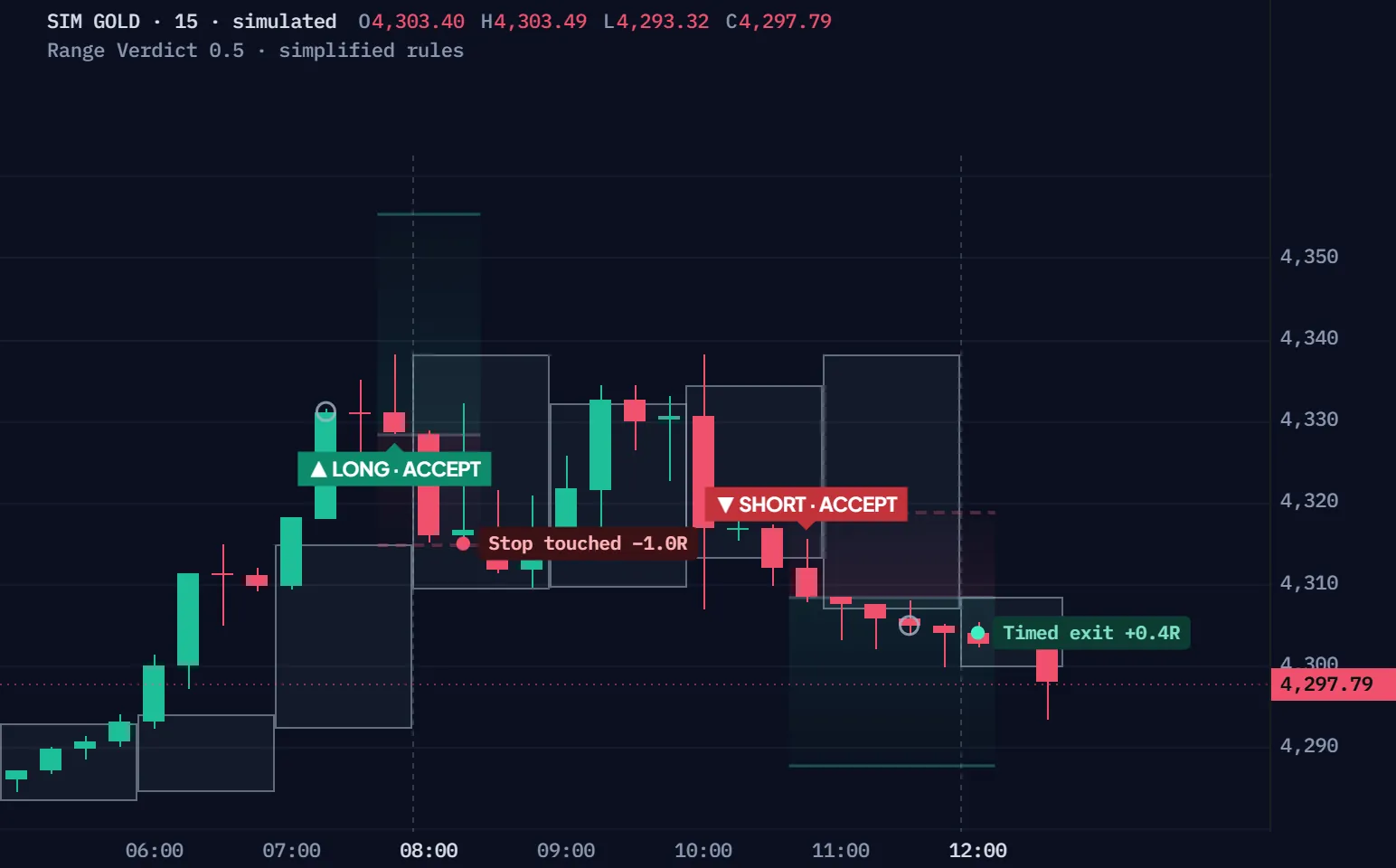
Morning 1 · the first whole morning after the warm-up
Simulated 15-minute gold candles, not a real market, run through Range Verdict Desk's rules, simplified: our own port of the script, not yet checked against TradingView for this version. Quiet candles run as a time-lapse; the ones that matter slow down. Morning 1: the first simulated New York morning that begins after the script's 250-bar warm-up and in which the desk confirms a plan; Another morning: the next simulated mornings with a plan, in order, whatever they do (after the twelfth, morning 1 again). R is before costs.
| Time | Event | Prices |
|---|---|---|
| 07:00 | Morning opens | Prior hour 4,292.12–4,314.89 |
| 07:15 | Closes above the prior hour · Outside NY 08:00-12:00 | Close 4,331.10 |
| 07:45 | Two closes above · Confirmed LONG plan | Close ref 4,328.38 · stop 4,314.89 · 2R 4,355.36 |
| 08:00 | Reference entry at the next open | Entry 4,328.38 |
| 08:15 | Stop touched −1.0R | Exit 4,314.89 |
| 10:45 | Two closes below · Confirmed SHORT plan | Close ref 4,308.33 · stop 4,318.69 · 2R 4,287.61 |
| 11:00 | Reference entry at the next open | Entry 4,308.33 |
| 11:30 | Closes below the prior hour · Skipped: plan already active | Close 4,304.83 |
| 12:00 | Timed exit +0.4R | Exit 4,303.93 |
A Pine v6 indicator · the full source in Pine Pro Library. It draws reference plans; it places no orders.
One range, two readings: a wick out and a close back inside is Fade's signal, and two closes beyond it is Accept's, the desk's default.
Two closes above 4,302.87: Accept's LONG plan, stop 4,302.87, objective 4,422.99.
The same simulated gold. This film is from morning 1 on, the first simulated hour in which the Fade setting would make a plan (a candle wicks through the prior hour's range and closes back inside) and two later closes beyond it make the desk's Accept plan. Fade is the script's other mechanism, one setting away.
Four complete 15-minute candles; after a gap in the data, no range until a whole hour has passed.
Two closes in a row beyond the same side, inside the current hour. The default.
A wick through one side and a close strictly inside; through both sides is no signal.
The hour's first signal spends it, even when a held plan refuses it.
Drag the last candle's close and pick the mechanism: the script answers in its own words, with a plan or a wait.
Confirmed LONG plan Two closes above 4,128.00: from the next open, stop 1 ATR away, 4,127.50, objective 4,136.50.
A drawn example, the same candles each time, with an ATR of 3.00. The verdict is the script's own rule, run on what you set.
The farther of 1 ATR and the range's edge (Accept) or the candle's wick (Fade).
Twice the risk from the signal close, frozen with the stop.
A reference plan, not a fill: the script places no orders.
Signal closes at or after 08:00 New York and before 12:00, by default.
A plan ends at its stop, at its 2R objective, or at 12:00, when one still held exits at the next open.
Target touched: the objective, 4,218.54, two risks from the signal close. +2.0R from the next open, 4,239.62.
Three plans from the same simulated gold: from morning 1's first plan on, the first simulated plan to reach its objective, the first to touch its stop, and the first still held at noon. R runs from the next open to the exit, before costs.
When one candle touches the stop and the objective, the script counts the stop.
An open past a level ends the plan at that open: Gap stop, or Gap target.
A plan still held when a candle closes at 12:00 exits at the next open, whatever its R.
At most sixteen held candles; in the default window, 12:00 comes first or at once.
One file, the complete v0.5.0-rc1 indicator, ready for TradingView's Pine Editor.
On a phone? Send this page to your desktop.
//@version=6 // Original ProEA Lab implementation. Utility release candidate 0.5.0-rc1; labels and tooltips reworded 2026-10-15. // Closed-bar decisions; UTC frames; four fixed NY signal-close windows; stop-first reference ambiguity. indicator("Range Verdict Desk FREE v0.5 Utility RC1", overlay=true) const string EDITION = "FREE"const bool PREMIUM = falseconst string SOURCE_VERSION = "0.5.0-rc1"int fromTime = input.time(timestamp("01 Jan 2018 00:00 +0000"), "Signal close from (inclusive)", group="Research dates")int toTime = input.time(timestamp("01 Jan 2099 00:00 +0000"), "Signal close to (exclusive)", group="Research dates")int refHours = 1string mechanism = input.string("Accept", "Mechanism", options=["Fade","Accept"], group="Recipe", tooltip="Fade: one-sided wick sweep then close inside. Accept: two closes beyond the same frozen boundary. These are hypotheses, not recommendations.")bool trendFilter = input.bool(false, "EMA50 / EMA200 alignment", group="Recipe")float atrFloor = 1.0float targetR = 2.0int maxBars = 16float assumedCost = input.float(0.40, "Assumed round-trip price cost", minval=0.0, step=0.1, group="Costs", tooltip="Illustrative: XAU 0.40, NAS100 2.00, US500 0.60 price units. NOT a live broker quote. Lab fees must also be set in Properties; this input only screens plans.")bool useCostGate = falsefloat maxCostR = 0.10string researchWindow = input.string("08:00-12:00", "NY signal-close window", options=["00:00-04:00","04:00-08:00","08:00-12:00","12:00-16:00"], group="Timing", tooltip="Four fixed New York windows to choose from. IANA New York time automatically handles DST. Signal closes at the end boundary are excluded. By default held plans request exit at window end and fill next available open. Timing experiments can stop entries earlier or disable this window-end exit without changing the bar cap.")int sessionStart = researchWindow == "00:00-04:00" ? 0 : researchWindow == "04:00-08:00" ? 240 : researchWindow == "08:00-12:00" ? 480 : 720int sessionEnd = sessionStart + 240int earlyCutoffMinutes = 0bool useWindowExit = truebool useRangeGate = falsefloat minRangeATR = 2.0bool useMidpoint = falsebool useBreakeven = falsebool showRange = input.bool(true, "Reference range", group="Display")
No coding needed.
The full Pine v6 source is in Pine Pro Library: read it, change it, keep it.
It draws the range, the plan and its panel; it places no orders.
Any symbol on standard 15-minute candles; New York time follows daylight saving.
Fade or Accept, the EMA 50 / 200 filter, one of four New York windows, and the dates it reads.
The page, the films and the manual are open to everyone. The code, the complete indicator, is in Pine Pro Library: $49 once for every desk and every update, or included in the Complete Suite. Sign in to copy or download.
We make no promise of results. The script draws a plan on closed candles; whether to take it, and the risk, stay with you.
A configuration label: it names the settings in use, not a result, as the script's own tooltip says. Range Verdict Desk's plan is fixed to that recipe: a 1 ATR stop floor, 2R, sixteen candles, out at the window's end.
No. Every decision reads a closed 15-minute candle, the plan is frozen at the signal close, and its entry is the next open.
It is one of four fixed New York windows (the script's tooltip). You can start the window at 00:00, 04:00, 08:00 or 12:00.
No Range Verdict features. It holds the other things we make, for one payment, and it includes Pine Pro Library, so this desk's code comes with it.
We, ProEA Lab, build Range Verdict Desk. The films run its rules, simplified, on simulated candles, not market data; R is before costs. Not financial advice.
Complete Suite · $97 · one payment
The Suite adds no Range Verdict features; it includes Pine Pro Library, so this desk's code comes with it.
Every rule, setting and panel row, one topic at a time.
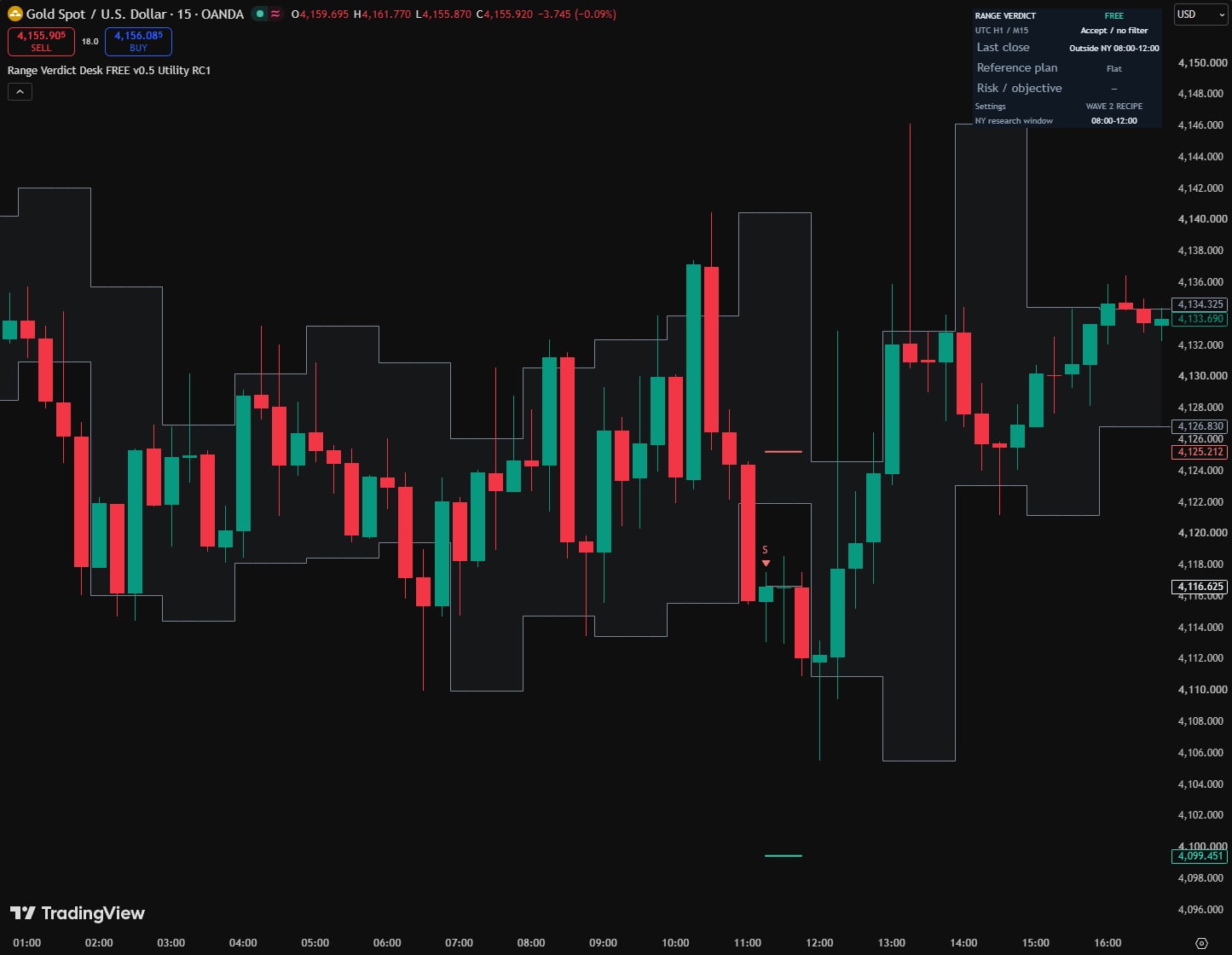
The high and low of the last complete UTC hour: four adjacent 15-minute candles. The script draws them over the current hour and reads every close against them. After a gap in the data there is no range until a whole hour has passed.
Accept, the default, follows a break: two closes in a row beyond the same side, inside the current hour. Fade takes the other side of a failed one: a wick through one side and a close strictly back inside. A candle that wicks through both sides is no signal.
Download the indicator (.pine)Licence
At a closed 15-minute candle, once the script has seen 250 of them: the prior UTC hour is complete; the close falls at or after the window's start and before its end (08:00 to 12:00 New York by default); the hour has not spent its one attempt; and the mechanism reads a side. With the EMA filter on, a long also needs the close above the EMA 50 and the EMA 50 above the EMA 200.
The first such signal in an hour spends the attempt even when a held plan refuses it (Skipped: plan already active), and no new plan starts on the candle where the last one ended.
Risk is the larger of 1 ATR (14) and the close's distance past its anchor: the range's edge for Accept, the candle's wick for Fade. The stop sits one risk behind the signal close and the objective two risks ahead. Both are frozen at the signal close; the reference entry is the next available open.
An open past the stop or the objective ends it at that open (Gap stop, Gap target). Otherwise a candle that reaches a level ends it there (Stop touched, Target touched), and a candle that reaches both counts the stop (Both touched: stop first). A plan still held when a candle closes at the window's end, or after sixteen held candles, exits at the next open (Timed exit).
Mechanism (Accept or Fade), the EMA 50 / 200 alignment, one of four New York windows (00:00, 04:00, 08:00 or 12:00, four hours each), the research dates, an assumed round-trip cost (illustrative, it changes no plan here), and what the chart shows: the range, the plan, the markers and the panel. The stop floor, the objective, the bar cap and the exit at the window's end are fixed in this script.
Every decision reads closed candles. Changing the symbol, the feed, the window or the inputs recalculates the history. A plan is a reference, not a broker fill; your fills and costs differ. It is research tooling, not financial advice.
What shipped and what changed in Range Verdict Desk, newest first. Ask for the next change below; what gets built lands here with a date, and on the lab queue on the front page.
Range Verdict Desk v0.5.0-rc1 Shipped
Two closes beyond the last UTC hour's range, then one frozen plan to 2R.
A small friction or a big idea. Tell us what would make this tool work better for you.
Requests for a new tool go on the same queue: see what is asked for and what is being built.