
Strategy Lab · optional
fractal-model-desk-strategy.pine
The same rules as broker orders for TradingView's Strategy Tester, entered at the review's close, with its own sizing and costs.
It marks a wick past the last higher-timeframe candle, the close that turns price back, and that candle closing inside, then flags a delivery review for you to assess.
Trade 1 · the run's first
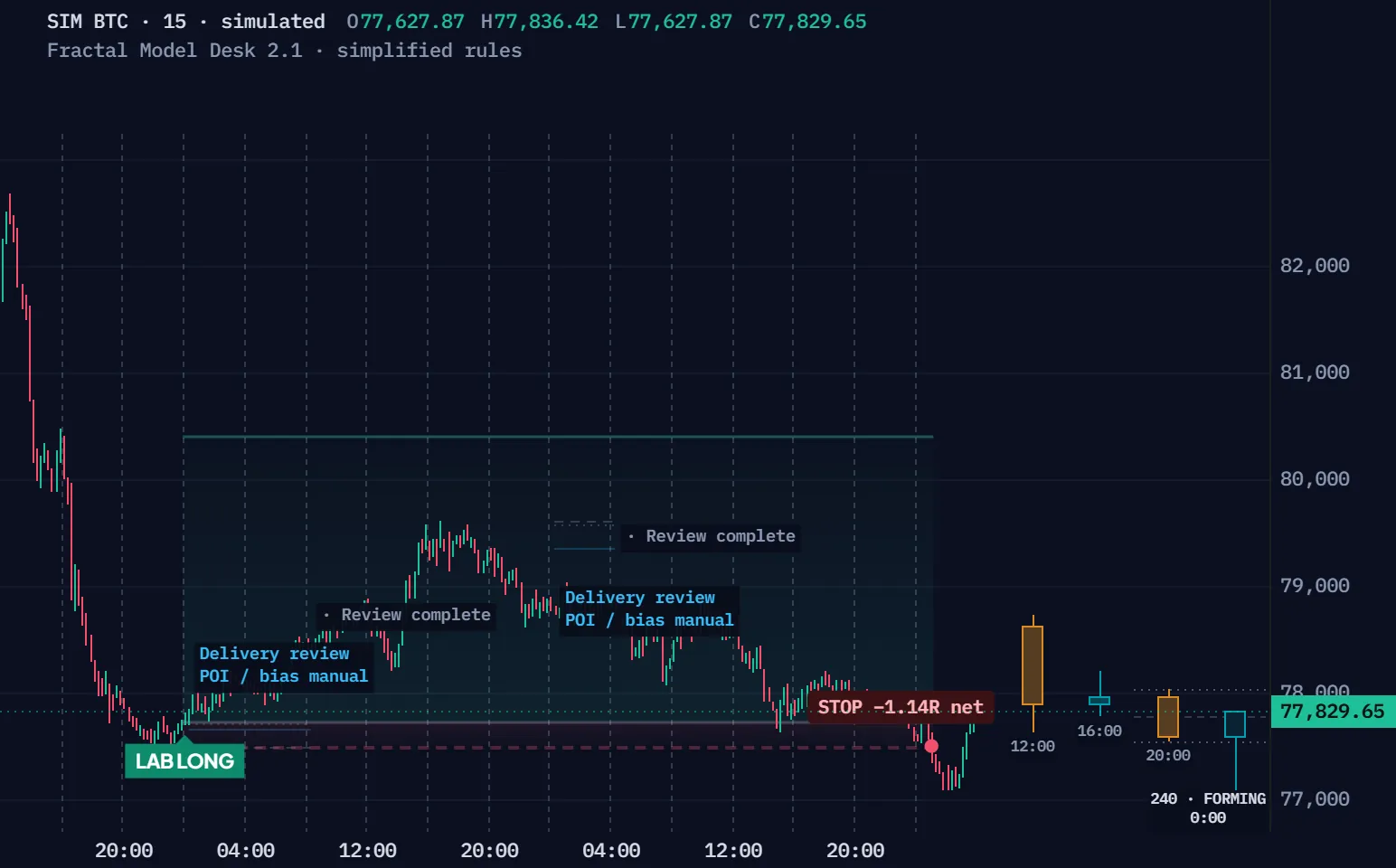
Simulated fifteen-minute BTC-like bars, not a real market, run through Fractal Model Desk's default rules, simplified for the browser; as in the script, a fifteen-minute chart reads four-hour candles. It draws the script's Focus view at each close (the two latest delivery reviews and the four-hour candles) and the Strategy Lab's default trade: entry at the review's close, stop a tick past C2's extreme, target at C1's far side, no time exit. R is after the strategy's commission on both prices. Trade 1 is the first simulated Strategy Lab trade of the run; Another trade plays the next trades in order, each entering more than twelve bars after the one before it ends, whatever they do.
| Time | Event | Prices |
|---|---|---|
| 16:00 | Window opens | Close 80415.33 |
| 16:00 | C1: the four-hour candle this window's setup measures from, opens | C1 range 77719.34–80415.33 |
| 20:30 | C2 sweeps C1's low (the setup this window follows) | C1 low 77719.34 |
| 22:15 | CISD observed | Line 77669.65 |
| 00:00 | C2 closed inside C1 | Invalid level 77503.48 |
| 00:00 | Delivery review · V reversal · POI / bias manual | Close 77729.71 |
| 00:00 | LAB LONG · 77729.72 | Stop 77503.47 · C1 target 80415.33 |
| 08:00 | Review complete · C4 window complete | Close 78416.89 |
| 00:00 | Delivery review · V reversal · POI / bias manual (a later setup's) | Close 78765.92 |
| 04:00 | Review complete · C4 window complete (a later setup's) | Close 78856.03 |
| 01:00 | STOP −1.14R net | Exit 77503.46 |
Full Pine v6 source in Pine Pro Library. It pairs a higher timeframe itself, draws on your chart, and leaves the decision to you.
C1 closes, a wick sweeps its low, a close turns price back, and C2 closes inside C1 before the script reviews the delivery.
The Strategy Lab enters long at 77729.72: stop 77503.47, a tick past C2's low; target 80415.33, C1's far side.
The same simulated market, simplified rules: the replay's window 1, up close. The words on the chart are the script's own.
The previous closed higher-timeframe candle; a fifteen-minute chart reads four-hour candles.
A wick past C1's low starts a long setup, past its high a short; one per side per candle.
A close past the open of the last opposite run of candle bodies; the line and the leg then freeze.
C2 closes inside C1's whole range; on its edge is not inside, and C3 can still close it later.
Set how fast the close turns price back and how big it is, and the script's own checks name the delivery.
A drawn leg, not the simulation: ATR 10. The verdict is the engine's own checks at the first CISD.
At most three closes from the extreme, with at least 0.7 of the path in one direction.
A body of at least 0.8 of the ATR before it, and 0.6 of its own range.
Either check needs the close to end at least 0.05 ATR past the CISD line.
The first CISD is measured when it closes; a later candle cannot improve it.
The stop sits a tick past C2's extreme and the target at C1's far side, so the target's distance changes trade to trade.
The run's first trade to reach its target, 0.24 risks away: +0.24R before fees, +0.21R net.
Three trades from the simulated run: the run's first trade to reach its target, the run's first trade to reach its stop, and the run's first trade to reach a target more than twice its risk away. Before costs is the move in R; net is after the strategy's commission on both prices.
One tick beyond C2's extreme, the level that invalidates the setup.
No stand-in: a target already reached, or within a tick, skips the trade.
C4 ending the watch does not close a Lab trade; the stop or the target does.
Commission on both prices and a tick of slippage, set in its properties.
Two files, the complete scripts, ready for TradingView's Pine Editor.
On a phone? Send this page to your desktop.
//@version=6 // …// Original implementation informed by public rules and separately documented source audits.// Raw sweeps are observations. Automated delivery review is not full model validation.// Closed-bar V/displacement proxies, overlap caution, and immutable review histories.// HTF closure known at first chart-bar close in next HTF period. POI and higher bias require assessment. indicator("Fractal Model Desk · Setup Atlas", "FM Atlas", overlay = true, max_labels_count = 500, max_lines_count = 500, max_boxes_count = 100) // Setup engine: no orders, positions, grade, session, or daily-trade gates.// C1 = reference HTF candle; C2 = sweep candle. All timestamps are observation times.type Setup string key = "" int dir = 0 int frameNo = 0 int c1Time = na int c2Time = na int seenTime = na float c1High = na float c1Low = na float seedExt = na float ext = na float bodyExt = na float anchor = na int anchorTime = na int extremeTime = na int cisdTime = na int cisdFrame = na float cisd = na float projOrigin = na float unit = na
No coding needed.
fractal-model-desk-strategy.pine
The same rules as broker orders for TradingView's Strategy Tester, entered at the review's close, with its own sizing and costs.
Read it, change it, keep it.
The indicator observes and reviews; the Strategy Lab sends its orders to the Strategy Tester.
Five-minute charts read one-hour candles; the films here use a simulated market.
Delivery reviews and their ends, IC reviews, and audit events; one JSON batch per close.
The page, the films and the manual are open to everyone. Both scripts, the indicator and its Strategy Lab, are in Pine Pro Library: $49 once for every desk and every update, or included in the Complete Suite. Sign in to copy or download.
No. It is automated evidence; the price area and the higher-timeframe bias stay yours to assess. Only the optional Strategy Lab sends orders.
The script pairs timeframes itself: fifteen-minute charts read four-hour candles, five-minute charts one-hour. The films use a simulated market that trades all week, so no candle is cut by a session.
No measured edge. We wrote the model down as rules and tested 108 versions on gold, FX, indices and Bitcoin; none held up. The lab notes show every number and how we measured them.
Yes. Fractal Model Lab, a strategy with the same settings we tested, comes with Pine Pro Library; it runs on your chart and keeps its own record. The lab notes link the file.
Everything else we make, for one payment. It adds no Fractal Model Desk features; it includes Pine Pro Library, so this desk's code comes with it.
We, ProEA Lab, build Fractal Model Desk. The films run its rules, simplified, on simulated candles, not market data. Not financial advice.
Complete Suite · $97 · one payment
The Suite adds no Fractal Model Desk features; it includes Pine Pro Library, so this desk's code comes with it.
Every rule, setting and check, one topic at a time.
Fractal Model Desk · v2.1.0
Audit records observations. Focus shortlists setups for your review.
TradingView indicator + test strategy · Pine Pro Library
Fractal, explained
Focus shortlists records. You assess the wider chart. The original feedback ↗
Explore the chartThis film shows raw observations in Audit, not a qualified review or entry. The two checks are independent. This short example has too little earlier price history to measure the first change against v2.1’s volatility baseline. Later candles cannot repair that missing evidence.
Trader feedback is paraphrased from the linked public discussion. V2.1 adds review filters and separate child observations; better trading returns have not been established. Failed records remain within the history limit. Read the release checks.
Fractal Model Desk v2.1 is a TradingView indicator in Pine Pro Library that records smaller-candle changes and larger-candle closures. Focus shows two recent delivery reviews after additional strength and context checks; Audit reveals retained raw events. Independent IC records track smaller continuation attempts. Reviews can end or be withdrawn without erasing their earlier evidence. Strategy Lab tests separate orders; observations are not trades.
Sweeps, CISD breaks and larger-candle closures are raw observations. Review also checks matching closure and CISD, first-CISD V reversal or displacement, intact structure, remaining objective and overlapping ranges. These are disclosed approximations; point of interest and higher-timeframe bias remain manual. Separate observations from review
Focus selects the two latest review times, including later withdrawals and completions. Audit reveals raw records. History defaults to 24, adjustable 8–40; capacity removes oldest completed records while protecting live setups. IC has separate retention. Changed data or settings can change recalculation. Read the history limits
No. The Lab needs an active parent review, available position and usable fixed stop/target. It does not trade IC children. Optional FVG retest requires review already known when the retest bar opens; an earlier first retest is skipped. Default 10% equity allocation is not stop-loss risk. Check the separate Lab rules
Start with price. Review needs more evidence.
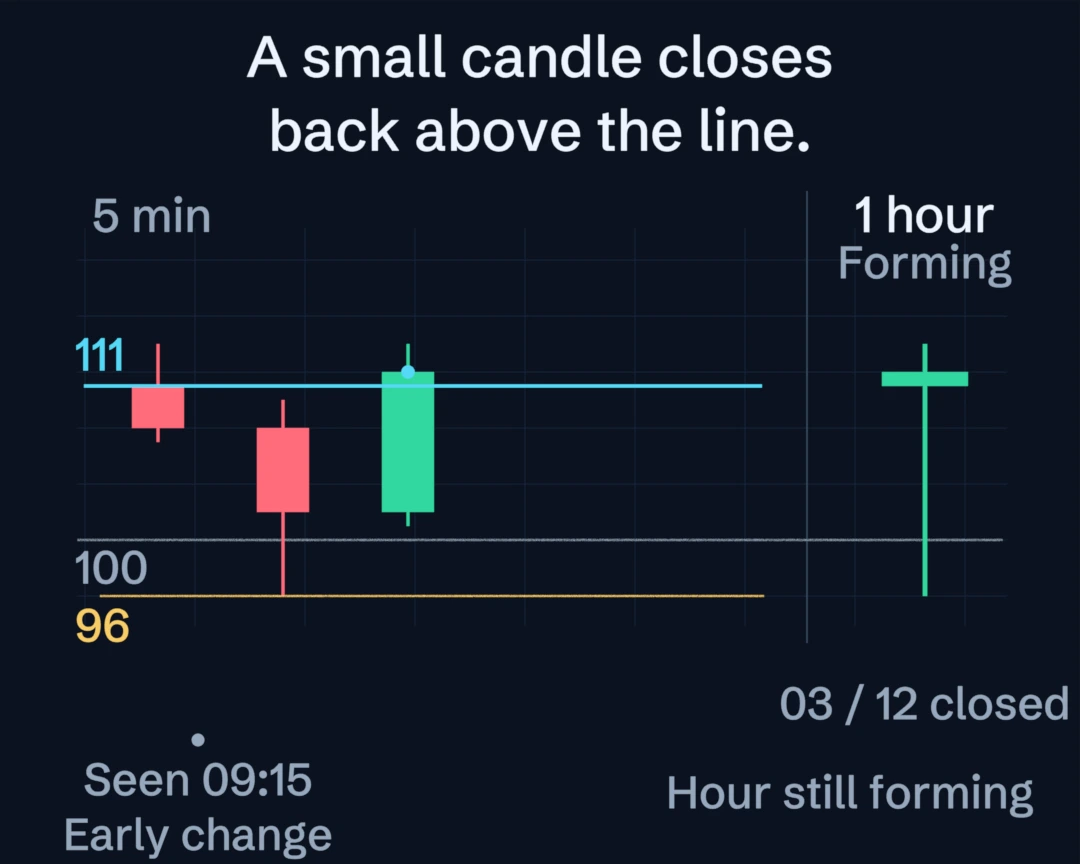
Audit · raw observations. Learn how candles connect. This short example does not earn a v2.1 delivery review.
Its thin line shows the high and low. The solid body joins the opening and closing prices.
Fictional prices. C1’s completed range is supplied; C2 uses only revealed candles. No orders or participants are inferred.
Focus shortlists records to study. You check the price area, larger direction and remaining objective. Review is not a buy or sell instruction.
Built from public TTrades material, trader feedback and research into three open-source projects. The numerical filters are disclosed choices; matching a paid indicator or improving returns has not been established.
Explore raw observations in Audit.
Audit · raw observations. These marks show what happened. Focus shows delivery reviews; none is earned by this short replay.
The completed 08:00–09:00 hour ranged from 100 to 136. C2’s first small candle stays inside. No sweep candidate exists yet.
This replay teaches raw observations. Its supplied C1 hour is not the earlier five-minute history needed for v2.1 volatility checks.
Steps skip quiet candles, not calculations. Later hours and decisions appear only when their inputs are known.
Record shown: the upward C2 from 09:00. Other detected setups remain independent. No record yet.
No v2.1 Lab submission is demonstrated here. Its default experiment requires a delivery review, not just a raw closure and CISD. A retest experiment additionally needs review before the retest bar; an earlier or same-bar first retest cannot qualify.
These configurable checks select records for manual assessment. They do not validate a complete trading model.
Path efficiency compares net travel from the wick extreme with the total path through closing prices; the extreme bar counts toward the 3-bar limit. Overlap is divided by the smaller hourly range. These are product heuristics, not a reference author’s exact rules.
Fictional continuous five-minute candles, automatic one-hour pairing, supplied completed C1 at 08:00–09:00. Later hourly prices use revealed candles. The unchanged raw core uses wick-origin projections and wick invalidation. C1’s hourly packet supplies no earlier five-minute ATR history. Delivery quality, congestion, IC children and Lab execution are not simulated. The raw lesson follows strict sweeps, body-series changes, newly known gaps, later overlap, opposing setups and retained records. It does not reproduce market data requests, session gaps, alerts or broker fills. Missing chart bars can delay observation of an hourly close.
CISD (change in state of delivery): a small candle closes beyond an opposing candle series’ opening price. FVG (fair value gap): space between the first and third candles’ ranges. Neither proves trader intent or a fill.
Start with Focus; inspect the sequence in Audit.
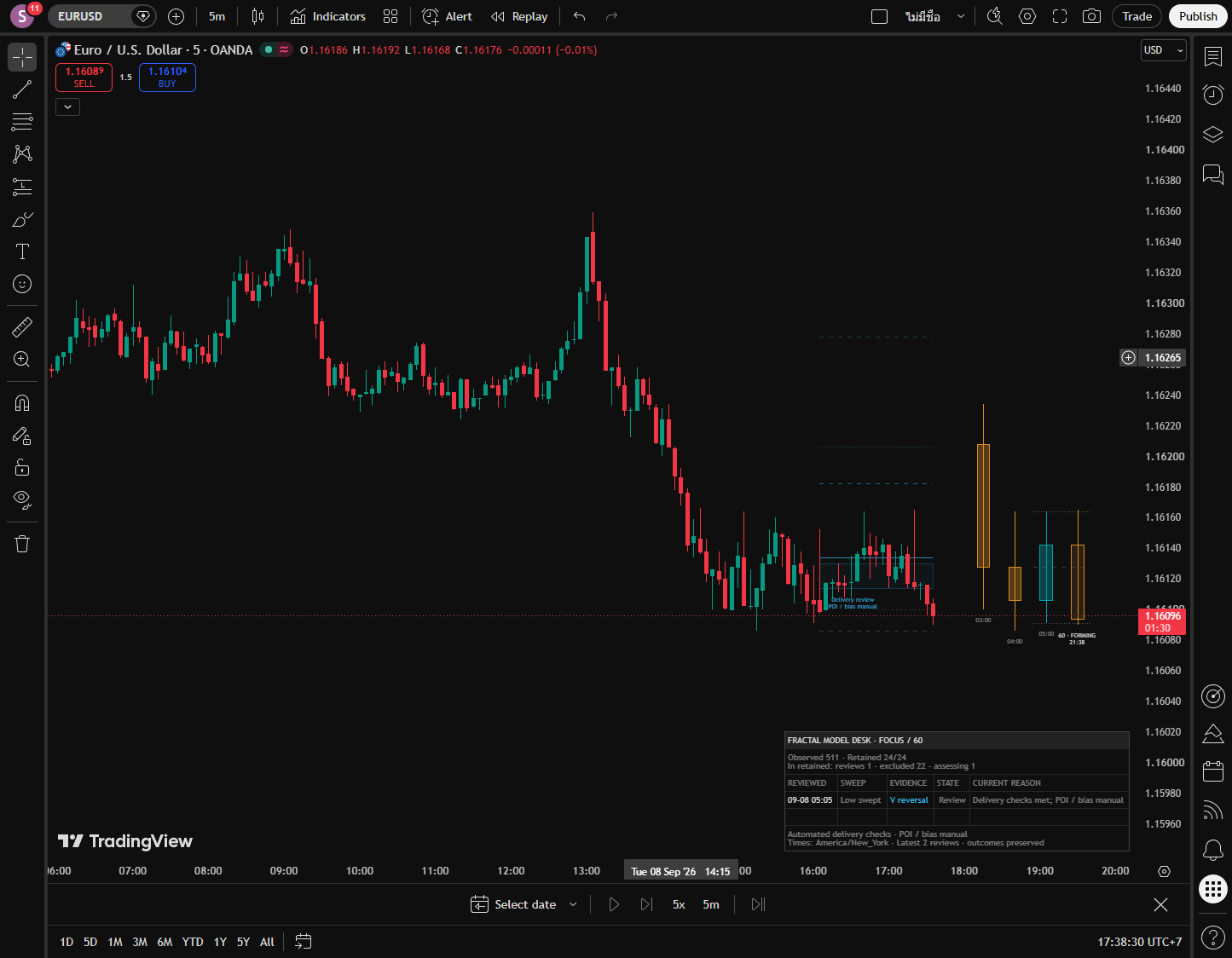
Two latest reviews, including later outcomes. Empty can be correct: read the reason.
Inspect sweeps, small-candle changes, hourly closes and failures. Hidden does not mean deleted.
Check the price area and larger direction. A delivery review is not complete model validation.
Complete Pine v6 source, in Pine Pro Library.
Start a new indicator on a standard five-minute TradingView chart.
Use the full Setup Atlas source. Automatic pairing selects one hour.
Hover a review for evidence. Inspect raw facts in Audit. Save Lab separately.
Focus/Audit, delivery reviews and independent IC history.
Copy the code as it is. No coding needed.
Tests review entries or later FVG retests. No IC trades.
Copy the code as it is. No coding needed.
Replace the whole script and recreate alerts. Defaults now use Focus, Latest review projections and Delivery review alerts. Webhook receivers must accept fm-desk-v2.1 and full_model_validation: false. Compare saved Lab settings with the new defaults; same-bar review/retest no longer qualifies. V1 grades and trade results remain historical.
Open the detail you need.
Five-minute charts automatically use one hour. All pairings appear in Settings below.
Use standard time-based candles. The larger interval must exceed the chart interval, with each chart candle wholly inside it. Boundary-crossing candles raise an error. The first partial larger interval is skipped.
C1 is the previous closed larger candle. A wick strictly beyond its low or high records a raw C2 candidate. No reclaim is required. One candidate per direction per larger candle is retained, including both on a dual sweep.
C2 closure needs its final close strictly inside the whole C1 range. Equality fails. Closure and CISD remain separate raw facts; neither alone qualifies for delivery review.
A larger close becomes known at the next interval’s first confirmed small-candle close. On 5m / 1h, C2 ending at 10:00 is recorded at 10:05, or later after a session gap.
Markers use observation time. In Audit, the dotted C1 reference points back to its source candle; Focus starts it no earlier than review. Atlas FORMING is a live preview, not confirmation; the Lab preview updates at chart-bar close.
The opposing candle series behind the extreme supplies its opening-price line. A confirmed small candle closes strictly beyond it. Dojis end a series; only a new strict C2 extreme can update a pending anchor.
First CISD freezes the line, extreme and projection leg. Its delivery quality is also measured then using prior volatility. A later strong candle cannot improve weak or missing evidence. A strict extreme breach records failure without erasing the earlier observation.
After failed C2 closure, bullish C3 can still hold C2's wick low and close above both C2 body prices; bearish mirrors it. This fallback is a declared implementation rule.
C3/C4 name stages, not entries. Strong C3 closes directionally beyond C2's range. C4 completion ends the observation window, not a broker position. New parent CISD cannot first confirm in C4.
After closure, a strict breach of fixed C2 extreme invalidates structure: wick by default, close optionally. Equality survives. Confirmed lines and observation times remain in the record.
A review can become Withdrawn or Complete without losing its original evidence. These are review states, not losses or wins. Focus selects two by original review time; Audit shows five recent raw records.
Raw history defaults to 24, adjustable 8–40. Oldest completed records are evicted first; developing records are protected. IC has a separate 24-record history, with active/current-frame overflow protected.
No. A raw FVG is the first new three-candle gap after known, unfailed CISD, starting no earlier than the tracked extreme. Audit begins its box at detection; Focus starts it no earlier than review. A retest needs a later overlapping candle.
Parent delivery review does not require an FVG. The limited IC-review route does. A gap or overlap proves neither trader intent nor a limit fill.
Closure and CISD must belong to the matching larger candle, with enough prior volatility history. The first CISD needs a decisive close and either a quick, direct V reversal or a strong directional candle.
Repeated overlapping ranges, dual sweeps, failed structure or a spent objective can block review. Thresholds are our adjustable heuristics. A first CISD without 14 prior chart bars is Excluded; later data cannot repair that frozen measurement. A review still leaves POI and bias to you.
IC follows a pullback inside C3/C4 of an already-reviewed parent. It has its own ID, opposing-leg opening level and protected three-candle swing. It never moves the parent anchor.
IC anatomy needs an opposing leg through the current larger-candle open, a later close back through that leg’s open, and a swing already confirmed by its right neighbor. IC review also needs a parent FVG already known when the touch bar opens, plus displacement. A same-bar new gap or later touch cannot improve earlier anatomy.
One IC attempt starts per parent per C3/C4 frame, even without an FVG; its confirmed swing must remain the pullback extreme. Attempts end with the frame or parent review. This does not cover every POI model. A protected-swing breach records a child outcome separately. Focus shows two IC reviews; Audit can show two formed anatomies. The Lab does not trade them.
No. It records a sweep/reclaim of an already-known local pivot before the outer candidate. It neither establishes anyone’s intent nor gates delivery review. IC protected-swing failure is also separate from parent invalidation.
Origin + direction × multiple × frozen leg. The 1 / 2 / 2.5 / 4 labels are price-leg multiples, not standard deviations or promised targets. The 1× line equals CISD.
For CISD 110, wick 100 and opposing-series extreme close 104: Wick gives 110 / 120 / 125 / 140; Body gives 110 / 116 / 119 / 128. Invalid geometry is not rescued with an absolute value.
Latest review can select an ended record. Focus never starts its displayed levels before review became known. An old projection is not a current entry.
Delivery review acts on a new qualifying review. FVG retest after review requires a later retest event with the review already known when that retest bar opens. A first retest before or in the review bar is skipped; no replacement retest is invented.
Both need active review, paired intact structure, unfailed CISD and an available C1 opposite-extreme target. IC children are not traded. One position and one submission per calculation are allowed. These restrictions never hide Atlas observations.
Stop uses fixed C2 extreme plus tick padding. Target uses the opposite C1 extreme; there is no 2R fallback. Spent or behind-entry targets and invalid distances are skipped. The entry submits its stop/limit bracket immediately. C4 completion does not itself close a broker position.
Audit shows neutral raw observations. Match IDs and observation times across the ledger and chart; Times uses the exchange timezone. FORMING is a live preview, never a review.
Focus instead selects the latest two reviews, including withdrawn/completed ones. Display filtering preserves engine history. Latest review projections can therefore belong to an ended review.
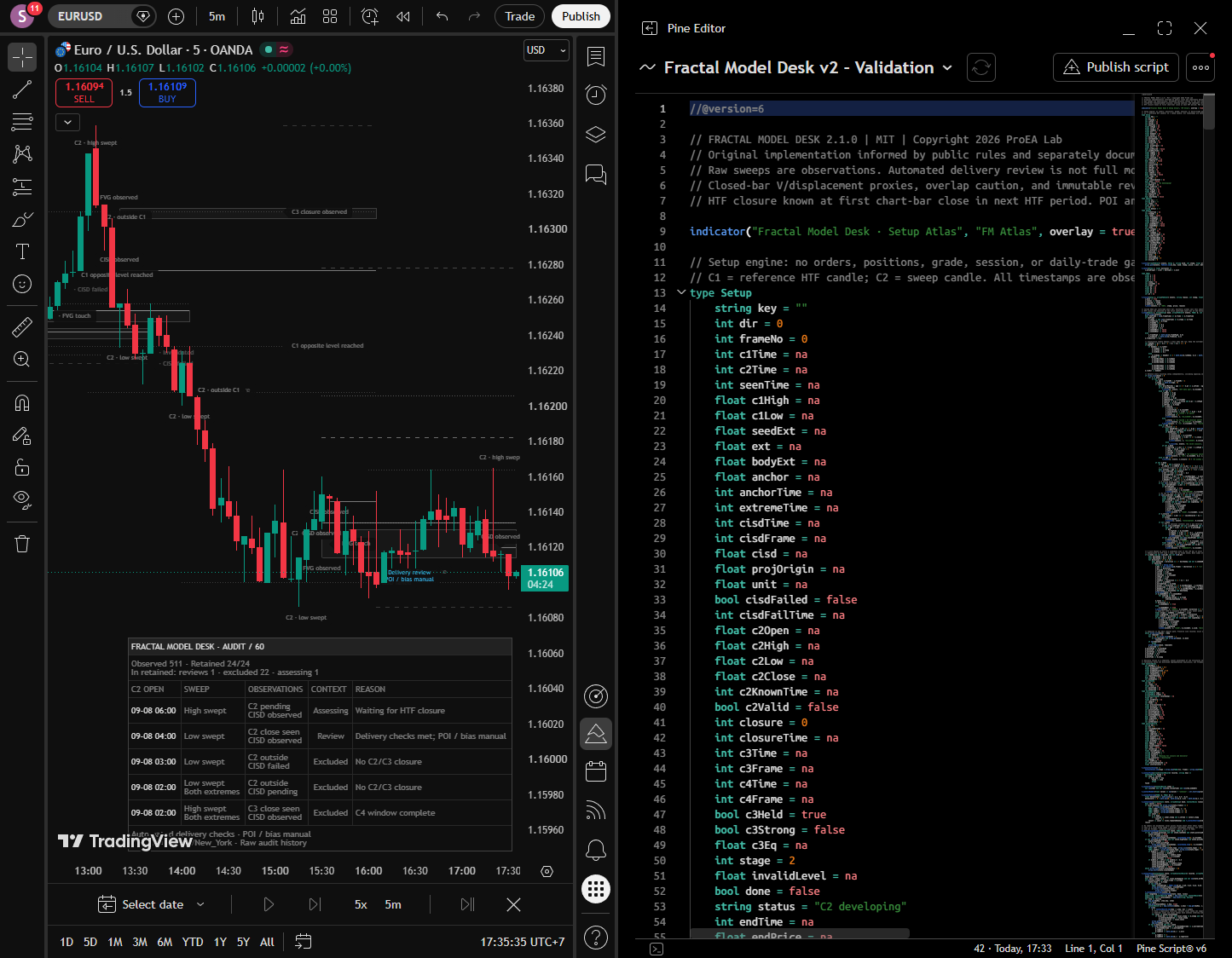
All 26 Setup Atlas inputs are also in Strategy Lab, with identical defaults. The Lab adds two controls. Exact TradingView names appear below each explanation.
Use standard time-based candles. Each chart candle must fit completely inside one strictly larger candle.
Recreate alerts for fm-desk-v2.1. Both formats follow Event stream; full_model_validation remains false.
Declared heuristics, not a commercial formula. Parent review accepts V reversal OR displacement. Evidence freezes at the first CISD; later candles cannot improve weak evidence. Prior ATR14 needs 14 earlier samples; missing history excludes that observation.
Orders use active parent reviews, never IC children. Raw records stay unchanged. One position maximum; point of interest and higher-timeframe bias remain manual.
Display controls preserve records. Forming previews move; confirmed anchors stay fixed for unchanged input data.
The tool skips a partial first larger candle. It observes each completed larger candle at the first confirmed chart close of the following interval.
These are the shipped broker-experiment defaults, separate from script Inputs. Saved Properties can override them. A setup ending does not close a Lab position; its fixed broker bracket continues independently.
Delivery review is the default stream: delivery/IC reviews and later outcomes. All observations also includes neutral raw facts and IC anatomy. Enable JSON batches and create Any alert() function call.
The schema is fm-desk-v2.1 with scope and full_model_validation: false. IDs, observation times and evidence travel with each event. Update old receivers and recreate alerts. Named alert conditions are indicator-only; Lab broker notifications are separate.
The producer's release evidence records 228/228 native Pine assertions across 50 fixtures: core 91, delivery/context 86 and IC 51. Its build/package tests passed 18/18. Both scripts and three probes compiled without errors or warnings.
Market smoke checks, prefix tests and same-history reconstruction have documented limits. No native five-minute Bar Replay or paid-indicator parity pass is claimed. These checks establish neither trading accuracy nor profit. Read the evidence and its limits.
The Lab's 10% equity position size is allocation, not stop-loss risk. Review costs, Properties and emulator fills separately.
POI means the price area you choose to study; bias means your larger directional view. Both remain manual, alongside the objective and trade risk. Review is not full model validation.
Published research informed these disclosed heuristics, not a recovered proprietary formula. Settings, feeds and loaded history can change recalculation. No blanket repaint or paid-indicator parity promise is made. Read the three-project source audit.
Use standard 5m / 1h and default Focus. Read one review's evidence, then compare its raw sequence in Audit. An empty Focus view can be correct. Learn the separate entry and cost rules before experimenting with the Lab.
What shipped and what changed in Fractal Model Desk, newest first. Ask for the next change below; what gets built lands here with a date, and on the lab queue on the front page.
Focused reviews, with the full audit history v2.1.0 Updated Fractal Model Desk
Focus highlights two delivery reviews; Audit keeps raw observations visible. Separate quality and IC checks explain what passed, waited or ended.
Historical v2.0.0 setup history and separate Lab Lab note Fractal Model Desk
V2.0 introduced separate closure, CISD and retained failures. Its original Lab rules and verification remain historical; current downloads serve v2.1.
Fractal Model Desk v1.1.0 Shipped
Connects a larger candle's reversal to an entry on smaller candles.
Historical v1.1.0 model and strategy twin Lab note Fractal Model Desk
The original v1.1.0 shipped CISD, formation tags, grades and projections. Its rules and measurements are historical; current downloads serve v2.1.
A small friction or a big idea. Tell us what would make this tool work better for you.
Requests for a new tool go on the same queue: see what is asked for and what is being built.