Apex evaluation rules at a glance
EOD and Intraday evaluations share the target, the drawdown, the contract limit and the clock. Only the daily loss limit differs.
| Account | Profit target | Max drawdown | EOD daily loss limit | Max contracts | Access |
|---|---|---|---|---|---|
| $25,000 | $1,500 | $1,000 | $500 | 4 (40 micros) | 30 days |
| $50,000 | $3,000 | $2,000 | $1,000 | 6 (60 micros) | 30 days |
| $100,000 | $6,000 | $3,000 | $1,500 | 8 (80 micros) | 30 days |
| $150,000 | $9,000 | $4,000 | $2,000 | 12 (120 micros) | 30 days |
Both pages list consistency and scaling as "Not Applied." The Intraday evaluation has no daily loss limit: "Risk control is enforced entirely through the real-time trailing threshold."
Sources, checked 2026-10-22: EOD Evaluations, Intraday Trailing Drawdown Evaluations, Position Sizing – Evaluation.
EOD or Intraday evaluation: what's different?
How the threshold moves, and whether there's a daily loss limit. Everything else is the same, and the Performance Account (PA) you can activate afterwards keeps your evaluation's type.
| EOD evaluation | Intraday evaluation | |
|---|---|---|
| The threshold follows | your highest close, set at 4:59:59 PM ET | your highest balance, open profit included, in real time |
| Enforced | in real time, from the next session | in real time |
| Daily loss limit | $500 / $1,000 / $1,500 / $2,000 | none |
| Trailing stops | at the target balance on Rithmic and Wealthcharts; never on Tradovate | the same |
| The PA you can activate | an EOD PA | an Intraday PA |
On an Intraday evaluation a trade that runs up and gives it back costs room even if it closes green, because the threshold rose with the open high. How far, with worked days on both types, is in Apex trailing drawdown.
Sources, checked 2026-10-22: EOD Drawdown Explained, Intraday Trailing Drawdown Explained, PA Activation Process & Deadline Explained.
How do you pass an Apex evaluation?
Reach the profit target and never touch the threshold. "There is no minimum number of trading days required. You may pass as soon as the profit target is reached, provided all rules are respected."
- Review at the close. Reach the target and "your account is reviewed at market close (4:59:59 PM ET). If approved, the Evaluation is marked as Passed after 6 PM ET."
- Then it locks. "As soon as an Evaluation from the new products is marked as Passed, it is automatically locked to prevent any additional trading."
- The last day counts. "As long as your account meets the target profit before the market close on the date of expiration," it's marked Passed that evening.
How many trades your target takes at your own risk and reward is what the profit target calculator works out.
One invented 50K EOD evaluation
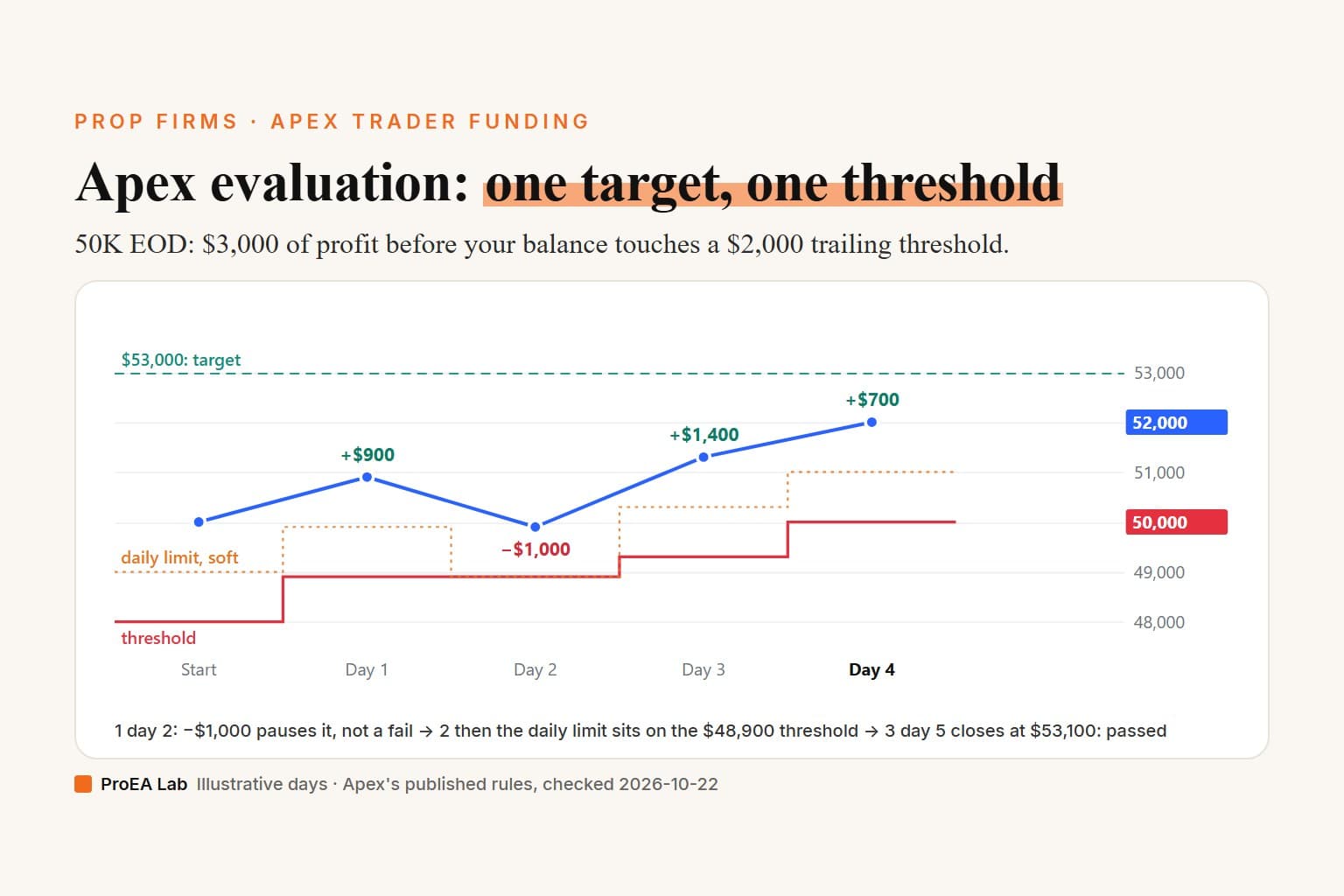
Five made-up days. The threshold is $2,000 under the highest close; the daily loss limit sits $1,000 under each session's starting balance.
| Day | P&L | Close | Profit | Threshold after the close | Daily loss limit next session | Room to the threshold |
|---|---|---|---|---|---|---|
| 1 | +$900 | $50,900 | $900 | $48,900 | $49,900 | $2,000 |
| 2 | −$1,000, limit hit | $49,900 | −$100 | $48,900 | $48,900 | $1,000 |
| 3 | +$1,400 | $51,300 | $1,300 | $49,300 | $50,300 | $2,000 |
| 4 | +$700 | $52,000 | $2,000 | $50,000 | $51,000 | $2,000 |
| 5 | +$1,100 | $53,100 | $3,100 | passed at the close | — | — |
Day 2 hits the daily loss limit. Apex flattens the account and pauses it for the session, and "Your account remains active." The threshold doesn't move on a losing day.
But look at day 3's starting position. The daily loss limit sits at $49,900 − $1,000 = $48,900, the same price as the threshold. A $1,000 loss would touch the threshold, which fails the evaluation, before the daily limit could pause it. Day 3 went the other way, and day 5's $53,100 close clears the $53,000 target.
Once your room to the threshold is no bigger than the daily loss limit, the daily limit can't save the evaluation.By day 4 the threshold has reached the $50,000 starting balance. In an evaluation it keeps rising from there: on Tradovate without end, on Rithmic and Wealthcharts until it reaches the $53,000 target balance.
Sources, checked 2026-10-22: EOD Evaluations, Evaluation Plan Fees and Access Explained, PA Activation Process & Deadline Explained, Daily Loss Limit Explained.
How many contracts can you trade in an Apex evaluation?
4, 6, 8 or 12 by size, from the first trade. "This limit applies across all instruments and all open positions combined," and "ten (10) micro contracts equal one (1) standard contract."
On a 50K that's 6 contracts: Apex's own examples include 60 micros, "2 ES contracts and 4 NQ contracts," and "50 MES and 10 MNQ." The limit is fixed for the whole evaluation. Going over it isn't a breach: "If an order exceeds your maximum allowable exposure, it will be automatically rejected and it will not count as a rule violation."
How many contracts a given stop allows inside that cap, for the dollars you plan to risk, is what the futures position size calculator works out.
Source, checked 2026-10-22: Position Sizing – Evaluation.
The 30-day clock, and no resets
An evaluation is a one-time fee for 30 calendar days. "The 30 calendar days run continuously, including weekends and holidays, and they are not based on trading days." It "expires automatically at 6:00 PM ET on Day 30."
- No extensions, no resets. "There are no reset options," and "There are no reset fees." A failed or expired evaluation is closed, and "your current balance does not carry over." You buy a new one.
- No subscription. "The fee is not a subscription and does not renew," so there's nothing to cancel.
- Bundles share one clock. Five evaluations bought as a 5-pack "share the same 30-day access period," counted from the bundle's purchase date.
Sources, checked 2026-10-22: Evaluation Plan Fees and Access Explained, Evaluation Bundle (5 Pack).
What fails an Apex evaluation, and what doesn't
Touching the threshold fails it. "If the EOD Threshold is touched at any time, the evaluation fails," and on an Intraday evaluation a breach is "immediately failed" too, open losses included.
- Prohibited activity. "You may not pass Evaluation Accounts by hedging them against each other." Apex's prohibited list also bans "Stockpiling Evaluation Accounts" to cycle through, and holding positions through the close: be flat before 4:59 PM ET.
- Not a failure: the daily loss limit. "Reaching DLL pauses trading for the remainder of the session. Your account remains active." The trading day resets at 6:00 PM ET.
- Not a failure: too many contracts. The order is rejected.
- Not a failure, but the end: day 30. The evaluation expires; it isn't marked failed, but nothing carries over.
Sources, checked 2026-10-22: EOD Evaluations, Intraday Trailing Drawdown Evaluations, Prohibited Activities, Futures Trading Times.
After you pass: activating the Performance Account
You get one PA of the same size and type. "You have 7 calendar days from the moment the Evaluation is marked as Passed to complete the PA Activation Fee," and if you miss it, "the activation opportunity expires and cannot be reinstated." Passing on day 30 still gives you the full 7 days.
The fee is one-time and non-refundable. On a No Activation Fee evaluation, "the total price to activate the PA is set at $0"; it otherwise follows the same rules, drawdown, access period and qualification. Apex's help center prints no fee amounts; what the home page's picker showed is in Apex PA account rules.
The PA keeps your drawdown amount and type, with the threshold starting again $2,000 under the $50,000 start on a 50K, and adds what the evaluation leaves out: contract and daily-loss tiers that move with profit, a threshold that stops at the start plus $100, 5 qualifying days per payout and a 50% consistency rule (Apex's consistency rule). Payouts are in Apex payout rules.
Sources, checked 2026-10-22: PA Activation Process & Deadline Explained, No Activation Fee Evaluations.
The Legacy evaluation Apex is selling again
Apex retired its old evaluations on March 1, 2026, and its home page now says "Legacy Accounts Are Back," "Available only while the promotion lasts." A Legacy evaluation follows its own page, edited 2026-10-15, and differs on almost every line.
| 50K | Current EOD or Intraday evaluation | Legacy evaluation |
|---|---|---|
| Trailing drawdown | $2,000 | $2,500, on the highest live balance |
| Max contracts | 6 | 10 |
| Minimum trading days | none | 7, unless a 1-day-pass promotion applies |
| Daily loss limit | $1,000 on EOD; none on Intraday | none |
| Billing | one-time fee, 30 days | monthly, "for as long as you need the evaluation account" |
| Resets | none | "as many times as necessary" |
The Legacy page asks that "Your balance must close at or above the profit goal," and a passed Legacy evaluation can only become a Legacy PA, which has the 30% consistency rule.
Sources, checked 2026-10-22: Legacy Evaluation Rules, Legacy Products Overview, Apex's home page.
Prices
Apex's help center prints no prices: "Current pricing can be viewed directly from the product selector during checkout." On 2026-10-22 the home page's banner read "90% OFF ALL EVALS!" with a coupon code. We don't reprint list prices that move with promotions; check the total at checkout.
Source, checked 2026-10-22: No Activation Fee Evaluations, Apex's home page.
Where Apex's pages disagree
- Where an Intraday evaluation's threshold stops. The Intraday explainer's main text: once the high reaches the "Profit Target Balance + Max Drawdown." Its FAQ: "Profit Target Balance + $2,000." The same on a 50K ($55,000), not on the other sizes. Either way it's above the target, where the evaluation has already passed.
- Can you still buy a Legacy evaluation? The Legacy Products Overview: "as of March 1st, 2026, Legacy evaluation accounts are no longer available for purchase to anyone." The home page, edited later, sells them again.
Not published
- Prices and activation fees, in the help center.
- Whether profit toward a current evaluation's target is counted after commissions. The Legacy evaluation page says its profit goal is.
- Whether a balance that touches the target during a session, then closes under it, has passed. Apex says you "may pass as soon as the profit target is reached" and that the account "is reviewed at market close"; neither line settles it.
- How many discounted evaluations count as "Stockpiling Evaluation Accounts."
Where we sit
We don't run a prop firm, we're not affiliated with Apex, and we earn nothing if you buy an Apex evaluation. We sell the Prop Firm Challenge Toolkit, a TradingView indicator that turns rule numbers you enter into dollar buffers on your chart. It has no Apex preset, so use its Custom rules. For a 50K evaluation:
| Toolkit setting (Custom) | 50K Apex evaluation | From |
|---|---|---|
| Profit target % | 6 | $3,000 of $50,000 |
| Max loss % | 4 | $2,000 of $50,000 |
| Drawdown mode | Trailing EOD, or Trailing Intraday | your evaluation type |
| Daily loss % | 2 on EOD, 0 on Intraday | $1,000 of $50,000 |
| Daily limit is soft | On | paused for the session, not failed |
| Min trading days | 0 | none required |
| Consistency % (0=off) | 0 | "Not Applied" |
| Trailing DD locks AT initial balance | On | stops trailing at $50,000 (below) |
| Reset timezone, hour | America/New_York, 18 | the 6:00 PM ET reset |
Where it differs from Apex, plainly. The Toolkit stops trailing at your starting balance; an Apex evaluation keeps trailing past it, so once your high passes $52,000 the Toolkit shows more room than you have. It doesn't read Apex's dashboard: you type the balance in, and the high it trails is the balance you type, so after a pullback from a higher close its floor sits under Apex's. Read Apex's threshold off your dashboard. It takes the daily limit as a percentage of the balance you type, which it treats as the day's start, so on a $51,000 morning 2% is $1,020, not Apex's fixed $1,000. It can't see losses you've already closed today: keep Current balance at the session's starting balance and put the day's running P&L, closed and open, in Open floating P/L.
Sources and their last edits
Each page was read on 2026-10-22. Dates are the pages' own last-modified stamps (UTC).
- EOD Evaluations, 2026-06-05; Intraday Trailing Drawdown Evaluations, 2026-04-28; Position Sizing – Evaluation, 2026-04-15.
- EOD Drawdown Explained, 2026-04-28; Intraday Trailing Drawdown Explained, 2026-10-12; Daily Loss Limit Explained, 2026-04-15.
- Evaluation Plan Fees and Access Explained, 2026-06-25; Evaluation Bundle (5 Pack), 2026-06-05; No Activation Fee Evaluations, 2026-06-05; PA Activation Process & Deadline Explained, 2026-04-15.
- Prohibited Activities, 2026-07-31; Futures Trading Times, 2026-04-20.
- Legacy Evaluation Rules, 2026-10-15; Legacy Products Overview, 2026-07-21; Apex's home page, 2026-10-15.
Disclosure
The evaluation above uses invented days and Apex's published rules. It isn't a forecast, and it doesn't say whether an Apex evaluation is worth buying. Apex's dashboard decides your pass, not this page. If a number here no longer matches Apex's pages, email support@pulltrade.app and we'll correct it in public.
Frequently asked questions
What are the Apex evaluation rules?
Reach the profit target ($1,500, $3,000, $6,000 or $9,000 on 25K to 150K) within 30 calendar days, without your balance touching the trailing threshold, which sits $1,000 to $4,000 under your highest balance. EOD evaluations also have a daily loss limit that pauses you for the session. There's no minimum number of days and no consistency rule, and you can't trade more than 4, 6, 8 or 12 contracts.
Can you pass an Apex evaluation in one day?
Yes. Apex's EOD and Intraday evaluation pages both say there's no minimum number of trading days and you may pass as soon as the profit target is reached. The account is reviewed at the market close, 4:59:59 PM ET, and marked Passed after 6 PM ET.
How many contracts can you trade on an Apex 50K evaluation?
6 contracts, or 60 micros, since 10 micros count as one contract. The limit covers all instruments and open positions combined, so 2 ES and 4 NQ is the full 6. It doesn't grow with profit, and an order over it is rejected without counting as a rule violation.
Does the Apex evaluation have a daily loss limit?
Only the EOD evaluation: $500, $1,000, $1,500 or $2,000 by size. Hitting it liquidates your positions and pauses trading for the session, and the account stays active. The Intraday evaluation has no daily loss limit; only its trailing threshold limits losses.
How long do you have to pass an Apex evaluation, and can you reset it?
30 consecutive calendar days from purchase, weekends and holidays included; the evaluation expires at 6:00 PM ET on day 30. There are no extensions and no resets: a failed or expired evaluation is closed, and trying again means buying a new one. Only Legacy evaluations can be reset.
Is there a consistency rule in the Apex evaluation?
No. Apex lists consistency as Not Applied on both evaluation types, and scaling too. The 50% consistency rule starts in the Performance Account, where it applies to payout requests.
What happens after you pass an Apex evaluation?
The evaluation is locked against further trading, and you have 7 calendar days from being marked Passed to pay the one-time Performance Account activation fee, or $0 on a No Activation Fee evaluation. Miss the window and it can't be reinstated. The Performance Account has the same size and drawdown amount and type, starting again from its starting balance, plus scaling tiers and payout rules.