Opening Range Desk Pro · for TradingView
Know which opening range is worth your attention before it breaks.
Pro grades every setup A, B or C on three conditions opening-range traders look for. It lists your markets with the ones in play at the top, marks the next key level in your way, takes half off at TP1 and moves the stop to the entry, and sends the whole plan to your phone the moment it happens.
What Pro adds
- Setup grade A · B · C
- Eight markets, in play first
- Key levels with room
- Half off at TP1
- The whole plan in every alert
- Strategy Lab and Research Lab
USD 49 one-time · not a subscription · included in Academy Premium and the Complete Suite · Pine v6 · personal-use licence

The same simulated sessions with Pro on the chart: key levels, today's grade, a graded entry, the alerts it sends and half off at TP1. Switch to Free desk to see the same candles with the free indicator. The candles are simulated, not market data; the rules, grades and wording are the indicator's own, with a risk of 250 per trade. Session 1 is the first simulated session whose trade reaches TP1; the next sessions follow in order, whatever they did.
Read as text
Every setup, graded.
Three conditions, counted the moment the range is set:
- In play: is there real volume behind this open? The opening range's volume against its own 20-session average.
- Size: is the range a normal size for this market, not a wide one that puts the stop far away?
- Early: does the break come early in the session, while the open is still driving the market?
All three is an A, two is a B, one or none is a C. The grade sits on the chart at every entry, in the panel from the moment the range is set, and in every alert. Your report card shows how each grade has done on your own chart, so you learn which setups suit your market. A grade counts conditions; it is not a promise.
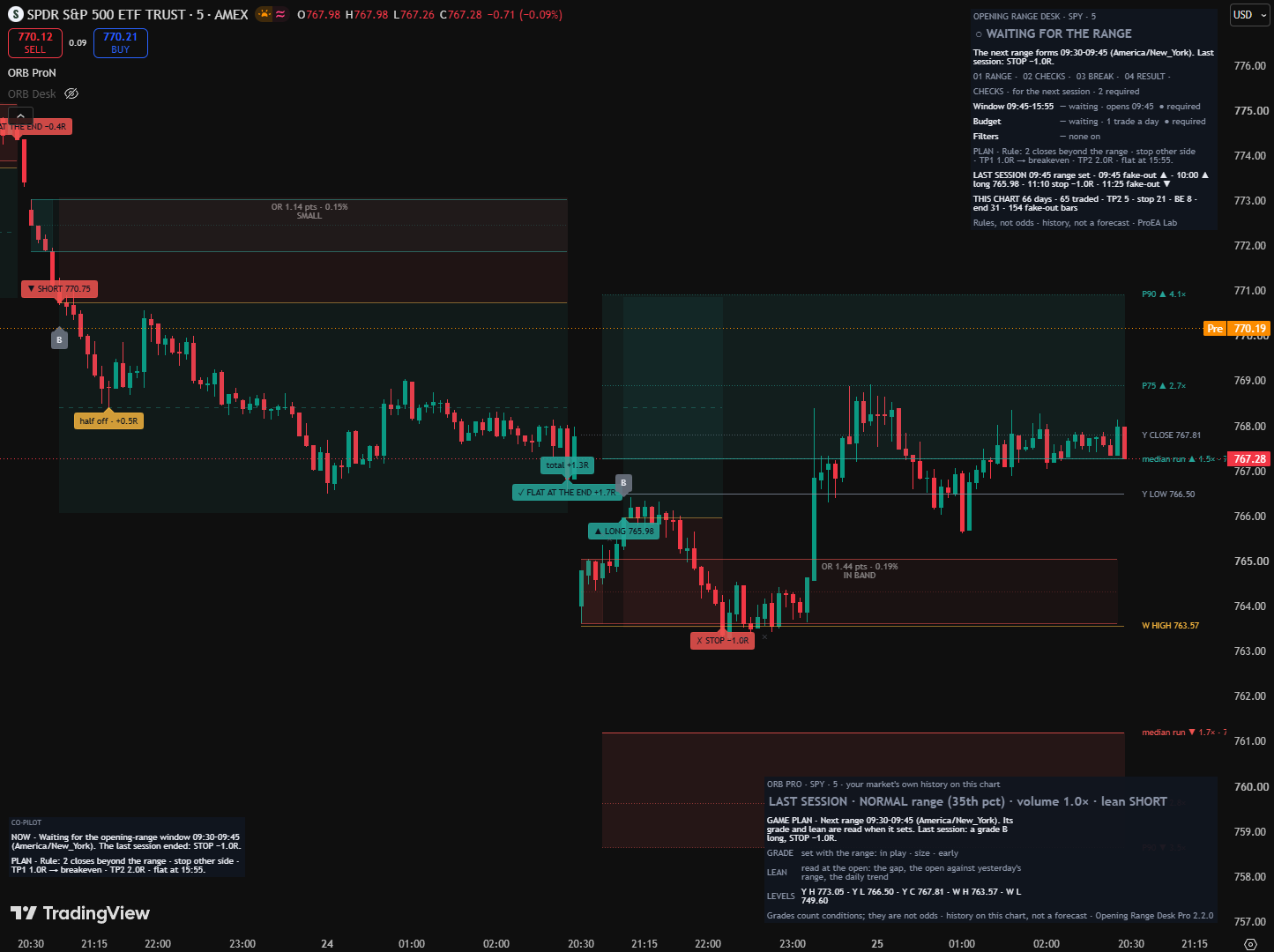
Bank half at TP1.
The free desk holds the whole position to the end, so a trade that reaches TP1 and comes back to the entry is recorded as breakeven. Pro takes half off at TP1 and moves the stop to the entry: the same trade ends with the half it banked. The other side of the same choice: when a trade runs all the way to TP2, the half you banked is the half that did not run. Switch the replay above between Free desk and Pro on session 1 to watch both.
| After the entry, the trade… | Free desk · the whole position | Pro · half off at TP1 |
|---|---|---|
| reaches TP1, then comes back to the entry | 0.0R | +0.5R |
| reaches TP1, then is flat at the end at +1.4R | +1.4R | +1.2R |
| runs to TP2 | +2.0R | +1.5R |
| stops out before TP1 | −1.0R | −1.0R · nothing to bank yet |
Your markets, in play first.
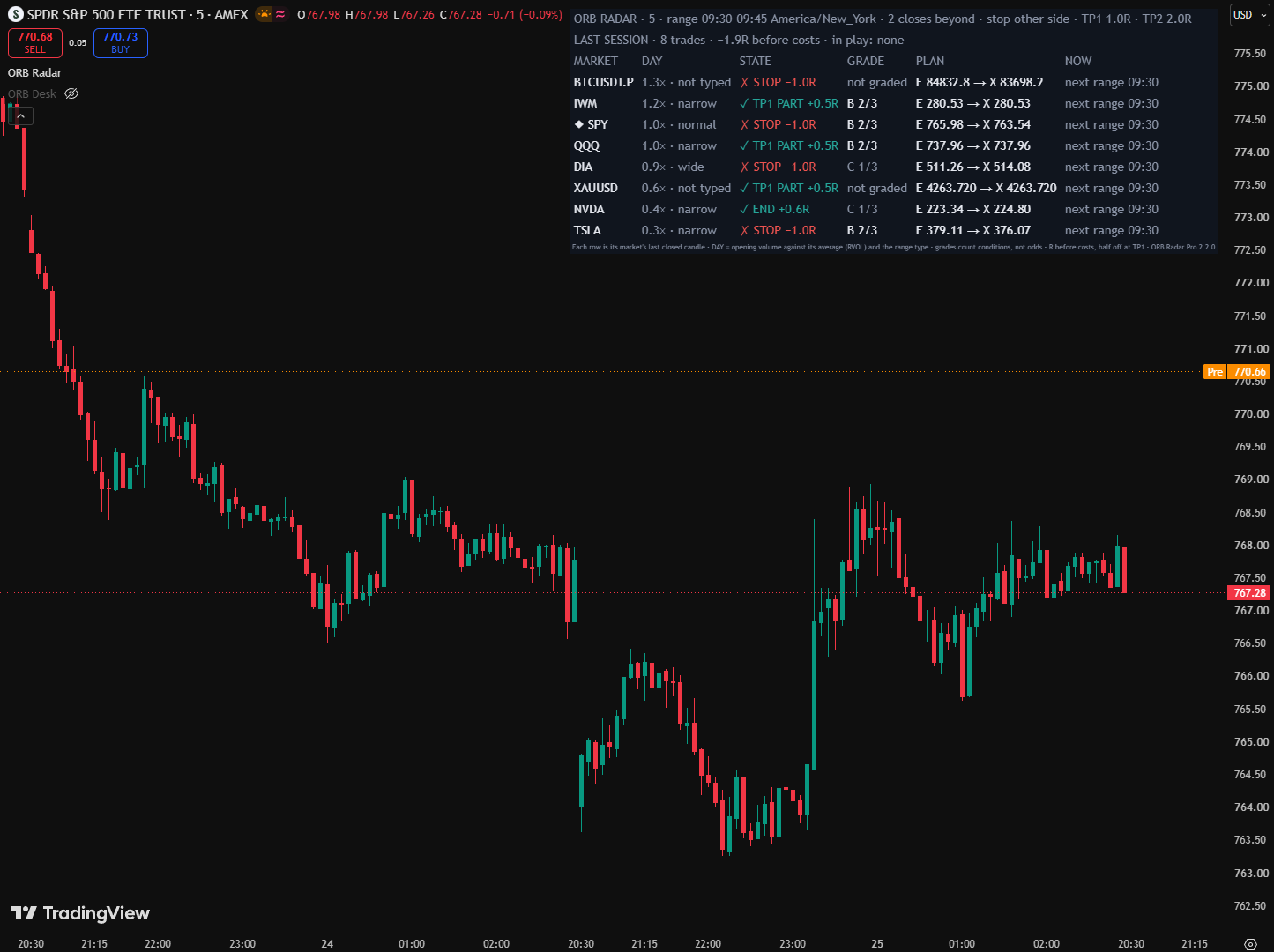
At 09:30 the move you wanted happens on the chart you were not watching. ORB Radar Pro runs the desk's rule on up to eight markets at once and lists them by how busy their open is, so the markets that are in play come first. Each row shows the setup grade, the plan and the next step, and each market sends its own alerts. A daily guard pauses new-entry alerts once the day's closed trades reach the loss you set. Every row is its market's last closed candle, so nothing on it can be taken back by a candle that is still forming.

| Market | Day | State | Grade | Plan | Now |
|---|
Eight simulated markets on the Radar's own rows, one table per five-minute candle: at 09:45 the ranges set and the busiest opens move to the top. Simulated candles, not market data; R before costs, with half off at TP1, as the Radar shows it. A grade counts conditions; it is not a forecast. The first session shown is the first simulated one with a market in play; the next ones follow in order.
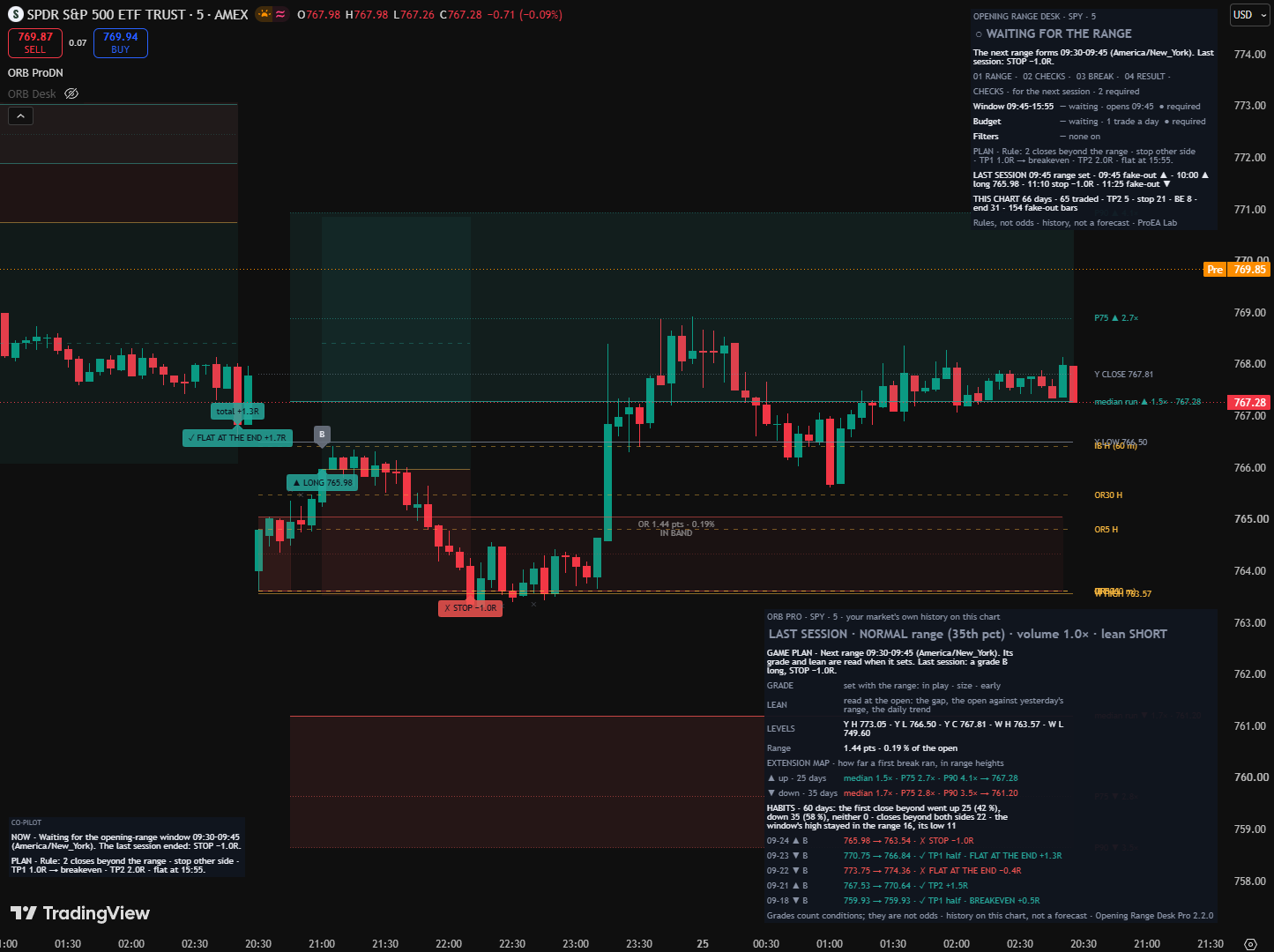
The day in plain words.
- Game plan: before the open, what to watch; once the range is set, today's grade and why, what a long and a short would run into, and the day's lean; in a trade, how far it is to the next level and to the target.
- Key levels and room: yesterday's high, low and close, the overnight range and last week's high and low, and the distance to the next one in R.
- The day's lean: the gap, where the day opened against yesterday's range, and the daily trend, read as one lean.
- The extension map: how far first breaks have run on this market, drawn from today's range as a band.
- Position: the size for your risk; in a trade, what is left after TP1, what the half banked, and the open R and cash.
The plan on your phone.
One alert on the indicator sends every event as it happens:
- the range;
- a heads-up on the first close beyond it;
- the entry, TP1 with what came off, and the exit.
Each message carries the whole plan: entry, stop, both targets, the size for the risk you set, the setup grade and the next key level. Choose "grade B or better" and only the setups you want reach you. The included relay posts each one to Discord or Telegram as one line, like the phone here: the replay's first session, in the relay's own words.
- RANGE_SET: the range, the day type, the opening volume and today's grade.
- BUILDING: the close that would enter, the grade and the next key level.
- ORB_LONG / ORB_SHORT: entry, stop, both targets, the size for your risk, the grade and the room to the next level.
- TP1: what came off, what it banked, and the stop moved to the entry.
- EXIT: how the trade ended and its R after the estimated cost, with any half banked at TP1 counted in.
The same entry as the indicator's full Text message:
Opening Range Desk Pro · SIM INDEX 5 · ORB_SHORT SHORT · entry 536.23 · SL 539.60 · TP 532.86 / 529.50 · grade B 2/3 · next W LOW 512.15 (7.2R) · size 74 for 250 risk · OR 536.75–539.51 · wide day · volume 2.2× · lean neutral · close-through
Simulated values, the indicator's and the relay's own wording. Alerts never place orders.
Test it on your market.
- Pro Strategy Lab: take only A setups, or B and better. Trade only some day types, gaps or opens. It takes the same share off at TP1 as your desk. Its table puts the desk's result next to TradingView's own fills after your broker's costs, so you see what a choice really does on your market.
- Research Lab: years of verified Binance data and a written-first way to test your own ideas, plus a trade-by-trade check of TradingView's log against the engine.
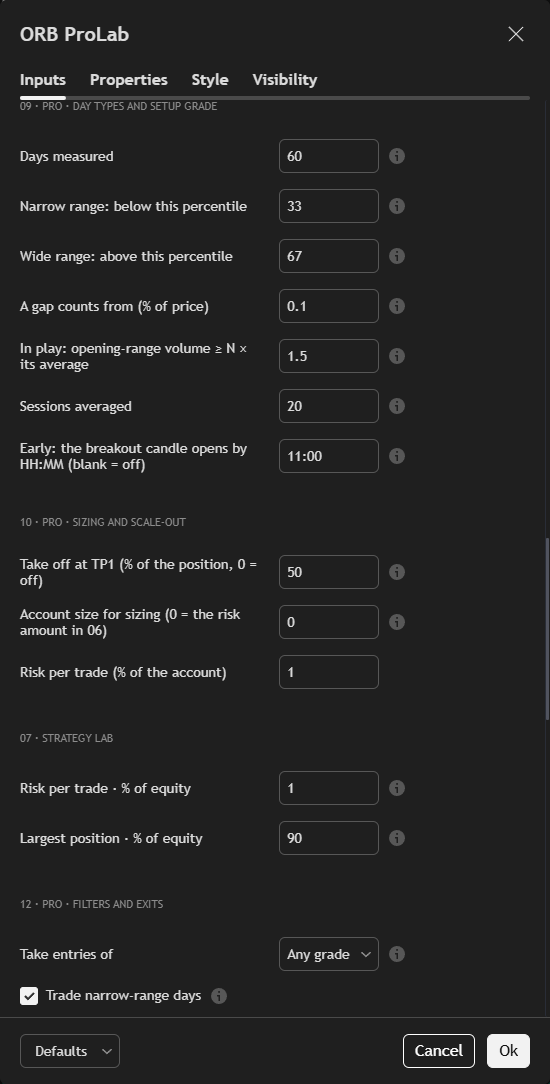
Build on it with AI.
Open the folder in Claude Code, Codex, Cursor or Windsurf and ask in plain words: "move the table", "add a market", "only alert me on grade A". The kit tells the agent the rules, the invariants and how to check a change.
What you get.
- Opening Range Desk Prothe setup grade, in-play volume, the game plan, key levels with room, the day's lean, day types, the extension map, half off at TP1, the report card by grade, sizing and full-plan alerts. The free desk is inside, unchanged.
- ORB Radar Proeight markets in one table, in play first, with grades, a day total, a daily guard and an alert per market.
- Pro Strategy Laba minimum grade, filters and the same share off at TP1, with the desk's result next to TradingView's fills.
- Research Labverified data, written-first tests and a parity check with TradingView.
- Alert relayDiscord and Telegram.
- AI Builder Kitagent brief, skill, recipes and a testing workflow.
The free desk or Pro.
| Feature | Free desk | Pro |
|---|---|---|
| The range, two closes to enter, the plan and its result on the chart | ✓ | ✓ the same engine, trade for trade |
| Setup grade A, B or C: in play, size, early | — | ✓ |
| Key levels, and the room to the next one in R | — | ✓ |
| The game plan in words, the day's lean, day types, the extension map | — | ✓ |
| A share off at TP1 | — holds it all | ✓ half by default, 0 to 90 % |
| The size for your risk; the open trade's R and cash | — | ✓ |
| Your record split by grade, from your own chart | — one record for all trades | ✓ |
| Alerts | The events, with entry, stop and targets | ✓ plus the heads-up, the size, the grade and the next level; a relay to Discord or Telegram |
| ORB Radar Pro: eight markets, in play first | — | ✓ |
| Strategy Lab | The free rule, with your costs | ✓ grade and day filters, the same share at TP1 |
| Research Lab and AI Builder Kit | — | ✓ |
| Price | Free, MIT | USD 49 one-time |
Price and questions.
USD 49, one-time. Not a subscription. It is included for Academy Premium members and Complete Suite buyers. Refunds follow the site's existing policy.
Pro is a set of tools for reading and planning the open. It does not trade for you and it does not promise results; every statistic it shows is your own chart's history.
Three ways to own Opening Range Desk Pro
This desk
Opening Range Desk Pro
$49once
- The Pro desk, ORB Radar Pro and the Pro Strategy Lab
- The Research Lab, the alert relay and the AI Builder Kit
- Readable Pine v6 source, personal-use licence
Everything, monthly
Academy Premium
$49/month
- Everything on ProEA while you're a member
- Opening Range Desk Pro included
- Cancel anytime
Everything, once
Complete Suite
$97once
- Every download on ProEA, yours to keep
- Opening Range Desk Pro and Drift Desk Premium included
- MTR, the Pine bundle, Evolution Lab, TradeLens and the AI Starter Packs
7-day refund on one-time purchases before you download. Secure checkout by Stripe.
Does it place trades?
No. It draws, grades, tabulates and alerts; the trading is yours.
Does an A setup always work?
No setup always works. The grade tells you which conditions are there, and your report card shows how each grade has done on your market.
Can I keep the whole position, like the free desk?
Yes: set "Take off at TP1" to 0. Any share from 10 to 90 % works too, and the desk, the alerts, the report card, the Radar and the Strategy Lab all count the one you set.
Does it repaint?
No. Every decision and alert reads closed candles, so what the chart shows at a close stays as it was.
Which markets?
Any market whose session includes the range window, on candles that divide it (five minutes for the default 09:30–09:45 New York range). The Radar takes up to eight at once. The grade needs volume data.
Which TradingView plan?
A Basic plan allows two indicators per chart, enough for the Pro desk and the Radar. Webhook alerts to the relay need a paid TradingView plan.
Can I change it?
Yes. You get the readable source under a personal-use licence, with the kit that lets an AI agent change it safely. The free engine inside stays MIT.
We, ProEA Lab, build Opening Range Desk and Opening Range Desk Pro. The code is AI-assisted. The films on this page run the desk's rules on simulated candles, not market data; the captures are TradingView on real charts. None of it is a trading record or a forecast. Trading involves risk.