Apex's consistency rules at a glance
One rule per stage, and only the Performance Account (PA) has one you'll meet on a normal path.
| Account | Consistency rule | What it holds back | Starts over |
|---|---|---|---|
| EOD or Intraday evaluation | None ("Not Applied") | — | — |
| EOD or Intraday Performance Account | Largest profitable day under 50% of net profit since the last approved payout | payout requests | after each approved payout |
| Legacy Performance Account | No day more than 30% of profit ("Windfall") | payout requests, until the sixth payout or a move to Live | after each approved payout |
| Live account, Level 1 | None | — | — |
| Requalification Eval-to-Live, after losing a Live account | 40% | passing back to Live | not published |
Sources, checked 2026-10-22: 50% Consistency Requirement, EOD Evaluations, Intraday Trailing Drawdown Evaluations, Legacy PA Payout Parameters, Apex Live Prop Trading Program FAQ.
How does Apex calculate the 50% rule?
Apex's formula: "Highest Profit Day ÷ Total Profit = Consistency Percentage," and "The result must be below 50%." Total profit is net profit since your last approved payout, or since the account started if there hasn't been one.
- Losing days count. "Net profit in the account is used to calculate consistency." Apex's own example: "$1000 (highest day net profit) divided by $800 (net profit balance) which is 125%."
- No profit, no payout. If you've made nothing or are down since the last payout, "consistency cannot be calculated, and you won't qualify yet."
- No deadline. "There is no time limit to reach the profit target or satisfy the consistency percentage." Being over 50% "does not fail your account"; "the payout request option will not be available."
- It starts over. After an approved payout, "The consistency calculation resets." Only profit earned after it counts.
Apex's shortcut turns your largest day into the profit you need: "Highest Profit Day / 0.5 = Minimum net profit required." Its FAQ wants the share below 50%, so treat that number as a line to pass, not to land on.
| Largest day | 50% rule, current PA: profit needed | 30% rule, Legacy PA: profit needed |
|---|---|---|
| $500 | more than $1,000 | $1,666.67 or more |
| $1,000 | more than $2,000 | $3,333.33 or more |
| $1,500 | more than $3,000 | $5,000 or more |
| $2,000 | more than $4,000 | $6,666.67 or more |
The 30% column uses Apex's Legacy formula, "Highest Profit Day ÷ 0.3 = Minimum Total Profit Required," which allows exactly 30%.
Sources, checked 2026-10-22: 50% Consistency Requirement, Legacy PA Payout Parameters.
One invented payout cycle on a 50K EOD PA
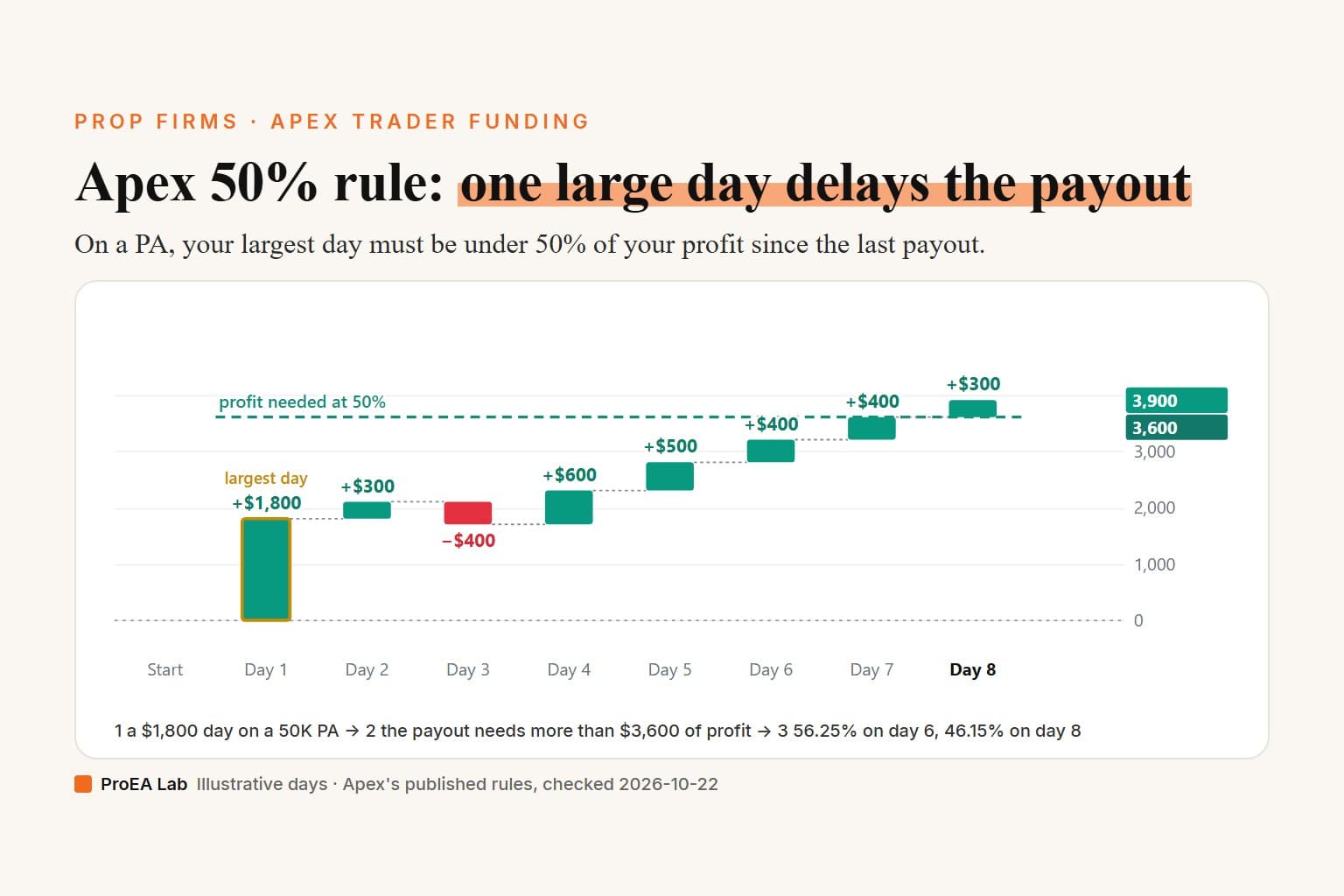
Eight made-up days toward a first payout. A day counts toward the 5 qualifying days with $250 or more of net profit, the 50K EOD minimum. The safety net is $52,100, so a $500 request needs a $52,600 balance, and payout 1 is capped at $1,500.
| Day | P&L | Profit since the start | Largest day | Largest day ÷ profit | Qualifying days | Payout button |
|---|---|---|---|---|---|---|
| 1 | +$1,800 | $1,800 | $1,800 | 100.00% | 1 | hidden |
| 2 | +$300 | $2,100 | $1,800 | 85.71% | 2 | hidden |
| 3 | −$400 | $1,700 | $1,800 | 105.88% | 2 | hidden |
| 4 | +$600 | $2,300 | $1,800 | 78.26% | 3 | hidden |
| 5 | +$500 | $2,800 | $1,800 | 64.29% | 4 | hidden |
| 6 | +$400 | $3,200 | $1,800 | 56.25% | 5 | hidden |
| 7 | +$400 | $3,600 | $1,800 | 50.00% | 6 | depends on which Apex line you read |
| 8 | +$300 | $3,900 | $1,800 | 46.15% | 7 | shown |
Day 6 meets everything else. Five qualifying days, and a $53,200 balance that's $1,100 above the safety net. But $1,800 is 56.25% of $3,200, so the button stays hidden. Apex's shortcut gives $1,800 / 0.5 = $3,600, so $400 more, on days smaller than $1,800, and a little over it to be under 50%.
Day 7 lands exactly on 50.00%. Apex's FAQ says the result "must be below 50%"; its own example table marks exactly 50% as "Consistency Met." We'd plan for day 8, where 46.15% clears both readings. The request can then be $1,500, payout 1's cap: $53,900 less $1,500 leaves $52,400, above the safety net.
A $1,800 day on a 50K PA means more than $3,600 of profit before the next payout, whatever else you've met.After that payout the calculation starts over at $52,400, and the $1,800 day no longer counts. Our free Apex consistency calculator runs the same check on your own largest day, profit and balance, with the safety net, the 5 days and each payout's cap. The payout side of the cycle is in Apex payout rules.
Sources, checked 2026-10-22: EOD Payouts, 50% Consistency Requirement.
Does the Apex evaluation have a consistency rule?
No. Both evaluation pages list consistency as "Not Applied" for every size, and the Intraday page explains why: "The Evaluation phase is designed to measure profitability under the trailing drawdown model. Consistency requirements are introduced later in the Performance Account phase."
So a single large day can pass an Apex evaluation; Apex says you "may pass in one trading day." The rule meets you at the first PA payout instead. Everything else the evaluation asks is in Apex evaluation rules.
Sources, checked 2026-10-22: EOD Evaluations, Intraday Trailing Drawdown Evaluations.
What is the 30% consistency rule in Apex?
It's the Legacy Performance Account's rule. Apex's Legacy PA Payout Parameters: "The 30% Consistency Rule ensures that no single trading day accounts for more than 30% of the total profit balance at the time of a payout request." Its example: "$1,500 ÷ 0.3 = $5,000."
It doesn't last forever: "The rule applies until the sixth payout or until the account is transferred to a Live Prop Trading Account." And a Legacy payout also needs 8 trading days, 5 of them with $50 or more of profit.
Legacy accounts were sold before March 2026, and the home page now offers Legacy evaluations again for a limited time. If your dashboard says Legacy, the 30% rule is yours; if it says EOD or Intraday, the 50% rule is. The 30% figure isn't a drawdown rule either, whatever the question in search suggests; drawdown is in Apex trailing drawdown.
Sources, checked 2026-10-22: Legacy PA Payout Parameters, Legacy Products Overview, Apex's home page.
Apex next to other firms' rules
Apex's 50% sits on payouts only, like Topstep's Consistency path, and unlike Lucid's evaluation rules. Topstep's Trading Combine wants your largest day under 55% of the profit target, and its XFA Consistency path 40% on payouts (Topstep consistency rule); Lucid's rules run from 20% to 50% by plan and stage (Lucid's consistency rule). Why a cap on your largest day works like a debt to pay down is in our prop firm consistency rule guide.
Where Apex's pages disagree
- Under 50%, or at 50%? The consistency page's first line bars any day of "more than 50%," its rule says "less than 50%," and the EOD Payouts and Intraday Payouts pages bar "50% or more." Its example table then marks a $1,000 day in $2,000 of profit, exactly 50%, "✓ Consistency Met." We plan for under 50%.
- Since the last payout request, or approval? The consistency page counts profit "since your last payout request" in one line and "since your last approved payout" in another. The payout pages say "since your last approved payout." A request that's denied would fall between the two.
- A PA, or an evaluation? The consistency page's example is "a $50k PA account," then says the profit needed is "for the evaluation to satisfy the 50% consistency." Evaluations have no consistency rule; we read it as the PA.
- Can you still buy a Legacy account, with its 30% rule? The Legacy Products Overview: "as of March 1st, 2026, Legacy evaluation accounts are no longer available for purchase to anyone." Apex's home page, edited later: "Legacy Accounts Are Back," "Available only while the promotion lasts."
Not published
- Whether a profitable day is counted after commissions.
- Whether the 5 qualifying days start over after each payout, as the consistency calculation does.
- The Requalification Eval-to-Live product's rules beyond Apex's table: how its 40% is counted, and against which profit.
- Whether a payout request that's denied resets anything.
Where we sit
We don't run a prop firm, we're not affiliated with Apex, and we earn nothing if you buy an Apex account. We sell the Prop Firm Challenge Toolkit, a TradingView indicator that turns rule numbers you enter into dollar buffers on your chart.
It isn't the tool for this rule. Its Custom rules take a consistency percentage, and it has a consistency tracker row, but in the version we sell (v1.4.0) that row can't follow your days: it only knows the balance you type in now, so it never sees a largest day and reads 0%. It also doesn't start over after a payout. For the 50% check, use the free Apex consistency calculator with the numbers on Apex's dashboard.
What the Toolkit does on a PA is the part that can close the account while you build those days. With Custom rules it shows your room above the trailing threshold and to the daily loss limit, from the balance and open P&L you type: a $2,000 drawdown on 50K is a Max loss % of 4, Level 1's $1,000 limit a Daily loss % of 2, with the daily limit soft and a 6:00 PM New York reset. Its daily limit is a percentage of the balance you type, which it treats as the day's start, so it can't see losses you've already closed today. It locks the threshold at your starting balance, $100 under Apex's stop. It doesn't read Apex's dashboard, which stays the source of truth, and the high it trails is the balance you type in, not your account's history. The settings, and where they differ from Apex, are in Apex trailing drawdown.
Sources and their last edits
Each page was read on 2026-10-22. Dates are the pages' own last-modified stamps (UTC).
- 50% Consistency Requirement, 2026-04-24; EOD Payouts, 2026-04-28; Intraday Trailing Drawdown Payouts, 2026-04-28.
- EOD Evaluations, 2026-06-05; Intraday Trailing Drawdown Evaluations, 2026-04-28.
- Legacy PA Payout Parameters, 2026-07-22; Legacy Products Overview, 2026-07-21.
- Apex Live Prop Trading Program FAQ, 2026-10-14; Apex's home page, 2026-10-15.
Disclosure
The payout cycle above uses invented days and Apex's published rules. It isn't a forecast, and it doesn't say whether an Apex account is worth buying. Apex's dashboard decides when your payout button appears, not this page. If a number here no longer matches Apex's pages, email support@pulltrade.app and we'll correct it in public.
Frequently asked questions
Does Apex Trader Funding have a consistency rule?
Yes, on Performance Account payouts only. Your largest profitable day must be under 50% of your net profit since your last approved payout, or since the account started if you haven't had one. Apex's current EOD and Intraday evaluations have no consistency rule; their parameter tables say Not Applied.
What is Apex's 50% consistency rule?
A payout condition on Performance Accounts: Apex divides your highest profit day by your total profit since the last approved payout, losing days included, and the result must be below 50%. Its shortcut is the highest day divided by 0.5: a $1,500 day needs $3,000 of profit, and its FAQ asks for a little more than that, since exactly 50% is not below it.
What is the 30% consistency rule in Apex?
The Legacy Performance Account's rule, which Apex calls the 30% Consistency Rule, Windfall: no single day may be more than 30% of your profit when you request a payout, so a $1,500 day needs $5,000. It applies until the sixth payout or a move to a Live account. Current Performance Accounts use 50% instead, but Legacy accounts still exist and Apex's home page says Legacy evaluations are back for a limited time.
Does the Apex evaluation have a consistency rule?
No. Apex's EOD and Intraday evaluation pages list consistency as Not Applied for every size, and say consistency requirements are introduced later, in the Performance Account. You pass by reaching the profit target without touching the trailing threshold.
Do losing days count in Apex's consistency rule?
Yes. Apex uses net profit, so a loss shrinks the total your largest day is measured against. Its own example: $1,000 on day 1 and a $200 loss on day 2 is $1,000 divided by $800, which is 125%. With no profit, or a loss, since the last payout, the rule can't be calculated and you don't qualify yet.
What happens if I break Apex's 50% consistency rule?
Nothing fails. Apex says being above 50% does not fail your account; the payout request option just isn't available until your largest day falls below 50% of your profit. There's no time limit, but the account still has to stay above its trailing threshold and meet Apex's inactivity policy while you trade.
Does Apex's consistency rule reset after a payout?
Yes. Once a payout is approved, the calculation resets and only profit earned after that payout counts. A large day from the last cycle no longer holds the next payout back.