Payout unlocked: $1,100 gross -> $990 at 90%
4/4 qualifying days ($150+) met, no consistency rule in Sim-Funded, soft daily pause triggered on Day 2 without failing.
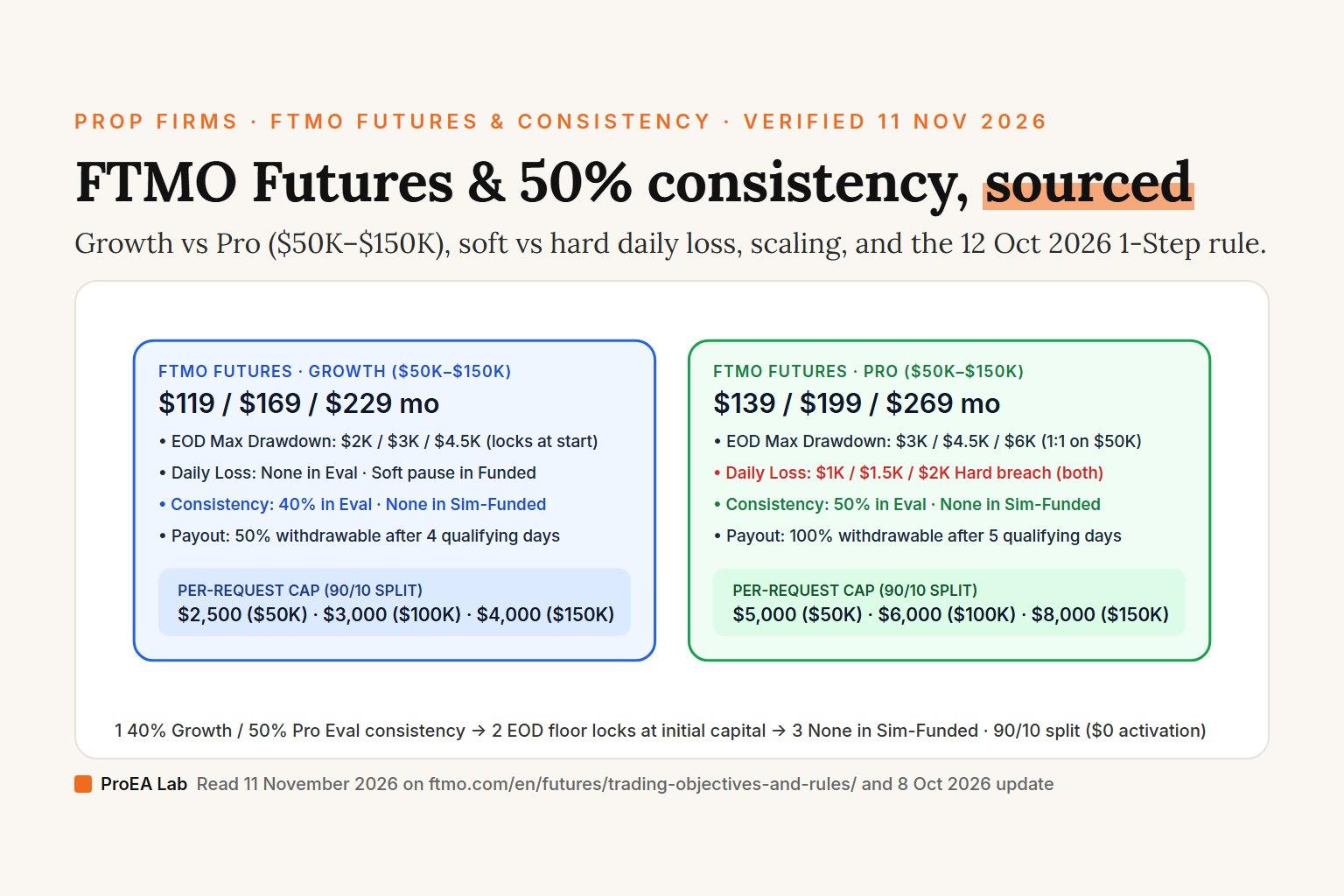
Growth vs Pro across $50K, $100K and $150K
Both FTMO Futures plans run as 1-step evaluations on CME Group futures (6:00 p.m. ET to 4:10 p.m. ET next calendar day, news trading permitted, up to 3 active Sim-Funded accounts up to $450,000 combined across three $150K accounts). Passing stops your monthly billing with $0 activation fee: during Evaluation and Sim-Funded, Level 1 live market data across all 30 offered CME Group futures instruments (CME, CBOT, NYMEX, and COMEX) is included at $0 extra cost, and upon transitioning to a Live Funded Account, FTMO covers 1 exchange (CME, including Level 2 Depth of Market) while any additional exchanges are paid directly to the platform provider:
| Rule / Parameter | Growth $50K | Growth $100K | Growth $150K | Pro $50K | Pro $100K | Pro $150K |
|---|---|---|---|---|---|---|
| Monthly subscription | $119 / mo | $169 / mo | $229 / mo | $139 / mo | $199 / mo | $269 / mo |
| Evaluation reset fee | $109 | $159 | $219 | $129 | $189 | $259 |
| Activation fee on pass | $0 | $0 | $0 | $0 | $0 | $0 |
| Evaluation profit target | $3,000 | $6,000 | $9,000 | $3,000 | $6,000 | $9,000 |
| EOD Trailing Max Drawdown | $2,000 | $3,000 | $4,500 | $3,000 | $4,500 | $6,000 |
| Eval Daily Loss Limit | None | None | None | $1,000 (Hard) | $1,500 (Hard) | $2,000 (Hard) |
| Sim-Funded Daily Loss Limit | $1,000 (Soft) | $2,000 (Soft) | $3,000 (Soft) | $1,000 (Hard) | $1,500 (Hard) | $2,000 (Hard) |
| Evaluation Consistency | 40% | 40% | 40% | 50% | 50% | 50% |
| Sim-Funded Consistency | None | None | None | None | None | None |
| Eval max contracts | 5 Mini / 50 Micro | 10 Mini / 100 Micro | 15 Mini / 150 Micro | 5 Mini / 50 Micro | 10 Mini / 100 Micro | 15 Mini / 150 Micro |
| Sim-Funded scaling start → max | 2 → 5 Mini | 4 → 10 Mini | 6 → 15 Mini | 2 → 5 Mini | 4 → 10 Mini | 6 → 15 Mini |
| Payout qualifying days | 4 days at $150+ | 4 days at $300+ | 4 days at $450+ | 5 days at $200+ | 5 days at $300+ | 5 days at $500+ |
| Withdrawable profit share | 50% | 50% | 50% | 100% | 100% | 100% |
| Per-payout cap (90/10 split, $20 min) | $2,500 | $3,000 | $4,000 | $5,000 | $6,000 | $8,000 |
Three mechanics that decide whether Growth or Pro fits your trading
1. EOD Trailing Max Drawdown (and its permanent lock at Initial Capital)
In both Evaluation and Sim-Funded, Max Drawdown is recalculated at the end of each trading day (4:10 p.m. ET) from your highest closed end-of-day balance—never from intraday unrealized highs—and locks permanently at your Initial Capital ($50,000, $100,000, or $150,000).
- On $50K Growth, your floor starts at
$48,000. Once you close a session at$52,000or higher, the floor locks at$50,000for the life of that stage. - On $50K Pro, your floor starts at
$47,000—giving you a 1:1 target-to-drawdown ratio ($3,000target vs$3,000drawdown)—and locks at$50,000once closed balance reaches$53,000. - The Pro 100%-withdrawal trap: Because Pro lets you withdraw 100% of profit above initial capital, requesting 100% after 5 small qualifying days—before your EOD floor has locked, or leaving zero cushion above
$50,000once locked—leaves no room for your next losing trade. Always check where your EOD floor sits before requesting a payout.
Day 5: close $53,000 (+$3,000, 4 qualifying days met). Floor stays locked at $50,000; 50% ($1,500) is withdrawable.
Illustrative balances, not market data: trades are invented to show FTMO Futures Growth Sim-Funded rules ($2,000 EOD Max Drawdown locking at $50,000 initial capital and $1,000 soft-breach Daily Loss Limit), read 2026-11-11.
Rule: EOD Max Drawdown = highest closed end-of-day balance − $2,000, locked permanently at $50,000 once closed balance reaches $52,000; Sim-Funded Growth $1,000 Daily Loss Limit is a soft pause until 6:00 p.m. ET.
Read as text
- Start: $50,000. Max Drawdown starts $2,000 below at $48,000; Sim-Funded soft DLL sits $1,000 below.
- Day 1: +$900, close $50,900. EOD Max Drawdown trails up to $48,900.
- Day 2: −$1,000 hits the $1,000 soft Daily Loss Limit—trading pauses until 6:00 p.m. ET, account survives $1,000 above $48,900.
- Day 3: +$1,400, close $51,300. EOD Max Drawdown trails up to $49,300.
- Day 4: close $52,150, past $52,000. Max Drawdown locks permanently at $50,000.
- Day 5: close $53,000 (+$3,000, 4 qualifying days met). Floor stays locked at $50,000; 50% ($1,500) is withdrawable.
2. Soft Daily Pause (Growth) vs Hard Termination (Pro)
- Growth has no Daily Loss Limit during Evaluation. Once in Sim-Funded, hitting
$1,000($50K),$2,000($100K), or$3,000($150K) in combined open + closed daily loss triggers a Soft Breach: open positions auto-liquidate and order entry pauses until the6:00 p.m. ETreopen, without failing the account (provided your Max Drawdown floor wasn't breached). - Pro enforces a Hard Breach (
$1,000/$1,500/$2,000) in both Evaluation and Sim-Funded. Touching that limit intraday terminates the account immediately.
3. Sim-Funded Contract Scaling Plan & Live Transition
While Evaluation lets you trade full size (5, 10, or 15 minis) from bar one, Sim-Funded scales contract capacity from your closed end-of-day profit above initial capital (1 mini = 10 micros):
$50K(Growth & Pro):$0–$999.99→ 2 minis (20micros) ·$1,000–$1,999.99→ 3 minis (30micros) ·$2,000+→ 5 minis (50micros).$100K(Growth & Pro):$0+→ 4 minis (40micros) ·$1,000+→ 5 minis (50micros) ·$2,000+→ 8 minis (80micros) ·$3,000+→ 10 minis (100micros).$150K(Growth & Pro):$0+→ 6 minis (60micros) ·$1,000+→ 8 minis (80micros) ·$2,000+→ 10 minis (100micros) ·$3,000+→ 12 minis (120micros) ·$4,500+→ 15 minis (150micros).
After consistent Sim-Funded performance, FTMO's Risk Management team can transition traders to Live Funded, where initial live capital equals the Safety Net ($2,000 / $3,000 / $4,500 on Growth; $3,000 / $4,500 / $6,000 on Pro), payouts unlock daily (90/10 split), and both Daily Loss Limits and Payout Caps are removed.
What changed on 12 October 2026: FTMO's 50% Consistency Rule vs Best Day Rule
If you searched "FTMO 50% consistency rule" because of FTMO's October 2026 announcement, note which product you are trading:
| FTMO Program | Consistency Rule in Challenge / Eval | Consistency Rule When Funded |
|---|---|---|
| FTMO Futures — Growth | 40% of closed Eval profit | None (4 qualifying days + 50% new profit rule) |
| FTMO Futures — Pro | 50% of closed Eval profit | None (5 qualifying days + 50% new profit rule) |
| 1-Step FTMO Challenge (CFD, ordered >= 12 Oct 2026, 9:00 GMT+3) | 50% Consistency Rule (net total profit incl. losing days) | 50% Consistency Rule (per Reward cycle; also applies to 1-Step accounts merged since 12 Oct 2026) |
| 1-Step FTMO Challenge (CFD, ordered < 12 Oct 2026) | 50% Best Day Rule (positive days' profit only) | 50% Best Day Rule (unless merged after 12 Oct 2026) |
| Instant Account (CFD) | N/A (instant start) | 30% Consistency Rule |
| 2-Step FTMO Challenge (CFD) | None (4 minimum trading days) | None |
Why did the 12 October 2026 formula change matter on 1-Step CFD accounts? Under the legacy Best Day Rule, losing days did not shrink the denominator (+$6,200, -$2,400, +$3,800, +$2,600 gave $12,600 in positive days, so $6,200 / $12,600 = 49.2% passed right at $10,200 net profit). Under the 50% Consistency Rule, the denominator is net total profit ($10,200), making $6,200 / $10,200 = 60.8%—so you must reach 2 × $6,200 = $12,400 net profit (+$2,200 extra) before passing or requesting a Reward. Neither rule ever breaches an account; switch to the second tab in the simulator above (or open our FTMO 1-Step vs 2-Step calculator) to test your own sequence.
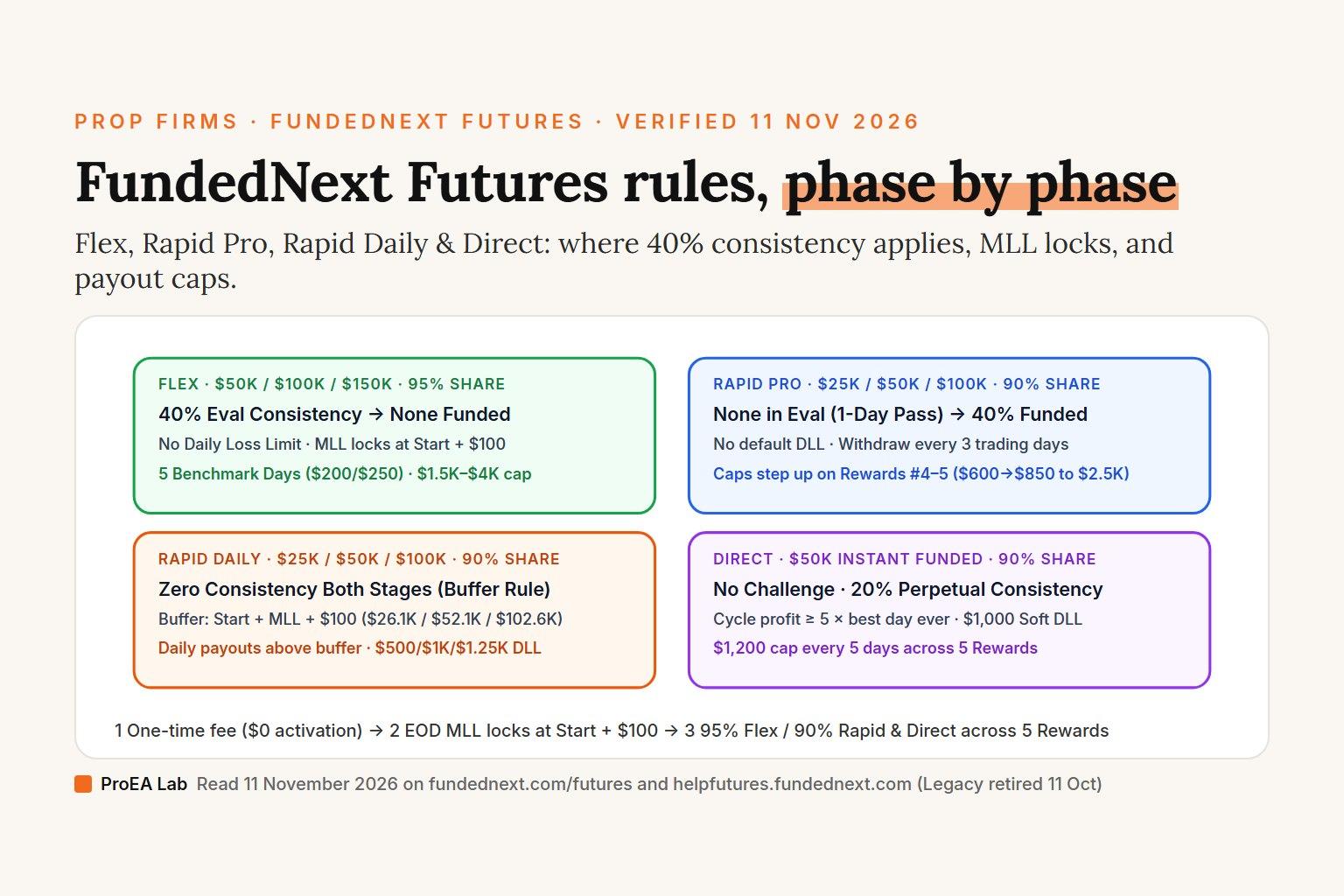
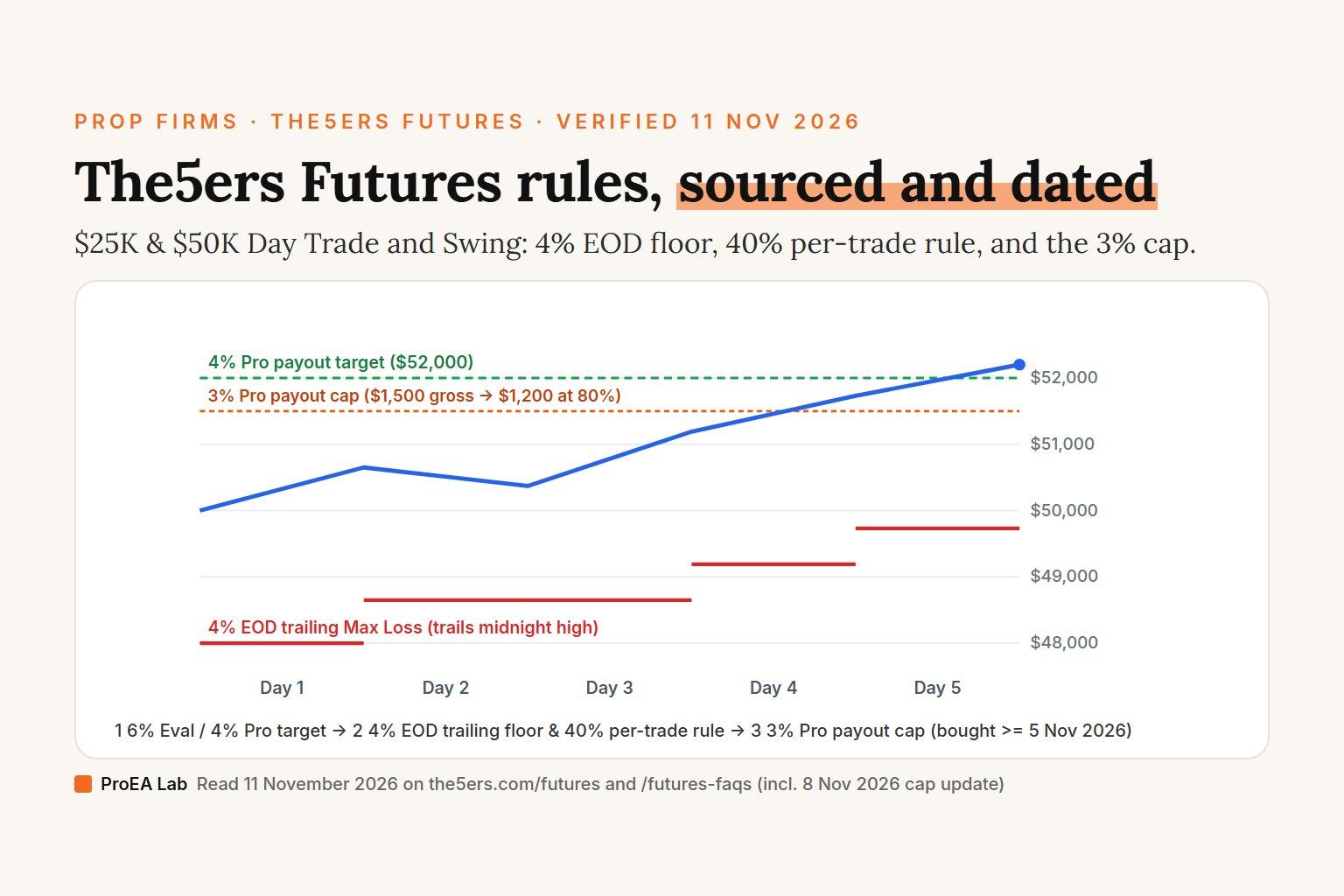
FTMO Futures vs The5ers Futures vs FundedNext Futures ($50K side-by-side)
Comparing CME futures evaluations across the three major multi-asset prop brands? Every $50K model below charges $0 activation fee and trails drawdown at end of day, yet differs sharply on billing, overnight permissions, and funded payout ceilings (all verified 11 November 2026):
| $50K Parameter | FTMO Futures Growth / Pro | The5ers Futures Day Trade / Swing | FundedNext Futures Flex / Rapid Daily |
|---|---|---|---|
| Fee structure | $119 / $139 monthly (stops on pass) | $100 / $120 one-time (refunded 3rd payout) | $74.99 / $149.99 one-time promo |
| Eval target & EOD drawdown | $3,000 target · $2,000 / $3,000 EOD DD (locks at $50,000) | $3,000 target (6%) · $2,000 EOD DD (4%) | $2,500 / $3,000 target · $1,500 / $2,000 EOD MLL (locks at $50,100) |
| Consistency rule | 40% / 50% Eval · 0% Sim-Funded | 40% per single trade (Eval & Pro) | Flex: 40% Eval / 0% Funded · Rapid Daily: 0% both |
| Funded split & per-payout cap | 90% · $2,500 (50% share) / $5,000 (100% share) | 80% after 14 days & +4% · $1,500 cap (3%) | 95% Flex ($1,500 cap) · 90% Rapid Daily ($1,000–$1,250 cap) |
| Sim-Funded reward limit & overnight | Ongoing until risk-team Live transition · flat by 4:10 PM ET | Scales to $500K · Swing allows 1 Mini / 10 Micro overnight | Concludes after 5 Performance Rewards for Live review |
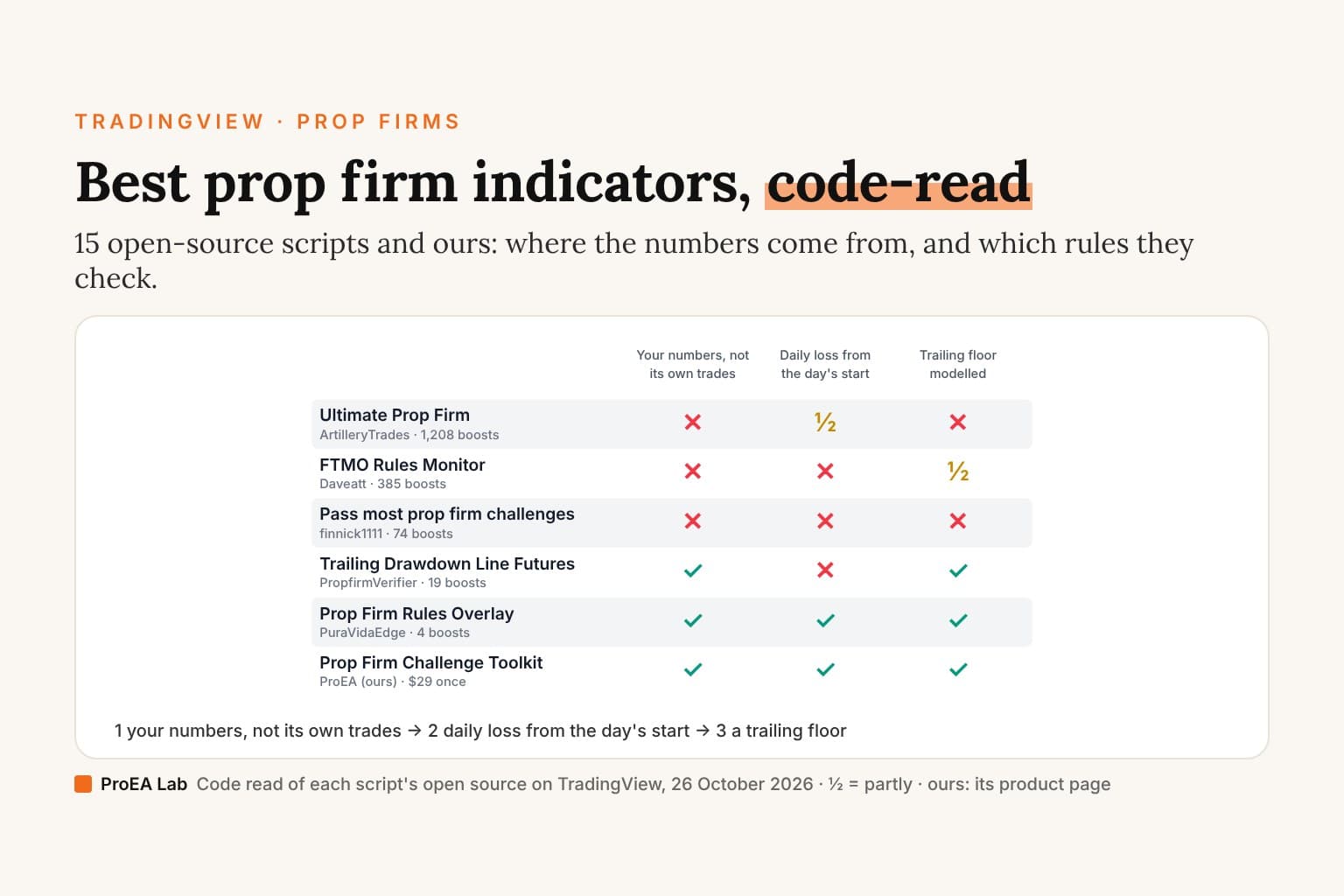
Run your exact profit target and payout-cap numbers across all three in our prop firm comparison calculator, inspect primary-source SHA-256 receipts in the prop firm rule tracker, or port NinjaTrader .cs / .zip indicators into TradingView with our NinjaScript to Pine Script v6 converter.
Use this animation on your site.
Frequently asked questions
What is the difference between FTMO Futures Growth and Pro?
On FTMO's Futures Trading Objectives page (read 11 November 2026), Growth costs $119, $169 or $229 per month ($50K, $100K, $150K), has no Daily Loss Limit in Evaluation, a soft-breach Daily Loss Limit in Sim-Funded ($1,000, $2,000, $3,000), a 40% Evaluation consistency rule, and lets you withdraw 50% of profits after 4 qualifying days up to $2,500, $3,000 or $4,000. Pro costs $139, $199 or $269 per month, gives wider EOD Max Drawdown ($3,000, $4,500, $6,000), enforces a hard Daily Loss Limit ($1,000, $1,500, $2,000) in both stages, uses a 50% Evaluation consistency rule, and lets you withdraw 100% of profits after 5 qualifying days up to $5,000, $6,000 or $8,000.
Does FTMO Futures have an activation fee or data fee?
FTMO charges $0 activation fee when you pass into Sim-Funded, and your monthly subscription stops renewing once you pass. During Evaluation and Sim-Funded, Level 1 live market data across all 30 offered CME Group futures instruments (CME, CBOT, NYMEX and COMEX) is included at $0 extra cost. Upon transitioning to a Live Funded Account, FTMO covers 1 exchange (CME, including Level 2 Depth of Market) while any additional exchanges are paid directly to the platform provider.
How does the EOD Trailing Max Drawdown lock on FTMO Futures?
Max Drawdown ($2,000, $3,000 or $4,500 on Growth; $3,000, $4,500 or $6,000 on Pro) trails your highest closed end-of-day balance and locks permanently at your Initial Capital ($50,000, $100,000 or $150,000). Once locked, it never moves higher, though touching it intraday on open plus closed P&L terminates the account.
Is there a consistency rule in FTMO Futures Sim-Funded accounts?
No. Consistency applies only during the Futures Evaluation (40% on Growth and 50% on Pro). Once you reach Sim-Funded or Live Funded on FTMO Futures, there is no consistency rule, though each payout request requires 4 qualifying days on Growth ($150, $300, $450) or 5 qualifying days on Pro ($200, $300, $500) plus the 50% minimum new profit rule after prior payouts.
What changed on 12 October 2026 in FTMO's 50% Consistency Rule?
Effective 12 October 2026 at 9:00 GMT+3, FTMO replaced the Best Day Rule with the 50% Consistency Rule on new 1-Step CFD FTMO Challenge orders and merged 1-Step FTMO Accounts. The legacy Best Day Rule divided your best day by positive days' profit only; the 50% Consistency Rule divides your best day by net total profit including losing days, while 1-Step orders placed before 12 October 2026 keep the Best Day Rule.
How many contracts can you trade on FTMO Futures Sim-Funded?
During Evaluation you have full contract access from day 1 (5 minis or 50 micros on $50K, 10 minis or 100 micros on $100K, and 15 minis or 150 micros on $150K). In Sim-Funded, a Contract Scaling Plan starts at 2, 4 or 6 minis ($0 profit) and unlocks up to 5, 10 or 15 minis as your closed end-of-day profit reaches $1,000, $2,000, $3,000 and $4,500.