LucidDirect at a glance
There's no evaluation and no scaling plan: the full size is available from your first trade.
| Account | Max Loss Limit | Locks once the balance passes | Locks at | Daily loss limit | Max size | Price (one-time) |
|---|---|---|---|---|---|---|
| $25,000 | $1,000 | $26,100 | $25,100 | None | 2 minis or 20 micros | $329 |
| $50,000 | $2,000 | $52,100 | $50,100 | $1,200, then LucidScale | 4 minis or 40 micros | $515 |
| $100,000 | $3,500 | $103,600 | $100,100 | $2,100, then LucidScale | 6 minis or 60 micros | $700 |
| $150,000 | $5,000 | $155,100 | $150,100 | $3,000, then LucidScale | 10 minis or 100 micros | $836 |
The 100K and 150K accounts trail wider than Lucid's evaluation plans, whose 100K and 150K Max Loss Limits are $3,000 and $4,500. Lucid's homepage sums up the trade-off in its own words: "Higher cost, trade for payouts immediately, stricter rules and longer payout delay."
Sources, checked 2026-10-20: funded account, drawdown, daily loss limit, plan cards and FAQ on lucidtrading.com.
The Max Loss Limit
It works like the evaluation plans' line, with wider amounts on 100K and 150K. "At the end of each trading session, the system calculates the account's highest closing balance." The limit sits a fixed amount below that and rises with it. Once the balance passes the Initial Trail Balance, it "locks and no longer moves", at the starting balance plus $100.
"If your account balance reached the MLL, your account will be breached." LucidFlex's drawdown page moves the line to its locked level when you request a payout; LucidDirect's has no such rule. A payout still lowers your balance, and that's what matters after the first one (the worked cycle below). To follow the line day by day, use our Lucid drawdown simulator.
Source, checked 2026-10-20: LucidDirect drawdown.
The daily loss limit and LucidScale
From 50K up, LucidDirect starts with a fixed daily loss limit. Once the account closes above its Initial Trail Balance, the fixed limit gives way to LucidScale: "Highest end-of-day account profit × 60% = LucidScale DLL". The 25K account has no daily loss limit at all.
- It's soft. You "do not lose your account for hitting DLL as long as the Max Loss Limit (MLL) has not been reached"; you're "restricted from placing additional trades until the next trading session".
- LucidScale only grows. It "increases as your account grows" and "does not decrease, even if the account draws down". Lucid's example: a $4,000 highest end-of-day profit gives $2,400.
- You can't switch it off. "LucidDirect has no add-ons; the Daily Loss Limit is set by account size."
Above the trail, watch both lines. At a new high close, LucidScale is the closer one: 60% of your profit, against the Max Loss Limit's room of all of it less $100. A large payout flips that: the balance drops toward the locked Max Loss Limit, while LucidScale, by Lucid's description, doesn't fall.
Source, checked 2026-10-20: LucidDirect daily loss limit, edited 2026-10-19.
LucidDirect payout rules
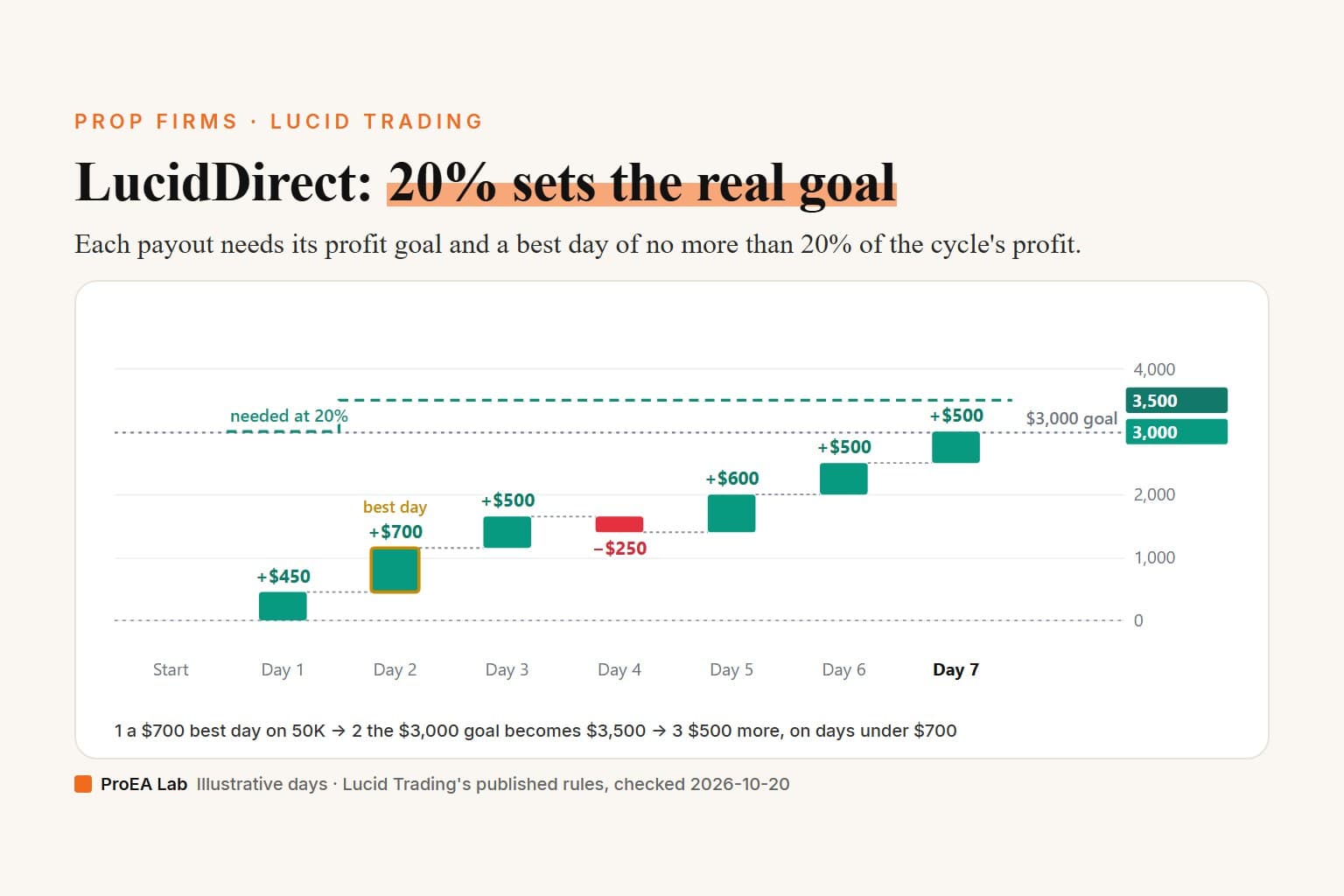
Every payout cycle needs two things, and both start over after each approved payout: the profit goal, and a best day of no more than 20% of the cycle's profit. Then you can request between $500 and the cap.
| Account | Profit goal, payout 1 | Profit goal, payouts 2 to 5 | Max, payouts 1 to 3 | Max, payouts 4 and 5 |
|---|---|---|---|---|
| $25,000 | $1,500 | $1,250 | $1,000 | $1,000 |
| $50,000 | $3,000 | $2,500 | $2,000 | $2,500 |
| $100,000 | $6,000 | $3,500 | $2,500 | $3,000 |
| $150,000 | $9,000 | $4,500 | $3,000 | $3,500 |
- Consistency: "Your largest single-day profit must be no more than 20% of your total profit during the payout cycle." The profit you need is five times your best day. At the goal, the biggest day that works is $300, $600, $1,200 or $1,800 for payout 1, and $250, $500, $700 or $900 after it. After a bigger day, the Lucid consistency calculator on a LucidDirect payout gives the profit you still need.
- The goal resets to zero. "This profit goal resets to $0 after each approved payout." And "If you take a trade before your payout is processed that drops below the profit goal, your request may be denied."
- Minimum $500, 90/10 split. No fixed payout window: "you may request a payout any day after meeting all eligibility criteria". Approved funds leave the account "within a few minutes" and reach you "within 2 business days". Requests "are final once submitted".
- Five payouts. Lucid's live-program page names Direct among the plans where "Payout 5 represents the maximum payout level". After it, Lucid's risk team decides whether you move live.
How many days? The plan card says "Min Day to Payout 5". Five equal days put your best day at exactly 20%, which the payout page's "no more than 20%" allows. The consistency page says to keep trading "until your largest day is below 20%", which five equal days aren't. Plan on six profitable days, more if one is bigger than the rest.
On-demand payouts (since 2026-10-19). The 50K, 100K and 150K accounts "have a Daily Loss Limit, so they can request payouts during the trading session, from profit made that session (6:00 PM to 3:45 PM ET)". The 25K's "payouts follow the regular end-of-day schedule." The LucidPro and LucidFlex pages add that trading pauses after an intraday request; LucidDirect's page doesn't say. To compare with the other plans on the same trades, see Lucid payout rules.
Sources, checked 2026-10-20: payout objectives, consistency, daily loss limit, New Live Structure, plan cards on lucidtrading.com.
One invented first payout on 50K
Eight made-up days on a new 50K LucidDirect account. The first payout needs $3,000 of cycle profit with the best day under 20%, the stricter of Lucid's two readings.
| Day | P&L | Close | Cycle profit | Best day | Best day ÷ profit | Max Loss Limit after the close | Daily loss limit next session |
|---|---|---|---|---|---|---|---|
| 1 | +$450 | $50,450 | $450 | $450 | 100.00% | $48,450 | $1,200 |
| 2 | +$700 | $51,150 | $1,150 | $700 | 60.87% | $49,150 | $1,200 |
| 3 | +$500 | $51,650 | $1,650 | $700 | 42.42% | $49,650 | $1,200 |
| 4 | −$250 | $51,400 | $1,400 | $700 | 50.00% | $49,650 | $1,200 |
| 5 | +$600 | $52,000 | $2,000 | $700 | 35.00% | $50,000 | $1,200 |
| 6 | +$500 | $52,500 | $2,500 | $700 | 28.00% | $50,100 (locked) | $1,500 (60% × $2,500) |
| 7 | +$500 | $53,000 | $3,000 | $700 | 23.33% | $50,100 (locked) | $1,800 (60% × $3,000) |
| 8 | +$550 | $53,550 | $3,550 | $700 | 19.72% | $50,100 (locked) | $2,130 (60% × $3,550) |
Day 7 reaches the $3,000 goal, but the $700 day from day 2 is 23.33% of it. The 20% rule needs $700 × 100 ÷ 20 = $3,500, so $500 more, on days smaller than $700. Day 8 makes $550, and 19.72% is under 20% on either reading of the rule.
The payout. The most you can request is the $2,000 cap; you receive $1,800. The balance drops to $51,550 while the line stays locked at $50,100, so you're left with $1,450 of room. The last close set LucidScale at $2,130, and Lucid doesn't say whether a payout changes it. If it stays there, a $1,450 losing day reaches the Max Loss Limit before the daily limit would stop you.
On 50K, one $700 day turns a $3,000 goal into $3,500, and the first full payout leaves $1,450 between you and the line.Payout 2 starts from zero: $2,500 of new profit with no day over $500.
LucidDirect next to the evaluation plans
Lucid's own summary is that LucidDirect costs more and has stricter rules, in exchange for skipping the evaluation. Here's what that means on a 50K account:
| 50K account | LucidDirect | LucidFlex | LucidPro |
|---|---|---|---|
| One-time price | $515 | $146 | $192 |
| Before you're funded | Nothing | $3,000 target, best day 40% or less | $3,000 target |
| Max Loss Limit | $2,000 | $2,000 | $2,000 |
| Daily loss limit | Built in: $1,200, then LucidScale | Optional: $1,200 | Optional: $1,200, then LucidScale |
| Consistency on payouts | 20% | None | 40% |
| What payout 1 needs | $3,000 of profit | 5 days of $150 or more, and $1,000 of profit for a $500 request | $500 of profit, and a $52,600 balance for a $500 request |
| Max payout 1 | $2,000 | 50% of profit, up to $2,000 | $2,000 |
These are rules, not a verdict. Which plan fits depends on how you trade, and an evaluation fee you pay more than once changes the arithmetic. Each plan's full rulebook is in LucidFlex rules and the Lucid Trading rules hub; every plan's consistency rule is side by side in Lucid's consistency rule.
Sources, checked 2026-10-20: LucidPro evaluation, LucidPro payouts, LucidFlex evaluation, LucidFlex payouts, plan cards on lucidtrading.com.
News, hours and the rest
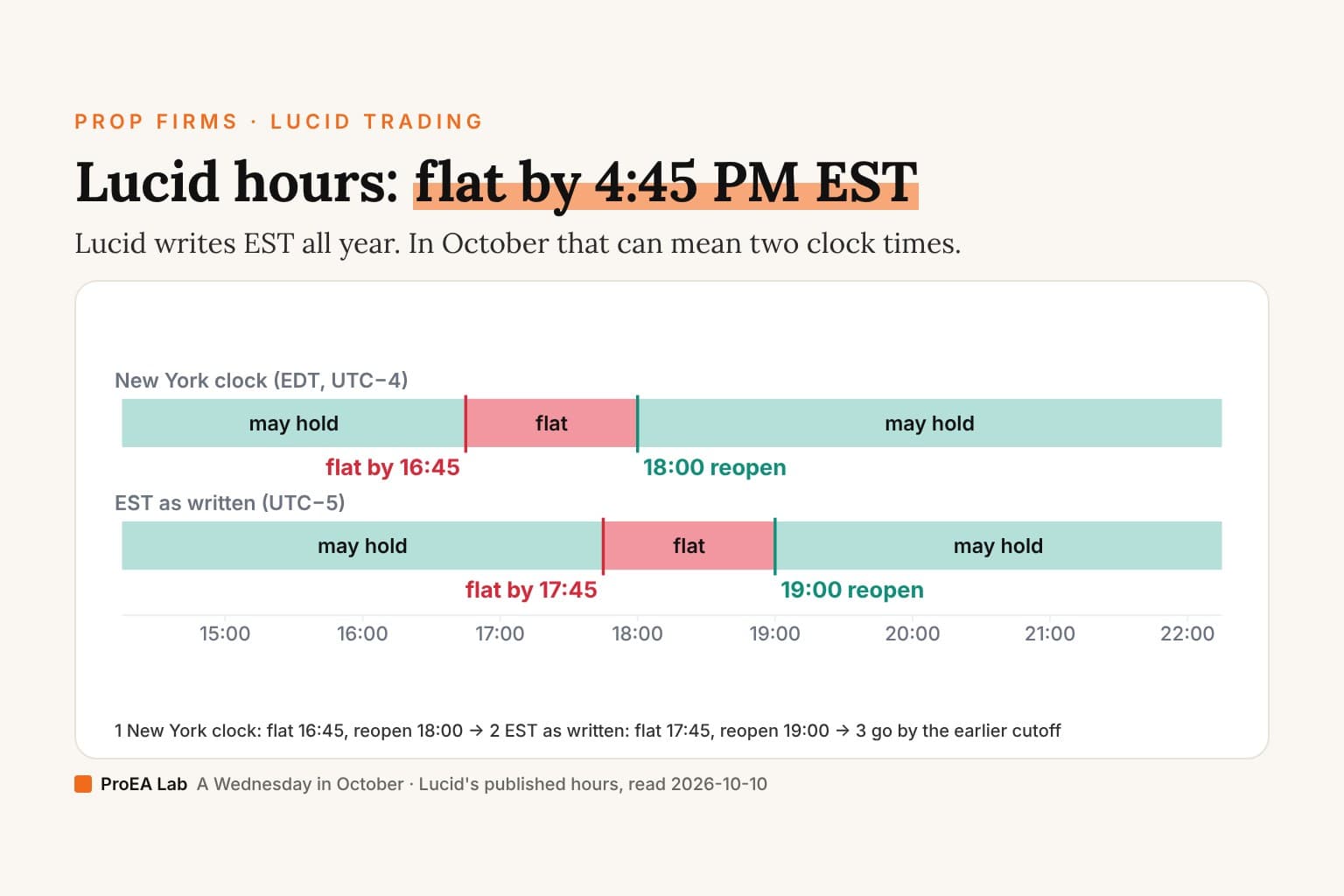
News trading is allowed on LucidDirect: you "may enter or exit positions around scheduled or unscheduled news events" without a breach. Be flat by 4:45 PM EST, Monday to Friday; Lucid closes anything still open then, and holding past it "does not result in a failed account". Trading resumes at 6:00 PM EST, Sunday to Thursday. Hedging, microscalping, account limits and commissions apply to every plan the same way; they're in the Lucid Trading rules hub.
Sources, checked 2026-10-20: other trading activities, allowed trading times.
Where Lucid's pages disagree
- Payout caps. The funded account page lists "No simulated payout caps". The payout objectives page prints a maximum for every payout. We go by the payout page.
- LucidScale: balance or profit? The funded page and the plan cards say "60% of Peak EOD Balance". The daily loss limit page gives "Highest end-of-day account profit × 60%", with a worked example. We use the formula; read literally, 60% of a $53,550 balance would be a $32,130 daily limit.
- "No more than" or "below" 20%? The payout page says "no more than 20%"; the consistency page says to keep trading until it's "below 20%". Stay under the line.
- The 25K's Initial Trail Balance. The daily loss limit page lists it as "None"; the drawdown page gives $26,100. The 25K has no daily loss limit to switch, so we read the "None" as that and use $26,100 for the Max Loss Limit.
Not published
- A payout buffer. Lucid prints none for LucidDirect.
- Whether trading pauses after an on-demand request, as it does on LucidPro and LucidFlex.
- Whether an on-demand request is capped at the profit made in that session.
- Whether a payout changes the LucidScale limit.
- What counts as a day for the plan card's "Min Day to Payout 5", and whether exactly 20% is enough.
Where we sit
We don't run a prop firm, we're not affiliated with Lucid Trading, and we earn nothing if you buy from Lucid. We sell the Prop Firm Challenge Toolkit, a TradingView indicator that turns rule numbers you enter into dollar buffers on your chart. It has no Lucid preset, so use its Custom rules. For a 50K LucidDirect:
| Toolkit setting (Custom) | 50K LucidDirect | From |
|---|---|---|
| Max loss % | 4 | $2,000 of $50,000 |
| Drawdown mode | Trailing EOD | the highest end-of-day balance |
| Daily loss % | 2.4 until a close above $52,100 | $1,200 of $50,000 |
| Daily limit is soft | On | locked out until the next session, not failed |
| Profit target % | 6 for the first payout | the $3,000 goal |
| Min trading days | 0 | v1.4.0 can't count them (below) |
| Consistency % (0=off) | 0 | v1.4.0 can't check it (below) |
| Reset timezone, hour | America/New_York, 18 | sessions resume at 6:00 PM |
Where it differs from Lucid, plainly. The toolkit locks its trailing floor at your starting balance; Lucid locks at the starting balance plus $100, so after the lock its floor sits $100 below Lucid's. It doesn't compute LucidScale, so above the trail you re-enter the daily limit yourself as it grows. It doesn't read Lucid's dashboard, which stays the source of truth: you type the balance in, and the high it trails is the balance you type, so after a pullback from a higher close its floor sits under Lucid's, showing more room than you have. It takes the daily limit as a percentage of the balance you type, which it treats as the day's start, so it can't see losses you've already closed today: keep Current balance at the session's starting balance and put the day's running P&L, closed and open, in Open floating P/L.
It can't check the payout's five days or its 20%. The version we sell (v1.4.0) counts no trading days, and its consistency tracker row only knows the balance you type in now, so it never sees a best day and reads 0%. Its PASSED means only that the $3,000 goal is reached, and it doesn't start over after a payout. Count the days on Lucid's dashboard and check the 20% with the free Lucid consistency calculator.
Sources and their last edits
Each page was read on 2026-10-20. Dates are the help center's own last-edit stamps (UTC).
- LucidDirect Funded Account, LucidDirect Payout Objectives, LucidDirect Consistency Percentage and LucidDirect Drawdown, all edited 2026-08-26.
- LucidDirect Daily Loss Limit, 2026-10-19: it added the on-demand payout section; the limits and LucidScale read as before.
- New Live Structure, 2026-10-14; Other Trading Activities and Allowed Trading Times, 2026-08-26.
- For the comparison: LucidPro Evaluation Account, 2026-08-26; LucidPro Payouts, 2026-08-06; LucidFlex Evaluation Account, 2026-10-19; LucidFlex Payouts, 2026-07-28.
- The plan cards and FAQ on lucidtrading.com carry no date; we read them on 2026-10-20.
Disclosure
The payout cycle above uses invented days and Lucid's published rules. It isn't a forecast, and it says nothing about whether a LucidDirect account is worth buying. Lucid's dashboard decides your payout, not this page. If a number here no longer matches Lucid's pages, email support@pulltrade.app and we'll correct it in public.
Frequently asked questions
What are the LucidDirect rules?
LucidDirect is Lucid's straight-to-funded plan: there's no evaluation, so you can work toward a payout from your first day. Each payout needs a profit goal ($3,000 for the first on 50K) with your best day at no more than 20% of the cycle's profit. The Max Loss Limit trails your highest end-of-day balance by $1,000 to $5,000 and locks at your starting balance plus $100. From 50K up, a daily loss limit is built in.
What are the rules for LucidDirect payouts?
Reach the cycle's profit goal ($1,500, $3,000, $6,000 or $9,000 for payout 1 on the 25K to 150K accounts, then $1,250, $2,500, $3,500 or $4,500) with your best day at no more than 20% of that profit. The minimum request is $500; the maximum is $1,000 to $3,000 on payouts 1 to 3 and $1,000 to $3,500 on payouts 4 and 5. The split is 90/10, and Payout 5 is the last.
Does LucidDirect have a daily loss limit?
Yes on 50K, 100K and 150K: $1,200, $2,100 or $3,000, fixed until the account closes above its Initial Trail Balance, then the LucidScale limit, 60% of your highest end-of-day profit, which never falls. The 25K has none. Hitting it locks you out until the next session without failing the account, and you can't switch it off.
How many days does a LucidDirect payout take?
The plan card says 5, and the 20% rule explains why: five equal days put your best day at exactly 20%. Lucid's consistency page asks for below 20%, so plan on six profitable days, more if one day is bigger than the rest.
Can LucidDirect request payouts during the trading session?
Yes on 50K, 100K and 150K since Lucid's page edit of 2026-10-19 (UTC): with the built-in daily loss limit, you can request during the trading session, from profit made that session (6:00 PM to 3:45 PM ET). The 25K account follows the regular end-of-day schedule.
How much does LucidDirect cost?
$329, $515, $700 or $836 for the 25K to 150K accounts, one-time, as the plan cards listed them on 2026-10-20. There's no separate evaluation fee and no monthly subscription; the cards also show a lower coupon price, which changes.
Is there a payout buffer on LucidDirect?
Lucid publishes none. But a payout lowers your balance while the Max Loss Limit stays where it was: on 50K, a $2,000 first payout from a $53,550 balance leaves $1,450 above the locked $50,100 line.