LucidFlex at a glance
The evaluation and the funded account share the same Max Loss Limit and size; only the evaluation has a consistency rule and a target.
| Account | Profit target | Max Loss Limit | Locks at | Evaluation consistency | Daily loss limit (if on) | Max size |
|---|---|---|---|---|---|---|
| $25,000 | $1,250 | $1,000 | $25,100 | 40% (50% with add-on) | $600 | 2 minis or 20 micros |
| $50,000 | $3,000 | $2,000 | $50,100 | 40% (50% with add-on) | $1,200 | 4 minis or 40 micros |
| $100,000 | $6,000 | $3,000 | $100,100 | 40% (50% with add-on) | $1,800 | 6 minis or 60 micros |
| $150,000 | $9,000 | $4,500 | $150,100 | 40% (50% with add-on) | $2,700 | 10 minis or 100 micros |
The funded account adds a scaling plan, so it starts below the max size in this table. The daily loss limit amounts come from the plan cards; the help center prints none.
Sources, checked 2026-10-20: evaluation, funded account, drawdown, plan cards on lucidtrading.com.
How do you pass the LucidFlex evaluation?
Reach the profit target, keep your balance above the Max Loss Limit, and finish with your best day at 40% or less of your evaluation profit. There's no minimum number of days. It's a one-time fee, and Lucid says "take as long as you need to pass". How many trades your target takes at your own risk, win rate and reward is what the profit target calculator works out.
- Consistency: "Largest Single Day Profit / Account Profit = Consistency Percentage". Standard is 40%; with the add-on, "it must be 50% or less". If your best day is over the line when you reach the target, you keep trading until it's back within it.
- Fewest days: at 40% it's three, because the better of two days is always at least 50% of their total. Three days of $1,000 on a 50K account pass at 33.33%. With the 50% add-on, two equal days pass. That's Lucid's "as few as 3 days with 40% consistency, or 2 days with the 50% consistency add-on".
- Activation: the funded account comes "within 5-30 minutes of hitting profit target", with no activation fee.
- Size: the evaluation has no scaling plan, so the full max size is available from your first trade.
The 50% add-on's cushion. Lucid builds "a small cushion" into the add-on and prints an example: on a 50K account that hits $3,000 exactly, a best day of up to $1,560 still passes. Every row of that table is 52% of the target ($650, $1,560, $3,120, $4,680). But Lucid says the cushion "is NOT a fixed dollar amount" and publishes no formula, so plan on 50%.
Resets. "Resets use 40% consistency. To keep 50%, purchase a new evaluation with the 50% add-on." The add-on is "Added at checkout for a small fee", and Lucid doesn't print the fee.
Sources, checked 2026-10-20: evaluation, consistency, customization, scaling plan. The first three were edited on 2026-10-19.
One invented evaluation on 50K
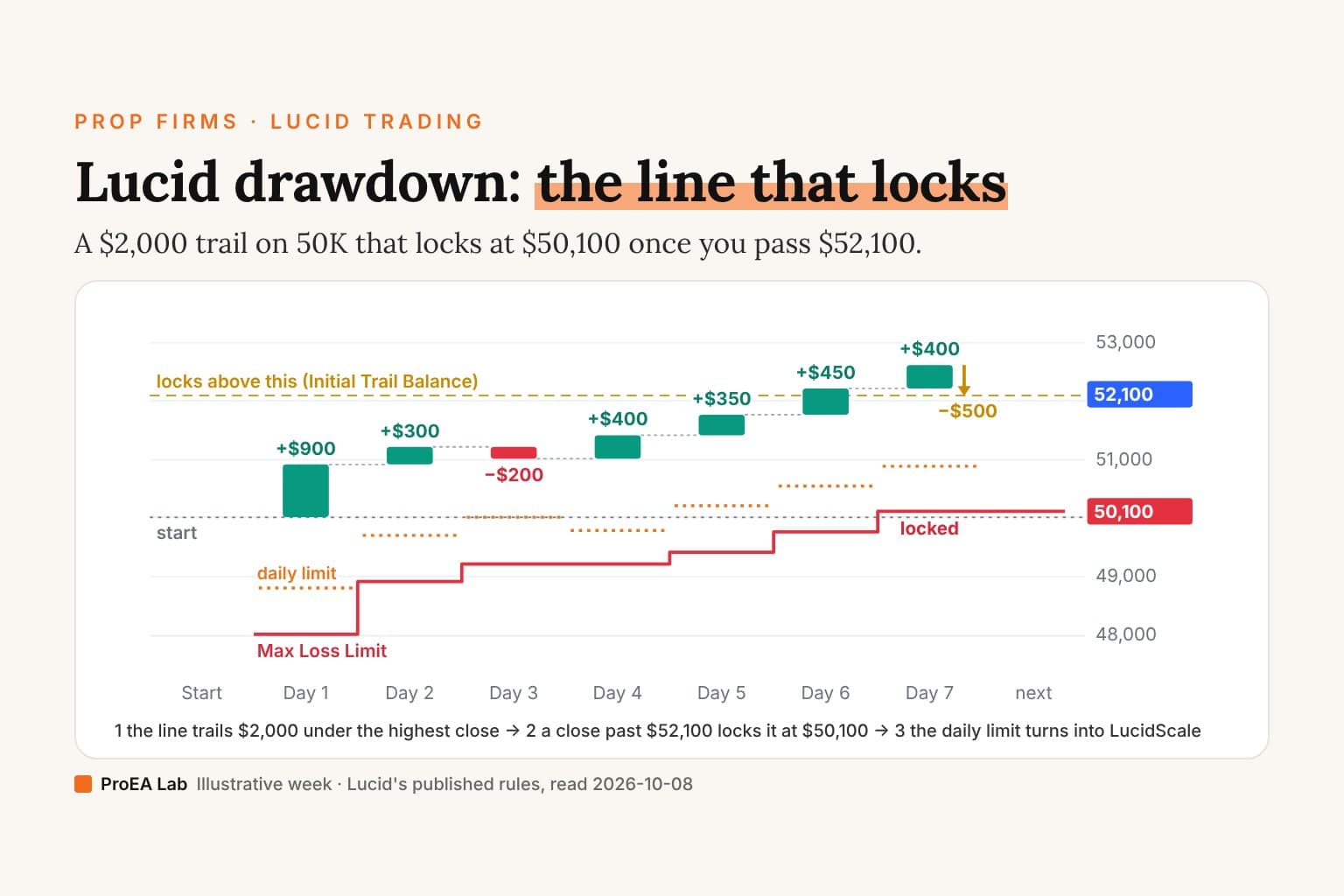
Five made-up days, read the way Lucid's formula reads them. The Max Loss Limit column follows the drawdown page: $2,000 under the highest close, locked at $50,100 once a close passes $52,100.
| Day | P&L | Close | Evaluation profit | Best day | Best day ÷ profit | Max Loss Limit after the close |
|---|---|---|---|---|---|---|
| 1 | +$600 | $50,600 | $600 | $600 | 100.00% | $48,600 |
| 2 | +$1,400 | $52,000 | $2,000 | $1,400 | 70.00% | $50,000 |
| 3 | +$400 | $52,400 | $2,400 | $1,400 | 58.33% | $50,100 (locked) |
| 4 | +$600 | $53,000 | $3,000 | $1,400 | 46.67% | $50,100 (locked) |
| 5 | +$500 | $53,500 | $3,500 | $1,400 | 40.00% | $50,100 (locked) |
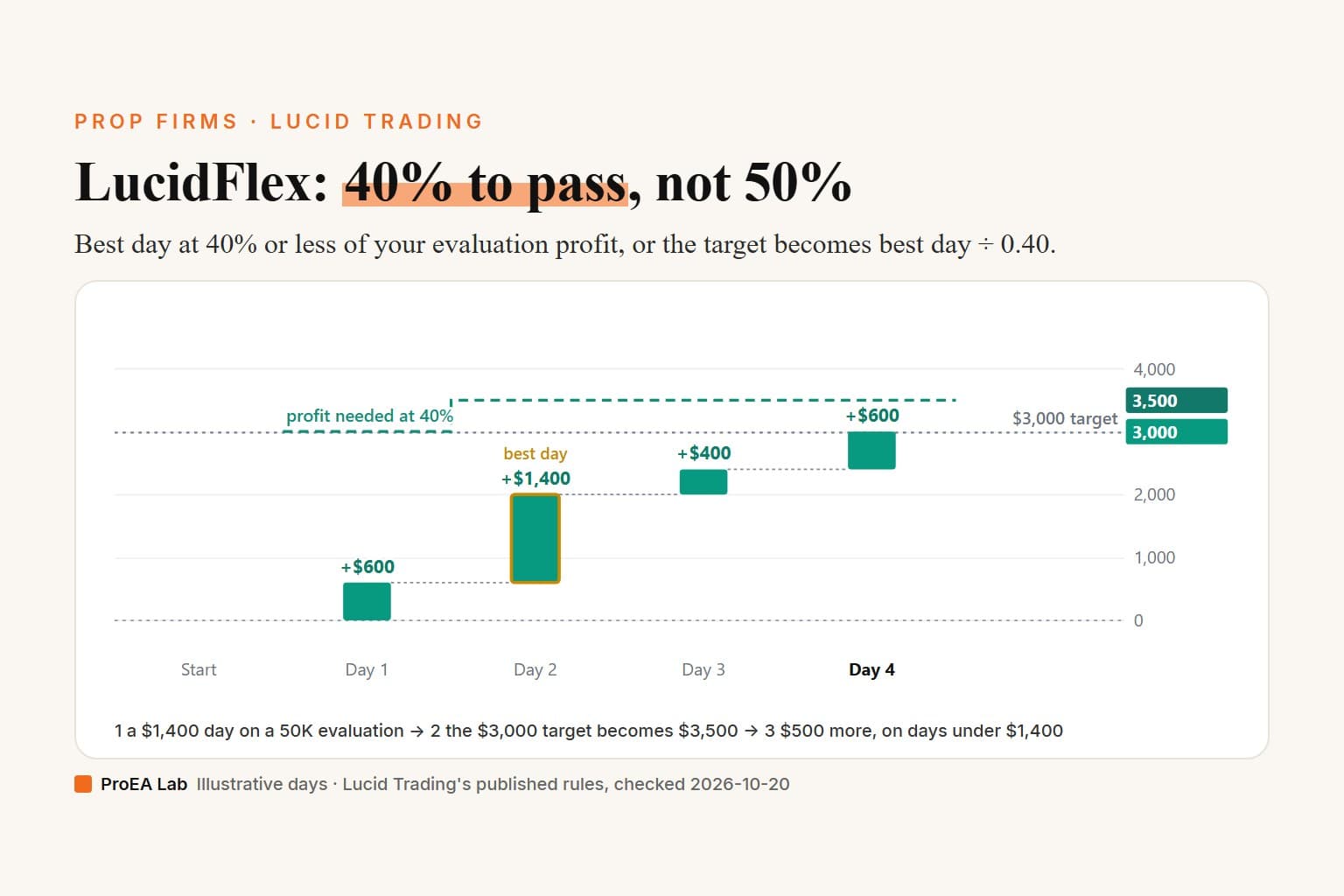
Day 4 reaches the $3,000 target. With the 50% add-on, 46.67% passes there. At the standard 40% it doesn't: $1,400 × 100 ÷ 40 = $3,500, so $500 more, made on days smaller than $1,400. Day 5 adds exactly that and lands on 40.00%, which is "40% or less". Had day 5 made $300 instead, you'd be at $3,300 and 42.42%, still $200 short.
At 40%, a $1,400 day on a 50K evaluation moves your real target from $3,000 to $3,500.The same arithmetic runs in our free Lucid consistency calculator: pick the LucidFlex evaluation, 40% or the 50% add-on, and enter your days. Every other Lucid plan's rule, stage by stage, is in Lucid's consistency rule; the plan that skips the evaluation and puts a 20% rule on every payout is LucidDirect.
The LucidFlex funded account
Funded, LucidFlex drops the consistency rule and has no payout buffer. Lucid's funded page sums it up: "an optional Daily Loss Limit, no consistency rule and no payout buffer. 90/10 profit split. EOD trailing drawdown."
Max Loss Limit. It's the same table as the evaluation. "At the end of each trading session, the system calculates the account's highest closing balance", the limit follows it up, and once the balance passes the Initial Trail Balance ($26,100 / $52,100 / $103,100 / $154,600) it locks at the starting balance plus $100. "If your account balance reached the MLL, your account will be breached." One rule is LucidFlex's alone: "Once you request a payout from LucidFlex, your MLL automatically adjusts to the Locked MLL Balance". Our Lucid drawdown simulator draws the line day by day.
Daily loss limit. You choose it at checkout, and "these settings cannot be changed for an active account". It's soft: "if you hit it you will simply be locked out until the next trading session". It applies to both the evaluation and the funded account. The help center prints no amount; the plan cards show $600 / $1,200 / $1,800 / $2,700, and the funded rules on the 25K card label it "DLL (Below Initial Trail)". Neither says what applies once the balance is above the Initial Trail Balance.
Scaling plan. Your contract limit follows your simulated profit and updates at the end of each session, not during it:
| Simulated profit | 25K | 50K | 100K | 150K |
|---|---|---|---|---|
| $0 to $999 | 1 mini or 10 micros | 2 minis or 20 micros | 3 minis or 30 micros | 4 minis or 40 micros |
| $1,000 to $1,999 | 2 minis or 20 micros | 3 minis or 30 micros | 4 minis or 40 micros | 5 minis or 50 micros |
| $2,000 to $2,999 | — | 4 minis or 40 micros | 5 minis or 50 micros | 6 minis or 60 micros |
| $3,000 to $4,499 | — | — | 6 minis or 60 micros | 8 minis or 80 micros |
| $4,500 and up | — | — | — | 10 minis or 100 micros |
A payout lowers your simulated balance, so "your scaling tier may adjust downward". Going over your limit on purpose "may result in having profit wiped for the day".
Sources, checked 2026-10-20: funded account, drawdown, customization, scaling plan, plan cards on lucidtrading.com.
LucidFlex payout rules
Each payout cycle needs two things, and both reset after every approved payout: 5 days with at least the minimum daily profit, and positive net profit in the cycle ("even just $1"). Then you can request 50% of profit, up to a cap that never grows.
| Account | Minimum daily profit, on 5 days | Max per payout | Profit for a $500 request | Profit for the full cap |
|---|---|---|---|---|
| $25,000 | $100 | 50% of profit, up to $1,000 | $1,000 | $2,000 |
| $50,000 | $150 | 50% of profit, up to $2,000 | $1,000 | $4,000 |
| $100,000 | $200 | 50% of profit, up to $2,500 | $1,000 | $5,000 |
| $150,000 | $250 | 50% of profit, up to $3,000 | $1,000 | $6,000 |
- Minimum $500, 90/10 split. At 50%, a $500 request takes $1,000 of profit. On 25K and 50K that's more than five days at the minimum make ($500 and $750), so there the minimum request, not the day count, sets your first payout.
- No buffer, no window. "There is no buffer balance that must be maintained in LucidFlex funded accounts", and "you may request a payout any day after meeting all eligibility criteria". Funds leave the account "within a few minutes" of approval and reach you "within 2 business days". Requests "are final once submitted".
- Don't trade it away. "If you take a trade before your payout is processed that drops your balance below the required amount, your request may be denied."
- Five payouts. "Traders may take up to 5 payouts from each LucidFlex account". What comes after is below.
On-demand payouts (on Lucid's pages since 2026-10-19, UTC). With the daily loss limit on, a funded account "can request payouts during the trading session, from profit made that session (6:00 PM to 3:45 PM ET)". After an intraday request, trading on the account "is paused until the end of the trading day", and "Accounts with a Hedging Violation are not eligible for intraday payouts." With the limit off, "payouts follow the regular end-of-day schedule." To compare LucidFlex's payouts with the other three plans on the same trades, see Lucid payout rules.
Sources, checked 2026-10-20: payouts (edited 2026-07-28), customization (edited 2026-10-19), plan cards on lucidtrading.com.
The first payout, and the room it leaves
An invented first cycle on a 50K funded account with the daily loss limit on. A day counts if it makes at least $150.
| Day | P&L | Close | Days at $150 or more | Cycle profit | Max Loss Limit after the close | Contract limit next session |
|---|---|---|---|---|---|---|
| 1 | +$400 | $50,400 | 1 | $400 | $48,400 | 2 minis or 20 micros |
| 2 | +$150 | $50,550 | 2 | $550 | $48,550 | 2 minis or 20 micros |
| 3 | −$250 | $50,300 | 2 | $300 | $48,550 | 2 minis or 20 micros |
| 4 | +$600 | $50,900 | 3 | $900 | $48,900 | 2 minis or 20 micros |
| 5 | +$300 | $51,200 | 4 | $1,200 | $49,200 | 3 minis or 30 micros |
| 6 | +$200 | $51,400 | 5 | $1,400 | $49,400 | 3 minis or 30 micros |
Day 6 is the fifth day at $150 or more, so the cycle qualifies. The most you can request is 50% of $1,400: $700, above the $500 minimum and under the $2,000 cap. You receive $630 after the 90/10 split.
Before the request you have $2,000 of room ($51,400 against $49,400). The request takes the balance to $50,700 and moves the Max Loss Limit to $50,100, so you're left with $600. Profit is now $700, back in the $0 to $999 tier, so the next session's limit is 2 minis.
Take the full 50% on a first payout and your room becomes half your profit minus $100.The smallest first payout leaves less: $500 on $1,000 of profit puts the balance at $50,500, $400 above the line. More profit before the first request means more room after it; on 50K the $2,000 cap only starts to bind at $4,000 of profit.
After Payout 5: the move to live
Payout 5 is the last one on a LucidFlex account. After it, you're in Lucid's live review pool, and its risk team decides whether you move to a live account.
The two pages word this differently (see the disagreements below). The live-program page says "Payout 5 represents the maximum payout level, not a guaranteed minimum for live eligibility" and that "All live transitions occur at the discretion of the Lucid risk team." Each funded account needs at least one payout to be moved, and live accounts have no consistency rule. What changes there, from the $0 starting balance to the Live Bonus, is in Lucid's live account rules.
Source, checked 2026-10-20: New Live Structure (edited 2026-10-14).
News, hours and the rest
News trading is allowed on LucidFlex: you "may enter or exit positions around scheduled or unscheduled news events" without a breach. Be flat by 4:45 PM EST, Monday to Friday; Lucid closes anything still open then, and holding past it "does not result in a failed account". Trading resumes at 6:00 PM EST, Sunday to Thursday.
Hedging, microscalping, account limits and commissions apply to every plan the same way; they're in the Lucid Trading rules hub, and the cutoff on your own clock is in Lucid's trading hours and news rules.
Sources, checked 2026-10-20: other trading activities, allowed trading times.
LucidFlex prices on 2026-10-20
These are one-time fees, as the plan cards print them, with no subscription.
| Account | LucidFlex evaluation |
|---|---|
| $25,000 | $89 |
| $50,000 | $146 |
| $100,000 | $293 |
| $150,000 | $407 |
The cards also show a lower coupon price and, with the daily loss limit on, a "LIMITED TIME — SAVINGS TOTAL" line. We don't reprint those because they change. Switching the daily loss limit off "Results in a higher evaluation purchase price", and the 50% add-on costs "a small fee"; Lucid gives neither amount. Check the total at checkout.
Source: plan cards on lucidtrading.com, checked 2026-10-20.
Where Lucid's pages disagree
- 40% or 50% to pass? The evaluation, consistency and customization pages, all edited 2026-10-19, say 40%, or 50% with the add-on. The plan cards on lucidtrading.com still showed "Consistency 50%" and a "2-day pass" on 2026-10-20. We go by the help center, the stricter reading.
- Balance or profit? The payouts text says you may request "50% of their account balance up to a maximum dollar amount". The table on the same page says "50% of Profit". We use profit; 50% of a $51,400 balance would be far over every cap anyway.
- Moved live, or reviewed? The payouts page says that after 5 payouts traders "will be moved live". The live-program page says Payout 5 is "not a guaranteed minimum for live eligibility" and that the risk team decides. We go by the live-program page.
Not published
- The price of the 50% consistency add-on, and how much more the evaluation costs with the daily loss limit off.
- The daily loss limit amounts, in the help center; the figures above come from the plan cards. Also what, if anything, replaces the limit once the balance is above the Initial Trail Balance.
- The formula behind the 50% add-on's cushion.
- From the second payout on, whether "50% of Profit" means this cycle's profit or the account's.
- Whether the minimum daily profit is counted net of commissions.
- Whether an intraday request is capped at the profit made in that session.
Where we sit
We don't run a prop firm, we're not affiliated with Lucid Trading, and we earn nothing if you buy from Lucid. We sell the Prop Firm Challenge Toolkit, a TradingView indicator that turns rule numbers you enter into dollar buffers on your chart. It has no Lucid preset, so use its Custom rules. For a 50K LucidFlex:
| Toolkit setting (Custom) | 50K LucidFlex | From |
|---|---|---|
| Max loss % | 4 | $2,000 of $50,000 |
| Drawdown mode | Trailing EOD | the highest end-of-day balance |
| Daily loss % | 2.4 with the limit on, 0 with it off | $1,200 of $50,000 |
| Daily limit is soft | On | locked out until the next session, not failed |
| Profit target % | 6 in the evaluation | $3,000 of $50,000 |
| Min trading days | 0 | none required |
| Consistency % (0=off) | 0 | v1.4.0 can't check it (below) |
| Reset timezone, hour | America/New_York, 18 | sessions resume at 6:00 PM |
Where it differs from Lucid, plainly. The toolkit locks its trailing floor at your starting balance; Lucid locks at the starting balance plus $100, so after the lock its floor sits $100 below Lucid's. It doesn't know that a LucidFlex payout moves the line to $50,100. It doesn't read Lucid's dashboard, which stays the source of truth: you type the balance in, and the high it trails is the balance you type, so after a pullback from a higher close its floor sits under Lucid's, showing more room than you have. It takes the daily limit as a percentage of the balance you type, which it treats as the day's start, so on a $52,000 morning 2.4% is $1,248, not Lucid's fixed $1,200. It can't see losses you've already closed today: keep Current balance at the session's starting balance and put the day's running P&L, closed and open, in Open floating P/L.
It can't check the 40% rule. Its consistency tracker row, in the version we sell (v1.4.0), only knows the balance you type in now, so it never sees a best day and reads 0%, and its PASSED means only that the target is reached. Check your best day with the free Lucid consistency calculator.
Sources and their last edits
Each page was read on 2026-10-20. Dates are the help center's own last-edit stamps (UTC).
- LucidFlex Evaluation Account, edited 2026-10-19; LucidFlex Consistency Percentage, 2026-10-19; LucidFlex Customization, 2026-10-19.
- LucidFlex Funded Account, 2026-10-13. Against the Internet Archive's copy of 2026-10-09, the only change is a promotional image; every rule reads the same.
- LucidFlex Payouts, 2026-07-28; LucidFlex Drawdown, 2026-08-26; LucidFlex Scaling Plan, 2026-05-06.
- New Live Structure, 2026-10-14; Other Trading Activities and Allowed Trading Times, 2026-08-26.
- The plan cards on lucidtrading.com carry no date; we read them on 2026-10-20.
Disclosure
The evaluation and the payout cycle above use invented days and Lucid's published rules. Neither is a forecast, and neither says whether a LucidFlex account is worth buying. Lucid's dashboard decides your pass and your payout, not this page. If a number here no longer matches Lucid's pages, email support@pulltrade.app and we'll correct it in public.
Frequently asked questions
What are the LucidFlex evaluation rules?
Reach the profit target ($1,250, $3,000, $6,000 or $9,000 on the 25K to 150K accounts) before your balance touches the Max Loss Limit, which trails $1,000 to $4,500 below your highest end-of-day balance. Your best day must be 40% or less of your evaluation profit, or 50% if you bought the add-on at checkout. There is no minimum day count; Lucid says you can pass in as few as 3 days at 40%, or 2 with the add-on.
Can you pass LucidFlex in 2 days?
Only with the 50% consistency add-on, which you buy at checkout for a fee Lucid doesn't publish. At the standard 40%, two days can't pass, because the better of two days is always at least half the profit. Three can: three days of $1,000 on a 50K account pass at 33.33%. A reset goes back to 40%.
Does LucidFlex have a consistency rule when funded?
No. Lucid's LucidFlex funded and customization pages both say funded accounts have no consistency rule; the 40% rule, or 50% with the add-on, applies to the evaluation only. A funded payout needs 5 days with at least the minimum daily profit ($100, $150, $200 or $250 by account size) and positive net profit in the cycle.
What is the max payout on a LucidFlex account?
50% of profit, up to $1,000 on 25K, $2,000 on 50K, $2,500 on 100K and $3,000 on 150K, and the caps don't grow with later payouts. The minimum request is $500, so a first payout needs at least $1,000 of profit. Lucid allows 5 payouts per account.
What happens to the LucidFlex drawdown after a payout?
Requesting a payout moves your Max Loss Limit straight to its locked level, the starting balance plus $100 ($50,100 on 50K), even if it hadn't locked yet. Take the full 50% on a first payout and the room you keep is half your profit minus $100: $600 after a $700 request on $1,400 of profit.
Does LucidFlex have a daily loss limit?
Only if you switch it on at checkout, and you can't change that on an active account. The plan cards show $600, $1,200, $1,800 or $2,700 by size; the help center calls it optional but prints no amount. It's soft: hitting it locks you out until the next session without failing the account. Keeping it on lowers the price and gives the funded account on-demand payouts during the session.
How many payouts before a LucidFlex account goes live?
Up to 5. Lucid's LucidFlex payouts page says you'll then be moved live, but its live-program page says Payout 5 is the maximum payout level, not a guaranteed minimum, and that every move to live is at the discretion of Lucid's risk team.