Blue Guardian rules, read on 2026-10-19: an Instant account with no evaluation and four evaluation models, 1-Step Standard (a 9% target), 1-Step Nano (10%), 2-Step Standard (8% then 4%) and 2-Step Nano (8% then 5%). The daily loss is 3% or 4% of the initial balance, reset at 5:00 PM EST; the maximum loss is a 6% trailing drawdown that locks at the start, or a static 8% or 10%. Funded, these five pay 80% or 85% by default.
Blue Guardian plans at a glance
| Plan | Steps | Profit target | Daily loss | Maximum loss | Minimum days | Consistency rule | Split when funded | Payouts |
|---|---|---|---|---|---|---|---|---|
| Instant | None | None | 3% | 6%, trailing, locks at the start | 5 profitable days before a payout | 20% (15% on $300K and $400K) | 80%, 90% with an add-on | On demand |
| 1-Step Standard | 1 | 9% | 4% | 6%, trailing, locks at the start | 3 profitable days to pass | None | 85%, 90% with an add-on | Every 14 days, 7 with an add-on |
| 1-Step Nano | 1 | 10% | 4% | 6%, trailing, locks at the start | None to pass; 5 when funded | 50%, challenge and funded | 85%, 100% with an add-on | Every 7 days |
| 2-Step Standard | 2 | 8%, then 4% | 4% | 8%, static | 3 profitable days to pass | None | 85%, 90% with an add-on | Every 14 days, 7 with an add-on |
| 2-Step Nano | 2 | 8%, then 5% | 3% | 10%, static | None | 50%, funded only | 80% | Every 14 days, capped at 2% |
A profitable day makes at least 0.5%. Instant runs from $5,000 to $400,000, the 2-Step Nano from $25,000 to $200,000, the rest from $5,000 to $200,000. The cards set no time limit, but 30 days without a trade breaches an account. Every account, funded ones included, is a demo account "with virtual funds." You may hold $400,000 of funded accounts at once; 12% profit in 3 months adds 30% of the initial balance, up to $4,000,000. Legacy models, futures accounts and the "Fast-Track Ticket" (blueguardian.com/fast-track, $5,000 to $200,000) aren't covered here.
Sources, checked 2026-10-19: the plan cards on blueguardian.com; the rules for Instant (edited 2026-10-05), 1-Step Standard, 1-Step Nano, 2-Step Standard and 2-Step Nano (2026-09-09); General Information (2026-10-09).
How Blue Guardian measures daily loss and drawdown
The trading day runs from 5:00 PM EST to 5:00 PM EST; Blue Guardian doesn't say whether that moves with US daylight time. As New York time it's 21:00 UTC on US daylight time and 22:00 UTC otherwise: 10 PM in London most of the year (9 PM in the weeks US and UK clocks differ). As a fixed UTC−5 it's 22:00 UTC all year: 23:00 London in summer, 22:00 in winter.
At the reset Blue Guardian takes "the higher figure of either the account balance or account equity" and subtracts a fixed 3% or 4% of the initial balance; equity may not go under that line before the next reset. Its example: $102,000 of equity on $100,000 at 4% puts the floor at $98,000. An open loss doesn't lower the floor, which then comes off the balance.
On Instant and both 1-Steps the maximum loss trails "your Highest Watermark Closing Trade" by 6% of the initial balance and, once the account is 6% up, "will lock in at your starting balance." On the 2-Steps it's static: on a $100,000 2-Step Standard, "Your account equity including unrealized/floating positions must not hit/exceed below $92,000."
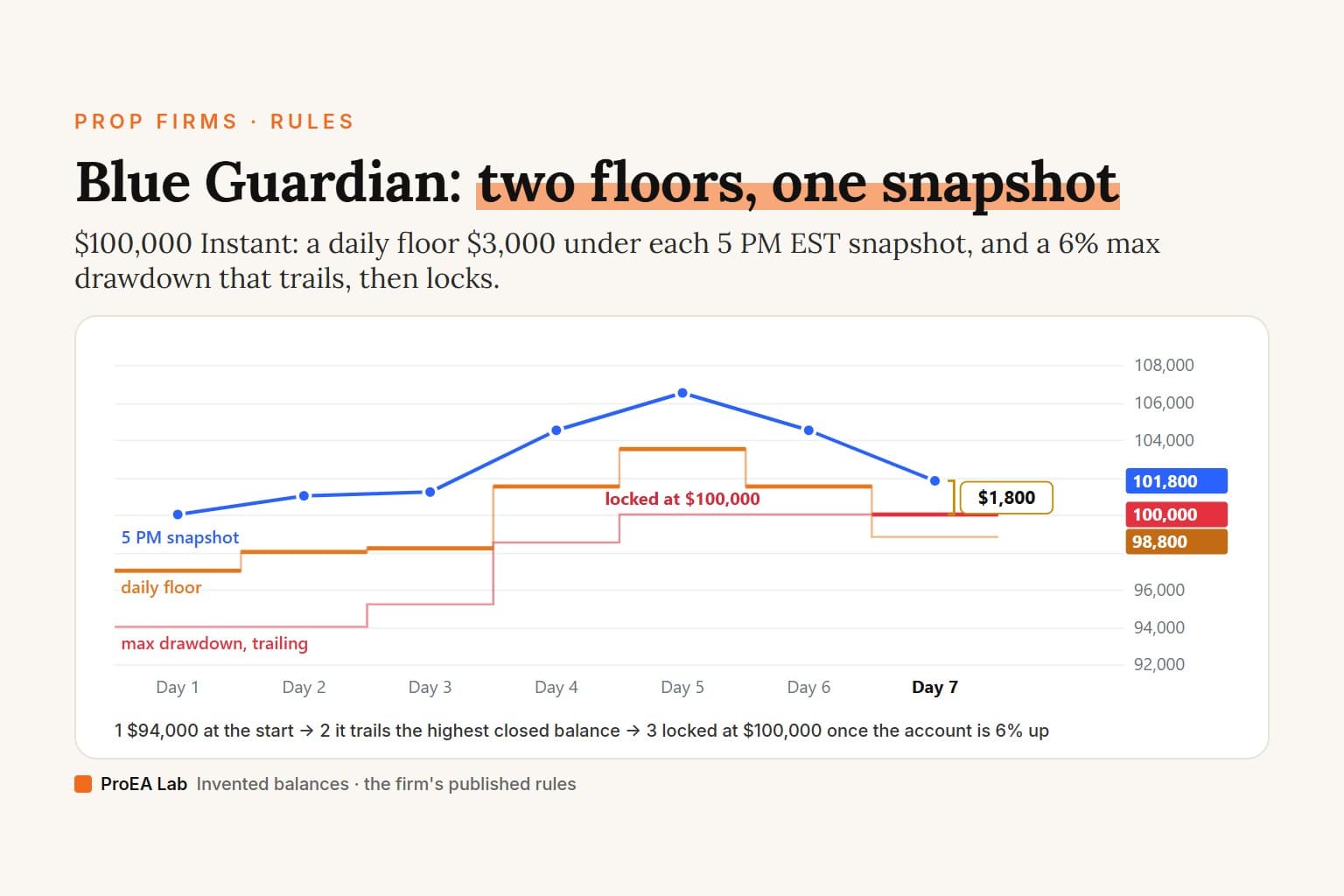
Day 7: the daily floor drops to $98,800, under the $100,000 max drawdown, which binds: $1,800 of room.
Illustrative balances, not market data: all seven days are invented. The rules are Blue Guardian's, as quoted in the drawdown section and read 2026-10-19: a daily floor 3% of the initial balance under the higher of balance and equity at 5:00 PM EST, and a max drawdown 6% under the highest closed balance that locks at the starting balance.
Rule: daily floor = the 5:00 PM EST snapshot (the higher of balance and equity) − $3,000; max drawdown = the highest closed balance − $6,000, never above $100,000. Equity under the daily floor is a breach; Blue Guardian doesn't say whether open losses count against the max drawdown. The higher floor binds.
Read as text
- Day 1 (invented): balance $100,000, equity $100,000 at 5:00 PM EST; the snapshot is the higher, $100,000. Daily floor $100,000 − $3,000 = $97,000; max drawdown $94,000 (trailing). The tighter is the daily floor, $3,000 away.
- Day 2 (invented): balance $100,000, equity $101,000 at 5:00 PM EST; the snapshot is the higher, $101,000. Daily floor $101,000 − $3,000 = $98,000; max drawdown $94,000 (trailing). The tighter is the daily floor, $3,000 away.
- Day 3 (invented): balance $101,200, equity $100,500 at 5:00 PM EST; the snapshot is the higher, $101,200. Daily floor $101,200 − $3,000 = $98,200; max drawdown $95,200 (trailing). The tighter is the daily floor, $3,000 away.
- Day 4 (invented): balance $104,500, equity $104,500 at 5:00 PM EST; the snapshot is the higher, $104,500. Daily floor $104,500 − $3,000 = $101,500; max drawdown $98,500 (trailing). The tighter is the daily floor, $3,000 away.
- Day 5 (invented): balance $106,500, equity $106,500 at 5:00 PM EST; the snapshot is the higher, $106,500. Daily floor $106,500 − $3,000 = $103,500; max drawdown $100,000 (locked). The tighter is the daily floor, $3,000 away.
- Day 6 (invented): balance $104,500, equity $104,500 at 5:00 PM EST; the snapshot is the higher, $104,500. Daily floor $104,500 − $3,000 = $101,500; max drawdown $100,000 (locked). The tighter is the daily floor, $3,000 away.
- Day 7 (invented): balance $101,800, equity $101,800 at 5:00 PM EST; the snapshot is the higher, $101,800. Daily floor $101,800 − $3,000 = $98,800; max drawdown $100,000 (locked). The tighter is the max drawdown, $1,800 away.
Breach: equity reaches the max drawdown, $100,000. Blue Guardian breaches the account.
Snapshots and floors from the film's invented days, under Blue Guardian's rules as quoted on this page, read 2026-10-19. The slider is the day's closed losses from the 5:00 PM EST snapshot, with no profit closed before them (a closed profit can lift the Instant account's trailing floor during the day). Open trades are left out: on a funded account the Guardian Shield closes them once they're down 1% together (Instant) or 2% (1-Step Standard and 2-Step Standard). Touching a floor counts as a breach here; slippage isn't modelled.
The check opens on Instant's Day 7: −$2,000 of closed losses from $101,800 breaches the locked $100,000 floor (an open −$1,000 trips the Shield).
Seven invented days on a $100,000 Instant account (3% daily, 6% trailing); each day's 5 PM balance is also its highest closed balance:
| Day | Balance at 5 PM EST | Equity at 5 PM EST | Snapshot, the higher | Daily floor | Max drawdown | Tighter floor | Room from the snapshot |
|---|---|---|---|---|---|---|---|
| 1 | $100,000 | $100,000 | $100,000 | $97,000 | $94,000 | Daily | $3,000 |
| 2 | $100,000 | $101,000 | $101,000 | $98,000 | $94,000 | Daily | $3,000 |
| 3 | $101,200 | $100,500 | $101,200 | $98,200 | $95,200 | Daily | $3,000 |
| 4 | $104,500 | $104,500 | $104,500 | $101,500 | $98,500 | Daily | $3,000 |
| 5 | $106,500 | $106,500 | $106,500 | $103,500 | $100,000 (locked) | Daily | $3,000 |
| 6 | $104,500 | $104,500 | $104,500 | $101,500 | $100,000 (locked) | Daily | $3,000 |
| 7 | $101,800 | $101,800 | $101,800 | $98,800 | $100,000 (locked) | Max drawdown | $1,800 |
On Day 2, $1,000 of open profit at 5 PM puts the daily floor at $98,000, only $2,000 under the closed balance. On Day 3 a $700 open loss leaves equity $2,300 above the floor. Day 5's $106,500 passes the $106,000 that is 6% up, so the trailing floor locks at $100,000, and by Day 7 it binds.
Five invented days on a $100,000 2-Step Standard account (4% daily, $92,000 static):
| Day | Balance at 5 PM EST | Equity at 5 PM EST | Snapshot, the higher | Daily floor | Max drawdown | Tighter floor | Room from the snapshot |
|---|---|---|---|---|---|---|---|
| 1 | $100,000 | $100,000 | $100,000 | $96,000 | $92,000 | Daily | $4,000 |
| 2 | $101,500 | $102,300 | $102,300 | $98,300 | $92,000 | Daily | $4,000 |
| 3 | $98,800 | $98,800 | $98,800 | $94,800 | $92,000 | Daily | $4,000 |
| 4 | $95,000 | $95,000 | $95,000 | $91,000 | $92,000 | Max drawdown | $3,000 |
| 5 | $93,500 | $93,500 | $93,500 | $89,500 | $92,000 | Max drawdown | $1,500 |
Day 2's $800 of open profit puts the floor $3,200 under the closed balance; below a $96,000 snapshot the static line binds first.
Blue Guardian Instant funding rules
Instant has no target: you sign the Trader Agreement and trade a funded account from the start. Once it has 5 profitable days, a balance above the start, no open positions and a best day under 20% of the period's profit, you can request a payout at any time. The split is 80%, or 90% with an add-on; forex leverage is 1:30.
On $300,000 and $400,000 accounts the consistency rule is 15%, and the first two payouts are capped (see the payout rules). Once the drawdown has locked, 1% of the initial balance must stay in the account: Blue Guardian's example, $6,000 of profit on $100,000, lets you withdraw $5,000.
The Instant Starter (edited 2026-10-09) is a one-off $5,000 account, one per trader: 3% daily, 5% trailing, 15% consistency, a 90% split, news allowed, a $250 profit cap and one payout. Buy Now Pay Later (2026-10-06) is a 1-step challenge (4% target, 4% daily, 8% trailing); pass, pay an activation fee ($686 on $100,000), and the funded account pays 80% on demand under a 20% rule.
Blue Guardian 1-Step and 2-Step rules
- 1-Step Standard: a 9% target for accounts bought from August 20 (no year given), 10% for earlier ones. The challenge card shows 1:100 leverage; Platform Rules say 1:50.
- 2-Step Standard: 3 profitable days to pass from August 20, 5 before.
- 1-Step Nano: no minimum days to pass, 5 once funded; 50% consistency in both stages; a 100% split add-on.
- 2-Step Nano: no minimum days; each payout capped at 2% of the initial balance, $2,000 on $100,000.
- Buffer: the 1-Steps keep Instant's 1% once their drawdown locks.
What is Blue Guardian's Guardian Shield?
Once open trades together are down 1% (Instant, Instant Starter, funded Buy Now Pay Later) or 2% (funded 1-Step Standard and 2-Step Standard), the Guardian Shield "will, in most cases, automatically close all open trades for all symbols": $1,000 or $2,000 on $100,000. You can trade on, but the first one cuts your split to 50% for good and the second "permanently" breaches the account. An EA holding several positions trips it on their combined loss. The Nano articles don't mention it.
Blue Guardian consistency rule
A consistency rule caps your best day as a share of the profit (how consistency rules work). Blue Guardian has none on the 1-Step Standard or the 2-Step Standard.
| Plan | Best day must stay under | Where it applies |
|---|---|---|
| Instant | 20% (15% on $300K and $400K) | Before each payout |
| Instant Starter | 15% | Before its one payout |
| 1-Step Nano | 50% | Challenge and funded |
| 2-Step Nano | 50% | Funded only |
| Buy Now Pay Later | 20% | Funded only |
Where the articles say what happens, going over doesn't fail the account; the payout waits until more profit brings the best day under the line. Blue Guardian's examples: a $1,000 day needs $5,000 of total profit at 20%, more than $2,000 at 50%.
Blue Guardian payout rules
The payouts article (edited 2026-10-18) sets the rule for funded accounts: a first payout once the minimum days are done and 14 calendar days have passed since your first trade, then every 14 days, or 7 and 7 with the add-on. The 1-Step Nano's article says every 7 days without one; Instant and Buy Now Pay Later pay on demand.
- To request: above the starting balance, flat, KYC done; the account is read-only until approval.
- Methods: crypto from $100 for amounts under $5,000; Rise from $500, no maximum. Every payout carries a 3% processing fee.
- Speed: "within 24 business hours." Under the 24-hour guarantee a late eligible payout earns 10% more profit share, weekends, holidays, reviews and Rise onboarding excepted.
- Caps: $10,000 for each of the first two payouts on $200,000 to $400,000 accounts; 2% a cycle on the 2-Step Nano; $250 once on the Instant Starter.
- Fee back: after the fourth payout, for accounts bought from January 21, 2026, not the Instant Starter.
Blue Guardian news trading rules
Challenges allow news trading. Funded challenge accounts must not open or close trades "5 minutes before and 5 minutes after red folder (high-impact) news events" or around FOMC speeches and statements; the profit is removed, "without any account violation." For a US release at 8:30 AM ET that's 8:25 to 8:35 AM ET: 12:25 to 12:35 UTC on US daylight time, 13:25 to 13:35 UTC otherwise, 1:25 to 1:35 PM in London most of the year. The calendar isn't named.
Instant Standard accounts bought after November 13, 2025 can't trade news at all; the Instant Starter can. USD news and FOMC also reach XAUUSD, XAGUSD, NDX100, SPX500, US30, BTCUSD and ETHUSD; EUR reaches GER40, GBP UK100, JPY JPN225.
Blue Guardian rules for EAs, copy trading and HFT
- EAs: "EAs are allowed. You may use EAs (Expert Advisors) that you setup to suit your own strategy or trading style." A VPS is fine unless it gets round the copy-trading rules.
- Bought EAs: the Terms ban "any third-party strategy, off-the-shelf strategy or one marketed to pass challenge accounts," not defined, so whether a bought EA counts is vague. Ask support in writing first.
- Banned: trades closed in under 2 minutes (tick scalping), high-frequency trading, arbitrage (bots, reverse, latency, hedge), trade emulators, hedging across accounts, and devices or a VPS shared with other traders. Margin use above 80% counts as gambling.
- Grid and martingale: not named; the nearest line is the Terms' "Excessive cumulative risk taking" over "a series of overlapping simulated-trades."
- Copy trading: only between accounts you own, at Blue Guardian or elsewhere.
- Overnight and weekends: "no restrictions" on any account type.
Platforms are MetaTrader 5, Match-Trader and TradeLocker. Commission is $5 a lot on forex and commodities, none on indices or crypto; stop-out is at a 100% margin level.
| Account | Forex | Indices | Commodities | Crypto |
|---|---|---|---|---|
| 1-Step challenge | 1:50 | 1:20 | 1:20 | 1:2 |
| 2-Step challenge and funded; funded 1-Step | 1:50 | 1:10 | 1:10 | 1:2 |
| Instant and Instant Starter | 1:30 | 1:10 | 1:10 | 1:2 |
Sources, checked 2026-10-19: Prohibited Trading Practices (edited 2026-06-25), Platform Rules (2026-08-21), the Terms (undated).
Who can sign up for Blue Guardian?
You must be 18 or older. The General Information article restricts Afghanistan, Albania, Algeria, Cuba, Iran, Jordan, Libya, Myanmar, North Korea, the Philippines, Senegal, Syria and Vietnam. The US, the UK, Canada and Australia aren't on it, so their residents can sign up on what the list says, but "Existing and prospective US clients are restricted to using Match Trader and TradeLocker only": no MT5. The Terms (Iconic Exchange FZCO, trading as Blue Guardian, under UAE law) list no countries and say the products "may not be available in your country." We give no legal or tax view.
Blue Guardian prices on 2026-10-19
| Size | Instant | 1-Step Standard | 1-Step Nano | 2-Step Standard | 2-Step Nano |
|---|---|---|---|---|---|
| $5,000 | $72 | $40 | $26.66 | $32 | Not sold |
| $10,000 | $100 | $66 | $38.66 | $75 | Not sold |
| $25,000 | $208 | $134 | $78.66 | $154 | $66.66 |
| $50,000 | $324 | $200 | $160 | $232 | $127 |
| $100,000 | $623 | $398 | $320 | $463 | $239 |
| $200,000 | $954 | $736 | $585 | $930 | $460 |
| $300,000 | $1,712 | Not sold | Not sold | Not sold | Not sold |
| $400,000 | $2,200 | Not sold | Not sold | Not sold | Not sold |
One-time list prices from the plan cards. The checkout's public product data labels the $100,000 Instant price USD (read from Thailand). A 25% code ran that day, with 30% to 40% more off 2 to 4 accounts; discounts change often. The Instant Starter showed $11 ($27 list); Buy Now Pay Later, $10 to start (its page's headline says $5) plus $52 to $1,033 on passing.
Where do Blue Guardian's own pages disagree?
- Profit splits. Instant's card: "90% Profit Split"; the Instant and payouts articles: 80%, 90% with the add-on. The 2-Step Nano's card: "Up to 100%"; its article: 80%, no add-on. How It Works: "up to a 95% profit split."
- Standard payouts. Cards: "Payouts in 7 days" and "Up To Weekly." Articles: every 14 days, 7 with the add-on.
- 1-Step challenge leverage. 1:100 on the card, 1:50 in Platform Rules.
- The daily loss base. The card's tooltip: "the day's starting balance." The articles: the higher of balance and equity at 5 PM EST.
- Instant and news. The article's summary says "Restricted 5 minutes before and after"; its body and the card say none at all after November 13, 2025.
- How many challenges. General Information: "as many challenge accounts as you like." The Terms: "one active account per challenge level, absent prior written approval."
- Demo or live. General Information: funded accounts "are demo accounts." The Terms: those who pass "shall be allocated capital to trade in a live account."
- The $10,000 cap. The Instant article's heading names $300K and $400K; its text and the payouts article add $200,000.
- Consistency at the line. "Equal to" the limit blocks a payout, yet the examples call it enough: $1,000 of $5,000 at 20%, $6,666 at 15% (15.0015%).
Not published
- The server time, and whether "5pm EST" follows US daylight time.
- Whether open losses count against the trailing drawdown before the trades close.
- What makes a strategy "off-the-shelf."
- Whether the 3% fee comes off the gross or your share, which accounts the 24-hour guarantee covers, and the add-on prices.
Compare FundedNext and E8 Markets; more on the prop firm rules hub.
Where we sit
We're not affiliated with Blue Guardian and earn nothing if you buy from it. We sell the Prop Firm Challenge Toolkit, a TradingView indicator that turns the rule numbers and balance you enter into loss and target buffers. It has no Blue Guardian preset, so set its Custom rules from the tables above. It doesn't read Blue Guardian's dashboard, which is the source of truth. The balance you type is both its day's start and the high a trailing limit follows, so it can't see losses you've already closed today or an earlier, higher close: keep Current balance at the session's starting balance and put the day's running P&L, closed and open, in Open floating P/L.
Disclosure
Every rule is quoted or summarized from the linked Blue Guardian page as read on 2026-10-19. The film and the check use invented days under Blue Guardian's published rules: not a forecast, and no view on whether an account is worth buying. If a row no longer matches Blue Guardian's pages, email support@pulltrade.app and we'll correct it in public.
Use this animation on your site.
Frequently asked questions
What are Blue Guardian's rules in 2026?
Blue Guardian's main plans are an Instant account with no evaluation and four evaluation models: 1-Step Standard (a 9% target), 1-Step Nano (10%), 2-Step Standard (8% then 4%) and 2-Step Nano (8% then 5%). The daily loss is 3% or 4% of the initial balance, reset at 5:00 PM EST. The maximum loss is a 6% trailing drawdown that locks at the starting balance (Instant and both 1-Steps) or a static 8% or 10% (the 2-Steps). Funded, these five pay 80% or 85% by default.
How does Blue Guardian's daily drawdown work?
At 5:00 PM EST Blue Guardian takes the higher of your balance and your equity and subtracts a fixed 3% (Instant, 2-Step Nano) or 4% (1-Step plans, 2-Step Standard) of the initial balance. Equity may not fall under that line before the next reset. An open profit at the reset raises the floor; an open loss doesn't lower it. Blue Guardian's own example: $102,000 of equity on a $100,000 account at 4% puts the floor at $98,000.
What are Blue Guardian's Instant funding rules?
No target: you trade a funded account from the start, with a 3% daily loss and a 6% trailing drawdown that locks at the starting balance once you're 6% up. A payout needs 5 profitable days of at least 0.5%, a best day under 20% of the period's profit (15% on $300,000 and $400,000) and no open trades. The split is 80%, or 90% with an add-on. Accounts bought after November 13, 2025 can't trade news, and the Guardian Shield closes open trades once they're down 1% together.
Does Blue Guardian have a consistency rule?
Not on the 1-Step Standard or the 2-Step Standard. Instant has 20% (15% on $300,000 and $400,000), the Instant Starter 15%, the 1-Step Nano 50% in the challenge and when funded, the 2-Step Nano 50% when funded only. Where Blue Guardian says what happens, going over doesn't fail the account: the payout button stays off until more profit brings your best day back under the line.
How do Blue Guardian payouts work?
On funded challenge accounts the first payout comes once the minimum days are done and 14 calendar days have passed since your first trade, then every 14 days, or every 7 with an add-on; the 1-Step Nano's own article says every 7 days, and Instant pays on demand. You must be flat and above the starting balance. Crypto pays from $100 for amounts under $5,000, Rise from $500; every payout carries a 3% processing fee and is processed within 24 business hours.
Can you trade news with Blue Guardian?
In the challenge, yes. On funded challenge accounts Blue Guardian removes the profit of trades opened or closed from 5 minutes before to 5 minutes after high-impact news and FOMC events, without failing the account. Instant Standard accounts bought after November 13, 2025 can't trade news at all; the Instant Starter can.
Does Blue Guardian allow EAs and copy trading?
EAs are allowed if you set them up for your own strategy, but the Terms ban off-the-shelf strategies and ones marketed to pass challenges, without defining either. Copy trading is allowed only between accounts you own. Banned: high-frequency trading, arbitrage, tick scalping (trades closed in under 2 minutes) and hedging across accounts; margin use above 80% counts as gambling.
Can US, UK, Canadian and Australian residents join Blue Guardian?
None of the four is on Blue Guardian's restricted list, which names Afghanistan, Albania, Algeria, Cuba, Iran, Jordan, Libya, Myanmar, North Korea, the Philippines, Senegal, Syria and Vietnam. US clients can use only Match-Trader and TradeLocker, not MT5. You must be 18 or older.