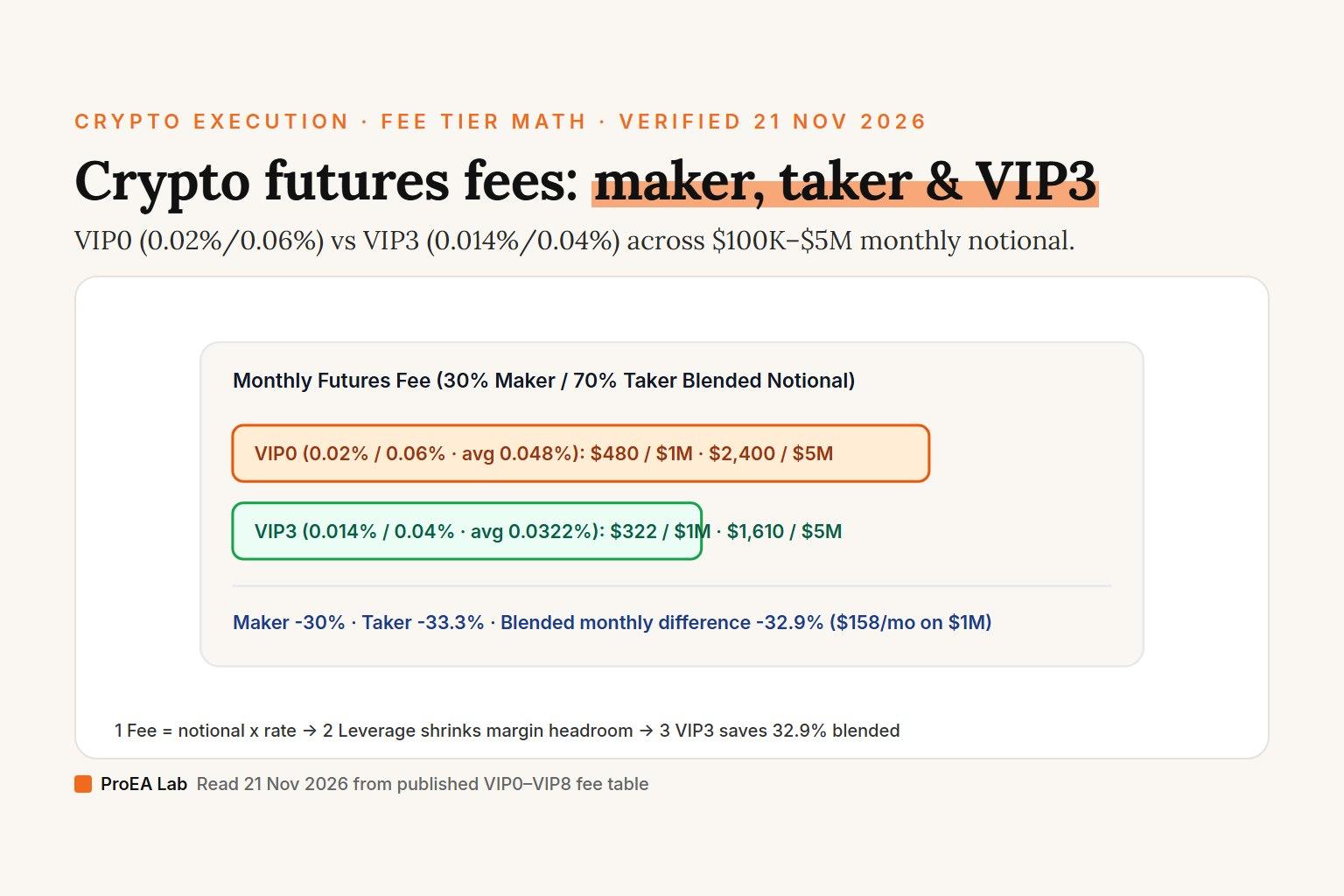
Crypto futures trading fees are charged on total leveraged notional value — not on the margin deposited — making order type (0.02% maker vs 0.06% taker at VIP0) and VIP tier the primary drivers of execution cost. At VIP3 (0.014% maker / 0.04% taker), maker fees drop 30%, taker fees drop 33.3%, and a blended 30% maker / 70% taker trader pays 32.9% less in futures fees than at VIP0 (less than that against VIP1 or VIP2, which volume reaches from 1,000,000 and 5,000,000 USDT a month).
Run your exact monthly volume, maker percentage, and leverage through the futures fee calculator or check your tier progress in the crypto VIP fee tier calculator.
How maker vs taker fees are calculated on notional size
Every perpetual futures fill computes Fee = Position Notional × Fee Rate, where Position Notional = Contracts × Fill Price:
- Maker fills (
0.02%at VIP0): Limit orders placed away from the spread withPost Onlyenabled add depth to the book. Each$100,000notional fill costs$20at VIP0 ($14at VIP3). - Taker fills (
0.06%at VIP0): Market orders, stop-loss market triggers, and crossing limit orders remove liquidity immediately. Each$100,000notional fill costs$60at VIP0 ($40at VIP3) — three times the maker rate. - Both sides pay: Opening a trade and closing a trade are separate executions. A full round-trip trade pays entry fee plus exit fee.
Because stop-losses and momentum breakout entries almost always execute as taker orders, active traders rarely achieve 100% maker flow. Blending 30% maker and 70% taker produces an effective per-side rate of 0.048% (4.8 bps) at VIP0 vs 0.0322% (3.22 bps) at VIP3.
Why leverage multiplies fee drag relative to margin
Changing leverage from 1x to 10x or 20x does not change the dollar fee on a fixed position size, because notional value is fixed. However, when traders size positions to match a fixed margin deposit, higher leverage inflates notional value and magnifies fee drag as a share of equity:
- 10x leverage (
$1,000margin =$10,000notional): A100%taker round trip (0.12%combined at0.06%per side) costs$12, consuming1.2%of initial margin before the market moves ($8, or0.8%, at VIP3). - 20x leverage (
$1,000margin =$20,000notional): The same100%taker round trip costs$24, immediately consuming2.4%of margin ($16, or1.6%, at VIP3).
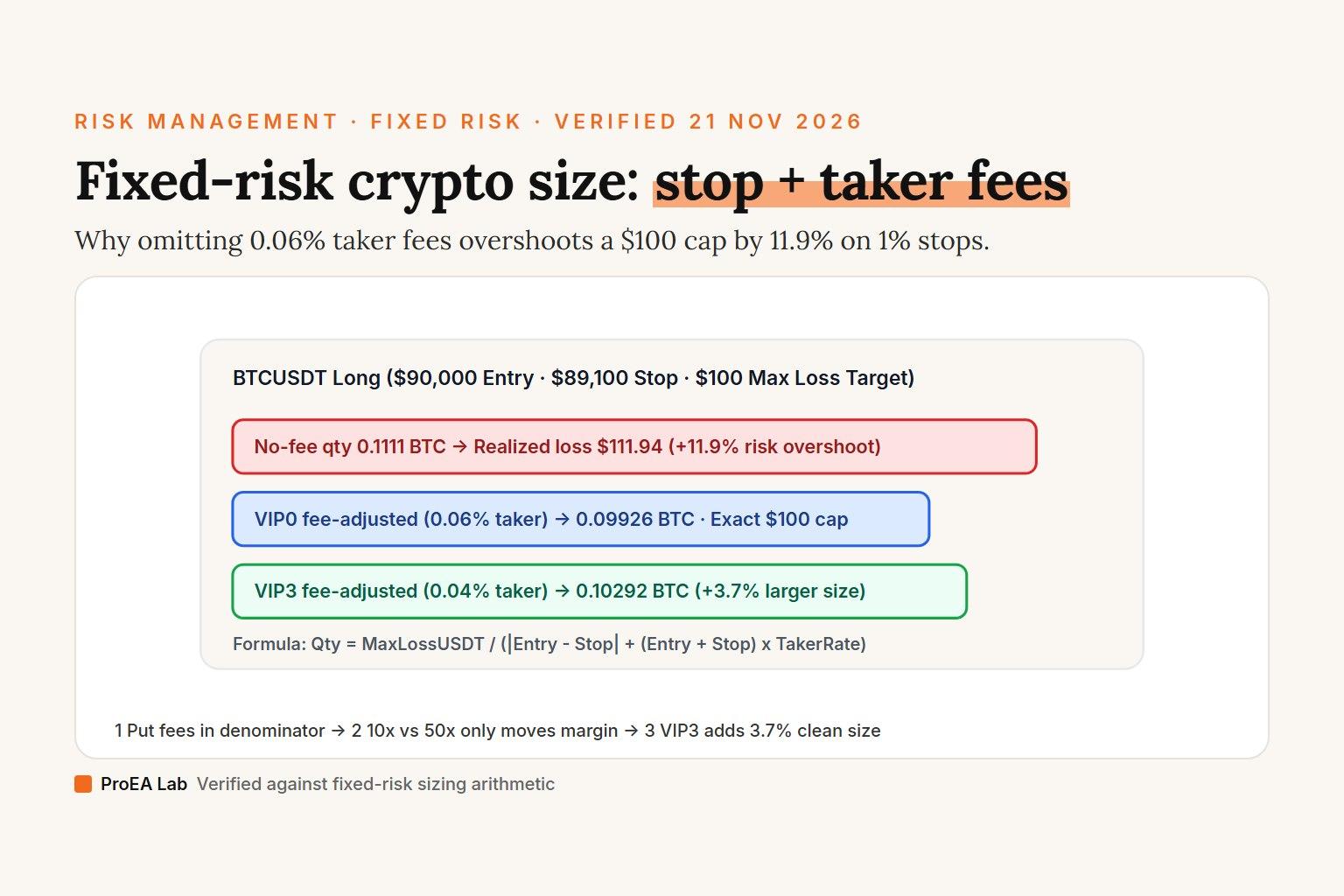
Check how taker fees shrink your maximum contract size for a fixed dollar stop in our fixed-risk position size calculator, or check exchange availability in the crypto exchange country checker.
Complete Bitunix VIP0–VIP8 fee table (read 26 November 2026)
| Tier | Futures Maker | Futures Taker | Spot Maker | Spot Taker | 30d Futures Vol (USDT) | 30d Spot Vol (USDT) | Balance (USDT) |
|---|---|---|---|---|---|---|---|
| VIP0 | 0.02% | 0.06% | 0.08% | 0.10% | < 1,000,000 | < 100,000 | < 300 |
| VIP1 | 0.02% | 0.05% | 0.07% | 0.09% | 1,000,000 | 100,000 | 300 |
| VIP2 | 0.016% | 0.05% | 0.06% | 0.08% | 5,000,000 | 500,000 | 5,000 |
| VIP3 | 0.014% | 0.04% | 0.035% | 0.06% | 8,000,000 | 800,000 | 25,000 |
| VIP4 | 0.012% | 0.0375% | 0.02% | 0.05% | 20,000,000 (API < 10%) | 2,000,000 | 140,000 |
| VIP5 | 0.01% | 0.035% | 0.015% | 0.045% | 50,000,000 | 4,000,000 | 700,000 |
| VIP6 | 0.008% | 0.0315% | 0.0125% | 0.0375% | 100,000,000 | 6,000,000 | 1,400,000 |
| VIP7 | 0.006% | 0.03% | 0.01% | 0.0325% | 200,000,000 | 8,000,000 | 2,400,000 |
| VIP8 | 0% | 0.026% | 0.0048% | 0.018% | 500,000,000 | 100,000,000 | — |
Spot fees also drop sharply by VIP3 (0.035% maker / 0.06% taker — 56.25% off maker and 40% off taker compared with VIP0).
Worked monthly cost table: your level by volume vs VIP3 at 30% maker / 70% taker
| Monthly Futures Notional | Level by volume (Bitunix's table) | Fee at that level | VIP3 Fee (0.0322% avg) | Monthly Difference | Over the 3 VIP3 months (3×) |
|---|---|---|---|---|---|
| $100,000 | VIP0 (0.048% avg) | $48 | $32.20 | $15.80 (32.9%) | $47.40 |
| $500,000 | VIP0 (0.048% avg) | $240 | $161 | $79 (32.9%) | $237 |
| $1,000,000 | VIP1 (0.041% avg) | $410 | $322 | $88 (21.5%) | $264 |
| $5,000,000 | VIP2 (0.0398% avg) | $1,990 | $1,610 | $380 (19.1%) | $1,140 |
How VIP3 access works and registration constraints
Without the PROEA request, reaching VIP3 requires hitting any one threshold on Bitunix's published tier table: 8,000,000 USDT in 30-day futures volume, 800,000 USDT in 30-day spot volume, or a 25,000 USDT account balance. On 21 November 2026, Bitunix's Head of BD wrote to ProEA that VIP3 for PROEA users "lasts 3 months" and "isn't an automatic event tied to the PROEA code": you register with the code, send ProEA your Bitunix UID through the Bitunix referral code page, Bitunix applies VIP3 to your account in its own timing, and you approve it in Bitunix. After the 3 months, the account returns to the standard tier its volume or balance reaches.
If you plan to open a new account where eligible, keep two documented rules in mind: Bitunix's help centre (article 157) states that an invitation code cannot be changed after registration, so it must be present in the Invitation code (optional) field at sign-up, and restricted regions (including the United States, Canada, mainland China, Hong Kong, Singapore, France, UAE, Malaysia, and others in Bitunix's terms, plus the UK and Thailand on ProEA) are not eligible. Always size positions from net risk including fees using our crypto position size calculator and track per-trade fees inside the crypto trading journal.
Frequently asked questions
What is the difference between maker and taker fees in crypto futures?
Maker fees apply when a post-only limit order rests on the order book and adds liquidity, such as 0.02% at VIP0 on Bitunix. Taker fees apply when a market order or marketable limit order executes immediately against existing orders, such as 0.06% at VIP0 — three times the maker rate.
How much do crypto futures fees cost at VIP0 vs VIP3 on $500K monthly volume?
Assuming 30% maker and 70% taker execution, VIP0 blends to 0.048% per side ($240 on $500,000 traded), while VIP3 at 0.014% maker and 0.04% taker blends to 0.0322% ($161) — a $79 monthly difference (32.9%). From 1,000,000 USDT of 30-day futures volume a trader is already at VIP1 on Bitunix's table, so the gap to VIP3 is smaller.
How does leverage affect futures trading fees?
Exchanges charge fees on full notional position value, not on initial margin. A 100% taker round trip at 0.06% per side costs 0.12% of notional: on $1,000 margin at 10x ($10,000 notional), fees take $12 (1.2% of margin), while at 20x ($20,000 notional) they take $24 (2.4% of margin).
What volume or balance unlocks VIP3 without the PROEA request?
On Bitunix's fee schedule read 26 November 2026, standard VIP3 requires at least 8,000,000 USDT in 30-day futures volume, 800,000 USDT in 30-day spot volume, or a 25,000 USDT account balance. Bitunix's Head of BD wrote to ProEA on 21 November 2026 that VIP3 for PROEA users lasts 3 months and is applied on request: the user sends ProEA their Bitunix UID, Bitunix applies VIP3 and the user approves it.
Can you add an invitation code after creating a futures account?
No. Bitunix's help centre (article 157) states that an invitation code cannot be changed after registration, so the code must be entered in the Invitation code (optional) field during sign-up.