Most crypto futures blow-ups happen when traders pick leverage first and guess contract size second. Fixed-risk sizing reverses the order: choose the exact USDT loss you accept if wrong, compute Qty = MaxLoss / (|Entry − Stop| + (Entry + Stop) × TakerRate) with fees inside the denominator, and keep leverage high enough only to cover margin without dragging liquidation in front of your stop.
Solve the exact coin quantity and fee breakdown for your setup in the fixed-risk position size calculator, then verify liquidation clearance in our crypto position size calculator.
Fixed-risk formula with round-trip taker fees
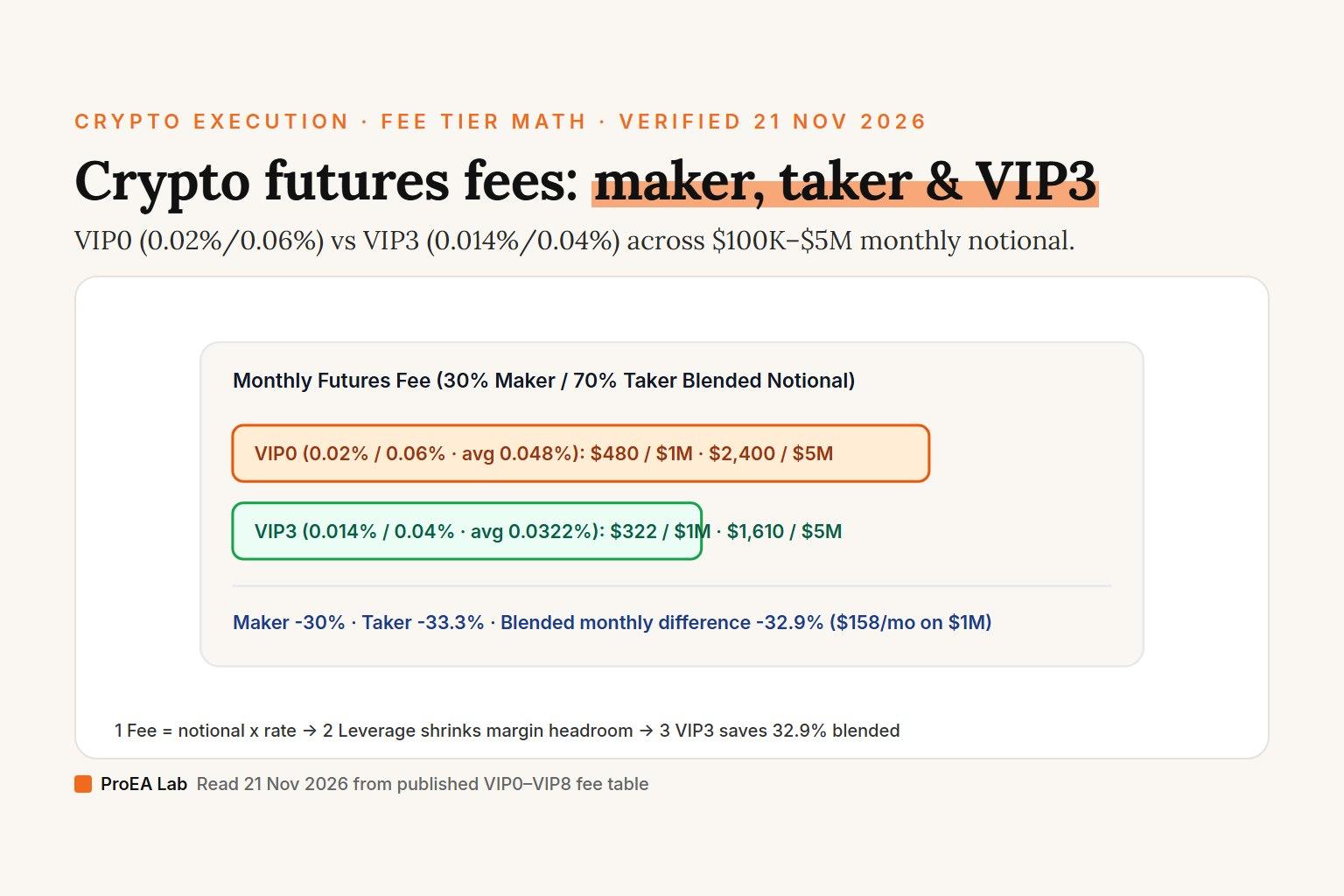
Naive sizing divides your dollar risk purely by price distance: Qty = MaxLoss / |Entry − Stop|. That works cleanly only when fees are zero. In live perpetual trading, both opening and stop-loss exits usually pay taker fees (on Bitunix, 0.06% at VIP0 or 0.04% at VIP3):
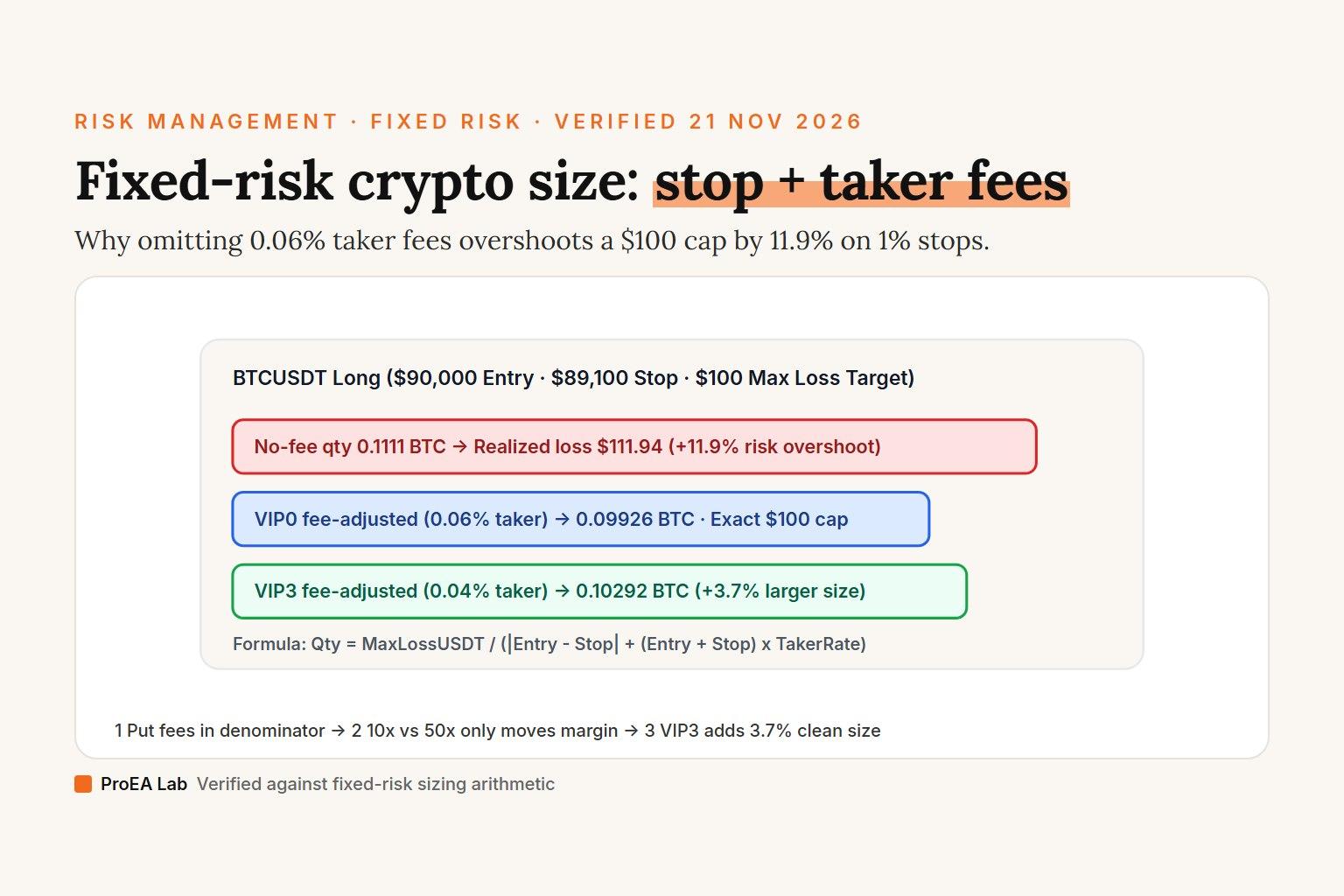
Qty = MaxLossUSDT / (|Entry − Stop| + (Entry + Stop) × TakerRate)
If your limit entry rests passively as a maker order (0.02% VIP0) while only your stop exits as taker (0.06%), replacing 2 × TakerRate with Entry × MakerRate + Stop × TakerRate makes sizing slightly tighter — treating both sides as taker acts as a worst-case safety buffer.
Worked example: $100 max loss on a 1% BTCUSDT stop
Suppose you plan a long BTCUSDT perpetual trade with Entry = 90,000 USDT, Stop = 89,100 USDT (900 USDT, or 1%, stop distance), and $100 maximum acceptable loss:
| Method | Per-unit risk incl. fees | Coin Qty | Position Notional | 10x Margin | Total Loss if Stopped (incl. 0.06% VIP0 fees) |
|---|---|---|---|---|---|
| No-fee formula | $900 | 0.1111 BTC | $10,000 | $1,000 | $111.94 (+11.9% overshoot) |
VIP0 taker (0.06%) | $1,007.46 | 0.09926 BTC | $8,933.36 | $893.34 | $100 |
VIP3 taker (0.04%) | $971.64 | 0.10292 BTC | $9,262.80 | $926.28 | $100 (at VIP3 rates) |
Omitting fees on a tight 1% stop costs $6.00 entering plus $5.94 exiting ($11.94), breaking a strict $100 risk cap by 11.9%. Moving from 0.06% VIP0 taker fees to 0.04% VIP3 taker fees drops fee drag per coin from $107.46 to $71.64, allowing 3.7% larger position size (0.10292 BTC vs 0.09926 BTC) while keeping total realized risk pinned to $100.
Why 10x vs 50x leverage keeps dollar risk identical
| Leverage | Position Qty | Notional | Initial Margin Needed | Loss at Stop (89,100 + fees) |
|---|---|---|---|---|
| 10x | 0.09926 BTC | $8,933.36 | $893.34 | $100 |
| 50x | 0.09926 BTC | $8,933.36 | $178.67 | $100 (liquidation risk rises if cross/isolated buffer is under ~1%) |
Although Bitunix's futures specifications read 26 November 2026 list 807 pairs with maximum leverage up to 200x on 5 pairs (BTCUSDT, ETHUSDT, PAXGUSDT, XAGUSDT, XAUUSDT), high leverage never reduces stop-out risk — if isolated margin (2% at 50x) sits too close to your 1% stop after maintenance margin is deducted, liquidation can close the trade early. Check your margin buffer before selecting leverage using our liquidation and DCA calculator and understand why position sizing errors blow up accounts.
How native Fixed Risk orders work on Bitunix
Bitunix's help centre (article 223, read 26 November 2026) documents a Fixed Risk position feature where traders specify a maximum USDT loss per trade and the interface automatically calculates the matching order quantity and attaches the stop-loss order. Check whether fees and slippage are excluded in the exchange preview before confirming, log every fill inside our crypto trading journal, and check fee reductions on our Bitunix fee calculator page or country eligibility in the crypto exchange country checker.
Frequently asked questions
What is the formula for fixed-risk position sizing with fees?
Divide your maximum allowed USDT loss by the sum of stop distance and round-trip taker fees per coin: Quantity = MaxLoss / (|Entry - Stop| + (Entry + Stop) * TakerRate). Including both entry and stop-exit fees prevents a stopped trade from losing more than your limit.
Does higher leverage increase risk on a fixed-risk crypto trade?
Leverage changes required initial margin and moves the liquidation price closer, not the dollar loss at your stop if Quantity stays identical. On a 0.09926 BTC position from 90,000 to 89,100 ($8,933.36 notional), 10x needs $893.34 margin and 50x needs $178.67 margin, yet both cap stop loss plus VIP0 fees at $100.
How much does forgetting taker fees overshoot a $100 max-loss BTC trade?
Ignoring fees on a 1% BTC stop (90,000 entry to 89,100 stop) gives 0.1111 BTC ($100 / 900). Adding 0.06% VIP0 taker fees on entry ($6.00) and stop-out ($5.94) pushes the realized loss to $111.94 — an 11.9% overshoot.
What is a Fixed Risk order on Bitunix?
Bitunix's help centre (article 223, read 26 November 2026) documents a Fixed Risk position tool that accepts the maximum USDT loss you set, automatically calculates an appropriate position size, and attaches a stop-loss order.
How much margin size headroom does a lower taker tier add?
With $100 max loss on a 90,000 to 89,100 BTC setup, sizing with 0.06% VIP0 taker fees allows 0.09926 BTC, whereas 0.04% VIP3 taker fees allows 0.10292 BTC — 3.7% more contract size under the exact same $100 risk ceiling.