Short answer: there is no right number of trades per day. No source we read gives one, and none could, because it depends on how many setups your plan finds. What you can set is a cap: the most entries you'll take in a day, decided before the session. Add a cooldown, a wait after each exit, and the count stops depending on how the last trade went. Signal Desk's defaults are 2 entries a day and 6 candles of cooldown.
Below: why the number depends on the plan, what SEBI found about traders who trade more often (and what it didn't test), the desk's cap and cooldown from its own source, and one simulated session where you set both and watch which signals get through.
How many trades per day is good?
As many as your plan's setups produce, up to a cap you set in advance. The first half isn't up to you: a plan that waits for a pullback in a trend finds fewer setups than one that takes every breakout, and a quiet day finds fewer than a busy one. The second half is. A cap turns "how many" from a question you answer mid-session into a rule you answered before it.
That's the case for a cap: it's a rule you can keep. You can check it at the end of the day, and it either held or it didn't. "Don't overtrade" can't be checked that way. "No more than two entries" can.
What a cap doesn't do is make the trades you take better. Nothing below shows that a lower count earns more, and we don't claim it.
How many trades per day for beginners?
No study we read tests a number for beginners. What's clear is the practical side: every trade is one more thing to review, and a day of twelve trades is hard to learn from. A cap of one or two keeps each trade reviewable.
It's also where Signal Desk's default comes from. Its source explains the tool: an options buyer was renting signal tools that "fire many times a day", and "He asked for “one or two strong calls a day”". Its page says what the default does: "The default allows at most two entries a day; some days have none."
How many trades per day in intraday trading?
The session sets a ceiling before your plan does. Signal Desk's default entry window on NSE is "0930-1445", Asia/Kolkata. On 5-minute candles that's 63 candles in which an entry can happen, from 09:30 to 14:45, and open trades are squared off in the "1500-1515" window. Its source says why the window starts at 09:30: "The default skips the first 15 minutes — the opening spike is where most chase entries come from."
Inside that window, the count is your setups, minus the ones you skip because a trade is already open, because you just closed one, or because you've hit your cap. The drill below shows each of those on one session.
How many trades per day is considered day trading?
A day trade is a position opened and closed on the same day. For US stock and options margin accounts the count of them used to matter: FINRA's margin rule labelled an account that made enough day trades a "pattern day trader", and that account then needed $25,000 in equity. That count is gone.
FINRA's Regulatory Notice 26-10, "FINRA Adopts New Intraday Margin Standards to Replace the Day Trading Margin Requirements" (20 April 2026), says the new standards "replace in their entirety the outdated day trading margin requirements, including the day trade count requirements". They took effect on 4 June 2026, and "Members that need more time to implement the rule change will be permitted to phase in their implementation over a period of 18 months, until October 20, 2027." In Rule 4210 itself, the paragraph that held the definition, (f)(8)(B), now reads "Reserved."
What counts now is margin during the day. FINRA's investor page puts it this way: intraday margin requirements "are margin calculations based on your positions during the trading day, not just at the end of the day". To trade on margin "you must maintain a minimum of $2,000 in equity in your margin account", and an account that keeps creating intraday deficits without meeting them may be frozen from margin trading "for 90 days or until the deficit is satisfied, whichever comes first."
How many trades per day on Robinhood? Robinhood's help page says: "On June 4, 2026, FINRA's new intraday margin standards will replace Pattern Day Trading (PDT)." It adds "No more day trade restrictions or day trade calls with your Robinhood margin account" and "You will no longer need to maintain a $25,000 minimum portfolio value to day trade in your margin account", while "the $2,000 margin minimum equity requirement will still apply." Other brokers that need more time may phase the change in until 20 October 2027, so check your own broker's page.
A regulator's count was never an answer to how many trades are good for you, either. That is still the cap you set.
What SEBI found about traders who trade more often
SEBI studied the trading behaviour of individual traders in equity derivatives over FY25 and FY26 ("Trading Behaviour of Individual Traders in the Equity Derivatives Segment (FY25-FY26)", read 29 October 2026). On frequency, in its words:
"The higher trading frequency was also associated with poorer trading outcomes. Traders with more frequent participation recorded higher average losses and higher shares of loss-makers, linking greater trading intensity with larger adverse outcomes."
And: "While the average trader was active on 55 days during the year, Large-Turnover traders were active on more than one-third of trading days, on average."
Its Table 17 groups traders by how many days they traded in a year:
| Days traded in a year | Median P&L (₹) | Share of loss-makers |
|---|---|---|
| Fewer than 10 | −654 | 83.3% |
| 10 to 25 | −2,665 | 85.8% |
| 25 to 50 | −5,297 | 84.7% |
| 50 to 100 | −19,183 | 90.8% |
| More than 100 | −76,722 | 89.4% |
SEBI's own summary: "The share of loss-makers was high across all frequency groups, ranging from 83.3% among traders active for fewer than 10 days to 89.4% among those active for more than 100 days."
Three things to keep straight when you read it:
- It counts days, not trades. The groups are days active in a year. The study doesn't measure trades per day.
- It's an association. SEBI writes "associated with". Traders who trade more often differ in other ways too: the same study's Table 11 links loss rates to turnover, capital and age. It doesn't show that trading less would have changed any trader's result, and it doesn't test a daily cap.
- The share isn't a straight line. 85.8% at 10 to 25 days, then 84.7% at 25 to 50. The median loss does grow at every step.
So the honest reading is: in SEBI's data, the median loss grew at every step in days traded, and the share of loss-makers was generally higher among traders active on more days, though not at every step: the most frequent group's 89.4% is below the 50-to-100-day group's 90.8%. A cap is one way to decide your frequency before the market decides it for you. Not: a cap of two improves results.
A daily cap and a cooldown
Signal Desk, our entry checklist indicator in Pine Pro Library, has both, set in its source:
- The cap. "Max entries per day", 2 by default, with the tooltip: "The 'one or two calls a day' rule — counted per exchange day, both directions together."
- The cooldown. "Cooldown after an exit (bars)", 6 by default. On a 5-minute chart that's 30 minutes after a trade closes before the next entry is allowed.
Its dashboard names the state it's in: "CAP = today's entry limit used." COOLDOWN means fewer candles have passed since the last exit than the cooldown asks for, and "NO ENTRIES = outside the entry window." When the cap is used, it says: "today's cap of 2 entries is used; the next call is tomorrow".
The cooldown does a different job from the cap. The cap limits the day. The cooldown spaces the entries, so a signal that fires right after a trade closes, win or loss, is skipped, and the next entry comes from a fresh setup rather than straight off the last one.
Other tools have the same idea:
- In a Pine strategy,
strategy.risk.max_intraday_filled_orders(): "This command specifies the maximum number of filled orders per trading day (or per chart bar if the chart’s timeframe is higher than “1D”). If the strategy fills more orders than the specified limit, the command cancels all pending orders, closes any open market position, and halts trading activity until the end of the current session." It counts filled orders, not trades, so an entry and its exit count as two. It works on a strategy's simulated trades in the Strategy Tester, not on your broker account. - At the broker. Dhan files its Kill Switch under "Kill Switch for Over-Trading", and Zerodha says its Kill switch is "part of the nudge initiative, which aims to prevent you from experiencing burnout due to excessive trading." Both stop new orders. Daily loss limit has both in their own words.
One session with a cap and a cooldown
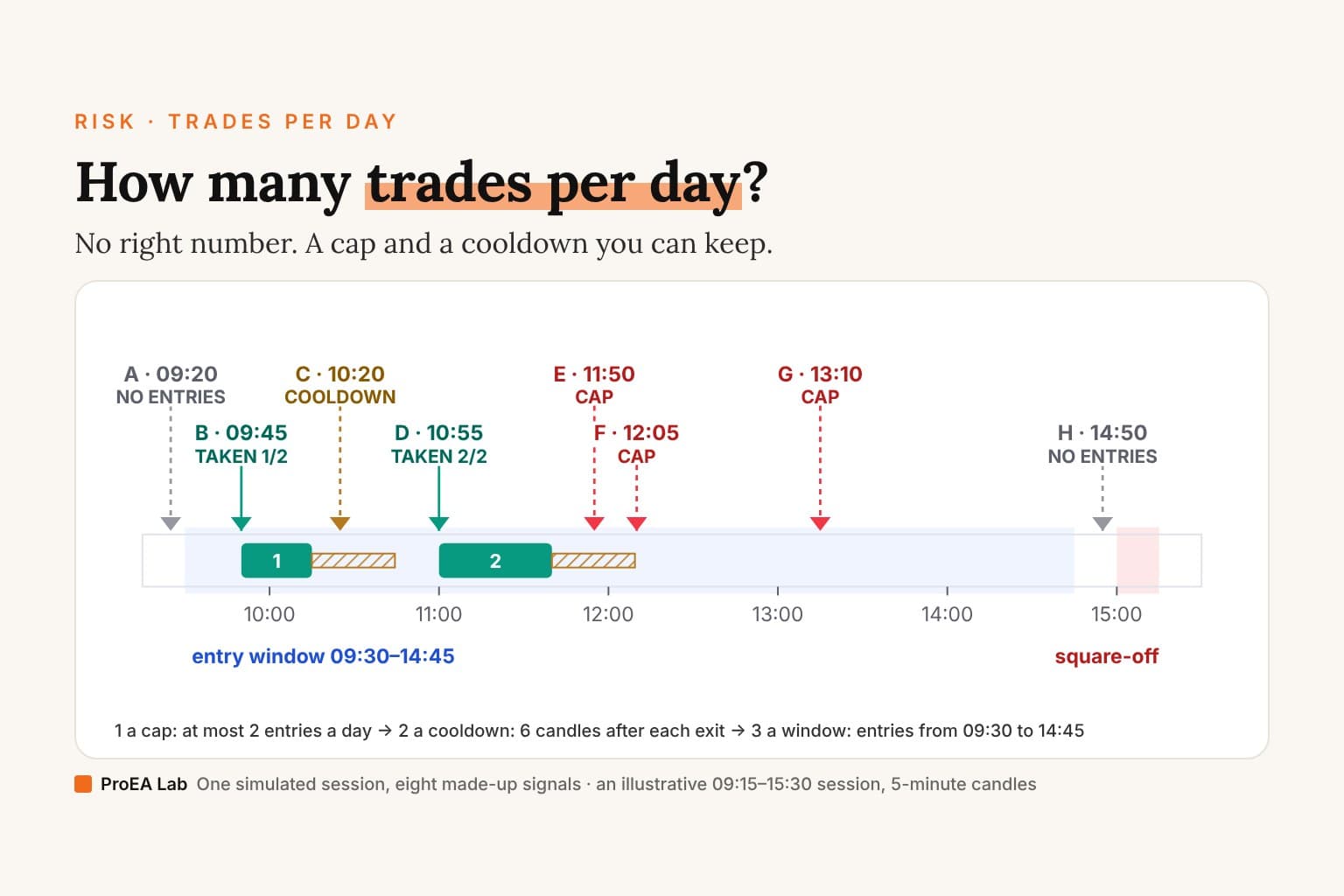
The session below is simulated: an illustrative 09:15–15:30 session of 5-minute candles named by their opening time, as TradingView names them, and eight made-up signals, A to H, all in the same direction. It isn't market data. Each signal fires at its candle's close, and if it's taken, the trade lasts the candles in the table. The rules are the desk's: entries only inside the window, at most the cap a day, at least the cooldown's candles after an exit, and one trade at a time. The drill counts entries, not results.
Cap 2, cooldown 6 candles: 2 of 8 signals taken (B, D).
Skipped: 1 by the cooldown, 3 by the cap and 2 outside the entry window. The count is decided before the day starts, so you can check it afterwards: it either held or it didn't.
Simulated and illustrative: a made-up 09:15–15:30 session with 5-minute candles named by their opening time, not market data. The rules are the library desk's: entries only in the window, at most the cap a day, and at least the cooldown's candles after an exit; one trade at a time. The drill counts entries, not results.
| Signal | Candle | If taken, lasts |
|---|---|---|
| A | 09:20 | 4 candles |
| B | 09:45 | 5 candles |
| C | 10:20 | 6 candles |
| D | 10:55 | 8 candles |
| E | 11:50 | 4 candles |
| F | 12:05 | 7 candles |
| G | 13:10 | 6 candles |
| H | 14:50 | 4 candles |
The drill. On the desk's defaults, a cap of 2 and a cooldown of 6 candles, inside the 09:30 to 14:45 window: which signals are taken, and what stops each of the others?
The answer, signal by signal
- A, 09:20: no entry. The window opens at 09:30.
- B, 09:45: taken, trade 1 of 2. It lasts 5 candles and exits on the 10:10 candle.
- C, 10:20: cooldown. It fires 2 candles after B's exit (the 10:10 candle to the 10:20 one), and the cooldown wants 6.
- D, 10:55: taken, trade 2 of 2. 9 candles after B's exit. It lasts 8 candles and exits on the 11:35 candle.
- E, 11:50, F, 12:05 and G, 13:10: cap. Both of the day's entries are used.
- H, 14:50: no entry. The window closed at 14:45, and the cap was used anyway.
2 of 8 signals taken: 1 skipped by the cooldown, 3 by the cap and 2 outside the window.
Change the settings and the count moves in ways worth seeing:
- Cap 2, no cooldown: B and C are taken, and the cap is used up by 10:20. D, E, F and G are all skipped. Without a cooldown, the cap goes to whatever fires first.
- Cap 5, no cooldown: 5 of 8 are taken (B, C, D, E and G). F fires while E is still open, so one trade at a time skips it.
None of this says which session ends better; the drill has no results in it on purpose. What it shows is that a cap and a cooldown make the count a decision you made in advance, one you can check at the close.
Signal Desk Premium: the cap, the cooldown and the lock
Signal Desk Premium keeps the desk's entries and its quiet edges: "Auto preset: no entries in the first 15 minutes or the last 30, square-off in the last 15. Plus a daily cap and a cooldown." It adds two locks that stop the day on what has happened, not only on the count:
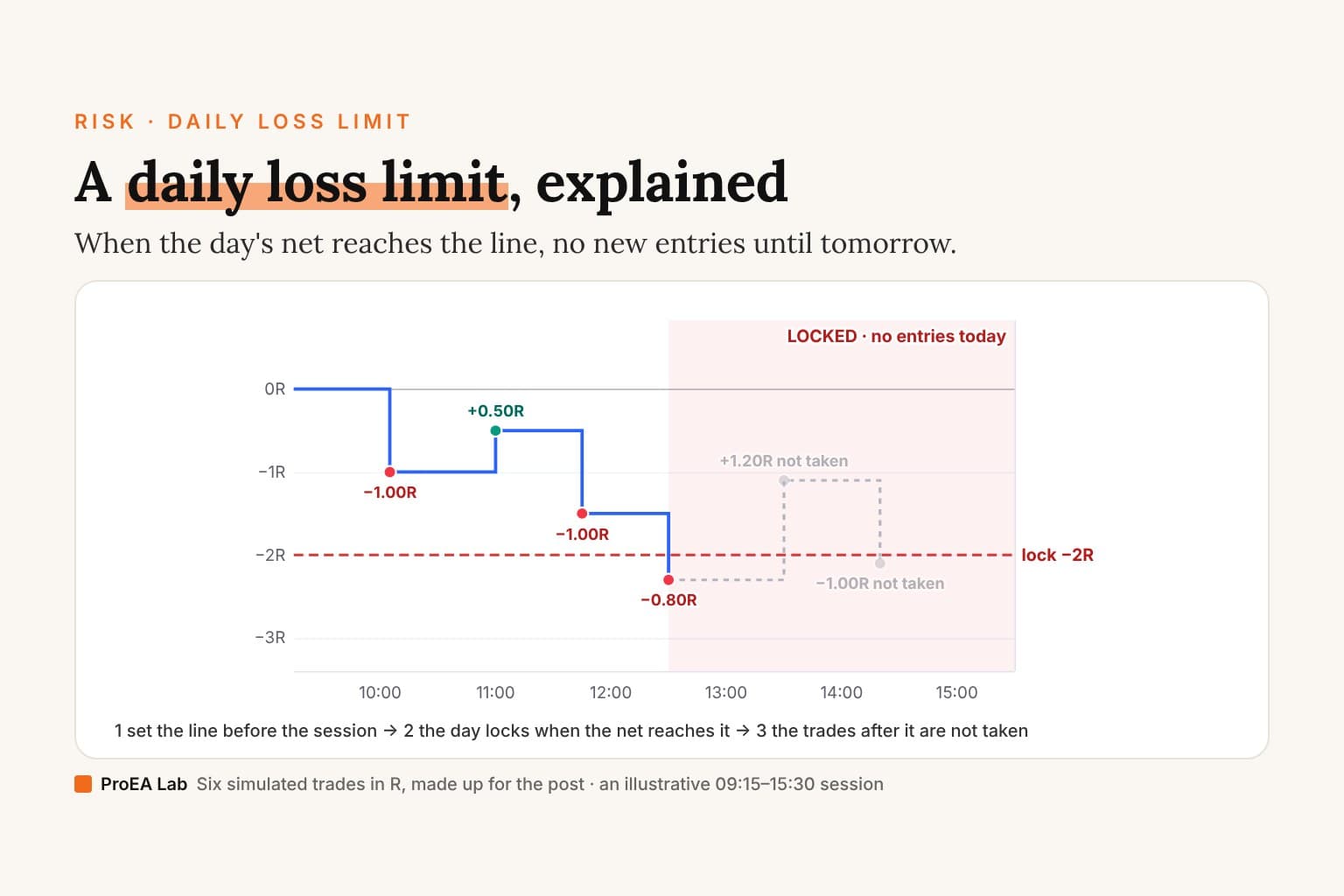
- "By default the day locks at −2R net. Set a money amount instead, or 0 to switch it off."
- "A second lock trips after 3 losses in a row today, whatever the net."
Its dashboard reads CAP, COOLDOWN or LOCKED, so you can see which rule stopped the day. The scripts never place orders. Premium uses the same entries as the library desk. It does not promise better results; it makes the same signals easier to prepare for, size, manage, filter and act on.
Sources
- SEBI, "Trading Behaviour of Individual Traders in the Equity Derivatives Segment (FY25-FY26)", PDF, sections 5.16 and 5.17 and Table 17, read 29 October 2026.
- TradingView Pine Script manual, Strategies (risk management), read 29 October 2026.
- Dhan, How can I activate the Kill Switch?; Zerodha, What is Kill switch?, read 29 October 2026.
- FINRA, Regulatory Notice 26-10, Rule 4210 (paragraph (f)(8)(B) and the amendment notes) and the investor page Day Trading; Robinhood, Pattern day trading, read 29 October 2026.
- Signal Desk 1.2.0's Pine source: "Max entries per day", "Cooldown after an exit (bars)", the entry window and the dashboard's states.
- The drill:
src/components/blog/trade-cap/cap-session.ts, the desk's gates on made-up signals.
Disclosure
We, ProEA Lab, build Signal Desk and Signal Desk Premium and sell them. The code is AI-assisted. The session and its eight signals are simulated and illustrative, made up to show how a cap and a cooldown work; they are not market data and not a result. Nothing here is advice. Trading involves risk.
Frequently asked questions
How many trades per day is good?
No source we read gives a number, and none could: it depends on how many setups your plan finds. What you can choose is a cap, set before the session, so the count can't grow with your mood. Signal Desk's default cap is 2 entries a day.
How many trades per day should a beginner take?
Few enough to review each one properly. No study we read tests a number for beginners. A cap of one or two is easy to keep and easy to check afterwards: it either held or it didn't.
How many trades per day in intraday trading?
As many as your plan's setups inside your entry window, up to your cap. With 5-minute candles, Signal Desk's default entry window, 09:30 to 14:45, holds 63 candles, and its default cap allows 2 entries.
Do traders who trade more often lose more?
SEBI's study of FY25 and FY26 found that traders active on more days had higher average losses and higher shares of loss-makers, from 83.3% among those active on fewer than 10 days to 89.4% among those active on more than 100. It's an association across traders, not a test of a daily cap.
What is a cooldown in trading?
A wait after a trade closes before the next entry is allowed. Signal Desk's default is 6 candles after each exit, so a signal that fires right after a trade closes is skipped.
How many trades per day is considered day trading?
In the US there is no longer a count in FINRA's margin rule. From 4 June 2026, FINRA's intraday margin standards replace the pattern day trader rules, including the day trade count and the $25,000 minimum, with a phase-in for brokers that need more time until 20 October 2027. A margin account still needs $2,000 in equity. Your broker's own page says when it switched.
Can TradingView limit the number of trades per day?
For a Pine strategy, yes: strategy.risk.max_intraday_filled_orders() sets the most filled orders per trading day, and once the strategy fills more, it closes the position and halts trading until the session ends. For manual trades, the limit is your broker's controls or your own cap.