Short answer: in our read, the free script that decides a false breakout most strictly is CRT Turtle Soup with HTF Candles, CISD and MSS by imrnshrf (965 boosts): a closed higher-timeframe candle that wicks past one side of its range and closes back inside, no signal when both sides are taken, a stop at the sweep's extreme, targets at 50% and 100% of the range, and alerts. The most boosted script named for the job, Zeiierman's False Breakout (Expo) (9,235), marks a close under the low of a candle that made a new 20-candle high, on the live candle, with no stop. The most boosted in the whole search, Flux Charts' ICT Turtle Soup (18,832), counts a wick past the high or low of the last four 15-minute candles, at its 60-minute default, and needs no close back inside at all.
Most lists name false breakout indicators.
This one reads them.
What we checked
We searched TradingView's scripts for 12 terms on 30 October 2026, among them "false breakout", "failed breakout", "fakeout" and "turtle soup", which returned 142 scripts. A turtle soup is a false breakout by another name: a fade of a breakout of an old high or low that fails. (Why a breakout rule pays for its false breakouts is in our breakout strategy explainer.) We took the ten most-boosted open-source scripts whose name says a false or failed breakout, a fakeout, a fakey or a turtle soup, down to 840 boosts, with none skipped, and read each one in full.
Three scripts rank above the tenth and aren't in the ten. CRT Trades by majky (3,805 boosts) is protected, so its code can't be read. SpxGh0st's CRT Hourly/15m dividers and opens (2,091) draws each hour's lines and opens, with no signal and no alert. BigBeluga's Volume Acceptance Zones (1,606) draws volume-weighted zones and arrows on closes beyond them, with no breakout rule. Neither of the two marks a false breakout.
We read two more in full. LuxAlgo's Breakout Detector (4,521 boosts, from our previous-hour search the same day) marks a false breakout of the previous period's high or low. vikprimus's Filtered False Breakout Detector (392) carries the search's own words.
Five questions for each:
- The definition: which level, and what counts as false?
- The close: is the mark decided on a closed candle, or on the live one? Which line says so?
- The plan: does a mark come with a stop and a target?
- Alerts: what can it send you?
- The licence: what its first lines say.
Line numbers below are each script's own, as TradingView's source view numbers them.
Best false breakout indicator: the table
Boosts as TradingView's search showed them on 30 October 2026.
| Script | Boosts | What it calls a false breakout | Decides on | Stop and target | Alerts | Licence |
|---|---|---|---|---|---|---|
| ICT Turtle Soup (Flux Charts) | 18,832 | A wick past the high or low of the last 4 chart candles (one hour on a 15-minute chart), then a wick through the 10-candle swing the other way; no close back inside needed | The live candle's wick | Yes: 3.5 × ATR(5) beyond the swing, target 0.9R | Buy, Sell, TP, SL | MPL 2.0 |
| False Breakout (Expo) (Zeiierman) | 9,235 | A close under the low of a candle that made a new 20-candle high, within 5 candles of it | The live candle | None | 2 | CC BY-NC-SA 4.0 |
| Turtle Soup ICT Strategy (TradingFinder) | 6,726 | An hourly candle that wicks past a 50-candle hourly swing and closes back inside, then a close through the chart's last small swing | The forming hour, on live bars | None | None | MPL 2.0 |
| Supertrend Fakeout (EmreKb) | 3,013 | A break of its Supertrend-style line that comes back within 5 candles, never 1.5 ATR beyond: the trend doesn't flip | The live candle | None | 3, one when a break starts | MPL 2.0 |
| False Breakouts (TradingFinder) | 1,615 | A close back under a 50-candle swing high right after a close above it, within 4 candles | The live candle | None | 2, once per bar | MPL 2.0 |
| Fakey pattern (MLansky) | 1,183 | An inside candle, then a candle past the mother candle's high or low that closes back inside it | The live candle | None | None | None stated |
| ICT Turtle Soup (Liquidity Reversal) (MrWoof888) | 967 | A wick past the last small swing high or low and a close back inside, every time | The live candle | None | 2 | None stated |
| CRT Turtle Soup with HTF Candles, CISD and MSS (imrnshrf) | 965 | A closed 1-hour to monthly candle that wicks past one side of its range and closes back inside; both sides: no signal | Closed candles | The sweep's extreme; 50% and 100% of the range | Yes | None stated |
| False Breakout (yehonatan.bus) | 844 | A candle that trades under the previous candle's low and closes at or above it, one direction at a time | The live candle | None | 1 | MPL 2.0 |
| TrendPredator FO (TC888) | 840 | A candle above the previous candle's high, not below its low, that closes at or under that high; it colours the candle | The live candle | None | 2 that fire as a candle develops | MPL 2.0 |
| Breakout Detector (LuxAlgo) | 4,521 | A close back inside on the candle right after a close beyond the previous period's high or low | The live candle | 3 × its range mean behind, 2:1 | 8 | CC BY-NC-SA 4.0 |
| Filtered False Breakout Detector (vikprimus) | 392 | A swing candle's high, broken by the next candle on more volume, then a close back under it | The live candle | None | 2 | MPL 2.0 |
| Range Verdict Desk (ours, its Fade setting) | — | A 15-minute candle that wicks through one side of the prior complete UTC hour and closes strictly back inside; both sides: no signal | Closed candles | At least 1 ATR(14) behind, 2R objective, frozen | 2 | Pine Pro Library |
Ten of the 12 decide on the live candle. Three give a stop and a target with the mark. Only imrnshrf's reads closed candles, gives a stop and targets, and alerts.
Three definitions, one chart
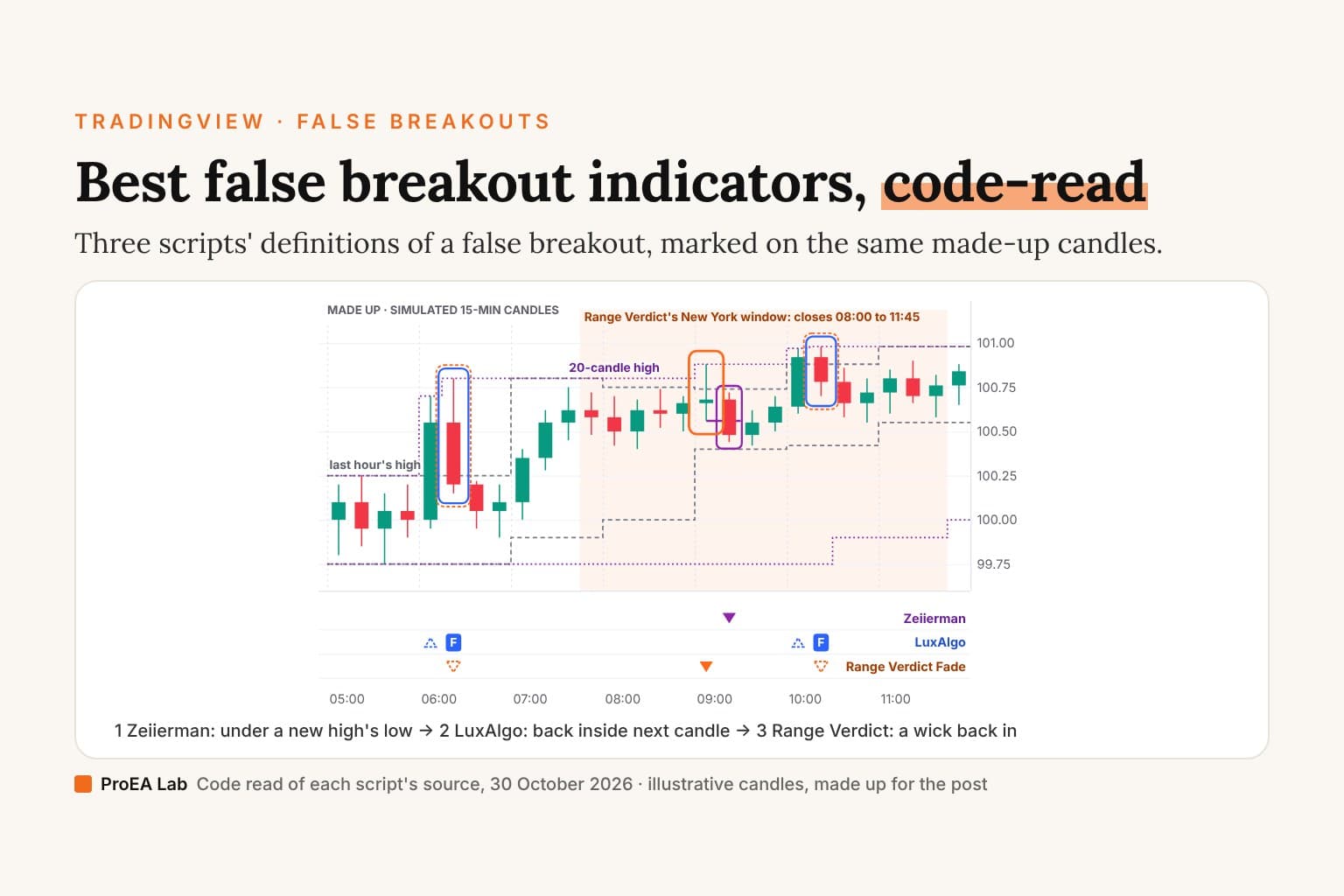
Three of these scripts on the same 28 candles. Zeiierman's waits for a close under the low of a new 20-candle high. LuxAlgo's, with its timeframe input set to 60 so its level is the last hour's high, waits for a close above that high and then a close back under it on the very next candle. Range Verdict's Fade reads a wick through the hour before and a close back inside, and makes a plan only inside its New York window, one attempt an hour.
- Zeiierman: a close under the low of a candle that made a new 20-candle high, within 5 candles, when that high came more than 5 candles after the last one. Code: False Breakout (Expo), lines 36–38, 43–49 and 62–66.
- LuxAlgo: a close beyond the last hour's high or low, then a close back inside on the very next candle. Code: Breakout Detector, lines 160–161, 174 and 244 (x = 2, line 34).
- Range Verdict Fade: a 15-minute candle that wicks through one side of the prior complete UTC hour and closes strictly back inside. Code: range-verdict.pine, lines 43–47 (f_direction) and 208–215.
Same candles, three definitions, and no candle marked by all three.
Zeiierman marks candle 18 (09:15); LuxAlgo marks 6 (06:15) and 22 (10:15), each the candle after a close above the last hour; Range Verdict's Fade reads 6 (06:15), 17 (09:00), 22 (10:15) and makes a plan at 17 (09:00). The wick at 09:00 that Range Verdict reads is a mark for Zeiierman only one candle later, and not one for LuxAlgo, which needs a close beyond the hour first.
Illustrative candles, made up for this explainer (simulated): not a market and not a result. Zeiierman's False Breakout (Expo) at its defaults and LuxAlgo's Breakout Detector with its timeframe set to 60, both ported line for line from the code TradingView served on 30 October 2026; Range Verdict Desk's Fade run through the desk's own engine, after 256 more made-up candles it needs to warm up (not drawn). No outcomes are shown.
Read as text: the 28 candles and their marks
| # | New York | Open | High | Low | Close | Marks |
|---|---|---|---|---|---|---|
| 1 | 05:00 | 100.00 | 100.20 | 99.80 | 100.10 | |
| 2 | 05:15 | 100.10 | 100.25 | 99.85 | 99.95 | |
| 3 | 05:30 | 99.95 | 100.15 | 99.75 | 100.05 | |
| 4 | 05:45 | 100.05 | 100.20 | 99.90 | 100.00 | |
| 5 | 06:00 | 100.00 | 100.70 | 99.95 | 100.55 | LuxAlgo: breakout |
| 6 | 06:15 | 100.55 | 100.80 | 100.15 | 100.20 | LuxAlgo: F; Range Verdict Fade: Outside NY 08:00-12:00 |
| 7 | 06:30 | 100.20 | 100.22 | 99.95 | 100.05 | |
| 8 | 06:45 | 100.05 | 100.20 | 99.90 | 100.10 | |
| 9 | 07:00 | 100.10 | 100.40 | 100.00 | 100.35 | |
| 10 | 07:15 | 100.35 | 100.62 | 100.28 | 100.55 | |
| 11 | 07:30 | 100.55 | 100.75 | 100.45 | 100.62 | |
| 12 | 07:45 | 100.62 | 100.72 | 100.48 | 100.58 | |
| 13 | 08:00 | 100.58 | 100.70 | 100.42 | 100.50 | |
| 14 | 08:15 | 100.50 | 100.68 | 100.40 | 100.62 | |
| 15 | 08:30 | 100.62 | 100.74 | 100.52 | 100.60 | |
| 16 | 08:45 | 100.60 | 100.70 | 100.50 | 100.66 | |
| 17 | 09:00 | 100.66 | 100.88 | 100.56 | 100.68 | Range Verdict Fade: plan |
| 18 | 09:15 | 100.68 | 100.72 | 100.44 | 100.48 | Zeiierman: False Breakout Up |
| 19 | 09:30 | 100.48 | 100.62 | 100.42 | 100.55 | |
| 20 | 09:45 | 100.55 | 100.70 | 100.50 | 100.64 | |
| 21 | 10:00 | 100.64 | 100.97 | 100.60 | 100.92 | LuxAlgo: breakout |
| 22 | 10:15 | 100.92 | 100.98 | 100.70 | 100.78 | LuxAlgo: F; Range Verdict Fade: Skipped: plan already active |
| 23 | 10:30 | 100.78 | 100.86 | 100.58 | 100.66 | |
| 24 | 10:45 | 100.66 | 100.80 | 100.55 | 100.72 | |
| 25 | 11:00 | 100.72 | 100.85 | 100.60 | 100.80 | |
| 26 | 11:15 | 100.80 | 100.90 | 100.66 | 100.70 | |
| 27 | 11:30 | 100.70 | 100.82 | 100.58 | 100.76 | |
| 28 | 11:45 | 100.76 | 100.88 | 100.65 | 100.84 |
No candle gets all three marks. The 09:00 wick that Range Verdict reads becomes a Zeiierman mark one candle later, and isn't a LuxAlgo mark at all, because nothing closed above the hour. The 06:15 and 10:15 candles are LuxAlgo marks and Range Verdict readings both, and the desk refuses both: one is outside its window, the other comes while its 09:00 plan is held.
Zeiierman's and LuxAlgo's rules are ported line for line from the code TradingView served on 30 October 2026, at their defaults except LuxAlgo's timeframe; Range Verdict's comes from the desk's own engine. The candles are made up.
What the code says
Flux Charts' ICT Turtle Soup is the popular one, and it doesn't wait for a close back inside. Its "last hour" is the highest high and lowest low of the last 4 chart candles on a 15-minute chart (ta.highest(barLength), lines 114–116, from its 60-minute input on line 17), set again each time a trade ends (lines 129–140), not the previous clock hour. With "Wick", the default Breakout Method (line 18), a low under that level is the grab (line 148). The buy comes when a later candle's high passes the 10-candle swing high (line 187). The stop sits 3.5 × ATR(5) beyond the 10-candle swing (its "Low" risk, lines 29 and 36) and the target at 0.9 times the risk (lines 34, 196–197). Grab and entry are decided by the live candle's high or low, and its alerts fire from the first realtime candle on (lines 293–307). A "TS Backtesting" table, on by default, prints its own wins and losses (lines 379–430). Pine v5, MPL 2.0.
Zeiierman's False Breakout (Expo) reads a new 20-candle high, not a session level. Line 36 takes the 20-candle highest high; line 38 flags a candle whose high beats the 20 before it when the candle before didn't. Each such candle sets val to its own low (lines 43–49). "False Breakout Up" is a close crossing under val (line 64) while two new highs have come in a row, within 5 candles of the latest, and more than 5 candles after the one before (lines 62–66). Its smoothing input defaults to "💎", whose branch returns the value unsmoothed (lines 28–32), so at its defaults nothing is smoothed. Decided on the live candle. No stop and no target; two alerts, "False Breakout Up" and "False Breakout Down" (lines 83–84). Pine v5, CC BY-NC-SA 4.0, which rules out commercial use.
TradingFinder's Turtle Soup reads the hour still forming. It finds 50-candle swings on the 60-minute timeframe (lines 17–18, 96) and marks an "HTF Liquidity Sweep" when an hourly candle wicks above a swing high and closes below it, before any hourly close above it (lines 128–134). Then it waits for a close through the chart's last small swing (line 291). The hourly read is request.security(syminfo.tickerid, TF, HTF_Detector(...), gaps = barmerge.gaps_on) on line 154, with no [1], so on live bars it reads the hour still forming. No stop, no target, and no alert in its code. Pine v5, MPL 2.0.
EmreKb's Supertrend Fakeout alerts on every break of its line, before anyone knows it's false. Its line is the close minus 3 × ATR(14), ratcheted up in an uptrend (lines 7–8, 24–28). A low under it starts a "fakeout" (lines 32–34); the trend only flips if the break lasts more than 5 candles or goes more than 1.5 ATR beyond (lines 36–39), and a low back above the line cancels it (lines 49–51). So the false breakout itself is never drawn: the line simply doesn't flip. "Fakeout Alert" fires when a break starts (line 71), and two more on trend changes (lines 72–73). Decided on the live candle. Pine v6, MPL 2.0.
TradingFinder's False Breakouts needs a close above first. Its level is a 50-candle swing high, confirmed 50 candles after it (lines 12, 76). The mark, "FBO", is a close back under that swing right after a candle closed above it, within 4 candles of the first close above, under the previous candle's open and with a lower low (lines 115–118, 124–125). That rule is written into the call ('Considerable SFP', line 148); no setting changes it. Its alerts go through TradingFinder's alert library with "Once Per Bar" written into both calls (lines 151–152), so its Message Frequency input (line 28) isn't used. Decided on the live candle. Pine v5, MPL 2.0.
MLansky's Fakey is one line each way. An inside candle, then a candle that trades above the mother candle's high and closes back under it (line 5), or the mirror (line 6). It shades the background and nothing else: no alert, no stop. It has no version line (study("Fakey [KV]", line 3), so it runs as Pine v1. No licence line.
MrWoof888's ICT Turtle Soup marks every wick back. Its swing high is a candle higher than one neighbour on each side, found 5 candles later (lines 5, 12). Any candle that trades above the last one and closes back below is marked (line 24), again and again until a new swing replaces it. Two alerts (lines 39–40). Decided on the live candle. Pine v6, no licence line.
imrnshrf's CRT Turtle Soup is the strictest. It reads closed 1-hour, 4-hour, daily, weekly and monthly candles in TradingView's safe form, one candle back with lookahead on (lines 1942–1946). A candle that wicks above its range and closes back inside is "-Ts: wick above, close inside = bearish" (lines 1808–1810); one that takes both sides logs "Both sides taken (no signal)" (line 1815). Its default signal is the first entry-timeframe candle to close back inside (line 200), with the stop at the sweep's extreme (line 206) and targets at 50% and 100% of the range. Alerts through alert() (lines 2054, 2069) and two alert conditions (lines 2073–2074). It is a CRT tool first, 3,211 lines long, with order blocks, gaps and a dashboard around the rule. Pine v6, no licence line.
yehonatan.bus's False Breakout reads the previous candle. Long, the default (line 7): a candle that trades under the previous candle's low and closes at or above it (line 11). Short mirrors it on the high (line 18); one direction shows at a time. One alert, "False Breakout Signal" (line 30). Decided on the live candle. Pine v4, MPL 2.0.
TC888's TrendPredator FO colours fakeouts and alerts on a developing candle. A "fakeout high" is a candle above the previous candle's high, not below its low, that closes at or under that high (line 390); the mirror on line 393. Its alert() calls say "Switch Bar developing" and fire once per bar (lines 516–520). Its two alertcondition lines pass the on/off settings themselves as the condition (lines 546–547), and both are on by default, so as written they are true on every candle. It calculates only the last 100 candles (line 11). Pine v6, MPL 2.0.
LuxAlgo's Breakout Detector is the closest to a previous-hour rule, and it judges in one candle. Its level is the previous period's high or low, daily by default and any timeframe you pick (line 13, lines 138–148). The first close beyond it in the period is the breakout (lines 160–161, 174), with a stop 3 × its cumulative mean range behind and a 2:1 target (lines 207–220). The "F" false breakout is a close back inside on the candle right after the breakout (n - bxTopBreak.idx < x, x = 2, lines 34 and 244): a close back inside two candles later doesn't count. No time window, and decided on the live candle. Eight alerts (lines 430–437). Pine v5, CC BY-NC-SA 4.0.
vikprimus's Filtered False Breakout Detector adds volume. Candle two back sets the level if its high was at least the highest of the 5 before it (lines 12, 23); the next candle breaks it with more volume (lines 13, 27, 31); the current candle closes back under it (line 32). On a symbol with no volume data, that volume check never passes until you switch it off. Two alerts (lines 61–62). Decided on the live candle. Pine v6, MPL 2.0.
What repaints
TradingView's Pine manual defines repainting as "script behavior causing historical vs realtime calculations or plots to behave differently". In this read it comes in two kinds.
The live candle. Ten of the 12 decide as the candle trades, with no closed-candle check, so a mark can print mid-candle and be gone at the close: Flux Charts' (lines 148 and 187), Zeiierman's (line 66), EmreKb's (line 32), TradingFinder's False Breakouts (lines 117–118), MLansky's (line 5), MrWoof888's (line 24), yehonatan.bus's (line 11), TC888's (line 390), LuxAlgo's (line 244) and vikprimus's (line 32). Pine's manual says "Alerts only trigger in the realtime bar", and the cure it gives: "configure the triggering frequency of alerts so they only trigger on the close of the realtime bar." For the scripts' alertcondition() alerts that is your choice in the alert dialog; for an alert() call, the script's code sets it.
The higher timeframe. TradingFinder's Turtle Soup asks for the 60-minute candle with no offset (line 154). The manual: on realtime bars request.security() "can return unconfirmed values"; the safe form is "offsetting the expression argument by at least one bar with the history-referencing operator [] and using barmerge.lookahead_on". imrnshrf's uses exactly that form. How to spot both kinds yourself: how to tell if an indicator repaints.
False breakout indicator MT4: what exists
None of the 12 runs in MetaTrader 4. Each is Pine Script, and TradingView's manual says what that is: "Pine Script® is TradingView’s programming language. It allows traders to create their own trading tools and run them on our servers."
For MT4 the place to look is the MQL5 Market. On 30 October 2026 its MetaTrader 4 indicators, filtered for "false breakout", returned 162 products. The filter reads descriptions too: four have a false breakout or a fakey in their title. Three are free: False Breakout MT4, Fakey Detector and Elliott Wave False Breakout Stochastic. One is paid: False Breakout Detector MT4, 30 USD with a free demo, published 24 February 2023, whose listing says "When the market tries to break these highs and lows but fails, the indicator places an arrow on the chart and sends out an alert".
We haven't read any of them, and can't: the Market's rules say a product "can be provided only as a compiled file with the EX5/EX4 extension." So whether they decide on a closed candle is for their demo to show you.
False breakout detector: check one yourself
- Find the level. Search the code for the line that sets it:
ta.highest,ta.pivothigh,high[1], or arequest.securitycall. That tells you what "breakout" means before "false" does. - Find the false. Find the line that sets the mark. Does it need a close back inside, or only a wick? Within how many candles? Does a candle that takes both sides count?
- Find the close. Look for
barstate.isconfirmed. If it isn't there, the mark is decided on the live candle. For another timeframe, look for[1]withbarmerge.lookahead_on. - Find the alert. Each
alertconditionis an alert you set up, at the frequency you pick; analert()call fires at the frequency in its code. TradingView's pricing page, read on 29 October 2026, shows no technical alerts on indicators on Basic, 20 on Essential, 100 on Plus, 400 on Premium and 1,000 on Ultimate.
Range Verdict Desk: one narrow false breakout
Range Verdict Desk does what the name means in one narrow form only: a one-candle wick back inside the prior UTC hour.
Set its Mechanism to Fade and it reads each closed 15-minute candle against the prior complete UTC hour, four 15-minute candles: a wick through one side and a close strictly back inside is the signal; a candle through both sides is none (f_direction, lines 43–47 of its Pine). It doesn't read a 20-candle high, a swing, the previous candle or the previous day. Its default Mechanism is Accept, two closes in a row beyond the same side, and its own tooltip says of both: "not recommendations".
Its limits, in the script's own words where it has them:
- The hour: the prior complete UTC hour only. The chart must be standard 15-minute candles; it stops on any other timeframe.
- One attempt an hour, after a 250-candle warm-up: the hour's first signal spends it, even when a held plan refuses it ("Skipped: plan already active").
- A New York window: signal closes from 08:00 to before 12:00 New York by default, one of four fixed windows.
- A frozen plan: at the signal close, risk is the larger of 1 ATR(14) and the distance from the close to the candle's wick; the stop sits one risk behind the close and the objective two risks ahead, and the reference entry is the next open. It ends at the stop, the objective, the window's end or 16 held candles.
- Alerts: "Confirmed long reference plan" and "Confirmed short reference plan", which need Essential or above.
- No orders. It draws reference plans; trading them is yours.
Its full Pine v6 source is in Pine Pro Library, $49 once for every desk and every update. We make no promise of results.
Range Verdict Pro runs the same engine unchanged, Fade included, so on the same chart and settings it confirms the same plans. It adds the game plan on your chart before and during the New York window, each plan with its size for your risk, plain-English alerts (Essential or above), a Radar that reads the same rule on eight markets on one board, and a strategy in which a confirmed plan submits a qty 1 simulated entry in TradingView's Strategy Tester. It places no orders either. It is $49 once, or in the Complete Suite.
Library desk · plan alerts
Prior UTC range visible. Last close: Outside NY 08:00-12:00.
Range Verdict Pro · indicator · Radar · strategy
Both candidate levels drawn and explained, with a configurable heads-up alert.
Starts at 0.34, the risk of the Fade plan the drill above freezes at 09:00, rounded. A wider stop means a smaller size for the same risk.
07:45 New York: the same plan, more on Pro's screen
Range Verdict Pro at your risk: ≈ 294 units · nominal 100 USD risk at signal close.
What each one shows, in the Pro page's own words (its "Library desk or Pro" comparison of one simulated morning). The same simulated morning on both screens. The plan is the same on both sides. The size line is Pro's own formula, risk ÷ (stop distance × point value), with an example point value of 1 USD. Uses symbol point value. Check broker contract and lot rules. No currency conversion; gaps and costs can change actual risk. Alerts on TradingView need a paid plan: its pricing page (read 29 October 2026) shows no technical alerts on indicators on Basic and 20 or more from Essential up.
Limits
One code read, on 30 October 2026, of the versions TradingView served that day. Scripts change, and boosts measure popularity, not quality. The drill's ports are ours, from those versions' code at their defaults, except LuxAlgo's timeframe. We build and sell Range Verdict Desk and Range Verdict Pro, and we have no relationship with any author named here. Nothing here is financial advice.
Frequently asked questions
What is the best false breakout indicator on TradingView?
In our read of 30 October 2026, the free one that decides most strictly is CRT Turtle Soup with HTF Candles, CISD and MSS by imrnshrf (965 boosts): a closed higher-timeframe candle that wicks past one side of its range and closes back inside, no signal when both sides are taken, with a stop at the sweep's extreme, targets at 50% and 100% of the range, and alerts. The most boosted script named for the job, Zeiierman's False Breakout (Expo) with 9,235 boosts, decides on the live candle and gives no stop.
Is there a false breakout indicator for MT4?
Yes, on the MQL5 Market, not on TradingView. On 30 October 2026 its MetaTrader 4 indicators filtered for false breakout returned 162 products, four of them titled for a false breakout or a fakey: three free and one at 30 USD. The Market sells compiled files, so their code can't be read. Every script in this read is Pine Script, which runs on TradingView.
How does a false breakout detector work?
It marks a break of a level that didn't hold, and the scripts we read disagree on both halves. The level can be a new 20-candle high, a 50-candle swing, the previous candle, the previous hour or day, or a Supertrend-style line. Didn't hold can mean a wick with no close beyond, a close back inside on the very next candle, or a close under the breakout candle's low within 5 candles.
Does the false breakout indicator repaint?
Most of the 12 decide on the live candle, so a mark can print and vanish before the candle closes. TradingFinder's Turtle Soup reads the hourly candle still forming on live bars. imrnshrf's script reads only closed candles, and Range Verdict Desk decides on closed 15-minute candles.
Do false breakout alerts work on TradingView's free plan?
No. TradingView's pricing page, read on 29 October 2026, shows no technical alerts on indicators on Basic, 20 on Essential, 100 on Plus, 400 on Premium and 1,000 on Ultimate. The scripts themselves run on any plan.
Which false breakout indicator does ProEA make?
Range Verdict Desk, in Pine Pro Library, $49 once for every desk, with its full Pine v6 source. It answers the name in one narrow form only: set its Mechanism to Fade and it reads a 15-minute candle that wicks through one side of the prior complete UTC hour and closes back inside, in a New York window, one attempt an hour, and freezes a plan with a stop of at least 1 ATR and a 2R objective. It places no orders.