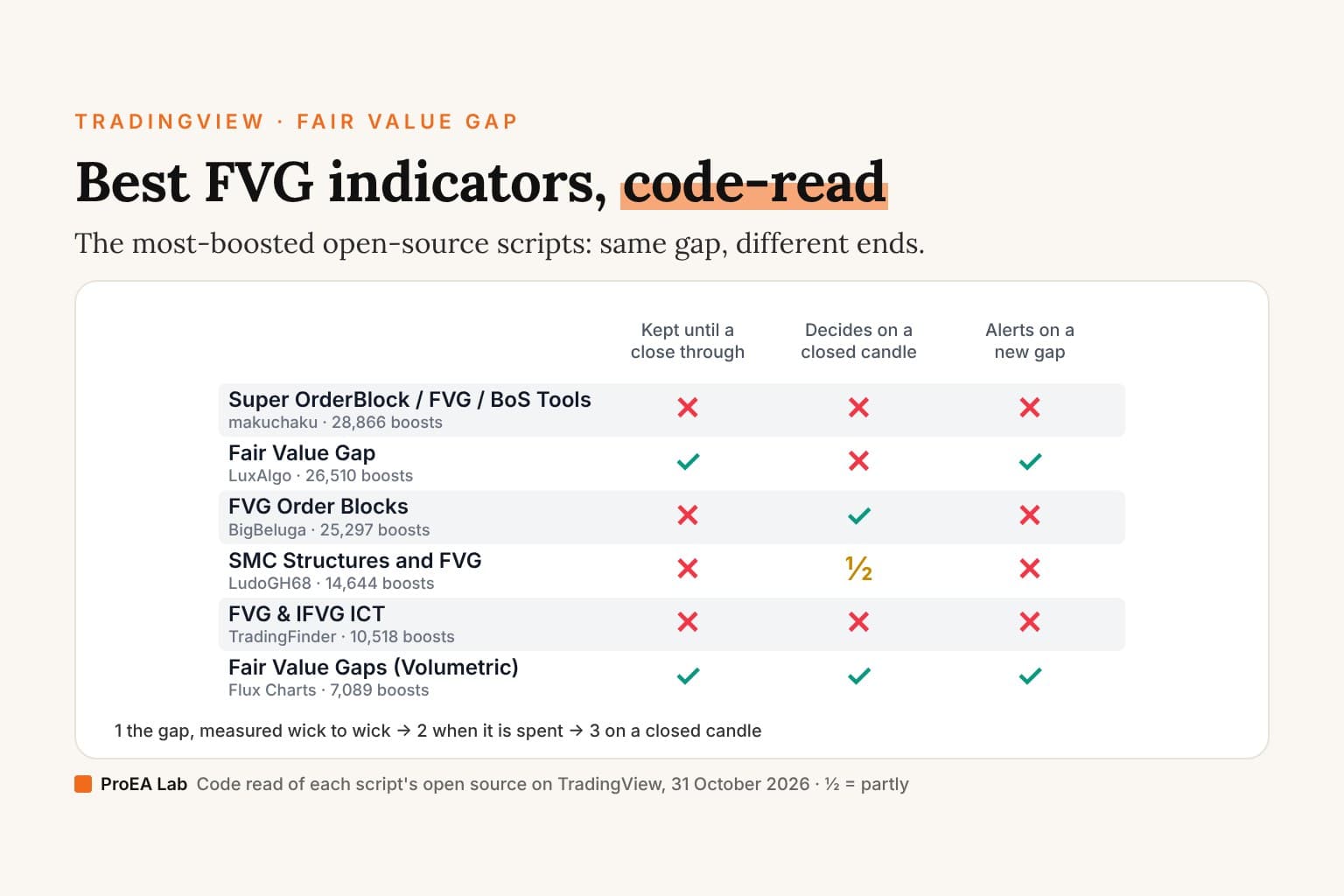
Short answer: the popular open-source FVG scripts agree on the gap and disagree on when it's spent. All 15 we read measure wick to wick, candle 1's high against candle 3's low, and none uses bodies. The most boosted open-source one, Super OrderBlock / FVG / BoS Tools by makuchaku & eFe, stops a gap at its first touch; Fair Value Gap by LuxAlgo keeps it until a candle closes through. Both draw on the live candle. For a gap drawn only once candle 3 has closed, kept until a close through, with an alert on each new one, Fair Value Gaps (Volumetric) by Flux Charts is the closest in our read, though by default it skips gaps whose three candles aren't all one colour.
Most lists name FVG indicators.
This one reads them.
What we checked
A fair value gap is the space three candles leave. Bullish: candle 3's low stays above candle 1's high, and the gap runs from that high to that low. Bearish: candle 3's high stays below candle 1's low. Its halfway line is called consequent encroachment, or CE. The gap exists only once candle 3 has closed; until then, candle 3 can still trade back into it. Some scripts call the same thing an imbalance.
An inverse fair value gap (IFVG) is what comes after: a gap a later candle closed through, kept on the chart with its direction flipped (explained, with the full rule). The FVG is the gap while price leaves it alone or fills it; the IFVG starts at the close that ends it.
The rule, on a simulated market. The third tab shows bodies apart and wicks overlapping, which no script here counts:
Simulated 15-minute candles, not market data. Gaps follow SMC Basics' rule (at least 0.3 × ATR(14)); each film draws only the gap it follows.
Read as text
- Candle 1's high is 99.35.
- Candle 2 is a fast up candle: its body is 2.9 times the window's average candle range.
- Candle 3's low, 99.54, stays above candle 1's high. The span between them, 99.35 to 99.54, is a bullish fair value gap: 0.19 tall, 0.70 times ATR(14). Its 50% line (CE) is 99.44.
- The gap exists only from candle 3's close. Until then, candle 3 could still trade back into it.
How this window was chosen: The first 15-minute window of the simulated market in which a bullish fair value gap forms at least 16 candles in, at least half an average candle tall, with a middle candle whose body is at least one average candle range, and no wick trades back into it in the 4 candles the film shows (fills are the next film's subject). The film ends 4 candles later.
We searched TradingView's scripts for four terms on 31 October 2026 ("fair value gap", "fvg", "fvg indicator" and "imbalance"), which returned 153 scripts with "fair value", "FVG" or "imbalance" in the name: 121 open source, 26 protected and 6 invite-only. We took the 15 most-boosted open-source scripts that draw three-candle gaps, other than LuxAlgo's IFVG script, which our IFVG roundup reads, and read every line that decides when a gap is drawn and when it ends, including the two TradingFinder libraries that three of them import. The questions:
- The rule: candle 1's wick against candle 3's wick, or bodies? And what else must candle 2 do?
- Size filter: is there a minimum size, in ATR, percent or points?
- When a gap is spent: a touch, its 50% line (CE), a wick to the far edge (a full fill), or a close through?
- Inversion: does a close through flip it into an IFVG?
- When it decides: a gap only exists once candle 3 closes. Does the script draw it on the live candle?
- Alerts, and the licence.
The first question has one answer for all of them: every script here measures wick to wick, and none uses bodies. The third splits them every way it can.
The table
Boosts as TradingView's search showed them on 31 October 2026. ATR(n) is the average true range of the last n candles. Candle 1 is the first of the three, candle 3 the one that completes the gap; the far edge is candle 1's high in a bullish gap, candle 1's low in a bearish one.
| Script | Boosts | Gap filter | When a gap is spent | Decides on | Alerts |
|---|---|---|---|---|---|
| Super OrderBlock / FVG / BoS Tools (makuchaku) | 28,866 | None | The box stops at the first candle whose range crosses one of its edges: in practice, the first touch | The live bar | None |
| Fair Value Gap (LuxAlgo) | 26,510 | Candle 2 closes beyond candle 1's high (low, if bearish); a threshold in %, 0 by default | Deleted on a close beyond the far edge | The live bar | Yes: new gap and mitigation, each way |
| Smart Money Concept (TradingFinder) | 25,556 | "Very Defensive" by default: candle 2 at least 1.5 × ATR(55) tall and mostly body, candles 1 and 2 closing the gap's way | Lines stop at the first wick to the near edge; only the latest gap each way is followed | The live bar | None for gaps; its alerts are for order blocks |
| FVG Order Blocks (BigBeluga) | 25,297 | Gaps over 0.5% of price; candle 2's high above candle 1's | Not followed: the gap is a fixed box ending 5 candles after candle 3; the "order block" behind it goes once a whole candle passes it | Closed candles | None |
| SMC Structures and FVG (LudoGH68) | 14,644 | None | Greyed at the first wick into it; deleted when a wick reaches the far edge | The gap on closed candles, as the next one opens; fills on the live bar | One: "FVG has been mitigated", at the first wick in |
| FVG Instantaneous Mitigation Signals (LuxAlgo) | 13,401 | Candle 2 closes beyond candle 1; a width filter in ATR(200), 0 by default | Shows only gaps the very next candle closes back through, each as a signal the other way | The live bar | None |
| FVG Sessions (LuxAlgo) | 11,788 | Candle 2 closes beyond candle 1; only the first gap of each day | Faded on a close beyond the far edge | The live bar | Yes, 8: new, mitigated, price inside, a cross of its midpoint |
| FVG Volume Profile (ChartPrime) | 11,196 | Candle 2's high beyond candle 1's; the gap over 0.5 × its own 200-candle standard deviation | Deleted on a wick beyond the far edge | The live bar | None |
| FVG & IFVG ICT (TradingFinder) | 10,518 | "Very Defensive", as its Smart Money Concept | Ends at a wick past its 50% line by default (near or far edge as options); flips into an IFVG on a close beyond the far edge in the 8 candles after that wick | The live bar | Yes: when a gap or an IFVG ends, not on a new gap |
| ICT Concept (TradingFinder) | 9,281 | "Defensive" by default: candle 2 at least 1.5 × ATR(55) tall | Lines stop at the first wick to the near edge; only the latest gap each way is followed | The live bar | None for gaps; its alerts are for order blocks |
| Imbalance Detector (LuxAlgo) | 8,581 | Candle 2 closes beyond candle 1; no opening gap on candle 2 or 3; a minimum width (points, % or ATR) off by default | Not followed on the chart; its dashboard counts a gap filled once a wick passes the far edge | The live bar | Yes: new gap |
| Fair Value Gap (spacemanbtc) | 8,101 | Candle 2 closes the gap's way | Shrinks as wicks enter; deleted when a wick reaches the far edge (its midpoint, as an option) | The live bar | None |
| Multitimeframe Fair Value Gap – FVG (Zeiierman) | 7,882 | Candle 3's body at least the average body; not right after another gap the same way | Deleted at a wick to its 50% line by default (the far edge, as an option) | The live bar; on a higher timeframe, history sees that candle before it closes | None |
| Liquidity Voids (FVG) (LuxAlgo) | 7,803 | Candle 2 closes beyond candle 1; gaps over 0.5 × ATR(144) | Split into 13 slices, each greyed as price trades into it | The live bar | None |
| Fair Value Gaps (Volumetric) (Flux Charts) | 7,089 | Candle 2 closes beyond candle 1; all three candles one colour; gaps over ATR(10) ÷ 6 | Ends on a close beyond the far edge by default (a wick, as an option) | Closed candles | One: "New FVG", as the next candle opens |
| IFVG Desk (ours) | — | At least 0.05 × ATR(14); intraday charts only | Not on a touch or a fill: a later close strictly beyond the far edge flips it into an IFVG, which ends on a close strictly beyond its other edge; 180 candles at most | Closed candles | Yes: new gap and inversion, among 7 conditions |
| SMC AI-Scored Toolkit (ours) | — | At least 0.25 ATR; each zone scored 0–100 | Once tested: held after a 1 ATR move its way, failed on a close through; undecided after 50 bars, expired | Bar close | 5 types on bar close, one for price entering a zone |
LuxAlgo's five, BigBeluga's and Zeiierman's are shared under CC BY-NC-SA 4.0, which doesn't allow commercial use; the other eight under the Mozilla Public License 2.0.
Four of the most boosted have closed code, so they aren't in the table: FVG by Nephew_Sam_ (37,418 boosts), the most boosted of all, Nephew_Sam_'s Market Structure BOS/CHOCH/MSB/FVG/OB/BB (30,639), majky's ICT SM Trades (20,302) and Fair Value Gap by Anche (7,337) are protected, free to add with the code hidden. Two open-source scripts above 7,089 boosts aren't in it either: LuxAlgo's Inversion Fair Value Gaps (15,503), which we read in our IFVG roundup, and Zeiierman's Volume Gaps & Imbalances (8,431), which marks price rows with no traded volume, not three-candle gaps.
Where they part is what price does when it comes back. Three cases on one simulated market: a partial fill, a full fill by a wick, and a close through. makuchaku's, and TradingFinder's Smart Money Concept and ICT Concept, end a gap at the first of these, ChartPrime's and spacemanbtc's at the second, and LuxAlgo's Fair Value Gap and Flux Charts' only at the third.
Simulated 15-minute candles, not market data. Gaps follow SMC Basics' rule (at least 0.3 × ATR(14)); each film draws only the gap it follows.
Read as text
- A bullish gap forms: candle 1's high 73.67, candle 3's low 73.79. CE (50%) is 73.73.
- 3 candles later a wick trades into the gap for the first time, 83% of the way to its far edge.
- Over the next 8 candles the deepest wick reaches 83% of the gap, past CE. No wick reaches candle 1's high: a partial fill.
How this window was chosen: The first window in which a bullish gap at least half an average candle tall is first traded into 3 to 12 candles after it formed, and no wick reaches its far edge in that candle or the next 8. The film ends 8 candles after the first touch. Each film's window starts after the windows of the films above it, so no two films share candles.
What the code says
Every one measures wick to wick. All 15 compare candle 3's low with candle 1's high (low > high[2]), or candle 3's high with candle 1's low for a bearish gap. What they add is about candle 2: LuxAlgo's five and Flux Charts' want it to close beyond candle 1, ChartPrime's and BigBeluga's want its high beyond candle 1's, spacemanbtc's wants it to close the gap's way, and TradingFinder's want it at least 1.5 × ATR(55) tall.
makuchaku's is the most boosted open-source one, and a gap lasts until its first touch. Each gap is boxed on the candle that completes it, live, with no size filter. The box stops growing at the first candle whose range crosses one of its edges and stays where it stopped, unless you switch on a grey colour for mitigated gaps. A gap whose middle candle closes through the last swing high, found with a one-candle pivot, is coloured blue as "structure breaking". It has no alerts, and it is shared under MPL 2.0.
LuxAlgo's keeps a gap until a close through it. Its Fair Value Gap boxes each gap for 20 candles to the right and deletes it when a candle closes beyond the far edge. That check runs on the live bar, so a box can vanish mid-candle and come back if price does. Its threshold starts at 0%, so every gap counts, and its four alerts cover new gaps and mitigations. FVG Sessions uses the same rule for the first gap of each day, fades it on a close through, and has eight alerts, including price inside the gap and a cross of its midpoint. Imbalance Detector draws each gap three candles wide with its midpoint and doesn't follow it; only its dashboard, off by default, counts a gap as filled, once a wick passes the far edge. Liquidity Voids splits gaps over 0.5 × ATR(144) into 13 slices and greys each one as price trades into it. FVG Instantaneous Mitigation Signals shows only the gaps the very next candle closes back through, as a signal the other way. All five decide on the live bar and are shared under CC BY-NC-SA 4.0.
TradingFinder's three filter hard and follow one gap each way. All three find their gaps with TradingFinder's FVG Detector library. Smart Money Concept's default filter, "Very Defensive", keeps a bullish gap only if candle 2 is at least 1.5 × ATR(55) tall with a body over 70% of it, candles 1 and 2 close up, candles 1 and 3 have bodies over 35% of their range, and candle 3's high clears candle 2's; ICT Concept's "Defensive" asks less. Only the latest bullish and the latest bearish gap are followed, and their lines stop at the first wick to the near edge. Both scripts' alerts are for order blocks. FVG & IFVG ICT draws through TradingFinder's Order Block Drawing library instead: a gap ends at a wick past its 50% line by default, or after 500 candles, and becomes an IFVG if one of the 8 candles after that wick closes beyond its far edge. A close beyond it on the wick's own candle doesn't count: the library line that ends an IFVG when its gap ends cancels it on that candle. Its alerts fire when a gap or an IFVG ends, not on a new gap. All three decide on the live bar and are shared under MPL 2.0.
Three end a gap on a wick, not a close. LudoGH68's SMC Structures and FVG greys a gap at the first wick into it, sends "FVG has been mitigated", and deletes it once a wick reaches the far edge. It finds gaps on closed candles, reading candles 1 and 3 one candle back, so a gap appears as the next candle opens; the fills it marks on the live one. ChartPrime's FVG Volume Profile deletes a gap on a wick beyond its far edge, and draws a volume profile of candle 2, from lower-timeframe candles, inside it. spacemanbtc's Fair Value Gap shrinks the box as wicks eat into it and deletes it when a wick reaches the far edge, or its midpoint with "MidPoint Fill" on. All three are shared under MPL 2.0.
Two decide on the closed candle. BigBeluga's FVG Order Blocks finds gaps on closed candles, over 0.5% of price by default, but doesn't follow them: each gap is a fixed box ending 5 candles after candle 3, and what stays on the chart is an "order block" one ATR(200) tall behind it, removed once a whole candle passes beyond it. Flux Charts' Fair Value Gaps (Volumetric) comes closest to the textbook life of a gap: found on closed candles, kept until a candle closes beyond the far edge ("Zone Invalidation: Close", its default) or until 200 candles pass with no wick back into it, and alerted as "New FVG" as the next candle opens. Its defaults also skip gaps whose three candles aren't all one colour or that are smaller than ATR(10) ÷ 6, and merge overlapping gaps into one. BigBeluga's is shared under CC BY-NC-SA 4.0, Flux Charts' under MPL 2.0.
Zeiierman's ends a gap at its midpoint, and reads ahead on a higher timeframe. Multitimeframe Fair Value Gap deletes a gap once a wick reaches its 50% line ("Mitigated on mid", on by default), and keeps a gap only if candle 3's body is at least the average body. On the chart's own timeframe it decides on the live bar. Pick a higher one and it reads that timeframe with lookahead on and no offset, so on history a gap shows from the first chart candle of the higher-timeframe candle that completes it, before that candle has closed. It is shared under CC BY-NC-SA 4.0.
Ours
IFVG Desk isn't on TradingView's search: its full Pine v6 source comes in Pine Pro Library, $49 once. It measures wick to wick, keeps gaps at least 0.05 × ATR(14) wide, and decides everything on closed candles; "New gap" is one of its 7 alert conditions. A fresh gap isn't ended by a touch, its 50% line or a full fill: a later candle's close strictly beyond the far edge flips it into an IFVG, which ends on a close strictly beyond its other edge, and any gap expires after 180 candles. It draws the gaps within 8 ATR of price, with a dotted midline. It runs on intraday charts only, and its entries are built around the flip, inside a New York session (09:30 to 11:00 by default), not around the gap itself.
The SMC AI-Scored Toolkit, $39 one-time with its full Pine source, does another job. It boxes order blocks and gaps a quarter of an ATR or wider on bar close, and scores each zone 0–100 on five factors (displacement, volume, a liquidity sweep, higher-timeframe alignment and time of day), frozen when the zone forms. A tested zone counts as held once price moves 1 ATR its way and as failed on a close through it; its 5 alert types, on bar close, include price entering a zone. Its page lists no IFVG flip; IFVG Desk does that. The score describes a zone; it isn't odds. On 1,693 resolved gold-futures zones, the top third by score was respected 2.6 points more often than the bottom third, and shuffling the scores at random gave gaps that size too (p = 0.21; the study).
SMC Basics, also in the library, is the plain version, and its rule is the one the two films above run: gaps of 0.3 × ATR(14) or wider on closed candles, faded at the first touch, removed on a close beyond the far edge, with a CE midline and no alerts.
An FVG and an IFVG are one zone at two moments, so a script that deletes a gap on a close through deletes it at the close an IFVG starts from. For the scripts that flip: best IFVG indicators, code-read. For scripts that count a gap only inside ICT's silver bullet hours, 03:00, 10:00 and 14:00 New York: best silver bullet indicators, code-read.
We haven't tested fair value gaps on their own as a trading rule.
Check one yourself
- The rule: find the line with
high[2].low > high[2]measures wick to wick; a script that comparesmath.min(open, close)withmath.max(open[2], close[2])measures bodies. - The end: find the line that deletes, greys or stops the box. A
closebeyond the far edge ends it on a close through;low <=the near edge on a touch;low <the far edge on a wick;(top + bottom) / 2on its 50% line. - The close: look for
barstate.isconfirmedaround the gap, or for candles read one back (high[3] < low[1], as LudoGH68's does). Without either, a box you see live may not be there when candle 3 closes. On a higher timeframe,lookahead = barmerge.lookahead_onwith no[1]reads that candle before it closes.
None of the scripts here, ours included, runs on MT4, MT5, NinjaTrader 8 or thinkorswim: Pine Script runs only on TradingView. On Zerodha, Dhan and Angel One, what each broker's help pages said on 29 October 2026 about TradingView scripts: buy sell indicator in Zerodha Kite, Angel One and Dhan.
How often does a close end a gap? In the IFVG Playbook's year of 5-minute gold, by IFVG Desk's rule, 86% of gaps flipped into IFVGs, a median 7 candles after forming. The guide has that study, the exact rule and two Pine templates:
The deep version, as a PDF
The IFVG Playbook
Inverse fair value gaps as exact rules, with a year of gold and Bitcoin data on what they really do.
- A one-year study: 34,537 IFVGs on gold and Bitcoin, how often gaps flip, how fast, and what price does next
- Eight IFVG plans tested against 1,000 random-entry runs each half, after costs, with the verdict
- The exact rule, the edge cases and a drill, so your chart and your notes stop disagreeing
One payment, instant download. Refund within 7 days if you haven't downloaded it.
Limits
One code read, on 31 October 2026, of the versions TradingView served that day, and of the TradingFinder libraries the three scripts import (FVG Detector Library versions 1 and 3, Order Block Drawing version 3). The toolkit's row comes from its product page. Scripts change, and boosts measure popularity, not quality. We build and sell IFVG Desk, SMC Basics and the SMC AI-Scored Toolkit, and we have no relationship with any author named here. Nothing here is financial advice.
Use these animations on your site.
Frequently asked questions
What is the best FVG indicator on TradingView?
It depends on when you want a gap to end. The most boosted open-source one, Super OrderBlock / FVG / BoS Tools by makuchaku & eFe (28,866 boosts), stops a gap at its first touch; Fair Value Gap by LuxAlgo (26,510) keeps it until a candle closes through. Both draw on the live candle. For gaps drawn only once candle 3 has closed, kept until a close through, with an alert on each new one, Fair Value Gaps (Volumetric) by Flux Charts (7,089) is the closest in our read. By default it skips gaps whose three candles aren't all one colour.
Is there a free fair value gap indicator for TradingView?
Yes. All 15 scripts in our table are free to add, with their code open. LuxAlgo's five, BigBeluga's and Zeiierman's are shared under CC BY-NC-SA 4.0, which doesn't allow commercial use; the other eight under the Mozilla Public License 2.0. The most boosted FVG script in our search, FVG by Nephew_Sam_ (37,418 boosts), is free to add too, but its code is hidden.
What are the best FVG indicator settings?
There is no best setting, only what each one changes. The minimum size decides how many gaps you see: LuxAlgo's threshold starts at 0%, Flux Charts' at a sixth of ATR(10), our IFVG Desk's at 0.05 × ATR(14). The end rule decides how long each one stays: Flux Charts' Zone Invalidation (Close or Wick), TradingFinder's Mitigation Level (Proximal, 50 % OB or Distal) and Zeiierman's Mitigated on mid each move it. A gap that ends on a touch goes first; one that ends on a close through stays longest.
What is the FVG indicator called on TradingView?
Search FVG or fair value gap in TradingView's indicator search. The most boosted script in our search on 31 October 2026 is named simply FVG, by Nephew_Sam_ (37,418 boosts), with its code hidden. The most boosted with open code are Super OrderBlock / FVG / BoS Tools by makuchaku & eFe and Fair Value Gap by LuxAlgo. Some scripts call the same gap an imbalance or a liquidity void.
Does the FVG indicator repaint?
Most of the popular ones draw on the live candle: makuchaku's, LuxAlgo's five, TradingFinder's three, ChartPrime's, spacemanbtc's and Zeiierman's. A gap only exists once candle 3 closes, so a box drawn mid-candle can vanish before it does. BigBeluga's and Flux Charts' decide on closed candles, and LudoGH68's finds its gaps on closed candles but marks fills on the live one. Ours, IFVG Desk, SMC Basics and the SMC AI-Scored Toolkit, decide on closed candles.
Is there an FVG indicator for MT4, MT5, NinjaTrader or thinkorswim?
Not among these: every script here is Pine Script, which runs only on TradingView, so none of them runs inside MT4, MT5, NinjaTrader 8, thinkorswim, Webull or Tradovate. With Zerodha, Dhan or Angel One, none of their help pages we read says a script of your own runs inside their apps, so run it on tradingview.com.
Which FVG indicator does ProEA make?
Three draw them, all deciding on closed candles. IFVG Desk and SMC Basics come in Pine Pro Library, $49 once with their full Pine v6 source: IFVG Desk draws gaps of 0.05 × ATR(14) or wider on intraday charts, alerts on each new one and flips a gap into an IFVG on a later close beyond its far edge; SMC Basics boxes gaps of 0.3 × ATR(14) or wider and removes them on a close through. The SMC AI-Scored Toolkit, $39 with its full Pine source, scores each gap 0–100 on five factors. We haven't shown that a gap, or its score, predicts anything.