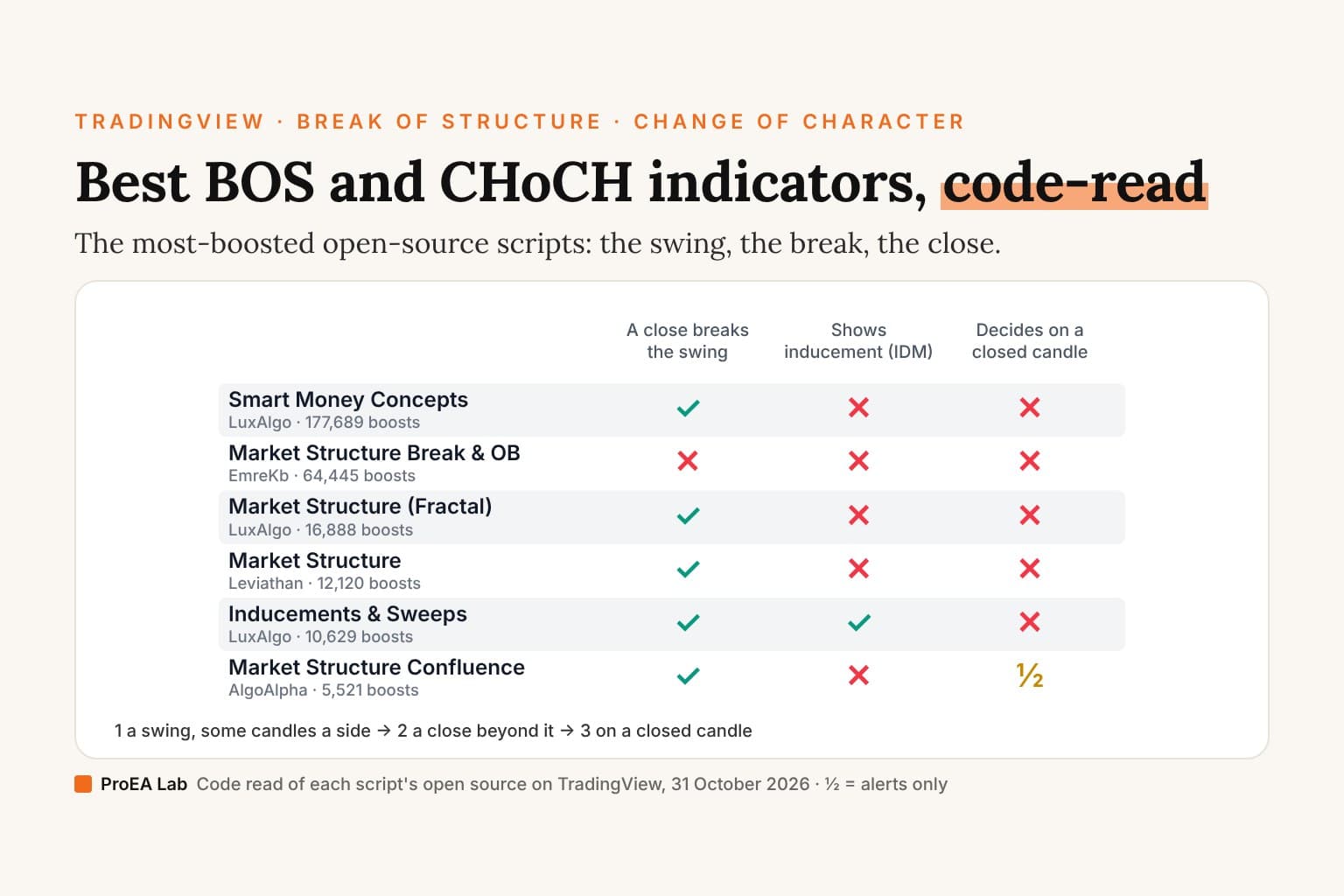
Short answer: the popular open-source BOS and CHoCH scripts mostly agree that a close breaks structure; 12 of the 15 we read use one by default. They disagree on what a swing is, from 1 candle a side to 50 candles after it, and none of the 15 waits for the candle to close before it draws the label. The most boosted that labels both, Smart Money Concepts by LuxAlgo (177,689 boosts), reads swing and internal structure and alerts on each. For inducement (IDM), it's Market Structure with Inducements & Sweeps by LuxAlgo. For alerts that wait for the close, Market Structure Confluence by AlgoAlpha, with one gap in how its CHoCH alerts are wired.
Most lists name BOS and CHoCH indicators.
This one reads them.
What we checked
A break of structure (BOS) is a candle closing beyond the last swing high or low in the direction structure already points. A change of character (CHoCH) is the first such close the other way. Every script below draws some version of that; they differ in the details that decide which candle gets which label.
We searched TradingView's scripts for five terms on 31 October 2026 ("bos choch", "choch", "break of structure", "change of character" and "market structure"), which returned 126 scripts: 106 open source, 17 protected and 3 invite-only. We took the 14 most-boosted open-source scripts that label structure breaks on the chart and that we read in full, down to 5,394 boosts, and added LuxAlgo's Smart Money Concepts, which a sixth search, "smart money concepts", finds: its name has none of the five terms. For each, we read every line that decides a swing, a break and its label. Eight questions:
- The swing: how is it found: a pivot with a set number of candles on each side, a fractal, or a zigzag?
- The break: must a candle close beyond the swing, or is a wick enough?
- Internal and swing structure: does it read both, or one?
- The first break the other way: what is it called?
- Inducement (IDM): is it shown?
- When it decides: how many candles after a swing is it known, and does the label wait for the candle to close?
- Alerts: which breaks can you alert on?
- Licence: what may you do with the code?
The table
Boosts as TradingView's search showed them on 31 October 2026. "A side" is the number of candles on each side of a pivot; a pivot is known that many candles after it prints. ATR(17) is the average true range of the last 17 candles.
| Script | Boosts | The swing | The break | Levels and IDM | First break the other way | Decides on | Alerts |
|---|---|---|---|---|---|---|---|
| Smart Money Concepts (SMC) (LuxAlgo) | 177,689 | A high above the next 50 candles' highs (swing structure) or the next 5 (internal) | A close | Swing and internal; no IDM | CHoCH | The live bar | BOS and CHoCH, swing and internal |
| Market Structure Break & Order Block (EmreKb) | 64,445 | A zigzag of 9: a low is recorded when price turns up to a new 9-candle high, and the mirror | A new zigzag low at least a third of the rise between the two lows below the one before, or the mirror; wicks, not closes | One; no IDM | "MSB" for every break: it marks only changes of direction | The live bar, and no earlier than the zigzag's turn | MSB, and price inside a box |
| Market Structure CHoCH/BOS (Fractal) (LuxAlgo) | 16,888 | A 5-candle fractal: two rising highs, the high, two falling; known 2 candles later | A close | One; no IDM | "ChoCH" | The live bar | None |
| Market Structure Break & OB Probability Toolkit (LuxAlgo) | 12,379 | Pivot, 7 a side | A close, on a candle whose close-to-close move is more than 0.5 standard deviations above its 50-candle average | One; no IDM | "MSB" for every break | The live bar | None |
| Market Structure (Leviathan) | 12,120 | Pivot, 20 a side | A close by default; wicks optional | One; no IDM | "BOS", unless you switch on "Show CHoCH" (off by default) | The live bar | None |
| Market Structure with Inducements & Sweeps (LuxAlgo) | 10,629 | A high above the next 50 candles' highs for the CHoCH; the next 3 for the IDM | A close | One, plus IDM: the latest 3-candle swing low, taken by a wick | Every change of direction is a CHoCH; a BOS needs the IDM taken first | The live bar | None |
| ICT Anchored Market Structures with Validation (LuxAlgo) | 7,235 | ICT's short-term swing, the middle of 3 candles (known 1 candle later), and swings of those for intermediate and long term | A close | Three, all labelled; no IDM | "ST-CHoCH", "IT-CHoCH", "LT-CHoCH" | The live bar; a label turns into "SWEEP" if price closes 1 ATR(17) back through the level first | None |
| MTF Break of Structure(BOS) & Market Structure Shift(MSS) (Lenny_Kiruthu) | 7,172 | Pivot, 7 a side, on your chart and on 2-hour candles | A close by default; high or low optional | One per timeframe; no IDM | "MSS"; the very first break gets no label | The live bar; live, its 2-hour breaks read the unfinished 2-hour candle | BOS and MSS, at your candle's close |
| Market Structures + ZigZag (TradingFinder) | 7,090 | A zigzag on pivots of 5 a side; the Major low is the last zigzag low before a close above the Major high | A close | Major shown; Minor off by default; no IDM | "Major ChoCh" | The live bar | None |
| BOS/CHOCH Demand & Supply (s3u1l) | 6,140 | Pivots of 1, 2, 3, 5, 11, 15 and 20 a side, all at once | A close, if the candle before didn't already trade beyond the level | Seven lengths, each labelled; IDM optional, off by default | "CHOCH" when the high it breaks was a lower high: set by the swings, not by the last break | The live bar | A new zone (the break), a touch, a broken zone |
| Market Structure Trend Targets (ChartPrime) | 5,872 | Pivot, 10 a side | A wick | One; no IDM | No BOS or CHoCH words: the first break each way shows its price, the next ones are numbered | The live bar | None |
| Market Structure (Breakers) (LuxAlgo) | 5,799 | Pivot, 20 a side | A close | One; no IDM | "MSS"; breaks the same way are "MSB" | The live bar | None |
| Market Structure Confluence (AlgoAlpha) | 5,521 | Pivot, 10 a side | A close by default; wicks optional | One; no IDM | CHoCH | Labels on the live bar; alerts wait for the close by default | BOS, CHoCH, swings, trend change; its Bullish CHoCH alert fires only when one candle breaks both sides, its Bearish CHoCH alert never |
| Algo Market Structure (Nephew_Sam_) | 5,509 | Its own, from candle colour: a high is fixed once candles turn down after it | A wick through its "TLQ" line, the low it protects after a higher high, or the mirror | One, on your chart by default; no IDM | "BOS", and that BOS turns its structure the other way: it has no CHoCH label | The live bar | None |
| Market Structure Inducements ICT (TradingFinder) | 5,394 | Pivots: 15 left and 30 right for the CHoCH level (known 30 candles later), 1 a side for BoS, 3 for IDM | A close | Two, plus IDM ("IDMT") | "Bullish ChoCh", drawn at the level that would flip the trend before price gets there | The live bar | None |
| Signal Desk (ours) | — | Pivot, 5 a side by default, 2 to 30 | A close, checked once the candle has closed | One; no IDM | CHoCH; the first break on a chart is a BOS | Closed candles | No alert on the tag; its Breakout entry trigger uses a break |
Seven more in the search rank above the table's last row and aren't in it. One is closed: Market Structure BOS/CHOCH/MSB/FVG/OB/BB by Nephew_Sam_ (30,639 boosts) is protected, free to add with the code hidden. Five don't label breaks on the chart: Flux Charts' Market Structure Dashboard (10,386) lists the last HH, HL, LH and LL on each timeframe in a table; LuxAlgo's Market Structure Oscillator (8,485) is an oscillator whose chart structures are off by default; LuxAlgo's Market Structure Trailing Stop (7,423) draws break lines, dashed for a CHoCH and dotted for a BOS, with no labels; TradingFinder's Turtle Soup ICT Strategy (6,734) labels a higher-timeframe sweep and then an "MSS" level after it: a setup, not a running BOS/CHoCH read; and LuxAlgo's Market Structure (Intrabar) (6,087) draws structure only inside the latest candle, from lower-timeframe candles. The seventh, The_Forex_Steward's Market Structure- ZigZag, Break of Structure & Order Blocks (6,311), runs to 2,266 lines with nine versions of its swing trigger and was updated on 29 October 2026; we didn't finish reading it, so we don't describe it. On fair value gaps: of the 15 we read, only LuxAlgo's Smart Money Concepts draws them; Nephew_Sam_'s protected script names them, and so does twingall's Market Structure & Liquidity: CHoCHs+Nested Pivots+FVGs+Sweeps (4,459 boosts), below our cut. The others in our search that name BOS, CHoCH and FVG all have under 500 boosts.
Why two scripts label the same chart differently
Mostly the swing length, then the break. A longer swing sees fewer, bigger swings, so it labels fewer breaks, and a break that is a CHoCH on a short swing can be the first break, a BOS, on a long one. Try it on one chart:
5 a side is Signal Desk's default, LuxAlgo's internal structure (the 5 candles after the swing) and TradingFinder's zigzag.
5 candles a side, a close: 4 labels, 2 BOS and 2 CHoCH.
A swing is known 5 candles (1 hour 15 minutes) after its high or low, so the first one here is known on the 23:30 candle. The first CHoCH is the 08:45 candle: its close crosses the swing low at 103.72 from 01:45. 4 candles wicked through a level and closed back (ringed), which breaks nothing here; read with a wick instead, the same candles give 6 labels. The same candles and break at 3: 6, 10: 2, 20: 1.
Simulated 15-minute candles, not market data: a window of the seeded market our structure films use. The first 72-candle window of the simulated market's 15-minute candles in which a longer swing length labels fewer breaks with a close (3 candles a side more than 5, 5 more than 10, 10 at least as many as 20, and 20 at least one), swing length 5 labels at least one BOS and one CHoCH, swing length 10 labels a CHoCH, and a wick at swing length 5 labels a different number of breaks than a close. One rule reads every setting: a swing high beats the candles on each side and is known only once they have closed; the first break against the last one is the CHoCH, and the first break on the chart is a BOS. It isn't any one script's code: the table says what each does. No outcomes are shown.
Read as text: the labels at every setting
- 3 a side, a close: BOS up at 02:45 through 104.03; BOS up at 04:15 through 104.22; CHoCH down at 07:15 through 104.05; BOS down at 08:30 through 103.77; BOS down at 11:15 through 103.54; CHoCH up at 12:45 through 104.12.
- 5 a side, a close: BOS up at 02:45 through 104.03; CHoCH down at 08:45 through 103.72; BOS down at 11:15 through 103.54; CHoCH up at 13:00 through 104.24.
- 10 a side, a close: BOS down at 08:45 through 103.72; CHoCH up at 13:00 through 104.24.
- 20 a side, a close: BOS up at 13:00 through 104.37.
- 3 a side, a wick: BOS up at 00:45 through 103.98; CHoCH down at 01:45 through 103.77; CHoCH up at 02:45 through 104.03; BOS up at 04:15 through 104.22; CHoCH down at 07:15 through 104.05; BOS down at 08:30 through 103.77; CHoCH up at 09:30 through 104.22; CHoCH down at 11:15 through 103.54; CHoCH up at 12:45 through 104.12.
- 5 a side, a wick: BOS up at 00:45 through 103.98; CHoCH down at 01:45 through 103.77; CHoCH up at 02:45 through 104.03; CHoCH down at 08:30 through 103.72; BOS down at 11:15 through 103.54; CHoCH up at 12:45 through 104.24.
- 10 a side, a wick: BOS down at 08:30 through 103.72; CHoCH up at 12:45 through 104.24.
- 20 a side, a wick: BOS up at 13:00 through 104.37.
At 5 candles a side, the 13:00 candle's close is a CHoCH; at 20, the same close is a BOS, because at 20 a side there's no earlier break for it to change. The 08:45 close is a CHoCH at 5 and a BOS at 10. Read with a wick instead of a close, swing length 5 turns 4 labels into 6.
What the code says
LuxAlgo's Smart Money Concepts is the one most traders find, and it does the most. It reads two structures at once: swing structure, from highs that stand above the next 50 candles' highs, and internal structure, from the next 5. A close across the level is a break, and a CHoCH when it goes against the last break; there's an alert for each, swing and internal, up and down. It also draws internal order blocks and equal highs and lows by default, and swing order blocks and fair value gaps once you switch them on. Nothing waits for the candle to close, so a label can print mid-candle and be gone at the close, and a swing is known only 50 candles after it prints. It's shared under CC BY-NC-SA 4.0. The rest of the suite is in our SMC roundup.
EmreKb's, the most-boosted market structure script, has no BOS or CHoCH. It draws a zigzag and labels "MSB" only when its direction changes: the newest zigzag low at least a third of the rise between the two lows below the one before, or the mirror for highs. It judges zigzag points, which are wicks, not closes, and its zigzag records a low only when price turns up to a new 9-candle high, so a bearish MSB can't print before that turn; the label is then drawn back at the level it broke. At each MSB it boxes an order block and a breaker or mitigation block, and it alerts on MSB and on price inside a box. It's shared under the Mozilla Public License 2.0.
Leviathan's and AlgoAlpha's are the plain BOS and CHoCH. Both use pivots, 20 and 10 candles a side, and a close by default, with a "Wicks" option. Leviathan's labels every break BOS unless you switch on "Show CHoCH", which renames the first break against the last one; it has no alerts. AlgoAlpha's shows the CHoCH by default and has alerts that wait for the candle to close, but its CHoCH alerts are wired so they rarely fire: by the time its "Bullish CHoCH" alert is checked, the script has already set the direction to up, so it fires only when one candle breaks both sides, and its "Bullish BOS" alert fires on every break up, a CHoCH included. Its "Bullish Trend Change" alert is the one that fires on a bullish CHoCH, and on the chart's first break. The bearish side is worse: the low break is handled last, so "Bearish CHoCH" can never fire; "Bearish BOS" fires on every break down, and "Bearish Trend Change" fires on a bearish CHoCH. Leviathan's is under the Mozilla Public License 2.0; AlgoAlpha's carries no licence line.
For inducement, LuxAlgo's and TradingFinder's. LuxAlgo's Market Structure with Inducements & Sweeps finds the CHoCH on 50-candle swings, then waits for a wick to take the latest 3-candle swing low, its IDM, before it will label a BOS: a close above the highest high since the CHoCH. A wick above that high which closes back is marked "x", a sweep. TradingFinder's Market Structure Inducements ICT draws its levels before price reaches them: "Bullish ChoCh" at the swing high that would end a downtrend, "BoS" at the highest 1-candle swing high of an uptrend so far, renamed "LQDT" if a wick takes it and the candle closes back, and "IDMT" at the latest 3-candle swing low. Neither has alerts.
LuxAlgo's ICT Anchored Market Structures can rename a label after the fact. It labels three structures at once, ICT's short-, intermediate- and long-term swings, so one close can carry an ST, an IT and an LT label. With its default "Market Structure Validation", a break that sees a close 1 ATR(17) back through the level before one 1 ATR(17) beyond is renamed "SWEEP": a label you saw as a BoS can change later.
Lenny_Kiruthu's reads a higher timeframe in a way that repaints. By default it reads 7-candle pivots on your chart and on 2-hour candles, and calls the first break the other way "MSS". On a live chart, its 2-hour close comes from request.security with no offset, which returns the 2-hour candle still forming; on history it returns the finished one. So a 2-hour BOS can print, and alert at your candle's close, before the 2-hour candle closes, and not be there after a reload if that candle closed back. The very first break gets no label. It's under the Mozilla Public License 2.0.
s3u1l's calls a CHoCH by the swings, not by the last break. It runs seven pivot lengths at once, from 1 to 20 candles a side, and labels a break "CHOCH" when the high it closes above was a lower high, "BOS" when it was a higher high. A close only counts if the candle before didn't already trade beyond the level, so a wick through on one candle cancels a close through on the next. It boxes a zone at the swing on the other side, alerts on new, touched and broken zones, and carries no licence line.
Three more mark breaks without the BOS and CHoCH split. LuxAlgo's Market Structure Break & OB Probability Toolkit labels every break "MSB" and counts one only if the breaking candle's close-to-close move is more than 0.5 standard deviations above its 50-candle average, so a slow close through the level isn't a break. ChartPrime's Market Structure Trend Targets breaks a 10-candle pivot on a wick, prints the level's price at the first break each way and numbers the next ones, with a trailing stop. Nephew_Sam_'s Algo Market Structure builds swings from candle colour and labels "BOS" when a wick goes through the low it protects after a higher high; that BOS turns its structure the other way, which most scripts here would call a CHoCH. Set it to a higher timeframe and it requests that timeframe with lookahead on and no offset, so on history it can use a candle's close before that candle finished.
The rest are close to the textbook. LuxAlgo's Fractal script breaks a 5-candle fractal on a close and names the first break the other way "ChoCH"; its Breakers script does the same on 20-candle pivots and says "MSS" and "MSB". TradingFinder's zigzag labels "Major BoS" and "Major ChoCh" on a close, with Minor structure off by default. None of the three has alerts.
Licences. LuxAlgo's six are shared under CC BY-NC-SA 4.0, which doesn't allow commercial use. EmreKb's, Leviathan's, Lenny_Kiruthu's, ChartPrime's and TradingFinder's two are under the Mozilla Public License 2.0. s3u1l's, AlgoAlpha's and Nephew_Sam_'s carry no licence line.
Ours
Signal Desk isn't on TradingView's search: its full Pine v6 source comes in Pine Pro Library, $49 once. Its BOS and CHoCH tags show when you set View preset to Pro or Full; the default, Clean, hides them. It finds swings with pivots of 5 candles a side by default, adjustable from 2 to 30, so a swing is known 5 candles after it prints. A break is a close beyond the last confirmed swing high or low, checked only once the candle has closed, and each swing breaks once. The first break against the last one is a CHoCH; the first break on a chart is a BOS. The tag sits on the candle that closed through, with no line back to the swing.
Where it does less than the free scripts above: one structure, no internal structure, no IDM, no sweep marks, and no alert on the tag itself. Its alerts are for entries, exits and targets; set Entry trigger to Breakout and an entry needs a BOS or CHoCH in the trend's direction, among its other checks. If you want inducement or two structures on one chart, LuxAlgo's free scripts do that. What Signal Desk adds is a tag decided on the closed candle, so what you see live is what history shows.
Two more of ours use the same kind of break without labelling it. SMC Basics, also in Pine Pro Library, takes a close through a swing confirmed 10 candles later, on closed candles, and boxes the order block that break leaves. The SMC AI-Scored Toolkit, $39, boxes order blocks at structure breaks on bar close and scores each zone 0 to 100.
We haven't tested BOS or CHoCH as a trading rule.
Check one yourself
- The swing: look for
ta.pivothigh(and its two numbers, or a high some candles back compared withta.highest(. The second number is how many candles late a swing is known. - The break: look for
close >orta.crossover(closeagainst the level. If it compareshighinstead, a wick is enough. - The CHoCH: look for the variable that remembers the last break's direction. The label should say CHoCH when the new break goes the other way.
- The close: look for
barstate.isconfirmedbefore the label. None of the 15 free scripts here has one there; Signal Desk's is on line 248 of its source. - A higher timeframe:
request.securitywith lookahead off and no[1]reads the candle still forming on a live chart.
None of the scripts here, ours included, runs on MT5, MT4 or NinjaTrader 8: Pine Script runs only on TradingView, and an MT5 version would be a new program in MQL5.
The deep version, as a PDF
The Smart Money Concepts Rule Book
ICT and SMC as exact rules on closed candles, every concept set against the ones it's confused with, and what our data says about each.
- 26 SMC and ICT terms, each one closed-candle rule: BOS, CHoCH, MSS, order blocks, breakers, fair value gaps, sweeps, OTE, killzones, SMT and more
- The comparisons traders search for, side by side: BOS vs CHoCH vs MSS, breaker vs mitigation vs order block, sweep vs grab vs breakout, FVG vs imbalance vs IFVG
- Every measurement we've published on these concepts, with its sample, period and costs, and why the book prints no win rate
One payment, instant download. Refund within 7 days if you haven't downloaded it.
Limits
One code read, on 31 October 2026, of the versions TradingView served that day. Scripts change, and boosts measure popularity, not quality. The drill's candles are simulated, and its one rule sweeps the two settings these scripts differ on most; it isn't any script's code. We build and sell Signal Desk and the SMC AI-Scored Toolkit, and we have no relationship with any author named here. Nothing here is financial advice.
Frequently asked questions
What is the best BOS CHoCH indicator on TradingView?
It depends on what you need. The most boosted that labels both, Smart Money Concepts by LuxAlgo (177,689 boosts), reads swing and internal structure from a close and has an alert for each kind of break, but labels the live candle. For alerts that wait for the candle to close, Market Structure Confluence by AlgoAlpha (5,521 boosts) is the one in our read, with one gap: its CHoCH alerts miss an ordinary CHoCH (the bullish one fires only when one candle breaks both sides, the bearish one never), so use its Trend Change alerts for a CHoCH. None of the 15 free scripts we read waits for the close before it draws the label.
What is the BOS CHoCH indicator called?
There isn't one indicator by that name. On TradingView, the most-boosted open-source scripts that label both are Smart Money Concepts by LuxAlgo, Market Structure CHoCH/BOS (Fractal) by LuxAlgo, Market Structure by Leviathan, where CHoCH is a setting that starts off, and Market Structure with Inducements & Sweeps by LuxAlgo. The most-boosted market structure script, EmreKb's Market Structure Break & Order Block, labels its breaks MSB instead.
Is there a BOS CHoCH IDM indicator on TradingView?
Yes, two in our read. Market Structure with Inducements & Sweeps by LuxAlgo (10,629 boosts) marks IDM where a wick takes the latest 3-candle swing low after a bullish CHoCH, or the high after a bearish one, and labels a BOS only after that. Market Structure Inducements ICT by TradingFinder (5,394 boosts) draws an IDMT line at the latest 3-candle swing against the trend. Both decide on the live candle and have no alerts.
Is there a BOS CHoCH FVG indicator?
Of the 15 scripts we read, only LuxAlgo's Smart Money Concepts also draws fair value gaps, once you switch them on; they're off by default. The most boosted in our search that names all three, Market Structure BOS/CHOCH/MSB/FVG/OB/BB by Nephew_Sam_ (30,639 boosts), is protected, so we couldn't read it; the others that name all three have under 500 boosts. twingall's Market Structure & Liquidity (4,459 boosts), which names CHoCHs and FVGs, fell below our cut.
Is there a BOS CHoCH indicator for MT5?
Not among these. Every script here, ours included, is Pine Script, which runs only on TradingView, not on MT5, MT4 or NinjaTrader 8. An MT5 version would be a new program written in MQL5.
What is the market structure break and order block indicator?
It's EmreKb's Market Structure Break & Order Block, the most-boosted script in our search (64,445 boosts). It draws a zigzag of 9 candles and labels MSB when the newest zigzag low is at least a third of the rise between the two lows below the low before it, or the mirror for highs, then boxes an order block and a breaker or mitigation block. It has no BOS or CHoCH labels, it reads wicks, not closes, and it records a zigzag low only once price turns up to a new 9-candle high.
Which BOS CHoCH indicator does ProEA make?
Signal Desk, in Pine Pro Library, $49 once with its full Pine v6 source. With View preset set to Pro, it tags BOS and CHoCH from swings of 5 candles a side by default, from 2 to 30, and decides each break on a closed candle: a close beyond the last confirmed swing high or low. It has one structure, no IDM and no alert on the tag itself.