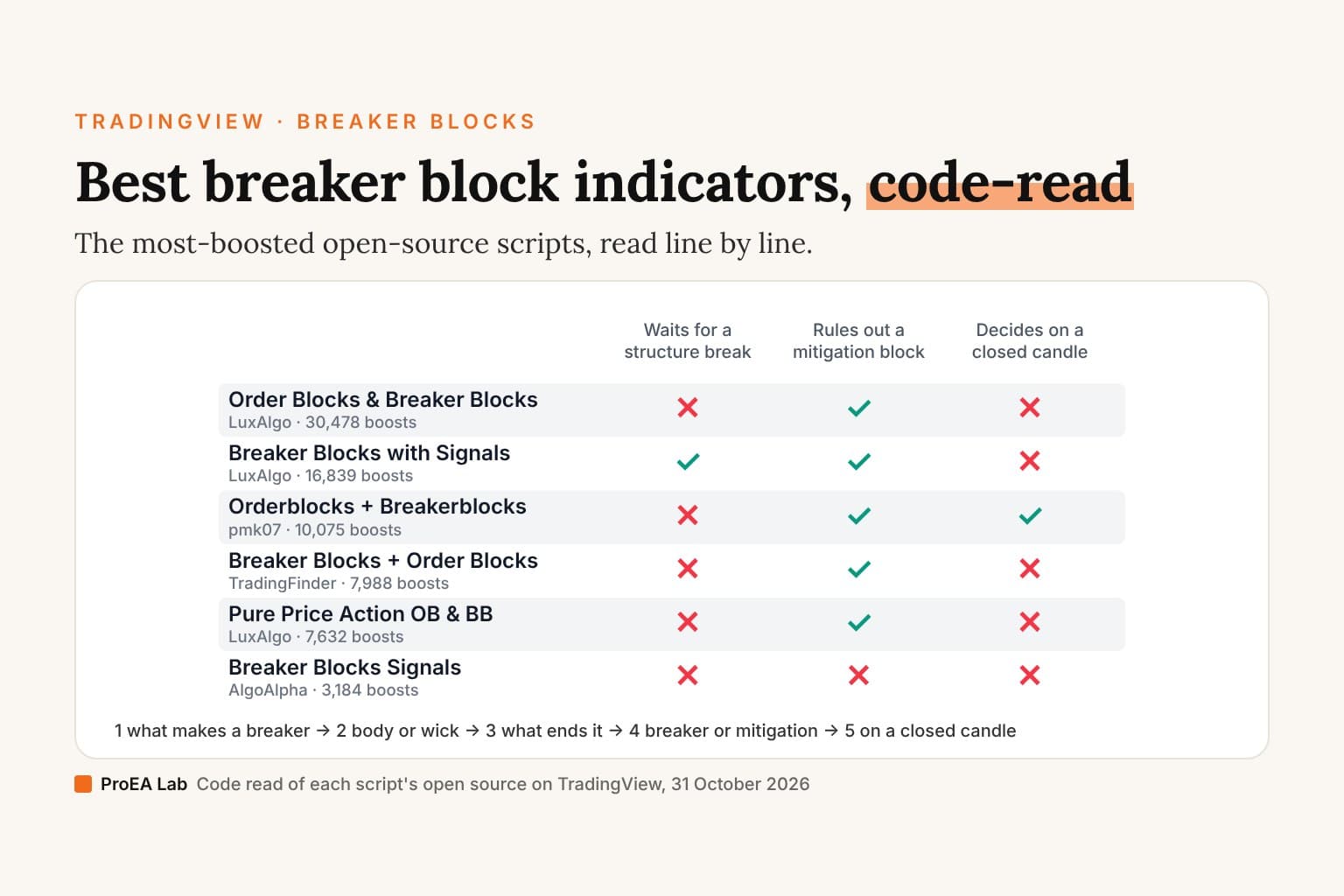
Short answer: the popular breaker block scripts don't agree on what a breaker is. The most boosted, Order Blocks & Breaker Blocks by LuxAlgo (30,478 boosts), flips an order block the moment a candle's body gets through it, with no break of structure, on the live bar, and has no alerts. Breaker Blocks with Signals by LuxAlgo (16,839) is the closest to the textbook: it waits for a drop that makes a lower low, then a close back above the swing high, and boxes the last up candle before that high, so it never boxes a mitigation block. It decides on the live bar and keeps one breaker at a time. For breakers drawn on closed candles, Breaker Blocks by Flux Charts (2,734) flips an order block on a close through it, ends it on a close back, and alerts on each new one, but never checks structure. None of our desks draws breaker blocks.
Most lists name breaker block indicators.
This one reads them.
What we checked
We read every script against one rule, the one in our SMC Rule Book. A candle closes beyond a swing, and the last candle that closed the other way is the order block, its body the zone. A later candle closes beyond the zone's far edge; a wick beyond it that closes back is only a touch. Then the next break of structure goes the other way. From the later of those two closes, the zone is a breaker, watched from the other side. A close back beyond its new far edge ends it. If the move before the break never closed beyond the last low (or high), the same zone is a mitigation block, not a breaker. The order block itself, and the 14 scripts that draw it, are in our order block indicator code read; the rules sit together in our smart money concepts guide.
We searched TradingView's scripts for four terms on 31 October 2026 ("breaker block", "breaker blocks", "breaker" and "order blocks & breaker blocks") and kept every script with "breaker" in its name: 70 scripts, 45 open source, 17 protected and 8 invite-only. We took the 14 most-boosted open-source scripts that draw breaker blocks and read every line that decides what is drawn, and the library code where a script imports its rule (TradingFinder's four do). Six questions:
- What makes a breaker: an order block that price closes through, a touch and then a close, a failed swing, or a break of structure?
- Its range: the candle's body, its wicks, or another price?
- What ends it: a close back through it, a touch, or something else?
- Breaker or mitigation block: does it check whether the move before the break made a new low (or high)?
- When it decides: on a closed candle or the live one, and how many candles late its swing is known?
- Alerts and licence.
The table
Boosts as TradingView's search showed them on 31 October 2026. "Bullish" throughout: a bearish order block that failed upward. The bearish breaker is the mirror in every script.
| Script | Boosts | What makes a breaker | Its range | What ends it | Breaker or mitigation block | Decides on | Alerts |
|---|---|---|---|---|---|---|---|
| Order Blocks & Breaker Blocks (LuxAlgo) | 30,478 | A candle's body through its order block: the candle with the highest high between a 10-candle swing low and the close below it. No structure check | Wick to wick; the body as an option | A close back below it | Built in: its order block needs a close below a swing low | The live bar; the swing known 10 candles late | None |
| Breaker Blocks with Signals (LuxAlgo) | 16,839 | A close above the last zigzag swing high when structure was down, after the drop from that high made a lower low. The zone: the last up candle at or before that high | Wick to wick; the body, or two candles, as options | A close below its bottom; a close below its midline first cancels its signals | Checked: no lower low, no breaker. The low is a wick | The live bar; swings 5 candles left, 1 right; one breaker at a time | Breaker, signal, cancel and mitigated, among 22; its alert() calls fire at the candle's close (the take-profit ones, off by default, once per bar) |
| Higher order Orderblocks + Breakerblocks + Range + Alerts (pmk07) | 10,075 | No close: a 3-candle swing low forming above its supply block | The supply block's: the higher-order swing high's wick down to the higher of its low and the previous candle's | A 3-candle swing high forming below it | Built in: its order block needs a swing below a swing low | Closed candles; 3-candle swings | One message per closed candle, breaker tests among them |
| Breaker Blocks + Order Blocks confirm (TradingFinder) | 7,988 | Price reaches its order block's near edge, and one of the next 3 candles closes beyond the far edge (its library, version 4; one made on the touching candle itself is cleared on that candle) | Its order block's, "refined" by its library by default | A wick back to its near edge, by default; the first touch of the next order block of its kind; or 500 candles | Built in: its order block needs a close below a swing low | The live bar; 9-candle swings | An "overlap" zone's first touch, once per bar |
| Pure Price Action Order & Breaker Blocks (LuxAlgo) | 7,632 | As LuxAlgo's Order Blocks & Breaker Blocks, on swings of 3-candle swings | The body, by default | A close back below it | Built in: its order block needs a close below a swing low | The live bar | None |
| Breaker Blocks Signals (AlgoAlpha) | 3,184 | Two closes in a row through its order block: the last opposite candle before a run of candles whose summed bodies cross 4 standard deviations above their 100-candle average. No structure check | Wick to wick | Two closes in a row back through it; or 500 candles | Not checked | The live bar | Breaker formed; a rejection |
| Order Blocks & Breaker Blocks Signals + Alerts (TradingFinder) | 3,107 | As TradingFinder's above, within the 8 candles after the touch (its library, version 3) | Its order block's, refined by default | A wick back to its near edge, by default; the first touch of the next order block of its kind; or 500 candles | Built in: its order block needs a close below a swing low | The live bar; 9-candle swings | The first touch of an order block or a breaker, once per bar |
| Breaker Blocks (Flux Charts) | 2,734 | A close through its order block: the candle with the highest high between a 10-candle swing low and the close below it, up to 3.5 ATR(10) tall. A wick as an option. No structure check | Wick to wick | A close back through it; a wick as an option | Built in: its order block needs a close below a swing low | Closed candles; the swing known 10 candles late | A new breaker, on a closed candle |
| Unicorn ICT Signals (TradingFinder) | 2,345 | As TradingFinder's above, after a wick through the order block's far edge. Breakers hidden by default: it draws a "Unicorn", a new fair value gap over a breaker | Its order block's, refined by default | A wick back to its near edge, by default; the first touch of the next order block of its kind; or 500 candles | Built in: its order block needs a close below a swing low | The live bar; 7-candle swings | A Unicorn's first touch, once per bar |
| Volatility Breaker Blocks (BigBeluga) | 2,141 | No order block: a zone at a volatile 5-candle swing, which flips when a whole candle clears it | One ATR(200) from the swing's high or low | A close back through its far edge | Not checked | Closed candles; the swing known 5 candles late; the last 500 candles | None |
| ICT Setup 02 Breaker Blocks + Reversal Candles (TradingFinder) | 2,133 | In a run of lower highs and lower lows, a close above the second-last lower high. The zone: that high's candle | That candle, refined by default | The first touch of its near edge; or 500 candles | Checked by its pattern: the low after the boxed high must be a lower low (TypePoint2 == 'LL'). The lows are wicks | The live bar; 2-candle swings | None |
| Orderblocks & Breakers (VEGAlgo) | 2,069 | A close through its order block: the last opposite candle before the first wick beyond a 5-candle swing, boxed on a close beyond it. No structure check | Wick to wick | A close back through it ("Chop Control", on by default); nothing with it off | Built in: its order block needs a close below a swing low | The live bar; the swing known 5 candles late | Price touching a breaker, an order block, or either |
| Breaker Blocks Finder / Gold (ProjectSyndicate) | 1,160 | The last up candle in the 10 before a 10-candle swing high, if a candle with a body over 2 ATR(14) closed above its high before the swing was confirmed | A band 0.75 ATR(14) tall around that candle's middle, by default | Nothing, by default; it keeps the newest 5 | Not checked | The live bar, once the swing is confirmed 10 candles late | None |
| Breaker Block Engine (AGProLabs) | 1,113 | A close 0.75 ATR(14) above the high of the last down candle at or up to 10 candles before a 5-candle swing high | Wick to wick | A close 0.12 ATR(14) back beyond its far edge | Not checked | Closed candles; the swing known 5 candles late | New, READY, retest held and invalidated |
Licences: LuxAlgo's three and BigBeluga's are shared under CC BY-NC-SA 4.0, which doesn't allow commercial use; AlgoAlpha's, ProjectSyndicate's and AGProLabs' carry no licence line; the other seven are under the Mozilla Public License 2.0.
Not in the table. Four open-source scripts in the top 18 have "breaker" in the name and draw no breaker block: LuxAlgo's Market Structure (Breakers) (5,799 boosts) draws a line at each broken 20-candle swing; Zeiierman's Implied Orderblock Breaker (4,072) boxes an order block at a break of structure and deletes it on a close through, with nothing flipping; ICT Breakers by Chartlix (3,267) calls its market structure shift line a "Breaker (MSS)"; and Flux Charts' Breaker Blocks Screener (1,090) lists breaker blocks in a table for five symbols instead of drawing them. IMGPro's HTF Structure / Order Blocks / Breakers (4,604) and SMRT Algo's MTF Breaker Blocks (2,084) are protected, free to add with the code hidden; astropark's (1,407) is invite-only.
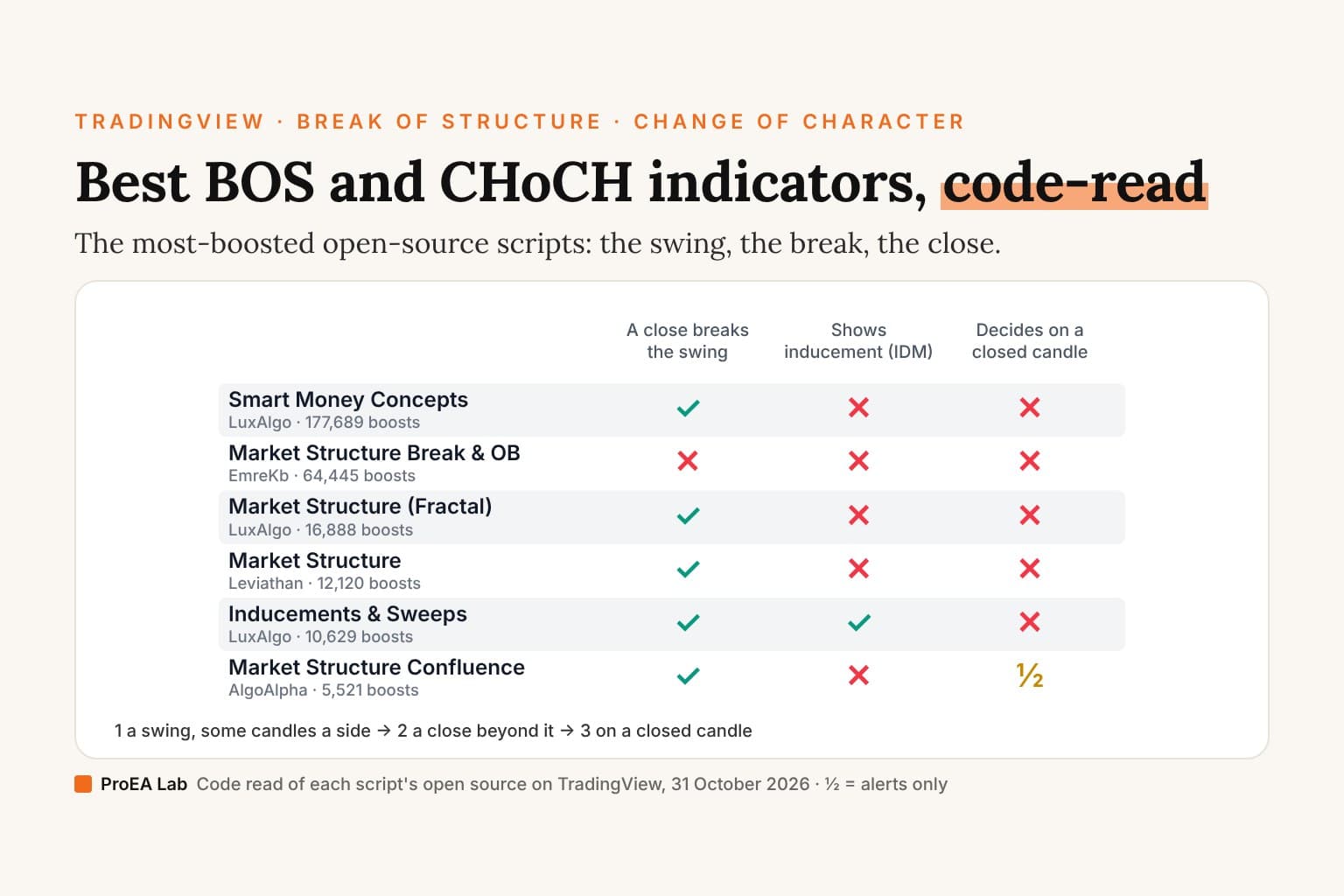
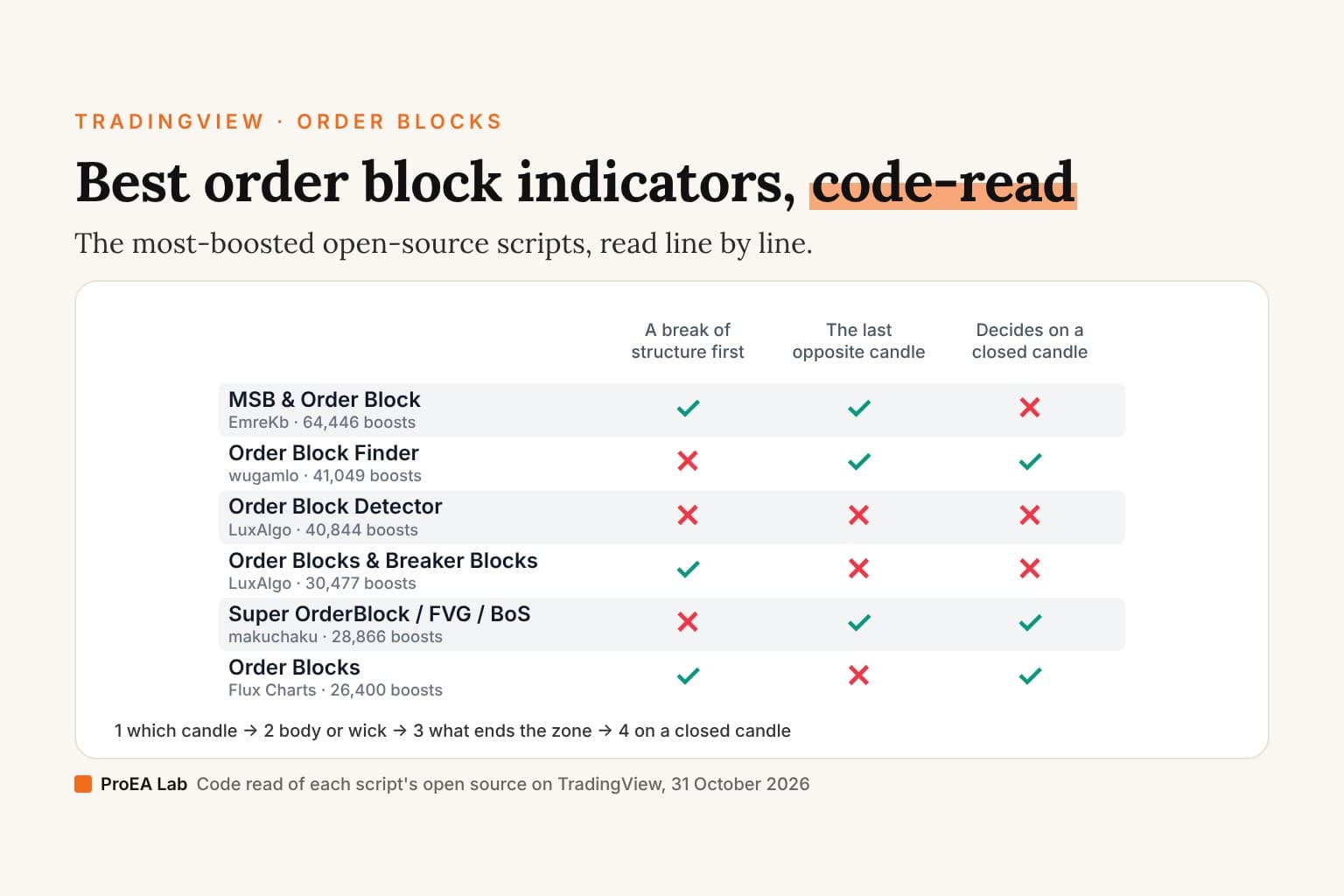
Two order block scripts without "breaker" in the name do more with it. Market Structure Break & Order Block by EmreKb, 64,446 boosts on the order block search that day, draws a breaker box at every market structure break and labels it Bu-BB or Bu-MB, a mitigation block, by whether the low before the break was a lower low. Order Blocks by Flux Charts (26,400) marks an order block as a breaker when a wick goes through it, by default, but draws only the order block, ending at that candle.
What the code says
What makes a breaker?
Five flip an order block on a close through it and check nothing else. LuxAlgo's Order Blocks & Breaker Blocks and its Pure Price Action test the candle's body (math.max(close, open) above a bearish block's top); Flux Charts' Breaker Blocks and VEGAlgo's test the close. AlgoAlpha's wants two closes in a row. None of the five asks whether structure broke the other way.
TradingFinder's three tie it to the first touch. Their order blocks come from 9-candle swings (7 in the Unicorn script), and the breaker comes from their OrderBlockDrawing library: once price reaches the block, a close beyond its far edge on one of the next 3 candles makes it a breaker; the library clears one made on the touching candle before that candle closes. The Signals + Alerts script imports version 3, which allows 8. A close through the block later than that makes no breaker.
Two wait for structure. LuxAlgo's Breaker Blocks with Signals waits for a market structure shift: a close above the last swing high of its zigzag when structure was down, after the drop from that high made a lower low. It boxes the last up candle at or before that high: the textbook bullish breaker. TradingFinder's ICT Setup 02 waits for five swings of lower highs and lower lows, then a close above the second-last lower high, and boxes that high's candle.
pmk07's needs no close at all. A supply block turns into a breaker when a 3-candle swing low forms above it: a failed swing.
Three start from something else. BigBeluga's zones hang one ATR(200) from 5-candle swings that print while a volatility reading is high, and flip when a whole candle clears them. ProjectSyndicate's takes the last up candle before a swing high, if a candle with a body over 2 ATR(14) closed above it before the swing was confirmed. AGProLabs' takes the last down candle at or before a swing high, once a closed candle closes 0.75 ATR(14) above it.
Our rule book wants both: the close through the block, and the break of structure the other way. The five close-through scripts check only the first. Move the two closes: the same candles make a breaker under one rule and a failed order block under another.
One close, three answers.
Candle A closed at 101.20, over the zone's wick-to-wick top of 101.10: LuxAlgo's, Flux Charts' and VEGAlgo's call it a bullish breaker from that close. AlgoAlpha's wants a second close above it, and B closed at 100.90: no breaker. Our rule book's order block, candle 10's body (100.60 to 101.00), failed at A's close, but no close over the last swing high at 102.00 has broken structure up: a failed order block, not yet a breaker.
Illustrative candles, made up for this explainer (simulated): not a market and not a result. Each candle opens at the last close; A's and B's wicks are a fixed 0.12 above and 0.06 below their bodies. Every rule reads a close strictly beyond a level, as the scripts' own code does (>, not >=): a close exactly on the edge doesn't count. The scripts' swing lengths differ (10 candles in LuxAlgo's and Flux Charts', 5 in VEGAlgo's); this chart uses 3 to fit the frame, and applies AlgoAlpha's flip rule to the same block, though its own block needs a displacement first.
Read as text: the candles, with A closing at 101.20 and B at 100.90
| Candle | Open | High | Low | Close |
|---|---|---|---|---|
| 1 | 101.10 | 101.30 | 101.00 | 101.25 |
| 2 | 101.25 | 101.50 | 101.20 | 101.40 |
| 3 | 101.40 | 101.95 | 101.35 | 101.85 |
| 4 | 101.85 | 102.00 | 101.65 | 101.70 |
| 5 | 101.70 | 101.75 | 101.15 | 101.20 |
| 6 | 101.20 | 101.25 | 100.65 | 100.70 |
| 7 | 100.70 | 100.80 | 100.30 | 100.40 |
| 8 | 100.40 | 100.75 | 100.35 | 100.65 |
| 9 | 100.65 | 100.80 | 100.50 | 100.60 |
| 10 | 100.60 | 101.10 | 100.55 | 101.00 |
| 11 | 101.00 | 101.05 | 100.05 | 100.15 |
| 12 | 100.15 | 100.28 | 100.00 | 100.22 |
| 13 | 100.22 | 101.12 | 100.18 | 100.38 |
| A | 100.38 | 101.32 | 100.32 | 101.20 |
| B | 101.20 | 101.32 | 100.84 | 100.90 |
- A close above the zone (LuxAlgo's Order Blocks & Breaker Blocks, Flux Charts' Breaker Blocks, VEGAlgo's; a close above 101.10, wick to wick): breaker at A.
- Two closes above it (AlgoAlpha's Breaker Blocks Signals; two closes in a row above 101.10): not a breaker.
- A close through it, and structure breaks up (our SMC Rule Book; a close above the body, 101.00, and above the last swing high, 102.00): failed at A, not a breaker.
At A's close of 101.20, the rule LuxAlgo's, Flux Charts' and VEGAlgo's share calls candle 10 a breaker. AlgoAlpha's waits for a second close above, and our rule book calls it a failed order block until a close above 102.00, the last swing high, breaks structure up.
Breaker or mitigation block?
Two scripts in the table check. LuxAlgo's Breaker Blocks with Signals draws a bullish breaker only if the low after the swing high is below the low before it (Ey < Cy, its zigzag's points); with no lower low it draws nothing, so it never boxes a mitigation block. TradingFinder's ICT Setup 02 checks it through its pattern: the low after the high it boxes must be a lower low (TypePoint2 == 'LL'). EmreKb's order block script, outside the table, draws the box either way and labels it Bu-MB, a mitigation block, when there was no lower low (l0 < l1 ? "Bu-BB" : "Bu-MB"). All three read those lows from wicks: a wick that sweeps the low and closes back counts as a lower low.
Eight more have it built in: their order block is born at a close (pmk07's: a swing) below a swing low, so the drop before any flip already made a lower low, on their own swing length. AlgoAlpha's, BigBeluga's, ProjectSyndicate's and AGProLabs' zones need no break at all, so a box they call a breaker can be what our rule book calls a mitigation block. The film shows the difference by closes, as the rule book reads it.
Simulated 15-minute candles, not market data. Swings are confirmed by 3 candles on each side; order blocks follow SMC Basics' rule. No ProEA indicator draws breakers; the breaker marks are this article's rule. Both blocks are drawn from the last up candle at or before the swing high.
Read as text
- A swing low at 74.38, then a swing high at 75.21. The last up candle at or before the high is the candle both blocks are drawn from: 75.01 to 75.17 (body).
- The drop from the high closes below 74.38: a new low and a BOS. By the order-block rule, that same up candle is now a bearish order block.
- A candle closes above the high at 75.21: a CHoCH.
- The order block failed after taking the low: the up candle's zone is a bullish breaker.
How this window was chosen: The first window in which a drop from a swing high closes below the swing low before that high (a new low), the order block of that close is the last up candle at or before the high and has a visible body, and a later close above the high comes within 12 candles of the drop's low. Windows are picked one after another, each starting after the last one picked, so no two films share candles.
Body or wick?
Six box the whole candle by default: LuxAlgo's Order Blocks & Breaker Blocks and its Breaker Blocks with Signals, AlgoAlpha's, Flux Charts', VEGAlgo's and AGProLabs'. LuxAlgo's Pure Price Action boxes the body by default.
The other seven draw something else. pmk07's runs from a swing high's wick down to the higher of two candles' lows. TradingFinder's four build the zone with their OrderBlockRefiner library, on by default. BigBeluga's hangs one ATR(200) from the swing. ProjectSyndicate's draws a band 0.75 ATR(14) tall around the candle's middle, so every zone is the same height ("Normalize All Zone Heights", on by default).
For a breaker the range decides twice: its far edge is the line a close must cross to make the breaker, and its other edge is the line a close back through ends it at. In the drill, the wick-to-wick top sits 0.10 above the body's.
What ends a breaker?
A close back through it ends it in eight. LuxAlgo's three, Flux Charts' (on "Close", its default), VEGAlgo's with "Chop Control" on (its default) and BigBeluga's end a breaker on one close beyond its far edge; AlgoAlpha's wants two in a row, and AGProLabs' a close 0.12 ATR(14) beyond it.
A touch ends it in TradingFinder's four. Their library stops a breaker when a wick reaches its near edge ("Mitigation Level BB": Proximal), or when the next order block of its kind is first touched, so a breaker lasts no longer than price's first return to it. The library sets that touch level at the top of each candle, before a new breaker updates it, so on the candle that makes a breaker it tests the previous breaker's level, and can clear the new one at once. And the scripts' "50 % BB" choice doesn't match the name the library checks ("50 % OB"), so in our read that setting turns the touch off and leaves the 500-candle limit and the next order block's touch.
pmk07's waits for a swing: a 3-candle swing high forming below a bullish breaker deletes it. ProjectSyndicate's never ends one by default; it keeps the newest 5, and "Enable Mitigation" stops a zone at the first close inside it.
The film's rule ends a breaker on a close back through, as eight of the 14 do.
Simulated 15-minute candles, not market data. Swings are confirmed by 3 candles on each side; order blocks follow SMC Basics' rule. No ProEA indicator draws breakers; the breaker marks are this article's rule. Both outcomes are shown; neither is a result.
Read as text
- A bearish order block (140.90 to 141.10) fails: a close above it and a close above the swing high at 141.19 (a CHoCH) make it a bullish breaker.
- 8 candles later price trades back into the zone from above: its first retest.
- That candle closes back above the zone, and no candle closes below the zone for the rest of the film, 8 more candles.
How this window was chosen: The first window in which a bullish breaker's first retest comes 3 to 12 candles after it was confirmed and closes back above the zone, and no candle closes below the zone for the next 8 candles (the rest of the film). Windows are picked one after another, each starting after the last one picked, so no two films share candles.
When does it decide?
Four decide on closed candles: pmk07's, Flux Charts', BigBeluga's and AGProLabs'. The other ten decide on the live bar, so a breaker can print mid-candle and vanish before the candle closes: LuxAlgo's three, TradingFinder's four, AlgoAlpha's, VEGAlgo's and ProjectSyndicate's.
A swing is late by the candles on its right. LuxAlgo's Order Blocks & Breaker Blocks, Flux Charts' and ProjectSyndicate's use 10-candle swings, known 10 candles after they print; TradingFinder's main two use 9, the Unicorn 7 and Setup 02 2; BigBeluga's, VEGAlgo's and AGProLabs' 5. LuxAlgo's Breaker Blocks with Signals needs 5 candles on a swing's left and 1 on its right, and pmk07's 1 on each side. AlgoAlpha's finds no swing at all: its block comes from the displacement.
Alerts and licences
Nine have alerts. Four send them from closed candles: LuxAlgo's Breaker Blocks with Signals (its alert() calls fire once per bar close, except the take-profit ones, off by default, which fire once per bar; its 22 alert conditions fire as you set them), pmk07's (one message per closed candle, breaker tests included), Flux Charts' (a new breaker) and AGProLabs' (new, READY, retest held, invalidated). TradingFinder's three send theirs once per bar by default, on the live candle; their "Per Bar Close" choice doesn't match the name their alert library checks ("Once Per Bar Close"), so in our read it sends nothing. AlgoAlpha's (breaker formed, rejection) and VEGAlgo's (price touching a zone) use alert conditions, so you pick the frequency in TradingView's alert dialog. LuxAlgo's Order Blocks & Breaker Blocks and Pure Price Action, BigBeluga's, TradingFinder's Setup 02 and ProjectSyndicate's have none.
Ours
None of our desks draws breaker blocks. We searched every desk's Pine source: none flips an order block or labels a breaker.
What we do sell draws the order block a breaker starts from. SMC Basics, in Pine Pro Library, $49 once with its full Pine v6 source, boxes the last opposite candle within the 20 before a close beyond a confirmed swing (10 candles each side by default), its body by default, on closed candles. A close through the block's far edge deletes it; turn on "Keep mitigated zones as ghost outlines" and it stays as a grey outline that ends at that candle. That is the first half of a breaker by our rule book, and SMC Basics stops there: it draws no break the other way and no flipped zone. The SMC AI-Scored Toolkit, $39 once, boxes order blocks at structure breaks on bar close and scores each one 0–100.
If you want breakers drawn for you, the table is the honest list: Flux Charts' for a close through on closed candles, LuxAlgo's Breaker Blocks with Signals for the lower low and the shift. The order block under each one, and when it's drawn, is in our order block indicator code read.
The deep version, as a PDF
The Smart Money Concepts Rule Book
ICT and SMC as exact rules on closed candles, every concept set against the ones it's confused with, and what our data says about each.
- 26 SMC and ICT terms, each one closed-candle rule: BOS, CHoCH, MSS, order blocks, breakers, fair value gaps, sweeps, OTE, killzones, SMT and more
- The comparisons traders search for, side by side: BOS vs CHoCH vs MSS, breaker vs mitigation vs order block, sweep vs grab vs breakout, FVG vs imbalance vs IFVG
- Every measurement we've published on these concepts, with its sample, period and costs, and why the book prints no win rate
One payment, instant download. Refund within 7 days if you haven't downloaded it.
Check one yourself
- What makes it: find the line that sets the breaker (a
breaker := true, a new box, a colour change).close, ormath.max(close, open)andmath.min(close, open), against the block's far edge is a close or a body through it;loworhighis a wick; a pivot compared with the block is a failed swing;ta.crossover(close, …)of a swing level is a break of structure. - Mitigation block: look for two lows (or highs) compared before the break, like
Ey < Cyorl0 < l1. No such line? Then look at what the order block is born from: if it needs a close below a swing low, the lower low is built in. - What ends it: find the line that deletes or stops the breaker's box, and read which price it compares with which edge.
- A library: if the script imports one (
import TFlab/...), the rule may live there. Read that too. - The close: look for
barstate.isconfirmed, and the swing length inta.pivothighorta.highest. Our repaint guide has the rest of the check.
None of the scripts here runs on MT5, MT4 or NinjaTrader 8: Pine Script runs only on TradingView. A breaker block indicator for MT5 is a new program in MQL5; check it the same way (Pine Script to MQL5 works through one port). The same flip happens to fair value gaps: a gap closed through is an inversion gap, and our IFVG indicator code read reads the scripts that draw them.
Limits
One code read, on 31 October 2026, of the versions TradingView served that day, and of the TradingFinder libraries its scripts import (OrderBlockDrawing versions 3 and 4, OrderBlockRefiner 2, AlertSender 1). We read the code; we didn't run the scripts on a live chart. Scripts change, and boosts measure popularity, not quality. The drill's and the films' candles are simulated. We haven't tested breaker blocks as a trading rule. We build and sell SMC Basics and the SMC AI-Scored Toolkit, and we have no relationship with any author named here. Nothing here is financial advice.
Use these animations on your site.
Frequently asked questions
What is the best breaker block indicator on TradingView?
It depends on the rule you want. The most boosted with breaker in its name, Order Blocks & Breaker Blocks by LuxAlgo (30,478 boosts), flips an order block when a candle's body gets through it, with no break of structure, on the live bar, and has no alerts. Breaker Blocks with Signals by LuxAlgo (16,839) is the closest to the textbook: a lower low, then a close back above the swing high, and the last up candle before that high. For breakers drawn on closed candles, Breaker Blocks by Flux Charts (2,734) flips an order block on a close through it and alerts on each new one, but checks no structure.
What is a breaker block indicator?
A script that marks order blocks that failed: price went through the block, and the same zone is then watched from the other side. The popular ones disagree on what counts as the failure: a candle's body or close through the block, two closes in a row, a close in the 3 or 8 candles after the first touch, a swing forming beyond it, or a lower low and then a close back above the swing high.
Is there a free breaker block indicator for TradingView?
Yes. All 14 scripts in our table are free to add, with their code open. LuxAlgo's three and BigBeluga's are shared under CC BY-NC-SA 4.0, which doesn't allow commercial use; seven are under the Mozilla Public License 2.0; AlgoAlpha's, ProjectSyndicate's and AGProLabs' carry no licence line.
How do I add a breaker block indicator on TradingView?
Open Indicators, search for breaker block, and add a community script. TradingView's script search returned 70 scripts with breaker in the name on 31 October 2026: 45 open source, 17 protected and 8 invite-only. Not all of them draw breaker blocks: LuxAlgo's Market Structure (Breakers) and ICT Breakers by Chartlix draw lines at structure breaks.
Which breaker block indicator tells a breaker from a mitigation block?
In our table, two check. LuxAlgo's Breaker Blocks with Signals boxes a breaker only when the drop from the swing high made a lower low first, and draws nothing otherwise; TradingFinder's ICT Setup 02 checks it through its pattern, a lower low after the high it boxes. EmreKb's Market Structure Break & Order Block, an order block script, labels each box Bu-BB or Bu-MB by the same test. All three read the low from wicks, so a wick that sweeps the low counts as a lower low. Eight more have it built in: they only flip an order block born at a break below a swing low.
Is there a breaker block indicator for MT5?
Not among these: every script here is Pine Script, which runs only on TradingView, and none of our desks draws breaker blocks. An MT5 version is a new program in MQL5, so check it the same way: what makes a breaker, body or wick, what ends it, and whether it decides on the candle still forming.