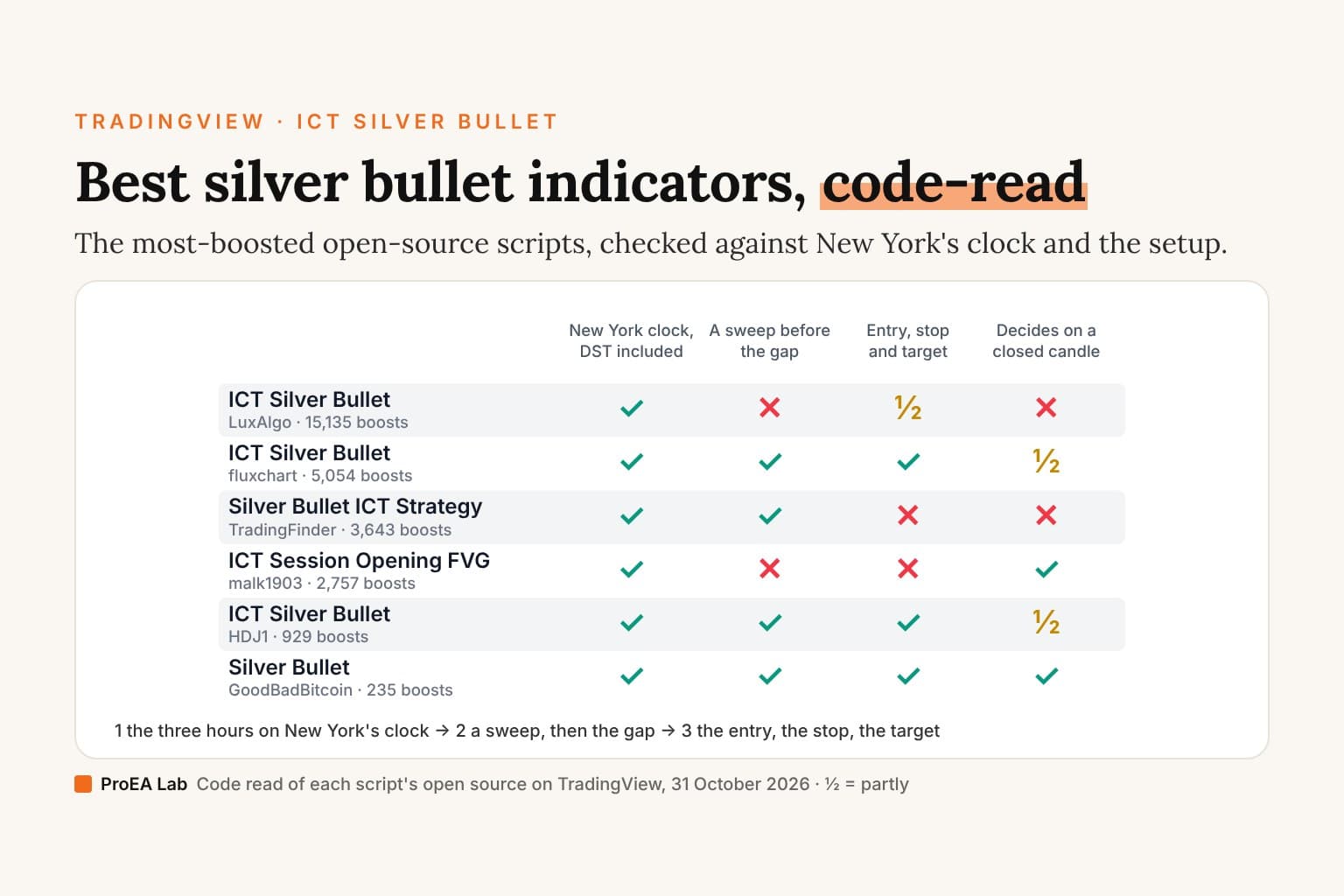
Short answer: the most-boosted one, ICT Silver Bullet by LuxAlgo (15,135 boosts), keeps the three hours on New York's clock, daylight saving time included, but it boxes every fair value gap that goes with its trend, waits for no sweep, draws targets with no entry or stop, decides on the live candle and sends no alerts. For a sweep first, then the first gap after it, with an entry, a stop and a target decided on closed candles, Silver Bullet by GoodBadBitcoin (235 boosts) is the closest in our read. ICT Silver Bullet by Flux Charts (5,054 boosts) is the most boosted that waits for a sweep. All of them are Pine Script, so none runs in MT5.
Most lists name silver bullet indicators.
This one reads them.
What we checked
The silver bullet is three one-hour windows on the New York clock: 03:00 to 04:00, 10:00 to 11:00 and 14:00 to 15:00, "New York local time" as the comments in LuxAlgo's code put it. Every script here that draws three windows uses those hours, whatever clock it reads them on. Our ICT killzone clock shows them on any clock, today. New York changes its clocks on the second Sunday of March and the first Sunday of November, so on UTC, and on most other clocks, each hour moves by one for part of the year: in UTC they start at 07:00, 14:00 and 18:00 while New York is on daylight saving time, and at 08:00, 15:00 and 19:00 while it's on standard time.
That makes the clock the first thing to check. Pine's time() reads a session in "the time zone of the exchange by default, unless a timezone argument is specified" (Pine manual, sessions). An IANA name such as America/New_York "represents UTC-4 or UTC-5, depending on the time of year"; a fixed offset doesn't (Pine manual, time, both checked 31 October 2026).
The setup inside the hour is where scripts part ways. The rule this replay runs on simulated candles is one reading of it: when the hour opens, mark the nearest swing high and low; the first candle through one has run that side; the first fair value gap toward the other side, inside the hour, is the setup, entered on the way back, with the stop beyond the gap's candles and the other side as the target.
Simulated candles, not market data. The simulated market is busier in London's and New York's office hours, read on each city's own clock: a choice of the simulation, not a measurement. Times are New York time. The levels are 15-minute swings (3 candles on each side) that no candle had traded through when the window opened; the gaps follow SMC Basics' rule (at least 0.3 × ATR(14)).
Read as text
- Simulated 3-minute candles from 09:00 New York time.
- At 10:00 the window opens. The nearest 15-minute swing high above price is at 74.72, the nearest swing low below it at 73.69.
- At 10:21 a candle trades above the swing high. That side has been run, so the draw is the other one: the swing low at 73.69, and only shorts count.
- The three candles from 10:27 to 10:33 leave the first bearish fair value gap after that candle, inside the window: 74.71 to 74.76. Its near edge, 74.71, is the entry. The stop is above its three candles, at 74.84. The draw is 7.8 times the risk away, more than the 2 the rule needs.
- At 10:39 price trades back into the gap before 11:00: the entry fills at 74.71.
- At 11:12 price reaches the draw at 73.69 before the stop: the target.
- The film ends 4 candles later, wherever price is.
How this window was chosen: The first simulated weekday whose 10:00–11:00 window gives a setup that fills and then reaches the draw before its stop. The film runs from 09:00 New York to 4 candles after the target, or to 11:06 if that is later.
We searched TradingView's scripts for three terms on 31 October 2026: "silver bullet", "ict silver bullet" and "silver bullet ict". We kept the 56 whose names say silver bullet: 36 open source, 16 protected (free to add, with the code hidden) and 4 invite-only. We took the 15 most-boosted open-source ones, none skipped, and read every line that decides what is drawn, plus two of the three TradingFinder libraries one of them imports (FVG Detector Library v3 and Order Block Drawing v4; not Order Block Refiner v2). Five questions:
- The hours and the clock: which windows, read on New York's own clock (so daylight saving time moves them with New York), on a fixed offset, or on the chart exchange's clock?
- The setup: what does it look for inside the hour: the first fair value gap, any gap, or a gap after a sweep of a high or low?
- The plan: does it draw an entry, a stop or a target?
- When it decides: on the closed candle, or on the live one?
- Alerts, and the licence.
The table
Boosts as TradingView's search showed them on 31 October 2026. Hours are each script's defaults; DST is daylight saving time.
| Script | Boosts | Hours · clock | Inside the hour | Entry · stop · target | Decides on | Alerts | Licence |
|---|---|---|---|---|---|---|---|
| ICT Silver Bullet (LuxAlgo) | 15,135 | 03, 10, 14 · New York, DST included | Every gap that goes with its trend; kept if price came back into it and the first close after the hour is beyond it | Targets only: swings past a kept gap | The live candle | None | CC BY-NC-SA 4.0 |
| ICT Silver Bullet (fluxchart) | 5,054 | 03, 10, 14 · New York, DST included | A wick beyond the past hour's high or low, then the first gap after it, if it points away from that side | An entry on the way back; a stop, and a target 0.99 times the risk | The live candle; drawn at the close | Buy, sell, take-profit, stop-loss | MPL 2.0 |
| Silver Bullet ICT Strategy (TradingFinder) | 3,643 | 10 only, after a 09:00–10:00 range · New York, DST included | That range's high or low taken, a close back through the CISD level, then the latest gap that way | Zones only: an order block and the gap | The live candle | None | MPL 2.0 |
| ICT Session Opening FVG / Silver Bullet (malk1903) | 2,757 | 03, 10, 14 and four more · New York by default, DST included | Every gap at 03, 10 and 14; only the first at 08:30, 09:30, 13:00 and 15:00 | None | Closed candles, one candle late | None | CC BY-NC-SA 4.0 |
| Silver Bullet (MacroBullet) | 1,039 | In its Silver mode, 03, 10, 14 · the exchange's clock | No gap: the hour's range, with retracement levels | None in Silver mode | The live candle | Candle patterns | None |
| ICT Silver Bullet (HDJ1) | 929 | 03, 10, 14 · New York, DST included | A swing swept and closed back, then a close beyond a small pivot with a gap in the last 10 candles | An entry at that close, a stop at the sweep, a 2R target | The live candle; alerts at the close | Sweep, MSS, entry, target, stop, invalidation | None |
| ICT Silver Bullet with signals (fikira) | 921 | 03, 10, 14 · New York, DST included | Every gap that goes with its trend, on 15-minute candles it builds | Targets only | The live candle; alerts at the close | New gap, retrace, target, cancel | CC BY-NC-SA 4.0 |
| Silver Bullet x Macro x Killzone (itradesize) | 889 | 03, 10, 14 · New York, DST included | Nothing: time boxes in a pane | None | The clock only | None | MPL 2.0 |
| ICT Silver Bullet Backtest (MarkLeRoy) | 668 | 03, 10, 14 on weekdays · New York, DST included | The latest gap in the hour, either way; no sweep | A strategy: in at the gap's midpoint, a stop past candle 1, a 2R target | The candle's close, filled at it | None in its code | MPL 2.0 |
| Overnight Session & Silver Bullet (itradesize) | 571 | 03, 10, 14 · New York, DST included | Nothing: each hour's high-low box | None | The live candle | None | None |
| Optimal Trade Entry + Silver Bullet (Quantum-Algo) | 554 | 03, 10, 14 on weekdays · New York, DST included | An OTE pullback after a structure break; the hour only raises its grade | An entry, a stop, two targets | Closed candles | Entry, window open | None |
| ICT Killzones and Sessions W/ Silver Bullet + Macros (SpxGh0st) | 446 | 03, 10, 14 · New York, DST included | Nothing: itradesize's boxes, plus session lines | None | The clock only | None | None |
| ICT Judas + Silver Bullet (drjproduction) | 405 | One "NY" hour, on 1 January 2023 only | A low under the last 20 candles' low | An entry, a 10-pip stop, a 2R target | The live candle | Silver Bullet, Judas Swing: can't fire today | None |
| ICT Silver Bullet Vertical Lines (Fahmi_Eshaq) | 337 | 03, 10, 14 · fixed GMT−4: an hour early on New York's standard time | Nothing: vertical lines | None | The clock only | None | MPL 2.0 |
| Silver Bullet (GoodBadBitcoin) | 235 | 03, 10, 14 · New York, DST included | The hour's first sweep of a level, then the first gap after it, all three candles in the hour | A limit at the gap, a stop past the sweep, a target at the nearest level the other way | Closed candles | Window, sweep, setup, fill, target, stop, time exit, cancel | MPL 2.0 |
| ICT Levels Desk (ours) | — | None of the three: killzones and 8 macro windows · New York, DST included | No setup: the first gap after 09:30, and what it did | None | Closed candles | First gap, macro open, sweeps | MIT |
Three more above the 15th have closed code, so they aren't in the table: TrenVantage ICT Silver Bullet Command by largepetrol (672 boosts), ICT [CASPER] Silver Bullet 2024 by abelespinozav (336) and ICT Kill Zones / Pivots, Silver Bullet & DWM by malibuuu (298) are protected, free to add with the code hidden. A second Silver Bullet ICT Strategy, by GeishaDoll (58 boosts), has TradingFinder's code line for line.
What the code says
The clock: 12 of the 15 keep New York's. Eleven pass "America/New_York" to time(), hour() or timestamp(): LuxAlgo's, Flux Charts', TradingFinder's, HDJ1's, fikira's, MarkLeRoy's, Quantum Algo's, GoodBadBitcoin's, itradesize's two and SpxGh0st's. malk1903's has a Time Zone setting that starts on America/New_York, its other choices fixed GMT offsets. Three don't:
- Fahmi Eshaq's draws its lines at
hour(time, "GMT-4:00"), under a comment that says it forces the New York time zone. GMT−4 is New York's summer offset only. From 1 November 2026 until New York's clocks go forward on 14 March 2027, its 10:00 and 11:00 lines fall at 09:00 and 10:00 New York, an hour early, and its other lines are an hour early too. - MacroBullet's reads
hour(time)with no time zone: the exchange's clock. Its Timezone (UTC Offset) setting changes only the hour printed in its label. TradingView's symbol data on 31 October 2026 gave FX:EURUSD and OANDA:XAUUSD America/New_York, where its hours are New York's; CME_MINI:ES1! America/Chicago, where its 10 o'clock hour is 11:00 to 12:00 New York; and BINANCE:BTCUSDT Etc/UTC, where it's 06:00 New York in summer and 05:00 in winter. - drjproduction's windows are date-and-time settings,
input.time(timestamp("2023-01-01T22:30:00+08:00"), "NY Killzone Start")and the like, and it checks whether a candle's time falls between two of them. With its defaults only candles on 1 January 2023 are inside one.
Pick your clock and a date: the drill draws New York's day on both, with the hours New York's clock, a fixed GMT−4 and the exchange's clock (on CME_MINI:ES1! and BINANCE:BTCUSDT) call 03:00, 10:00 and 14:00. Try 30 October on London's clock, the week Europe is back on winter time and New York isn't yet.
Friday 30 October 2026: 10:00–11:00 New York is 14:00–15:00 on the London (UK) clock.
New York is on daylight saving time, UTC−4 that day; London (UK) is on UTC. In 2026 New York moves its clocks on 8 March and 1 November; London (UK) on 29 March and 25 October. A script on a fixed GMT−4 draws its 10:00 at 10:00 New York, on time. One that reads the exchange's clock draws its 10:00 hour at 11:00 New York on CME_MINI:ES1! and at 06:00 on BINANCE:BTCUSDT.
Every time is computed in your browser from the IANA time zones (America/New_York for New York), not typed by hand. A fixed GMT−4 is Fahmi Eshaq's lines (hour(time, "GMT-4:00")). The exchange's clock is MacroBullet's Silver mode (hour(time), no time zone): TradingView's symbol data, read on 31 October 2026, gives CME_MINI:ES1! America/Chicago, BINANCE:BTCUSDT Etc/UTC, and FX:EURUSD and OANDA:XAUUSD America/New_York, where that clock is New York's. Holidays and early closes aren't shown.
Read as text: Friday 30 October 2026, on the London (UK) clock
| Window | New York | UTC | London (UK) |
|---|---|---|---|
| London open | 03:00–04:00 | 07:00–08:00 | 07:00–08:00 |
| New York AM | 10:00–11:00 | 14:00–15:00 | 14:00–15:00 |
| New York PM | 14:00–15:00 | 18:00–19:00 | 18:00–19:00 |
| How it reads the time | Its 03:00 | Its 10:00 | Its 14:00 |
|---|---|---|---|
| New York's own clock (12 of the 15 scripts we read) | 03:00–04:00 New York (on time) | 10:00–11:00 New York (on time) | 14:00–15:00 New York (on time) |
| A fixed GMT−4 (Fahmi Eshaq's lines) | 03:00–04:00 New York (on time) | 10:00–11:00 New York (on time) | 14:00–15:00 New York (on time) |
| The exchange's clock on CME_MINI:ES1! (MacroBullet's Silver mode) | 04:00–05:00 New York | 11:00–12:00 New York | 15:00–16:00 New York |
| The exchange's clock on BINANCE:BTCUSDT (MacroBullet's Silver mode) | 23:00–00:00 New York | 06:00–07:00 New York | 10:00–11:00 New York |
New York's midnight that day is 04:00 on the London (UK) clock.
What they look for inside the hour. Four wait for a sweep of a high or low first: GoodBadBitcoin's, Flux Charts', HDJ1's and TradingFinder's. Four take a gap without one: LuxAlgo's and fikira's every gap that goes with their trend, malk1903's every gap in the hour, MarkLeRoy's the latest. Quantum Algo's looks for an OTE pullback and only grades the hour. The other six look for no gap in the hour at all: MacroBullet's in its Silver mode, itradesize's two, SpxGh0st's, Fahmi Eshaq's, and drjproduction's, which labels gaps all day but signals on a low under the last 20 candles' low.
GoodBadBitcoin's is the closest to the replay's rule, and the least boosted of the 15. Its hours are hour(time, TZ), with TZ set to "America/New_York", equal to 3, 10 or 14. Its liquidity is swing highs and lows (5 candles each side), Asia's 20:00–24:00 and London's 02:00–05:00 highs and lows, the previous day's and the previous clock hour's. The hour's first trade through one of them by a tick is the sweep. The setup is the first gap after it whose three candles all sit inside the hour, with the middle candle's body at least 1 × ATR(14) and the gap at least 0.1 × ATR and 2 ticks, one per direction. It rests a limit at the gap's near edge, filled only when price trades a tick through it, puts the stop a tick beyond the sweep's extreme and the target at the nearest untouched level on the other side, and skips the setup when that's under 1.5R (2R when there's none). An unfilled order is cancelled when the hour ends; an open trade is closed an hour after it. Everything runs on closed candles (barstate.isconfirmed), every alert() fires on the close, it takes one trade per hour by default and skips its first 5 trading days on the chart. Charts of 1 to 15 minutes; MPL 2.0. Its panel prints its own statistics, which we haven't checked.
Flux Charts' waits for a sweep of the hour before. On the hour's first candle it takes the highest high and lowest low of the last hour of candles, that first one included. A later candle whose wick goes beyond one (its Breakout Method, Wick by default) sets the side: below the low for a long, above the high for a short. The first gap after that, whichever way it points, is the only one it considers; if it points the wrong way, that hour has no trade. By default the gap's three candles must be one colour, the middle one must close beyond candle 1, and the gap must be more than a sixth of ATR(5). The entry is the close of the first candle back into the gap, the stop 5.5 × ATR(5) beyond the lowest low (or highest high) of the last 10 candles, the target 0.99 times that risk the other way. Its states and its four alerts run on the live candle; its boxes and labels are drawn at the close. It refuses charts above 5 minutes, and its backtest table prints its own results, which we haven't checked. MPL 2.0.
HDJ1's sweeps a swing, then wants a break. Inside an hour, a candle that trades through a swing (6 candles each side) and closes back starts a setup. It then needs a close beyond the latest small pivot (2 candles each side) within 30 candles, with a gap among the last 10 candles; a deeper wick first, or no break in time, drops it. By default it enters at that close, with the stop at the sweep's extreme and a 2R target line; its FVG Retest Entry option waits for price to come back into the gap instead. Only the sweep has to be inside the hour: the break can come up to 30 candles later. Its alerts fire at the candle's close; its drawings follow the live candle. 1-, 3- and 5-minute charts only; no licence line.
TradingFinder's is 10:00 only. It marks the 09:00–10:00 New York high and low. Inside 10:00–11:00, the first candle above that high (with the low untouched), or below the low, starts it, and it then wants a close back through its CISD level: the lower of the first two opens after the last down candle before the break (the higher, after the last up candle, for a low). On that close it draws an order block and, when there is one, the latest gap that way in the hour that price hasn't traded back into. Zones only, no entry, stop or target, no alerts, all on the live candle. Its Bar Back Check setting does nothing: the function is called with 120 in its place. MPL 2.0, like the two of its libraries we read.
LuxAlgo's boxes every gap that goes with its trend. Its hours are on America/New_York, and it asks for a chart of 15 minutes or less. Inside an hour, each gap in the direction of its trend (a close beyond its last swing, on swings of 5 candles back and 1 forward) is boxed on the live candle. With its default Super-Strict filter, a close through the gap's far side removes it, and once the hour is over it keeps a bullish gap only if price dipped into it and the first candle after the hour closes above it (a bearish one: back up into it, and a close below). Then it draws targets: the swing highs above a kept bullish gap, or the lows below a kept bearish one, each ending in a dot when price trades through. No sweep test, no entry, no stop, no alerts. CC BY-NC-SA 4.0, which doesn't allow commercial use.
fikira's builds its own 15-minute candles. On charts under 15 minutes it assembles 15-minute candles from the chart's own, starting 30 minutes before each hour, and boxes every gap among them that goes with its trend (swings of 10 back and 1 forward). A close through a gap removes it. When price trades back into one, it draws targets: untouched swing highs or lows, Monday's open and Friday's close, the day's open and the previous close, beyond a minimum distance. A gap price never came back to goes when the hour ends. Alerts at the candle's close for a new gap, a retrace, a target and a cancel; boxes on the live candle. CC BY-NC-SA 4.0.
malk1903's counts every gap in the three hours. Seven hours are on by default: at 03:00, 10:00 and 14:00 it boxes every gap, with a midline; at 08:30, 09:30, 13:00 and 15:00 only the first. It reads a gap one candle after the third closes (a request.security call that returns the last closed candle's values), so it decides on closed candles, and it checks the hour on that later candle: a gap that completes on the hour's last candle isn't counted, and one that completes on the candle before 10:00 is. No entry, stop, target or alerts; charts of 5 minutes or less. CC BY-NC-SA 4.0.
MarkLeRoy's is a strategy on the latest gap. Weekday hours on America/New_York. Any gap inside the hour, either way, becomes the setup, and a newer one replaces it; there's no sweep. It enters when a later candle in the same hour trades through the gap's midpoint, at that candle's close (process_orders_on_close), with the stop a tick beyond candle 1 and a 2R target, then an ATR trailing stop once price is 1.5R in favour; one entry per hour. As a strategy() without calc_on_every_tick, it decides at the candle's close. Its short title reads "LuxAlgo Quant SB TEST"; LuxAlgo's own script is the table's first row. Its code has no alert() or alertcondition(). MPL 2.0.
Quantum Algo's is an OTE tool that grades the hour. Its windows are weekdays on America/New_York, and it boxes gaps of at least 0.15 × ATR(14) inside them. Its signal is a pullback into 61.8–79% of the leg after a close beyond the last swing (10 candles each side), on a closed candle, with an entry, a stop beyond the leg's start and two targets at the −0.27 and −0.62 extensions. By default neither the hour nor a gap is required: each adds a point to its A+ to C grade. Alerts for the signal and for a window opening; no licence line.
MacroBullet's draws ranges in its Silver mode. Its code's variable names are scrambled. Its default Bullet Mode is Macro, 20-minute boxes around the hour; Silver, with Macro Time set to ICT Sessions, boxes the 03, 10 and 14 o'clock hours on the exchange's clock, with retracement levels from 0 to 1 across each hour's range. Its gaps and its trade alerts belong to Macro mode; in Silver mode it alerts on candle patterns only. As we read it, its default Macro Time, All Hours, isn't one its code turns into hours, so its boxes need ICT Sessions. No licence line.
drjproduction's can't signal today. Its "NY" window, 22:30 to 23:30 UTC+8 on 1 January 2023 (09:30 to 10:30 New York that day), is a fixed date, so its BUY, a low under the last 20 candles' low inside that window, and the "Silver Bullet" alert of that name don't fire on a chart now unless you type new dates. On a signal it plots an entry, a stop 10 pips below it (for sells too) and a 2R target. No licence line.
The rest draw time, not trades. itradesize's Silver Bullet x Macro x Killzone boxes the three hours, three killzones and the macros in a pane under the chart, placed each day at 01:00 New York; SpxGh0st's is a copy ("Original script: … by [itradesize]") with session lines added at fixed hours from the exchange's midnight. itradesize's Overnight Session & Silver Bullet boxes each hour's high and low as it forms, on New York time, beside an overnight range read in Chicago. Fahmi Eshaq's draws vertical lines at 00:00, 03:00, 04:00, 10:00, 11:00, 14:00 and 15:00 GMT−4. None of the four sends alerts.
Licences. The Mozilla Public License 2.0 for Flux Charts', TradingFinder's, itradesize's Silver Bullet x Macro x Killzone, MarkLeRoy's, Fahmi Eshaq's and GoodBadBitcoin's; CC BY-NC-SA 4.0, which doesn't allow commercial use, for LuxAlgo's, malk1903's and fikira's. MacroBullet's, HDJ1's, itradesize's Overnight Session, Quantum Algo's, SpxGh0st's and drjproduction's carry no licence line.
Ours
ICT Levels Desk isn't on TradingView's search: its full Pine v6 source comes in Pine Pro Library, $49 once for every desk and every update. It isn't a silver bullet indicator. It has no 03:00, 10:00 or 14:00 window, looks for no setup inside one and draws no entry, stop or target. How close it gets, from its Pine:
- The clock. Every time is read in its Timezone setting, America/New_York by default, so daylight saving time moves everything with New York (the previous day's and week's highs and lows are the chart's own daily and weekly candles).
- The macros around the hours. Eight macro windows: 02:33–03:00 and 04:03–04:30 in London; 08:50–09:10, 09:50–10:10 and 10:50–11:10 in New York AM; 11:50–12:10 at lunch; 13:10–13:40 and 15:15–15:45 in New York PM. Two straddle the edges of 10:00–11:00, and London's sit either side of 03:00–04:00. Each is shaded, with a dotted line at its start and end; the panel shows the minutes left in one or counts down to the next ("opens in 12 m"), and the alert "Macro window opening" fires when one starts.
- The killzones and their liquidity. Asia 20:00–00:00, London 02:00–05:00, New York AM 08:30–11:00 and New York PM 13:30–16:00, boxed on closed candles; the three silver bullet hours sit inside the last three. When a window ends, its high and low become lines that read resting, swept or broken, with the alert "Session high / low swept", beside the previous day's and week's highs and lows: the levels a silver bullet setup runs.
- The first-presented FVG. The first gap after 09:30 (and, if you switch them on, also the first after 08:30 and after midnight), of any size by default, boxed with its midline. The panel says what it did: fresh, touched (price traded back into it) or inverted (a close through its far side), with alerts for each. It's the first gap after 09:30, not the first inside 10:00–11:00: on a day the first gap prints before 10:00, the desk's gap isn't the silver bullet's.
You can type 1000-1100 into its New York AM session to box the hour itself and keep that hour's high and low once it's over; the desk still looks for no gap inside it.
IFVG Desk, in the same library, comes closer to a trade inside the hour. Its entries are gated to a New York session, 09:30–11:00 by default, which you can set to 1000-1100, and it can require a recent liquidity sweep (off by default). What it enters on is different: a gap a later candle closed through, flipped into an inverse fair value gap, not a fresh gap entered on the way back. It decides on closed candles, with the stop beyond the last 10 candles' swing and a 1R target by default. For the plain gap scripts: best FVG indicators, code-read. For the killzones the three hours sit in: best killzone indicators, code-read.
We haven't measured whether trading the silver bullet hours does better than any other hour.
The SMC Rule Book's chapter on time works the killzones, the silver bullet and the power of 3 on the New York clock, and what daylight saving time does to them on yours:
The deep version, as a PDF
The Smart Money Concepts Rule Book
ICT and SMC as exact rules on closed candles, every concept set against the ones it's confused with, and what our data says about each.
- 26 SMC and ICT terms, each one closed-candle rule: BOS, CHoCH, MSS, order blocks, breakers, fair value gaps, sweeps, OTE, killzones, SMT and more
- The comparisons traders search for, side by side: BOS vs CHoCH vs MSS, breaker vs mitigation vs order block, sweep vs grab vs breakout, FVG vs imbalance vs IFVG
- Every measurement we've published on these concepts, with its sample, period and costs, and why the book prints no win rate
One payment, instant download. Refund within 7 days if you haven't downloaded it.
Check one yourself
- The clock: find
time(,hour(ortimestamp(. "America/New_York" follows New York's clock changes; "GMT-4:00" or "UTC-5" doesn't; no time zone reads the exchange's clock, which is New York's on FX:EURUSD and OANDA:XAUUSD and Chicago's on CME futures. - The setup: find the gap test,
low > high[2], and read what has to be true before it runs. A level traded through and a flag set first means it waits for a sweep; a flag set on the first gap means it takes only the first; neither means every gap. - When:
barstate.isconfirmed, oralert.freq_once_per_bar_close, means the close. Astrategy()decides at the close and fills at the next open, or at that close withprocess_orders_on_close.
None of the scripts here, ours included, runs on MT5, MT4 or NinjaTrader: Pine Script runs only on TradingView.
Limits
One code read, on 31 October 2026, of the versions TradingView served that day, and of two of the three TradingFinder libraries one script imports (FVG Detector Library version 3, Order Block Drawing version 4; we didn't read Order Block Refiner version 2). The drill's exchange clocks are TradingView's symbol data from the same day. Scripts change, and boosts measure popularity, not quality. We build and sell ICT Levels Desk and IFVG Desk, and we have no relationship with any author named here. Nothing here is financial advice.
Use this animation on your site.
Frequently asked questions
What is the best silver bullet indicator on TradingView?
It depends on how much of the setup you want the script to do. The most boosted, ICT Silver Bullet by LuxAlgo (15,135 boosts), reads 03:00, 10:00 and 14:00 on New York's clock with daylight saving time, boxes the gaps that go with its trend and draws targets, but waits for no sweep, draws no entry or stop, decides on the live candle and sends no alerts. Silver Bullet by GoodBadBitcoin (235 boosts) is the closest in our read to a sweep, then the first gap after it, with an entry, a stop and a target decided on closed candles, and alerts. ICT Silver Bullet by Flux Charts (5,054 boosts) is the most boosted that waits for a sweep first.
Is there a silver bullet indicator for MT5?
Not among these. Every script in our TradingView search, ours included, is Pine Script, which runs only on TradingView, so none of them runs in MT5, MT4 or NinjaTrader 8. The hours themselves are New York's: 03:00 to 04:00, 10:00 to 11:00 and 14:00 to 15:00, which on any other clock move by an hour when New York changes its clocks and that clock doesn't.
What times does a silver bullet indicator use?
ICT's three one-hour windows on the New York clock: 03:00 to 04:00, 10:00 to 11:00 and 14:00 to 15:00. In UTC they start at 07:00, 14:00 and 18:00 while New York is on daylight saving time (from the second Sunday of March) and at 08:00, 15:00 and 19:00 while it's on standard time (from the first Sunday of November). Twelve of the 15 scripts we read follow New York's clock. Fahmi Eshaq's uses a fixed GMT-4, an hour early on New York's standard time; MacroBullet's uses the chart exchange's clock; drjproduction's windows are a date in 2023.
What does an ICT silver bullet indicator look for?
In the 15 we read, anything from nothing to a full trade plan. Four wait for a sweep of a high or low inside the hour before they take a gap: GoodBadBitcoin's, Flux Charts', HDJ1's and TradingFinder's. Four take gaps without one: LuxAlgo's and fikira's every gap that goes with their trend, malk1903's every gap in the hour, MarkLeRoy's the latest. Quantum Algo's looks for an OTE pullback and only grades the hour, and six look for no gap in the hour at all.
Which silver bullet indicators draw an entry, a stop and a target?
Of the 15 we read: GoodBadBitcoin's (a limit at the gap's near edge, a stop past the sweep, a target at the nearest level on the other side), Flux Charts' (an entry on the way back into the gap, with stop and take-profit boxes), HDJ1's (an entry, a stop at the sweep and a 2R target), MarkLeRoy's strategy (a stop past the gap's first candle and a 2R target), Quantum Algo's (an entry, a stop and two targets for its OTE signal) and drjproduction's (a 10-pip stop and a 2R target). LuxAlgo's and fikira's draw targets only; the other seven draw none.
Which silver bullet indicator does ProEA make?
None as such. ICT Levels Desk, in Pine Pro Library at $49 once with its full Pine v6 source, reads every time on New York's clock, daylight saving time included, and draws what sits around the silver bullet hours: the killzones they fall in, eight ICT macro windows with a countdown to the next, the first fair value gap after 09:30 and what it did, and session and previous-day highs and lows marked swept or broken, on closed candles, the macro windows by the clock. It has no 03:00, 10:00 or 14:00 window and draws no entry, stop or target.