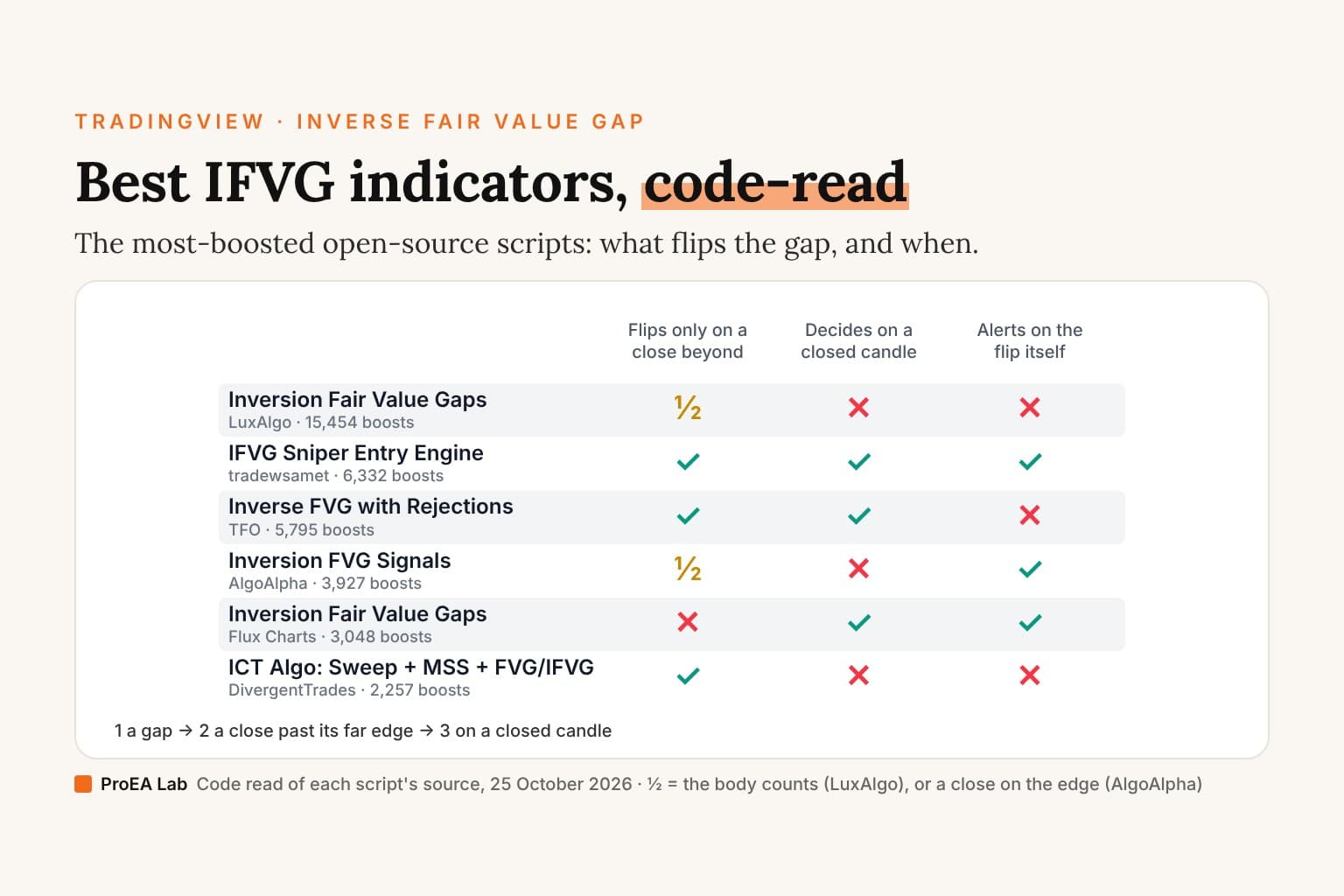
Short answer: the popular open-source IFVG scripts disagree on the one thing that makes an inverse fair value gap: what flips the gap. The most boosted, Inversion Fair Value Gaps by LuxAlgo, flips it when a candle's body gets beyond the far edge, and decides on the live bar. For the textbook rule, a close beyond the far edge on a closed candle, Inverse FVG with Rejections by TFO is the closest in our read; it shows the flip as the next candle opens.
Most lists name IFVG indicators.
This one reads them.
What we checked
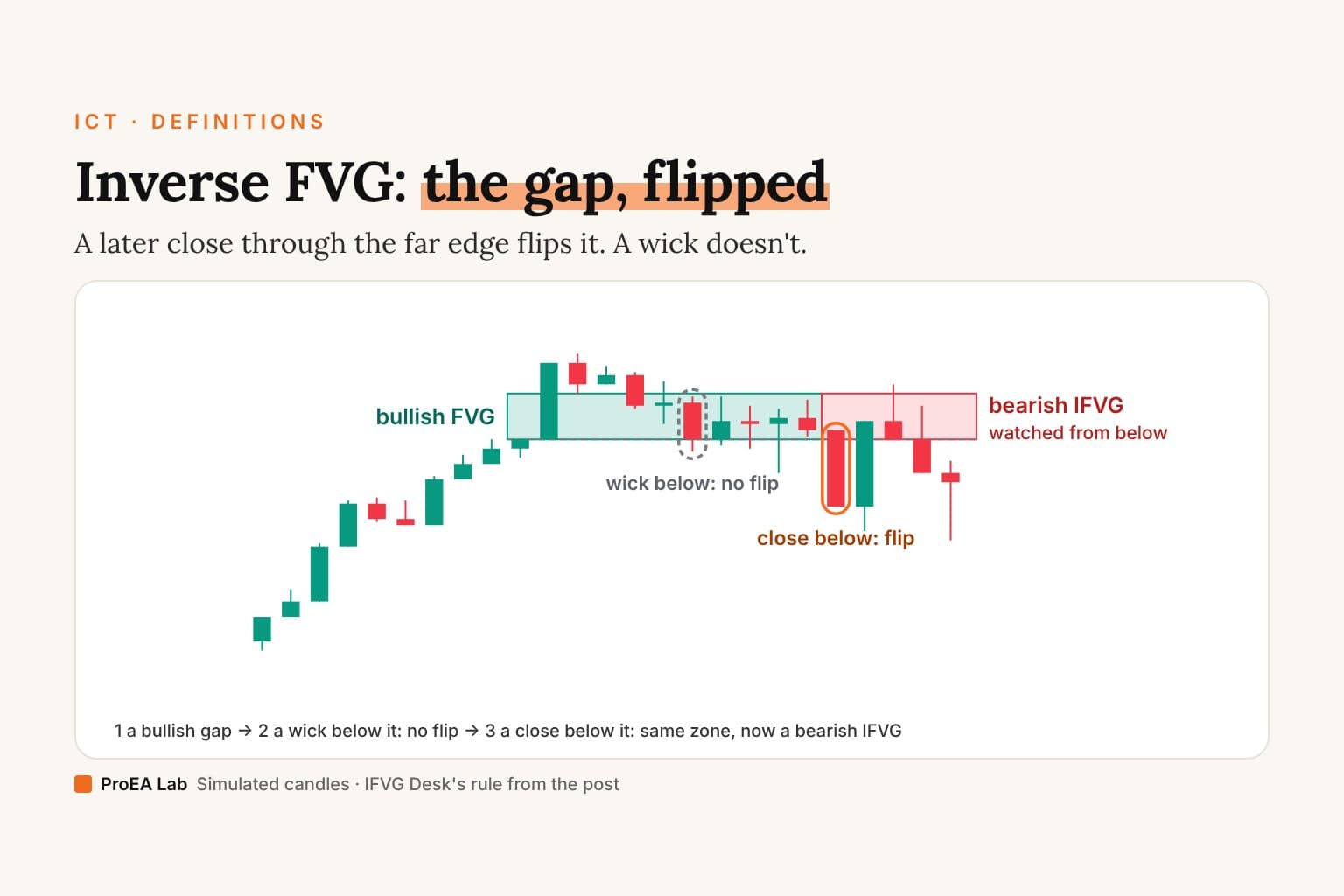
An inverse fair value gap is a fair value gap that a later candle closed through: a bullish gap closed below its bottom becomes a bearish IFVG, and a bearish gap closed above its top becomes a bullish one (explained, with the full rule). ICT calls it an inversion fair value gap; iFVG and inverse FVG are the same thing.
We searched TradingView's scripts for six IFVG terms on 25 October 2026 ("ifvg", "inverse fvg", "inverse fair value gap", "inversion fvg", "ifvg indicator" and "ict ifvg"), which returned 98 scripts. We took the 10 most-boosted open-source scripts that flip a gap themselves and read every line that decides when one flips. Four questions:
- The flip: what has to get beyond the gap's far edge, a close, a wick or a candle's body?
- The edge: does a close exactly on the edge count?
- When it decides: on a closed candle, or on the live one?
- Alerts: can you set an alert for the flip itself?
The table
Boosts as TradingView's search showed them on 25 October 2026. ATR(14) is the average true range of the last 14 candles.
| Script | Boosts | The flip | Decides on | Alerts on the flip |
|---|---|---|---|---|
| Inversion Fair Value Gaps (IFVG) (LuxAlgo) | 15,454 | A candle's body, its open or its close, beyond the far edge; gaps wider than 0.25 × ATR(200) | The live bar | No: its two alerts are retest signals |
| IFVG Sniper Entry Engine (tradewsamet) | 6,332 | A close beyond the far edge by 0.05 × ATR(14), its default "Balanced" filter; gaps at least 0.25 ATR wide, with candle filters | Closed candles | Yes, and on its entries |
| Inverse FVG with Rejections (TFO) | 5,795 | A close strictly beyond the far edge, on a timeframe you pick (the chart's by default); gaps wider than about 0.3 × the average range of the last 20 candles | Closed candles, shown as the next one opens | No: its alerts are rejections |
| Inversion Fair Value Gap Signals (AlgoAlpha) | 3,927 | A close at or beyond the far edge; gaps wider than 0.3 × ATR(150) | The live bar | Yes: "Bullish IFVG Created", among 12 alerts |
| Inversion Fair Value Gaps (Flux Charts) | 3,048 | A wick beyond the far edge by default; a close is an option | Closed candles | Yes, one: "New IFVG" |
| ICT Algo: Sweep + MSS + High Prob FVG/IFVG (DivergentTrades) | 2,257 | A close beyond the far edge, kept only with displacement and a sweep in the last 60 candles; otherwise the gap is deleted | The live bar | No |
| Inversion Fair Value Gaps (IFVG) (ChartPrime) | 1,915 | A close strictly beyond the far edge | Gaps on closed candles, the flip on the live bar | No alerts |
| Time-Based Fair Value Gaps (FVG) with Inversions (iFVG) (BigGuavaTrading) | 1,047 | A candle's body beyond the gap's near edge, with the gap directions swapped; gaps at any minute by default, or only in 10-minute windows you pick | The live bar | No: two of its alerts fire on every bar |
| IFVG Desk (ours) | — | A close strictly beyond the far edge, by a later candle than the gap's third; gaps at least 0.05 × ATR(14) wide; each gap flips once and expires after 180 candles | Closed candles | Yes: inversion, among 7 alert conditions (new gap, entry, invalidation, expiry, paper result), plus a JSON alert per entry |
Flux Charts' Inversion Fair Value Gap Consumption (1,817 boosts) and HTF Inversion Fair Value Gap (1,549) run the same engine as its main script, a wick by default; the HTF one has no alerts. Three more TradingFinder scripts, FVG & IFVG ICT (10,425), its Balanced Price Range script (1,942) and Inversion Fair Value Gaps (1,033), find their gaps with TradingFinder's FVG library and flip them in its order-block drawing library, neither of which we read, so they aren't in the table. We read both libraries on 31 October for our code read of the FVG scripts: FVG & IFVG ICT flips a gap on a close beyond its far edge, on the live bar, only within 8 candles of a wick past the gap's 50% line.
Two well-boosted scripts with "IFVG" in the name, LuxAlgo's ICT Implied Fair Value Gap (6,125) and TradingFinder's Implied Fair Value Gap (2,184), are about the implied fair value gap, a different idea. Two more, Algoryze's iFVG (BPR) (4,870) and RAFENTech's BISI - SIBI (1,776), have no inversion code. Above 800 boosts, five have closed code: the Inverse Fair Value Gap Indicator by donnydropout (1,441), IFVGs [NINE] (1,183) and ACE FVG & IFVG Trading System (801) are protected, free to add with the code hidden; iFVG Ultimate+ / DodgysDD (1,404) and toodegrees' Inverse Fair Value Gap [Pro+] (979) are invite-only and paid (how they compare with IFVG Desk). One more paid one didn't come up in the search, though traders look for it by name: Inversion Fair Value Gap Model [PJ Trades], built by Flux Charts with PJ Trades, invite-only, with 2,204 boosts on its page (how it compares).
What the code says
LuxAlgo's is the popular one, and it reads the body, not the close. It flips a gap when the lower end of a candle's body, its open or its close, gets below a bullish gap's bottom, or the upper end above a bearish gap's top. Usually that is a close, but a candle that opens beyond the edge and closes back inside also counts. Nothing waits for the candle to close, so an IFVG can print mid-candle and vanish. Its two alerts are for retests of the inverted zone, with a wick or a close as you choose; the flip itself has none. It is shared under CC BY-NC-SA 4.0.
IFVG Sniper Entry Engine waits for the close, and then some. Everything runs inside a closed-candle check. A gap flips only when a close gets beyond its far edge by a buffer, 0.05 × ATR(14) in its default "Balanced" filter, and it is shown only if the gap was at least 0.25 ATR wide and its third candle passed body and range filters. It remembers a gap for 60 candles and flips at most one per candle. Then, if no plan is already open, it draws an entry, at the broken edge by default, with a stop 1.5 ATR away and a target at 3R, its default: drawings, not a backtest. Published 10 June 2026, it carries no licence line.
TFO's is the textbook rule, shown as the next candle opens. It works on the candles of the timeframe you pick, the chart's by default, and reads each one only once it has closed: the flip appears as the next candle opens. A gap flips on a close strictly beyond its far edge, and an inverted gap ends on a close strictly beyond its other edge. Its alerts are for rejections, a swing that turns inside a gap or an IFVG, not for the flip. It is shared under MPL 2.0.
AlgoAlpha's counts a close on the edge. It flips a gap on a close at or beyond the far edge, so a close exactly on it is enough, and it decides on the live bar. Its alerts are the fullest here, 12 of them, from "Bullish IFVG Created" to rejections. It is shared under MPL 2.0.
Flux Charts' flips on a wick by default. Its "Zone Invalidation" setting starts on "Wick": a low below a bullish gap's bottom flips it, even if the candle closes back inside. Switch both "Zone Invalidation" and "IFVG Zone Invalidation" to "Close" for the textbook rule. It decides on closed candles, within the last 1,750 candles of the chart.
Three more check the flip on the live bar. ChartPrime's draws its gaps on closed candles but flips them on a strict close of the live one, and has no alerts. DivergentTrades' flips on a close only after displacement and a sweep in the last 60 candles, and its higher-timeframe gaps, hidden by default but used by its signal filter, are requested with lookahead and no offset, so on history a gap exists from the first chart candle of the higher-timeframe candle that completes it, before it formed. BigGuavaTrading's swaps the gap directions and then reuses LuxAlgo's body test against the gap's near edge, so almost every gap counts as inverted on the candle that completes it, and two of its alert conditions are set to true, so they fire on every bar.
Ours
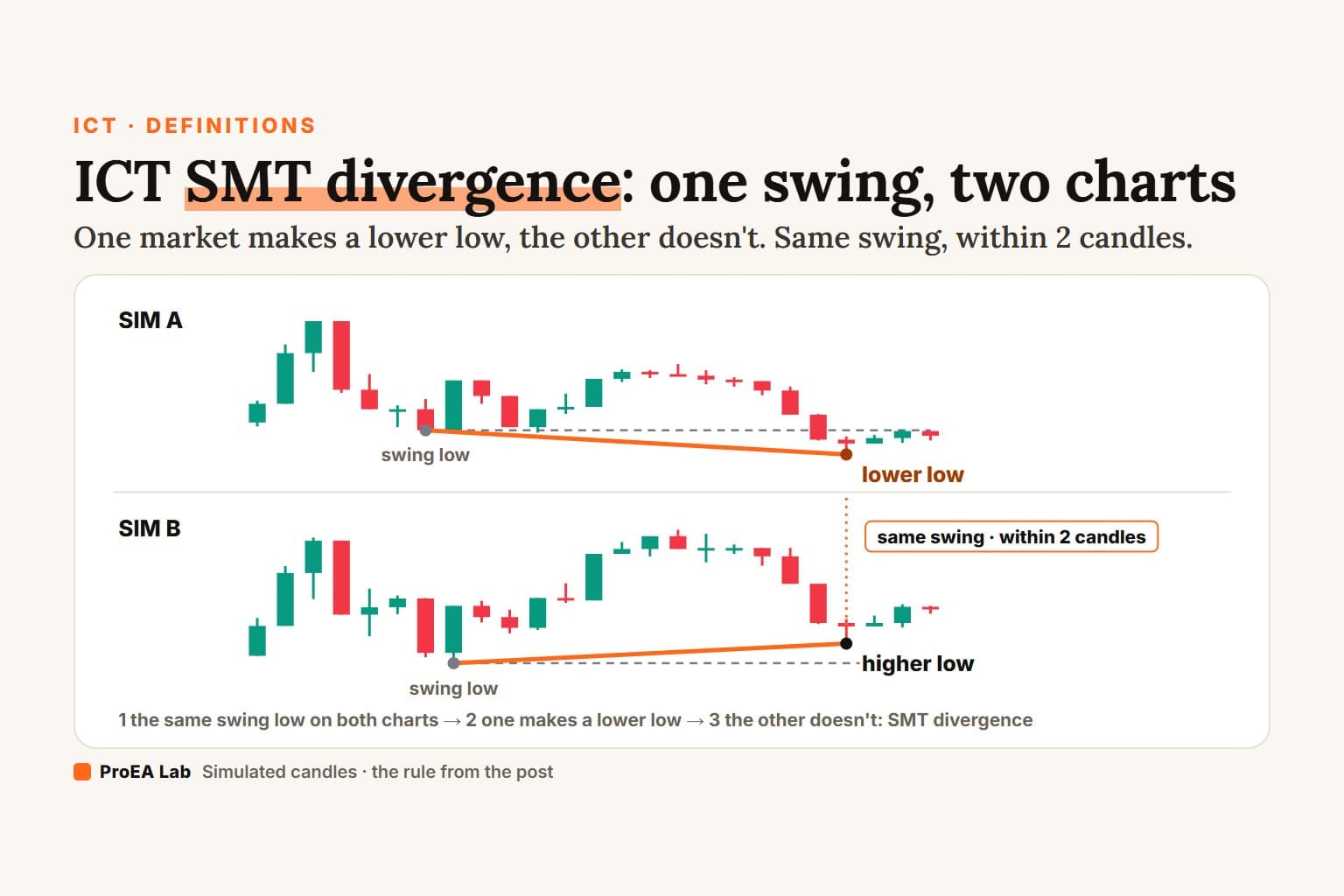
IFVG Desk isn't on TradingView's search: its full Pine v6 source comes in Pine Pro Library, $49 once. It flips a gap only on a close strictly beyond its far edge, by a later candle than the one that completed the gap, so a wick or a close on the edge doesn't count. Gaps must be at least 0.05 × ATR(14) wide; each flips once, ends on a close strictly beyond its other edge, and expires after 180 candles. Everything is decided on closed candles. Its dashboard shows the desk's state, WAIT, ARMED, PLAN ACTIVE or DAY DONE, and its setup history records why an armed IFVG was entered or skipped. A strategy companion runs the same rule in the Strategy Tester. Its optional SMT check, against ES futures by default, is compared with the free SMT scripts in best SMT divergence indicators, code-read.
Paying for an IFVG model instead? DodgysDD's iFVG Ultimate+ against IFVG Desk, with the routes to buy we could price, dated. The rule on one page: the IFVG strategy cheat sheet (PDF). The same code read for order block scripts, which candle each one boxes and what ends a zone: best order block indicators, code-read. An IFVG is a gap that flipped on a close; the same flip on an order block is a breaker, and the scripts that draw one disagree on what flips it: best breaker block indicators, code-read.
We tested IFVG Desk's default rule on QQQ and SPY 1-minute candles from 17 Aug to 5 Sep 2026, with costs (run on version 1.0.0 and repeated on 1.0.1; not re-run on 1.2.0): 15 trades on each, −525.57 USD on QQQ and +210.81 USD on SPY. The same rule over the same weeks, with opposite signs: too small a test to say either way. The IFVG explainer has every number.
Check one yourself
- The flip: find the line that turns a gap into an IFVG. If it compares
loworhighwith the edge, a wick flips it;closemeans a close;math.min(open, close)means the body. - The edge:
<and>need a close beyond it;<=and>=also count a close exactly on it. - The close: look for
barstate.isconfirmedaround the flip, or for values read one candle back (close[1]throughrequest.securitywith lookahead on, as TFO's does). Without either, an IFVG you see live may not be there when the candle closes.
None of the scripts here, ours included, runs on MT5 or MT4: Pine Script runs only on TradingView.
The deep version, as a PDF
The IFVG Playbook
Inverse fair value gaps as exact rules, with a year of gold and Bitcoin data on what they really do.
- A one-year study: 34,537 IFVGs on gold and Bitcoin, how often gaps flip, how fast, and what price does next
- Eight IFVG plans tested against 1,000 random-entry runs each half, after costs, with the verdict
- The exact rule, the edge cases and a drill, so your chart and your notes stop disagreeing
One payment, instant download. Refund within 7 days if you haven't downloaded it.
Limits
One code read, on 25 October 2026, of the versions TradingView served that day. Scripts change, and boosts measure popularity, not quality. We build and sell IFVG Desk, and we have no relationship with any author named here. Nothing here is financial advice.
Frequently asked questions
What is the best IFVG indicator on TradingView?
It depends on the rule you want. The most boosted, Inversion Fair Value Gaps by LuxAlgo (15,454 boosts), flips a gap when a candle's body gets beyond its far edge, and decides on the live bar. For the textbook rule, a close beyond the far edge on a closed candle, Inverse FVG with Rejections by TFO (5,795 boosts) is the closest in our read, though it shows the flip as the next candle opens. IFVG Sniper Entry Engine (6,332 boosts) also waits for the close, adds a buffer of 0.05 ATR and draws a stop and a target.
Is there a free IFVG indicator for TradingView?
Yes. Every TradingView script in our table is free to add, with its code open. LuxAlgo's is shared under CC BY-NC-SA 4.0, which doesn't allow commercial use; TFO's, AlgoAlpha's, Flux Charts', ChartPrime's, DivergentTrades' and BigGuavaTrading's under the Mozilla Public License 2.0; IFVG Sniper Entry Engine carries no licence line.
Does the IFVG indicator repaint?
Some do. LuxAlgo's, AlgoAlpha's, ChartPrime's, DivergentTrades' and BigGuavaTrading's check the flip on the live bar, so an IFVG can print mid-candle and vanish before the candle closes. IFVG Sniper Entry Engine and Flux Charts' decide on closed candles; TFO's reads the candle that just closed, as the next one opens. Our IFVG Desk decides on closed candles.
Does a wick through a fair value gap flip it in these indicators?
In some. Flux Charts' scripts flip a gap on a wick beyond its far edge by default, with a close as an option. LuxAlgo's and BigGuavaTrading's look at a candle's body, its open or its close. TFO's, ChartPrime's, DivergentTrades' and IFVG Sniper Entry Engine need a close; AlgoAlpha's also counts a close exactly on the edge.
What is the IFVG Sniper Entry Engine?
An open-source TradingView indicator by tradewsamet, published 10 June 2026, with 6,332 boosts. On closed candles it flips a gap when a close gets beyond its far edge by 0.05 ATR (its Balanced filter), keeps only gaps at least 0.25 ATR wide, and draws an entry with a stop 1.5 ATR away and a target at 3R. The stop and target are drawings, not a backtest.
Is there an IFVG indicator for MT5 or MT4?
Not among these: every script here is Pine Script, which runs only on TradingView.
Which IFVG indicator does ProEA make?
IFVG Desk, in Pine Pro Library, $49 once with its full Pine v6 source. It flips a gap only on a close strictly beyond its far edge, by a later candle, decides on closed candles, and records why each armed IFVG was entered or skipped. A strategy companion runs the same rule in the Strategy Tester.
Does the IFVG work?
We haven't shown that it does. IFVG Desk's default rule on QQQ and SPY 1-minute candles, 17 Aug to 5 Sep 2026, made 15 trades on each: −525.57 USD on QQQ and +210.81 USD on SPY. That is too small a test to say either way.