Drift Desk's band is a SuperTrend-style ATR trail: it ratchets with the trend and flips on a close. We tested it, and a long-only version of it, the written-first way.
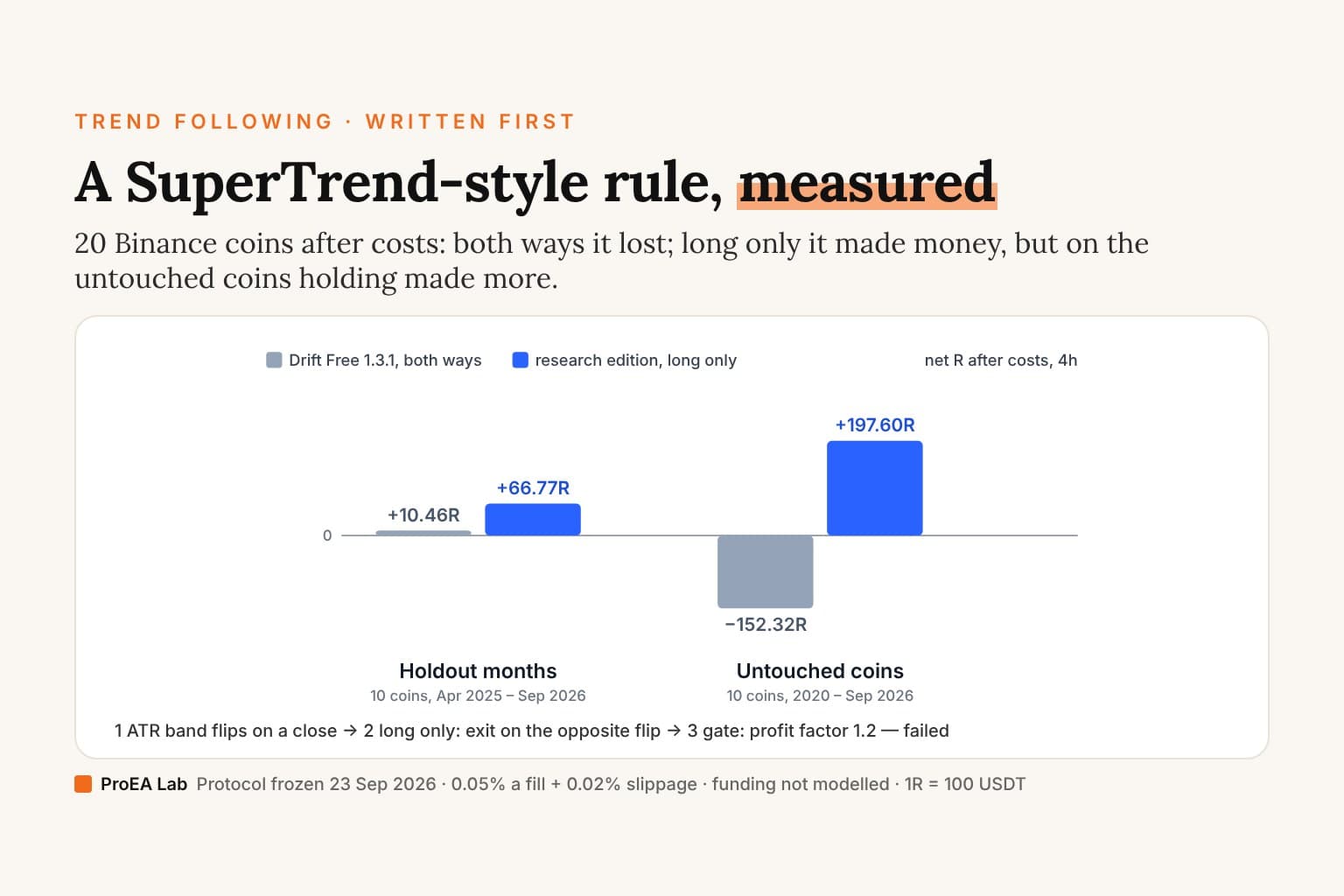
After costs, the both-ways rule lost on 20 coins; the long-only version made money, but on the untouched coins holding long made more, and it failed its gate.On the 10 coins never used to build it, Drift Free lost −152.32R; the long-only research edition made +197.60R.
Holding those coins long the whole time, with the same capital, made +299.09R.
The plan required a profit factor of 1.2; the research edition reached 1.16 and 1.12.
The full test, every file and every caveat, is on the Drift Premium test result page. This article is the plain-language version of it.
The rule
The test ran two editions on 4-hour candles:
- Drift Free 1.3.1: Drift Desk's strategy, version 1.3.1, with its default inputs, long and short. Drift Desk's band, as its current source draws it, is SuperTrend-style: an ATR trail that ratchets with the trend and flips on a close, centred on the candle's price shifted by a candle-pressure read.
- The research edition (long only): Drift Free's signals with every optional gate off; a short flip is skipped; the initial stop is Drift Free's 10-bar structure stop plus 0.25 ATR(14), sized to 1R and kept for the life of the position; no profit target, so the position closes at the first opposite flip.
The research edition was built for the test. It is not Drift Desk Premium 1.1.0, the toolset sold today, and today's Drift Desk is 1.5.0, not the 1.3.1 tested.
How we measured
- Written first: the protocol was frozen on 23 September 2026, before the final run, with the pass rule (the "gate") committed before the result.
- Data: Binance spot 4-hour candles from its public archives, cut off at 23 September 2026, 12:00 UTC.
- Two sets:
- Set A, the holdout months: BTC, ETH, BNB, XRP, ADA, LINK, LTC, TRX, ATOM and XLM, from 1 April 2025.
- Set B, the untouched coins: DOGE, QTUM, ETC, XTZ, VET, ALGO, ZEC, DASH, HBAR and NEO, from January 2020, never used to build or choose the rule.
- Costs: 0.05% commission per fill and 0.02% slippage on market and stop fills; a stress run used 0.10% and 0.05%. Funding and borrow costs weren't modelled.
- Units: 1R is 100 USDT of planned risk per position, one position per coin at a time.
- Parity: the lab's engine matched TradingView's Strategy Tester on 914 of 914 Drift Free trades.
- The gate, set in advance: in both sets the research edition had to make money, beat Drift Free, reach a profit factor of 1.2, profit on at least 6 coins and stay above zero at the stress costs; on Set B it also had to beat Drift Free taking only its long signals.
The results
After costs (0.05% a fill plus slippage):
| Set | Edition | Positions | Won | Net R | Profit factor | Average win | Average loss |
|---|---|---|---|---|---|---|---|
| A, holdout months | Drift Free 1.3.1 | 642 | 37.5% | +10.46R | 1.03 | 1.72R | −1.01R |
| A, holdout months | Research edition (long only) | 1,108 | 37.0% | +66.77R | 1.16 | 1.15R | −0.58R |
| B, untouched coins | Drift Free 1.3.1 | 2,607 | 35.6% | −152.32R | 0.91 | 1.60R | −0.97R |
| B, untouched coins | Research edition (long only) | 4,685 | 36.9% | +197.60R | 1.12 | 1.04R | −0.54R |
Across all 20 coins, Drift Free lost −141.86R over 3,249 positions and was profitable on 7 of the 20; the research edition made +264.37R over 5,793 positions and was profitable on 14.
At the stress costs, Drift Free lost on both sets (−15.13R and −205.83R) and the research edition stayed above zero (+18.39R and +85.38R).
The gate failed
The research edition passed every condition but one. The export's own reasons:
- "Set A: Premium profit factor 1.16 is below 1.2."
- "Set B: Premium profit factor 1.12 is below 1.2."
So the plan's verdict is a failure, and it stays one: the bar was set before the result.
What explains the profit
The test's own caveats answer it, and they don't flatter the rule:
- Being long explains it. On the untouched coins, Drift Free taking only its long signals made +170.73R, and holding long the whole time with the research edition's average capital made +299.09R after costs, more than the research edition's +197.60R.
- On the holdout months it did beat holding: +66.77R against +24.90R for holding long with the same average capital. The untouched coins, where holding won, are the larger and longer set.
- A few months made it. 94.5% of the research edition's Set A net R came from positions exiting in July 2025; on Set B its three largest months gave +191.21R of +197.60R.
- It isn't statistically resolved. No net R interval of the week-block bootstrap excludes zero.
- It lost in falling markets and made money in rising ones, as a long-only rule does.
What this says about SuperTrend-style trend following
One ATR band rule, on one asset class, on one timeframe. Within that:
- Both ways, it didn't hold up after costs. On the untouched coins, Drift Free's long signals alone made +170.73R while the both-ways rule lost −152.32R: the shorts were what lost.
- The win rate was about a third, and that's normal for a trend rule: it lives on wins being bigger than losses (Drift Free's average win was 1.72R and 1.60R against losses of about 1R).
- Long-only beat both-ways, but not holding on the untouched coins. If a trend rule doesn't beat simply holding, its job is risk control, not extra return.
What we haven't tested
- Other markets (stocks, indices, gold, forex) and other timeframes.
- Today's Drift Desk 1.5.0 and Drift Desk Premium 1.1.0: neither is the tested build.
- SuperTrend itself, with its classic settings. Drift's band is SuperTrend-style, not SuperTrend.
Sources
- The test's export,
public/premium-vault/drift-desk/research/v2/2026-09-24-final-r6/summary.json, and its protocol, frozen on 23 September 2026; every number above is a field of it, and the test result page shows them all. - How SuperTrend, Chandelier Exit and ATR trailing stops are built: the SuperTrend indicator, explained.
Disclosure
We, ProEA Lab, build Drift Desk and Drift Desk Premium, and sell them in Pine Pro Library and the Premium Vault. The code is AI-assisted. These are hypothetical backtests on historical Binance spot data, chosen among pairs still trading in 2026; no live trading record is implied. Nothing here is a forecast. Trading involves risk.
Frequently asked questions
Does trend following work?
In our written-first test on 20 Binance coins, 4-hour candles, after costs: Drift Desk's both-ways rule lost −141.86R over 3,249 positions. The long-only research edition made +264.37R over 5,793 positions, but on the untouched coins simply holding long made more (+299.09R against +197.60R), and it failed the pre-set gate.
Is a SuperTrend-style strategy profitable after costs?
Not as a both-ways rule in this test: Drift Free ended at +10.46R on the holdout months and −152.32R on the untouched coins. Long-only, the research edition ended at +66.77R and +197.60R, with profit factors of 1.16 and 1.12, below the 1.2 the plan required.
What is the win rate of an ATR trailing stop trend rule?
About a third of trades: Drift Free won 37.5% on the holdout months and 35.6% on the untouched coins; the research edition 37.0% and 36.9%. Trend rules live on the size of the wins: Drift Free's average win was 1.72R and 1.60R against an average loss of about 1R.
Does trend following work on crypto?
On these 20 coins the long-only version made money in rising markets and lost in falling ones, and its profit is explained by being long: Drift Free taking only its long signals made +170.73R on the untouched coins, and holding long the whole time with the research edition's average capital made +299.09R.
How was the trend following backtest run?
A protocol frozen on 23 September 2026 before the final run: 20 Binance spot pairs on 4-hour candles, a holdout set of months and a set of coins never used to build the rule, 0.05% commission per fill and 0.02% slippage, and a pass rule written before the result. The engine matched TradingView's Strategy Tester on 914 of 914 trades.