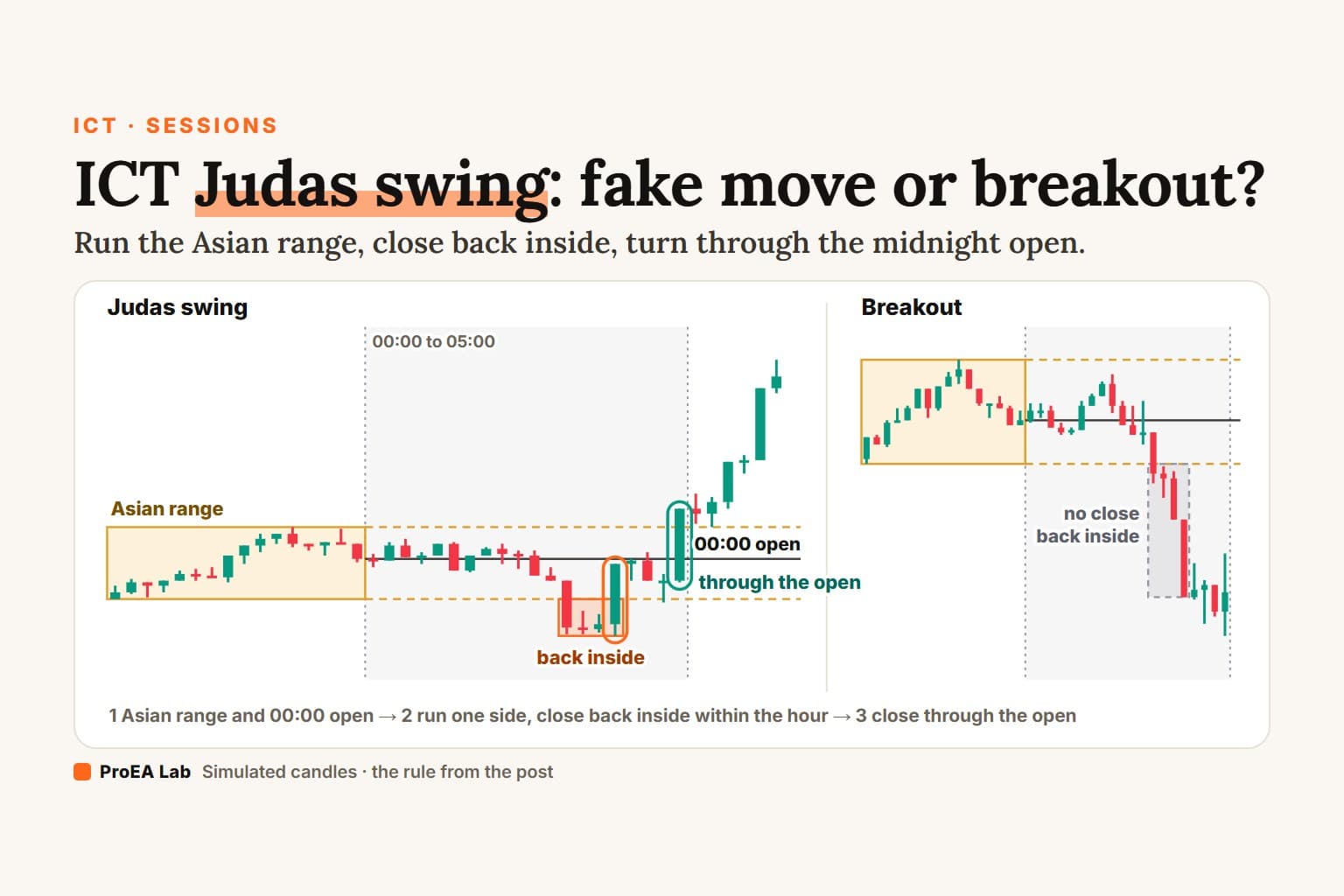
The ICT Judas swing is a false move early in the trading day. Between 00:00 and 05:00 New York time, price runs beyond one side of the Asian range (20:00 to 00:00), where stops sit, closes back inside within the hour, then closes through the 00:00 midnight open the other way. A run below the range makes a bullish Judas swing; a run above it, a bearish one. If the run never closes back inside, it was a breakout, not a Judas swing.
Every chart below is a replay of simulated candles read by one written rule. The clock is the one from ICT killzones: America/New_York, daylight saving time included. The run itself is a liquidity sweep with a clock on it.
What is a Judas swing in trading?
A move that betrays the traders who follow it, hence the name. ICT, the Inner Circle Trader, teaches it as the early false move of the day. innercircletrader.net calls it "a false move at session open designed to trap retail traders before the real institutional move of the day begins" (ICT Judas Swing guide, last updated 7 May 2026, checked 2026-10-04).
A chart can't show anyone's design. It shows a shape: a run through a level where stops sit, a close back, and a move the other way.
Simulated 15-minute candles, not market data. Times are New York. The Asian range is 20:00 to 00:00; the window runs from 00:00 to 05:00; the close back inside has to come within the hour. The strip's UTC and "You" rows are tonight's times, computed in your browser.
Read as text
- Simulated 15-minute candles, New York time. From 20:00 to 00:00 price stays between 112.79 and 113.22: the Asian range. The 00:00 open is 113.03.
- At 03:00 price trades below the Asian low, to 112.57 at the furthest. That's where stops on overnight longs would sit.
- The 04:00 close is back inside the range, 4 candles after price left it (the rule allows 4, one hour). The move out did not hold.
- The 05:00 close is above the 00:00 open, before 05:00: by this page's rule, a bullish Judas swing.
- By 08:00 price is at 114.58. The swing's low of 112.57 was not traded again. The rule says nothing about what comes after 05:00.
How this window was chosen: The first simulated night that prints a bullish Judas swing by this page's rule with every part visible: an Asian range at least 1.5 average candles tall, a swing at least half an average candle below it, and the 00:00 open at least half an average candle above the Asian low.
Use itMark the Asian high and low and the 00:00 open before midnight. The swing has to run one of those levels, close back, then cross the open.
Watch outThe strip under the film gives tonight's times on your clock. A box typed in UTC is an hour off for part of the year.
What time does the Judas swing happen?
In this page's rule, between 00:00 and 05:00 New York time, after an Asian range drawn from 20:00 to 00:00. The London killzone, 02:00 to 05:00, sits inside that window.
| Moment | New York | UTC, Nov to Mar | UTC, Mar to Nov |
|---|---|---|---|
| Asian range starts | 20:00 | 01:00 | 00:00 |
| Midnight open | 00:00 | 05:00 | 04:00 |
| London killzone | 02:00–05:00 | 07:00–10:00 | 06:00–09:00 |
| Window ends | 05:00 | 10:00 | 09:00 |
New York is on standard time from the first Sunday of November to the second Sunday of March. The guides agree on the start and split on the hours. All checked 2026-10-04:
- innercircletrader.net (updated 7 May 2026): "between the New York midnight open (00:00 NY local) and roughly 05:00 AM New York time", and "Setups that print after 05:00 AM NY local are not Judas Swings." It puts the London open at 03:00.
- TradingFinder (modified 9 Dec 2025): "It typically occurs between the New York Midnight Open (00:00) and 5:00 AM New York Time."
- LuxAlgo's library (no date shown): "roughly 2:00 to 5:00 a.m. New York time", adding that ICT's "stated windows vary across different series of teachings".
- ictkillzone.com (published May 2026): "2:30–3:00 AM ET: The highest-probability Judas Swing window." It shows no data behind that.
- FXNX (17 Apr 2026) writes it in London time: "roughly 8:00-9:00 AM GMT/BST".
We use 00:00 to 05:00, the window innercircletrader.net and TradingFinder both give. We haven't measured which half-hour is best, so we don't rank them.
Where do the guides disagree?
On almost everything after the start time:
- Which level. innercircletrader.net runs the swing against one price: "Mark the New York midnight open price at 00:00 NY local time." TradingFinder marks "The Asian High" and "The Asian Low" and says the move "breaks one of these two zones". ictkillzone.com lists the Asian high first, then equal highs, the previous day's high and the prior week's high.
- What confirms it. innercircletrader.net: "price returns back through the opening level after the spike", then a market structure shift. ictkillzone.com: "Watch for the body of the Judas candle to close back inside the range."
- Which one is bullish. innercircletrader.net calls the fake move down a "bullish-bias Judas Swing". ictkillzone.com calls the fake move up a "bullish Judas (bearish day)". Same picture, opposite names. We name it after the real move, as the AMD page does: a run below the range is bullish.
- Which session. London by default. In a reply under the guide (25 June 2026), its author adds: "Apply it to the New York 9:30 open just like you would to London."
The rule
Judas swing rule
New York time (America/New_York, daylight saving time
included), 15-minute candles.
1. Levels: the Asian range, the high and low of the candles
   from 20:00 to 00:00, and the 00:00 open (midnight open).
2. Window: 00:00 to 05:00. Nothing after 05:00 counts.
3. Swing: the first candle in the window that trades beyond
   the Asian high or low. Only the first one counts.
4. The close decides: a candle closes back inside the Asian
   range within the hour (4 candles, the first included).
   No close back inside in time: a breakout, not a Judas swing.
5. Cancel: a close beyond the swept side again.
6. Judas swing: after the close back inside, a candle closes
   through the 00:00 open the other way. A run below the
   range is a bullish Judas swing; above it, a bearish one.
   No such close by 05:00: it never reversed.
Each step comes from a guide above; the combination is ours. The Asian range is where the stops sit; the midnight open is innercircletrader.net's line for the failure. The one-hour deadline is the one our liquidity sweep and AMD (power of 3) rules use. Without one, every breakout that fails at 04:30 becomes a Judas swing in hindsight.
Judas swing or breakout?
The close decides. When the first candle closes beyond the Asian range, a Judas swing and a real breakout look the same. A close back inside within the hour makes it a sweep. A close through the 00:00 open makes it a Judas swing. No close back inside makes it a breakout.
Simulated 15-minute candles, not market data. Times are New York. The Asian range is 20:00 to 00:00; the window runs from 00:00 to 05:00; the close back inside has to come within the hour.
Read as text
- Simulated 15-minute candles, New York time. From 20:00 to 00:00 price stays between 69.54 and 69.77: the Asian range. The 00:00 open is 69.65.
- At 02:00 price trades below the Asian low and the candle closes at 69.52, outside the range. At that close a Judas swing and a breakout look the same.
- The 03:00 close is back inside the range, the fourth candle after price left it, inside the hour the rule allows. Now it is not a breakout.
- The 03:30 close is above the 00:00 open. Only now does the rule name it: a bullish Judas swing.
How this window was chosen: The first simulated night after the two above that prints a Judas swing, either way, under the same visibility rule, whose first candle out of the Asian range closes outside it (so at that close it looks like a breakout).
Use itWait for the close back inside. Before it, the run beyond the range is just a run.
Watch outinnercircletrader.net: if price 'closes past the opening price and stays past it through 05:00 AM NY, the breakout is real'. Don't fade a range that price has accepted.
What if the Judas swing never reverses?
Then it wasn't one. The rule gives a swing that closed back inside two ways out: a close through the 00:00 open (a Judas swing), or a close beyond the swept side again (cancelled). In the simulated year, no swing that closed back inside just sat between the two until 05:00.
A Judas swing that the rule names can still fail. Price can come back through the swing's extreme, where the guides put the stop.
Simulated 15-minute candles, not market data. Times are New York. The Asian range is 20:00 to 00:00; the window runs from 00:00 to 05:00; the close back inside has to come within the hour.
Read as text
- Simulated 15-minute candles, New York time. From 20:00 to 00:00 price stays between 76.33 and 76.91: the Asian range. The 00:00 open is 76.82.
- At 02:00 price trades below the Asian low and the 02:30 close is back inside: so far, a Judas swing in the making.
- The 03:30 close is below the Asian low again, before any close above the 00:00 open. That cancels it: no Judas swing.
- At 05:00 price is at 75.97, still below the range: the swing never reversed. By 08:00 it is at 75.72.
How this window was chosen: The first simulated night whose swing closes back inside the Asian range within the hour, then closes beyond the swept side again before any close through the 00:00 open, and is still beyond that side at the 05:00 close (the swing never reversed in the window), under the same visibility rule as the first film.
Use itWrite down what ends the idea before it starts: no close back inside within the hour, a close beyond the swept side, or a trade through the swing's extreme.
Watch outLuxAlgo: 'If price holds beyond the swept level and builds on it, there is no Judas swing, just a trending open that should not be faded.'
Does the Judas swing show up in random prices?
Yes. Our simulated market has no orders, no stops and nobody behind it: seeded random candles with a quiet Asian session and a busier London morning. By this rule, 74 of its 291 nights printed a Judas swing (34 bullish, 40 bearish). On 145 the swing was a breakout; on 72 it was cancelled. And on 56 of the 74 Judas nights, price traded back through the swing's extreme before 08:00.
So the shape alone can't prove anyone hunted anything. These counts depend on how we built the simulation and say nothing about how often real markets print a Judas swing, or how often one holds.
Judas swing vs AMD (power of 3)
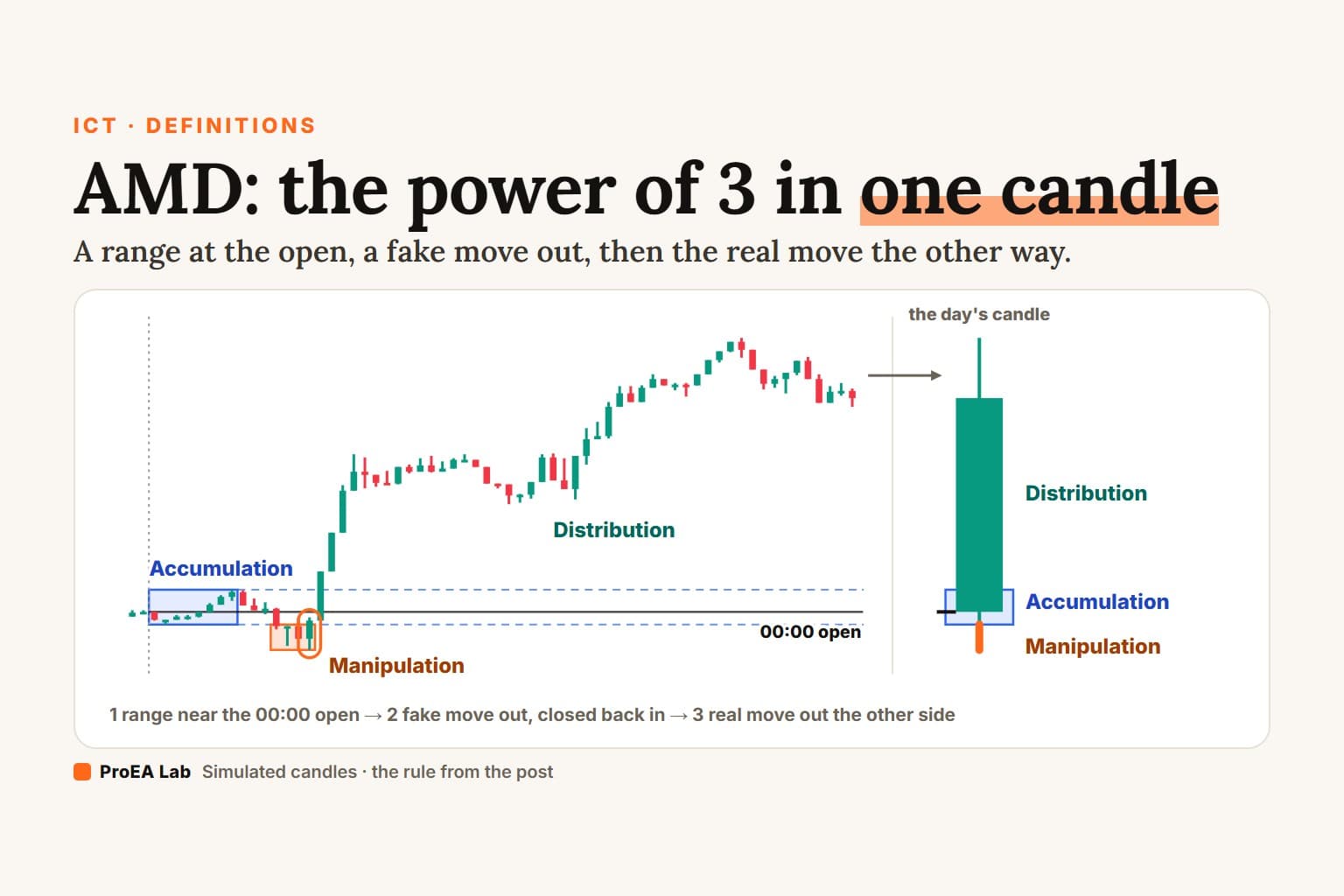
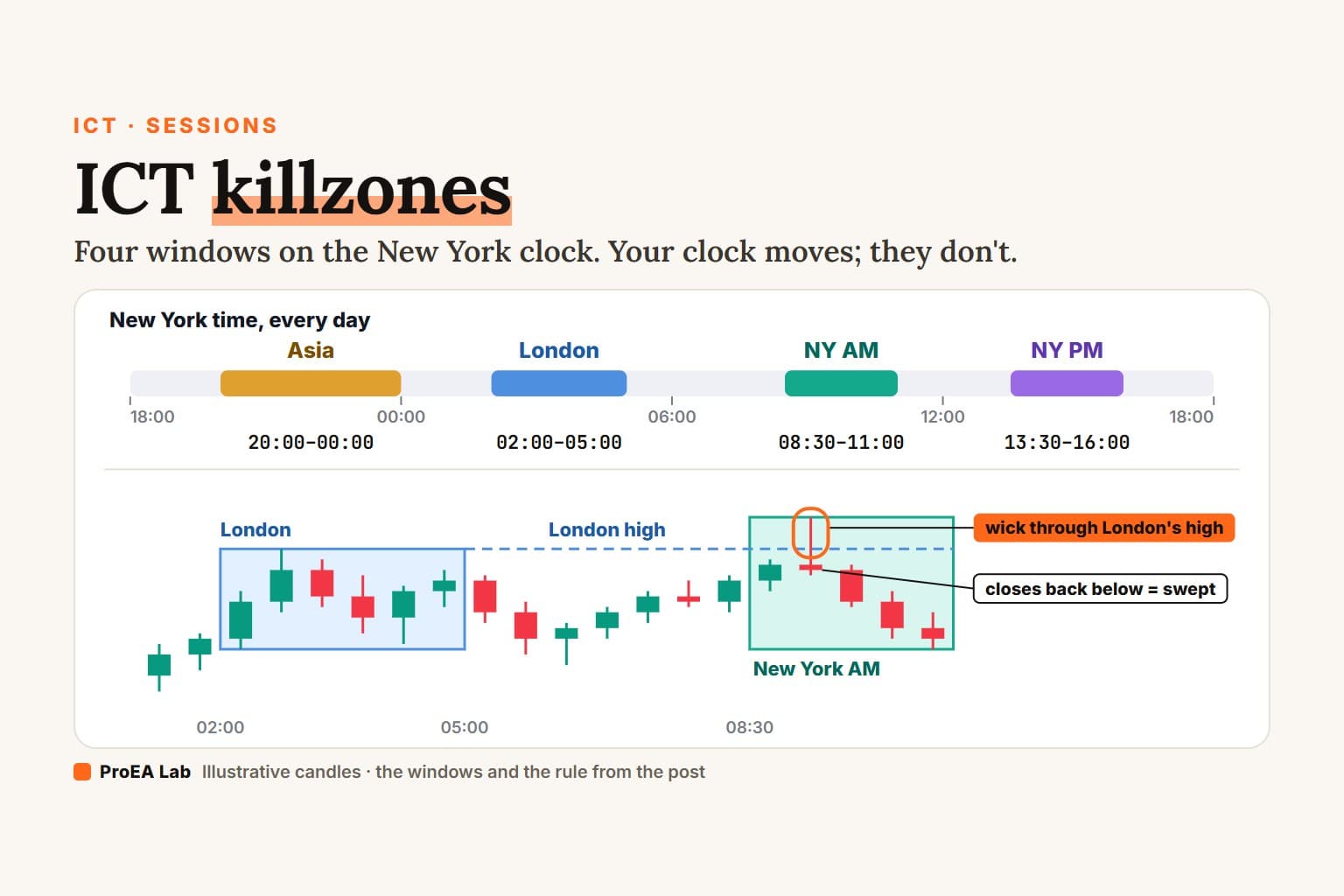
The same idea on a different clock. In ICT's AMD (power of 3), the Judas swing is the manipulation step: LuxAlgo calls it "the middle act", ictkillzone.com "the manipulation phase of AMD". The AMD page reads it against the 00:00 to 02:00 range, after 02:00; this rule reads it against the Asian range, from 00:00. Both sit around the London window of the ICT killzones.
Different ranges give different answers. On the same simulated year, 9 of the 74 Judas nights were AMD days by the AMD page's rule, and only 4 of those in the same direction.
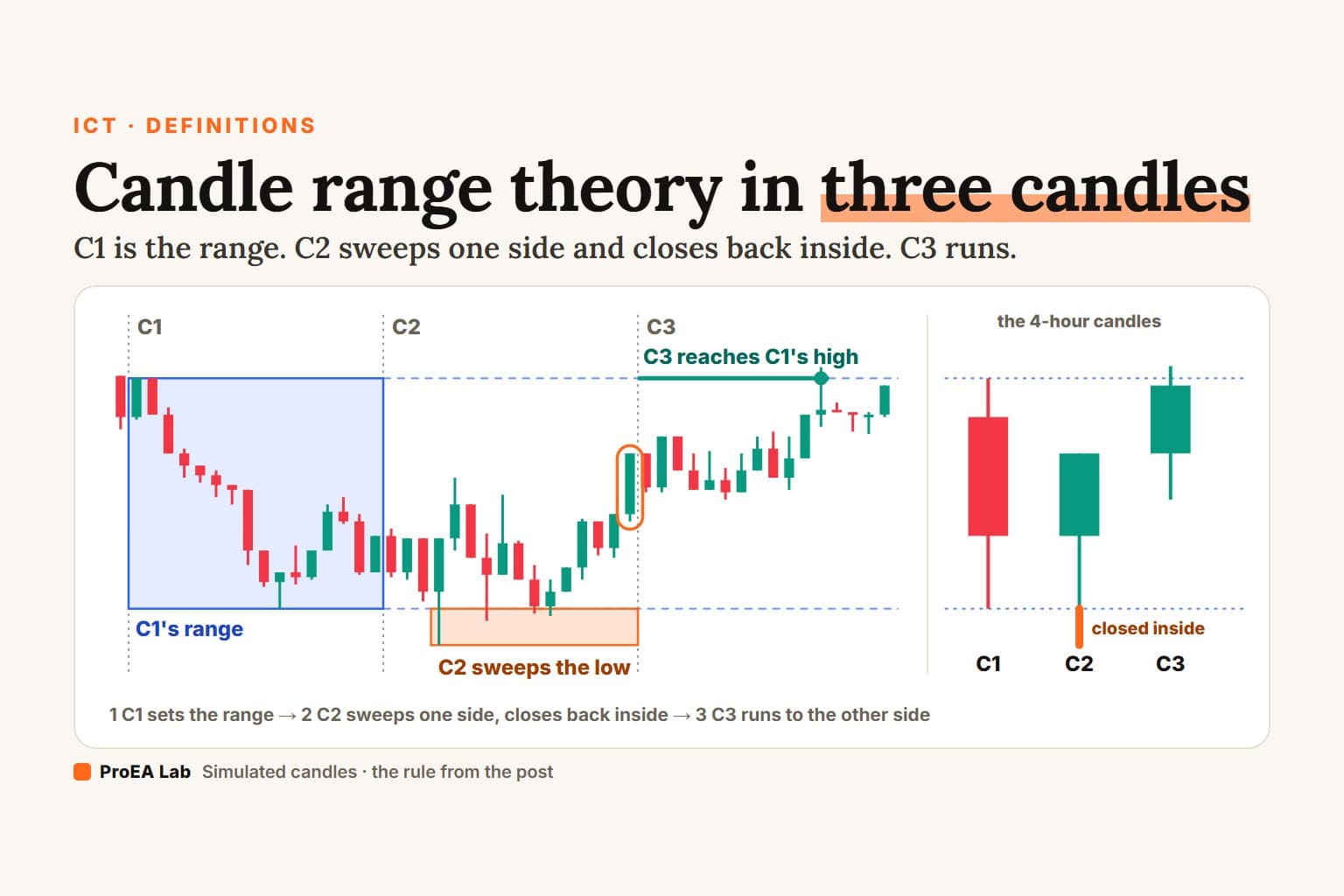
The same sweep-and-turn on three 4-hour candles is candle range theory (CRT): one candle's high and low are the range, the next sweeps one side and closes back inside.
Stretch the range to 20 sessions and you get the older fade, turtle soup, from Connors and Raschke's Street Smarts: a new 20-day low that breaks one at least four sessions old, bought back on a stop order the same day.
Judas swing vs liquidity sweep
Every Judas swing is a sweep; most sweeps aren't Judas swings. LuxAlgo: "Every Judas swing sweeps liquidity; not every sweep is a Judas swing." A liquidity sweep is a wick through any level and a close back. The Judas swing adds a clock (00:00 to 05:00), a level (the Asian range) and a second close (through the midnight open). TradingFinder files it under inducement: "A timed and specific subset of inducement".
The run can be read on two markets at once, too. When one takes its Asian low and a market that usually moves with it doesn't, at the same swing, that's an SMT divergence.
How to trade a Judas swing, step by step
- At 00:00 New York, mark the Asian high and low (20:00 to 00:00) and the 00:00 open. Don't move them later.
- Price runs beyond one side: do nothing yet.
- A close back inside within the hour is a sweep. Note the swing's extreme.
- A close beyond the swept side again ends the idea.
- A close through the 00:00 open, the other way, is the Judas swing. That's the earliest this rule names a direction.
- Pick your entry before midnight: a fair value gap, a CHoCH (BOS vs CHoCH), a close, or an optimal trade entry (OTE) on the pullback. Stop beyond the swing's extreme.
- Nothing by 05:00: no Judas swing tonight.
Common mistakes
- Fading the first candle out of the range. That's the moment a Judas swing and a breakout look the same.
- Calling it after 05:00. Any morning with a wick can be drawn as a Judas swing once it's over.
- Moving the range. The Asian range, the 00:00 to 02:00 range and yesterday's low give different answers.
- Typing the hours in UTC. They drift an hour against New York twice a year.
- Trusting the name. Guides call the same night bullish and bearish. Use the direction of the real move.
- A stop just past the wick. In our random prices, the swing's extreme was taken again by 08:00 on most Judas nights.
Does the Judas swing work?
Which tools draw the Judas swing?
None of ours labels a Judas swing; none of our Pine source contains the word. Three free ones draw its parts, and one runs the closest rule we've tested. We read the Pine source of each.
The Judas swing's parts on your own chart, free. Gold Sweep Desk boxes the Asia range (20:00 to 24:00 New York) and marks a raid through it that closes back inside, on the raid candle or within the next three, as SWEPT, in the London window (02:00 to 05:00) or the New York one, then waits for the flip: a close through the nearest opposing gap. It's built for gold and has no midnight open: an Asia high taken between 00:00 and 02:00 is used up before London opens. ICT Levels Desk draws the 00:00 open as a solid line and the Asia session box, 20:00 to 00:00 New York; when the session ends, its high and low stay as lines, and a candle that trades through one and closes back on that same candle gets a ⚡ swept mark. A swing that closes outside first, as in the second film, reads broken there. Opening Range Desk boxes any window you type: set 2000-0000 and it draws the Asian range, then marks a ✕ fake-out when a candle wicks out and closes back inside before any close beyond it. Its "trade the failure" switch, off by default, enters the other way after a close beyond the range is followed by a close back inside; move its trade window to 0000-0500 as well.
Sweep Desk doesn't track the Asian range or the midnight open, so it can't mark this rule's swing. Its session levels start with London's high and low. The SMC AI-Scored Toolkit (v1.4.2) doesn't draw a Judas swing either; it scores order blocks and fair value gaps.
More concepts, each with one rule and its own replays: smart money concepts.
Disclosure
We build Gold Sweep Desk, ICT Levels Desk, Opening Range Desk and Sweep Desk and give them away; we sell other indicators, including the SMC AI-Scored Toolkit. We have no relationship with innercircletrader.net, TradingFinder, LuxAlgo, ictkillzone.com or FXNX. Nothing here is financial advice.
Use these animations on your site.