Short answer: a gold liquidity sweep strategy watches three pairs of levels, yesterday's high and low, the Asia range (20:00 to 24:00 New York) and the London range (02:00 to 05:00), and waits for a candle to trade through one and close back inside. That sweep is step two of three: the plan comes only after a close through the nearest opposing fair value gap, the flip. Every clock here is New York's, the one gold's day runs on.
These are the rules of Gold Sweep Desk, our gold indicator for TradingView, at its defaults. Other traders draw the same idea with other levels and times; the steps below are one written version, so you can check every word against a chart.
The three pools
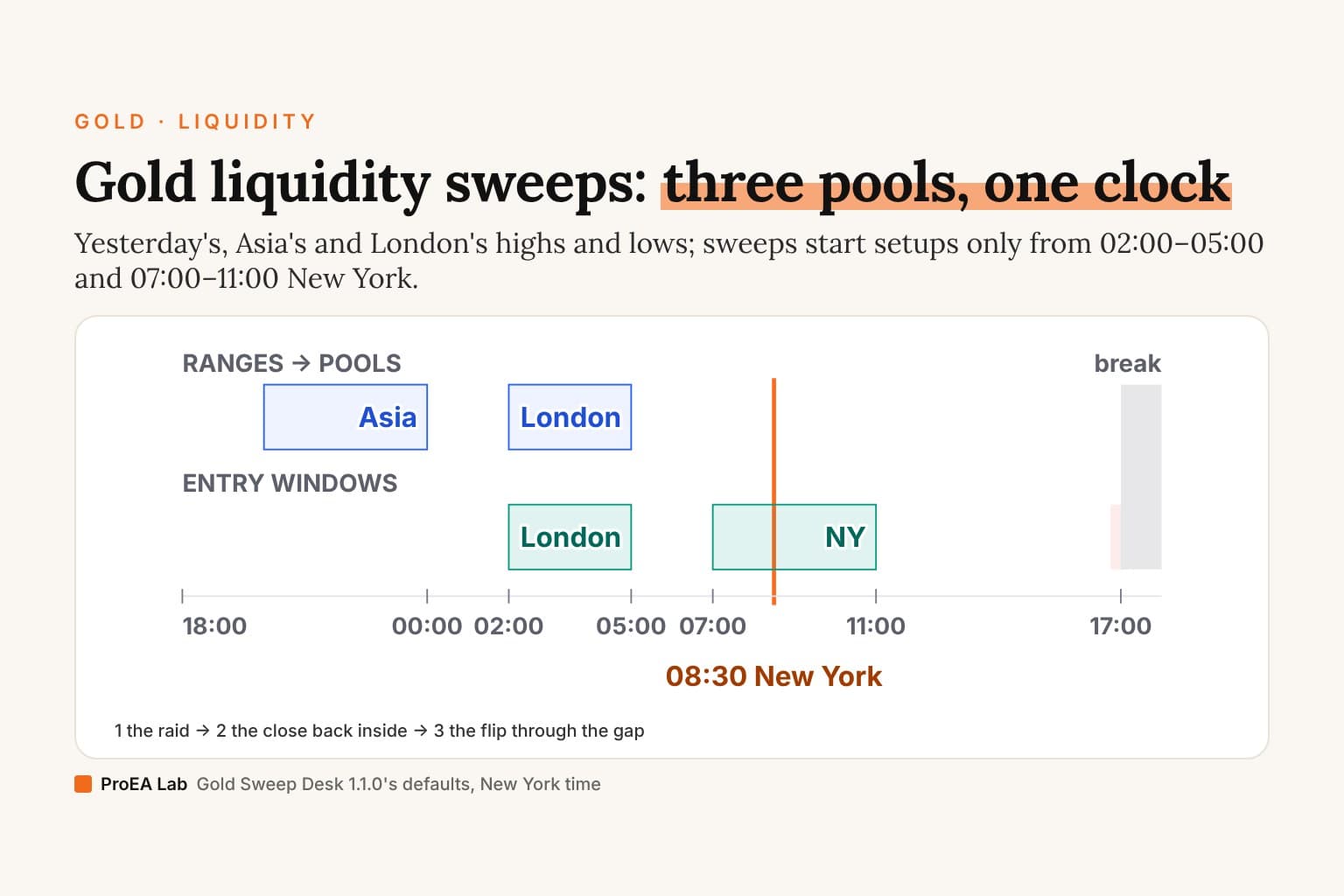
03:00 New York: the London window is open. A sweep now can start a setup.
Fresh pools a raid could take: Yesterday's high and low, Asia's high and low. London's range is still forming (02:00–05:00); its high and low become pools at 05:00.
Times are New York, by the candle's open. Ranges, windows and 16:45: Gold Sweep Desk 1.1.0's own defaults. Pools are shown fresh; on a real chart any candle that trades through one uses it up, inside a window or not.
Gold's trading day opens at 18:00 New York and closes at 17:00, with a daily break from 17:00 to 18:00. Three pairs of levels are where stops gather:
- Yesterday's high and low: the previous trading day's, a pool from the day's first candle.
- The Asia range: the high and low of the candles that open from 20:00 to 24:00, a pool from the first candle after midnight.
- The London range: the high and low from 02:00 to 05:00, a pool from the first candle after 05:00.
A pool stays fresh until any candle trades through it, in a window or not. A level that was raided at 01:00 is gone by the time London opens.
When a sweep can start a setup
The windows are London, 02:00 to 05:00, and New York, 07:00 to 11:00. A raid outside them still uses a pool up, but starts nothing.
The two windows don't see the same pools. During the London window London's own range is still being drawn, so a London sweep takes yesterday's or Asia's high or low. From 05:00 the London range is a pool too, so a New York sweep can take any of the three. Pick 03:00 and 08:30 on the clock above to see the difference.
These are two of the ICT killzones, the New York one longer. Nothing starts on or after 16:45, and an open plan closes at 16:45, before the daily break.
Raid, sweep, flip
- The raid. A candle in a window trades through a fresh pool by at least 0.05 ATR (14). A raid through two pools at once counts from the outermost one.
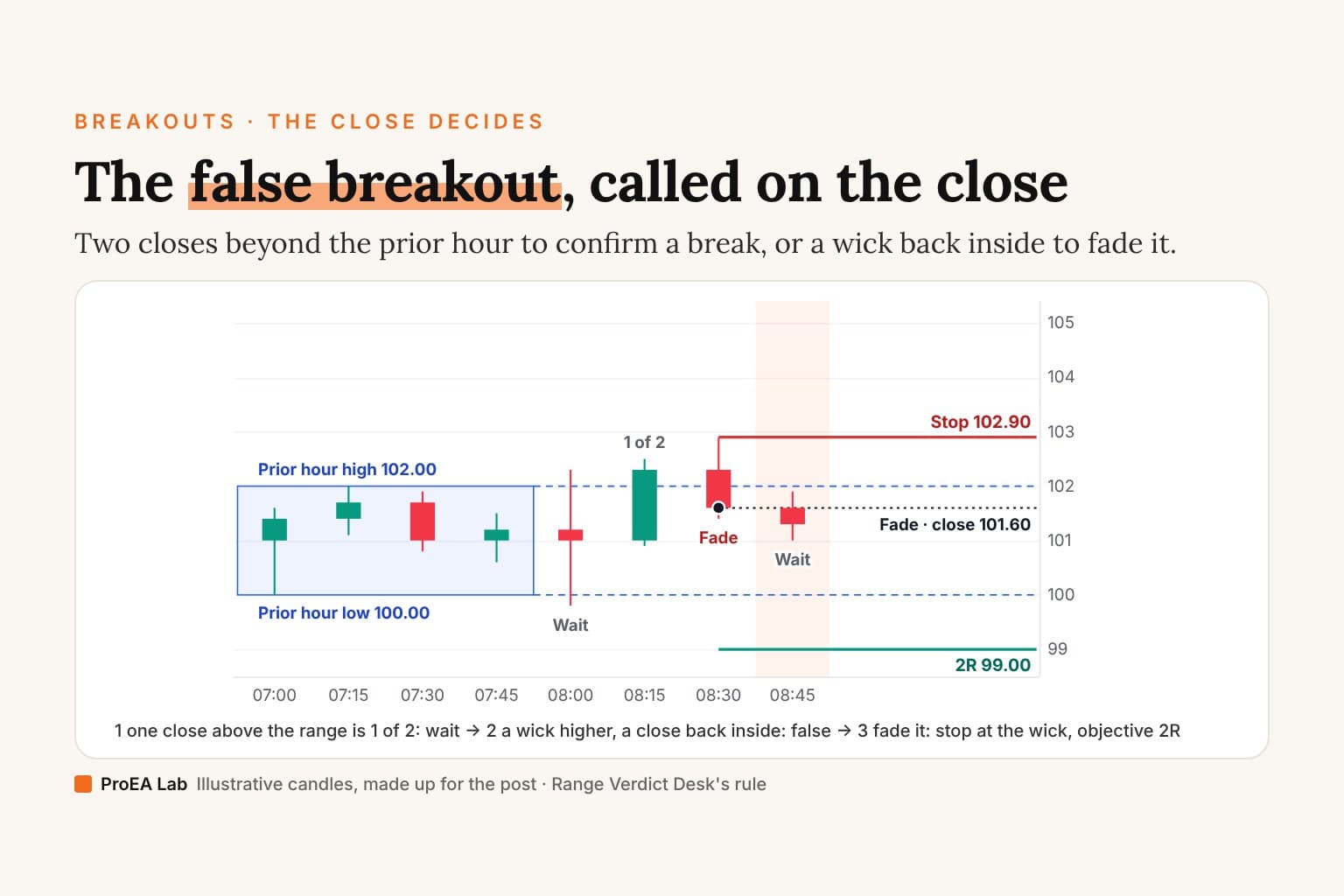
- The sweep. A close back inside the level, on the raid candle or within the next three. A raid that keeps closing beyond is held: price was accepted out there, and no plan follows.
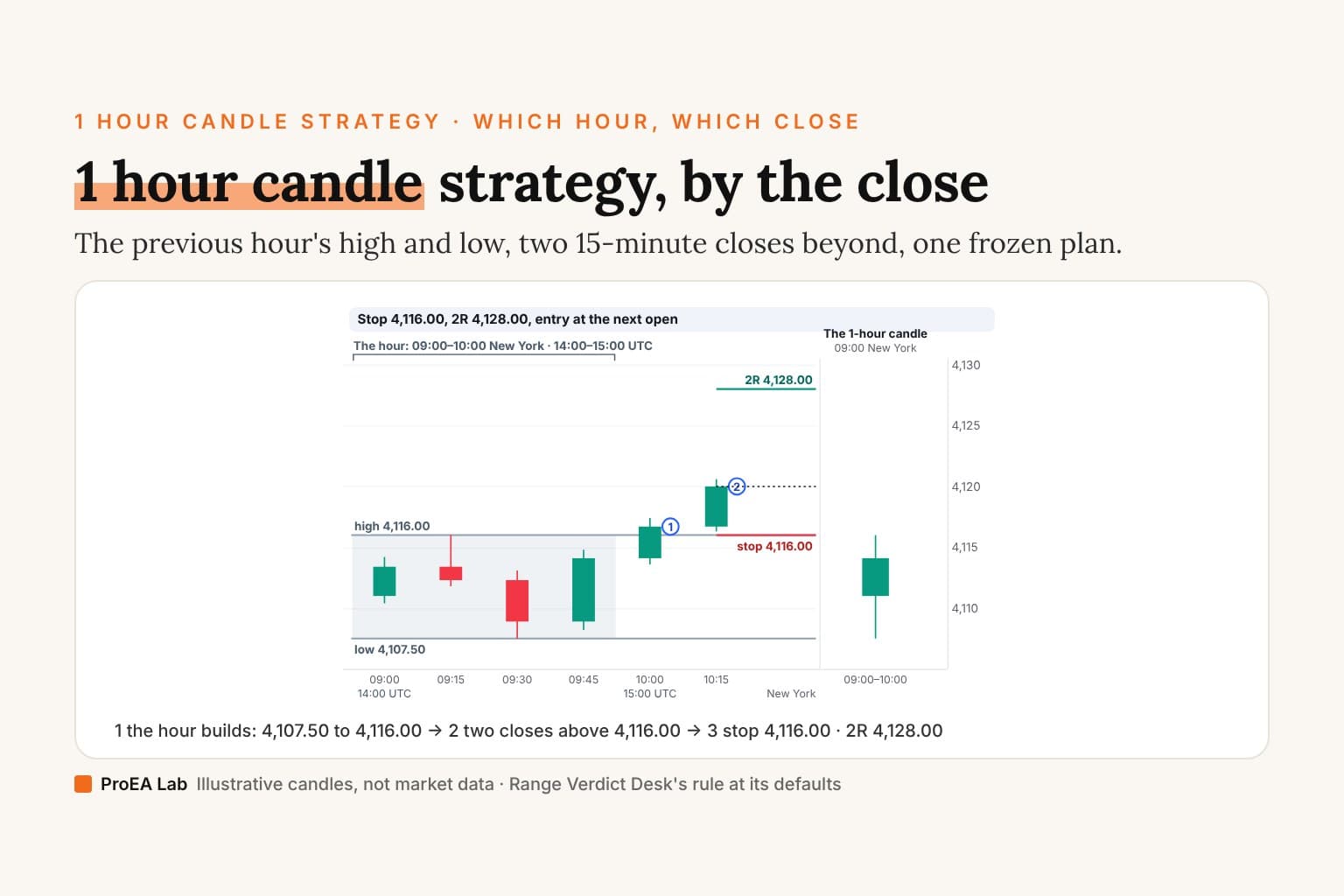
- The flip. A close through the nearest opposing fair value gap born in the 30 candles before the sweep, at least one ATR from the sweep's extreme, within twelve candles. After a sweep of a high, the gap is a bullish one below, and the flip is a close down through it.
While the desk waits for the flip, a close back beyond the swept level ends the setup; a new wick beyond it only moves the extreme, and the stop with it.
On a real chart, OANDA:XAUUSD 15-minute, the 63 trading days from 30 June 2026 (read 26 September 2026), the desk counted 72 raids, 54 sweeps, 13 flips and 12 plans. Most sweeps never flip. That's why a sweep alone isn't a signal.
The plan
- Entry: the flip's close. A variant waits for the first close back inside the gap.
- Stop: 0.1 ATR beyond the sweep's extreme, fixed when the plan is made. A stop wider than six ATR is skipped.
- Target: twice the risk, 2R. The 1R line on the way is drawn, and Pro can take half off there.
- Time: flat at 16:45 New York; if a candle touches both the stop and the target, the stop counts first.
- Costs: every R is after 0.40 an ounce for the round trip, spread and slippage. Set your own broker's.
The 2R target is a design choice, not a tested setting. To size the stop in lots, the XAUUSD lot size calculator turns a dollar risk and a stop distance into a position.
London session or New York session?
The London window raids the night: Asia's high or low, or yesterday's. A raid of Asia's range in London that closes back inside is most of ICT's Judas swing, which adds the midnight open; the desk doesn't use it. The New York window has London's range as well, and the most pools to take.
We didn't test London against New York. Study 2 below tried the two windows together against one continuous window, 01:00 to 11:00, and no candidate held up.
What we measured
We tested this rule twice on Binance's XAUUSDT perpetual, January to June 2026, with every candidate and the pass rule written down before the first result; July and August were held back for a final run that never came. 16 candidates in all, on 5- and 15-minute candles.
- Study 1: eight candidates, none with the 30 trades the plan required.
- Study 2: one candidate passed the first period (40 trades, profit factor 1.13) and then lost in its check period: 15 trades, −11.63R, profit factor 0.14.
No setting became a tested default, so the desk ships with design-choice defaults and says so. Every row, and the small recent record on TradingView, is in Gold Sweep Desk: what we measured.
Why New York time
Gold's day, its daily break and the session ranges are set on the New York clock. When New York moves to or from daylight saving, every window moves an hour against UTC, and against London for two or three weeks in March and one week around the start of November. A desk that reads New York time keeps the windows where the rule puts them, whatever your chart's time zone. The desk also skips the candles while spot gold is closed, so a spot chart and a 24-hour gold feed give the same setups.
What it takes by hand, every window
The rule fits on a page. Trading it means the same jobs before every London and New York window:
- The pools. Mark yesterday's high and low and the Asia and London ranges, every day.
- The window. Be at the screen before each window, with both sides worked out.
- The sweep. Watch each pool for a raid, a close back inside, then the gap that flips.
- The context. Measure the setup in ATR (the sweep, the flip, the stop) and note the pool, the window and yesterday's candle.
- Silver. Check whether silver made the same new high or low.
- The size. Risk ÷ the stop's distance, for every plan, before you click.
- Half at 1R. Close the share you planned at 1R and let the rest run to the target or the 16:45 flat.
- Other markets. Look for the same setup on the other charts that run on the same clock.
Gold Sweep Desk Pro does these on the chart and on your phone: the pools named, both sides' plan 15 minutes before each window, an alert at the sweep, seven context checks, SMT with silver, the size in the entry alert, an alert at 1R and a Radar on up to eight markets. You place the orders.
Tools for this strategy
Get it on your chart. Gold Sweep Desk draws the three pools and the windows, names every raid it refuses (held, no gap, sweep failed, no flip), and writes the plan in words, on closed candles. Its full Pine v6 source is in Pine Pro Library, with a strategy twin for the Strategy Tester. Gold Sweep Desk Pro adds the game plan for both sides before each window, seven context checks, SMT with silver, your own gates, half off at 1R and an eight-market Radar.
Comparing scripts first? We read the code of the most-boosted open-source ones in the best gold indicators for TradingView and the best liquidity sweep indicators. The one-page gold liquidity sweep checklist has the pools, the windows and the three steps.
We build and sell Gold Sweep Desk and Gold Sweep Desk Pro. Nothing here is financial advice, and no rule here is shown to make money.
Frequently asked questions
What is a liquidity sweep in gold?
A candle trades through a level where stops are likely to sit (yesterday's high or low, the Asia range's or the London range's) and closes back inside. Gold Sweep Desk counts it when the raid reaches at least 0.05 ATR beyond the level and the close back inside comes on the raid candle or within the next three; a raid that stays beyond for longer is held, not swept.
What are the best times to trade a gold liquidity sweep?
Gold Sweep Desk starts setups only in two windows, New York time: London, 02:00 to 05:00, and New York, 07:00 to 11:00. In the London window London's own range is still forming, so a sweep there takes yesterday's or Asia's high or low; from 05:00 London's high and low are pools too. Nothing starts on or after 16:45, and spot gold breaks 17:00 to 18:00.
What is the Asia range in gold trading?
The high and low of the candles that open from 20:00 to 24:00 New York. Gold Sweep Desk makes them pools from the first candle after midnight, ahead of London's open, and keeps each fresh until a candle trades through it.
Is a liquidity sweep a signal to trade?
Not on its own. In the desk's rule the close back inside is step two of three: a plan comes only after a close through the nearest opposing fair value gap, at least one ATR from the sweep's extreme, within twelve candles. On a real chart the desk counted 72 raids, 54 sweeps, 13 flips and 12 plans.
Does the gold liquidity sweep strategy work?
We couldn't show that it does. Two studies, written down before they ran, tried 16 candidates on 2026 gold data. The one candidate that passed the first period then lost 11.63R over 15 trades in its check period, so no setting became a tested default.
What timeframe is best for a gold liquidity sweep?
Gold Sweep Desk is built for 5- and 15-minute candles. On 30-minute and longer candles a plan has little room for its 2R target before 16:45; below 5 minutes TradingView loads too few days of candles for a record.
Why use New York time for gold?
Gold's trading day runs 18:00 to 17:00 New York, and the windows are set on that clock. New York's daylight saving shifts every window by an hour against UTC twice a year, so a desk that reads the New York clock keeps them in place whatever your chart's time zone.