Short answer: a false breakout is a move beyond a level that doesn't hold. Price trades above a high, or below a low, and the candle closes back inside the range, or the next one does. While the candle is open, nobody can tell a false breakout from a real one: only the close decides. Two written rules answer it, and both come from one TradingView indicator. To confirm a break, wait for two closes in a row beyond the same side. To trade the failure, take a wick through one side that closes back inside, the other way. Each freezes a plan with its stop at least 1 ATR away and a 2R objective. Below: both rules worked by hand, a film of each, and a drill where you call every close.
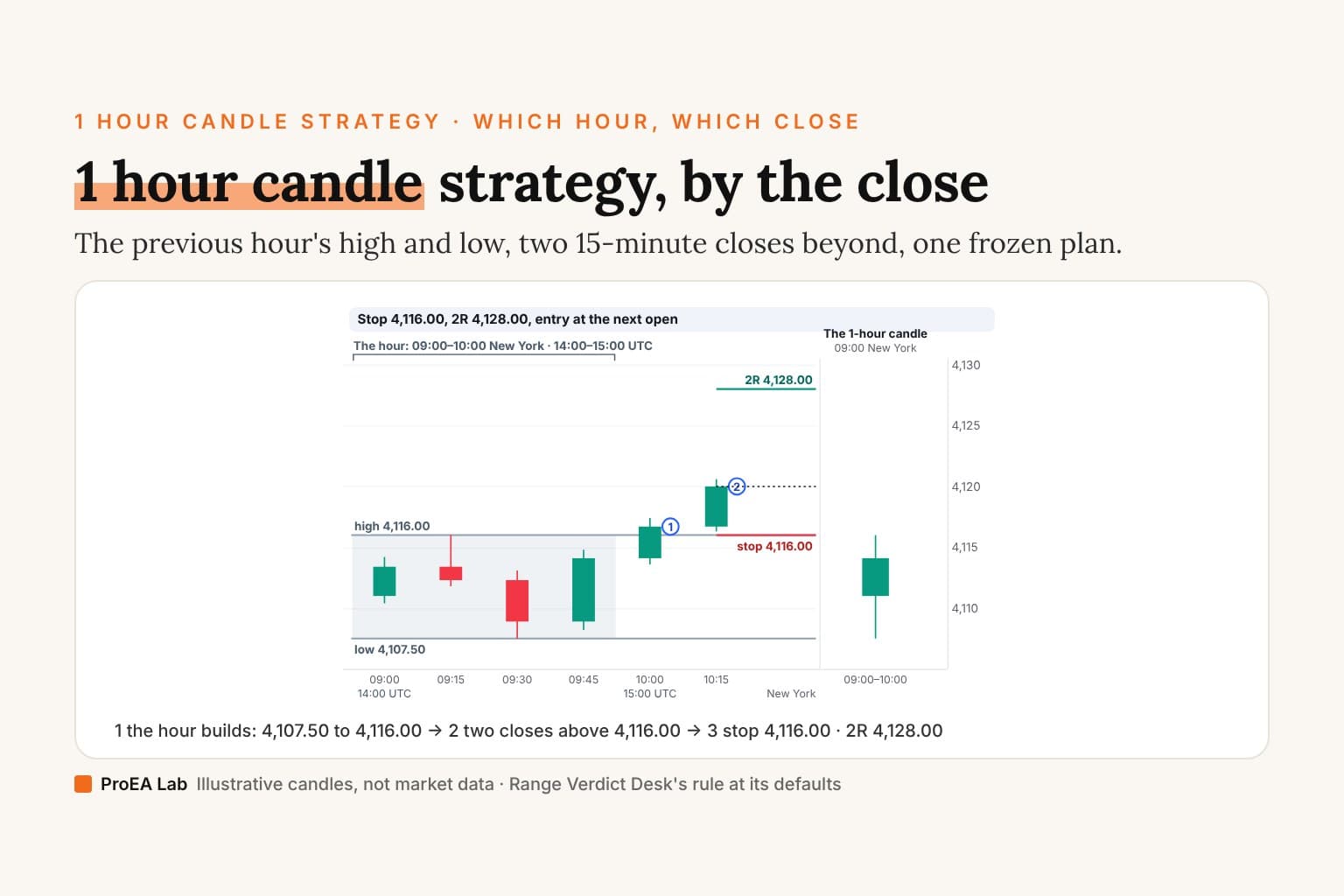
Every chart on this page uses the same illustrative prior hour: four 15-minute candles from 07:00 to 08:00 New York, high 102.00, low 100.00. The rule that reads them is Range Verdict Desk's, our TradingView indicator, run by our port of its own Pine code at its defaults. The candles are made up. The answers are the rule's, not typed in by hand.
What is a false breakout in trading?
A breakout is price moving beyond a level that held it: above the high of a range, or below its low. A false breakout, also called a fakeout or a failed breakout, is one that doesn't hold. It comes in two kinds:
- The wick kind. The candle trades through the level and closes back inside. On the close, nothing broke.
- The close kind. A candle closes beyond the level, and the next closes back inside. A rule that bought the first close bought a false breakout.
False breakouts aren't rare. The original Turtle rules, a system that bought breakouts, say so plainly: "Most breakouts do not result in trends. This means that most of the trades that the Turtles made resulted in losses."
Illustrative 15-minute candles, made up for this post: simulated, not market data and not a result. Times are New York. The rule is Range Verdict Desk's, from our port of its Pine 0.5.0-rc1, at its defaults: the prior complete UTC hour, two closes in a row beyond one side, a signal close between 08:00 and 12:00 New York, one attempt an hour, a stop at least 1 ATR away and a 2R objective. A reference plan, not an order.
Read as text
- Illustrative 15-minute candles, New York time. The prior hour, 07:00 to 08:00, trades between 100.00 and 102.00. That is the range each close of the next hour is read against.
- The 08:00 candle closes at 102.30, above 102.00. One close beyond is not two: the desk's panel says "Wait for Accept".
- The 08:15 candle closes at 102.60, above 102.00 again: two closes in a row. The panel says "Confirmed LONG plan".
- The plan freezes at that close. ATR(14) is 1.03 and the close is 0.60 past the high, so the risk is the larger, 1.03: the stop sits at 101.57 and the objective, two risks up, at 104.66.
- The reference entry is the next open, the 08:30 candle's, at 102.60. That candle and the next close above 102.00 too, but the hour's one attempt is spent: "One attempt used this frame".
How this window was chosen: Illustrative candles, made up for this post. The prior hour is the same in both cases; the next hour was drawn to show one break that holds for two closes and one wick out that closes back inside.
Use itMark the prior hour's high and low the moment the hour closes. Every close of the next hour is read against those two numbers.
Watch outWhile a candle is open it can be above the high. Only where it closes counts.
False breakout pattern: the candle that closes back inside
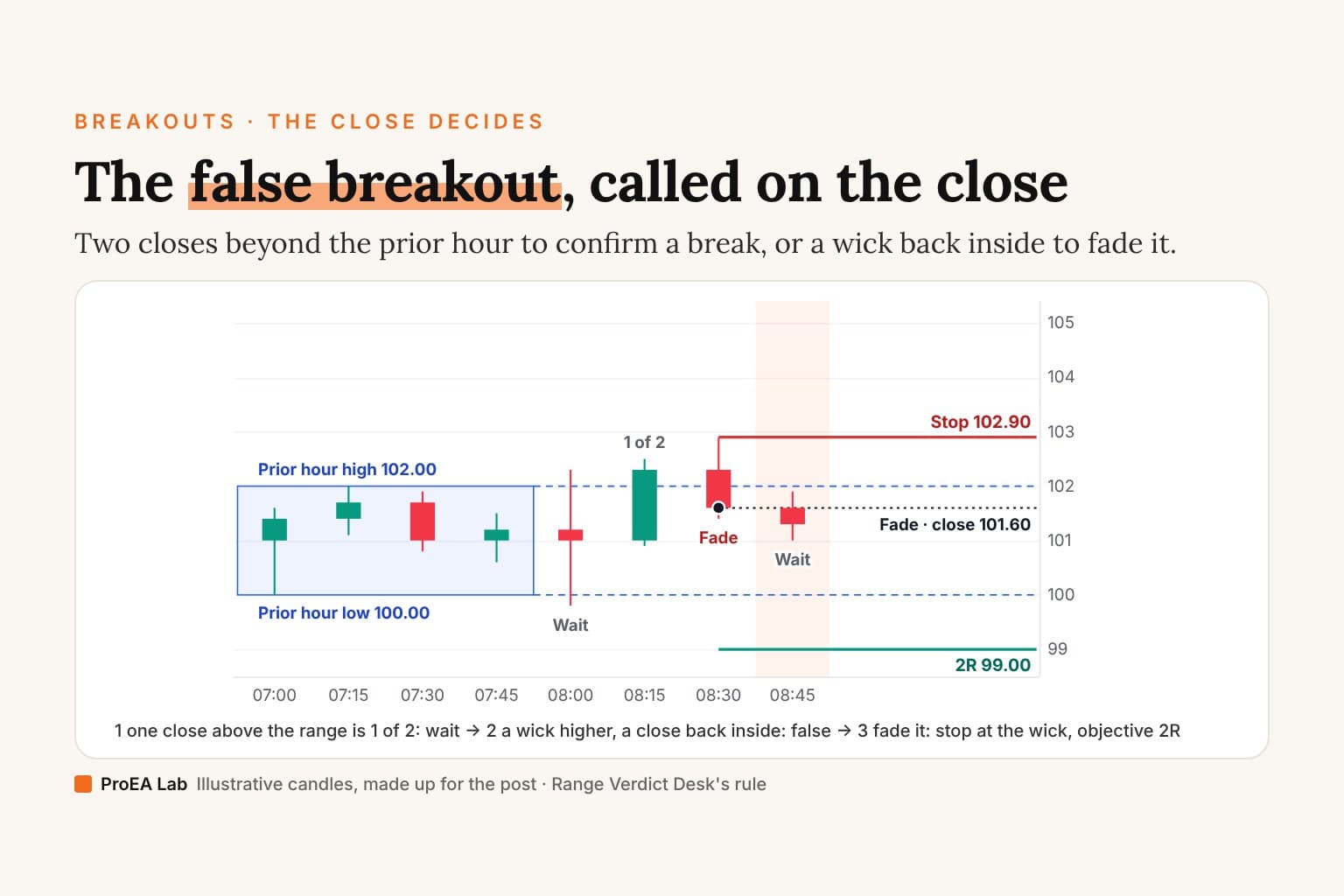
The false breakout candle is a long wick through the level and a close back inside it. In the film's second hour, the 08:00 candle opens at 101.20, trades up to 102.80, 0.80 above the prior hour's 102.00 high, and closes at 101.60. For part of its 15 minutes it was a breakout. At its close it is a false one.
Three details decide whether a candle counts:
- Strictly beyond. A close exactly on 102.00 is not above it. Range Verdict's rule asks for a close strictly beyond the high or low, and for the Fade signal a close strictly inside.
- One side only. A candle that trades above the high and below the low and closes inside swept both sides. Which side was false? The rule can't tell, so it fades neither. The desk's page puts its Fade signal in one line: "A wick through one side and a close strictly inside; through both sides is no signal." The drill's Morning 1 opens with one.
- The two-candle version. A close above, then a close back inside, is the close kind. The first candle looked like a confirmed break; the second undid it. The drill's Morning 1 has one of these too.
Turtle soup is this pattern on a 20-day low or high, traded with a stop order before the day closes (turtle soup, animated). Candle range theory (CRT) reads it on one 4-hour candle: the next 4-hour candle sweeps one side of its range and closes back inside, and only that 4-hour close counts.
How to confirm a breakout: candle close confirmation
Wait for the close. A level broken during a candle can be unbroken by the time it closes, as the 08:00 candle above was. TradingView's Pine Script manual gives scripts a flag for exactly this: "barstate.isconfirmed is true on all historical bars and on the last (closing) update of a realtime bar." And it says what the flag is for: "It can be useful to avoid repainting by requiring the realtime bar to be closed before a condition can become true." Range Verdict Desk makes every decision inside that check, on closed 15-minute candles.
Candle close confirmation has a price, and it's worth naming:
- What it ignores. Every wick that closes back inside. The wick kind of false breakout never reaches a close rule.
- What it pays. A later entry on the breaks that hold. In the film's first hour, the first close above 102.00 was 102.30; the second, where the plan froze, was 102.60, 0.30 higher.
- What it can't stop. The close kind. A close beyond, then a close back inside, fools a one-close rule. Asking for a second close is the answer to that, and it costs another candle.
The Turtle rules made the opposite choice: "Turtles always traded at the breakout when it was exceeded during the day, and did not wait until the daily close or the open of the following day." That buys the break at its first price and takes every wick with it. Our breakout trading strategy post sets three breakout rules side by side, shows where each one's false breaks come from, and answers "What is a false breakout?" in its FAQ.
Breakout confirmation strategy: two closes beyond
Range Verdict Desk's default mechanism, Accept, is a breakout confirmation strategy written down:
Accept (Range Verdict Desk's default)
1. The range: the high and low of the previous complete
   UTC hour, four 15-minute candles.
2. The count: closes strictly above the high (or below
   the low) in a row, inside the current hour. A close
   back inside, or a new hour, starts it again.
3. The signal: the second close in a row beyond one side.
4. The window: a signal close at or after 08:00 New York
   and before 12:00. One attempt an hour.
5. The plan, frozen at that close: risk = the larger of
   1 ATR(14) and the close's distance past the high
   (or the low); stop one risk behind, objective two
   risks ahead (2R); reference entry at the next open.
ATR(14) is Wilder's average true range over 14 candles. StockCharts defines the true range as "the greatest of the following: Method 1. Current High less the current Low Method 2. Current High less the previous Close (absolute value) Method 3. Current Low less the previous Close (absolute value)".
Worked by hand: the hour that holds
The film's first hour, after the same prior hour:
| Candle (New York) | Open | High | Low | Close | Closes above 102.00 | The panel says |
|---|---|---|---|---|---|---|
| 08:00 | 101.20 | 102.50 | 101.10 | 102.30 | 1 of 2 | Wait for Accept |
| 08:15 | 102.30 | 102.80 | 102.10 | 102.60 | 2 of 2 | Confirmed LONG plan |
| 08:30 | 102.60 | 103.10 | 102.30 | 102.90 | 3 | One attempt used this frame |
| 08:45 | 102.90 | 103.40 | 102.70 | 103.20 | 4 | One attempt used this frame |
- The range. The prior hour's high is 102.00, the 07:15 candle's; its low is 100.00, the 07:00 candle's.
- One close. The 08:00 candle closes at 102.30, above 102.00. One close is not two: "Wait for Accept".
- Two closes. The 08:15 candle closes at 102.60, above 102.00 again: "Confirmed LONG plan".
- The risk. ATR(14) at that close is 1.03. The close is 102.60 − 102.00 = 0.60 past the high. The larger of the two is 1.03, so 1R = 1.03. The panel's Risk / objective cell reads "1.03 / 2R".
- The stop and the objective. Stop 102.60 − 1.03 = 101.57. Objective 102.60 + 2 × 1.03 = 104.66.
- The entry. The next open, the 08:30 candle's, 102.60. The panel's plan cell goes from "Pending next open" to "Active / frozen".
- The rest of the hour. Two more closes above 102.00, and no second plan: the hour's one attempt is spent.
The 1 ATR floor did the work here. A stop on the prior hour's high would be 0.60 away, less than one average candle's true range; the rule puts it 1.03 away, 1 ATR, instead.
Failed breakout strategy: fade the close back inside
The desk's other setting, Fade, trades the false breakout itself:
Fade (Range Verdict Desk's other setting)
1. The range: as above.
2. The signal: a candle trades beyond ONE side of the
   range and closes strictly back inside it. Beyond
   both sides: no signal.
3. The window and one attempt an hour: as above.
4. The plan, frozen at that close: risk = the larger of
   1 ATR(14) and the distance from the close to the
   candle's wick; stop one risk behind, objective 2R;
   reference entry at the next open.
A failed break of the high is a short; a failed break of the low is a long. Because the risk is measured to the wick, the stop is never inside it.
Worked by hand: the hour that wicks back inside
- The candle. The 08:00 candle opens at 101.20, trades up to 102.80, above 102.00, and closes at 101.60, inside. Its low, 101.00, stays above 100.00: one side only.
- The readings. With Fade, the panel says "Confirmed SHORT plan". At the default, Accept, it says "Wait for Accept": nothing closed above 102.00.
- The risk. ATR(14) is 1.08. The distance from the close to the wick is 102.80 − 101.60 = 1.20. The larger is 1.20, so 1R = 1.20.
- The stop and the objective. Stop 101.60 + 1.20 = 102.80, the wick itself. Objective 101.60 − 2 × 1.20 = 99.20.
- The entry. The next open, the 08:15 candle's, 101.60.
Here the distance to the wick was larger than 1 ATR, so the stop sat on the wick. When the wick is short, the 1 ATR floor moves the stop beyond it.
Call the close: a drill
Same prior hour, two different next hours. Step through each hour's four candles and call every close: Accept, Fade or Wait. The desk's own rule answers, in its panel's words. The last row sets how many closes count as acceptance; 2 is the desk's.
The 08:00 candle closes at 101.00 (high 102.30, low 99.80). Accept, Fade or Wait?
The prior hour's range is 100.00 to 102.00. Accept: the break held, two closes in a row beyond one side. Fade: a wick out and a close back inside. Wait: neither yet. Make your call; the rule answers.
Illustrative candles, made up for this post: not a market and not a result. The answers come from Range Verdict Desk's own rule (our TypeScript port of its Pine 0.5.0-rc1), run at its defaults (Accept) and with its Fade setting on these candles: the prior complete UTC hour, a signal close between 08:00 and 12:00 New York, one attempt an hour. The plan is a reference plan, not an order.
Use itCall the close before you look at the answer. Then check what the Fade setting says too: Accept and Fade never fire on the same close.
Watch outA wick back into the range doesn't reset the count. Only a close back inside does.
The answers, close by close
Morning 1, where every break fails:
| Candle (New York) | Open | High | Low | Close | The rule | Why |
|---|---|---|---|---|---|---|
| 08:00 | 101.20 | 102.30 | 99.80 | 101.00 | Wait | A wick through both sides and a close inside: no signal |
| 08:15 | 101.00 | 102.50 | 100.90 | 102.30 | Wait | One close above 102.00: 1 of 2 |
| 08:30 | 102.30 | 102.90 | 101.40 | 101.60 | Fade | A wick above 102.00 and a close back inside; Accept's count starts again |
| 08:45 | 101.60 | 101.90 | 101.00 | 101.30 | Wait | A close inside; with Fade, "One attempt used this frame" |
At the 08:30 candle's close, ATR(14) is 1.19 and the wick is 102.90 − 101.60 = 1.30 away, so 1R = 1.30: stop 102.90, objective 101.60 − 2 × 1.30 = 99.00, entry at the 08:45 open, 101.60. At the default, Accept, the hour makes no plan: the second close above 102.00 never came.
Morning 2, where the break holds:
| Candle (New York) | Open | High | Low | Close | The rule | Why |
|---|---|---|---|---|---|---|
| 08:00 | 101.20 | 102.40 | 101.00 | 102.20 | Wait | One close above 102.00: 1 of 2 |
| 08:15 | 102.20 | 102.60 | 101.90 | 102.40 | Accept | Two closes in a row above 102.00; the wick to 101.90 doesn't count |
| 08:30 | 102.40 | 103.00 | 102.20 | 102.80 | Wait | "One attempt used this frame" |
| 08:45 | 102.80 | 103.10 | 102.50 | 102.70 | Wait | "One attempt used this frame" |
At the 08:15 candle's close, ATR(14) is 1.03 and the close is 102.40 − 102.00 = 0.40 past the high, so 1R = 1.03, the floor: stop 102.40 − 1.03 = 101.37, objective 102.40 + 2 × 1.03 = 104.46, entry at the 08:30 open, 102.40.
What is acceptance in trading?
On this page, acceptance means one thing: Range Verdict Desk's Accept rule. Price is accepted beyond the prior hour's range when two closes in a row sit strictly beyond the same side, inside the current hour. One close is a break, not acceptance yet. A close back inside ends it, and so does the end of the hour. That's also what this page means by price acceptance; it gives no wider meaning of the word.
Two is the desk's setting, not a law of the market. The drill's last row reads the same candles with 1 or 3 closes, on the engine's own counts:
| Closes needed | Morning 1 | Morning 2 |
|---|---|---|
| 1 | Accepts the 08:15 candle's close, 102.30; the next candle closes back inside, at 101.60 | Accepts the 08:00 candle's close, 102.20 |
| 2, the desk's | Never: the second close doesn't come | Accepts the 08:15 candle's close, 102.40 |
| 3 | Never | Accepts the 08:30 candle's close, 102.80 |
Fewer closes accept more false breakouts: one close bought Morning 1's break, which was back inside the range at the very next close. More closes pay more to get in: three closes accepted Morning 2 at 102.80, 0.40 higher than two. And because the count starts again every hour, a 3-close rule can only fire on an hour's third or fourth close. Only the desk's count of 2 freezes a plan in the drill.
How to avoid false breakouts
You can't avoid all of them. You can choose which ones your rule ignores, and know what each choice costs:
- Decide on the close. The wick kind never reaches a close rule. It costs a later price on the breaks that hold.
- Ask for two closes in a row. The close kind that turns back after one close never makes a plan. It costs another candle: 0.30 in the film's first hour.
- Ignore a candle that wicks through both sides. It swept both, so it says nothing about either.
- Take one attempt an hour. Range Verdict spends the hour's attempt on its first signal: "The hour's first signal spends it, even when a held plan refuses it." A level that keeps breaking and failing gets one plan, not four.
- Put the stop at least 1 ATR away. A stop on the level is reached by any wick back inside. The plan's risk is the larger of 1 ATR and the distance to the level or the wick.
- Know which hour. "The previous hour" means different candles on different charts. TradingView's intraday candles start at the session's open; its Help Center: "On a 45-minute chart of META, candles start at 9:30, 10:15, 11:00, and so on." Range Verdict reads the previous complete UTC hour, a clock hour. On a market whose session opens on the hour the two match; on a stock that opens at 9:30 they don't.
None of this makes a false breakout impossible. A break that closes beyond the range twice can still turn back afterwards; that is what the stop is for.
Both rules, the frozen plan and the four New York windows fit on one page: the false breakout cheat sheet (PDF).
Range Verdict Desk: both rules on TradingView
Range Verdict Desk is the indicator both rules come from. In its page's words: "It reads every 15-minute close against the last UTC hour's range and, on two closes beyond it in the New York morning, freezes one plan: a stop of at least 1 ATR and a 2R objective." Fade is one setting away. It is sold in Pine Pro Library, $49 once for every desk and every update, with its full Pine v6 source.
Its limits, as its code sets them:
- The prior complete UTC hour only. No other level: not the day's high, not a 4-hour candle, not a swing.
- One attempt an hour, inside one New York window: a signal close in one of four fixed windows, 08:00 to 12:00 by default. New York time follows daylight saving.
- Standard 15-minute candles only. "It stops on any other timeframe: its reference is the UTC hour."
- A frozen plan. A stop at least 1 ATR away and a 2R objective, a reference entry at the next open, out by the window's end. It places no orders, and the plan is not a fill.
- Alerts need a paid TradingView plan. Its code has two alert conditions, "Confirmed long reference plan" and "Confirmed short reference plan". TradingView's pricing page (read 29 October 2026) gives the row "Active technical alerts on indicators, strategies, and drawings" as ✗ on Basic, 20 on Essential, 100 on Plus, 400 on Premium and 1,000 on Ultimate, so its alerts need Essential or above.
Range Verdict Pro runs the desk's engine unchanged, so on the same chart and settings it confirms the same plans, Accept or Fade. What it adds sits around them: the game plan on your chart before and during the New York window, each plan with its size for your risk, plain-English alerts (Essential or above, as above), a Radar that reads the same rule on eight markets on one board, and a strategy in which a confirmed plan submits a qty 1 simulated entry in TradingView's Strategy Tester. It places no orders either. It is $49 once, or in the Complete Suite.
Library desk · plan alerts
Prior UTC range visible. Last close: Outside NY 08:00-12:00.
Range Verdict Pro · indicator · Radar · strategy
Both candidate levels drawn and explained, with a configurable heads-up alert.
Starts at 1.03, the risk of the plan the film froze above (1R = 1.03). A wider stop means a smaller size for the same risk.
07:45 New York: the same plan, more on Pro's screen
Range Verdict Pro at your risk: ≈ 97.1 units · nominal 100 USD risk at signal close.
What each one shows, in the Pro page's own words (its "Library desk or Pro" comparison of one simulated morning). The same simulated morning on both screens. The plan is the same on both sides. The size line is Pro's own formula, risk ÷ (stop distance × point value), with an example point value of 1 USD. Uses symbol point value. Check broker contract and lot rules. No currency conversion; gaps and costs can change actual risk. Alerts on TradingView need a paid plan: its pricing page (read 29 October 2026) shows no technical alerts on indicators on Basic and 20 or more from Essential up.
Does it make money? Its own page answers: "We make no promise of results. The script draws a plan on closed candles; whether to take it, and the risk, stay with you." The same shape on one higher-timeframe candle is CRT, and the open-source indicators that draw it are code-read in the best CRT indicators for TradingView.
Sources
- TradingView, Pine Script manual, Bar states, read 30 October 2026.
- TradingView Help Center, Time intervals, read 30 October 2026.
- StockCharts ChartSchool, Average True Range (ATR), read 30 October 2026.
- The Original Turtle Trading Rules (PDF), on the Original Turtles site, read 29 October 2026.
- TradingView's pricing page, the alert rows, read 29 October 2026.
- The rule: Range Verdict Desk 0.5.0-rc1's Pine source and its page in Pine Pro Library. The drill and the film run our TypeScript port of that Pine on this post's illustrative candles (
src/components/blog/false-breakout/false-breakout.ts).
Disclosure
We, ProEA Lab, build Range Verdict Desk and Range Verdict Pro, and sell them: the desk in Pine Pro Library, Pro on its own page. The code is AI-assisted. The candles on this page are made up to show the rule: they are not a market and not a result. The answers are the desk's rule run on them by our port of its Pine code. A reference plan is not an order or a fill, and the R figures are distances, not outcomes. Trading involves risk.
Use this animation on your site.
Frequently asked questions
What is a false breakout in trading?
A move beyond a level that doesn't hold. Price trades above a high or below a low, then the candle closes back inside the range, or the next candle does. While the candle is still open you can't tell a false breakout from a real one: only the close decides.
How do you avoid false breakouts?
You can't avoid all of them; you can choose which ones your rule ignores. Decide on closed candles, not during the candle. Ask for two closes in a row beyond the same side. Ignore a candle that wicks through both sides of the range. Put the stop at least 1 ATR from the close, not on the level, and take one attempt an hour. Each of these skips some false breakouts and pays for it with a later entry on the real ones.
What is a failed breakout strategy?
Trading the failure the other way. In Range Verdict Desk's Fade setting, a candle trades beyond one side of the prior hour's range and closes back inside it. A failed break of the high is a short, a failed break of the low a long, with the stop at least 1 ATR away and never inside the wick, and the objective at 2R. A candle that wicks through both sides is no signal.
What does a false breakout candle look like?
A long wick through the level and a close back inside it: the candle traded beyond the high or low and couldn't stay there until it closed. In this post's example, a 15-minute candle trades up to 102.80, above a 102.00 high, and closes at 101.60.
How do you confirm a breakout?
On the close, and more than once. A candle that trades beyond a level and closes back inside hasn't broken it. Range Verdict Desk's default asks for two closes in a row strictly beyond the same side of the previous hour's range, inside the same hour; a close back inside starts the count again.
What is candle close confirmation?
Acting on a level only once a candle has closed beyond it, not when price first trades through it. On TradingView a script does it with barstate.isconfirmed, which the Pine manual says is true on the last, closing update of a realtime bar. It ignores wicks and pays a later price on the breaks that hold.
What is price acceptance in trading?
On this page, price is accepted beyond a level when two closes in a row sit strictly beyond the same side of the previous hour's range, inside the current hour: Range Verdict Desk's Accept rule. One close is a break, not acceptance. A close back inside ends it. This page gives no wider meaning of the word.
Is one close enough to confirm a breakout?
It's a setting, not a fact about the market. One close takes more false breakouts; three closes pay more to get in. In this post's drill, a one-close rule accepted a break that was back inside the range at the very next close, and a three-close rule accepted 0.40 higher than two.