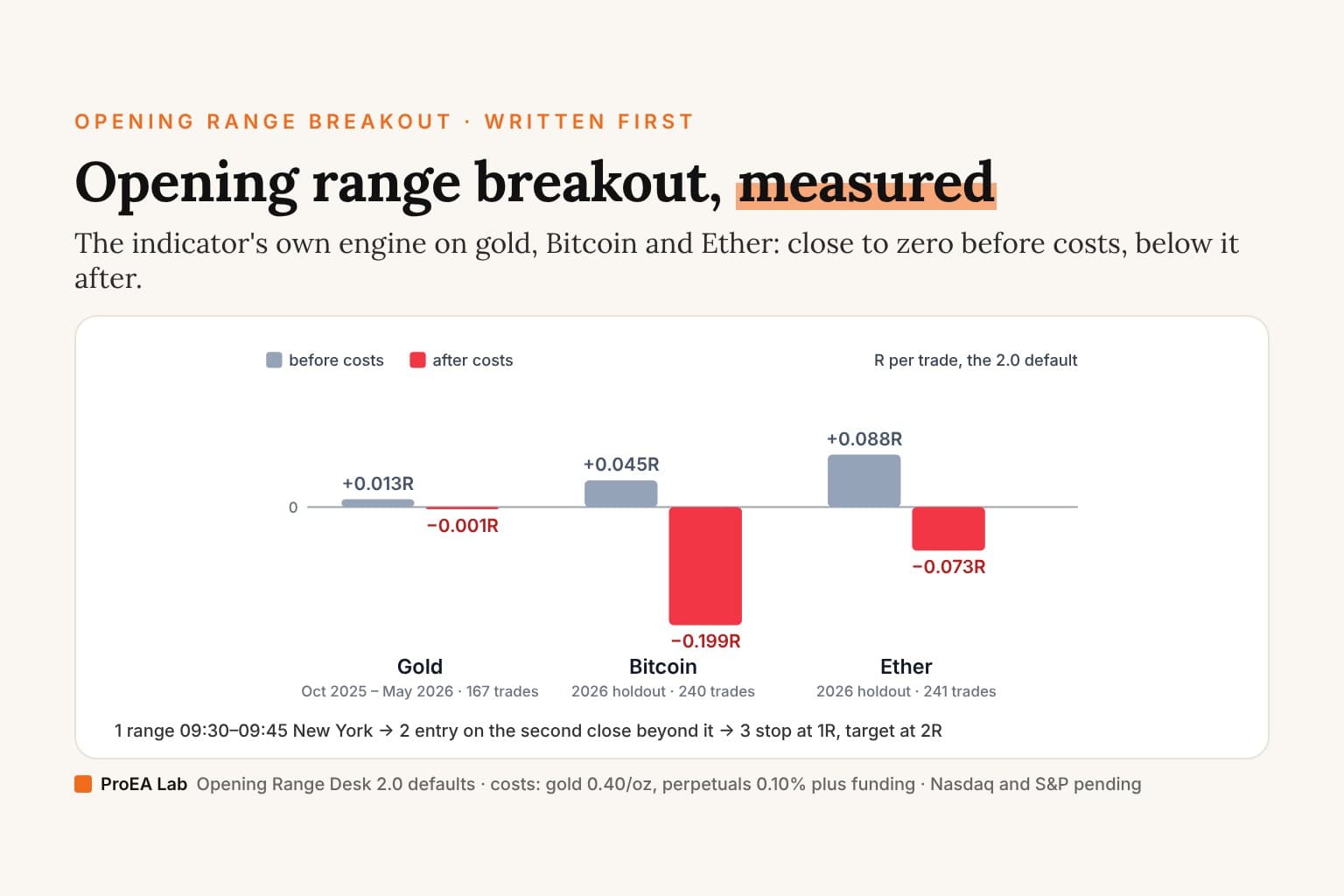
We measured the opening range breakout the written-first way, with the indicator's own engine.
After costs, nothing we ran passed the plan's rule, and the default lost money on every market.On gold, the default rule took 167 trades in eight months and ended at −0.24R after costs.
On Bitcoin and Ether it lost in every period from 2021 to August 2026.
Waiting for a second breakout close lost less than taking the first, everywhere.
The Nasdaq 100 and the S&P 500 are not in this article yet: the data feed blocked our download, and that run is still to come.
This article is where the numbers live. The desk page carries none of them, and the Pro page makes no performance claim.
The rule
Opening Range Desk 2.0's defaults, unchanged:
- The range: the high and low of the 09:30–09:45 New York candles. It is final on the first candle after 09:45.
- The entry: two consecutive closes beyond the range's high (long) or low (short). A close back inside resets the count.
- The stop: the other side of the range, plus 0.1 × ATR(14).
- The targets: TP1 at 1R moves the stop to the entry; TP2 at 2R ends the trade.
- The day: one trade, entries from 09:45 to 15:55, and anything still open is closed at the end of the window: on the first candle that closes at or after 15:55 (on 15-minute candles, the 15:45 candle, which closes at 16:00).
- The order inside a candle: stop first, then TP2.
The written contract is in the release (docs/engine-contract.md), beside the measurement plan the owner registered on 25 September (docs/measurement-plan.md).
Run it yourself. Opening Range Desk ships with its full Pine v6 source in Pine Pro Library, and its Strategy Lab is the second file in the same download. See Opening Range Desk in Pine Pro Library →
How we measured
- The engine: the release's reference engine,
tests/reference/engine.mjs, unmodified, read from the release zip and checked against its SHA-256 at every run. The release's native check found it identical to the Pine indicator in every field: 60 of 60 trades on SPY 5-minute and 59 of 59 on OANDA:XAUUSD 15-minute. - Written first: the plan, with the frozen hashes, the variants, the costs and the decision rule, was committed before the first result, and so was its first amendment. Every result below comes from the run after those commits. A second amendment, written after the run, corrects how the runner applied the decision rule and records a funding rule we had changed from the release plan's without saying so. It changes no verdict.
- Gold: Dukascopy bid 5-minute candles built into 15-minute candles, 1 October 2025 to 29 May 2026, the period before the data the owner had already looked at. Cost: 0.40 an ounce per round trip.
- Bitcoin and Ether: Binance's USD-M perpetuals, 5-minute candles from its public archives, every file matching its published checksum, January 2021 to August 2026, with the 09:30 New York range as the anchor. Cost: 0.05% taker a side, plus the funding paid or received while the trade was open. These were the owner's own plan: development 2021–24, validation 2025, and a holdout, January to August 2026, read once. Only the holdout gets a verdict; the other two periods are descriptive.
- Three variants judged: the classic single close (the baseline), the 2.0 default (two closes) and the default with an ATR trail after TP1.
- The decision rule, set in advance: promising only with at least 60 trades, a total above zero after costs, the 5th percentile of a day-by-day bootstrap above zero, and the default at or above the baseline. At least 60 trades and a total at or below zero is a rejection; anything else is inconclusive.
Gold: about zero
Opening Range Desk on Dukascopy XAUUSD, 15-minute candles, 1 October 2025 to 29 May 2026, 170 days with a range:
| Variant | Trades | Won | Before costs | After costs | At 2× costs | Bootstrap 5th pct | Verdict |
|---|---|---|---|---|---|---|---|
| One close (baseline) | 169 | 39.1% | −3.26R | −6.14R | −9.03R | −26.21R | Rejected |
| Two closes (2.0 default) | 167 | 40.1% | +2.22R | −0.24R | −2.70R | −18.99R | Rejected |
| Two closes + ATR trail | 167 | 46.1% | +5.35R | +2.89R | +0.44R | −15.96R | Inconclusive |
The default won 67 of its 167 trades and still ended below zero.
That is because most of its trades ended at neither the stop nor TP2. 97 of the 167 were closed at the end of the window (two of them on holiday early closes, below), 39 hit the stop, 15 came back to the entry after TP1, and 16 reached TP2.
The cost was small on gold, 0.015R a trade, because its median stop was 30.21 an ounce from the entry.
Its deepest fall was −9.93R, and its longest losing run six trades.
The trail turned the default's −0.24R into +2.89R. But a bootstrap of its days put the 5th percentile at −15.96R: 167 trades can't tell that apart from luck.
Shorts did better than longs, +5.65R after costs on 73 shorts against −5.90R on 94 longs. We didn't test that split in advance, so it is a description, not a finding.
Bitcoin and Ether (crypto): below zero in every period
The default (two closes), the owner's three periods:
| Market | Period | Trades | Won | Before costs | After costs | Cost a trade | Verdict |
|---|---|---|---|---|---|---|---|
| Bitcoin | 2021–24 | 1,444 | 30.1% | +47.51R | −219.99R | 0.185R | Descriptive |
| Bitcoin | 2025 | 363 | 32.2% | −1.42R | −73.86R | 0.200R | Descriptive |
| Bitcoin | Jan–Aug 2026 (holdout) | 240 | 32.9% | +10.81R | −47.82R | 0.244R | Rejected |
| Ether | 2021–24 | 1,447 | 31.7% | +61.26R | −148.59R | 0.145R | Descriptive |
| Ether | 2025 | 360 | 33.3% | −1.89R | −43.05R | 0.114R | Descriptive |
| Ether | Jan–Aug 2026 (holdout) | 241 | 33.2% | +21.29R | −17.71R | 0.162R | Rejected |
Before costs the rule was close to zero: under a tenth of an R a trade either way. On Bitcoin the default took 1,444 trades from 2021 to 2024 for +47.51R before costs and −219.99R after them.
After costs it lost in every period. The fees and the funding took about 0.11R to 0.24R a trade on average (0.19R to 0.24R on Bitcoin), and the rule never made that much before them.
The baseline and the trail were rejected on the holdout too, and ended below zero in every period.
Two closes or one?
The 2.0 default waits for a second close beyond the range. It lost less than the classic single close in all seven cells:
| Market and period | One close | Two closes |
|---|---|---|
| Gold, Oct 2025–May 2026 | −6.14R | −0.24R |
| Bitcoin 2021–24 | −260.34R | −219.99R |
| Bitcoin 2025 | −90.16R | −73.86R |
| Bitcoin, 2026 holdout | −71.66R | −47.82R |
| Ether 2021–24 | −183.28R | −148.59R |
| Ether 2025 | −52.80R | −43.05R |
| Ether, 2026 holdout | −43.28R | −17.71R |
Losing less is not making money. Neither version ended above zero anywhere.
The ATR trail after TP1 was mixed: better than the default on gold (+2.89R) and on Ether's holdout (−15.12R), worse on Bitcoin's holdout (−56.19R) and in every development and validation period.
5, 15 or 30 minutes?
We also ran the 5- and 30-minute ranges on gold. They are descriptions, not tests: the plan gives them no verdict.
The candle size changes with them. The 5-minute range ran on 5-minute candles, because 15-minute candles can't rebuild it; the 15- and 30-minute ranges ran on 15-minute candles. So the two breakout closes are 5-minute closes in the first row and 15-minute closes in the other two.
| Range | Trades | Won | Before costs | After costs |
|---|---|---|---|---|
| 5 minutes (09:30–09:35, on 5-minute candles) | 170 | 34.7% | −1.97R | −6.00R |
| 15 minutes (the default) | 167 | 40.1% | +2.22R | −0.24R |
| 30 minutes (09:30–10:00) | 160 | 39.4% | +3.62R | +1.61R |
The 5-minute range made the smallest stops, so the same 0.40 cost took more of each trade: 0.024R on average, against 0.015R for the default and 0.0125R for the 30-minute range.
The 30-minute range ended above zero. With one market and eight months, that says which way to look next, not what works.
The win rate (success rate)
People ask for the ORB strategy's win rate more than anything else.
With a stop at 1R, a breakeven stop after 1R and a target at 2R, the win rate doesn't decide the result.
On gold, the default won 40.1% of its trades and still ended below zero, because most trades were closed at the end of the window for a small gain or loss.
On Bitcoin and Ether it won about a third of its trades, and costs turned small wins into losses.
Our "won" counts a trade that ended above zero after costs. A breakeven exit isn't a win.
Three holiday trades
On three of the default's trade days the market closed early: the day after Thanksgiving, Christmas Eve and Martin Luther King Day. The window's last candle never came.
As the engine's contract says, those trades ended on the first candle after the window, which was the next session's first candle. One of them reached its stop there. The Pine indicator follows the same rule.
We left them in, because that is what the indicator does.
What we haven't tested
- The Nasdaq 100 and the S&P 500. They are in the plan, on the twelve months to May 2026. Dukascopy's feed refused this session's download after a few files, so they run when the download completes, with the same scripts, and this article will add them with the date.
- The forward test. The owner's plan A runs the default forward on SPY, QQQ and gold on TradingView until 60 trades per market or 31 March 2027.
- Opening Range Desk Pro's extras. The setup grade, the key levels, the half off at TP1 and the Radar aren't in the reference engine, so none of them is tested here.
- Your market, your costs. A different spread or commission changes every row above. The Strategy Lab runs the same rule on your chart with your costs.
What this means
On the markets we could measure, the classic opening range breakout and its two-close version gave back after costs whatever they made before them.
That doesn't mean no opening range trade works. It means this rule, at its defaults, on these markets and dates, didn't show an edge.
Opening Range Desk ships with these defaults as a starting point you can read and change, not as a tested strategy.
The rule is explained step by step, with a drill on two real gold days, in the opening range breakout strategy. The free ORB scripts on TradingView are code-read here.
Disclosure
We, ProEA Lab, build Opening Range Desk and Opening Range Desk Pro, and sell them in Pine Pro Library and the Premium Vault. The code is AI-assisted. Results are R multiples on historical candles, after the costs stated above, and say nothing certain about future trades. Trading involves risk.
Frequently asked questions
Does the opening range breakout strategy work, and is it profitable?
Not after costs, in what we have measured so far. Opening Range Desk's default rule took 167 trades on gold from October 2025 to May 2026 and ended at −0.24R after costs. On Bitcoin and Ether perpetuals it lost in every period from 2021 to August 2026, −47.82R and −17.71R in the 2026 holdout alone. Nasdaq 100 and S&P 500 are still pending.
What is the ORB strategy's win rate (success rate)?
The default won 67 of its 167 gold trades after costs, 40.1%, and still finished at −0.24R, because 97 of the 167 ended at the end-of-window exit, neither stopped nor at TP2. On gold, the 5-minute range won 34.7% and the 30-minute range 39.4%. On the 2026 holdout the default won 32.9% on Bitcoin and 33.2% on Ether and lost money on both. A win rate alone doesn't say whether a rule makes money.
Is the 5-minute or the 15-minute opening range better?
On gold, the 5-minute range did worst: 170 trades, 34.7% won, −6.00R after costs. The 15-minute default ended at −0.24R and the 30-minute range at +1.61R over 160 trades. That is one market over eight months, reported as a description, not a test.
Does the ORB strategy work on gold?
Not proven. The 15-minute default made +2.22R before costs over 167 trades and −0.24R after them: rejected under the plan's rule. With the ATR trail after TP1 it made +2.89R after costs, but the bootstrap's 5th percentile was −15.96R, so that result is inconclusive.
Does the opening range breakout work on Bitcoin?
Not at the New York open, after costs. On Bitcoin's perpetual the default took 1,444 trades from 2021 to 2024 for +47.51R before costs and −219.99R after them. Fees and funding cost about 0.19R to 0.24R a trade, more than the rule made.
Are two breakout closes better than one?
Better, but not good. In all seven cells we ran, waiting for a second close beyond the range lost less than entering on the first: on gold −0.24R against −6.14R, on Bitcoin's holdout −47.82R against −71.66R. Neither version ended above zero anywhere.
How was the backtest run?
With the release's own reference engine, unmodified, the one that matched the Pine indicator trade for trade on TradingView (60 of 60 on SPY, 59 of 59 on gold). The plan, its decision rule and one amendment were committed before the first run; a second amendment, written after it, corrected the runner and changed no verdict. Gold used Dukascopy 15-minute candles; Bitcoin and Ether used Binance's checksummed 5-minute archives with fees and funding.